English Workers at the Dayton Woolen Mill

power looms

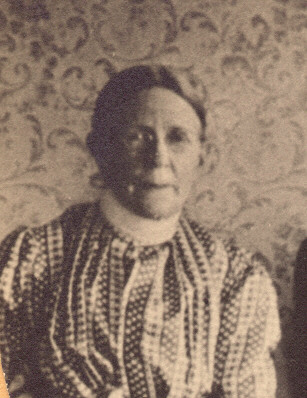
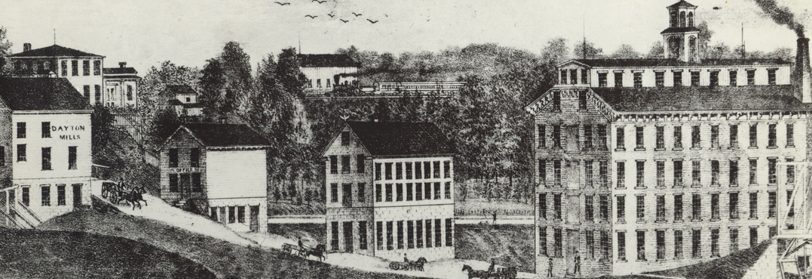
Many of the employees at the Dayton Woolen factory were from England, bringing their previous experience of factory work to the Dayton mill. One of these, William Lancaster, was working in Dayton as a wool sorter in 1870.

William was born in Addingham, Yorkshire on May 31, 1835, the son of Thomas and Ann (Wildman) Lancaster. Thomas and all his family were deeply involved in the wool trade.  Thomas worked in the West Yorkshire mills as a wool top finisher;  at least five of his sons and three of his daughters also worked in the factory. The children would start by the age of ten, on the spinning machines. As they got older, they moved on to more responsible jobs – wool combing overseer, power loom weaver, or wool top finisher. William, at the age of fifteen, was a power loom weaver of worsted cloth.

In 1859 William married Elizabeth Muff, the daughter of William and Patience (Elsworth) Muff. They had a daughter, Frances Elsworth Ann, born the following year, and in 1862, a son, Seth Elsworth. For whatever reason, William seems to have left the wool trade and moved to Pudsey, Yorkshire, where he was a milk dealer in 1861. Whether this was because of a slowdown in the wool trade or merely a desire for a change, in 1866 William left Yorkshire altogether and with his wife and son (Frances having died in 1865) took ship for America on the City of New York leaving from Liverpool and arriving in New York on July 30, 1866.

Apparently wool was in William’s blood though, as he found recruiters were encouraging workers to go to Lowell, Massachusetts, to work in the mills there. He found work there as a wool sorter, and while living in Lowell, a daughter, Martha Ellen was born. More research will be needed to explain how he heard of Dayton and why he decided to go there, but by 1870 he was at work in Dayton as a wool sorter. He inspected all incoming wool and was skilled in sorting it into lots by color and quality, as length and fineness of fiber. A successful wool sorter would have had a perception of color shades greater than that of an artist.

By 1880, William had moved his family to Jacksonville, Illinois, where he and his son, Seth, were working in the Jacksonville Woolen Mills. Apparently unable to settle in one place, by 1900 he was working and living in Chester, Pennsylvania, another mill town not far from Philadelphia. Here his wife, Elizabeth died in 1893, and a few years later he remarried, to Margaretta, widow of John Blithe. In 1910, at the age of 74, he was still working as a wool sorter. He died on March 9, 1917, bringing to a close a life dedicated to the wool trade.

A Network of Groves and Greens

The group of 24 settlers from Licking County, Ohio, that John Green led to La Salle County, Illinois in 1829 were primarily two family groups, Green and Groves. On the Green side were John, his wife Barbara Grove, and their seven children; and Henry Brumbach, with his wife Elizabeth Pitzer, who was John Green’s niece, and their son, David.

The Groves were David (Barbara’s brother) and his wife, Anna Houser, and their daughter Elizabeth; Rezin DeBolt and his wife, Emma Grove (Barbara’s sister), and their daughter Barbara; Joseph and Samuel Grove (Barbara’s brothers).

These two families account for 20 of the 24 settlers. The other four were young unmarried men: Jacob DeBolt, Jacob Kite, Alexander McKey, and Harvey Shaver.

Marriage of Jacob Trumbo and Elizabeth Snyder

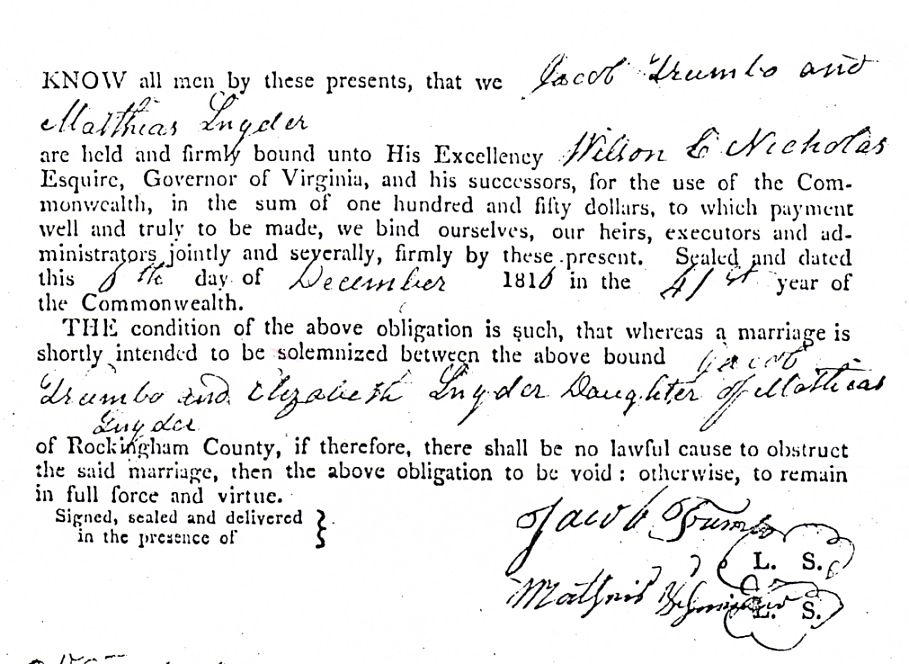
Trumbo, Jacob & Eliz Snyder - marriage bond

This marriage bond was drawn up in Rockingham County, Virginia, on December 6, 1816 between Jacob Trumbo and the father of his bride-to-be, Elizabeth Snyder. The bond was to certify that there was no impediment to the marriage, which took place on December 12, 1816. Jacob and Elizabeth continued to live in Rockingham County, where they raised a family of eleven children, eight boys and three girls. In 1853, Jacob, with five of his sons and at least one of his daughters, moved to Illinois, and purchased 160 acres in Dayton Township. He was not to enjoy his new home for long, however, dying shortly after their arrival, on November 10th, 1853. Elizabeth continued to live on the farm until she retired to a house in Dayton, leaving the farm in the hands of her son, Moab. Elizabeth died May 1, 1873 and was buried beside her husband in Buck Creek Cemetery, in Dayton Township. In 1911 their bodies were moved to the Ottawa Avenue Cemetery in Ottawa and the cemetery is now a cornfield.

The Marriage of Noah Brunk and Amanda Parr

State of Illinois
La Salle County

Noah Brunk Being duly Sworn, Deposes and says, he is engaged to be married to Miss Elizabeth Amanda Parr that the said Amanda Elizabeth is under the age of Eighteen Years, and that he is over the age of Twenty-one Years. that he [has] the consent of the parents of said Amanda for her marriage with him at this time.
Noah Brunk
Subscribed and sworn before me
this 19th day of September 1857
S W Raymond   Clerk

In a somewhat unusual procedure, the consent for the marriage of this under-age bride was not given by her parents, but by the prospective bridegroom, who assured the authorities that he did indeed have the consent of her parents. The marriage was solemnized on the 24th of September, as shown by the marriage license.

Amanda would have been about 16 at this time. In the 1850 census, she appears with her parents and siblings as Elizabeth A. Parr, age 9.

Noah and Amanda had three children, Thomas L., Ida Bell, and Cora B. Ida Bell died as a child and is buried in the Dayton cemetery.

Eliza Ann, wife of two Civil War soldiers

At the 2008 meeting of the Dayton Cemetery Association the program was about Eliza Ann Shaw, who was married to two Civil War soldiers and is buried in an unmarked grave in the cemetery. This is the transcript of the program.

            Eliza Ann Shaw was born in London, England, in 1841. Her father, James Shaw, was a greengrocer; her mother, Catherine Henessey, was born in Ireland. The family lived on Carnaby Street, less than a mile from Buckingham Palace. It is possible, even likely, that ten-year-old Eliza and her brothers and sister were among the crowds that watched Queen Victoria on her way to open the Great Exhibition at the Crystal Palace in 1851.

            James Shaw brought his family to the United States in 1854. I don’t know why he came to Dayton, but there were a number of English families in Dayton then. Perhaps there was some connection that brought the Shaws to La Salle County. In December of 1856, shortly before her 16th birthday, Eliza married a young man from Dayton named Michael Klingston. Michael came to the US from Bavaria and became a US citizen in 1863. By 1864, they had three small children.

In September of that year, Michael was drafted in the 1st Illinois Light Artillery, at a time when Sherman was fighting the battles around Atlanta. Sherman had been fighting since May and needed replacements for his army. Michael Klingston probably arrived at Atlanta just after the city surrendered on Sept. 2. He then took part in the march to the sea and arrived in Savannah, GA in December. Savannah surrendered on the 22 and Michael was probably taken ill around this time, since he did not take any further part in Sherman’s march north through the Carolinas. Instead he was transferred to David’s Island in New York suffering from chronic diarrhea. From there he was sent to Quincy, IL, where he died on April 15, 1865. His cause of death is given as consumption.

Michael appears to have been buried at Quincy; he is not buried in the Dayton Cemetery. Eliza and the children continued to live in Dayton. In December 1865 Eliza remarried. Her second husband, John Jaka, a farm hand from the St. Louis area, had also served in the Civil War.

            John Jaka volunteered at the beginning of the war in July of 1861 and joined the 9th Illinois Infantry, which became known as the “Bloody Ninth”. The 9th earned its reputation by being involved in the fighting at Forts Henry and Donelson in Feb. 1862, then being sent to Pittsburg Landing, which was the site of the battle of Shiloh. At Shiloh, the 9th was in some of the worst of the fighting, and of the 520 enlisted men that went into the battle, 324 of them were either killed or wounded. John must have had a charmed life if he escaped all this with no injuries. Between spring of 1862 and summer of 1864, the 9th was mounted on mules and so scouted and raided through Alabama and Mississippi. It was during this time that John was injured the first time. Quoting from his application for invalid pension, he states “He was on picket-duty mounted on his mule when said mule was shot from under him by a shot from the enemy. He thought he could get the mule on his feet again and while attempting to do so, the mule in his struggles, struck John on the great toe of his left foot dislocating the said toe and otherwise greatly injuring the foot. On account of that he went to the Regimental Hospital near Atlanta, GA where he remained untreated for 24 hours, then returned to his regiment.” The 9th took part in Sherman’s battle for Atlanta, and that was where John was injured for the second time. Quoting again, “At the battle of Atlanta, on or about the 22 day of July, 1864, while in the act of discharging his Spencer rifle at the enemy, his said gun was struck by a gun shot from the enemy which struck the stock of his rifle and threw a splinter therefrom which struck him in or near the right eye seriously injuring the same.” John probably didn’t see any more action in the war, since he was discharged in August of 1864, probably because his 3 years were up. The 9th was one of about 16 regiments across the country that were considered “German” and John Jaka was German by birth.

            Following his discharge in August of 1864, John came to Dayton. Again, it’s not known what brought him to Dayton. He may have known someone during the war who was from this area. He worked as a farm hand for Sylvester Brown, near Wedron. In 1865, he married the young widow, Eliza Klingston. All was well for a time, but a year later Eliza’s mother, Catherine Shaw, was named guardian of the Klingston children, due to their mother’s being adjudged insane. This guardianship was probably to ensure that the pension the children were entitled to for their father’s war service would not be controlled by their mother’s second husband. The insanity appears to have been temporary, however, and Eliza soon returned home, to take up her life with John Jaka. By 1883, Eliza and John had four sons.

            When Eliza was about 46, she again became insane and was in a hospital for a short time, but then appears to have again recovered and returned home. This recovery was not permanent, either, and in 1893, at the age of 52, she was again confined to an insane asylum, first in Kankakee and later in the La Salle County asylum. In 1904, after John’s death. she entered Bartonville Asylum, near Peoria where she spent the rest of her life. Her son Otto was named her guardian. When she died, in July 1907, Otto brought her body back and she was buried in the Dayton cemetery. There is no stone marking her grave.
Last Will and Testament of John Green

1098-john-green-frame

On January 19, 1874, John Green, of Dayton, made out his will. He was 84 years old and was to die in less than four months, on May 17. He laid out his wishes in a series of nine provisions, as follows:

First, he instructed his executors to pay all of his debts

Second, his three sons were each required to pay their mother $25 per quarter, so that she would have an annuity of $300 per year for the rest of her life. Also Barbara was to have her bed and bedding and make her home with her youngest son, Isaac.

Third, his son Jesse was to inherit 95 acres of farm land and 8 lots in the village of Dayton.

Fourth, his son David was to inherit 19 acres of land and 8 acres of riverfront, along with the rights to a certain fraction of the water power of the Fox River and 8 village lots.

Fifth, his son Isaac was to inherit the land where the house stood, along with the farm land (which is now [2017] still in the family).

Sixth, his daughter Rebecca Trumbo was to inherit 5 lots in the village.

Seventh, he noted that his daughters Eliza Dunavan, Nancy Dunavan, Katharine Dunavan, and Rachael Gibson had all been provided for previously.

Eighth, if any personal property remained after settling the debts, it was to be divided equally among his three sons.

Ninth, he appointed sons Jesse and David as executors

The complete transcription of the will may be seen here.

Hardy Pioneer Women

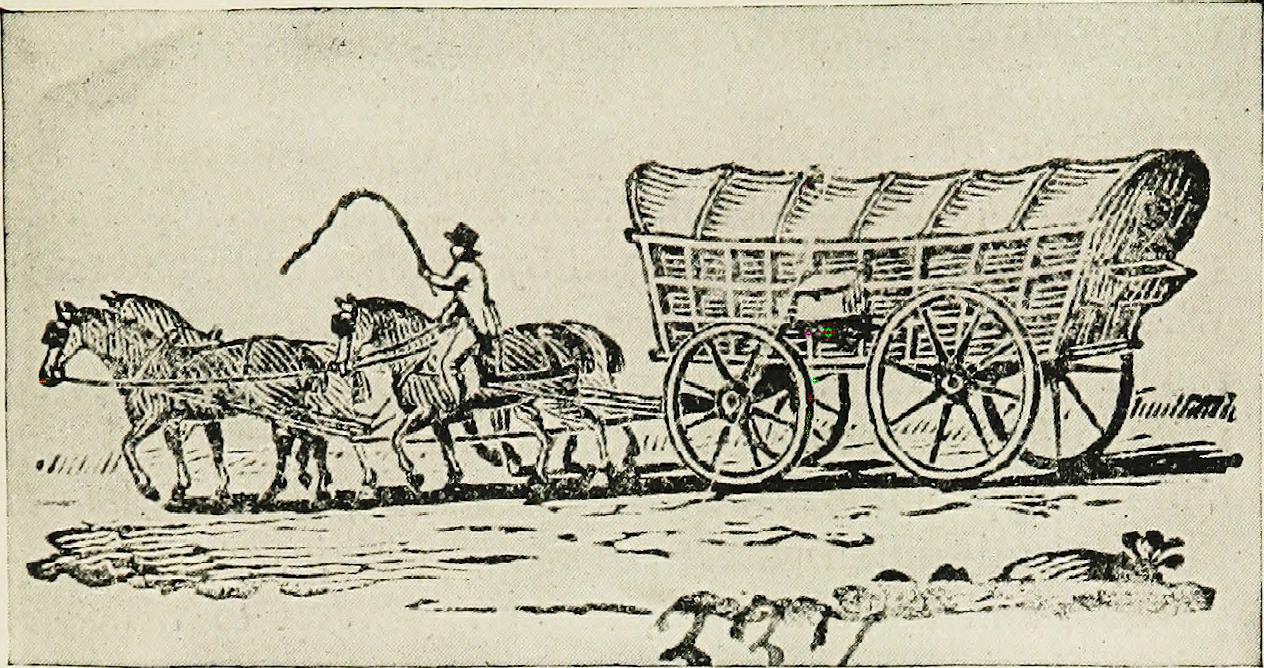
conestoga-wagon

The women who settled the Illinois frontier in the 1820s had to be hard-working, resourceful, determined, and tough. Barbara Grove Green, who, with her husband John, led a small band of pioneers from Ohio to Illinois in 1829, was surely that. She may have imagined her life to be settled,  living in Licking County, Ohio, with her husband and seven children, but at the age of forty, John decided to move west. He found a suitable place in Illinois, on the Fox river, four miles above the junction with the Illinois river and returned to announce that they would leave immediately, although it was late in the fall. Ignoring advice to wait until spring, a group of twenty-four men, women and children left for the west. John and Barbara were the senior members of the group, at 40 and 37; in addition there were three young couples in their twenties and six young unmarried men.

The first years were difficult ones. The small cabin where the group spent the first winter was replaced as soon as the saw mill was up and running. Two more children were born in Illinois: Rebecca in 1830 and Isaac in 1833. During the Indian Creek massacre scare, Barbara walked the four miles from Dayton to Ottawa with the rest of the family, carrying the baby, Rebecca, who cried if anyone else carried her.

Homemaking chores would have consumed her time. In the early days, these would have included salting and preserving the plentiful prairie chickens and quail that her sons trapped during the winter. Life became a little easier after the grist mill was in operation and she no longer had to grind wheat in a hand grinder. With yarn from the woolen mill, she knit socks and long stockings for everyone. Along with all the necessary sewing and mending, she made candles, rag carpets, and all the many other needs of a self-sufficient household.

Maud Green remembered her grandmother Barbara:
“Then in February it was carpet-rag time and we all sewed & wound carpet-rags & sent them to the weaver.  The new carpet went in the “sitting room” and the others were moved back until at last they reached the kitchen & were worn out there. I can just remember Grandma making candles for us to carry upstairs.  They were afraid to have us carry a lamp, but we had lamps as long ago as I remember. Grandma spent her time knitting socks and long stockings for all of us, out of factory yarn, and we had woolen underwear, skirts and dresses made of factory flannel.”

Barbara led a long life as the matriarch of the Green clan. When she died in Dayton, May 3, 1886, at the age of 93, she was remembered with affection in her obituary:

Granma Green, the oldest settler in the county, died Wednesday morning, at the age of 84 [sic] years. She was of a kind, benevolent disposition and was well beloved by her wide circle of relatives, friends and acquaintances by whom she will be greatly missed.1


  1. Ottawa (Illinois) Free Trader, 8 May 1886


Rev. Laing – Universalism in Dayton

047-rev-laing-edited

Rev. Alfred H. Laing

Alfred H. Laing was a Universalist pastor in Earlville, Marseilles, and Joliet, and often preached in Dayton. He was born February 8, 1844, in Kosciusko, Indiana and died in Joliet, Illinois, August 31, 1923. Many members of the Green family, early settlers of Dayton, were Universalists and knew Rev. Laing well.

The Universalist society held their earliest meeting here [Earlville] in Robinson’s Hall, in the winter of 1866-7. The first pastor was Rev. W. S. Ralph, who remained from Jan. 1867 to Jan. 1870. During the year 1869, they built their house of worship, a commodious brick structure, costing nearly $1,500. During the summer of 1870, the pulpit was filled by Miss Mary H. Graves. In October, Rev. Alfred Rains was called, who remained four years, and was succeeded by the present pastor, Rev. A, H. Laing, who came in Nov., 1875. There are now about two hundred attendants at this church.1

Charles Green, son of David and Mary (Stadden) Green, wrote some reminiscenses of early Dayton Universalists, in which he included the following memories of Rev. Laing:

The Rev. A. H. Laing preached at Earlville, fifteen or twenty miles northwest of Dayton, and later on was pastor at Marseilles and at Joliet. He was a comparatively young man when he first preached at Dayton. He was well liked and preached some good sermons full of interest and gospel teachings. He used to come down from Earlville in the spring on fishing trips. Dayton at that time was a fine fishing place, and people used to come there from many miles around, camping out for a few days or a week along the banks of the Fox River. I have seen at least 200 people there at one time. The state maintained a dam across the river about a half mile above the village, and in the spring of the year when the game fish were running up stream to spawn they were very hungry and voracious and were anxious to get hold of the fisherman’s bait. On account of the dam across the river the fish could not go up stream any farther, thus making good sport for the many anglers. So our Izaak Walton lover, the Rev. A. H. Laing, soon learned where the good fishing grounds were, and came down from Earlville quite frequently to indulge in the sport, and incidentally to preach us a good sermon.

More of the early recollections of Charles Green, including other Universalist preachers in and near Dayton, may be seen here.


  1. The Past and Present of La Salle County, Illinois, (Chicago: H.F. Kett & Co., 1877), 341

Emma Dunavan – inventor

dunavan-emma-invention

In 1891, Emma S. Dunavan, of Dayton, Illinois, received a patent on a new and useful improvement in the class of mailboxes intended to be placed on the door of a building, including a bell linked to the door of the mailbox which would ring when mail was deposited. The full description of this invention may be seen here.

Emma was the wife of William J. Dunavan, son of Albert F. and Emma (Cooper) Dunavan, and grandson of William Lair and Eliza (Green) Dunavan. He was the junior member of the Fox River Horse Collar Manufacturing Co. in Dayton, in partnership with his father. William traveled a great deal in connection with the factory and in October 1887, he opened a wholesale and retail store of horse collars, harnesses, buggies, etc., at Kinsley, Kansas.

                                                       DUNAVAN-SWANK
On Wednesday, January 9, 1889, W. J. Dunavan, of the firm of Dunavan & Son, this city, reported at the Swank mansion in Fort Scott, Kansas. His credentials being satisfactory, at 9 p. m. he was united in marriage to Miss Emma Swank, in accordance with the solemn but beautiful Episcopal church ritual. A brief wedding tour, embracing Kansas City and Hutchinson in the route, landed the happy couple in Kinsley, the home of the groom, where they received the congratulations of his many friends.1

The news of her invention was well received in Fort Scott:

A WOMAN WHO THINKS
An Illinois Lady, Formerly of Fort Scott, Invents a Useful Contrivance.

Yesterday the scribe dropped into the office of Dal Burger’s Fort Scott Carriage Works on his rounds and was shown a newly patented mail box that is certainly getting near the acme of achievement in its line.

The box is the invention of Mrs. Emma S. Dunnavan, of Ottawa, Illinois, who was formerly well known here as Miss Emma Swank, and is the daughter of Mrs. Agnes Swank of this city. It consists of an ordinary wooden or metal box of the usual form and size, with a spring door near the top through which the letter or card is put. A push button extends out from an opening above the door, which is used in opening the latter. When the button is thrust in by the postman as he pushed back the door, an electric bell is set ringing which calls attention to the postman’s visit as the whistle commonly used now does, but in a surer and at the same time a more genteel manner. The ring is surer because the bell is rung inside the hall or room.

The intention is to place the box on the outside of the door, the bell being placed inside. This does not disfigure the door as the box can be made as ornamental as may be desired, and the bell is much like an ordinary door bell.

Below the spring door for the insertion of letters is a glass through which the contents may be seen. Below that is an ordinary lock such as is used on postoffice boxes, which when unlocked allows the hinged bottom to be opened and the contents removed. The box with its bell attachment is certainly a convenient and useful contrivance and shows a good degree of practical ingenuity in its inventiveness.2


  1. The Kinsley [Kansas] Graphic, January 18, 1889, p. 3, col. 2
  2. The Fort Scott [Kansas] Daily Monitor, August 26, 1891, p. 4, col. 6

The Hite Family

                          James M. Hite    Hite, Martha (Jones)

James and Martha (Jones) Hite

The Dayton Cemetery Association holds its annual meeting every year on the Sunday of Memorial Day weekend. In addition to the pot luck lunch and business meeting, each year a historical program is given on some aspect of the history of the families buried in the cemetery and of the history of Dayton.

In 1964, Maud Hite Temple was the speaker. She told of the preceding generations of her family and of their move from Virginia to Ohio and then to Illinois. The full text of her presentation can be read here.

Happy New Year!

party-ribbons-balloons-background-free-vector

The beginning of a new year is a good time to start any new enterprise and marriage is one of the best, especially if it comes with cake, as shown in this newspaper article:

HYMENEAL

Married – At Dayton, in this county, on the 31st inst. (New Year’s Eve) by the Rev. David Newton, Mr. John Stadden to Miss Ann Maria Miller, both of Dayton.

Accompanying the above notice, was that which always gladdens the poor printer’s heart – a bountiful supply of Miller’s workmanship, in the shape of delicious wedding cake. The happy couple have our best wishes for their future happiness, hoping that the evening of their days will be as pleasant as the first dawn of 1841 met them agreeable and happy.1

Ann Maria Miller was the daughter of Isaac and Esther (Gleim) Miller. She was born in Pennsylvania about 1818, one of a large family. Her brother Reuben left Pennsylvania for the west in 1836 and came to Dayton. The rest of the family soon followed, including her widowed father, Isaac, and settled in Freedom township. Ann and John did not stay long in Dayton. By 1846 they had moved to Dallas county, Texas where she died November 23, 1872 and was buried in the Stadden cemetery in Wilmer.


  1. Ottawa Free Trader, January 1, 1841, p. 3, col. 3

Happy Birthday, Jesse!

birthday-cake

Yesterday was the seventy-third anniversary of the birthday of Jesse Green of Dayton, and to properly celebrate that event his relations from far and near gathered to wish the old gentleman and his estimable wife a happy New Year and many pleasant returns of the day and consequent similar gatherings. Including the relations in Dayton and from abroad, the residence of Mr. Green was crowded but all present enjoyed themselves to the fullest extent. After all the guests had assembled, Thomas E. MacKinlay in behalf of the company, presented Mr. Green with a very handsome easy chair and Mrs. Green with a table. Mr. Green was taken completely by surprise, but managed to express his thanks. An elegant dinner was served, and a fine time was had by all present.

Those from abroad were Attorney General McCartney and wife of Hutchison, Kan.; Ed. Jackson, Cincinnati; Joseph Jackson, Millington; L. C. Robinson and wife, Rutland; N. M. Green and wife, Serena; Kent Green, Chicago; Mrs. Craig, Jacksonville; Mrs. John Crum, Mrs. Joseph Harris and Mrs. L. Matlock, Misses Ray Harris and Mertie Crum, Yorkville, and T. E. MacKinlay and wife, C. B. Hess and wife, H. B. Williams and wife, T. H. Green and wife, W. N. Bagley and wife, Will and Don MacKinlay, Ed. Hess and Theodore Strawn, of Ottawa.1


  1. The above unidentified clipping, found among other Green papers, can be dated to 22 Dec 1890, as Jesse Green was born 21 Dec 1817. Assuming it came from an Ottawa newspaper, it probably appeared in the Ottawa Free Trader or the Republican-Times, as the Fair Dealer did not begin publication until 1892. The Free Trader microfilm is missing the issues for this period, so the paper cannot be firmly identified. There is no Republican-Times issue for 22 Dec 1890 on the microfilm. The next issue, 25 Dec, was checked, but nothing found.

A Hand-drawn Birth Record

trumbo-ahab-christopher-birth-record

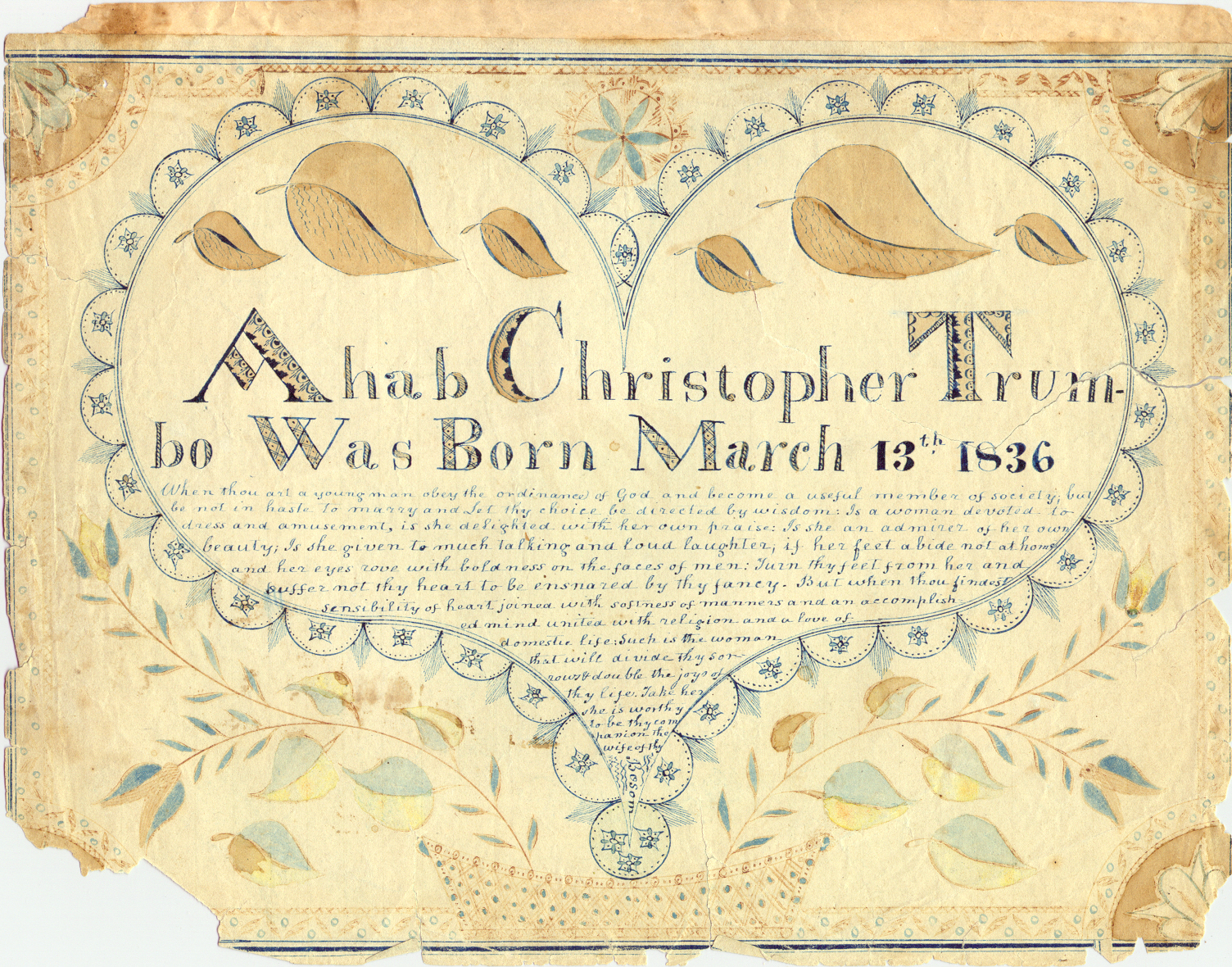
This hand-drawn birth record is an example of fraktur,1 a Pensylvania German folk art tradition. In addition to recording that Ahab Christopher Trumbo was born March 13th, 1836, it adds words of advice to a young man in selecting a wife.

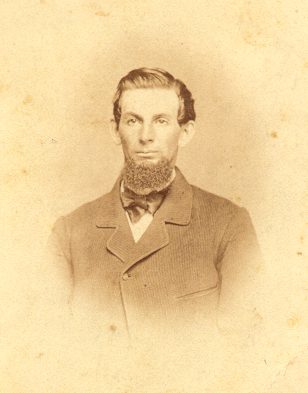
Ahab Christopher was the son of Jacob Trumbo III and his wife, Elizabeth Snyder. He was born in Brock’s Gap, Rockingham county, Virginia, and came to Illinois with his family in 1853. The family settled in Dayton township, on Buck Creek. Christopher married Fidelia Kagy January 28, 1869 in Ottawa. They had one child, who died in infancy. Christopher died of consumption in October, 1869, at the age of 33, and is buried in the Ottawa Avenue cemetery in Ottawa, Illinois. Note that his obituary says that he died on October 22nd. However, his mother’s family Bible gives the date of his death as October 10

trumbo-christopher

Christopher Trumbo

DIED
In the village of Dayton, October 22d, 1869, A. C. TRUMBO, age 33 years.

The subject of this notice was a native of Rockingham county, Virginia, but for several years a resident of the town of Dayton. He was one of our most exemplary young men, and his loss will long be felt by a large circle of relatives and friends. Behind his modest bearing he concealed sterling qualities of mind and heart, – accurate judgment, inflexible devotion to principle, warm, affectionate, exceeding purity of heart and character. He was at an early age marked by the fell destroyer consumption. He leaves a young wife and an aged mother, who but a few days since was notified of the death of her son W. B. T., who had recently returned to Virginia to recruit his failing health. The funeral services of both of her sons will take place at her house on Sunday, the 24th inst, at 10 o’clock a. m., by the Rev. Mr. Thompson, of Putnam county. Thus, in the short space of five weeks, has this aged mother been bereft of two noble, high minded young men, just in the prime of life. She has a hope both sure and steadfast, that what is her apparent loss is their gain.2


  1. For more information on fraktur, see http://frakturweb.org/
  2. Ottawa Free Trader, October 23, 1869, p. 5, col. 3.

William Stadden, State Senator and Convention Delegate

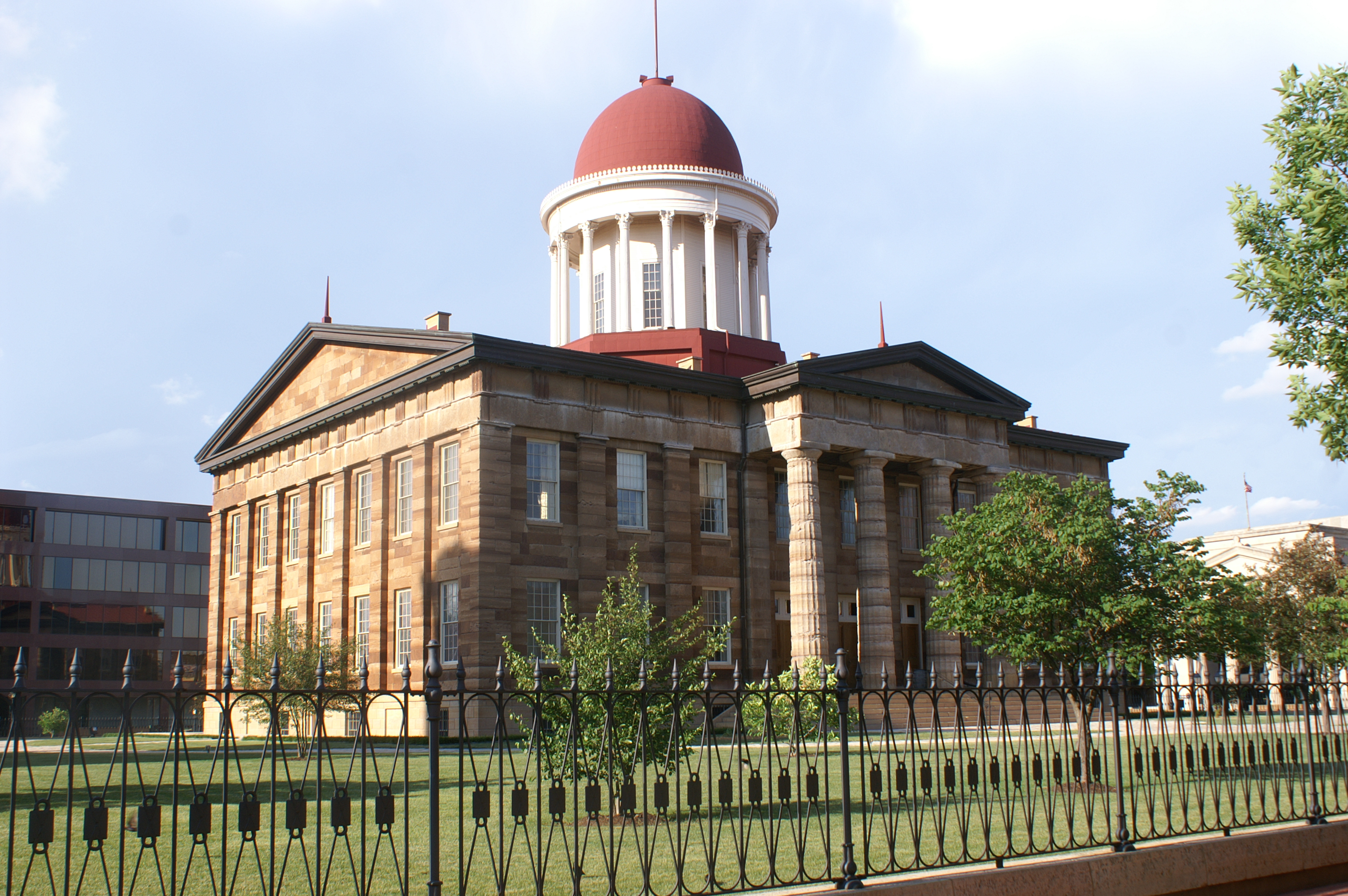
Springfield, Illinois, Old State Capitol

Springfield, Illinois, Old State Capitol

Dayton resident William Stadden was elected to the Illinois State Senate in 1836 and served for four years, representing La Salle, Iroquois, and Kane counties. He served at the same time that Abraham Lincoln was serving in the Illinois House of Representatives. In the Senate, Stadden was on the committee on canal and canal lands, where his familiarity with the Illinois & Michigan canal, and the feeder from Dayton to Ottawa, might be useful.

In 1847, Illinois needed to revise its first constitution to meet the needs of a growing population and a constitutional convention was convened. William Stadden was one of two delegates from La Salle County to the convention, where he served on the revenue committee. The convention met in June, 1847, and spent nearly three months devising a new instrument; the following March its work was ratified by a large majority of the voters; and on April 1, 1848, it became operative. William Stadden was able to see the new constitution become law before he died the following November.

Additional biographical information on William Stadden may be found here.

Joseph Green, Adventurer

Joseph Green

Joseph Green, like his father and brothers was of an adventurous nature. He was only one year old when the family moved to Illinois and making a home out of the wilderness was surely an adventure. The expedition to the California gold mines in 1849, with his father and his older brother Jesse was a welcome change from his life in Dayton, which in twenty years had become much more civilized. Very much the little brother, he was eleven years younger than Jesse and although he would have considered himself, at 21, the equal of any man on the trip, he was still one of the younger ones. He was sorely missed in Dayton by his sisters, Rachael and Rebecca, who filled their letters with a wish that he would be home soon.

Most of the gold miners returned home in January of 1851, but Joseph and three others were left behind in Mexico, where they were to remain until spring, in charge of some Mexican horses which were bought in coming through that country.

Joseph had barely returned to Dayton when it became clear that his taste for adventure was still strong. His younger brother Isaac, who was deemed too young to go on the previous trip, wanted his chance and Joseph got up an expedition of his own to California, which left Dayton in April. As in the previous attempt, there were no great riches in the end, but the adventure may have been its own reward.

Joseph had expressed a desire to go to China, but this never came to pass, due to his untimely death, December 27, 1855, at the age of 27. He is buried in the Dayton cemetery


Rebecca Green Trumbo

Rebecca (Green) Trumbo

Rebecca Green Trumbo, or “Aunt Beck” as she was known to her niece, Maud, was the tenth child and sixth daughter of John and Barbara Green. She was born across the river from Dayton, in Rutland township, September 8th, 1830, the first of their children to be born in Illinois. She grew up with a number of Dunavan children near her own age, all of them her aunts and uncles, children of her older sisters, Eliza and Nancy. She was also very close to her brother Joseph, who was two years older. When Joseph went with the Dayton party to the gold fields in 1849, she wrote often, teasing him about some of the local girls who missed him very much.

In return, Joseph said
“(I want you to explain yourself about what letter you had reference to when you spoke of Miss E J B receiving that letter is entirely beyond my comprehension I am in the dark on the subject if it is anything relating to me I would like to understand it –  as to who gets Miss E. J. B. is the least of my concerns But as far as I know she is a very nice girl”

He also added some very sage advice:
“(Becks be carefull here after about whittling allways whittle from you and you will not be apt to cut your fingers — always take it moderate for a few days until you get your hands tuffend to it”

Rebecca and Rachel, her sister, filled their letters with wishes for the men to come home:
“O Joseph if you could only be here next saturday night we have first rate cotillion parties last saturday evening we had three musician’s and first rate music (and some pretty good dancing) but o how we miss you at them. do hurry and satisfy yourself and come back to gladden our hearts dont be too hard to satisfy either for it is to hard for near and dear friends to be seperated for gold or anything else aint it”

On October 15, 1854, Rebecca married Oliver W. Trumbo. As if the three Green-Dunavan marriages had not complicated relationships already, in 1865 her little brother Isaac would add another Green-Trumbo marriage when he married Oliver’s sister, Mary Jane.

Rebecca and Oliver lived on a farm in Dayton township. They had two daughters, Jessie, born  June 1, 1867, and Frankie Rae, born November 30, 1876.

Frankie died at the age of seven of a malarial fever. From her obituary:
“Frankie was the light and joy of her home, and by her death a place is left vacant that cannot be filled until that joyful meeting of families on the other shore. Having attended school but a little over a year she had reached a grade seldom attained by a child of her age, and won the warmest love from teachers and schoolmates.”

Jessie married Wilmot Van Etten June 13, 1888. They lived in Mendota. Rebecca lived with them after Oliver died, and she died there September 25 1916. She is buried in the Dayton Cemetery.

The Young Settlers’ Association – Part 2

Two men and wagon

We give a few additional names that have been sent to C. J. Skinner of persons 30 years of age born in La Salle county. He now has between forty and fifty, but there are many others. If a Young Settlers’ Association is to be formed it is desirable that the names be handed in at an early day. Send them on a postal card to that gentleman, together with the date and place of birth. Following is the supplemental list:

Geo. W. Shaver, farmer, born in Rutland Jan. 12, 1842.
A. F. Dunavan, manufacturer, Rutland, Oct. 29, 1832.
Cyrus Debolt, farmer, Rutland, October 28, 1839.
Elizabeth Dunavan, wife of Cyrus Debolt, Aug. 11, 1838.
Geo. W. Lamb, stock dealer, Rutland, April 23, 1850.
O. D. Walbridge, farmer, Rutland, June 15, 1841.
George W. Parr, farmer, Manlius, March 24, 1847.
Jesse Grove, farmer, Rutland, January 29, 1841.
Lucien Grove, farmer, Rutland, January 29, 1842.
Samuel Grove, farmer, Rutland, March 21, 1836.
William Trumbo, farmer, Fall River, June 16, 1848.
Stephen Kleiber, farmer, Rutland, Nov. 12, 1841.
Matt Debolt, farmer, Rutland, November 4, 1841.
George D. Shaver, farmer, Rutland, Jan. 12, 1839.
George Hayward, stock dealer, Ottawa, April 19, 1843.
James Armour, farmer, Ottawa, September 21, 1841.
Louisa Pembrook, wife of Thos. Bartlett, Rutland, Sept. 2, 1832.
James Shaughnessy, farmer, Deer Park, May 1, 1837.1


  1. Ottawa Free Trader, April 21, 1883, p. 8, col. 1

The Young Settlers’ Association

Family and wagonYoung Settlers’ Association

    Some time since a suggestion was made through the Free Trader that a Young Settlers’ Association be formed, consisting of those who were natives of La Salle county and now over thirty years of age; and all such were requested to send a statement to Charles J. Skinner, of this city, containing name and date and place of birth. Up to the present time the following have been received by that gentleman:

George Galloway, born April 12, 1828, in Fall River; farmer.
(Mr. Galloway was the first white male born in the county.)
E. F. Dimmick, May 24, 1849, at Vermillionville; farmer.
James Collins, June 6, 1838, Ottawa; laborer.
Gilbert P. Brown, March 28, 1851, Dayton; painter.
Charles L. Eaton, Dec. 6, 1845, Deer Park; farmer.
Robert J. Wallace, May 28, 1852, Utica; laborer.
William Haynes, June 1, 1839, La Salle; merchant.
George Howland, August 10, 1848, South Ottawa; farmer.
Albert Maierhofer, May 27, 1851, Ottawa; plow manufacturer.
William H. Daggett, Dec. 13, 1843, Ottawa; boatman.
Samuel Richolson, March 25, 1841, Holderman’s Grove; attorney.
Benjamin Lewis, Sept. 26, 1833, Serena; farmer.
John S. Clayton, June 17, 1837, Deer Park; stock raiser.
William R. Clayton, May 8, 1835, Deer Park; farmer.
Charles J. Skinner, Feb. 10, 1841, Dayton; clerk.
W. W. Calkins, May 29, 1842, Farm Ridge; lumber merchant, Chicago.
Mary Jane Painter, Nov. 24, 1847, Bruce; now wife of T. L. Green, and postmistress at Reddick,                   Kankakee county, Ill.
John G. Armstrong, July 7, 1836, near Morris, then a part of this county; editor.
R. E. Skinner, May 10, 1843, Serena; clerk.
William Richards, Dec. 25, 1852, Farm Ridge; farmer.

The above list is scarcely a commencement of that which might be obtained were all who come within the thirty years’ limit to affix their names. A society once organized could not be otherwise than successful, and their annual meetings would be an appropriate complement to that of the present Old Settlers’ Picnics. Or, if it be deemed best, finally, not to complete the organization, still the possession of the list would be an advantage to the Old Settlers’ Association, and a matter of history for the county. We would therefore suggest that all others who were born in La Salle county and are now over thirty years of age forward on a postal card to Mr. C. J. Skinner, Ottawa, the desired information.1


  1. Ottawa, Free Trader, March 10, 1883, p. 5, col. 3

Warner, Wolfe, Tanner, and Luce

warner-joel-f - tombstone

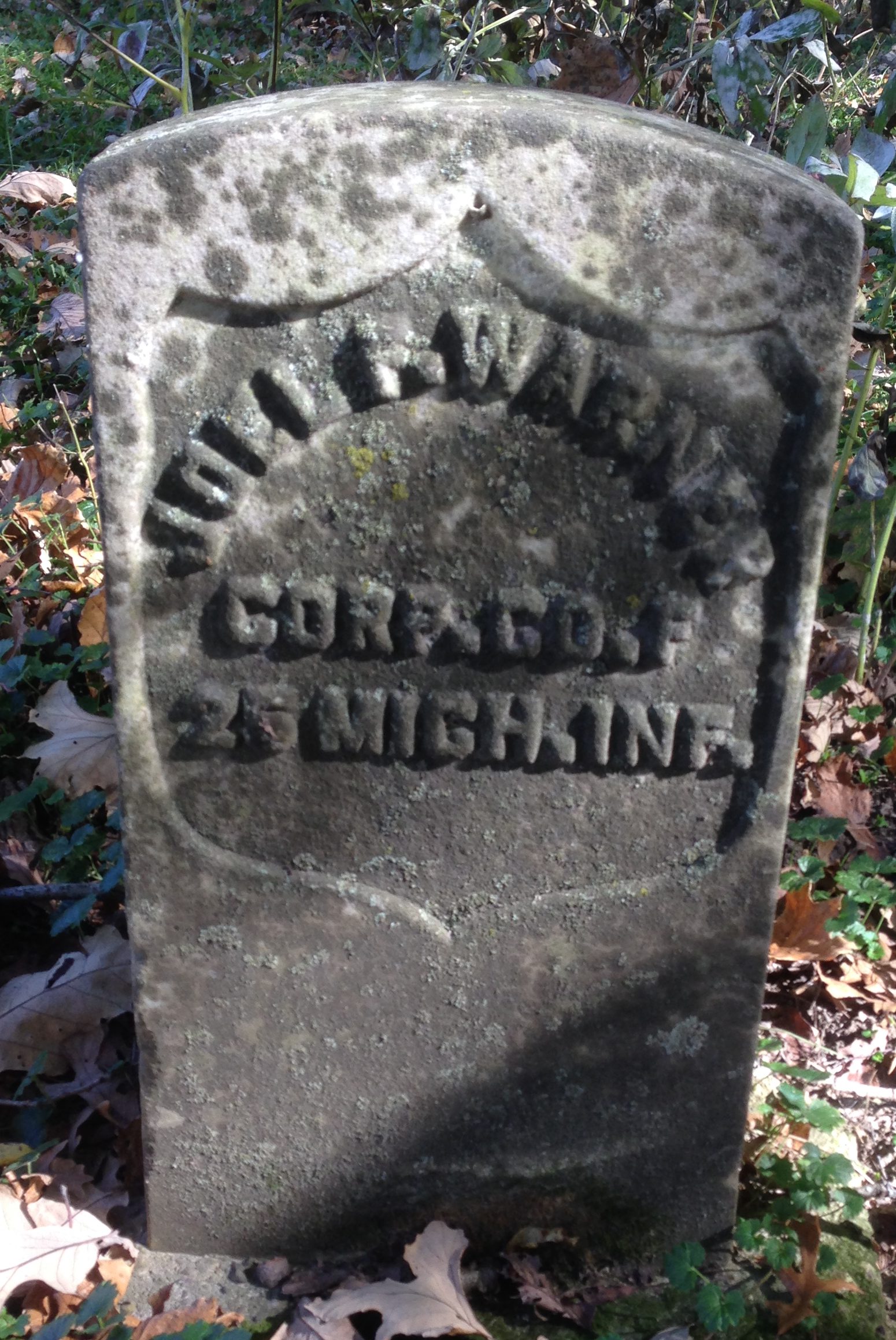
With no surnames in common, it might be hard to realize that the Warner, Wolfe, Tanner, and Luce families in the Dayton cemetery are related, but they represent a couple and their three married daughters.

Joel Foster “Faut” Warner was born June 14, 1831, in Syracuse, New York. On July 3, 1856, he married Mary Ann Inman in New Buffalo, Michigan. She was born January 15, 1839, in Butler County, Pennsylvania. Joel served in the Civil War from Michigan in Company F, 25th Michigan Infantry. He was wounded at the battle of Pumpkin Vine Creek. After his discharge in 1865, he returned home and moved to Kendall County, Illinois, where he farmed. In 1877, he fell under a train and his left leg had to be amputated four inches below the knee. Following this accident, he gave up farming and supported himself with various jobs. In 1882 he moved to Dayton, where he was able to work as a fisherman. He died September 26, 1911 and was buried in the Dayton cemetery. Mary lived with her daughter Ada in Ottawa until her death on January 20, 1918. She too was buried at Dayton.

Ida and Ada, twin daughters, were born October 1, 1857, in Michigan. Ida married Alvin Tanner December 23, 1880, in Kane County, Illinois. They also moved to Dayton before 1900 and lived there for the rest of their lives. Alvin died on December 29, 1927 and Ida on June 18, 1930. Both are buried in the Dayton cemetery.

Twin sister Ada married George Wolfe June 19, 1883 in Kendall County, Illinois. They also moved to the Dayton area, settling across the river in Rutland township. George died January 5, 1909 in Ottawa and was buried at Dayton. No record has been found of Ada’s death but presumably she is buried with her husband.

Daughter Edith Warner was born May 22, 1860 in Three Oaks, Michigan. She married Edgar H. Luce, a farmer, on September 24, 1881 in Kendall County, Illinois. Edgar died November 23, 1899 and was buried at Dayton. After his death Edith moved to Ottawa, where she died on April 14, 1937 and was also buried in the Dayton cemetery.

Elizabeth Trumbo’s Will

The Elizabeth Trumbo house

Elizabeth Trumbo house

Will of Elizabeth Trumbo, Deceased

I, Elizabeth Trumbo of the Town of Dayton in the County of La Salle and State of Illinois, being of sound and disposing mind memory and understanding, do make publish and declare this to be my last will and Testament hereby revoking and making Void, all former Wills and testaments by me heretofore made.  It is my will, First that my funeral charges and debts shall be paid by my Executor Oliver W. Trumbo, my son whom I do nominate and appoint to be the sole Executor of this my Last Will and testament. In the Second place, what property remains after the payments of my just debts, and funeral charges and the Expenses attending the Execution of this my last Will, and the Administration of my Estate, I wish to dispose of in the following named manner, to wit; Third I give devise and bequeath to my daughter Mary Jane, wife of Isaac Green of La Salle County in the State of Illinois the sum of Two Thousand dollars, Also all that tract or parcel of land designated as Block one in Green’s Addition to the Village of Dayton, in La Salle County Illinois together with the house, and other improvements, and the household furniture, Beds bedding, and all the hereditaments and appurtenances thereunto belonging, or in anywise appertaining, to have and to hold the premises above described to the said Mary Jane Green of La Salle County Illinois, and to her heirs and assigns forever, Fourth, I give and bequeath unto my Grand son Walter Trumbo, Son of John Trumbo decd the sum of Eight Hundred dollars, when he shall arrive at the age of Twenty-one years But if he shall not live to become twenty-one years of age, then at his death, the said sum of Eight Hundred dollars Shall come back to my children, Fifth I give to my daughter-in-law Delia wife of Ahab Christopher Trumbo decd the sum of one dollar.

Sixth I give and bequeath unto my daughter-in-law Rebecca G. Trumbo, wife of Oliver W. Trumbo, of Dayton La Salle County Illinois the sum of Eight hundred dollars, also one Horse, One Spring Wagon together with any surplus in money or personal property that may be left after satisfying the above and foregoing Will. Seventh, All of my other heirs not mentioned in this will have heretofore been provided for.

In witness whereof I the said Elizabeth Trumbo have hereunto Subscribed my name and affixed my seal this Eighth day of April A. D. one thousand eight hundred and Seventy three1

The house shown above , the one referenced in the third clause in the will, is also the place where Mary Jane Trumbo and Isaac Green were married. It is located at the top of the hill, on the south side of the road which leads down to the new bridge across the Fox river. The house is still relatively unchanged.


  1. Elizabeth Trumbo probate file, 1873, file T48, La Salle County Genealogy Guild, 115 W. Glover, Ottawa, IL.