“A Useful School House”

picture of school

In the spring of 1895, this Dayton school was only a few years old. Dayton had gone without a school building for a year when the old school burned in November1892 and this building filled a definite need. It became the center of Dayton life, although, as shown here, that was not to everyone’s liking.

A Dayton correspondent sends us a complaint about the economical methods adopted by some of its citizens. He says they are making use of the public school building for a dancing hall and club room. He says the young men are backed up by the directors and others. The same building is used for an opera house, and that the directors and their families get free tickets for the dances and shows, but that they and their families are not very largely represented when the school is used on Sunday for Sabbath School. The correspondent is a tax payer, he claims, and does not get in under the canvas.1


  1. Ottawa Republican, March 21, 1895, p. 3,

A Flood Remembered

Clearly no camera captured this scene, but this is what it might have looked like.

The February 7,1857 flood stuck in Dayton’s memory like a marker stone — the kind of event people kept referring to for decades afterward. Not because it was picturesque or dramatic in the usual way, but because it rearranged things. It changed the shape of the town’s work, its riverbanks, and its sense of what the Fox River could do when it felt like it.

The Green family took the worst of it. The newspapers called them the “only serious sufferers,” which was probably true in terms of property loss. Their new dye house was wrecked so thoroughly it had to be rebuilt from scratch. The kilns and kettles were ruined. Six or seven feet of water stood on the lower floor of their woolen factory. And with the Fox River Feeder torn open — sixty or seventy rods of it simply gone — their mills were expected to sit idle for a month.

But what people remembered wasn’t just the Greens’ misfortune. It was the scale of the thing.

Dayton’s own bridge, only four or five years old and costing the community a full $1,000, was lifted off its abutments and carried away. And here’s the part that still shocks me: that same day, every single bridge over the Fox River from the Wisconsin line to Ottawa was washed away.

That fact tells you what the flood meant. Not just local damage, but a whole river corridor snapped in two. Travel halted. Communities cut off. A sense that the river had shown its full reach, and that human engineering — however proud or expensive — was only temporary.

No wonder people were still talking about it thirty years later. It wasn’t just a flood. It was the day the river reminded everyone who was in charge.

A Time-Stained Hoary-Headed Deed

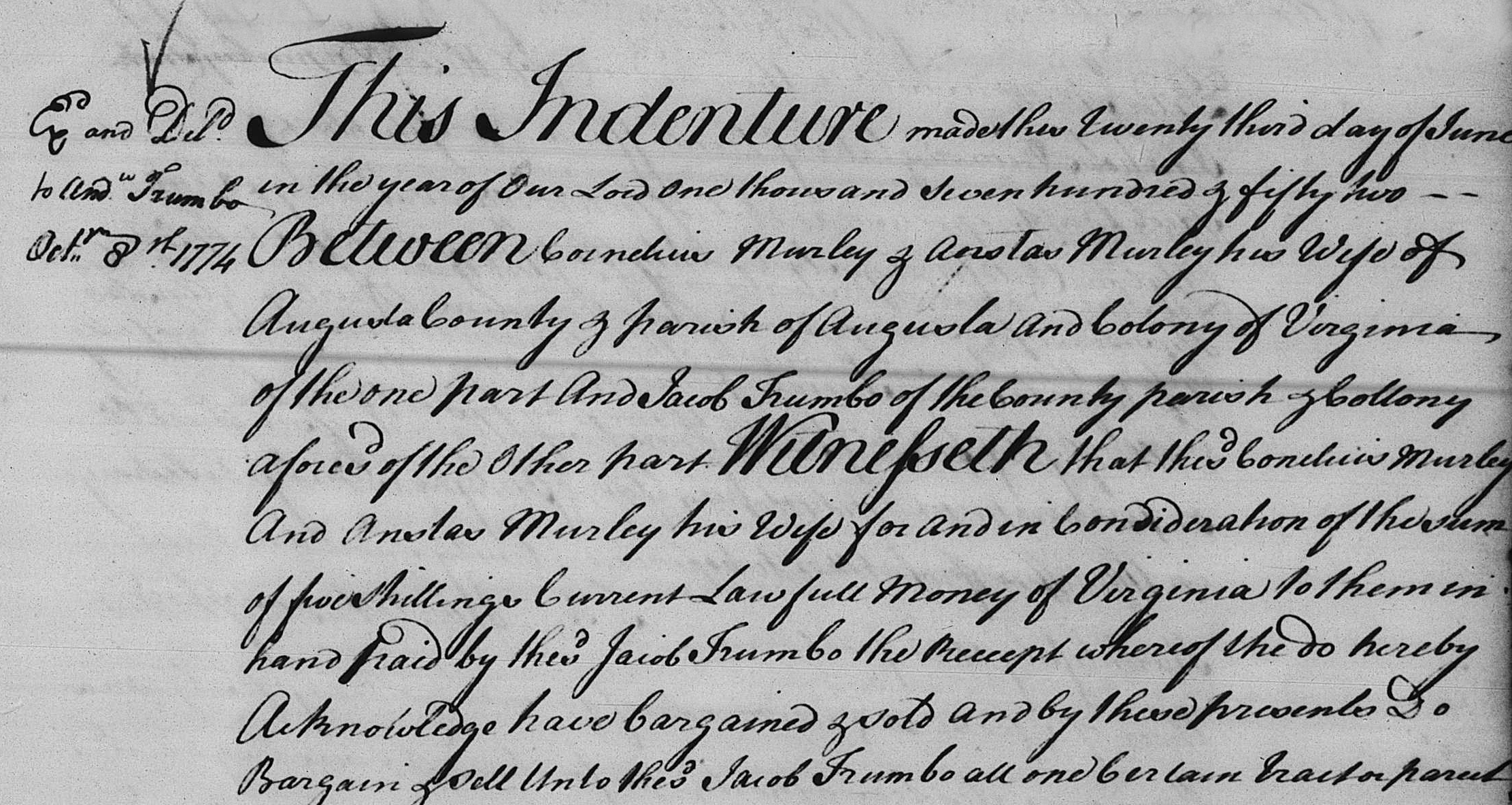
A few days ago O. W. Trumbo, of Dayton, left at this office a document that is somewhat of a curiosity. It is a time-stained hoary headed deed, and was drawn up June 23, 1752, being 133 years old. It is a deed for 400 acres of land given by “Cornelius Murley and Austas Murley, his wife, of Augusta county and parish of Augusta, and colony of Virginia, of ye one part, and Jacob Trumbo of ye county and parish and colony aforesaid of ye other part.” This Jacob Trumbo above referred to was the great-great-grandfather1 of O. W. Trumbo, and the document had been among some old papers for 30 years unnoticed when Mrs. Trumbo discovered it on the 23d day of last June, exactly 132 years after the paper was executed. Mr. Trumbo brought this paper with him when he went on his visit recently to friends in Rockingham county, VA., taking in the inauguration also. As there were no records dating back half that far he could not trace it. The deed was drawn 23 years before the breaking out of the revolutionary war, when Washington was a young man, and when Virginia was governed by Robert Dinwiddie, who was appointed by the crown of England.2

Two Old Deeds
Jacob3 Trumbo, a native of Rockingham, but now and for thirty years a resident of Illinois, has a copy of a deed for Four Hundred Acres of land, lying on the North Fork of North River, in Augusta county, made by Cornelius Murley and wife to Jacob Trumbo, dated June 3rd, 1752, or 133 years ago. The document is in a fine state of preservation, and both the Murleys made their mark instead of writing their names, which looks as if the people in those days, even large property holders, were not very highly educated.4

The image at the top is from the recorded copy of the deed, from Deed Book 4 (1751-1752) Augusta County of the colony of Virginia. You can view the entire recorded copy here.


  1. correction: great-grandfather
  2. Ottawa (Illinois) Free Trader, April 4, 1885, p. 1, col. 3
  3. correction: O. W.
  4. Staunton (Virginia) Vindicator, April 17, 1885, p. 3, col. 3.

A Poetical Evening and a School Vacation


Rural Happenings

Dayton, March 30. – Mr. George W. Gibson, of Rutland, who has purchased Mr. J. Read’s property on the hill, is moving into town this week. Mr. Gibson and family will be welcome additions to our town and society, and will be most acceptable and enterprising citizens.

The Tile Works commenced operations this week and are turning out a fine lot of tile. The popularity of this firm, and their wide-spread reputation for manufacturing fine drain tile, is shown by their receiving a letter of inquiry from a gentleman in Oil City, Penn. Among other orders received this week was one for 4,000 8-inch tile.

The Whittier entertainment at the school house March 18, the second of the series of “Evenings with the Poets,” by the Musical Union, was a good success. The programme passed off smoothly and in a delightful manner. Little Jimmy Ryan and Gertie Grow in a duet captured the audience, and were forced to respond to an encore. The select readings by Mr. James Green and Miss Dessie Root were read with considerable spirit and taste. The remainder of the programme, dialogues, recitations, quartets, etc., was well carried out, and every one pronounced the entertainment a very enjoyable one, and one that reflects considerably to the credit of the committee, Miss Cora Green and Mrs. C. B. Hess. The last of the series, a Lowell entertainment, will be given this Saturday evening, April 1. It is under the management of Miss Dessie Root, who has taken considerable pains in preparing a fine programme, and promises to be an enjoyable entertainment. It should be greeted with a full house.

The Schools are having a vacation this week. We understand the two schools are to be continued under the present competent instructors, and we hope the following summer will witness the erection of a new school building. It is something that is much needed, and as the railroad pays over one-half the school tax, the district is abundantly able to build one. Patrons of the school will do well to consider the matter, and if brought to a vote to cast their ballots intelligently.

The board of town auditors met at the town clerk’s office last Monday to audit the accounts of the town.

Mr. Noah Dunavan has departed for Texas, where he will make his future home.

Occasional1


  1. Ottawa (Illinois) Free Trader, April 1, 1882, p. 8, col. 1
A Potentially Serious April Fool’s Prank

PULLED GUN TO FOOL GIRL
April Fool Joke Might Have Had Serious Termination

            As the result of being the victim of an April fool prank, 14-year-old Cora Tanner, of Dayton township, is nursing a badly injured limb containing the contents of a 22-calibre revolver, which was shot into her by a companion this morning shortly after 9 o’clock at her home in that village.

William Luce, a cousin of the injured girl, had been planning an April fool joke, and he with another companion fixed it up to scare her with a 22-calibre revolver they had run across. Going into the room the supposedly harmless gun was pointed at the girl, who naturally felt more or less uneasy at its presence. With a laugh the boy told her it was not loaded, then pulled the trigger.

The bullet entered the left limb a short distance above the knee and is still imbedded in her flesh. She was brought to this city and Dr. Hathaway probed for the missile, but was unable to find it. In a few days the X-ray will be used to determine the location of the bullet and in all probability it will be extricated.

This is probably the last April fool joke of that kind the young man will ever play again. It is to be considered fortunate that the weapon was not pointed at a more vital spot, for without a doubt the “joke” would have had a much more serious termination.

Miss Tanner was taken back to her home, where she is resting fairly comfortable this afternoon.1


  1. Ottawa (Illinois) Free Trader, 5 Apr 1907, p16, col 2