*Dunavan – Martell Marriage


Dunavan-Martell

Married. – Wednesday, Sept. 28, at 1 o’clock P.M., at the residence of the bride’s parents, Mr. and Mrs. A. F. Dunavan, their daughter Jennie E. to William H. Martell of Chicago.

The ceremony was performed by the Rev. W. Day of Ottawa, in the presence of about 30 of the relatives and intimate friends of the bride and groom. After congratulations and a feast at the bountiful board, the newly married couple took the 3:50 p. m. accommodation to Chicago, where they will make their home.

The bride was one of Dayton’s fairest daughters, and will be greatly missed from our society. She was organist in our Sunday school for a good many years and a prime mover in all social events. She was a graduate of the Ottawa High School of the class of ’85. The groom is a solicitor for the Gas Consumer’s Co. of Chicago.

The presents were many and fine, and evinced the love and respect in which the bride and groom are held by their numerous friends and relatives.

The following guests were present: Mrs. Dunavan of Fairbury, Ill., sister of the bride’s mother; Mrs. Behm of Syracuse, N. Y., aunt of the groom; Miss Clark of Chicago, and Mrs. A. E. Butters of Ottawa, of the High School class of ’85; Mr. and Mrs. C. B. Hess, Mr. and Mrs. H. B. Williams, Mr. and Mrs. David Hall and Will Rising, of Ottawa; Misses Cora Moore, Maud Green, Mae Trumbo, Ella Green, Eva Channel, and Jessie Trumbo; Mr. and Mrs. Chas. Green; Messrs. A. W. Ladd, W. Van Etten, John Green, James Green, Harry Green, Joseph Green. A large number of regrets were received from those who were unable to be present. A number of fine presents were received by express.

Mr. Wm. Dunavan, the eldest brother of the bride, was unable to attend the ceremony as he has just opened a wholesale and retail store of horse collars, harnesses, buggies, &c., at Kinsley, Kansas.

Occasional1

Jennie Edith Dunavan was the daughter of Albert F. and Emma (Cooper) Dunavan. She was born May 29, 1866.


  1. Ottawa Free Trader, October 1, 1887, p. 1, col. 4

The Elm Tree Isaac Planted

The tall tree behind the house is surely the elm Isaac planted the same year the house was built

Every so often, while rummaging through old posts on my website, I stumble across a detail that meant nothing when I first wrote it — and suddenly means everything now. This week’s discovery came from a piece I wrote years ago about the paper toys my great‑aunt used to make for us. I wasn’t looking for anything important; I was just checking whether I’d already written about them. But tucked into that post was a memory I had completely forgotten.

My great‑aunt was describing the afternoon she and I spent measuring the elm tree in their backyard. I remember the day: the tape measure, the rough bark, the way she insisted we “do it properly.” The tree was enormous — thirty feet around at the base. Even then, I knew it was old. What I didn’t know was its origin.

She wrote, almost casually, that the elm had been planted by her father, Isaac, in 1853.

At the time I first read that, the date didn’t register. It was just a number, one more scrap of family lore. But now — after months of reconstructing land chains, aligning plats, and tracing the early settlement along the ridge — that date rings like a bell.

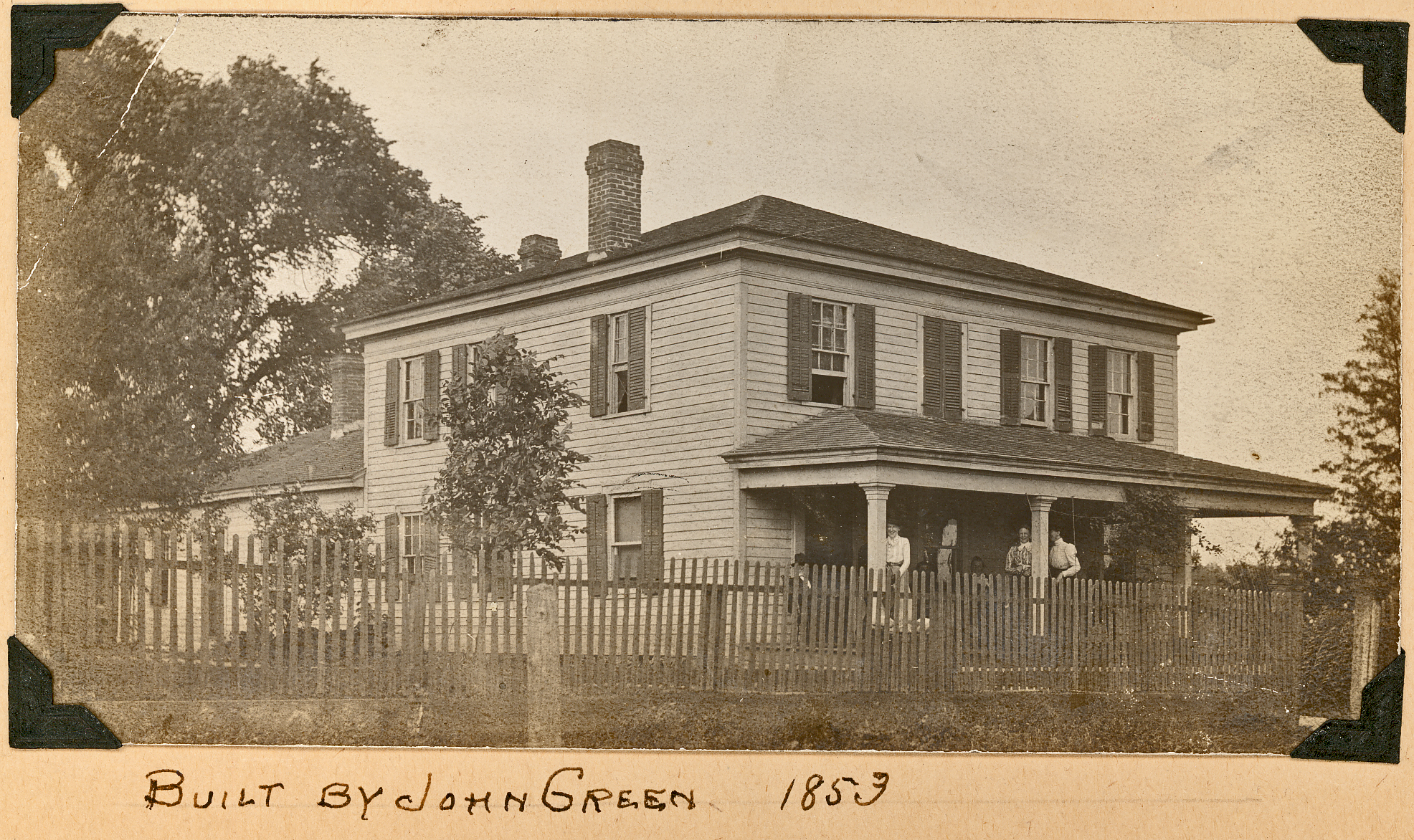
Because 1853 was the year John, Jesse, and David Green all built their solid frame houses along the shelf of land overlooking the river. The identical houses with the hipped roofs and the row of windows across the front. The houses that marked the moment the family shifted from older buildings to new shiny homes. The year the family cluster became the center of the Green settlement.

And while those houses were going up, Isaac planted an elm.

That tree grew alongside the houses — literally. It stood there through every change: the farm years, the dairy years, the years when the town was busy and the years when it was quiet. By the time my great‑aunt and I wrapped a tape measure around it, the elm had lived through the entire arc of the family’s Dayton history.

It wasn’t just a tree. It was a witness.

I didn’t know that when I wrote the original post. I didn’t know it when I measured the tree as a child. But now, with the whole 1853 landscape finally coming into focus, that little detail — buried in a paragraph about paper toys — suddenly feels like a thread that ties everything together.

Sometimes the past doesn’t reveal itself all at once. Sometimes it waits patiently in an old remark until you’re finally ready to understand it.

From Bright Eyes to Greenacres: A Century of Cattle

A Shorthorn Matriarch

If you stand in the old barn long enough, you can almost hear them: the soft shifting of hooves, the creak of stanchions, the low, steady breath of cows who lived a century apart yet shared the same worn floorboards. The Green farm in Dayton held cattle for nearly a hundred years, and in that time the herd changed as surely as the world around it.

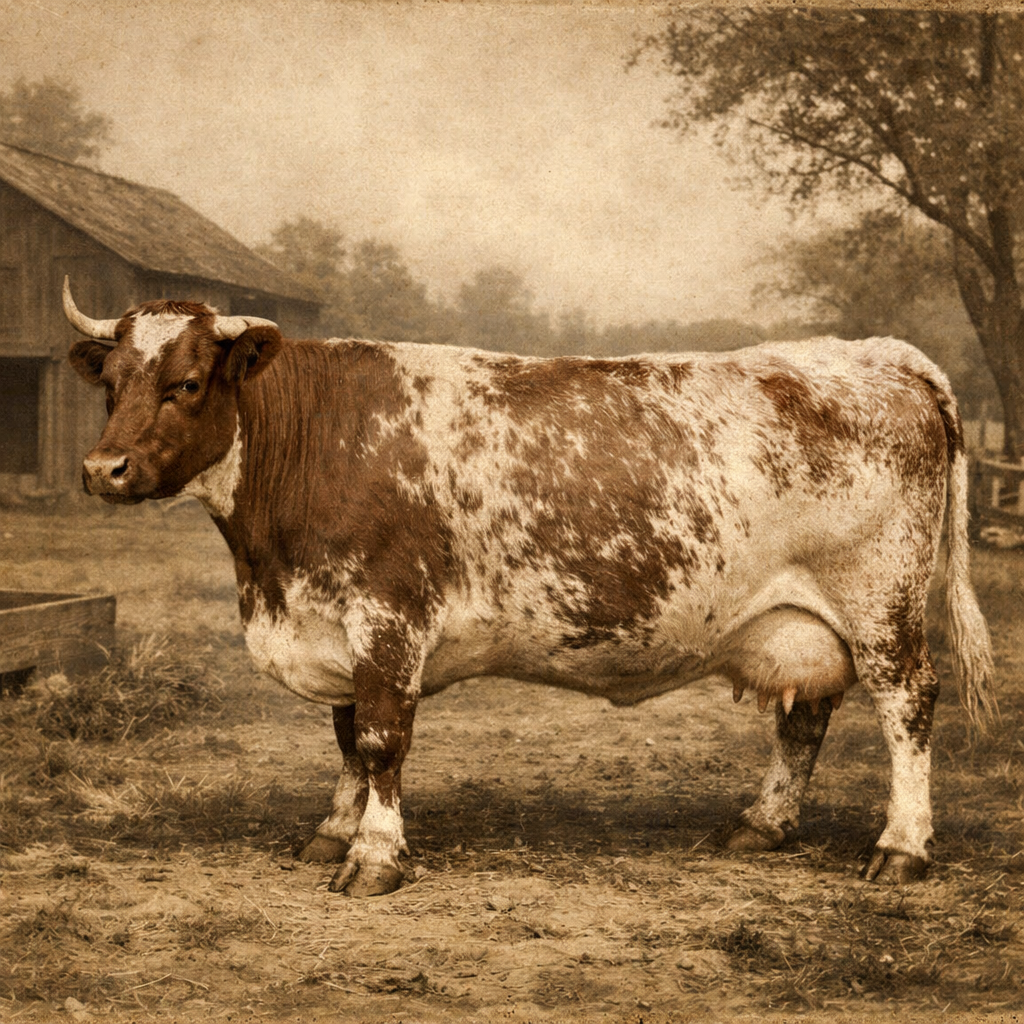
It began with Isaac Green in the 1850s, a man with an eye for Shorthorns and the patience to build a herd one careful breeding at a time. His cows had names like Bright Eyes, Lilac, and Jenny Lind — Victorian names for Victorian cattle — and their daughters and granddaughters shaped the farm for decades. Isaac’s herd was a breeder’s herd, full of ambition and pedigree, the kind of cattle meant to improve a breed, not just fill a milk pail.

When Isaac died in 1904, the Shorthorn era slowly faded. The cows aged out, the bulls were sold, and the farm shifted into a quieter rhythm as a new chapter began. By 1916, Isaac’s son, Lyle, was buying registered Jersey bulls; by 1918 he appeared in the Jersey Herd Register with more than seventy animals. The farm had changed breeds, changed purpose, and even gained a name — Greenacres — though the land beneath it was the same.

By the 1930s, Lyle’s Jerseys were a full, accredited dairy herd: sleek, golden cows tested and certified tuberculosis‑free by the USDA. Their birth certificates were ornate, their pedigrees carefully kept, and their milk rich with the butterfat Jerseys are famous for. This was the farm at its modern peak.

And then, in time, the herd shrank again. By the years I remember, there were maybe twelve or fifteen cows left. My father would walk across the bridge to the far pasture to bring them home in the evening, the river sliding by quietly as the cows came up the road in that unhurried way cattle have. They were the last generation — the final echo of a story that began with Isaac’s Bright Eyes almost a century before.