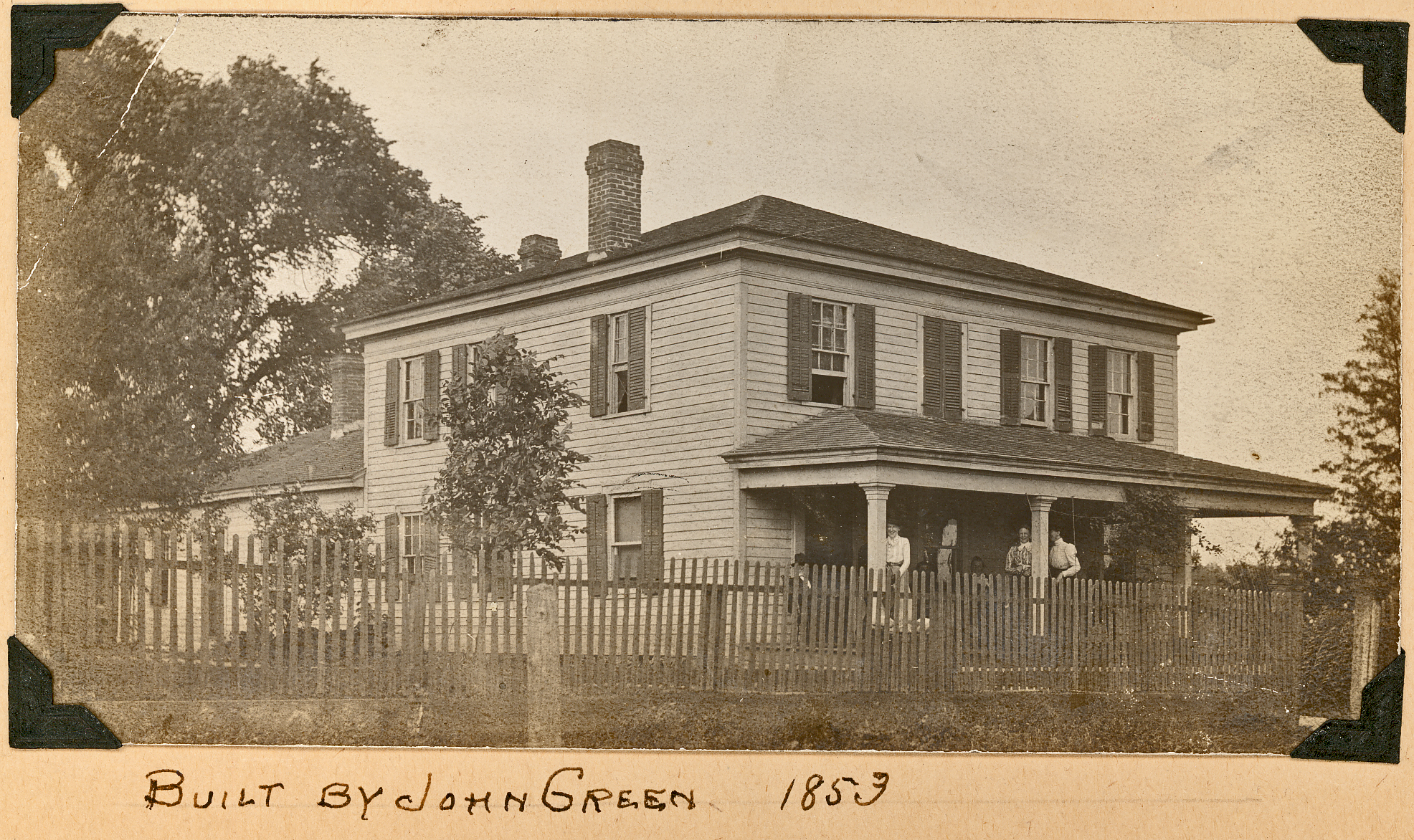
The tall tree behind the house is surely the elm Isaac planted the same year the house was built
Every so often, while rummaging through old posts on my website, I stumble across a detail that meant nothing when I first wrote it — and suddenly means everything now. This week’s discovery came from a piece I wrote years ago about the paper toys my great‑aunt used to make for us. I wasn’t looking for anything important; I was just checking whether I’d already written about them. But tucked into that post was a memory I had completely forgotten.
My great‑aunt was describing the afternoon she and I spent measuring the elm tree in their backyard. I remember the day: the tape measure, the rough bark, the way she insisted we “do it properly.” The tree was enormous — thirty feet around at the base. Even then, I knew it was old. What I didn’t know was its origin.
She wrote, almost casually, that the elm had been planted by her father, Isaac, in 1853.
At the time I first read that, the date didn’t register. It was just a number, one more scrap of family lore. But now — after months of reconstructing land chains, aligning plats, and tracing the early settlement along the ridge — that date rings like a bell.
Because 1853 was the year John, Jesse, and David Green all built their solid frame houses along the shelf of land overlooking the river. The identical houses with the hipped roofs and the row of windows across the front. The houses that marked the moment the family shifted from older buildings to new shiny homes. The year the family cluster became the center of the Green settlement.
And while those houses were going up, Isaac planted an elm.
That tree grew alongside the houses — literally. It stood there through every change: the farm years, the dairy years, the years when the town was busy and the years when it was quiet. By the time my great‑aunt and I wrapped a tape measure around it, the elm had lived through the entire arc of the family’s Dayton history.
It wasn’t just a tree. It was a witness.
I didn’t know that when I wrote the original post. I didn’t know it when I measured the tree as a child. But now, with the whole 1853 landscape finally coming into focus, that little detail — buried in a paragraph about paper toys — suddenly feels like a thread that ties everything together.
Sometimes the past doesn’t reveal itself all at once. Sometimes it waits patiently in an old remark until you’re finally ready to understand it.


This blog reminds me of when you pointed out the lilac tree next to the Clifford home. It was a good sized tree with a thick trunk like an elm or oak. I was completely unaware that it was a lilac as the purple blooms were way beyond the roof line, high above our heads. I had a new appreciation for old lilac bushes!
LikeLike