The Meat Cleaver Bandits

Dayton store

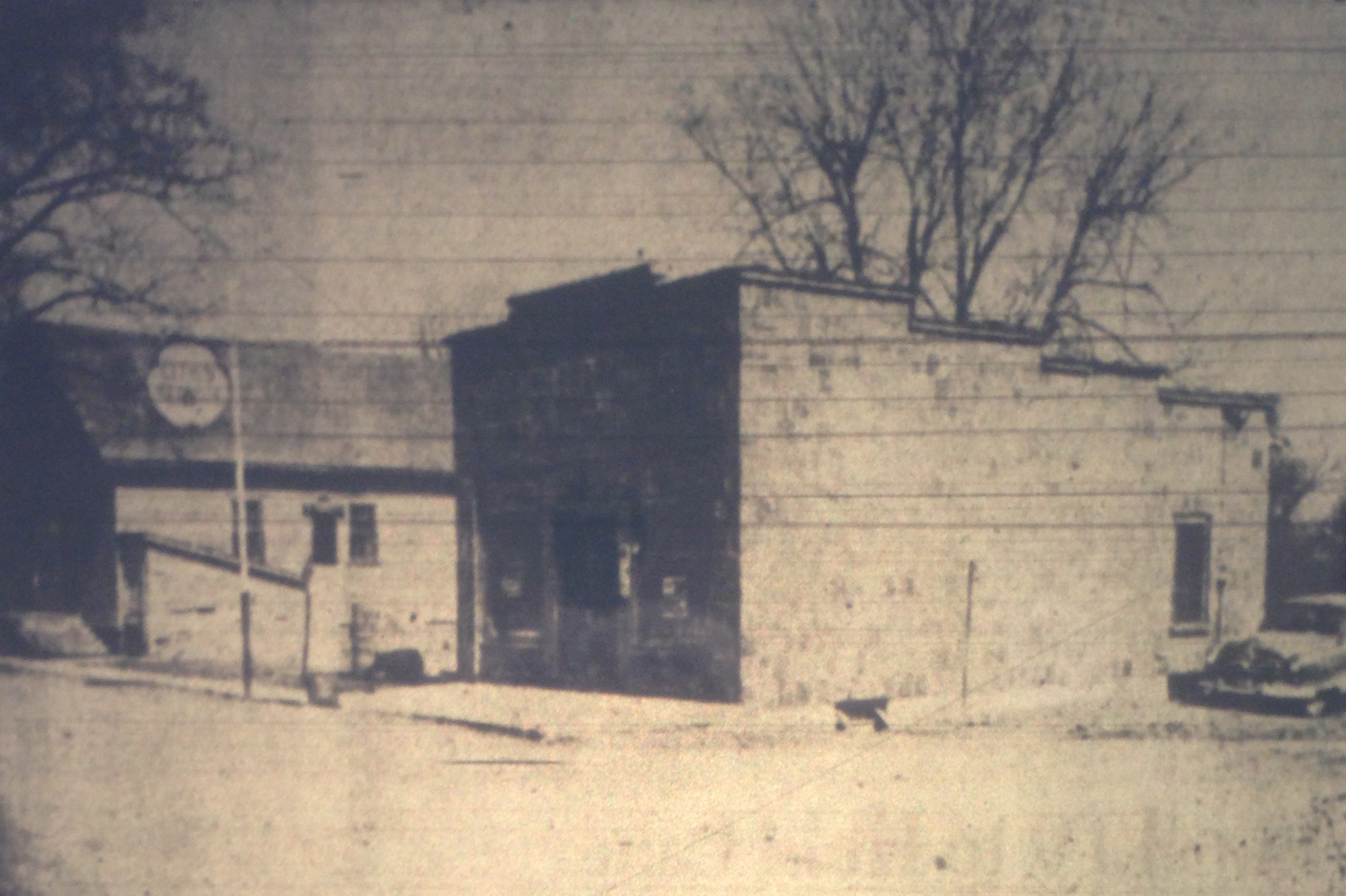
The Dayton store/post office/gas station

from the January 26, 1922 Free-Trader Journal

DAYTON P. O. ROBBED BY MEAT CLEAVER BANDITS; GET $7.25

Thieves Use Butcher’s “Weapon” to Break Open Strong Box Containing
Funds Belonging to Uncle Sam and Store Keeper

Running a risk of facing a term in the federal prison to secure a few dollars of government money, thieves last night robbed the Dayton postoffice, making way with $5.25 in postal funds and $2 in pennies from the W. B. Fleming grocery store. The robbery is believed to have been pulled by the rankest kind of amateurs, so kiddish did the traces left behind by the robbers seem.

The postoffice which is located in one corner of the Fleming grocery store, was closed shortly before 9 o’clock last night. This morning at 7 o’clock Mr. Fleming opened his place of business and built a fire before he discovered that the place had been burglarized.

A small safe, which is more in the nature of a strong box, twelve by twenty-four inches in dimensions, which held the postoffice funds, had been smashed open by a meat cleaver, which was taken from the butcher shop. The supply of stamps was passed over, the robbers evidently searching only for cash. The money from the store was taken from a cash drawer and from a dish in the candy counter.

The meat cleaver was found where it had been hidden by the robbers, after the theft in the coal pile, in the basement.

Entrance to the building was gained by breaking out a basement window. The robbers then went upstairs by an inside stairway. They worked with the door, until they succeeded in getting the wooden bar lock that fastened it from the arm that held it.

A trail of burnt matches which were strewn on the floor around the room, showed that the burglars had taken their time in making the search. The robbers were evidently of a hungry frame of mind, for they stopped long enough to have a lunch, opening a can of peaches, and scattering crackers all around the cracker box, Some bars of candy are also believed to have been devoured by the hungry boys or men.

The candy and cigarette case was evidently overlooked for it is not believed to have been touched.

The thieves left the building by a side door which they unlocked from the inside of the building. The door was carefully closed after the robbers and it was not until a careful investigation was made that it was learned that the exit had been made that way.

Deputy Sheriff Fred E. Stedman went to Dayton this morning to make an investigation.1


  1. Ottawa Free Trader-Journal, January 26, 1922, p 1, col 2

Bridging the Fox

wooden bridge

In 1837, John Green and William Stadden, who owned the land on either side of the Fox river at Dayton, were granted permission from the state to build a toll bridge. They had to complete the bridge within 5 years and could place a toll gate at either end to collect a toll, the amount of which was set by the county commissioners’ court.

By 1854, the bridge needed replacement and a subscription was taken up to build a free bridge. The toll was dropped to encourage those living on the east side of the river to patronize the businesses in Dayton.

In 1857, there was a severe ice jam in the Fox River between Dayton and Ottawa and the free bridge at Dayton was carried away. Jesse and David Green took on the job of rebuilding and in December of that year, the following announcement appeared in the Ottawa paper:

Free Bridge

The free bridge across Fox River at Dayton is now completed, and persons living on the east side will again have the privilege of patronizing our new Grist and Flouring Mill, which is capable of grinding from 50 to 60 bushels per hour. As the undersigned have expended their means very liberally in erecting such a Mill and Bridge as the growing wants of the country require, they hope to receive a liberal share of public patronage. Persons coming from a distance will find good warm stabling in connection with the above Mill, free of charge, and their public house has passed into other hands, and bids fair to do justice to the inner man at reasonable rates. Please give us a call.                                                              J. & D. Green1

In 1875, the bridge washed out again and for the next ten years, there was only a precarious ford to cross the river. The county agreed to pay one-half of the cost of a new bridge, leaving Dayton and Rutland to pay one-fourth each. In 1885, although Dayton was ready to pay their share, Rutland opposed the bridge, because they had recently been taxed for a bridge at Marseilles. Dayton offered to pay part of Rutland’s share, but it was some time before the bridge proposal was passed by the Rutland voters. The bridge was not finished until April 1887, and lasted until it collapsed in 1940.


  1. The Ottawa [Illinois] Free Trader, December 12, 1857, p. 3, col. 6

The Bran Duster

Bran Duster

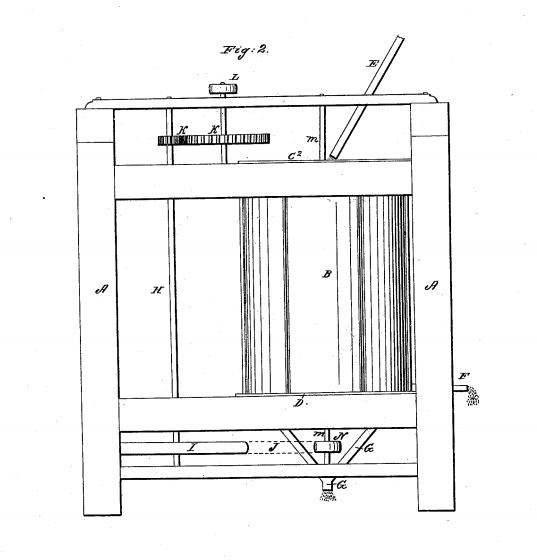
Drawing of Bran Duster from patent application

No one could accuse David Green of not being up-to-date. Left in charge of the Green businesses in Dayton while his father and brother went to California to seek gold, he refurbished the grist mill and installed a newly invented piece of machinery. In February of 1849, Frost & Monroe, a Michigan company, got a patent for a machine called a Bran Duster. By November of that year, one of these newfangled machines was installed in the mill at Dayton, as reported to the Prairie Farmer by one of its correspondents:

At Ottawa, on my return, I saw a machine, called a Bran Duster, patented by Messrs. Frost & Monroe, for the purpose of taking the flour out of bran after the latter has passed through the mill. It is said to gather five barrels of flour from the bran of a hundred. One is put up at Dayton, La Salle county. The cost I did not learn.1


  1. Prairie Farmer, November 1, 1849, p 22

A Summer Crime Wave

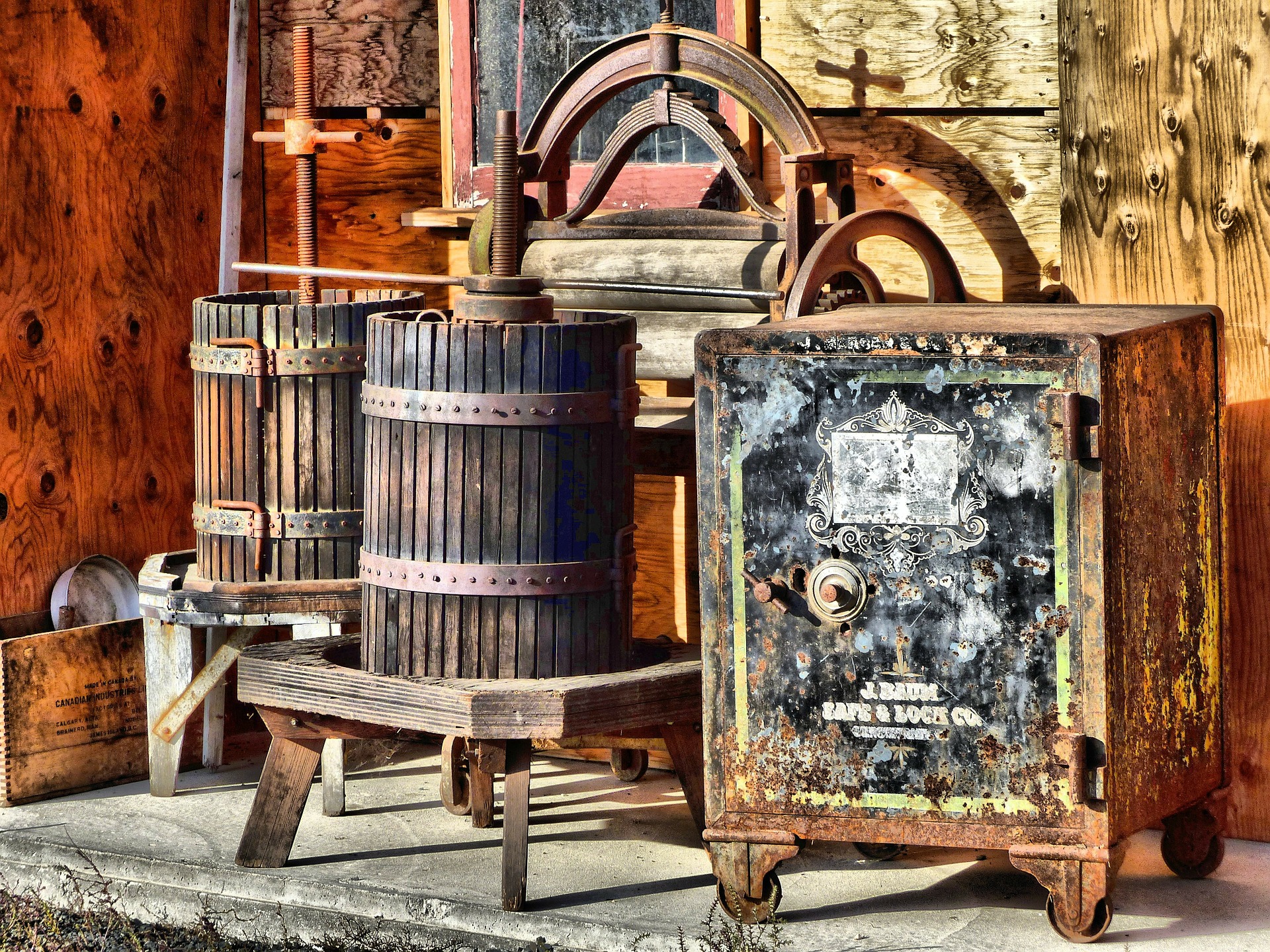
picture of an old safe

1885 was not a good year for the Dayton Horse Collar Factory. As you will see, there were no less than THREE attempts to rob the safe that summer.

The first try:

A. F. Dunavan, of the Dayton Collar Factory, was in the Free Trader office last Thursday morning and stated that an attempt had been made the night previous to blow open his safe. Powder was placed in the keyhole and fuse was found on the floor, but the burglar or burglars left, finding the attempt unsuccessful. Krouse, the gunsmith, went up and opened the lock of the safe, which had been so damaged that it could not be opened.1

Later in the summer, two more attempts were made:

Wednesday night of last week burglars broke into the safe of A. F. Dunavan & Son, of Dayton, the celebrated horse collar men. The safe was blown open with powder, but the thieves found nothing to reward them for their trouble, the safe being only used for the protection of books and papers in case of fire. This was the second attempt made by burglars, within the last two weeks, to break open this safe. Safe cracking is getting almost too numerous in this vicinity of late. There is work for a good detective in this county.2

However, it doesn’t appear that the thieves made any profit from their labors, reinforcing the notion that crime doesn’t pay.


  1. Ottawa Free Trader, May 30, 1885, p. 1, col. 5
  2. Ottawa Free Trader, August 15, 1885, p. 1, col. 5

Cooking in the Schools

               Apple    potatoes    Oyster

School lunch and home ec classes are nothing new. In 1913, the Farmer’s Voice, a farm magazine, reported on the forward thinking of La Salle County schools.

LaSalle county is forging ahead in things educational. This is shown by the splendid county institutes that are being held there. An item in the LaSalle County School bulletin tells of the work being done in the rural and village schools. Cooking in the schools is the newest thing up there. In some cases the teacher had a little oil stove on which soups and various dishes were prepared. In one district during cold weather a warm drink at noon is always provided, and sometimes roasted apples. The families are interested in this new departure and furnish materials. Baked potatoes were prepared at one school, using the ashes and ash pan as an oven. Vegetable soup and oysters have also been prepared and various hot drinks. Some of the girls spend scraps of time at home looking up dishes that might be prepared at school.1


  1. Farmer’s Voice, May 15, 1913, p 15

Neither snow nor rain nor heat nor gloom of night . . .

Jesse Green - postmaster appointment

. . .stays these couriers from the swift completion of their appointed rounds.
(The unofficial motto of the United States Postal Service)Dayton postmark

Dayton had a post office from 1837 to 1954. In that 117 years, there were 17 postmasters, George Makinson and Edward McClary having each held the post at two different times. An example of the appointment procedure in the 1840s is shown above in Jesse Green’s appointment, which lists the steps he must follow in order for his appointment to be approved. He had to post a bond and swear an oath, all of which had to be documented and sent to Washington.

The Dayton postmasters were
William Stadden 1837
Charles Miller 1839
Aaron Ford Jr. 1845
Jesse Green 1847
Christian Stickley 1849
George W. Makinson 1854
Oliver W. Trumbo 1857
George W. Makinson 1866
Maud V. Green 1895
Edward McClary 1897
Charles Hippard 1907
Frank Brown 1914
Mary Fleming 1919
Obert Howe 1923
Grace MacGrogan 1924
Edward McClary 1925
Catherine Corso 1940
Donald Ainsley 1945
Dominic DeBernardi 1946

In 1954 the Postal Service discontinued the Dayton post office, all Dayton addresses changing to RFD Ottawa. The final day of the Dayton post office was April 15, 1954.

Medicine on the Frontier


The following is an excerpt from a memoir written by Jesse Green, recounting tales of life in early Dayton and promoting a truly terrifying prescription for cholera:

“The next day after reaching home, I was taken down with the scarlet fever, which we supposed was contracted on a trip to St. Louis a short time previous.  This came very near to ending my earthly career, being the first and only time I ever fainted.  We had a German doctor who bled me with a high fever on.  I keeled over and was unconscious for quite a spell.  This was my first severe attack of sickness, but afterwards I had five others equally as severe, scarlet fever, lung-fever or pneumonia, inflamation of the bowels, cholera on route to California in 1849, and a fall on my head and shoulders, that came near to proving fatal.  I was saved in my attack of cholera by a prescription found in a medicine chest we bought in St. Louis put up by Dr. Westbrook.  It proved successful in every case where I knew it to be used.

“I will herewith give the formula from Dr. Westbrook:

Camphor                     6 grains
Capsicum                    6 grains            One dose in severe cases,
Blue-Mass                   6 grains            to be repeated often if
Pow’d Opium              3 grains            necessary.  1/2 dose
Prepared Chalk         20 grains            sufficient in mild cases.

“Some doctors claim that this is too large a dose, but I took three or four full doses myself.  It should be repeated every ten or fifteen minutes, but in mild cases of cholera morbus I found that a half dose was sufficient, and soon effected a cure.”

On Memorial Day We Honor Our Veterans

US flag

On this Memorial Day weekend, the veterans buried in the Dayton Cemetery take the spotlight. One of them is John Heath Breese, who was born October 12, 1830 in New Jersey. He was married to Elizabeth Lewis in Peoria, Illinois, on November 16, 1859.

They had seven children:
Nellie Virginia, born September 2, 1861
Ellis E., born April 14, 1867
Emmor E., born 29 June 1869
Cora, born September 19, 1871
Nora B., born March 11, 1874
William L., born October 25, 1876
Walter, born December 24, 1878.

John enrolled as a private in Company C (Houghtailing’s), 1st Regiment, Illinois Light Artillery Volunteers on August 22, 1862. At the time of enlistment he was a farmer, 5 feet 8 inches tall, with light hair and blue eyes. He joined the unit just before the march to Nashville, Tenn., September 3-12. He saw action at Murfreesboro; the Battle of Stone’s River; the Tullahoma Campaign; the Battle of Chickamauga; Mission Ridge; Rocky Faced Ridge; Buzzard’s Roost Gap; Pumpkin Vine Creek; Kenesaw Mountain; Pine Hill; Lost Mountain; the siege of Atlanta; the battle of Jonesboro; Lovejoy Station; the march to the sea; the siege of Savannah; the campaign of the Carolinas; surrender of Johnston and his army; the march to Washington, D.C., via Richmond, Va.; and the Grand Review. He was mustered out at Springfield, Illinois, June 12, 1865. He suffered from rheumatism and heart trouble as a result of a fever he contracted at Nashville in the winter of 1862-3. He spent some weeks in the hospital and suffered from rheumatism from then on. This severely limited his ability to do farm work and made him eligible for a pension.

On his return from the war, he spent 8 years in Kansas, returning to Dayton in 1874. In the summer of 1880 he was working in the paper mill in Dayton when he injured himself jumping up out of a pit without waiting for the ladder to be brought.

photo of John H. Breese tombstone

He died in Dayton, September 30, 1914. Both he and Elizabeth are buried in the cemetery, along with children Nellie Virginia, Ellis, Emmor, and Nora (wife of Lowell Hoxie).

The Black Hawk War – An Eyewitness Account from 1832

(1099) Barbara Grove Green - frame


Maud Green

Barbara Grove Green                                 Maud V. Green

The following account was dictated to Maud V. Green by her grandmother, Barbara Grove Green, December, 1884. It was transcribed from the handwritten original by Candace Wilmot, gr-gr-granddaughter of Barbara Grove Green.

On the 16th of May 1832, about ten o’clock in the morning, myself and the girls were washing at the spring near where the feeder bridge now is when Eliza came down on horseback and told us that the Indians were coming & that we would have to go to Ottawa right away.  Then we went to a place a couple of miles below Ottawa (to Penbrook) and stayed there all night the next day come up to Ottawa and next day home again.  This was Sunday and the next day the men made a stockade around the house out of plank.  After it was finished they tried it to see if a bullet would go through it, and it did, so they hung up feather beds all around.  There were about sixty people here at the time, we were so crowded that they had to sleep on tables, under the beds and all over the house.

The same night George Walker came and told us that we must go to Ottawa again, so we left right away and went down to the river to get in the pirougue, but when we got there we found that Daniels’ had taken the boat and gone before we got there, so we had to walk.  As I had forgot some of Rachel’s clothes and, coming back to the house, I found Jesse and David yet in bed.  They had been waked before we started so I supposed they were with us.  We followed the river bank all the way down and I had to carry Becky all the way because she would cry when anyone else took her.

Aunt Becky Trumbo was sick so that she could not walk and she rode on the horse behind old Mr. Letts.  Eliza Trumbo was left standing on the river bank and we went off and forgot her.  Wm Dunavan came back and got her.  When we got to Ottawa there was no fort there, only a log cabin on the south side of the river, but they soon built a fort on top of the hill.  We went to the fort but there was so much confusion there that we had the log house moved up on the hill and lived in it.  We women didn’t know what the trouble was til we reached Ottawa and then they told us about the “Indian Creek Massacre” where there were sixteen people killed.  Two boys who ran away and two girls who were taken prisoners, were the only ones that escaped.

The next day (?) a company of soldiers from the southern part of the state passed through Ottawa on the way up the river and two men Hazleton and Schemerhorn who lived at Mission Settlement intended to go with them to their farms but failed to get ready in time and so were an hour or two behind the soldiers.


The Library Association of the Dayton Literary Society

Book label - Dayton Literary Society

The Dayton Literary Society flourished in the 1870s and 1880s as shown by the clippings below, taken from the Ottawa Free Trader newspaper. Book No. 70, in which this bookplate appears is My Own Times by John Reynolds, published in 1855. Reynolds was governor of Illinois from 1830-1834. It is tantalizing to speculate on what the other 99 volumes might have been.

December 7, 1878, p. 4, col. 5
The Literary meets Friday evening to re-organize and adopt a new constitution. A committee has been appointed to procure more books for the library.

March 15, 1879, p. 8, col. 2
The Literary is in good running order and having good success. The exercises show care in their preparation and talent in their delivery. The library of the society, containing over a hundred volumes of choice reading, is a great benefit to the town. Much interest is taken in it and beneficial results we have no doubt will proceed from its use.

February 5, 1881, p. 8, col. 2-3
The Library Association has reorganized and will soon add a few more volumes to their catalogue. The following officers were chosen for the ensuing year: Mr. Isaac Green, president; Chas. Green, secretary; Harry Green, librarian. An initiation fee of fifty cents for the year will be charged, with no monthly dues. An invitation is extended to all to join the association and enjoy the privileges of the library. It contains many readable and instructive volumes.

February 19, 1881, p. 8, col. 1
The Library Association has adopted a constitution and is receiving many new members. The library is at the store, and Harry is the librarian. He will issue cards of membership at fifty cents each, and allow the holder to read any and all of the hundred volumes in the library.

A School Christmas Program

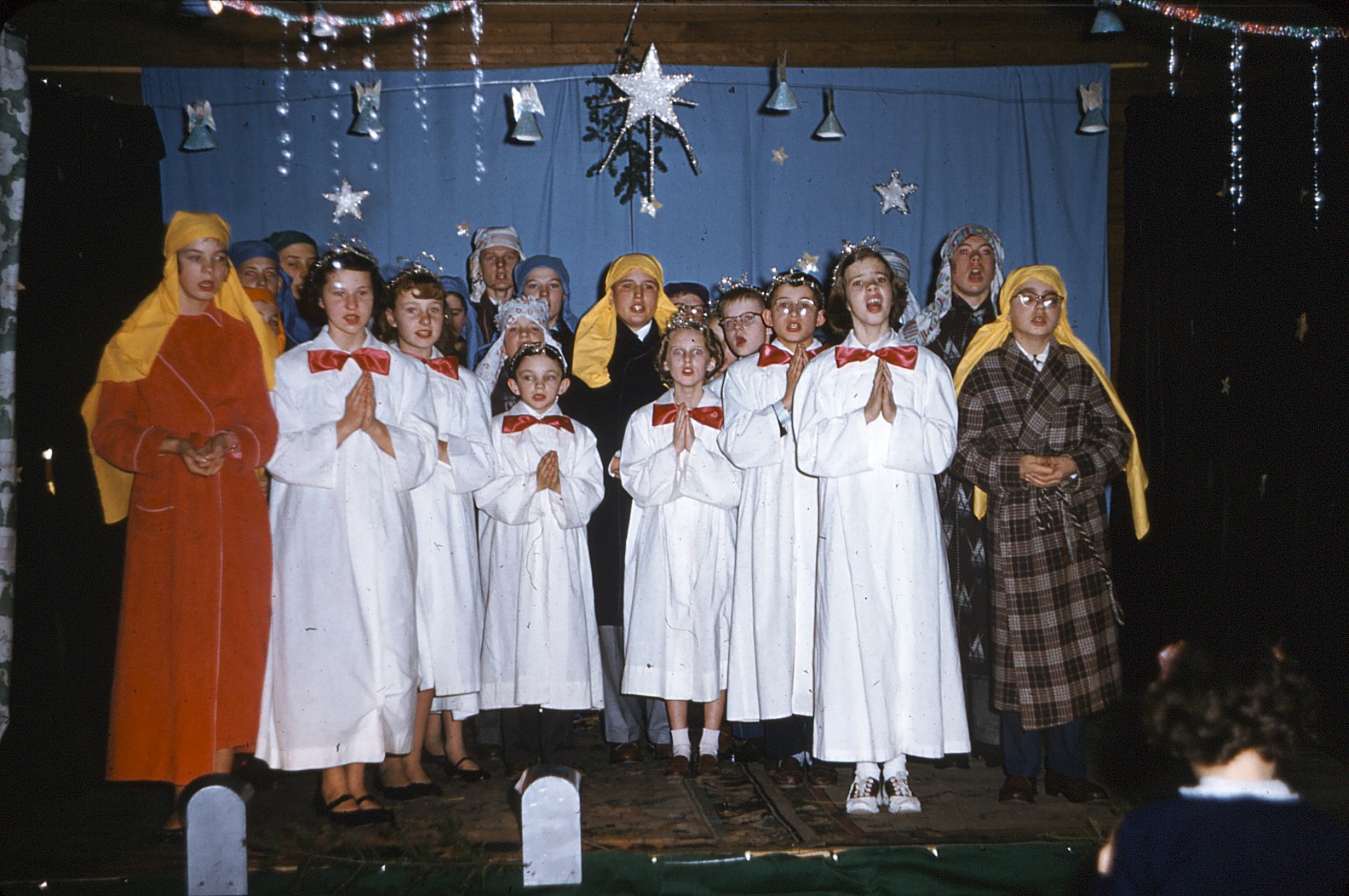
School Christmas program

This picture of a Dayton school Christmas program dates from about 1955. It was held in the Dayton clubhouse and as you can tell by the picture, told the traditional Christmas story, complete with shepherds and angels. The six angels are (l to r) unknown, Sandra Leonard, Jimmie Mathias, Sally Clifford, Ronnie Thompson, and Betty Jo Hughes If you can identify any of the others, please leave your information in a comment.

Mrs. Trent and Santa

Following the pageant, Mrs. Trent (teacher of grades 5 through 8) welcomed a rather pop-eyed Santa who distributed gifts from the tree. Again, if you can identify anyone in the pictures below, please leave a comment. Click on the picture to see a larger version.

.18       Dayton school Christmas party


Happy Birthday, Nancy!

Joseph Albert and Nancy Green Dunavan

Nancy Green was born 200 years ago today, April 26, 1816, in Licking County, Ohio, the second daughter of John and Barbara (Grove) Green. She was 13 years old when her family moved to what later became La Salle county, Illinois. In 1831, her older sister, Eliza, married William L. Dunavan. Three years later, on January 26, 1834, Nancy married William’s brother, Joseph Albert, and three years after that, Nancy’s sister Katherine married Albert’s brother George. Joseph and Nancy lived on a farm in Rutland township, across the Fox river from Dayton. They had twelve children:

Katherine (1835-1915) married Benjamin Frank Brandon March 21, 1857
Samuel (1837-1914) married Amanda Miranda Munson March 22, 1859
Isaac (1838/9-1914) married Mary Ann Lafferty March 9, 1880
David (1840-1910)
Amanda (1843-1846)
Joseph (1845-     )
George (1847-1922) married Kate Rogers March 4, 1877
John (1849-1854)
Jane (1852-1927) married Aaron Howe December 25, 1872
Alice C. (1854-1904)
Lewis (1856-    ) married Jennie McMichael in 1879
Anna L. (1859-1884) married William Miller February 22, 1883

Nancy’s husband went to California in the gold rush. There was no word of him for some time and the rumor spread that they had started home through Mexico (as indeed they had) and had been killed there (as they had not). The night he got home, Nancy had a headache as a result of a toothache cure she had applied. She had run a hot darning or knitting needle into the cavity of her tooth to stop the pain. When he got home she entirely forgot the tooth and headache and they sat up about all night talking and visiting.

John Green had given Nancy and Albert a quarter section of land when they married, and they had turned it into a prosperous farm, where they raised their large family. However, in 1883 disaster struck. Albert and his brother, George, had been buying and selling cattle and were in debt. They borrowed from Matilda Hogue, a wealthy widow, and her son Joshua. In order to pay this debt they speculated on the Chicago Board of Trade and lost. Albert and Nancy sold their farm to their son Lewis for $10,400. After the debt was paid they had only a thousand dollars to begin a new life in the West. They moved to Sterling, Colorado, in 1889, where Albert farmed with his sons. They later returned from Colorado to Hamilton, Missouri, where Albert died in 1892. Nancy continued to live in Hamilton with her son, David, until her death on February 27, 1905.

Here Comes the Railroad

railroad tracks

The railroad track heading south on its way to Ottawa.

Burlington passenger car

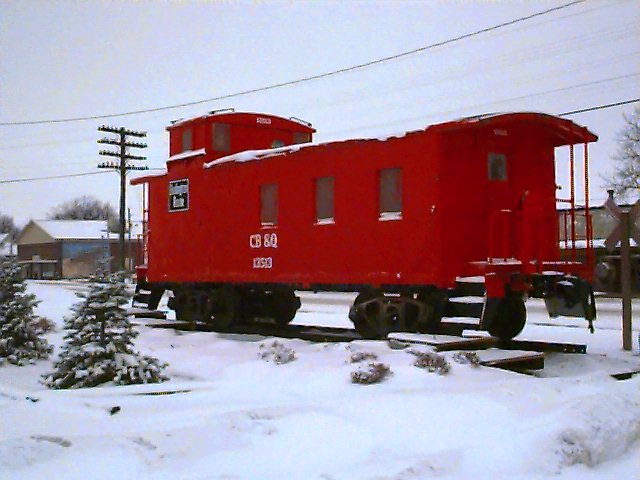
CB&Q caboose

CB&Q passenger car and caboose

store, depot, elevator

The railroad depot in Dayton, between the store on the left and the elevator on the right.

In 1869 the Ottawa, Oswego and Fox River Valley Railroad began purchasing the right of way through Dayton for their planned route from Aurora to Streator. The portion of the route that went through Dayton was not completed until about 1876.

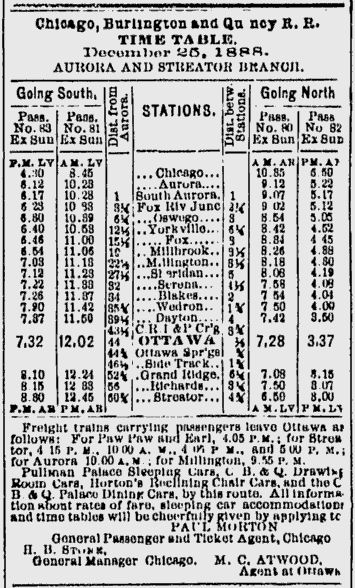
C B & Q 1888

The Chicago, Burlington & Quincy schedule in the Free Trader shown above lists a stop in Dayton. A passenger could board the train at 7:42 in the morning and be in Chicago at 10:35. After a day’s business or shopping, the 4:30 pm train would get one back to Dayton at 7:37. It made spending the day in Chicago an easy trip as nowhere in Dayton was far from the depot.

The CB&Q leased their route from Aurora to Streator, which passed though Dayton, from the O. O. & F.R.V. RR and in 1899 the O. O. & F.R.V. RR was bought by the CB&Q. The CB&Q assets were sold in 1999 to Illinois RailNet, which became Illinois Railway (IR) on May 1, 2005.

B is for Bottle

Dayton Dairy milk bottles

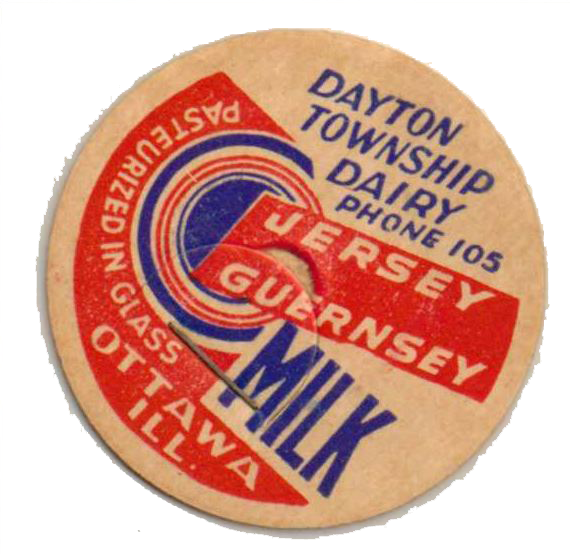
Dayton Dairy bottle capsDayton Dairy cottage cheese lid

Milk bottle, that is.

Farmers throughout the Dayton area sold their milk to the Dayton Dairy. In the early days of the twentieth century, the Green farm had one of the oldest Jersey herds in the state of Illinois. Lyle A. Green, who took over the farm on the death of his father, Isaac, upgraded the herd until many of the cows made their way into the Jersey Registry of Merit. He traveled, often into neighboring states, to purchase pedigreed stock to improve the herd. He became a breeder, building a good reputation for Greenacres Farm of Dayton, Illinois.

The names of the cows give some hint of the  status of these ladies: Poppy Golden Oxford, Royal Mary’s Design, and Belle’s Golden Finance were surely belle dames of the dairy world. Raleigh’s Meg, Raleigh’s Ota and Raleigh’s Lady Brookhill all gave evidence in their names of their descent from Raleigh’s Lord Brookhill, who sired many prolific daughters for Lyle Green’s breeding program.

Despite the use of milking machines, the milking was still finished by hand, and the barn cats were adept at catching their daily ration of fresh milk. The cows were pastured in fields on the east side of the river and twice a day the herd made its slow way across the bridge. After Lyle Green’s death, his brother, Ralph, took over the farm and soon took his son-in-law, Charles Clifford, into partnership.

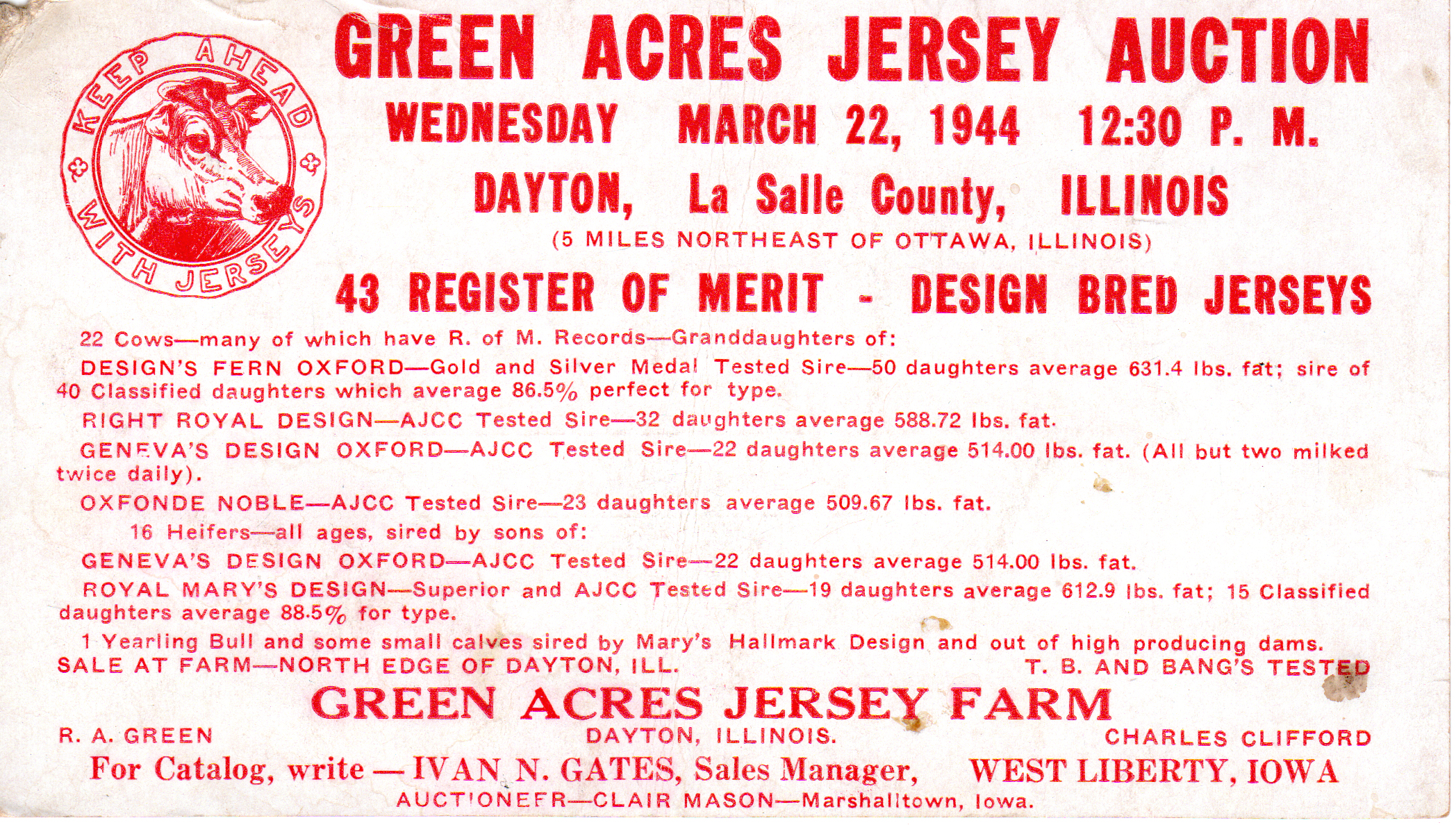
Green Acres Jersey Auction

As you can see, the Green herd was sold in 1944 and, although the Dayton Dairy continued for some years, it, too, is no longer. The milk bottles are now only found at flea markets or on eBay, but they serve as a reminder of one of the major enterprises in Dayton in the first half of the twentieth century.

The End of the Dayton School

newspaper clipping - end of Dayton school

Bell Silent, Dayton School To Be Sold

School’s out for good at Dayton. The 75-year-old school house is going to be sold.

It stands alone on the hill, with grass and weeds growing a foot high, the playground sets turning to rust. The only form of life around is the pigeons in the bell tower.

The school opened in September, 1891. A two-story frame building with a half dozen large rooms, it sits on the foundation of a former school, occupied from 1882 until it burned down the day before Thanksgiving in 1890.

Dayton’s first school, erected in 1849 where the elevator now stands, doubled as a church and a town hall.

Until about five years ago, no church had been built in Dayton since the school served the purpose, or the people went to church elsewhere.

The first board of school directors consisted of David Greene, Richard Stadden and Rees Morgan, who were elected October 6, 1849.

Among the property and equipment to be auction off at 1 p.m. June 25 are several slate blackboards, antique patio blocks and an old school bell.

The youngsters don’t hear the bell clanging on their way to school. Instead, they are bused to the Wallace school, which whom the Dayton school district has consolidated.

In the 1965 school year book, a poem on the school reads:

In eighteen-hundred eighty three. . .
Our Dayton stood new for all to see. . .
Many a child has come and gone . .
And with knowledge they carry on . . .
After 73 years of golden rule . .
The sun now sets on Dayton School . . .1


  1. Ottawa Republican-Times, May 25, 1966


A Different Look at the Dayton Cemetery

IMG_0961

How many people are buried in the cemetery?
There are 221 people known to be buried in the cemetery, as of July 1, 2012. Undoubtedly, there are some undocumented burials, as La Salle county did not register deaths until 1877 and even then not everyone complied. Even when deaths were mentioned in the newspaper, women and children were largely ignored. A child whose parents and siblings are buried in the cemetery, and whose family was known to be living in Dayton at the child’s death, is likely to be buried there. Where there is no confirmation of that, that child is not included with the 221 for whom some evidence exists.

Age at death Number of deaths
0-5 years         37
6-10                   5
11-20              13
21-30              15
31-40              16
41-50              10
51-60              16
61-70              33
71-80              40
81-90              21
91-100              8
Unknown         7

Causes of death
Of the 98 persons for whom cause of death is known, the seven most common causes were (in order of frequency): heart disease, cancer, meningitis/pneumonia, accident, apoplexy/cerebral hemorrhage, old age, and tuberculosis.
These seven accounted for 62 deaths.

Family clusters
The largest cluster is that of the Green/Grove/Dunavan families, which, with in-laws, includes 147 people. There are ten members of the Warner/Tanner/Luce family, nine members of the Timmons family, 11 members of the Breese/Hoxie family, seven Hoags, and seven in the Bennett/Wilson cluster.

Joel Foster Warner in the Civil War


warner-joel-f - tombstone

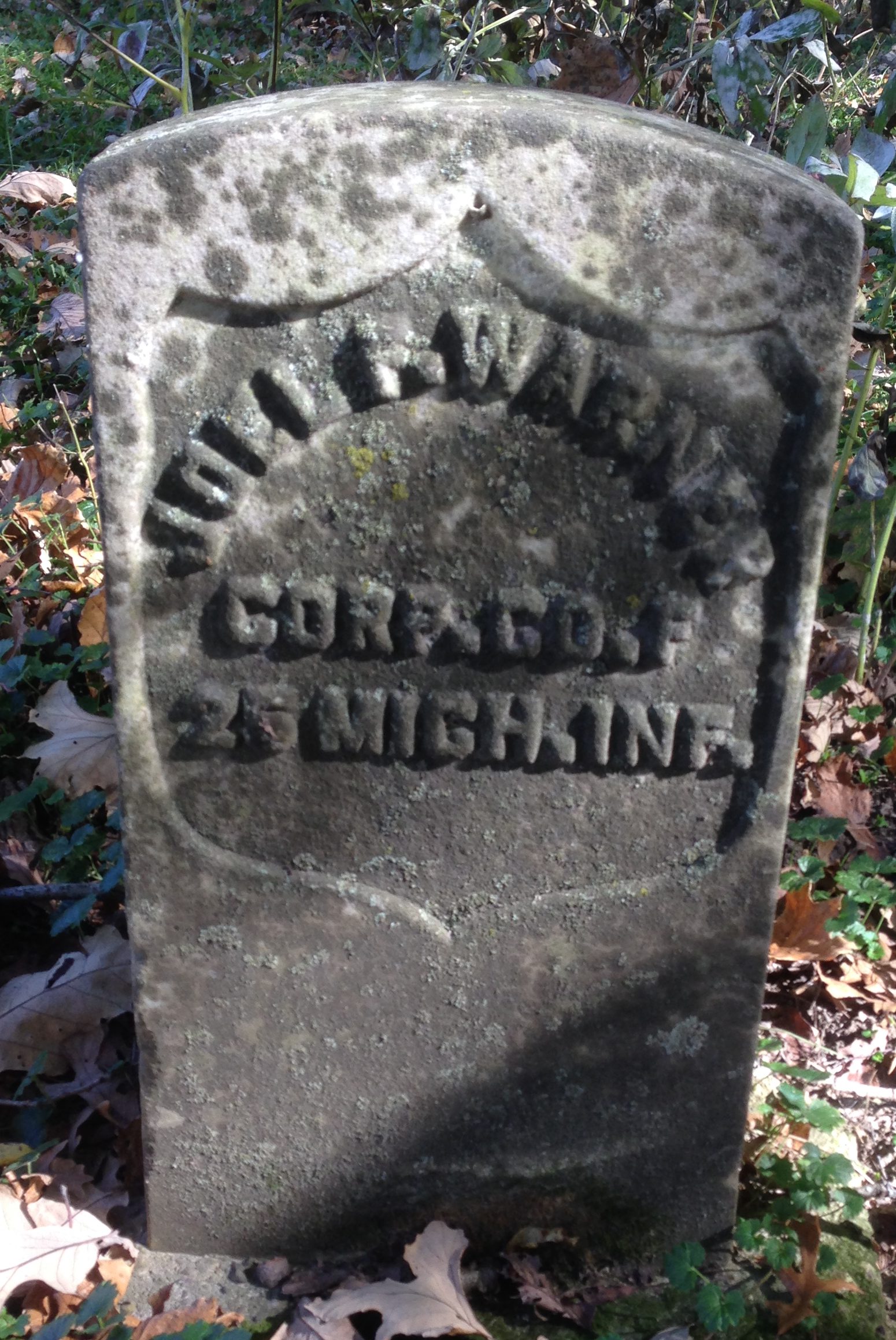
Joel F. Warner, who is buried in the Dayton Cemetery, was born June 14, 1831, in Syracuse, New York. He enlisted August 14, 1862, in New Buffalo, Michigan, in company F of the 25th Regiment of Michigan infantry and was mustered in as a corporal on September 22, 1862, in Kalamazoo, Michigan. In the spring of 1863, the regiment joined the Georgia campaign with General Sherman from Chattanooga to Atlanta, participating in the battles of Tunnel Hill, Rocky Face and Resaca, among others. On June 12, 1864,  while the company was in action at Pumpkinvine Creek near Dallas, Georgia, Warner was injured. In the words of his sergeant:

I was first Sergt at the time. We moved up in front of the enemies line about noon of the day in question. We hurriedly threw up breastworks, had orders late in afternoon to strengthen the works that night. I made a detail from my Co, J. F. Warner being one of the number & set them to work.I then went to the rear some 10 or 15 rods & lay down for the night, The weather was warm and our line in the woods. We put up no tents. The night was very dark. Some of the men went in front of the works to dig a trench, J. F. Warner with their number. Through some mistake or neglect a gun with fixed bayonet was left leaning against the works. Some time in the night the enemy opened fire on our line with artillery. It lasted but a few minutes, did not alarm the camp to much extent. But the men in front of the works came back very hurriedly. J. F. Warner came in contact with said bayonet, which struck him somewhere in the region of the groin, and carried clear over on the point of it to the ground. He seized hold of the bayonet with both hands and being a man of superior strength kept it from going through him, twisting the shank of the bayonet around the barrel of the gun. I did not see the wound, he was immediately  moved to Hospital before I was apprised of the fact. I saw the condition of the bayonet.

He returned to duty September 16. He had two other short spells in the hospital, in October for fever and in November for neuralgia. He was mustered out with the company on June 24, 1865 at Salisbury, North Carolina. Following his discharge he returned to Three Oaks, Michigan, where he remained until 1872, when he moved to Oswego, Illinois, and then to Dayton.

In 1876, Joel Warner applied for an invalid pension since his ability to work was hampered by the effects of his old injury. He was examined by a local doctor, who estimated that he was 50 percent disabled because of a scrotal hernia on the left side. He had also suffered the loss of his right leg four inches below the knee in a railroad accident, although this happened many years after his war service.

His request for a pension was initially refused, on the grounds that he was not truly incapacitated. However, in 1890 another pension law was passed, expanding the grounds for acceptance. He reapplied, and this time received a pension of $12/month, which was later raised to $20/month.

Warner died in Dayton September 26, 1911, and was buried in the Dayton Cemetery. His widow received a pension of $12/month following her husband’s death, and in 1916 that was increased to $20/month. Mary Ann (Inman) Warner died January 20, 1918, at the age of 79, and is also buried in the Dayton Cemetery.

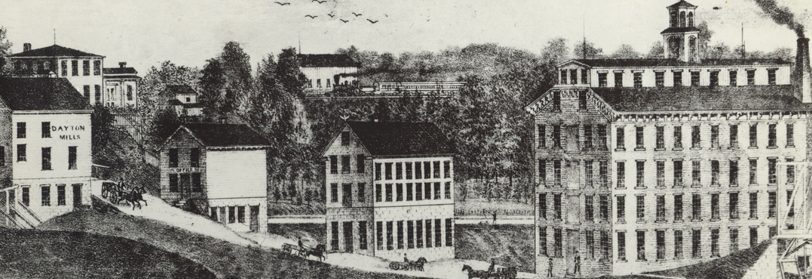
Dayton in 1850 – Where we came from

In 1850, the first year for which we have places of birth from the census,  there were 85 people living in the village of Dayton. Of these:

22 were born in Illinois
18 were born in Ohio
5 were born in Pennsylvania
4 were born in Virginia
3 were born in New York
3 were born in Vermont
2 were born in Maine
1 was born in New Hampshire
13 were born in Norway
9 were born in England
4 were born in Ireland
1 was born in Wales

The oldest of the children born in Illinois was 16, reflecting the settlement of the area in the early 1830s. The first party of settlers came from Ohio; thus, the second largest group were born there.

Except for William Wheatland, a Methodist minister, all the people who  were born in England were connected with the wool trade and came to Dayton because of Green’s woolen mill.

The other large group, the 13 born in Norway, are a result of the work of Cleng Peerson. Cleng Peerson was a Norwegian-American pioneer who led the first group of Norwegians to emigrate to the United States. In 1834 he led a group to La Salle County, who settled on the Fox river 5 or 6 miles above Dayton. More information on Peerson can be found here.

Fardowners vs. Corkonians

Irish canal workers

The word  “fardowner” appeared in America at least as early as the 1830s, and referred to people from Ireland who came to obtain work on the new systems of canals and railways. The Corkonians came from County Cork in southern Ireland, while the Fardowners were from central Ireland. Rival clans competed with each other for jobs on the canals and there were frequent outbreaks of violence. One such outbreak among the workers on the Illinois-Michigan canal in 1838 is told of by Jesse Green in his memoir:

The season of 1838 we had what Mr. Baldwin in his history of the county terms “The Irish rebellion,” the Corconians being in the majority on the canal, the rivalry between that class and the Far-downs, culminated in the attempt of the Corconians to drive all Far-downs off the canal.

The sheriff Alson Woodruff called out all the available men he could get to thwart their purpose, he sent up to Dayton where we had on the upper and lower works something over one hundred men, all Far-downs, working on the feeder. The contractors on both works were absent that day and no one was left except myself and Cousin John Stadden who was willing to marshall and lead our men to the scene of expected battle. We were the only Americans in the squad, so we marched our men down the tow-path unarmed expecting to meet the sheriff in Ottawa, but he had preceded us down the Canal, and we continued our march down the tow-path, and met the Corconians coming up at the upper end of Buffalo Rock, armed with all manner of death dealing weapons, guns, pistols, scythes, shovels and picks &c. As soon as our men saw their opponents marching up the canal in such formidable array, they all broke ranks and ran up the North bluff like a herd of wild swine, leaving Stadden and myself alone there, and though a serious matter we almost burst with laughter to see the stampede. Doubtless it proved to be a very lucky circumstance, had they stood their ground and met the Corconians unarmed, we should probably have had a bloody battle and our men would have fared badly.

The Corconians continued their march up the canal to Ottawa when the sheriff with his posse of armed men halted them just west of town and read to them the riot act, and demanded that they lay down their arms and disperse, which most of them did but some attempted to run with their arms (not a gun was fired up to this time) in Mr. Baldwin’s history he says “it was claimed by some that fourteen or fifteen were killed.” We were ordered by the sheriff to pursue the fugitives on horseback and disarm them, which seemed to imply that if they ran too fast they were justified in retarding their speed, but I only heard of one instance of this kind, one bragadocia whom I will not name bragged that he stopped his man “rather suddenly” in the high grass fronting Judge Catons residence. I pursued one man and overtook him on the bank of the river just east of the present water works plant. I could not see that he had any arms, but told him he had a pistol which he must surrender, but he stoutly denied having any kind of weapon, until I told him my orders were to shoot if obliged to; and drew down my gun and cocked it as in the act of shooting, he then said he had a pistol but it was a borrowed one and he was afraid if he gave it up he never would find it again; I assured him that all arms and weapons taken would be left in charge of the sheriff and be returned to owners as soon as the difficulty was settled, he then handed the pistol to me.

On our return home that night we found our men had all returned home safely, and “Begore lucky it was fur us that we did run, faith had we stood our ground, ivery mithers son ivus would have been kilt.” The work proceeded without much trouble on this score, but it was desirable and almost a necessity on the part of contractors to not mix the two clans on the same work.

If It’s Not One Thing, It’s Another

June of 1880 had an outbreak of disease, injury and death in Dayton, as the following newspaper reports show.

DIPTHERIA AT DAYTON IS ABATING

But one new case – that of Mabel, a girl of 7 years, youngest child of Jesse Green – is reported, and with her the disease is not violent. The others, who were very low with it last week, are recovering.

Fred Green, the lad who was so frightfully mangled in the paper mill last week, is bearing up bravely. His recovery would seem miraculous, considering the tortures he has suffered. In addition to the tearing off of the right hand, he lost the first and second fingers of the left hand, his right leg was broken below the knee, the left leg knee joint dislocated and the knuckle bone thereof broken and the right arm broken above the elbow. He successfully bore this awful shock and the subsequent one of the amputation of the fingers and right arm above the wrist, and apparently is on the mend, though many dangers lie in wait before he can recover.1

DIED

At Dayton, May 20th [sic: 26], 1880, of diphtheria, ALLIE, son of Jesse and H. R. Green.

At the same place on the same day and of the same disease, EDWARD, son of George and Charlotte McKinson [sic: Makinson].2


1. The Ottawa [Illinois] Republican, June 3, 1880, p. 1, col. 3
2. p.8, col. 5