
The following paper was prepared by Mr. Jesse Green to be read at the recent Old Settlers’ Picnic in Allen’s Grove at this city, but for want of time was not read. It contains so much of interest in regard to the early history of this county that it would be a real loss to make no use of it, and accordingly we cheerfully give it a place in our columns:
My father, in company with three others, his brother Wm, Jos. Grove and a Mr. Lambert, first visited this state during the fall of 1829 to look out a new home in this then wild and unsettled country, his object being to find a good farming country and a good water power on which to erect mills, which seemed to be a necessity at that time. He passed through Chicago, and the few inhabitants there at that time urged him very strongly to locate there: but coming on and finding what was then called the rapids of Fox river, which filled the object of his search, and, being favorably impresses with the appearance of the country, he ascertained that the mill site was on seminary land and subject to entry at Vandalia, the then seat of government. He then bought the claim and improvements of a Mr. Clark, two and one-half miles north-east of Dayton, and contracted with him to build a larger cabin that the one he occupied and to put in forty acres of fall wheat. He then went to Vandalia and entered the land on which the water-power is situated and returned home and made speedy arrangements to move that fall, but it was the latter part of October before he and those who proposed to go with him could get ready to start on their perilous journey. There were three other families, David Grove, R. DeBolt and Henry Brumbach and a half dozen single men, making twenty-four in all.
I think we were forty-six days on the road, landing in the new cabin (which, by the way, was not completed,) about the middle of December. You can imagine the kind of weather we had at that season of the year. I remember one morning, when my mother attempted to get out of the carriage in which she rode and slept, she found her clothing was frozen fast, which somewhat delayed an early breakfast that morning.
About ten miles before reaching the prairie in Indiana we were compelled to cut out a new road through a dense undergrowth of timber for that distance, and here was the last white setter on our route until we reached the trading post of Mr. Hubbard, on the Iroquois, of whom my father bought a large perogue and loaded upon it all it would carry, and detailed three men to run her down to the rapids on the Illinois (now Marseilles.)
But of the last setter (I think his name was Parish,) with whom we stayed all night. Father had sent me and my brother David ahead of the teams to engage feed and lodging if possible, and during the evening this man did all in his power to persuade my father to abandon the idea of attempting to reach his destination that winter. He was sure we would all perish; but, if he “must go, I want you to leave those two little boys with me.”
Next morning, without further knowledge of the country than his first trip gave him, he launched out on the broad prairie, and without any road for about one hundred miles he piloted us across these trackless prairies; when he sighted, one afternoon, what he thought to be Hawley’s Grove (later Holderman’s Grove), he started off alone on horseback, hoping to find some provisions, and grain for our teams, having been on short allowance for several days. One of the company had refused to eat anything, preferring to save it for the women and children: he made it a rule to walk behind a certain wagon with a feed box on, and the women would put some provisions in this box hoping he would take it on the sly, but no, he would not.
When my father started off for the grove one of our party (will not name him) thought he would console the women by telling them that my father knew he was lost and had gone off to make way with himself. Imagine our feelings and delight to see him return at about 10 o’clock at night with Robert Beresford and an old gray horse and a Democratic wagon loaded with a quarter of fresh killed beef and other edibles, and made out a load with corn. Never was there a happier company on those wild prairies than we had that night. Next day we landed all safe and sound in our new cabin, which had to accommodate the whole company until other cabins could be built: but, having a pretty good force of men, they were soon built.
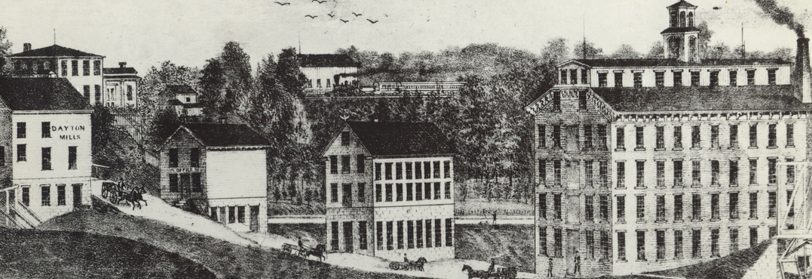
The next thing in order when we finally got comfortably settled was rail splitting for the farm, and everything that could be done in the way of building a mill dam and mills (having brought irons along) was done, and as early in the spring as it was practicable, work commenced to erect first a sawmill, with the intention of putting on one end of the mill a pair of stones, to be made from two large boulders just across the river from the mill. A man by the name of Paine, brother of the Rev. Paine whose head was erected on a pole near Marseilles during the Black Hawk war, got the boulders in shape by firing and pounding, being almost as long as the rest were in building the mill. He was an eccentric genius, and used to claim that there were three brothers, all preachers; two were preachers of Christ and salvation, and he was a preacher of hell and damnation.
By the 4th of July saw and grist mills were both running and ground our 4th of July dinner from wheat grown on the forty acres, but not bolted.
We had been living principally on hog, hominy and potatoes, and as a dessert pound cake occasionally, as someone felt in the pounding mood. We thought Graham flour a decided improvement.
I would like to tell the boys what I did in helping along this first enterprise in mill building in the northern part of Illinois. Myself and brother David (now deceased), he being ten years old and I twelve, we scraped out the race from Dam to mill, about half a mile. Each had a yoke of oxen and old style scraper, and by the time mill and dam were completed we had finished our job. Where are there two boys today of the same ages that would undertake such a job?
I do not wish to be understood that ours was the first mill in this part of the country, but was the first to be propelled by water power. There was a kind of an ox mill at Mission Point, where the Rev. Jesse Walker had a mission to teach the young Indian’s ideas how to shoot, but this mill was but little better than a coffee mill.
Myself and uncle Samuel Grove, took a small grist up there and ground part of it, and as soon in the spring as we could cross the river here just above the mouth of the Fox, we started, that is myself and uncle Joseph Grove for another similar mill on Covel Creek with about the same result. We were ferried across the river by two of uncle David Walker’s daughters, later Mrs. Cloud and Mrs. Hickling.
There are a number of other thrilling incidents that I would like to give but time and your patience forbid. Jesse Green1
- Free Trader, September 1, 1894, p. 4, cols. 5-6

