What That 1871 Lawsuit Was Really About
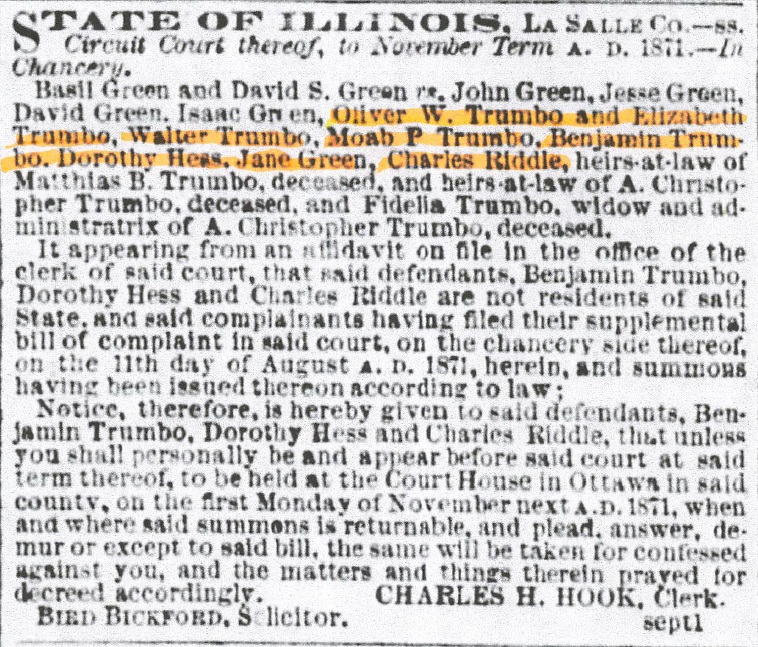
Every so often, a document turns up that looks dramatic — a chancery suit, a long list of heirs, a mill, a tangle of Greens and Trumbos — and you think, “Well, this must have been something.” And then you read forty‑odd related filings and discover that the drama is mostly in the paperwork.
The 1871 Trumbo–Green lawsuit is one of those.
Here’s the short version, now that I’ve dug through the whole stack:
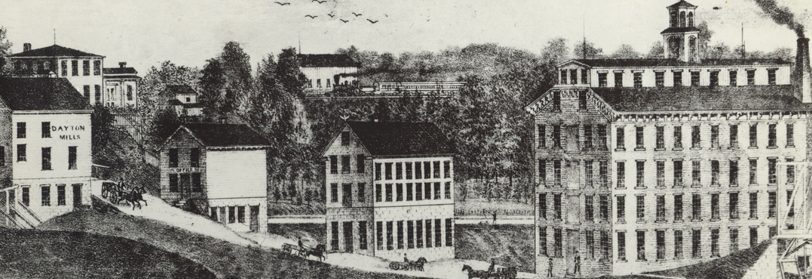
Two Trumbo brothers died. They owned pieces of the woolen mill, pieces of land, and pieces of various business ventures. Their heirs were scattered across several states, and some of them probably didn’t know they were heirs at all. Meanwhile, the Greens — who were involved with the mill in every possible capacity except perhaps weaving — had money tied up in it too.
Nothing could be settled by handshake. Not with that many heirs, that many interests, and that much property frozen in place.
So someone had to go to court and ask the judge to sort it out.
And that someone was Basil Green.
By this point in my reading, Basil has emerged as the family’s unofficial legal‑financial handyman. He’d already managed his children’s inherited land (which turned out to include coal rights, pasture rents, and a railroad right‑of‑way), negotiated leases, held mortgages, and generally kept track of who owed what to whom. He was a justice of the peace, a county court clerk, and apparently the man everyone called when a situation needed both a steady hand and a working knowledge of how to file things.
So Basil filed the suit — not because he was feuding with anyone, but because the mill and the land couldn’t be divided or sold until the court untangled the ownership. Chancery was simply the tool available for a complicated, multi‑party estate problem.
And that’s it. Forty‑four documents later, the story is not scandal but structure: a mill, two estates, a web of heirs, and Basil doing what Basil always seems to do — stepping in when the paperwork gets complicated.
Once you see the whole picture, the lawsuit stops looking like a mystery and starts looking like housekeeping. Necessary, tedious, and probably accompanied by a great deal of sighing.1
- Ottawa Free Trader, September 16, 1871, p. 7, col. 3.

