Dayton Residents in 1911

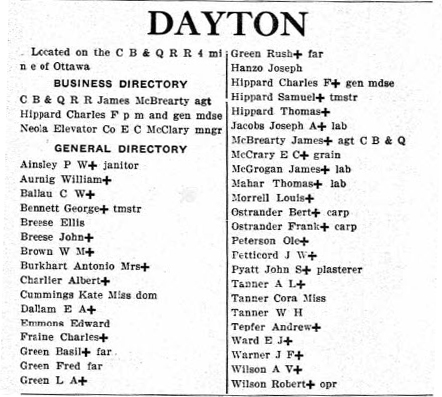
from the 1911 La Salle County directory, p. 55

DAYTON
Located on the C B & Q Railroad 4 miles north east of Ottawa

BUSINESS DIRECTORY
C B & Q Railroad James McBrearty agent
Hippard Charles F postmaster and general merchandise
Neola Elevator Company E C McClary manager

GENERAL DIRECTORY
* indicates head of family

*Ainsley P W janitor
*Aurnig William
*Ballau C W
*Bennett George teamster
Breese Ellis
*Breese John
*Brown W M
*Burkhart Antonio Mrs
*Charlier Albert
Cummings Kate Miss domestic
*Dallam E A
Emmons Edward
*Fraine Charles
*Green Basil farmer
Green Fred farmer
*Green L A
*Green Rush farmer
Hanzo Joseph
*Hippard Charles F general merchandise
*Hippard Samuel teamster
*Hippard Thomas
*Jacobs Joseph A laborer
*McBrearty James agent C B & Q
*McCrary E C grain
*McGrogan James laborer
*Mahar Thomas laborer
*Morrell Louis
*Ostrander Bert carpenter
*Ostrander Frank carpenter
*Peterson Ole
*Petticord J W
*Pyatt John S plasterer
*Tanner A L
Tanner Cora Miss
Tanner W H
*Tepfer Andrew
*Ward E J
*Warner J F
*Wilson A V
*Wilson Robert operator

144 Years Ago Today in The Free Trader


from The Ottawa Free Trader, April 12, 1879, P. 8, col. 1

Dayton, April 10. – The concert given by Prof. Newberry and class last Wednesday evening, was quite well attended notwithstanding the inclemency of the weather. Solos, duets, quartets and choruses were given in most acceptable manner. The “Hunter’s Chorus” and the “Bugle Horn” choruses by the class were quite good. In fact in all the choruses there was plain evidence of careful and efficient drill although only a few days were employed in preparation. Mrs. Newberry, who has been holding a convention at Serena, came down and took part in the concert. Her alto is very fine. The class may well be proud of their first concert.

The Musical Union will hold regular meetings every Wednesday evening. In our report last week of the officers of the Union, we omitted to give the name of Miss Jennie Dunavan, organist.

Mr. O. Black of Ottawa visited our Sunday School last Sabbath.

Last Saturday we were shown a large swan shot by Mr. Jos. Green near Sulphur Spring. It measured 6 ½ feet from tip to tip of the wings; 4 feet from head to tail; 2 ¼ feet length of neck. Joe will have the bird stuffed and mounted and placed on exhibition as the “luck” of his latest hunting expedition.

At the school election held at the school house last Saturday, T. A. Metcalf was chosen director for the short term, and Jesse Green for the long term.

Last Monday evening a school exhibition was held at the Buck Creek school house by Miss Eva Angevine. Miss A. had spent considerable time in making arrangements and deserved a complete success, which we have no doubt she had.

A few game fish are being caught, but not enough to call it “good” fishing yet.

Maud V. Green, Without Whom This Web Site Would Not Exist

This is my great-aunt, Maud Virginia Green. She was born in Dayton September 4, 1866, the daughter of Isaac and Mary Jane (Trumbo) Green. She went to the Dayton school, where she earned high marks in grammar and history. As you can see, she was never absent or tardy, but her deportment evidently needed improving. Ada Green, her teacher, was her first cousin.

She lived at home with her grandparents, John and Barbara Green, her parents, Isaac and Jennie (Mary Jane was called Jennie) and her younger brothers and sisters, Lyle, Ralph, Grace, and Barbara.

As the youngest son, Isaac remained at home, working the family farm with his father. Isaac married Jennie September 6, 1865 and Maud was born a year later.  She was eight when her grandfather died and 19 when her grandmother died. She heard many stories of the early days of Dayton’s settlement from her grandmother.  I have a handwritten sheet on which she wrote down Barbara’s recollections of the Black Hawk war. Maud was interested in Dayton’s history from an early age, as so much of it was the history of her own family. It is because she collected so much information on Dayton’s early days that this web site exists. She was also related to most of the families in Dayton and Rutland. I can remember drawing family charts for her on the back of rolls of wallpaper. She passed her interest and information on early Dayton to other family members and years later i was able to draw on all this collected information.

In 1904 her father died and her brother, Lyle, took over the farm. Maud remained at home, keeping house for her mother and brother. When Lyle married in 1908, Maud and her mother moved to Ottawa. After her mother’s death, Maud returned to Dayton to keep house for her brother. After Lyle’s death, Ralph and his family moved to the family home and Maud continued to live there until her death in 1952.

So I knew her for the first thirteen years of my life, saw her nearly every day, and have many memories of her. That’s why this web site exists.

Kirby Todd and Folk Valley

In 1947 Kirby Todd became the music teacher for the rural schools of La Salle County. I was attending the Dayton school when he first took up his post, succeeding Miss Ida Chamberlain. He taught us folk songs and square dancing and was immediately very popular.

He was the founding president of Folk Valley, a non-profit corporation dedicated to the preservation of the art of square dancing and other folk arts. Folk Valley was situated on land near the Illinois river east of Marseilles. The idea of Folk Valley came to him when he was teaching the school children in Grand Ridge. The principal and several adults asked him to teach adult square dancing. He began teaching square dance classes every fall and winter.

He was an assistant professor of health and physical education at Illinois State University from 1964 to 1972 and served as sponsor and director of two groups that provided recreational activities for students –  Shufflin’ Shoes and the Lloyd Shaw Dancers. He retired in 1989 and died September 21, 1998, at the age of 88.

Wedding Gifts – 1881 Variety


When Ada Green married William McMillen in Dayton on March 10, 1881, the Free Trader’s account of the ceremony included something that was common for that day, but unusual today. In addition to a description of the ceremony, the remarks made by the pastor, and the wedding dinner, the next paragraph gave a list of the wedding gifts and their donors.


Here are some examples of the types of wedding gifts of the time:

a sugar spoon


a cake basket


engravings

The First Step

Family Cares


a salt and pepper castor


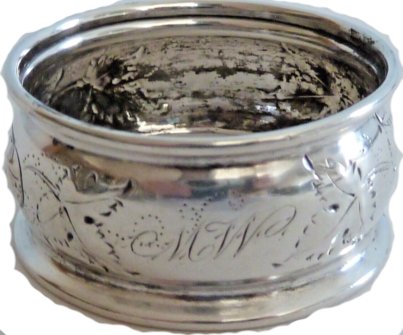
napkin rings


a pickle castor


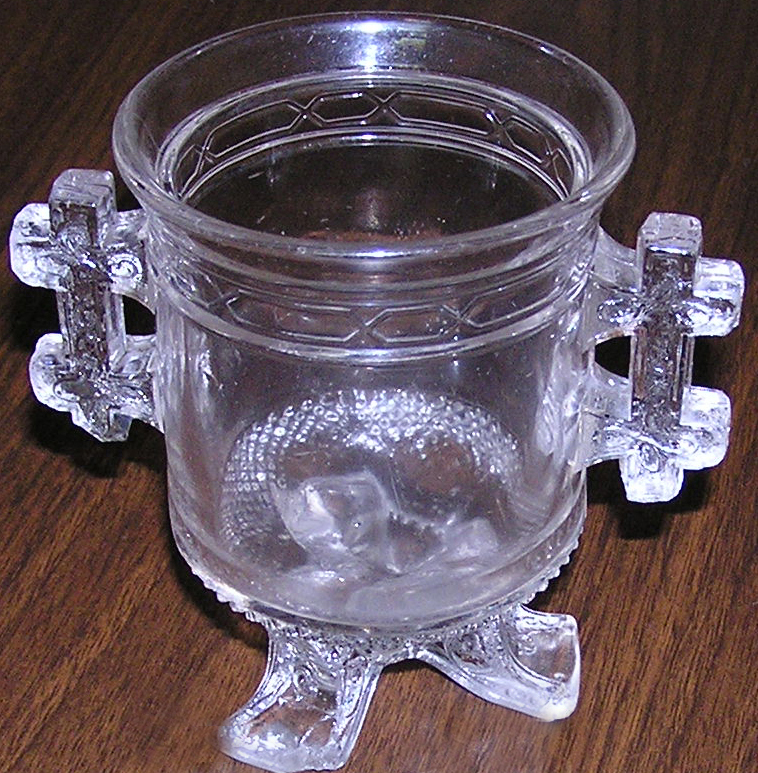
a spoon holder


glassware


This was very definitely a family wedding – of all the donors listed only a half-dozen are not members of the Green family.


144 Years Ago This Week in Dayton Social Life

Rural Happenings

            Dayton, March 13. – We derive considerable enjoyment here from reading the correspondence from neighboring towns, and have always thought it an interesting part of the county newspaper; and such items as may in our humble judgment be of interest to your readers, we will try to send from here from time to time.

The ice has moved out of the river. Boating will soon be all the “rage.” The river is slowly falling and will soon be fordable. This beautiful spring weather seems such a relief from the cold, cold winter. Roads are getting quite dry.

The Literary is in good running order and having good success. The exercises show care in their preparation and talent in their delivery. The library of the society, containing over a hundred volumes of choice reading, is a great benefit to the town. Much interest is taken in it and beneficial results we have no doubt will proceed from its use.

Harry, Jos., and James Green arrived home on the 1st from Aurora, where they have been attending school during the winter. The boys look fine. “Hash” seems to agree with them.

Rev. Sophie Gibb preaches in this place every two weeks. Her next appointment is Sunday evening, March 16.

Rev. G. Barnes, Congregational minister at Ottawa, delivered a discourse here last Thursday evening. He has a regular appointment once in four weeks.

Our school ma’am, Miss Frank Mott, will give an exhibition Saturday evening, March 22. Miss M. we understand, closes her labors here with the winter term. She has taught our school quite successfully during her sojourn here of about three years, and now feels she needs a rest from her labors. Mr. Chas. K. Howard will teach the summer school.

A number of our young folks visited your city Tuesday evening to witness the performance of “Fanchon.” They all seemed well pleased, and especially spoke highly of Miss Kate Smith’s acting.

The social party at the hall week before last was quite an enjoyable affair. The young folks seem to have gone with the intention of having a good time, and we think they were not disappointed. Another in the near future is talked of. Prof. Sweet, who furnishes the music, says he is the happiest man in Plano. (N. B. It’s a boy.)

The Literary at their last meeting appointed a committee to make arrangements for an entertainment the proceeds of which will be devoted to the purchase of an organ. The temperance and moral drama “Three Glasses a Day, or The Broken Home,” is in rehearsal.

Mr. Basil Green has the contract of filling in the deep ravine south of town.

By the great firing of guns and general confusion taking place at the time of writing, we should judge a battle was taking place at Wedron. A “chivaree,” we suppose.

“Fishing” days are not far off.                                                Oc.1


  1. The Ottawa Free Trader, March 15, 1879, p. 8, col. 2

Settling the Prairies

Township 34 North Range 4 East of the 3rd Principal Meridian

The map above is the original survey of the area around Dayton (starred) and indicates by the green lines the extent of the timber in the area. In his memoir, Jesse Green wrote of the impact of the open prairies on settlers from the east: –

The first settlers all came from heavily timbered country and as a consequence did not think it possible that those broad prairies would be settled in their day but expected to have unlimited range for all the stock they might desire to keep. The first settlers secured as much of the best timber as they possibly could, through pre-emptions and floats (as they were called) which were subject to transfer and sale by their holders. In the course of time they expected to have neighbors skirting the timber belts of the country but did not have the remotest idea the prairies would be occupied, however, it was not long until coal was discovered and thought to be almost inexhaustable. Lumber began to be brought across the lakes, and the problem of the feasibility of settling up the prairies was solved, and only a few years later the prairies in this section were nearly bought up, largely by eastern land speculators which retarded the settlement of the country considerably for a number of years, driving immigrants still farther west,

Who is on the Honor Roll?

Honor roll of the pupils of districts 2 and 10, Dayton township, for the term commencing May 3d, 1880, and ending July 1st, 1880. The pupils were graded on a scale of 10 in their studies and deportment, a deduction being made for each case of tardiness and absence. There were 13 pupils enrolled. The following named pupils attained an average grade of 8: Mabel Trumbo, Bertha D. Angevine, Clara S. Angevine, Lester Brown and Mamie Debolt.
E. M. Angevine, Teacher1

Mabel Trumbo, born 1866, was the daughter of Moab Perry and Rebecca (Kagy) (Walters) Trumbo.

The Angevine sisters, Clara, born 1864, and Bertha, born 1867, were the daughters of Charles Edward and Cornelia (Davenport) Angevine. The teacher was their sister, Eva.

Lester Brown, born 1871, was the son of William M. and Kate (Hess) Brown.

Mamie DeBolt, born 1868, was the daughter of George W. and Mary (Sutton) DeBolt


  1. The Ottawa Free Trader, July 24, 1880, p. 1, col. 4

My Name Is Not Judith

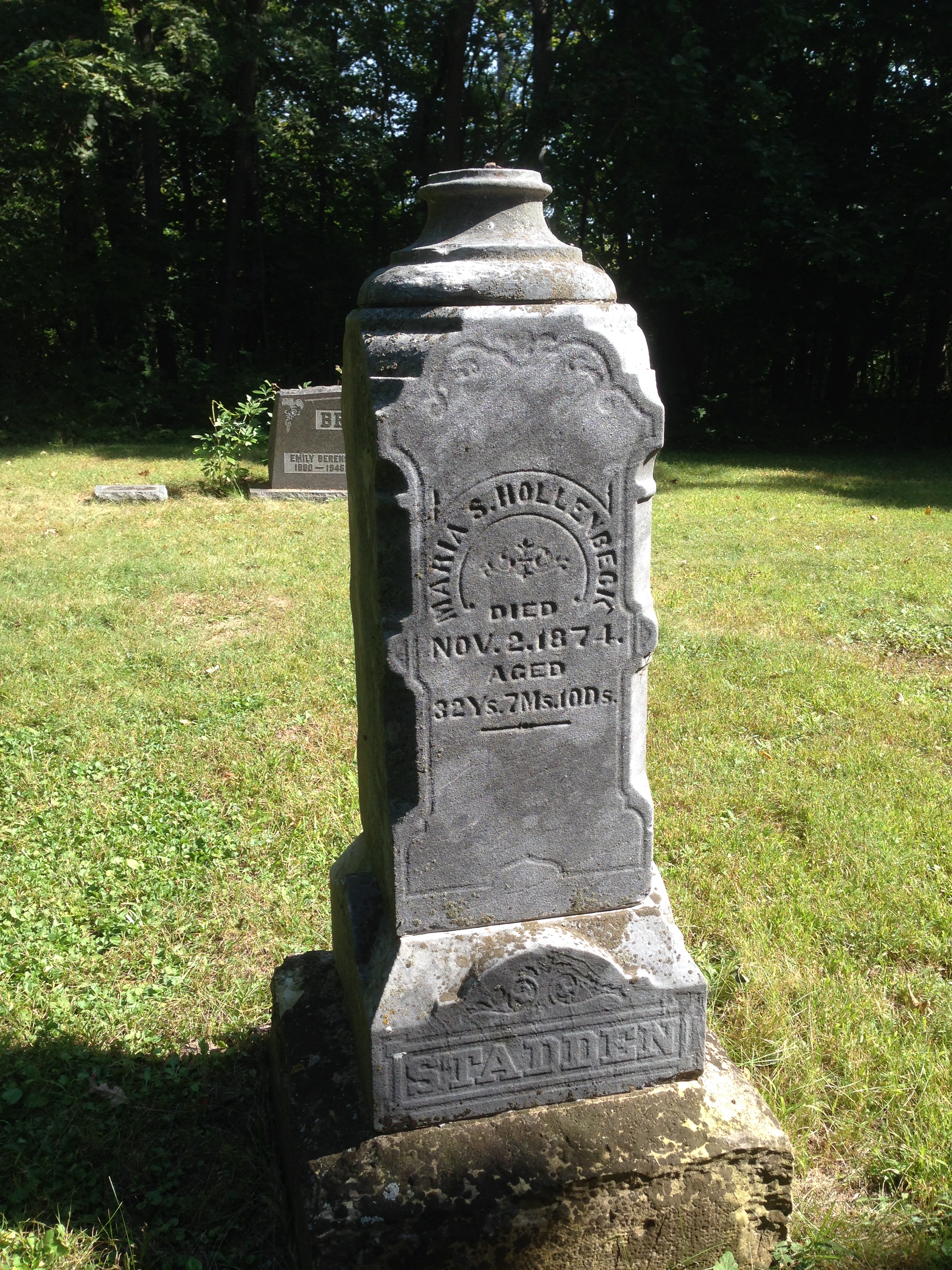
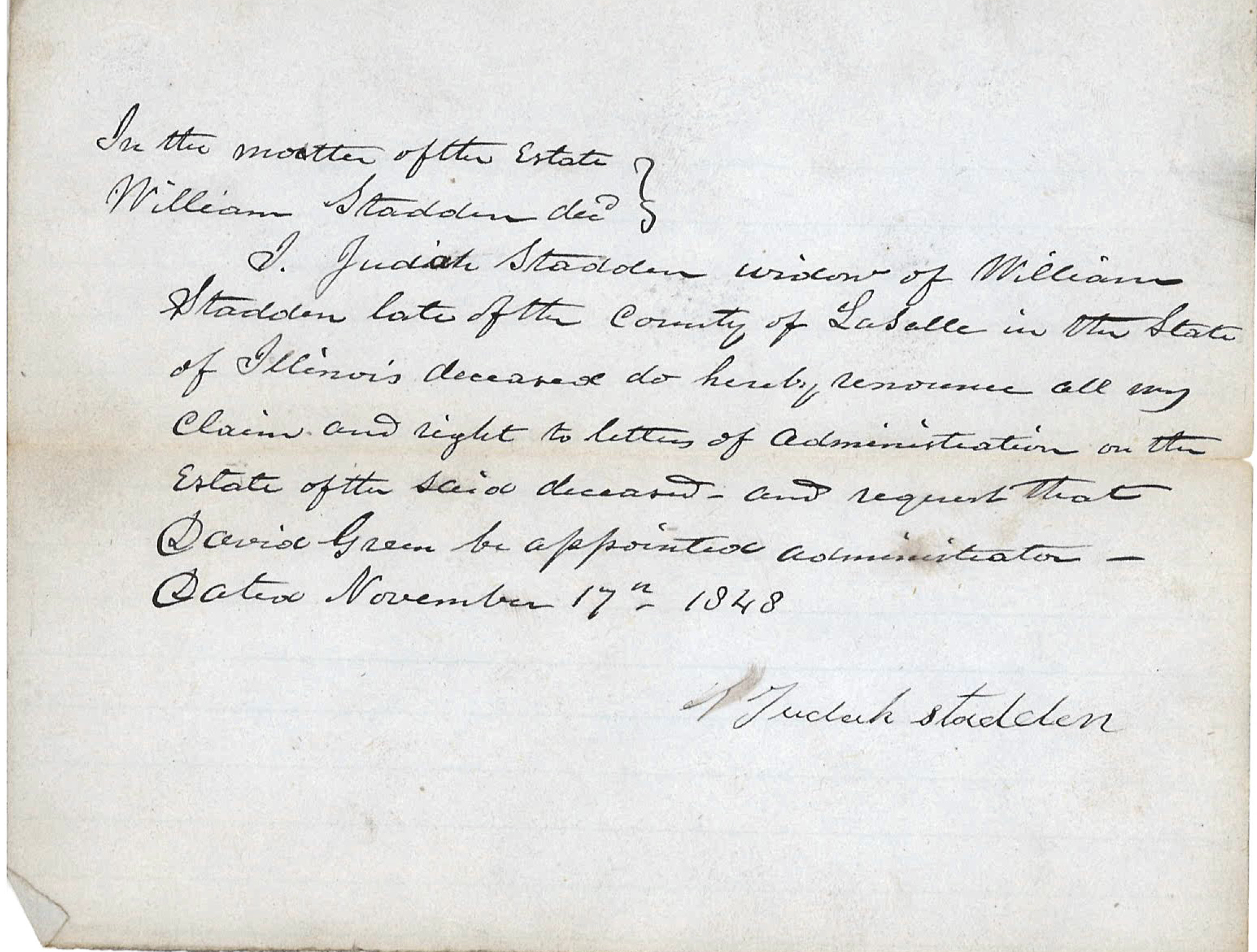
If you search for Judah Daniels, who married William Stadden in Ohio on January 25, 1827, you will find over one hundred trees on Ancestry. I didn’t look at every one, but it appears that about half have recorded her first name as “Judith”, as opposed to the half who call her “Judah”. As there seems to be some doubt as to the spelling, let’s ask the lady herself.

The document shown above is from the probate file of her husband, William Stadden. The document was written by someone other than Judah herself, as shown by the difference in handwriting. Her name was initially written as “Judith” (even the people who knew her got it wrong a lot) but she obviously insisted that it be corrected and she then clearly signed her name, “Judah”.

Deaths Recorded in the Isaac Green Bible

Frank B. Green died
in Central City Colorado
January 7th 1881 aged
13 years 4 months and 1 day

Mother
Elizabeth Green died
in Denver Colorado at
Sister Rachels, August
30th 1892 at 12:30 A. M.
aged 89 years, 1 month,
and 10 days

Father
Isaac Green died
Aug. 4th 1850 in
Georgetown California
aged 46 y. 6 m. 25 days

Father
George M. Dunnavan
died Oct. 2d 1894 in
Chicago Illinois, aged
79 yrs. 6 m. 23 days

Mother, Catherine Green
Dunnavan, died
in Chicago, Illinois
May 27 A D 1899
aged 77 years, 2 months
and 19 days
gr grand daughter of Ben. Green

Mama
Louisa Jane Green wife
of David S. Green, Died
May 28 A. D. 1906 aged
64 years 6 months and
9 days, in Denver
City, Colorado
b Nov. 19, 1841, LaSalle Co, Illinois
She was a gr. granddaughter of Benj. Green

David Samuel Green
died in Denver Colo
Aug 26 1912, aged
73 yrs 8 months 3 days

See the previous posts listing the births and marriages pages from this bible.

The births and marriages from the Isaac Green Bible are also available.

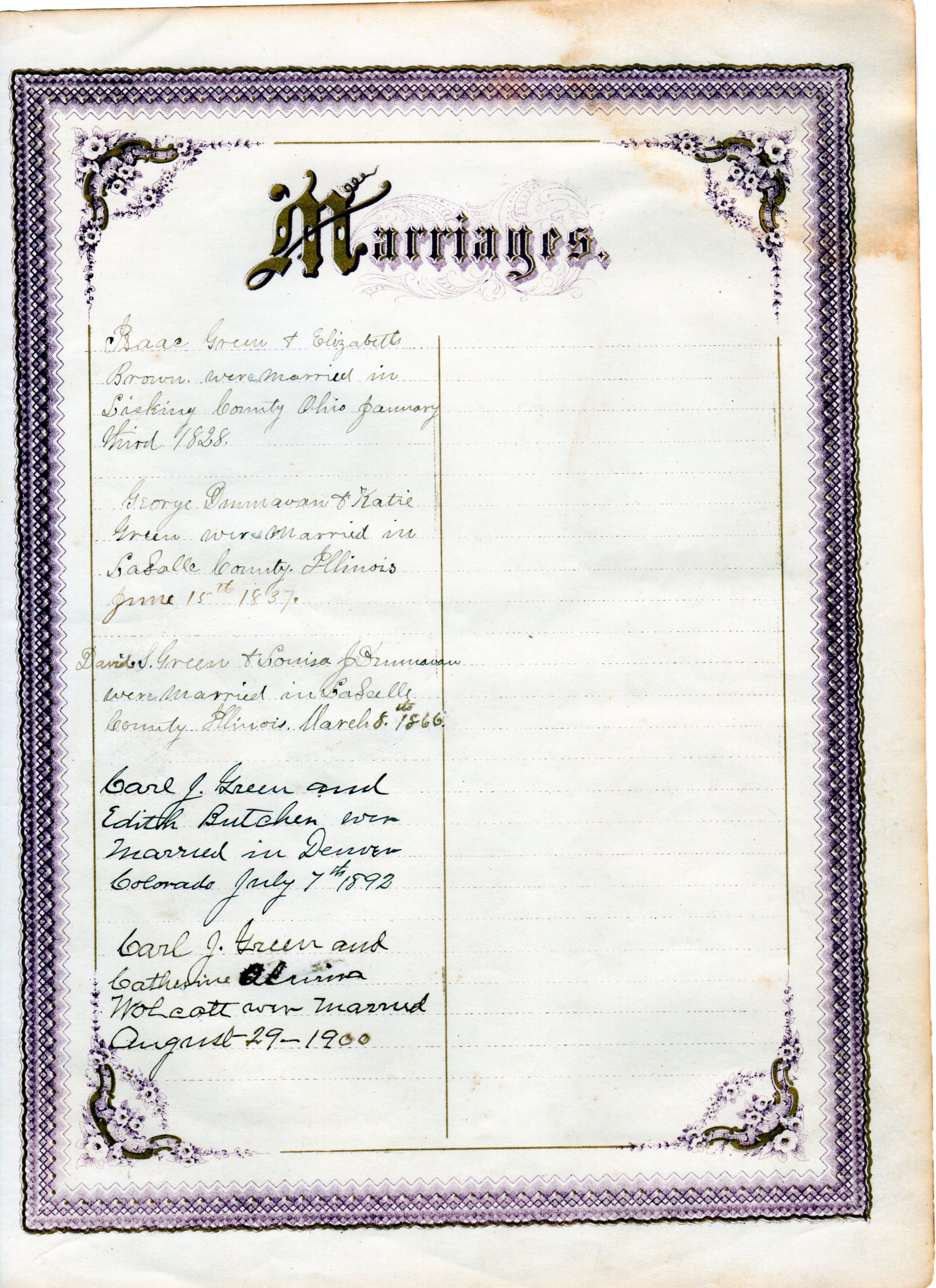
Marriages Recorded in the Isaac Green Bible

Isaac Green & Elizabeth
Brown were married in
Licking County Ohio January
Third 1828.

George Dunnavan & Katie
Green were married in
LaSalle County, Illinois
June 15th 1837.

David S. Green & Louisa J. Dunnavan
were married in LaSalle
County Illinois March 8th, 1866.

Carl J. Green and
Edith Butcher wer
married in Denver
Colorado July 7th 1892

Carl J. Green and
Catherine Almira
Wolcott wer married
August 29 – 1900

David S. Green is the son of Isaac and Elizabeth (Brown) Green’

Louisa J. Dunnavan is the daughter of George andKatie (Green) Dunnavan

Carl J. Green is the son of David and Louisa (Dunnavan) Green

The births and deaths from the Isaac Green bible are also available.

Births Recorded in the Isaac Green Bible

Isaac Green was born
in Licking County Ohio
January 10th 1804

Elizabeth Brown was born
in Matison County Kentucky
July 20th 1803

George M. Dunnavan was
born in Licking County Ohio
March 9th 1815

Catherine Green was born
in Licking County Ohio
March 8th 1822.

David S. Green was born
in Licking County Ohio
November 23d 1838.

Louisa J. Dunnavan was
born in LaSalle County Illinois
November 19th 1841.

Frank B. Son of
D. S. & L. J. Green, was born
Sept. 6th 1867, in Denver
City Colorado Territory

Arthur S. Son of D. S.
and L. J. Green was born
January 3d A.D. 1870 in
Terre Haute Indiana.

Carl J. Green Son
of D. S. and L. J. Green
was born May 7th
A. D. 1872 in Green
City Colorado Territory

Walter Lee Son of D. S. and
L. J. Green was born January
28th A. D. 1875 in Nevada,
Colorado Territory.

David and Louisa were first cousins once removed, as her grandfather, John Green, and his father, Isaac Green, were brothers, sons of Benjamin Green.

The marriages and deaths from the Isaac Green Bible are also available.

News From Dayton – January 1901


Image by igrishkoff from Pixabay

Dayton

An average of 15 loads of tile have been hauled from the tile mill every day for the past ten days for Wallace and Rutland.

Effie and Willie Timmons, who have been down with the grippe, are now able to be about again.

Otis Hager and John Bogerd, have finished shelling their corn.

Mrs. E. Luce and Mrs. Leroy Luce, have recovered from their attack of the grippe.

John Carpenter, Jr., has been home the past few days, laid up with a severe sore throat.

Some of the State Fish Commissioners have made several trips here of late, and it is surmised that the holes in the ice used for spearing fish will soon be allowed to freeze up again.

Roy Luce was on the street Monday morning, doubled up like a jack knife. Cause, the grippe.

The tile mill is busy shipping fire clay this week.

Thomas McGrogan has been very poorly of late, and has not as yet recovered from his recent illness.

On Monday last Emory Waller moved his furniture to Rutland, where he and his family intend making their future home.

The graveling on the plank road is finished for the present.

Lucile Maud, only child of Mr. and Mrs. John Bogerd, aged 1 year and 4 days, died on Monday morning, at 5 o’clock, of pneumonia. Funeral will be held at 1 o’clock on Wednesday afternoon. Interment in Ottawa avenue cemetery.

It was the intention of Mr. Sanderson to commence filling his ice house here on Wednesday morning. The outlook for doing so is not very favorable at present.

A. W. Ladd has been summoned as a grand juryman, and will commence his duties as such on next Monday, Jan. 14th.

Owing to the unfavorable weather for the past few days, every one you meet seems to be ailing from a cold or some other trouble, and “how are you feeling today” is about all you hear at greeting one another.

Dockey Tanner, the last one in our burg whom you would suppose could get sick, is suffering with a severe cold.

A. W. Shaw has trouble enough of his own just at present. A lame back.

Miss Mary Campbell, of Dayton, and Dr. F. Gustlow, of Prophetstown, Ill., were married on Wednesday afternoon at the residence of the bride’s brother, P. M. Campbell, Rev. David Gustlow, father of the groom, officiating.

The ice in the Fox river, at this point, will soon travel south if the weather continues as it has for the past few days.

Lyle A. Green is spending to-day (Wednesday) at Aurora.1


  1. The Ottawa Republican-Times, January 10, 1901, p. 4, col. 4

A Double Wedding

Andrew Jackson Brown

Hannah Loretta Brown


Andrew Jackson and Hannah Loretta were the children of Sylvester Brown and Catherine Altenburg. They grew up on a farm in Dayton township. Andrew was one of the thousands of young men who were drawn to California by the lure of gold. While there he became friends with a young man about his age named William Martin.

The two spent several years in panning for gold, but after several years of roughing it, they decided they had enough gold and would like to go home. There was no way of transporting their gold in those days except carrying it on their persons, so they had money belts made, with pockets for the gold dust and nuggets. They each carried what was then considered a small fortune with them.

Andrew pursuaded his friend to come home with him to Illinois and there William met Andrew’s sister, Loretta. The two young men made quite a splash with their money and Andrew was as interested in Emma Dunavan as William was in Loretta. They married in a double wedding ceremony on March 2, 1865, and all went to Niagara Falls for their honeymoon.

Highly Recommended

blanket from the Dayton woolen factory

This blanket may be more elaborate than the ones described in this clipping, but it comes from the same woolen factory in Dayton.

DAYTON GOODS. – We have now in daily use, and have had so for twenty-five years, several pairs of blankets made by the Greens at Dayton, and they are apparently good for a dozen years more. This accords with a recent incident at the mill. An old friend of the Greens ordered six pairs of blankets, saying that the four pairs he had bought thirty years ago began to show wear, and as the present would probably last him the rest of his days, he took enough to go ‘round. We have never seen “store” blankets that equaled those made by Jesse Green & Sons at Dayton, in point of either finish or durability, at so low a price.1


  1. The Free Trader, 22 Sep 1877, p1, col 2

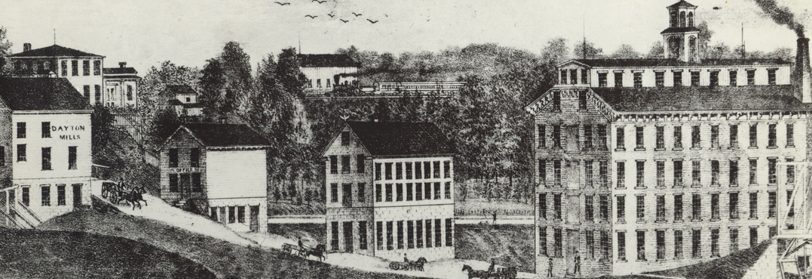
Dayton on the Fox

The following unidentified clipping comes from a family scrapbook.

DAYTON ON THE FOX
Mrs. John W. Fogle
Grand Ridge, Ill., R. F. D. 1

They will build a dam at Dayton,
At Dayton on the Fox,
Where the water twists and tumbles
As it flows between the rocks.

They will undertake this enterprise
If they can overcome their fears,
And bring new life to this village
Which has been asleep for years.

‘Twas a town of thrift and action
As it nestled between the hills,
For the water furnished power
For the flour and woolen mills.

‘Twas a thriving little village
As I look back o’er the years,
And the breaking up of home ties
Caused many bitter tears.

There’s a quiet little graveyard
Along the river’s brink,
Where the leaves in golden autumn
Are all colors you can think.

Where the squirrels frisk and chatter
As they hunt their winter’s store,
From trees that shade the silent homes
Of our loved ones gone before.

Broad and fertile farm lands
Surround this little place,
Where years ago the timberlands
Furnished ground for hunters’ chase.

‘Twas the stopping place of Shabbona,
And many Indian braves
Who gave their time to hunt and fish,
And the fun their spirit craves.

And now it comes to life again,
In this age of power and gold,
When even running waters
Are being bought and sold.

They will build this dam at Dayton
For the wealth of coming trade,
And harness up the waters,
Changing scenes that nature made.

When we visit scenes of childhood
In the sunset of our years,
We will praise the work of science
With everlasting cheers.

How we wish the running waters
Could talk as they go by,
They would preach a lasting sermon
Of our blessings from on high.

As the waves go splashing by you,
Listen now – they seem to say,
“Dayton takes her place in history
In the grand old U. S. A.”

Why do I love this river
As it zigzags ‘round the rocks?
Why, I was born at Dayton,
At Dayton on the Fox.

Mrs. John W. Fogle was Mary Bunna Rhoads, daughter of Thomas and Katherine Rhoads. She was born February 17, 1864 in Dayton. She married John W. Fogel August 22, 1888 in La Salle county, Illinois, and lived in Grand Ridge. She died April 11, 1926, in Ottawa.


Holiday Memories – Christmas 1953

The following column is reprinted from volume 3 of the 1953-54 publication, Our School News, produced by the students of the Dayton School.

Holiday Memories

Mrs. Genevieve Hall of Ottawa called at the John Jackson home on Christmas eve.

Mr. and Mrs. Thomas Hiland, Terry, Janelle and Laurel visited Mr. and Mrs. Vernon Hiland and family of Moline.

Mr. and Mrs. Charles Clifford, Candace, Sally and Mrs. Ralph Green spent New Year’s Day with Mr. and Mrs. Eichelberger of LaGrange.

On Christmas Day, the Clifford family called on Mr. Clifford’s mother. Mr. and Mrs. Sears, their children, Mr. and Mrs. Roberts and their two girls also were there.

On Christmas Day Mr. and Mrs. Floyd McMichel, Mrs. Mossbarger and Bobby called at the home of George McMichel of Wedron.

Mr. and Mrs. Cruit and their children, Mr. and Mrs. Lloyd Ray and their three children, Mr. and Mrs. Cecil Barr and child came to spend a day at the home of Oran Mathias in honor of Mrs. Mathias’s birthday.

On New Year’s Day, Mr. and Mrs. Wayne Thompson and their three children came from Florida and spent the day at the Chester Thompson home.

Mr. and Mrs. Bernard Hackler, Bryan and Gary were vacation guests of Mr. and Mrs. Howell of LaGrange.

Holiday visitors at the Mathias home included Mr. and Mrs. Cecil Barr of Decatur, Mr. and Mrs. Lloyd Ray of Bethany, Mr. and Mrs. Wayne Cruit and Mr. and Mrs. Henry Heiland of Findlay, Ilinois.

Mr. and Mrs. Charles Poole, Robert, David, Nancy and Patty spent Christmas Day with Mr. and Mrs. George Poole.

Mrs. Oran Mathias, Jimmy, Linda, and Gary spent Christmas in the home of Mr. and Mrs. Chester Mathias in Shelby County. They also visited Mr. and Mrs. Ray of Bethany.

Mr. and Mrs. Jesse Leonard spent Christmas Day with the Don Leonard Family.

Mr. and Mrs. Jason Hughes spent New Year’s in Pontiac at the Ramsey home.

Dixie Slover spent Christmas in Chicago with her father. She had an enjoyable time shopping, going to the big stores and visiting relatives. Mr. Slover brought her home New Year’s.

Mrs. Kossow’s parents from Peru were New Year’s guests at the Kossow home.

Marty reports a vacation in Florida during the holidays where he went swimming, sight seeing and fishing. To go fishing Marty and his Dad went out in a boat.

The George Pinske family visited relatives in Freedom township during the holidays.

Mr. and Mrs. Joe Frig, Lounetta, Clarence and Mary Jo spent Christmas at the home of their grandmother, Mrs. McConnahay in Ottawa. Lounetta enjoys using her flash bulb camera which she received as a gift.

The traditional gathering at the home of Fred Eichelkraut in Ottawa was attended by the Robert Ohme family, it is held on Christmas eve.
Robert and Charles are busy with the gas model airplanes which they received at Christmas.

Carol Dezso accompanied her parents, Mr. and Mrs. Frank VanDorn, and brother, Jimmie, to South Bend, Indiana, during the holidays where they visited friends and relatives.

Sally Ann Peters enjoyed riding her mule during the holidays. Her grandmother, Mrs. Pearl Peters entertained relatives at Christmas time.

Mr. and Mrs. Leslie Carrier, Jack Traeger of Chicago were holiday visitors at the home of Mr. and Mrs. A. Walleck.
During the holidays, Bob skated to Wedron.

Mr. and Mrs. Harold Fosse entertained the Melvin Holm family on Christmas Day. On December 27, Mr. and Mrs. Melvin Holm and family attended the Fosse family reunion held at the Masonic Temple in Ottawa.

Larry Mettille is the possessor of a new gun and enjoyed hunting during the holidays. The Jess Mettile family visited Mr. and Mrs. L. Halterman of Ottawa on Christmas Day. An interesting specimen, that of a heart, was viewed by Larry Mettile while at this aunt’s home,

Dick Jackson visited friends at Earlville at Christmas time, later during the vacation he entertained these Earlville friends at his home. Dick has a new electric train which he enjoys greatly.

On Christmas eve, a gift exchange was held at the home of Mr. and Mrs. Theodore Wilson. Guests present included Mr. and Mrs. Eugene Davis and son of Maywood and Mr. and Mrs. Lum McKinney.

Kenneth Newtson received a 16 gauge shotgun for Christmas. He skated to Wedron during the vacation period. Guests at the Newtson home for Christmas included Mr. and Mrs. LaVerne Jamieson and daughters, and Fred Newtson.

Larry Polen tried out his new skates during the holidays.

Eddy Peters visited relatives in Marseilles during the holidays. Eddy enjoyed decorating, then later taking the tree down.

Mrs. Eva Charlier, Miss Emma Fraine, Mrs. Mathias and Linda were guests at the home of Mrs. J. Trent during the holidays.

The Great Flood of 1855

The Fox River has seen ice jams many times over the years.

The last of January, 1855, witnessed a great storm and flood, extending over several States and doing vast damage everywhere, this county not excepted. At Ottawa the principal loss was the destruction of the Illinois River bridge, then but about two years old. Up to the evening of Saturday, Jan. 31, and as long as the ice from the Illinois River came square upon the piers, they bore the pressure without sign of giving way; but on that evening, when the ice came out of Fox River, borne on a drifting current of six or seven miles an hour, and striking the piers from a quartering direction, they could resist the shock no longer, and before midnight an ominous crashing heard in that direction above the roar of the ice showed that the noble bridge had shared the fate of so many others and gone down before the flood.

Daylight on Sunday morning revealed the extent of the ruin. The trestle-work and the second pier from the north shore had entirely disappeared, taking down with them the entire bridge to the third pier, leaving the two south spans still resting on the piers so shattered as to be barely able to carry their weight. The woodwork of the bridge lodged on an island near Utica, and a portion of it was recovered.

The cost, however, of repairing the damage exceeded half the original coat of the bridge. At the time of this disaster the water rose a foot above the highest point touched since the county was settled, the point mentioned being reached in 1849.

Some damage was done to the Fox River bridge. Considerable property was injured and carried off from the low ground on the east side of Fox River. Messrs. Fredenburgh, Smeaton and Van Gaebeck, living next to the bridge, were obliged to emigrate, and lost in fences, hay, wagons, etc., seriously. Persons living on the south side of Main street, east of Fox River, who had their stables on low ground, all lost something. Below the hydraulic basin, south of the main part of the city, some damage was done. On the low ground in Ottawa Center about a dozen houses, generally small and occupied by poor people, were submerged to the roof and the contents ruined where not carried off.

The chief disaster at Dayton was the destruction of the fine bridge erected by the people four or five years before at an expense of some $4,000, It was taken off bodily, leaving nothing but the naked abutment The feeder was so injured that mills could not run for a month or so. Some sixty or seventy rods of the bank were swept away and the lock was seriously damaged.

At Peru and La Salle the damage was pretty heavy. At the latter place all the lower stories of the buildings on the canal basin were submerged, and much fear was entertained with reference to the fleet of loaded canal boats in the basin, but they appear not to have suffered much. At Peru the fine stone freight house of the Rock Island Railroad had its whole east side knocked out Several loaded canal-boats were sunk, and some warehouses and other buildings damaged in various ways.1


  1. History of La Salle County, Illinois, 2 vols. (Chicago: Inter-State Publishing Co., 1886), 1, 451-452.

Saved From Amputation

Having a good doctor in the early days was essential, as this excerpt from Jesse Green’s memoir shows:

Our first physician in Dayton, was a German, whose name I have forgotten, next was Allen H. Howland, Harmon Hurlbut and Peter Schemerhorn, Dr. Howland was also an excellent surgeon whom father employed, when he had his arm smashed from the hand to above his elbow, in cutting the ice from a water wheel, other Physicians wanted to amputate his arm, above the elbow but father would not consent to this, and sent for Dr. Howland, notwithstanding they had just passed through a very bitter campaign, in which Wm. Stadden was the regularly nominated candidate for the state Senate and Dr. Howland ran against him as an independent candidate and was defeated. When he called to see father and examined his wound, father made this proposition to him, “if he would save his life and his arm, he would give him five hundred dollars,” and the Dr. said he could do it, and took the case and did do it, and got his five hundred dollars.


A little information about the good doctor:

Dr. Allen H. Howland was born in 1796 in Saratoga County, New York. In 1823 he was one of the organizing physicians of the Wayne County, NY, Medical Society. In 1826 he married Catherine Reed in Canandaigua, New York. By 1838 he had moved to La Salle County , living in Ottawa.

In 1838 Allen H. Howland ran as an independent against William Stadden (who was running for re-election) in the race for state senator for the counties of La Salle, Kane, Iroquois & Livingston. Stadden, a long-time friend and family connection of John Green’s,  won with a sizeable margin.

In 1848, Howland was elected president of the Ottawa Medico Chirurgical Society. A prominent physician in Ottawa for nearly a third of a century, he died in 1866.

The First Mills

An example of a water-driven mill. The ones described below may have looked similar.

From Jesse Green’s Memoir

Early in the spring of l830 development of the water power was commenced by using the stumps from the timber from which the mill was being constructed. Economy was sought to a greater extent than it is at the present time. The saw mill was built with sufficient room to put a pair of stones in one end of it to do our grinding until a better mill could be erected, having brought with us the necessary mill irons, black-smith tools etc. Whilst the men were getting out the timber for the mill and dam, which had to be built to intersect a small island, brother David and myself took the contract of scraping out the race or waterway for a distance of about a half mile (he being ten, and I twelve years old). We each had a pair of oxen and an old fashioned scraper. I sometimes had to help him load and dump his scraper and vice versa. We had the race completed by the time the mills were ready to draw their gates.

On the morning of the 4th day of July 1830 the first wheat was ground by water power in the northern portion of Illinois. We did not at this time have a bolt for separating the flour from the bran but we thought that graham flour was good enough to celebrate that Natal day with a double purpose that will never be forgotten by the latest survivor of the memorable event. It marked the first and greatest step in the alleviation of the hardships and suffering of the early settlers, and they soon all had plenty of graham flour and corn dodgers. Up to this time we were obliged to grind our grain in a coffee mill, or pound it in a mortar improvised by burning out a hole in the top of a stump, and attaching an iron wedge to a handle to use as a pestle which was operated in a manner similar to the old fashioned well sweep.

Our second flouring mill was built in 1831. Having plenty of lumber at this time, a good frame building was erected but before we had got fully acquainted with the pranks of old “Fox”, we found that we had encroached too closely on her banks, and by way of admonition a gorge of ice shoved the mill back a little, sufficient for a warning, the damage not being so great but that it was soon repaired so as to do our grinding until a third mill could be built.

The third mill was built in 1834 of much greater dimensions containing five pairs of “flint ridge burrs” gotten in Ohio together with the old Pioneer [grindstones], which were used for grinding corn and buck-wheat. This mill did a very extensive business in the manufacture of flour which found a ready market in St. Louis at that time, and a little later Chicago became our market.