Hardy Pioneer Women

conestoga-wagon

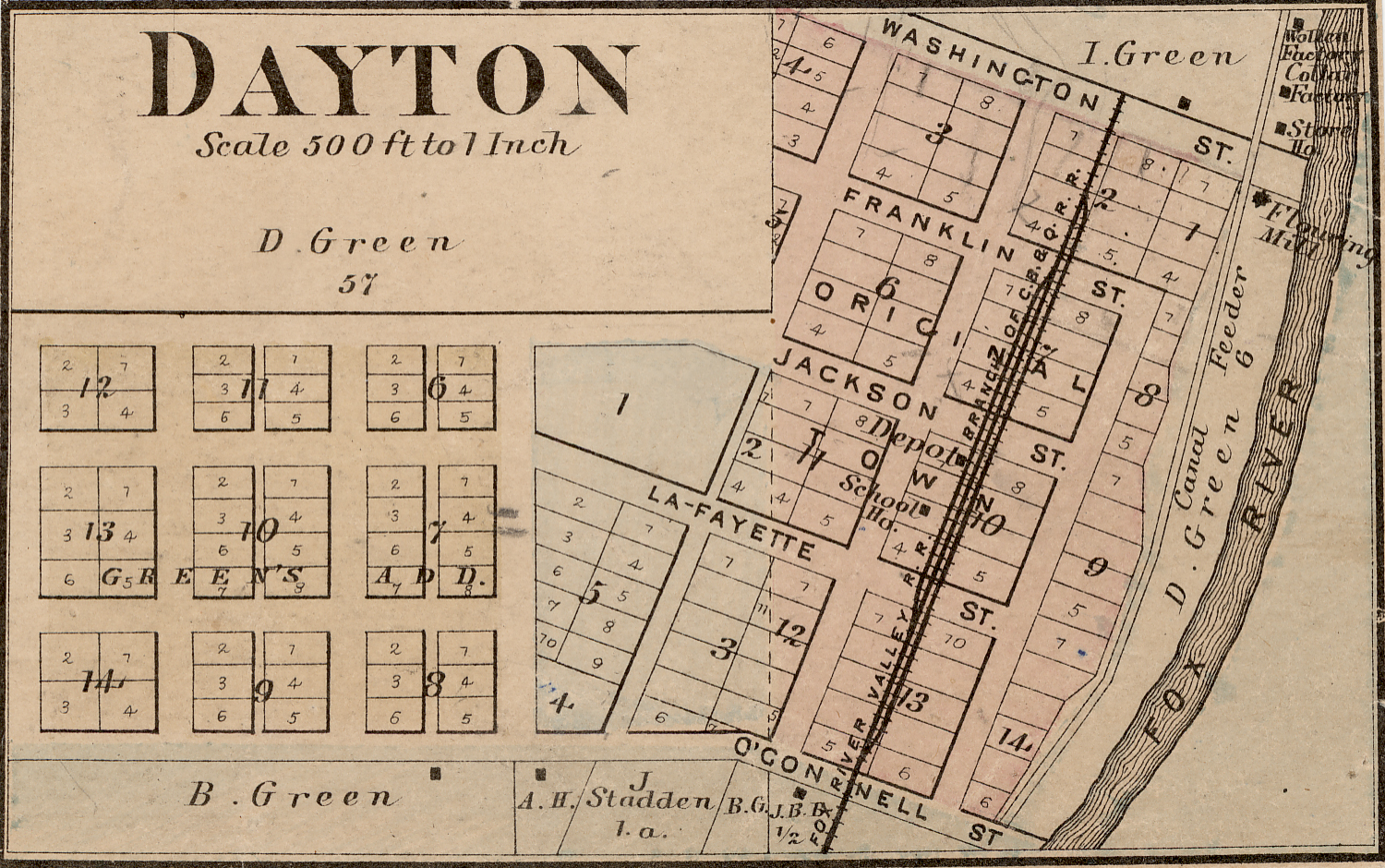
The women who settled the Illinois frontier in the 1820s had to be hard-working, resourceful, determined, and tough. Barbara Grove Green, who, with her husband John, led a small band of pioneers from Ohio to Illinois in 1829, was surely that. She may have imagined her life to be settled,  living in Licking County, Ohio, with her husband and seven children, but at the age of forty, John decided to move west. He found a suitable place in Illinois, on the Fox river, four miles above the junction with the Illinois river and returned to announce that they would leave immediately, although it was late in the fall. Ignoring advice to wait until spring, a group of twenty-four men, women and children left for the west. John and Barbara were the senior members of the group, at 40 and 37; in addition there were three young couples in their twenties and six young unmarried men.

The first years were difficult ones. The small cabin where the group spent the first winter was replaced as soon as the saw mill was up and running. Two more children were born in Illinois: Rebecca in 1830 and Isaac in 1833. During the Indian Creek massacre scare, Barbara walked the four miles from Dayton to Ottawa with the rest of the family, carrying the baby, Rebecca, who cried if anyone else carried her.

Homemaking chores would have consumed her time. In the early days, these would have included salting and preserving the plentiful prairie chickens and quail that her sons trapped during the winter. Life became a little easier after the grist mill was in operation and she no longer had to grind wheat in a hand grinder. With yarn from the woolen mill, she knit socks and long stockings for everyone. Along with all the necessary sewing and mending, she made candles, rag carpets, and all the many other needs of a self-sufficient household.

Maud Green remembered her grandmother Barbara:
“Then in February it was carpet-rag time and we all sewed & wound carpet-rags & sent them to the weaver.  The new carpet went in the “sitting room” and the others were moved back until at last they reached the kitchen & were worn out there. I can just remember Grandma making candles for us to carry upstairs.  They were afraid to have us carry a lamp, but we had lamps as long ago as I remember. Grandma spent her time knitting socks and long stockings for all of us, out of factory yarn, and we had woolen underwear, skirts and dresses made of factory flannel.”

Barbara led a long life as the matriarch of the Green clan. When she died in Dayton, May 3, 1886, at the age of 93, she was remembered with affection in her obituary:

Granma Green, the oldest settler in the county, died Wednesday morning, at the age of 84 [sic] years. She was of a kind, benevolent disposition and was well beloved by her wide circle of relatives, friends and acquaintances by whom she will be greatly missed.1


  1. Ottawa (Illinois) Free Trader, 8 May 1886


A Sudden Change of Temperature

winter-storm

From Jesse Green’s memoirs:

I will give an account of the most sudden, and greatest change in temperature, in my recollection, which occured in the early winter of 1837 & ’38.  I left home about noon when it was drizzling rain sufficient to wet my clothing, and when I reached a point a little below Starved Rock, it commenced turning cold so fast that I ran my horse as fast as he could go to Utica, and by the time I reached the hospitable home of Simon Crosiar, it had frozen the ground hard enough to bear up my horse, and my clothing as stiff as it would freeze from being wet.  I had to be helped from my horse, and saddle and all together my clothing being frozen to the saddle, and I do not think I could have gone a quarter of a mile farther.

The next day returning home it was a terrible cold day, my left side against the wind was nearly frozen by the time I reached Ottawa, where I went into a store to warm myself, and all I could do to prevent it, fell asleep in a short time, I heard a number say that during that blizzard, they saw chickens frozen in their tracks.

Jesse was a year off in his memory of the event, as the “sudden change” happened on December 20, 1836, but he well remembered the after effects, as did many others. The meteorological background of the sweeping cold front, and a number of stories of Illinoisans caught as Jesse was, can be found here.

The Dayton School in 1925

school-children-at-desksschool-children-at-desks

The Ottawa Daily Republican-Times published a special school section on March 20, 1925, which included this list of the pupils of the Dayton school.

           District 209 – Dayton school.

teachers:
Jennie L. Fraine, Emma C. Fraine;
pupils:
eighth grade: Helen Hallowell, Robert Meagher, Edith Reynolds, Donald Ainsley;
seventh grade: Evelyn Huston, James Gleeson, George Garcia;
sixth grade: Elizabeth Meagher, Howard Tanner, Olive Draper, Donald Blue, Olive Garcia, Emmett                        Gleeson, Paul Ainsley;
fifth grade: Joseph Jacobs, Burrel Draper;
fourth grade: Dorothy Davis, Frank Davis, Billie Gleeson,;
third grade: Esther Meagher, Roy Fraine, Glenn Thorson, Reynold Ainsley;
second grade: Margaret Thorson, Janie Huston, Irene Meigs, Dollie Davis, Vera Draper;
first grade: Zelda Garrow, Kenneth Fraine, Vernon Blue, Loretta Gleeson, Stanley Thorson, Russell                      Metge, Mary Ryan, Billie Prince, Joe Davis.

The teachers, Jennie and Emma Fraine, were sisters, and life-long residents of Dayton. Their parents, Charles and Clementine Fraine, came to the United States from France about 1875 and settled in Dayton. Miss Jennie retired around 1945 and died in 1949. Miss Emma retired in 1952, after 50 years of teaching, most of them in Dayton. She died in 1959.

The Standard Fire Brick Company

standard-fire-brick-company

The Standard Fire Brick Company1
Fire Brick and Fire Clay Articles

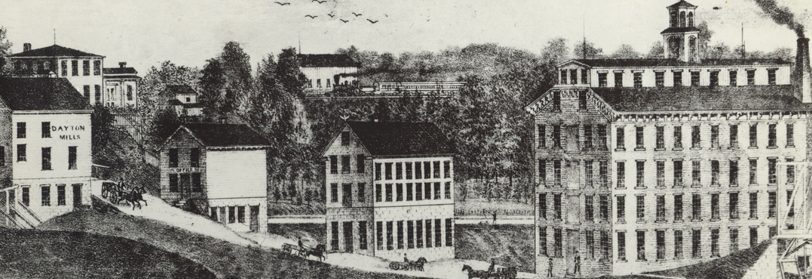
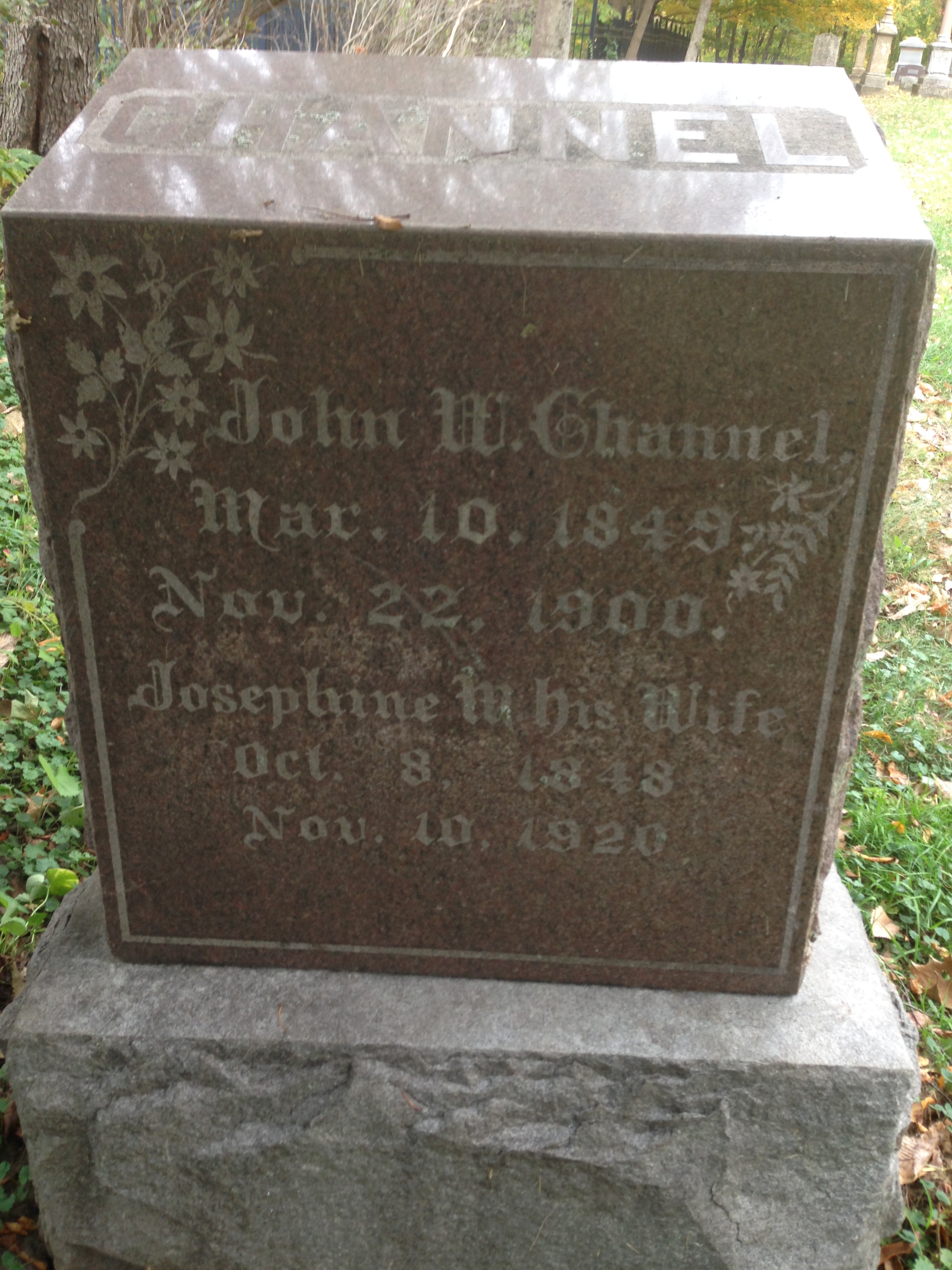
            In August, 1892, the Ottawa Paving Brick Company, under the management of John W. Channel, who, for several years prior to this date, had been superintendent of Hess, Crotty & Williams’ brick factory, leased the brick works at Dayton, Ill. For three years this plant was run successfully, when, in November 1895, the Standard Fire Brick Company, of Ottawa, Ill., was organized by Thomas D. Catlin, John W. Channel, M. W. Bach and E. W. Bach, with $25,000 capital stock. The company bought the Dayton property, consisting of the large, substantial four-story stone building, formerly used as a woolen mill, and also the three-story frame building used for many years as a horse collar factory, together with all the clay-lands, waterpower and machinery. John W. Channel was made president and general manager, Thomas D. Catlin, vice-president and treasurer, and E. W. Bach, secretary.

            Shortly after the Standard Fire Brick Company had been legally organized and had commenced business, negotiations were entered into with the firm of Hess, Crotty & Williams for the purchase of their brick factory, located about a mile east of Ottawa, at a location called “Brickton.” The capital stock of the Standard Fire Brick Company was increased to $50,000 and the purchase of the plant of Hess, Crotty & Williams effected, and the company assumed control in May, 1896, with the same set of officers that the original Standard Fire Brick Company had, each private individual of the old firm of Hess, Crotty & Williams taking an interest in the company which purchased their plant.

            On May 1, 1900, the Standard Fire Brick Company assumed control of the plant of the Ottawa Fire Clay & Brick company, whose interests are now merged in the Standard’s. The plant, an immense one, is located east of Ottawa, and east of the Standard Fire Brick Company’s original Brickton plant, and is on the line of the C., R. I., & P. Ry.

            With these three factories the capacity of the Standard Fire Brick Company, as regards fire brick and fire clay, is practically unlimited. It is the largest fire brick plant in the United States, and will produce 100,000 fire brick per day. The officers are T. D. Catlin, president and treasurer; M. W. Bach, vice-president; E. W. Bach, secretary. The Dayton plant is situated four miles north of Ottawa, on the Fox River branch of the Chicago, Burlington & Quincy railroad system, and has its own side-track along the yards, and the Ottawa factory is located on the Chicago, Rock Island & Pacific mainline, with a side-track at the factory also. Thus the company has double the shipping facilities that any concern located on a single system would have, saving, of course, a great deal of annoyance and the expense caused by transferring from one road to the other. The company is a member of the Western Railway Weighing Association, from which a great benefit is derived.

            At the Dayton factory the company has abundant water-power, and at Ottawa steam-power is used. Both places are heated thoroughly by a complete system of steam pipes, and they are also amply equipped with the usual dry pans, pug mills, clay crushers, conveyors, hand and power presses, clay bins and auger machines, no steam presses being used in the manufacture of their wares.

            The company has 65 acres of clay land, all underlaid with a vein of fire clay, most of it within 8 to 16 feet of the surface. At Ottawa, on top of this fire clay, there is a vein of coal about 22 inches in thickness, and above this coal a vein of common clay, varying from common yellow clay to one having the nature of soapstone. This yellow clay, properly mixed with a proportion of fireclay, is used in making their sidewalk tile. At Dayton, on the west side of the river, there is, above the fire clay, besides a vein of coal, an extensive bed of valuable shale about 30 feet in depth. This makes good common ware, and mixed with a little fire clay, makes as fine a sidewalk tile as one will find anywhere in the country. On the east side of the river, where the main supply of the company’s fire clay is obtained, there is nothing above the fire clay except a bed of excellent gravel about five to eight feet in thickness. This gravel makes it possible to maintain the roads to the factory in excellent condition.

            Fire brick and fire clay articles are the company’s main product. The market for this material is, besides Chicago, the great trade center of the West, all of the northern part of this state, Iowa, Wisconsin, Minnesota and Michigan, all of them great manufacturing states. Their competitors in the fire clay materials are very few, while the competitors in the common clay products are many, nearly every location of any size at all having its own common brick yard.

            This fire clay is the material out of which they manufacture their most important products. The upper stratum of common clay and coal is removed and the beds of fire clay exposed, they being from six to ten feet in depth.

            They can well be proud of the reputation their brick have attained in Chicago and the Northwest, which is unparalleled by any of their competitors. They supply material for stack linings, boiler settings, iron cupolas, furnaces, foundries, lime and brick kilns, retorts, and any purpose requiring refractory brick. The beds of plastic fire clay at Brickton, and also to a limited extent at Dayton, have not been touched in recent years, although they are very valuable deposits, as they are adapted for the manufacture of stone ware and articles of that kind.


  1. Ottawa in Nineteen Hundred (1900; reprint, Ottawa, Illinois: La Salle County Genealogy Guild), 20. viewed on Google Books

Rev. Laing – Universalism in Dayton

047-rev-laing-edited

Rev. Alfred H. Laing

Alfred H. Laing was a Universalist pastor in Earlville, Marseilles, and Joliet, and often preached in Dayton. He was born February 8, 1844, in Kosciusko, Indiana and died in Joliet, Illinois, August 31, 1923. Many members of the Green family, early settlers of Dayton, were Universalists and knew Rev. Laing well.

The Universalist society held their earliest meeting here [Earlville] in Robinson’s Hall, in the winter of 1866-7. The first pastor was Rev. W. S. Ralph, who remained from Jan. 1867 to Jan. 1870. During the year 1869, they built their house of worship, a commodious brick structure, costing nearly $1,500. During the summer of 1870, the pulpit was filled by Miss Mary H. Graves. In October, Rev. Alfred Rains was called, who remained four years, and was succeeded by the present pastor, Rev. A, H. Laing, who came in Nov., 1875. There are now about two hundred attendants at this church.1

Charles Green, son of David and Mary (Stadden) Green, wrote some reminiscenses of early Dayton Universalists, in which he included the following memories of Rev. Laing:

The Rev. A. H. Laing preached at Earlville, fifteen or twenty miles northwest of Dayton, and later on was pastor at Marseilles and at Joliet. He was a comparatively young man when he first preached at Dayton. He was well liked and preached some good sermons full of interest and gospel teachings. He used to come down from Earlville in the spring on fishing trips. Dayton at that time was a fine fishing place, and people used to come there from many miles around, camping out for a few days or a week along the banks of the Fox River. I have seen at least 200 people there at one time. The state maintained a dam across the river about a half mile above the village, and in the spring of the year when the game fish were running up stream to spawn they were very hungry and voracious and were anxious to get hold of the fisherman’s bait. On account of the dam across the river the fish could not go up stream any farther, thus making good sport for the many anglers. So our Izaak Walton lover, the Rev. A. H. Laing, soon learned where the good fishing grounds were, and came down from Earlville quite frequently to indulge in the sport, and incidentally to preach us a good sermon.

More of the early recollections of Charles Green, including other Universalist preachers in and near Dayton, may be seen here.


  1. The Past and Present of La Salle County, Illinois, (Chicago: H.F. Kett & Co., 1877), 341

Emma Dunavan – inventor

dunavan-emma-invention

In 1891, Emma S. Dunavan, of Dayton, Illinois, received a patent on a new and useful improvement in the class of mailboxes intended to be placed on the door of a building, including a bell linked to the door of the mailbox which would ring when mail was deposited. The full description of this invention may be seen here.

Emma was the wife of William J. Dunavan, son of Albert F. and Emma (Cooper) Dunavan, and grandson of William Lair and Eliza (Green) Dunavan. He was the junior member of the Fox River Horse Collar Manufacturing Co. in Dayton, in partnership with his father. William traveled a great deal in connection with the factory and in October 1887, he opened a wholesale and retail store of horse collars, harnesses, buggies, etc., at Kinsley, Kansas.

                                                       DUNAVAN-SWANK
On Wednesday, January 9, 1889, W. J. Dunavan, of the firm of Dunavan & Son, this city, reported at the Swank mansion in Fort Scott, Kansas. His credentials being satisfactory, at 9 p. m. he was united in marriage to Miss Emma Swank, in accordance with the solemn but beautiful Episcopal church ritual. A brief wedding tour, embracing Kansas City and Hutchinson in the route, landed the happy couple in Kinsley, the home of the groom, where they received the congratulations of his many friends.1

The news of her invention was well received in Fort Scott:

A WOMAN WHO THINKS
An Illinois Lady, Formerly of Fort Scott, Invents a Useful Contrivance.

Yesterday the scribe dropped into the office of Dal Burger’s Fort Scott Carriage Works on his rounds and was shown a newly patented mail box that is certainly getting near the acme of achievement in its line.

The box is the invention of Mrs. Emma S. Dunnavan, of Ottawa, Illinois, who was formerly well known here as Miss Emma Swank, and is the daughter of Mrs. Agnes Swank of this city. It consists of an ordinary wooden or metal box of the usual form and size, with a spring door near the top through which the letter or card is put. A push button extends out from an opening above the door, which is used in opening the latter. When the button is thrust in by the postman as he pushed back the door, an electric bell is set ringing which calls attention to the postman’s visit as the whistle commonly used now does, but in a surer and at the same time a more genteel manner. The ring is surer because the bell is rung inside the hall or room.

The intention is to place the box on the outside of the door, the bell being placed inside. This does not disfigure the door as the box can be made as ornamental as may be desired, and the bell is much like an ordinary door bell.

Below the spring door for the insertion of letters is a glass through which the contents may be seen. Below that is an ordinary lock such as is used on postoffice boxes, which when unlocked allows the hinged bottom to be opened and the contents removed. The box with its bell attachment is certainly a convenient and useful contrivance and shows a good degree of practical ingenuity in its inventiveness.2


  1. The Kinsley [Kansas] Graphic, January 18, 1889, p. 3, col. 2
  2. The Fort Scott [Kansas] Daily Monitor, August 26, 1891, p. 4, col. 6

The Hite Family

                          James M. Hite    Hite, Martha (Jones)

James and Martha (Jones) Hite

The Dayton Cemetery Association holds its annual meeting every year on the Sunday of Memorial Day weekend. In addition to the pot luck lunch and business meeting, each year a historical program is given on some aspect of the history of the families buried in the cemetery and of the history of Dayton.

In 1964, Maud Hite Temple was the speaker. She told of the preceding generations of her family and of their move from Virginia to Ohio and then to Illinois. The full text of her presentation can be read here.

Happy New Year!

party-ribbons-balloons-background-free-vector

The beginning of a new year is a good time to start any new enterprise and marriage is one of the best, especially if it comes with cake, as shown in this newspaper article:

HYMENEAL

Married – At Dayton, in this county, on the 31st inst. (New Year’s Eve) by the Rev. David Newton, Mr. John Stadden to Miss Ann Maria Miller, both of Dayton.

Accompanying the above notice, was that which always gladdens the poor printer’s heart – a bountiful supply of Miller’s workmanship, in the shape of delicious wedding cake. The happy couple have our best wishes for their future happiness, hoping that the evening of their days will be as pleasant as the first dawn of 1841 met them agreeable and happy.1

Ann Maria Miller was the daughter of Isaac and Esther (Gleim) Miller. She was born in Pennsylvania about 1818, one of a large family. Her brother Reuben left Pennsylvania for the west in 1836 and came to Dayton. The rest of the family soon followed, including her widowed father, Isaac, and settled in Freedom township. Ann and John did not stay long in Dayton. By 1846 they had moved to Dallas county, Texas where she died November 23, 1872 and was buried in the Stadden cemetery in Wilmer.


  1. Ottawa Free Trader, January 1, 1841, p. 3, col. 3

Happy Birthday, Jesse!

birthday-cake

Yesterday was the seventy-third anniversary of the birthday of Jesse Green of Dayton, and to properly celebrate that event his relations from far and near gathered to wish the old gentleman and his estimable wife a happy New Year and many pleasant returns of the day and consequent similar gatherings. Including the relations in Dayton and from abroad, the residence of Mr. Green was crowded but all present enjoyed themselves to the fullest extent. After all the guests had assembled, Thomas E. MacKinlay in behalf of the company, presented Mr. Green with a very handsome easy chair and Mrs. Green with a table. Mr. Green was taken completely by surprise, but managed to express his thanks. An elegant dinner was served, and a fine time was had by all present.

Those from abroad were Attorney General McCartney and wife of Hutchison, Kan.; Ed. Jackson, Cincinnati; Joseph Jackson, Millington; L. C. Robinson and wife, Rutland; N. M. Green and wife, Serena; Kent Green, Chicago; Mrs. Craig, Jacksonville; Mrs. John Crum, Mrs. Joseph Harris and Mrs. L. Matlock, Misses Ray Harris and Mertie Crum, Yorkville, and T. E. MacKinlay and wife, C. B. Hess and wife, H. B. Williams and wife, T. H. Green and wife, W. N. Bagley and wife, Will and Don MacKinlay, Ed. Hess and Theodore Strawn, of Ottawa.1


  1. The above unidentified clipping, found among other Green papers, can be dated to 22 Dec 1890, as Jesse Green was born 21 Dec 1817. Assuming it came from an Ottawa newspaper, it probably appeared in the Ottawa Free Trader or the Republican-Times, as the Fair Dealer did not begin publication until 1892. The Free Trader microfilm is missing the issues for this period, so the paper cannot be firmly identified. There is no Republican-Times issue for 22 Dec 1890 on the microfilm. The next issue, 25 Dec, was checked, but nothing found.

Christmas at the Dayton School

Christmas play at Dayton School

This Christmas version of the Maypole was part of the annual Christmas program given in the clubhouse in Dayton about 1955. This annual affair was a highlight of the Christmas season. The program was a composite of the Christmas story, the anticipation of Santa Claus’s visit, singing carols, and, of course, plenty of Christmas goodies to reward the actors.

It’s hard to identify anyone because most of the faces are hidden, but if you know anyone, please leave a comment identifying them.

The Sounds of Winter


sleigh

In the absence of paved roads, a wet fall could make roads impassable and people waited eagerly for cold weather and snow. It was then time to get out the sleigh and resume visiting with friends and neighbors.

Maud Green remembered that ” ‘Old Jim’ belonged to Grandma Trumbo, & mother inherited him in 1873.  The sleigh bells & a sleigh came with him.”

The sleigh, unfortunately, is gone, although in my childhood it was still up in the hayloft of the old barn. My mother always wanted to get it down and restore it, but it never happened and then the barn burned. However, the sleigh bells are still in existence and are brought out every Christmas to hang on the door. Here’s a reminder of the joys of a sleigh ride:


A Hand-drawn Birth Record

trumbo-ahab-christopher-birth-record

This hand-drawn birth record is an example of fraktur,1 a Pensylvania German folk art tradition. In addition to recording that Ahab Christopher Trumbo was born March 13th, 1836, it adds words of advice to a young man in selecting a wife.

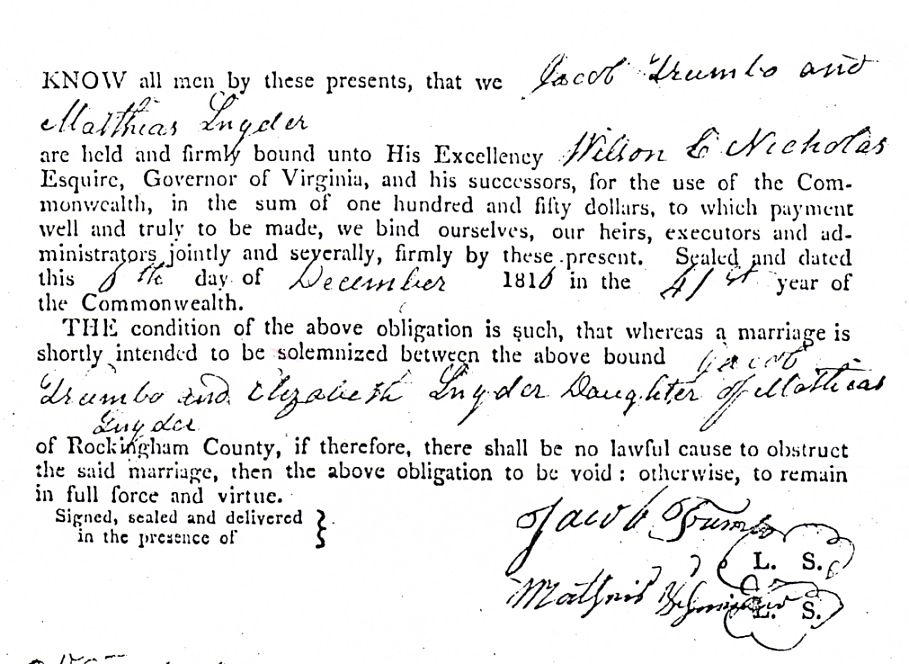
Ahab Christopher was the son of Jacob Trumbo III and his wife, Elizabeth Snyder. He was born in Brock’s Gap, Rockingham county, Virginia, and came to Illinois with his family in 1853. The family settled in Dayton township, on Buck Creek. Christopher married Fidelia Kagy January 28, 1869 in Ottawa. They had one child, who died in infancy. Christopher died of consumption in October, 1869, at the age of 33, and is buried in the Ottawa Avenue cemetery in Ottawa, Illinois. Note that his obituary says that he died on October 22nd. However, his mother’s family Bible gives the date of his death as October 10

trumbo-christopher

Christopher Trumbo

DIED
In the village of Dayton, October 22d, 1869, A. C. TRUMBO, age 33 years.

The subject of this notice was a native of Rockingham county, Virginia, but for several years a resident of the town of Dayton. He was one of our most exemplary young men, and his loss will long be felt by a large circle of relatives and friends. Behind his modest bearing he concealed sterling qualities of mind and heart, – accurate judgment, inflexible devotion to principle, warm, affectionate, exceeding purity of heart and character. He was at an early age marked by the fell destroyer consumption. He leaves a young wife and an aged mother, who but a few days since was notified of the death of her son W. B. T., who had recently returned to Virginia to recruit his failing health. The funeral services of both of her sons will take place at her house on Sunday, the 24th inst, at 10 o’clock a. m., by the Rev. Mr. Thompson, of Putnam county. Thus, in the short space of five weeks, has this aged mother been bereft of two noble, high minded young men, just in the prime of life. She has a hope both sure and steadfast, that what is her apparent loss is their gain.2


  1. For more information on fraktur, see http://frakturweb.org/
  2. Ottawa Free Trader, October 23, 1869, p. 5, col. 3.

Thanksgiving Day 1900 in Dayton

Thanksgiving dinner

A report of one Thanksgiving feast:

A Thanksgiving dinner given by Mr. and Mrs. O. W. Trumbo was largely attended. Among those present were Mr. and Mrs. W. Van Etten and three children, Batavia, Mr. Eugene Appleton, Miss Ella Green, Aurora, Wm. Miller, wife and three children, Rutland, Mr. and Mrs. Isaac Green, Miss Carrie Green and Lyle A. Green, Dayton.1

The hosts were Oliver W. Trumbo and his wife, Rebecca Green. Their daughter Jessie was the wife of Wilmot Van Etten and the mother of Clare Trumbo Van Etten, Walcott Gumaer Van Etten, and Frank Campbell Van Etten.

Ella Green, whose name appears coupled with Eugene Appleton was the daughter of David and Mary (Stadden) Green. Eugene appears to have been an unsuccessful wooer, as Ella later married Dr. George H. Riley.

William Miller’s wife was Alta Barbara Gibson, daughter of George W. and Rachael (Green) Gibson. Their children were Gertrude Rae Miller, Howard Miller, and Glenn Gibson Miller.

Isaac Green and wife Mary Jane Trumbo attended with their son Lyle. They had no daughter named Carrie, but they did have one daughter at home in 1900. Possibly daughter Maud was misidentified as Carrie.


  1. Ottawa Republican-Times, December 6, 1900, p. 4, col. 4

The Dayton Dam

The Dayton dam

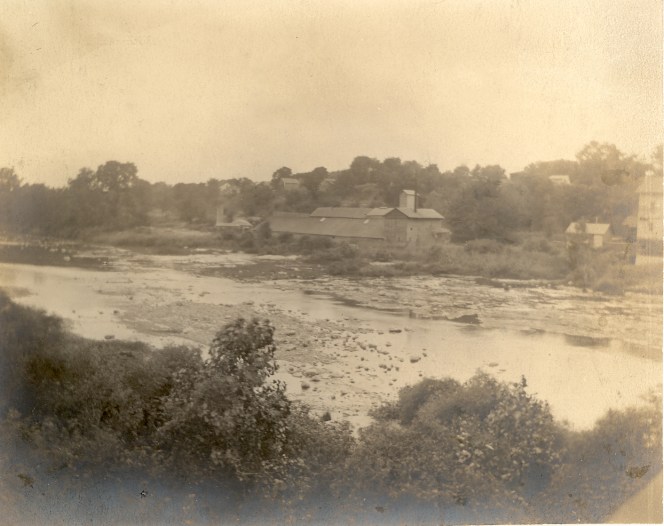
This picture of the dam at Dayton was taken from the hayloft of the old barn on the Green farm, probably about 1955. This is the dam that was built by the state of Illinois in 1924 to replace the dam that was washed out in 1904. The picture below was taken during the construction of the dam and powerhouse. The barn from which the 1955 picture was taken is just out of sight to the left of the new barn in the 1924 picture.

dam-under-construction

William Stadden, State Senator and Convention Delegate

Springfield, Illinois, Old State Capitol

Springfield, Illinois, Old State Capitol

Dayton resident William Stadden was elected to the Illinois State Senate in 1836 and served for four years, representing La Salle, Iroquois, and Kane counties. He served at the same time that Abraham Lincoln was serving in the Illinois House of Representatives. In the Senate, Stadden was on the committee on canal and canal lands, where his familiarity with the Illinois & Michigan canal, and the feeder from Dayton to Ottawa, might be useful.

In 1847, Illinois needed to revise its first constitution to meet the needs of a growing population and a constitutional convention was convened. William Stadden was one of two delegates from La Salle County to the convention, where he served on the revenue committee. The convention met in June, 1847, and spent nearly three months devising a new instrument; the following March its work was ratified by a large majority of the voters; and on April 1, 1848, it became operative. William Stadden was able to see the new constitution become law before he died the following November.

Additional biographical information on William Stadden may be found here.

Great care has been taken in the burning . . .

tile-works-letterhead

            Green Bros. have just finished burning their third kiln of tile, and are now ready to furnish customers with a good quality of tile at the lowest market price. Great care has been taken in the burning, and the tile taken from the kilns are found to be of the same degree of hardness none too soft, but all alike. Some parties have been misrepresenting the tile by saying they are too soft, but to those who would know the truth, we must say, “visit the kilns and see.” Tile will be drawn to the top of the hill by the proprietors for those who will notify them of their desire. In fact, the firm will do everything to please customers, not only in market prices but in a good quality of tile.1

            Drain Tile. – We have been shown specimens of Drain Tile manufactured by the Green Brothers at the Dayton Tile Works, and if all are like these, and we are assured they are, there are no better tile made in the country. They are made in all sizes from 2 to 8 inches. Sold at Ottawa prices, with 10 per cent. off for cash. For sale at the works in Dayton or at Freeman Wheeler’s on the Chicago road, east of Dayton.2


  1. Ottawa Free Trader, September 13, 1879, p.8, cols. 1-2
  2.  Ottawa Free trader, September 20, 1879, p. 1, col. 2

Millstones

millstone-shabbona-parkOne of the original Dayton millstones

The reason the Green party settled at what became Dayton was the presence of the rapids of the Fox river. They were looking for a mill site and liked the look of this spot. They had brought the mill irons and the millwright with them from Ohio, but the mill stones were a local product, created from boulders found along the river bank. The mill was the first order of business upon arriving, and Jesse Green remembered its first day of operation:

On the morning of the 4th day of July 1830 the first wheat was ground by water power in the northern portion of Illinois. We did not at this time have a bolt for separating the flour from the bran but we thought that graham flour was good enough to celebrate that Natal day with a double purpose that will never be forgotten by the latest survivor of the memorable event. It marked the first and greatest step in the alleviation of the hardships and suffering of the early settlers, and they soon all had plenty of graham flour and corn dodgers. Up to this time we were obliged to grind our grain in a coffee mill, or pound it in a mortar improvised by burning out a hole in the top of a stump, and attaching an iron wedge to a handle to use as a pestle which was operated in a manner similar to the old fashioned well sweep.

In one of the many upgrades and improvements to the mill, the original millstones were removed, but not discarded. They are today to be found in Shabbona park, near Earlville.

The Drunken Dancing Master

drunken-dancing-master

FROM DAYTON, Jan. 8, 1877

Being a constant reader of your paper, I see no one has taken note of our little village for some time. Permit me, therefore, to give you some items of interest.

Our improvements are plain. The paper mill of Williams & Co. is running in full and is in a flourishing condition, turning out about 24 tons of paper per week.

It is needless to say the Fox River Horse Collar Manufacturing Co. still carry on an extensive business. They are known far and wide. Nothing seems to daunt them, nor does their trade decrease. In spite of hard times they prosper.

The store formerly owned by John T. Makinson has been purchased by Jesse Green & Sons, who have enlarged the building and now have on hand a full line of groceries, woolen goods, &c.

Our inhabitants are a class of persevering, energetic people. Among them is a renowned ex-granger, to whom life on a farm becoming monotonous, he concluded to enter into something which would bring him more in contact with the people of the world. So he engaged in wholesale manufacturing pursuits, but becoming weary of the hum of machinery, retired from business and set himself down to think what he should do next. At length he exclaimed, “I have it!” I will do something for the people which will cause my name to be handed down to future generations with honor never to be forgotten.

‘Tis true, we have no churches, but we don’t need any – our people are good enough. They are noted for honesty, integrity, and warm genial disposition. Neither have we any saloons, nor do we need them – our people are temperate, and Ottawa is not far distant. But notwithstanding our people are good and temperate, they are deficient in good manners and gracefulness – cannot describe a proper circle in making a bow; in short, need a dancing master. Therefore he had one imported from the east, organized a dancing school – in fact, two dancing schools, one for juveniles at 4 P. M., another for adults at a later hour. Juvenile class assemble to meet their tutor dressed with all the care and taste their fond mothers could devise, their flashing eyes sparkling with anticipated pleasure, the bloom of health and innocence upon their cheeks. Their teacher arrives by the train, alights and walks up the railroad track describing a Virginia worm fence. Great consternation among his admirers. It was a stunner, a perfect surprise. Crowds could be seen on every corner with blanched cheeks and distended eyes, asking what shall we do? “Pickles!” shouts one. “Lemons!” cries another. “Yes, that’s business, give us lemons,” says a third. “Who cares for expenses. Here – you – somebody – hold him up on t’other side; feed him lemons; walk him two miles and a half!” A consultation was then held as to whether the school should continue, the gentlemen being in favor of a change of tutors, while the sentiments of the majority of the ladies seemed to be, “get drunk if you want to, boys, we’ll forgive you.” This is apparently a new style of crusaders.

Much more might be said upon the subject; but suffice it that the adult class proceeded to be instructed, and got through as well as could be expected under the trying circumstances, closing with an appointment for Thursday evening, Jan. 11.

A READER1


  1. The Ottawa [Illinois] Free Trader, January 13, 1877

Joseph Green, Adventurer

Joseph Green

Joseph Green, like his father and brothers was of an adventurous nature. He was only one year old when the family moved to Illinois and making a home out of the wilderness was surely an adventure. The expedition to the California gold mines in 1849, with his father and his older brother Jesse was a welcome change from his life in Dayton, which in twenty years had become much more civilized. Very much the little brother, he was eleven years younger than Jesse and although he would have considered himself, at 21, the equal of any man on the trip, he was still one of the younger ones. He was sorely missed in Dayton by his sisters, Rachael and Rebecca, who filled their letters with a wish that he would be home soon.

Most of the gold miners returned home in January of 1851, but Joseph and three others were left behind in Mexico, where they were to remain until spring, in charge of some Mexican horses which were bought in coming through that country.

Joseph had barely returned to Dayton when it became clear that his taste for adventure was still strong. His younger brother Isaac, who was deemed too young to go on the previous trip, wanted his chance and Joseph got up an expedition of his own to California, which left Dayton in April. As in the previous attempt, there were no great riches in the end, but the adventure may have been its own reward.

Joseph had expressed a desire to go to China, but this never came to pass, due to his untimely death, December 27, 1855, at the age of 27. He is buried in the Dayton cemetery


How to Make a Rainbow

rainbow

The Dayton woolen factory’s products came in a range of colors. In order to produce the various shades, a large number of vegetable dyes had to be kept on hand. From an inventory of the factory in 1873, they had a variety of dyes and other products used in making woolen cloth.

Before dyeing, the raw wool had to be washed and cleaned with something that would remove the oils that occur naturally. The oxalic acid listed in the inventory would have been used on the wool as a first step.

Alum, chrome, and soda ash were used as dye fixatives, or mordants.

Extract of logwood, a purplish-red natural dye obtained from the logwood tree, could produce black, grey, navy blue, purple, violet or lavender, depending on the mordant used.

Sicily sumac could produce dyes of red, yellow, black, or brown.

Cudbear was extracted from a lichen and produced dyes in the purple range.

Camwood produced a brilliant but non-permanent red dye.

Brazilwood extract produces bright reds, corals, and pinks.

Fustic , a bright yellow dye, is very colorfast. It is frequently combined with other dyes to produce a range of yellow and green colors.

Lard oil was used to prepare the dyed and dried wool for carding.

Large quantities of these were kept on hand. The inventory listed 533 pounds of logwood; 800 pounds of Sicily sumac; 1260 pounds of Camwood and more than a ton of soda ash.

It was certainly a colorful business!