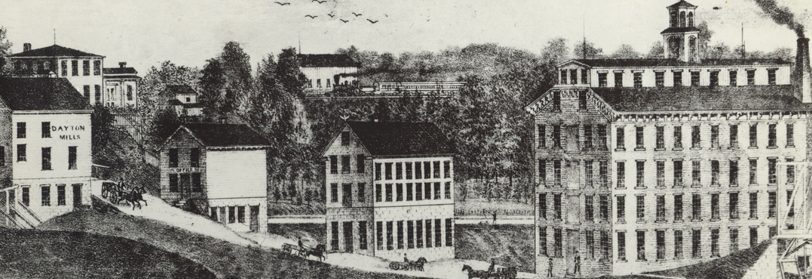
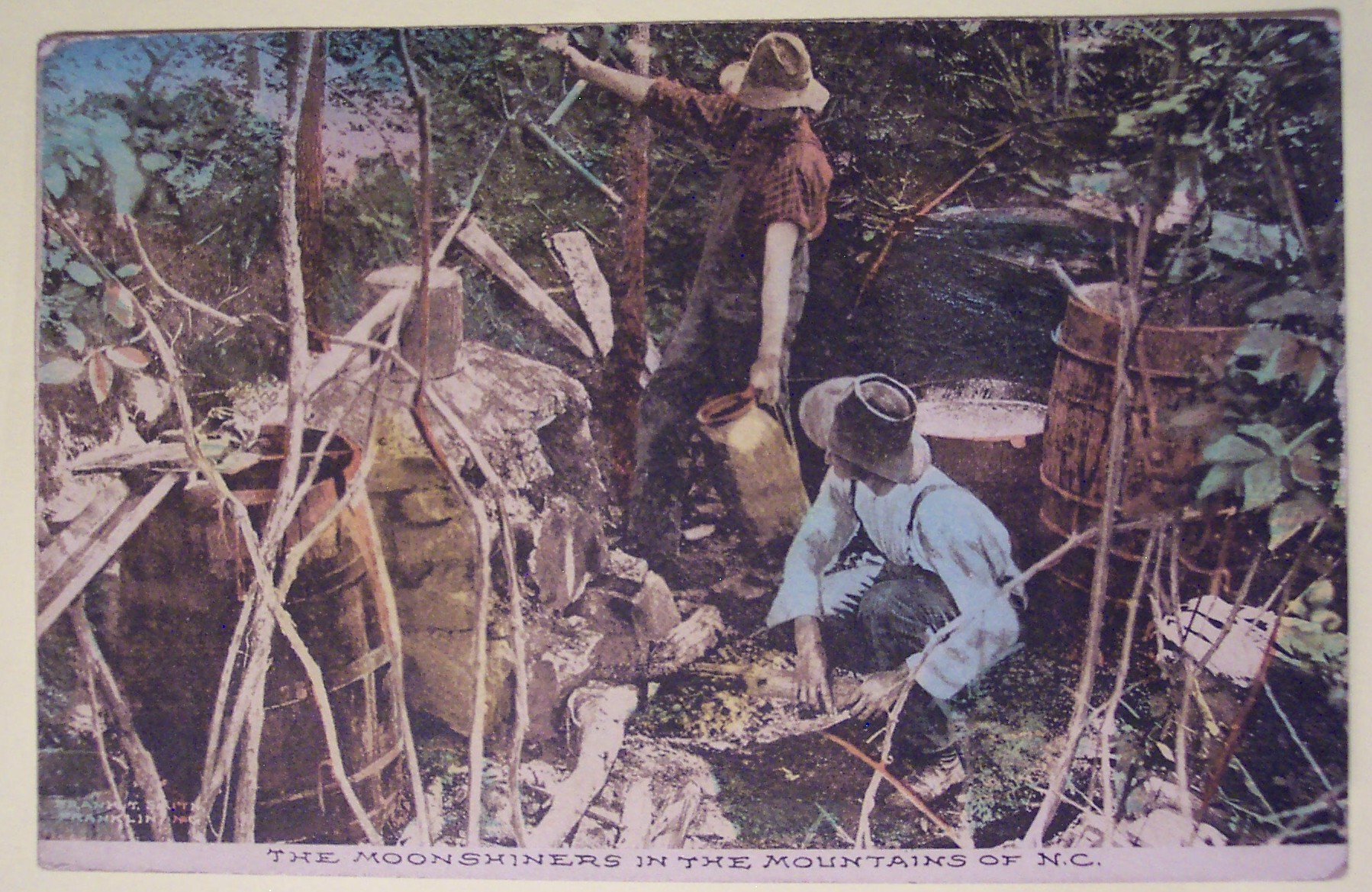
New businesses are not always welcome, especially when uninvited. Some time around 1950, without the knowledge of the owners, a still was being operated on the Green farm, in one of the ravines north of the barn. For several weeks there had been rumors of a still in operation somewhere in Dayton. Then Dom DiBernardi, who kept the store in Dayton, told Charles Clifford, operator of the Green farm, that three boys had seen the still. Clifford investigated and, upon finding the still, contacted Harland Warren, La Salle County State’s Attorney. Warren, in turn, contacted the Internal Revenue Service. An agent for the Alcohol and Tobacco Tax Division was sent out immediately and was shown to the scene. He commented that apparently someone had returned to the still the previous night and attempted to burn part of the barrels and remove several pieces of pipe. He described the still as “peculiar” and seemed to think the operators were on the amateur level. The still had been chopped to pieces, and no further investigation was planned. Mrs. Ruth Green, owner of the farm, was subjected to considerable teasing in the days that followed.
Social
A Party in Dayton

Dayton on September 14, 1929, was the scene of a glorious centennial party, marking the 100th anniversary of the arrival of the Green party in Illinois. Two bands, a children’s chorus, and a dance orchestra provided music; a gigantic tug-of-war and other tests of skill and strength amused the merry-makers; and former residents came from near and far to join the festivities.
A marker was dedicated on the spot where the mill-stones were found which were used in Green’s mill, the first water-powered mill in northern Illinois. The marker, a brass plate with the story of the discovery, was placed on a boulder set in cement, along the east bank of the river. Although the boulder may still be there, the brass plate disappeared many years ago.
During the afternoon, Miss Maude Green, Mrs. John Bowers, Miss Helen Hallowell and Miss Edith Reynolds donned garments of several decades ago and promenaded the streets, reviving an interesting bit of history in regard to modes and fashions. Only the marcelled hair of Miss Hallowell and Miss Reynolds which peeked from underneath their quaint old bonnets showed that they were maids of the twentieth century rather than of the days when Dayton was in its infancy.
There were many mementos, relics and curios on display:
. straw plug hat and woman’s straw hat of the vintage of about 1800
. old candle molds
. flintlock guns which belonged to Peter W. Ainsley and Tim Thompson
. blankets and coverlets made in the old woolen mill
. hoop skirts, dresses, black silk and satin capes
. an 85 year old spinet, having twenty-nine keys, and thirty inches in height
. a tardy bell and a call bell from an old school
. mourning shawls and hats, which were loaned out at the time of funerals
The revelry went on well into the evening and a good time was had by all.
Holidays at Dayton

Walter Brown cottage – Dayton
In the late 1800s and early 1900s Dayton was quite an attraction. In the summer weather it was the stamping ground of many a picnic party. During the fishing season, sportsmen and picnickers flocked there by the hundreds. A few brought tents and camped out for a few days, although unseasonal cold weather could put a damper on events. A number of summer cottages were built along the east side of the river, below the dam. One of these cottages, pictured above, was owned by Walter Brown, and the Green and Brown families spent many vacations there in the summer. A camping trip to Dayton was popular with residents of other towns, also, as shown in the newspaper reports below:
1881
The river is falling slowly, and is now being crossed at both fords. Fishermen and sportsmen are here in great numbers. The Earlville people seem to have struck a “boom” and are turning out en masse for a good time fishing and camping out.
1882
Our busy little neighbor, Dayton, besides becoming famous for her horse collars, woolen goods, tile and paper, is getting to be quite a popular summer resort. The stream of visitors during the few weeks since the fishing season opened must be enormous, for on every bright day at least the banks of the river are lined with people. As a sample of the size of parties: – Some 25 couples from Streator went up in a special car on Tuesday! Already the campers have begun to put in their appearance, and it is altogether likely that from this time until fall there will be no great diminution in the number of visitors. We should think the citizens would turn this flood of tourists to their advantage; and they certainly could make themselves vastly popular with the people of the Fox River Valley by lending their aid in the suppression of illegal seining in their waters.
1885
A mammoth pleasure excursion and basket picnic has been arranged to run from Streator to Dayton on Tuesday, Aug. 18th. For three years similar excursions have left there, and this promises to be the most enjoyable of all. Dayton’s beautiful scenery, fine shade, and unequaled reputation as a pleasure resort is unsurpassed, and Streator people, having no such beautiful or romantic camping out places near their city, have to come this way for such beneficial pleasures.
1901
The camp just north of the ice house above the dam, is certainly an ideal spot. There are about a dozen glass blowers from Streator at the camp, and sometimes as many as fifty visitors can be seen enjoying camp life at one time. Good boating, turtle soup and fresh fish always on hand, and no one who ever visited there ever went away without leaving sweet memories behind. On Saturday, August 17th, will be “Ladies’ Day” at the camp, when the wives and lady friends of the members will be present and a most enjoyable day is expected by all. Good music and dancing will be one of the features of the day.
Twenty-nine boys ranging in age from five to ten years of the “Fresh Air Fund” arrived over the Q. R. R. at 11:17 A. M. on Tuesday. A number of ladies and gentlemen from Ottawa met them at the train and escorted them to their camping ground, just west of Basil Green’s residence. The camp presents a very pretty appearance, everything about it being very neat and tidy. Eight tents comprise the sleeping apartments, while one dining, two commissary and one kitchen tent make up for the rest. Felix Mader of Ottawa presides over the culinary department, while Charles Caton acts as his assistant. Through the courtesy of Mr. Basil Green a dam has been built just south of the camp, where the boys may bathe and enjoy a fresh water bath, unlike that of the Chicago river. Judging from the first day or two, the visitors next week will be very numerous, and will no doubt wake up this old burg, which has so long been sleeping.
1902
There are more than one hundred people in camp along the Fox river between Dayton and Wedron.
1908
Dayton, just north of Ottawa, on the Fox river, is becoming a great summer and fishing resort. A party from Streator has been camping there for several weeks. The Burlington sells from fifteen to twenty tickets each day to parties who go there to spend the day fishing and visiting the campers already there.
Christmas Greetings, 1884 Style

If you received this card in 1884, you were part of the new American practice of sending Christmas cards. The first Christmas card originated in England in 1843, but not until Louis Prang, a Boston lithographer, introduced them in 1875 did they become popular in America. By 1881 he was printing as many as 5 million cards a year. The earliest cards were simple flower designs with the words “Merry Christmas.” Later, the cards had more traditional holiday motifs and some were fringed with silk, as in the 1884 Prang card shown above. His cards used the new method of photolithography to produce the intense color and gradation that he was known for. This was a very labor-intensive process, and when cheap German cards flooded the market in the early 1890s Prang got out of the greeting card business rather than lower his standards. Perhaps you could have bought this card or others like it at the Dayton store, but if not, a good supply could be found in Ottawa at the millinery store of Mrs. Gregg, on Main street.
Christmas Shopping 1875

If you were Christmas shopping in Dayton in 1875, you were reading the ads in the Ottawa Free Trader carefully. You might have chosen your Christmas gifts from any of these:
Handsome trimmed cloaks at $5.00
Table lines, towels and napkins – fine turkey red damask – $1.00
Nice two-button kid gloves $.75
Handsome new chintz print dress goods – 6 to 8 cents per yard
Paisley shawls from $9 to $60
Large, all wool blankets $5.50
For the ladies: special attention is called to the new Florentine hat, which is a marvel of beauty and commands the admiration of all. Also, the “Vampire Queen”, trimmed beautifully by our new trimmer.
For the gentlemen: cigars, tobacco, and tobacconists’ fancy articles generally, such as fine genuine meerschaum pipes, cigar holders, cigar cases and brier pipes.
And of course, toys for the children!
For Christmas Trees
Mr. Louis Hess, on Madison street, has bought the largest stock he ever had of fancy candies, for special use as ornaments for Christmas trees, such as fruits, toys, &c., &c.; also fancy cakes of all kinds, of which he always has a fine assortment, and will manufacture to order. And, by the way, as we need crackers with our oysters, it should be remembered that he manufactures all his crackers himself and his customers will hence be able to get them fresh every day.
You own a piano? That’s $4, please.
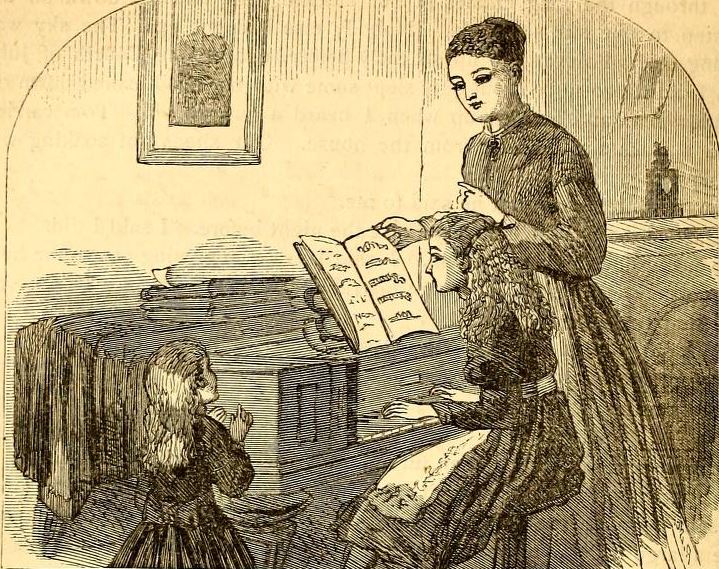
It’s not well known, but income tax in the US didn’t begin with the ratification of the 16th amendment in 1913. In 1862 an act of Congress established an income tax to pay the cost of the war. In addition to income, a number of luxury goods, such as watches, carriages, or pianos were taxed and the records show that a number of Dayton people possessed such luxuries. For example, in 1866 George W. Dunavan was taxed $2 for a watch, $4 for a piano, $2 for one carriage and $3 for a second, presumably of greater value. Isaac Green was taxed $1 for his watch, obviously not as valuable as George’s was. David Green paid $4 for his piano and brother Jesse had to come up with $2 for his carriage. James Hite was taxed only $1 for his carriage; it must not have been in very good condition. Seth Sage also paid $1 for his carriage. Moab Trumbo had a carriage ($1) and a watch ($1). Fred Tavener’s piano wasn’t all that good – he paid only $2 tax on it. Luckily, no one in Dayton had an unlicensed billiard table – that would have cost the owner $10. The Civil War taxes were not immediately repealed at the end of the war, but most of the “emergency” taxes were repealed in 1872.
May I have your autograph?

Maud Green’s autograph album, shown above, was given to her for Christmas, 1879, when she was 13 years old. She kept the album and treasured it, as years later, she added the married names of some of her young friends to their verses. A sample of some of the entries:
Remember me when washing dishes
Remember me and my best wishes.
Dear Maud,
Many a bow the archer sent
Hits a mark that was never meant.
So many a word though lightly spoken
Has healed a heart that’s almost broken.
Yours truly
Frankie R. Trumbo, by her mama
Passing through life’s field of action
Lest we part before its end;
Take within your modest volume
This memento from a friend.

The album from which this page came was given to Grace E. Green for Christmas, 1885, when she was twelve.
Dear Grace,
A little word in kindness spoken
A motion or a tear
Has often heal’d the heart that’s broken
And made a friend sincere.
Your friend and school-mate,
Allie Ainsley
Dayton, Jan. 12th 1886
My pen is poor
My ink is pale
My love to you
Shall never fail.
A verse you ask this fine day
Of course I’ll write you one.
The task of writing finds its pay
In joy that it is done.
The Dayton Enterprise

For a brief period of time, Dayton had its own newspaper, the Dayton Enterprise. It was the product of Charles Green, son of David Green. With his own small printing press, Charlie was reporter, editor, printer, and publisher. He was also a musician, giving lessons and conducting a singing school at the schoolhouse
The October 18, 1878, edition contains local and area news, humor, advertising, and an editorial about the poor condition of the sidewalks. A year’s subscription could be had for 40 cents, and it is a great loss that only this one issue has survived.
A few excerpts:
Wit and Humor
A poor relation – a carb-uncle.
Why is an insensible man like a wicked man? Because they both need to be revived.
What is the difference between a gas tube and a silly Dutchman? One is a hollow cylinder, and the other is a silly Hollander.
The first thing in a boot is the last.
Is it right for young ladies to smoke? – Yes, there can be no harm in taking a lady-like cigar – a she-root, for instance.
Query for naturalists: If a bird in the hand is worth two in the bush, is a mole on the face worth two in the ground?
Population of Dayton, latest census, 204.
Number of young men, actual count, 12.
” ” ” ” ladies, ” ” 6.
Boys, a half a dozen of us will have to go,
so as to give the other six a chance.
No. of dwelling houses in the town, 41.
” ” manufacturing establishments, 4.
” ” Hotels, 2.
1 Store.
1 Meat-market.
and 1 Printing Office,
Don’t forget that!
The Dayton Literary Society

The Dayton Literary Society was founded in February of 1881, with Isaac Green as President, Charles Green as Secretary and Harry Green as Librarian. Harry was the librarian because the library, all one hundred volumes of it, was housed at his store. You paid a monthly fee and then you could borrow any book. This label, found in every book, listed some of the rules governing the library:
ART. 4. The Time of Keeping a Book shall be Two Weeks, and any person failing to return said book inside the specified time, shall be fined the sum of 5 cts. for each day until returned. Also, any person returning a book unnecessarily soiled, shall be fined the sum of 10 cts.
ART. 6. The Librarian shall not issue Books to any person who is known to be in arrears of monthly dues or fines.
ART. 7. No person shall be allowed more than ONE Book at a time.
Unfortunately, no record of the complete “Rules to Govern Library” has survived. Did it contain guidelines for what books to include? Were books purchased, or donated from town residents? What was the most popular subject matter?
The Temperance Movement in Dayton in 1842

Temperance Meeting at Dayton1
Pledge
We, whose names are hereunto subscribed, being thoroughly convinced that the use of intoxicating liquors is pernicious to health and good morals, therefore pledge to each other, in the presence of God, and our country, our most sacred honor to abstain, in all time to come, from the use of all intoxicating liquors, except as a medicine; and that we will use our influence, on all proper occasions, to cause our friends to unite with us in this pledge.
Wm Stadden Lars Harrison
C G Miller Isaac Miller
W L Dunavan Morris Laupher
Joshua Fairchild James Thompson
Z H Baxter Lars Larson
Jesse Green Isaac Hayes
Jacob Leavens Stephen Donohoe
David Green Elizabeth Miller
Peley Frink L W Abbot
A T Marr Mrs Elvira Laupher
John Lewis Jefferson Weatherford
E G Janes Mrs Mary Weatherford
Z A Kelly Francis Weatherford
Z Preston Rachael Weatherford
Uriah Miller Rebecca Green
Joseph Green Elizabeth Jacobs
John A Quick Isaac Green
Jonathan Stadden Mrs. Mary Ann Fairchild
Albert Dunavan Mrs Eliza Dunavan
Hardin Weatherford Emma Dunavan
H Fairchild Mrs E Baxter
J M Laurence Mrs Eliza Miller
John Miller Mrs Tobitha Bockorn
John Combs Chilson McKurley
1. The Illinois Free Trader, February 25, 1842, p. 2, col. 6

