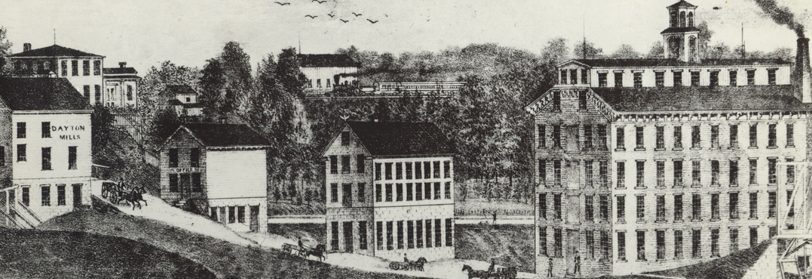
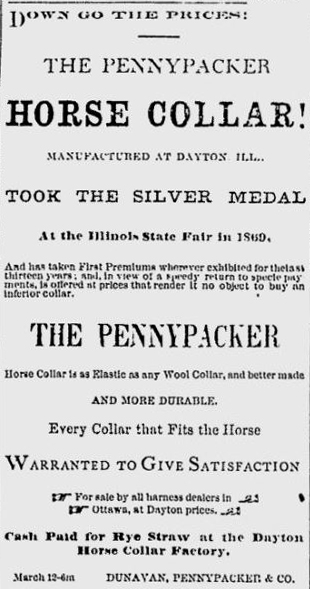
Products of the Dayton Woolen Factory

Woolen factory coverlet

This woven coverlet is one of my treasured family heirlooms. It was produced at the Dayton Woolen Factory and has been handed down in the family for over 150 years. The pattern is an example of an overshot pattern, where the horizontal yarn shoots over several vertical yarns at a time. The slight discontinuity in the pattern (circled) shows where two lengths woven on a 36 inch loom were joined to make the full sized coverlet.

Woolen ad

The factory made many kinds of cloth, as noted in this ad. Satinet was a satin-weave fabric made with cotton warp and wool filling; cassimere, a twill-weave, worsted suiting fabric; flannel, a fabric made in plain or twill weave, usually with carded yarns and napped for added warmth. My great-aunt remembered that the family was always well-supplied with stockings knit from factory yarn and the family clothing, as well as the blankets for their beds, were products of the factory. Fabric was obtainable in many colors, with basic grey, brown and black as well as blue, scarlet, green, and red. I also have another, light-weight, blanket from the factory which is a pale yellow. The products of the factory were of a high quality, as evidenced by the awards they won at cattle shows and county and state fairs, throughout Illinois and other states in the midwest.

The early mill

Green's Mills ad

In the early days of the settlement of northern Illinois, one of the most pressing needs was for a grist mill. When the Greens built their first grist mill, in 1830, it was one of the few places where people could have their grain ground. People came from as much as fifty miles away, and because of the distance and the number of people waiting for their turn, they sometimes had to wait in line for several days. The hardships of those early days made good telling in later years, as shown by this excerpt from the Earlville Gazette of February 8, 1868

Recollections of the Early Settlement of the Town of Earl, by Charles H. Sutphen

The first two winters we were here it was very difficult to get grinding, Green’s mill, at Dayton, being the only one within fifty or one hundred miles, and this mill occasionally froze up in the winter; the mill would be so crowded sometimes in the winter, that parties going to mill would have to wait sometimes two and three days for their grist.  I have laid by the hopper some two nights in succession, in the coldest of weather, waiting for my turn.  If you left your post, some one might slip a grist in ahead of yours; but this was soon remedied by the erection of mills on the Big Vermillion, and Dr. Woodworth’s, at Marseilles.