The widow is entitled to the following . . .

Appraisal of property for widow

Christian Stickley died in Dayton on April 19, 1854, and is buried in the Dayton cemetery. His widow was entitled by law to certain items from the estate for the support of herself and her children. The inventory (shown above) lists the following items:

Necessary beds, bedsteads and bedding for the family of the deceased
Necessary household and kitchen furniture
One spinning wheel
One loom and its appendages
One pair of cards [for carding the wool before spinning]
One stove and the necessary pipe therefore
The wearing apparel of the family
milk cow with calf, one for every four persons in the family
One horse, at the value of forty dollars
One woman’s saddle and bridle, of the value of fifteen dollars
Provisions for the family for one year
sheep, two for each member of the family
Fleeces taken from the same
Food for the stock above described for six months
Fuel for the family for three months
Sixty dollars worth of other property

Left with small children, the widow, Esther (Morgan) Stickley remarried, to Aaron Daniels, on February 22, 1855, and he became the guardian for her children. Watch for a future post on the guardianship releases for sons Edward and Henry Stickley.

You Wouldn’t Get Rich This Way


Illinois law in 1845 allowed for payment for certain tasks required by law:

Coroner’s Fees:

For holding an inquest over a dead body, when required by law, five dollars.
For summoning the jury, seventy-five cents.
For burial expenses, &c., ten dollars.
All of which fees shall be certified by the coroner, and paid out of the county treasury, when the same can not be collected out of the estate of the deceased.

Juror’s Fees:

To every juror sworn in each civil action in the circuit court, twenty-five cents.
To each juror sworn in a civil case, before a justice of the peace, twenty-five cents.
For attending an inquest over a dead body, when summoned by the coroner, to be paid out of the county treasury, twenty-five cents.

Fees for Guarding Jail:

To each man, for every twenty-four hours guarding jail when required, on producing the certificate of the jailer, sheriff, coroner or justice of the peace, of the same, to be paid out of the county treasury, one dollar.

The twenty-five cents paid to jurors in 1845 is equivalent to about $7.50 in current money. Until the Illinois law governing juror’s pay was changed in 2015, jurors were getting from $4 to $10 a day. Taking inflation into account, their pay hadn’t gone up in 170 years! However, jurors are now a little  better off – the present-day juror’s fees are $25 for the first day and $50 for each additional day.

The Paper Mill


tile factory about 1864

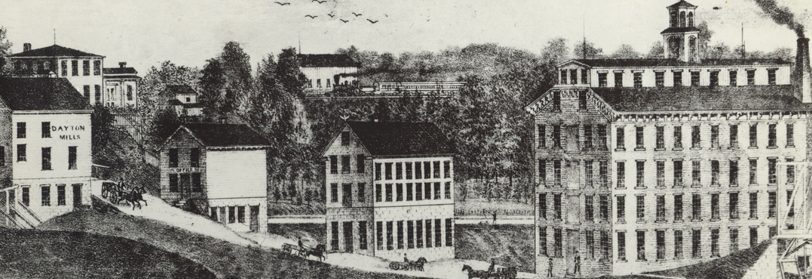
This picture, taken about 1864, shows the tile works on the west bank of the Fox river, below the bridge at Dayton. The paper mill was later constructed in the open area to the left of the existing buildings, about 500 feet south of the tile factory. As one of the major industries in Dayton, the paper mill received its fair share of mention in the Ottawa Free Trader.


July 12, 1879, p. 8, col. 1
The paper mill of Williams & Co., situated at the lower end of the manufacturing portion of the town, is one of the best in the state. Their products are so favorably known that running night and day the year round they are unable to supply the demand.

February 19, 1881, p. 8, col. 1
Williams & Co. shipped a car load of paper to Vermont a couple of weeks ago.

May 7, 1881, p. 8, col. 1
Mr. L. Eels, fireman at the paper mill, is lying dangerously ill with the erysipelas.

June 11, 1881, p. 8, col. 1
Mr. Brown, a paper mill hand, shipped his wife last Wednesday on account of her immorality.

March 8, 1884, p. 8, col. 1
The paper mill after being shut down for three months, will start up this week.

January 17, 1885, p. 5, cols. 1-2
The paper mill owned by H. B. Williams is closed for the winter, having at this time a large surplus stock on hand. It gives employment to 15 men.

January 9, 1886, p. 8, cols. 1-2
The tile works and paper mill have shut down for the winter, the latter mill putting in another machine. The tile works have had a very successful trade during the season and have sold off all their stock on hand.

February 20, 1886, p. 2, col. 4
We notice that Mr. Burks has invested in a new team and wagon. He will haul straw for the paper mill this summer.

May 8, 1886, p. 8, col. 3
The paper mill is to be started up this week, and has been rented by Mr. H. B. Williams to Messrs. David, Moore, and Hewitt. It has been overhauled, new water wheels put in, and will be in good shape for doing a good business.

July 10, 1886, p. 8, col. 4
The Paper Co. are turning out about six tons of straw wrapping paper per 24 hours.
H. B. Williams, Esq. has been painting and repairing his tenant houses in Dayton this spring, and greatly improved their appearances. The paper mill also received a coat of paint which makes it look quite respectable.

August 28, 1886, p. 8, col. 1
The paper company are putting in a new pulp engine and a new bleach tub.

September 18, 1886, p. 5, col. 3
The paper mill is receiving large quantities of straw every day. They are stocking up for winter.

November 13, 1886, p. 8, col. 1
H. B. Williams, Esq., has traded his interest in the paper mill here to F. D. Sweetzer for the latter’s interest in the agricultural store at Ottawa.

February 5, 1887, p. 8, col. 2
The paper mill has been shut down for a week or ten days to make some repairs.

February 12, 1887, p. 4, col. 6
Dayton, Ill., Feb. 11th, 1887. – The little Fox became the raging Ohio during the flood of last Tuesday. The paper mill lost six hundred dollars worth of straw, which is quite a loss to them, as it is difficult to replace it at this time of year, on account of the bad roads.
The paper mill has been fitted up with new calenders, and expected to start up this week, but cannot do so on account of high water.

February 11, 1888, p. 2, col. 4
The paper mill expects to get started this week or next. The state’s men have been busy during the past two weeks stopping a leak in the bank near the flume.

March 3, 1888, p. 8, col. 4
The paper mill men discovered another leak in their bank last week and put in a coffer dam so as to repair the damage. The holes in the bank were no doubt made by muskrats.

May 12, 1888, p. 8, col. 2
The paper mill was compelled to close down about ten days ago for want of straw. We understand they have now made arrangements for bailed straw to be shipped in and will soon be started up again. We hope they may find plenty of stock and not be obliged to stop their mill again during the year.

June 2, 1888, p. 8, cols. 2-3
The paper mill has started up again, and is getting a number of car loads of baled straw.

June 30, 1888, p. 8, col. 1
The Paper Co. are getting to plenty of baled straw and are running right along. The prospects at present are that there will be plenty of straw in the country for them after harvest.

25 Aug 1888, p1, col 4
Bart Ford, who hauls straw for the Dayton paper mill, was the victim of an unfortunate mishap on Monday evening. He was driving by the mill with a heavy load of straw, when the wagon wheels struck an obstruction and the load tipped over, throwing him to the opposite side of the wagon. He struck his face upon the tire of one of the wheels and was knocked senseless. He is terribly bruised and his nose is broken.

December 29, 1888, p. 5, col. 2
The Tile Works, Paper Mill and Collar Factory are running right along and doing a good business.

March 11, 1893, p. 7, col. 1
F. D. Sweetser has sold the Dayton paper mill to the Columbia Paper Company, a member of the trust, for $20,000. The mill was Dayton’s chief industry, and as the trust has closed it indefinitely, another nail has been driven in the coffin of village ambitions.

November 15, 1901, p. 12, col. 1
The young Indians were out in full force of Sunday morning, the event being the moving of the boiler from the old paper mill to the saw mill, at the organ and piano factory at Ottawa. It proved to be quite a task, but Bert Holmes and his little Eugene proved equal to the emergency. Mr. Lou Merrifield was in charge.

An oyster supper was held last Wednesday . . .

oyster stew

An oyster supper was held last Wednesday evening at Mr. Jesse Green’s, the proceeds of which will go toward purchasing an organ for the school house. Quite a number were present. The old organ was put up at lottery, and the proceeds from both amounted to about $25. Mr. H. B. Williams drew the instrument and we understand will sell tickets for it again, the proceeds to go for the same purpose.

The literary’s entertainment will be held at the school house Friday evening, April 4. The following is the cast of characters of the play, “Three Glasses a Day, or The Broken Home:”
Ralph Aubrey                          Mr. John Green [son of David Green]
Harry Montford                      Mr. Wm. Dunavan [grandson of Eliza Green Dunavan]
Zeke Wintergreen                   Mr. Chas. Green [son of David Green]
Mrs. Aubrey                            Miss Cora Green [daughter of Jesse Green]
Clara Aubrey                           Miss Josie Green [daughter of Basil Green]
Julia Lovegrove                       Miss Ada Green [daughter of David Green]
The entertainment will conclude with the extremely ludicrous Dutch farce, “Hans, the Dutch J. P.”1

The previous notice, which appeared in the Dayton news column of the Ottawa Free Trader describes two of Dayton’s popular social activities of the 1870s. Frequently held as a fund raiser, as in this case, the oyster supper was a well known and popular event. Packed in barrels and whisked from New York by train, oysters were a popular food. Diners could usually choose from a variety of oyster dishes: raw, fried, or scalloped, but oyster stew was the mainstay.

The play, described as “A Moral and Temperance Drama, in Three Acts” was published just the previous year. The cast of the play consisted entirely of the young Greens, aged 17 to 24, showing themselves to be very up-to-date in their literary endeavors.

“Hans, the Dutch J. P.” was also a new offering. Judge for yourself whether it is as “extremely ludicrous” as reported. A copy of the short script can be read here.


  1. The Free Trader, March 29, 1879, p. 2, col. 4

On Memorial Day We Honor Another Veteran

US flag

On this Memorial Day weekend, the veterans buried in the Dayton Cemetery take the spotlight. One of them is John W. Channel. He was born March 10, 1849 in Licking County, Ohio and came to Illinois with his parents in 1851.

In April, 1865, at the age of 16, he lied about his age to enroll in Company E, 3rd Illinois Cavalry. In May, the Regiment went to Minnesota where he participated in an Indian expedition through Minnesota and Dakota Territory. They arrived back at Fort Snelling in October, where he was discharged.

He returned to Dayton where he married Josephine Makinson on June 27, 1868. They had two children who lived to adulthood, Eva M., born in Dayton July 31, 1869, and Clyde W., born July 5, 1887.

In 1870, he was working in the Green Woolen Mill as a cloth finisher. In 1881 he moved to St. Louis where he was engaged in the manufacturing of horse collars, with J. W. Denning & Co. He sold his interest to his partner on account of poor health, and returned to Dayton  to assume the management of the Basil Green tile works. When the firm of Hess, Crotty and Williams was organized, Mr. Channel became the superintendent of the works. He remained in this position until the Standard Fire Brick Co. was organized, when he left the employ of Hess, Crotty and Williams, to become president and general manager of the new company. In 1898 he disposed of his interest in the Standard Fire Brick Co. and purchased the tile factory of Basil Green of Dayton, in company with his son-in-law, Arthur T. Ladd, operating under the firm name of J. W. Channel & Co. He died November 22, 1900 and is buried in the cemetery, as is his wife.

John W and Josephine Channel, tombtone

A Medical Story from Early Dayton

caduceus

The following report, from the Ottawa newspaper, gives details of the courage required to confront the horrors of medical care without anesthesia, in early Illinois.

Surgical Operation

           Messrs. Editors. – Permit me to lay before the readers of your paper a detailed account of an operation I yesterday saw performed upon the breast of a female living at Dayton, who, for her courage and fortitude in sustaining it, has scarcely a parallel on the records of Chirurgery. Mrs. Q____, aged about 30, perceived a tumour eighteen months’ since in the left breast, which in consequence of its small size and not being painful, was little regarded until three months since, when it began rapidly to enlarge, ulcerating and becoming very painful. Accordingly she was apprised of the truth, that there was no hope of a cure in her case, short of a complete extirpation of the tumour, to which operation she expressed her assent; and with an unflinching resolution she seemed to call forth all the energies of her body and mind, and bared her bosom to the formidable strokes of the Scalpel. The operation was performed by Doct. Hurlbut, according to the approved method laid down by Sir Astley Cooper, with a clear perception of the nature and extent of the malignant mass, being a Medullary Sarcoma, of which he was careful not to leave the least particle from which it might again form. The tumour, which weighed five pounds, was removed in about 20 minutes, although it was rendered very intricate by many adhesions. Dr. H. shurely merits the approbation of the profession, for the expert manner in which he removed the tumour; and Drs. Hatch, Sanger, and myself, who by request lent our assistance, can vouch for the feeling and tender manner the operation was conducted. Nothing, Messrs. Editors, could be more touching to our feelings than to see this poor dependent creature alive to every trivial roughness while treading the prosperous path of life, suddenly raising in mental and bodily force, to abide with unshrinking firmness this most formidable operation, not a groan passed her lips, nor was there the least distortion, or rigidity of the muscles.


  1. The Ottawa [Illinois] Free Trader, February 25, 1842, p. 2, col. 4

English Workers at the Dayton Woolen Mill

power looms

Many of the employees at the Dayton Woolen factory were from England, bringing their previous experience of factory work to the Dayton mill. One of these, William Lancaster, was working in Dayton as a wool sorter in 1870.

William was born in Addingham, Yorkshire on May 31, 1835, the son of Thomas and Ann (Wildman) Lancaster. Thomas and all his family were deeply involved in the wool trade.  Thomas worked in the West Yorkshire mills as a wool top finisher;  at least five of his sons and three of his daughters also worked in the factory. The children would start by the age of ten, on the spinning machines. As they got older, they moved on to more responsible jobs – wool combing overseer, power loom weaver, or wool top finisher. William, at the age of fifteen, was a power loom weaver of worsted cloth.

In 1859 William married Elizabeth Muff, the daughter of William and Patience (Elsworth) Muff. They had a daughter, Frances Elsworth Ann, born the following year, and in 1862, a son, Seth Elsworth. For whatever reason, William seems to have left the wool trade and moved to Pudsey, Yorkshire, where he was a milk dealer in 1861. Whether this was because of a slowdown in the wool trade or merely a desire for a change, in 1866 William left Yorkshire altogether and with his wife and son (Frances having died in 1865) took ship for America on the City of New York leaving from Liverpool and arriving in New York on July 30, 1866.

Apparently wool was in William’s blood though, as he found recruiters were encouraging workers to go to Lowell, Massachusetts, to work in the mills there. He found work there as a wool sorter, and while living in Lowell, a daughter, Martha Ellen was born. More research will be needed to explain how he heard of Dayton and why he decided to go there, but by 1870 he was at work in Dayton as a wool sorter. He inspected all incoming wool and was skilled in sorting it into lots by color and quality, as length and fineness of fiber. A successful wool sorter would have had a perception of color shades greater than that of an artist.

By 1880, William had moved his family to Jacksonville, Illinois, where he and his son, Seth, were working in the Jacksonville Woolen Mills. Apparently unable to settle in one place, by 1900 he was working and living in Chester, Pennsylvania, another mill town not far from Philadelphia. Here his wife, Elizabeth died in 1893, and a few years later he remarried, to Margaretta, widow of John Blithe. In 1910, at the age of 74, he was still working as a wool sorter. He died on March 9, 1917, bringing to a close a life dedicated to the wool trade.

Could you have voted in 1845 in Dayton?

ballot-box

Women and non-whites need not apply:

At any and all elections held in this State, all white male inhabitants above the age of twenty-one years, and having resided in the State six months next preceding such election, shall enjoy the rights of an elector, whether such elector has been naturalized or not;1

There was no such thing as a secret ballot:

Electors shall vote, by first announcing their own names to the judges and clerks of the election, and then the names of the persons for whom they wish to vote; and the clerk shall enter their names and votes accordingly: Provided, That a voter may vote by presenting an open ticket to the judges, containing the names of the persons for whom he votes, and the offices; and the said judge shall read the same to the voter, and the clerks, with the assent of the voter, set the same down in their books, as in other cases.2

And precautions were taken, should things get ugly:

For the preservation of order, as well as the security of the judges and clerks of the election from insult and abuse, it shall be the duty of any constable or constables residing within the precinct to attend at all elections within such precinct . . .3

Judges could impose a fine of up to $20 on any persons who persisted in conducting themselves in a disorderly or riotous manner after having been warned. If they refused to pay, they could be jailed for up to twenty days, or until the fine was paid.

If any judge or clerk knowingly allowed an unqualified person to vote, that judge or clerk had to pay $100 to the county, for use in defending any suit that might arise. If a judge refused to receive the vote of a qualified person, he could be indicted and, if convicted, fined $500.


1. Brayman, M., Revised Statutes of the State of Illinois (Springfield: Walters & Weber, 1845), 217, Sec. 18
2. ibid, Sec. 15
3. ibid, 218, Sec. 21

A Spring Tradition


violets          Virginia Bluebells

In the early 1900s kids made May Baskets – sometimes pages from wallpaper sample books formed into cone shapes, sometimes strips of paper woven into square baskets.  They filled them with flowers, often violets and bluebells, and with candy and hung them on friends’ doors.  The trick was to yell “May Basket!” and run away fast, because if the receiver of the basket caught you, you’d get kissed.  Of course, some ran away faster than others.

One time a boy who lived here happened to be upstairs when he heard the call “May Basket!”  He ran to a window, jumped on the porch roof, and then flung himself the 12 or 14 feet to the ground and landed running.

“Did you catch them?” he was asked.

“Oh, yes, they wanted to be caught.”

Sending Money in 1854

torn bill

Brighton Iowa May the 8th A D 1854
Dear Nephue
I have at last got ready to write to you conserning your money I went after it the first week in Aprile but Mr Dfrans was not at home and I left word for him to bring it down but he did not come tell last friday. he gave me $88 in $3 $5 and 10 bills and the ballence in gold. on saterday I turnd out to git large bills, and found but one fifty Dollar bill and that was all that I could git, larger then $10 but I have $20 so I will inclose $100 in this letter, or one half of each bill, and the other half in A letter that I have rote to send to Ephraim whare you will find it if he gits his letter and as soon as I can git sutable bills for the gold I will send it if this gose safe
I have not got that rent money yet but I sent him sharp orders if he dit not soon pay it I would give it to some boty to colect it I think your Mother could afford to come after it
we ar all well except my self I had another turn of the rumitis but am gaining again
hoping that these fue lines ma find you all in good health, write as soon as you git this and not fail, so fairwell
Jacob Snyder
[The spelling has been left uncorrected. To see the original, click here.]

This letter was written by Jacob Snyder to his nephew, Oliver Trumbo, of Dayton. In the days before the existence of checks or money orders, it was difficult to send money to someone at a distance. If it could be sent with a trusted person who was traveling to that location, that was the best. In the absence of such a person, careful people often resorted to the method Jacob describes in the above letter. A bill or bills would be cut in half; one half sent in one letter and the other half, as in this case, sent to a friend. The person to whom the money was sent would then join the two halves, which could be exchanged for complete bills. Another method was to mail the half bills and wait until confirmation arrived that the money was received. Then the second half could be sent. This method took more time, but did not require involving a second party.

A Network of Groves and Greens

The group of 24 settlers from Licking County, Ohio, that John Green led to La Salle County, Illinois in 1829 were primarily two family groups, Green and Groves. On the Green side were John, his wife Barbara Grove, and their seven children; and Henry Brumbach, with his wife Elizabeth Pitzer, who was John Green’s niece, and their son, David.

The Groves were David (Barbara’s brother) and his wife, Anna Houser, and their daughter Elizabeth; Rezin DeBolt and his wife, Emma Grove (Barbara’s sister), and their daughter Barbara; Joseph and Samuel Grove (Barbara’s brothers).

These two families account for 20 of the 24 settlers. The other four were young unmarried men: Jacob DeBolt, Jacob Kite, Alexander McKey, and Harvey Shaver.

Marriage of Jacob Trumbo and Elizabeth Snyder

Trumbo, Jacob & Eliz Snyder - marriage bond

This marriage bond was drawn up in Rockingham County, Virginia, on December 6, 1816 between Jacob Trumbo and the father of his bride-to-be, Elizabeth Snyder. The bond was to certify that there was no impediment to the marriage, which took place on December 12, 1816. Jacob and Elizabeth continued to live in Rockingham County, where they raised a family of eleven children, eight boys and three girls. In 1853, Jacob, with five of his sons and at least one of his daughters, moved to Illinois, and purchased 160 acres in Dayton Township. He was not to enjoy his new home for long, however, dying shortly after their arrival, on November 10th, 1853. Elizabeth continued to live on the farm until she retired to a house in Dayton, leaving the farm in the hands of her son, Moab. Elizabeth died May 1, 1873 and was buried beside her husband in Buck Creek Cemetery, in Dayton Township. In 1911 their bodies were moved to the Ottawa Avenue Cemetery in Ottawa and the cemetery is now a cornfield.

The Marriage of Noah Brunk and Amanda Parr

State of Illinois
La Salle County

Noah Brunk Being duly Sworn, Deposes and says, he is engaged to be married to Miss Elizabeth Amanda Parr that the said Amanda Elizabeth is under the age of Eighteen Years, and that he is over the age of Twenty-one Years. that he [has] the consent of the parents of said Amanda for her marriage with him at this time.
Noah Brunk
Subscribed and sworn before me
this 19th day of September 1857
S W Raymond   Clerk

In a somewhat unusual procedure, the consent for the marriage of this under-age bride was not given by her parents, but by the prospective bridegroom, who assured the authorities that he did indeed have the consent of her parents. The marriage was solemnized on the 24th of September, as shown by the marriage license.

Amanda would have been about 16 at this time. In the 1850 census, she appears with her parents and siblings as Elizabeth A. Parr, age 9.

Noah and Amanda had three children, Thomas L., Ida Bell, and Cora B. Ida Bell died as a child and is buried in the Dayton cemetery.

A Social Party

couple dancing

Dayton, March 4, 1884. – The young folks sent out about twenty-five invitations last week for a social party at the residence of H. B. Williams, Esq., in East Ottawa of Friday evening, Feb. 29. Messrs. John Hall, Chas. Green and Wm. Dunavan were the invitation committee, and Messrs. C. B. Hess and S. W. Dunavan were floor managers. About twenty couples were present and all had a very enjoyable time. Two large parlors had been prepared for dancing, the floors nicely waxed, and everything was in good trim. The music by Prof. Cliff G. Sweet and wife of Aurora, consisting of violin and harp, was excellent and was greatly enjoyed by all present. For good first class music, new changes and delicious waltzes, they cannot be excelled and we can heartily recommend them to parties desiring such music. At a late hour the guests retired thanking Mr. and Mrs. W. for their kind hospitality and for the pleasant time they had had. The following guests were present: Prof. and Mrs. C. W. Tufts; Mr. and Mrs. T. E. MacKinlay; Mr. and Mrs. C. B. Hess; Misses Stout, Misses Angevine, Misses Dunavan, Misses Watts, Craig, Barnes, Marriner, Misses Childs, Misses Loy and others. Messrs. Angevine, Trumbo, Hall, Mitchell, Butters, Dunaway, Flick, Clauson, Messrs. Green, Messrs. Dunavan and others.1


  1. Ottawa [Ilinois] Free Trader, March 8, 1884, p. 8, col. 1

Ice Jam and Flood

The Fox River has put on some spectacular floods in its time, but perhaps none were more newsworthy than the great ice gorge of 1952. A photographer from Chicago television station WNBQ-TV was flown over the gorge to film it and thousands of spectators flocked to Dayton to see what was happening. A slight bow appeared in the bridge due to the intense pressure against it by the slush ice. The bridge was closed to traffic when the gorge first formed, but later even pedestrians were not allowed on the bridge. When the ice subsided, the bridge was tested to be sure it was still usable.

A number of the houses on either side of the river at Dayton were submerged in the ice. The power house of the North Counties Hydro-Electric Company was out of commission due to several feet of water on the floor of the plant. The Red Cross opened an emergency shelter in the Dayton Women’s Club clubhouse to assist those displaced by the flood.

The Army Corps of Engineers was asked to assess the possibility of using dynamite to blow up the gorge, but the opinion of an expert was that the ice was too slushy and it might take a whole trainload of dynamite. The better choice was to let the rising temperature let the gorge break up gradually, not with a sudden break which would flood many of the low-lying homes along the river in Ottawa.

In a day or two, the river had dropped and the ice melted, but the cleanup for the flooded houses and power plant took weeks.

Students in the Dayton School – 1938-1942

school-children-at-desks   school-children-at-desks

The following list of students in the upper grades of the Dayton School comes from the La Salle County Genealogy Guild’s notebook on county schools.

                                1938-1939
8th grade
John Reynolds
Ruth Ralrick
Melvin Davis 
7th grade
Kenneth Buckley
Jack Reiner
Bjarne Eltrevoog
Rosemary Davis
Raymond Mathews
6th grade
John McGrogan
5th grade
Theo Mathews
Billy Buckley
Mary Logsdon
Helen Eltrevoog
Robert Lattimore
Albert Davis
Herbert Davis
                               1939-1940
8th grade
Bjarne Eltrevoog
Kenneth Buckley
Jack Reiner
Raymond Mathews
7th grade
Rosemary Davis
6th grade
Herbert Davis
Robert Lattimore
Mary Logsdon
Theo Mathews
Helen Eltrevoog
Billy Buckley
Albert Davis
5th grade
Barbara Ralrick
Betty Mathews
Glenn Logsdon
Robert McGrogan
                              1940-1941
8th grade and beyond
Kenneth Buckley
Jack Reiner
Bjarne Eltrevoog
Rosemary Davis
Raymond Mathews
William Patterson (possibly 7th grade)
7th grade
Theodore Mathews
Billy Buckley
Mary Logsdon
Helen Eltrevoog
Robert Lattimore
Albert Davis
Herbert Davis
                              1941-1942
8th grade
Billy Buckley
Robert Lattimore
Helen Eltrevoog
Mary Logsdon
Theodore Mathews
Herbert Davis
7th grade
Betty Mathews
Edward Patterson
Albert Davis
Glenn Logsdon
Leo Taylor
Barbara Ralrick
Alice Newtson
6th Grade
Jimmie Lambert
John Edsad (?)
Colline Davis
5th grade
Ruth Schmidt
Imogen Davis
Nora Davis
Donald Patterson
Marshall Claude

Eliza Ann, wife of two Civil War soldiers

At the 2008 meeting of the Dayton Cemetery Association the program was about Eliza Ann Shaw, who was married to two Civil War soldiers and is buried in an unmarked grave in the cemetery. This is the transcript of the program.

            Eliza Ann Shaw was born in London, England, in 1841. Her father, James Shaw, was a greengrocer; her mother, Catherine Henessey, was born in Ireland. The family lived on Carnaby Street, less than a mile from Buckingham Palace. It is possible, even likely, that ten-year-old Eliza and her brothers and sister were among the crowds that watched Queen Victoria on her way to open the Great Exhibition at the Crystal Palace in 1851.

            James Shaw brought his family to the United States in 1854. I don’t know why he came to Dayton, but there were a number of English families in Dayton then. Perhaps there was some connection that brought the Shaws to La Salle County. In December of 1856, shortly before her 16th birthday, Eliza married a young man from Dayton named Michael Klingston. Michael came to the US from Bavaria and became a US citizen in 1863. By 1864, they had three small children.

In September of that year, Michael was drafted in the 1st Illinois Light Artillery, at a time when Sherman was fighting the battles around Atlanta. Sherman had been fighting since May and needed replacements for his army. Michael Klingston probably arrived at Atlanta just after the city surrendered on Sept. 2. He then took part in the march to the sea and arrived in Savannah, GA in December. Savannah surrendered on the 22 and Michael was probably taken ill around this time, since he did not take any further part in Sherman’s march north through the Carolinas. Instead he was transferred to David’s Island in New York suffering from chronic diarrhea. From there he was sent to Quincy, IL, where he died on April 15, 1865. His cause of death is given as consumption.

Michael appears to have been buried at Quincy; he is not buried in the Dayton Cemetery. Eliza and the children continued to live in Dayton. In December 1865 Eliza remarried. Her second husband, John Jaka, a farm hand from the St. Louis area, had also served in the Civil War.

            John Jaka volunteered at the beginning of the war in July of 1861 and joined the 9th Illinois Infantry, which became known as the “Bloody Ninth”. The 9th earned its reputation by being involved in the fighting at Forts Henry and Donelson in Feb. 1862, then being sent to Pittsburg Landing, which was the site of the battle of Shiloh. At Shiloh, the 9th was in some of the worst of the fighting, and of the 520 enlisted men that went into the battle, 324 of them were either killed or wounded. John must have had a charmed life if he escaped all this with no injuries. Between spring of 1862 and summer of 1864, the 9th was mounted on mules and so scouted and raided through Alabama and Mississippi. It was during this time that John was injured the first time. Quoting from his application for invalid pension, he states “He was on picket-duty mounted on his mule when said mule was shot from under him by a shot from the enemy. He thought he could get the mule on his feet again and while attempting to do so, the mule in his struggles, struck John on the great toe of his left foot dislocating the said toe and otherwise greatly injuring the foot. On account of that he went to the Regimental Hospital near Atlanta, GA where he remained untreated for 24 hours, then returned to his regiment.” The 9th took part in Sherman’s battle for Atlanta, and that was where John was injured for the second time. Quoting again, “At the battle of Atlanta, on or about the 22 day of July, 1864, while in the act of discharging his Spencer rifle at the enemy, his said gun was struck by a gun shot from the enemy which struck the stock of his rifle and threw a splinter therefrom which struck him in or near the right eye seriously injuring the same.” John probably didn’t see any more action in the war, since he was discharged in August of 1864, probably because his 3 years were up. The 9th was one of about 16 regiments across the country that were considered “German” and John Jaka was German by birth.

            Following his discharge in August of 1864, John came to Dayton. Again, it’s not known what brought him to Dayton. He may have known someone during the war who was from this area. He worked as a farm hand for Sylvester Brown, near Wedron. In 1865, he married the young widow, Eliza Klingston. All was well for a time, but a year later Eliza’s mother, Catherine Shaw, was named guardian of the Klingston children, due to their mother’s being adjudged insane. This guardianship was probably to ensure that the pension the children were entitled to for their father’s war service would not be controlled by their mother’s second husband. The insanity appears to have been temporary, however, and Eliza soon returned home, to take up her life with John Jaka. By 1883, Eliza and John had four sons.

            When Eliza was about 46, she again became insane and was in a hospital for a short time, but then appears to have again recovered and returned home. This recovery was not permanent, either, and in 1893, at the age of 52, she was again confined to an insane asylum, first in Kankakee and later in the La Salle County asylum. In 1904, after John’s death. she entered Bartonville Asylum, near Peoria where she spent the rest of her life. Her son Otto was named her guardian. When she died, in July 1907, Otto brought her body back and she was buried in the Dayton cemetery. There is no stone marking her grave.

Last Will and Testament of John Green

1098-john-green-frame

On January 19, 1874, John Green, of Dayton, made out his will. He was 84 years old and was to die in less than four months, on May 17. He laid out his wishes in a series of nine provisions, as follows:

First, he instructed his executors to pay all of his debts

Second, his three sons were each required to pay their mother $25 per quarter, so that she would have an annuity of $300 per year for the rest of her life. Also Barbara was to have her bed and bedding and make her home with her youngest son, Isaac.

Third, his son Jesse was to inherit 95 acres of farm land and 8 lots in the village of Dayton.

Fourth, his son David was to inherit 19 acres of land and 8 acres of riverfront, along with the rights to a certain fraction of the water power of the Fox River and 8 village lots.

Fifth, his son Isaac was to inherit the land where the house stood, along with the farm land (which is now [2017] still in the family).

Sixth, his daughter Rebecca Trumbo was to inherit 5 lots in the village.

Seventh, he noted that his daughters Eliza Dunavan, Nancy Dunavan, Katharine Dunavan, and Rachael Gibson had all been provided for previously.

Eighth, if any personal property remained after settling the debts, it was to be divided equally among his three sons.

Ninth, he appointed sons Jesse and David as executors

The complete transcription of the will may be seen here.

Hardy Pioneer Women

conestoga-wagon

The women who settled the Illinois frontier in the 1820s had to be hard-working, resourceful, determined, and tough. Barbara Grove Green, who, with her husband John, led a small band of pioneers from Ohio to Illinois in 1829, was surely that. She may have imagined her life to be settled,  living in Licking County, Ohio, with her husband and seven children, but at the age of forty, John decided to move west. He found a suitable place in Illinois, on the Fox river, four miles above the junction with the Illinois river and returned to announce that they would leave immediately, although it was late in the fall. Ignoring advice to wait until spring, a group of twenty-four men, women and children left for the west. John and Barbara were the senior members of the group, at 40 and 37; in addition there were three young couples in their twenties and six young unmarried men.

The first years were difficult ones. The small cabin where the group spent the first winter was replaced as soon as the saw mill was up and running. Two more children were born in Illinois: Rebecca in 1830 and Isaac in 1833. During the Indian Creek massacre scare, Barbara walked the four miles from Dayton to Ottawa with the rest of the family, carrying the baby, Rebecca, who cried if anyone else carried her.

Homemaking chores would have consumed her time. In the early days, these would have included salting and preserving the plentiful prairie chickens and quail that her sons trapped during the winter. Life became a little easier after the grist mill was in operation and she no longer had to grind wheat in a hand grinder. With yarn from the woolen mill, she knit socks and long stockings for everyone. Along with all the necessary sewing and mending, she made candles, rag carpets, and all the many other needs of a self-sufficient household.

Maud Green remembered her grandmother Barbara:
“Then in February it was carpet-rag time and we all sewed & wound carpet-rags & sent them to the weaver.  The new carpet went in the “sitting room” and the others were moved back until at last they reached the kitchen & were worn out there. I can just remember Grandma making candles for us to carry upstairs.  They were afraid to have us carry a lamp, but we had lamps as long ago as I remember. Grandma spent her time knitting socks and long stockings for all of us, out of factory yarn, and we had woolen underwear, skirts and dresses made of factory flannel.”

Barbara led a long life as the matriarch of the Green clan. When she died in Dayton, May 3, 1886, at the age of 93, she was remembered with affection in her obituary:

Granma Green, the oldest settler in the county, died Wednesday morning, at the age of 84 [sic] years. She was of a kind, benevolent disposition and was well beloved by her wide circle of relatives, friends and acquaintances by whom she will be greatly missed.1


  1. Ottawa (Illinois) Free Trader, 8 May 1886


A Sudden Change of Temperature

winter-storm

From Jesse Green’s memoirs:

I will give an account of the most sudden, and greatest change in temperature, in my recollection, which occured in the early winter of 1837 & ’38.  I left home about noon when it was drizzling rain sufficient to wet my clothing, and when I reached a point a little below Starved Rock, it commenced turning cold so fast that I ran my horse as fast as he could go to Utica, and by the time I reached the hospitable home of Simon Crosiar, it had frozen the ground hard enough to bear up my horse, and my clothing as stiff as it would freeze from being wet.  I had to be helped from my horse, and saddle and all together my clothing being frozen to the saddle, and I do not think I could have gone a quarter of a mile farther.

The next day returning home it was a terrible cold day, my left side against the wind was nearly frozen by the time I reached Ottawa, where I went into a store to warm myself, and all I could do to prevent it, fell asleep in a short time, I heard a number say that during that blizzard, they saw chickens frozen in their tracks.

Jesse was a year off in his memory of the event, as the “sudden change” happened on December 20, 1836, but he well remembered the after effects, as did many others. The meteorological background of the sweeping cold front, and a number of stories of Illinoisans caught as Jesse was, can be found here.