It’s All Grist to the Mill

sliced bread

from Jesse Green’s memoir:

Early in the spring of 1830 development of the water power was commenced by using the stumps from the timber from which the mill was being constructed. Economy was sought to a greater extent than it is at the present time. The saw mill was built with sufficient room to put a pair of stones in one end of it to do our grinding until a better mill could be erected, having brought with us the necessary mill irons, black-smith tools etc. [This mill was called the Old Pioneer.]

Our second flouring mill was built in 1831. Having plenty of lumber at this time, a good frame building was erected but before we had got fully acquainted with the pranks of old “Fox”, we found that we had encroached too closely on her banks, and by way of admonition a gorge of ice shoved the mill back a little, sufficient for a warning, the damage not being so great but that it was soon repaired so as to do our grinding until a third mill could be built.

The third mill was built in 1834 of much greater dimensions containing five pairs of “flint ridge burrs” gotten in Ohio together with the old Pioneer [stones], which were used for grinding corn and buck-wheat. This mill did a very extensive business in the manufacture of flour which found a ready market in St. Louis at that time, and a little later Chicago became our market. I find an old receipt reading as follows.

“Dayton, June 10th, 1843”
Received of John Green nine barrels of flour in good condition, which I agree to deliver in like condition to  J. V. Farwell in Chicago without delay.
Signed Gersham Burr.

This mill did all the grinding for the surrounding country for a radius of eighty and in some cases, one hundred miles. I distinctly remember grinding a grist of white winter wheat for “Old Davy Letts” as he was familiarly called, that made him forty pounds to the bushel of the best flour I ever made, this after tolling it, and I think better flour than we get today with all of our boasted improvements in milling. I attended mill for five or six years, and learned the impossibility of making number one flour out of inferior wheat, and I do not think it can be done under present processes. Among my first mill customers after I commenced tending mill, were our Indian friends. In grinding their small grists of from one peck to two bushels of wheat to each family, which is what they had gleaned from wheat fields, after the harvesters had passed over the ground, and it was always a question in our minds whether those having the larger grists, might not have encroached upon some of the sheaves or shocks in passing them. I had thirty different families to grind for at one time, which I did free, until I came to one of those two bushel grist, when I attempted to toll it, (which would be one peck for toll) it seemed to them too much like discrimination, as I had been grinding all of those smaller grists free, so I put the toll back and ground for all free.

Such was the rush to our mill, that frequently there would be too many to be accommodated at my father’s home, and they were obliged to camp out, about the mill, sometimes for near a week, awaiting their turn for grinding and we were unable to store their grain in the mill, until near their turn for grinding. The mill ran day and night to its full capacity (of six pairs of stones.) Soon after this mill was built, the Rock river country commenced settlement, and they had to depend upon our mill for their flour, and would come with ox teams (four pairs) and take two tons to the load, I frequently loaded up one of these teams before breakfast, and probably by noon would have the train all loaded up. They would come with little bags of silver (their only currency then) and I remember at one time, I had a little trunk nearly filled with it.

The demand for flour was so great that it necessarily annoyed those waiting so long to have their grists ground, to see several of those large teams come in the evening, and start off the next day with their loads. But we reserved the right and satisfied them, that we should be entitled to the use of one pair of burhs out of the six, to do our own grinding for those not having wheat of their own, and to keep the toll wheat out of the way which would require the use of one pair, three fourths of the time to do it, and this pair was kept running constantly on what was termed merchant work, or flour for sale.

Musical Dayton


DAYTON, Dec. 24. – Dayton, unlike many western towns, is blest with a number of good things, and one of the good things is the Musical Union, which was organized last spring by Prof. Newbury, and has since been conducted by our esteemed fellow citizen, Mr. Chas. Green. We also have a Glee Club in Dayton. And all feeling a high appreciation of Mr. Green, determined to make that feeling manifest by giving him a benefit. Hence a concert was agreed upon and given last Friday evening, which was well attended, not only by the village people, but by many from the country. All were well pleased with the entertainment and expressed a desire to come again. We certainly have good reason for anticipating a bright future for Charlie in his wisely chosen field of labor, knowing as most of us do that he is in a very large degree self-made in his profession. May success crown your every noble effort, friend Charles.1

Dayton, Feb. 24. – Friday evening, Feb. 13, the Musical Union gave a concert and entertainment, which was well attended and quite a pleasant occasion. The class are making good progress in music and it is to be hoped the Union will continue its existence for a long period. The choruses “Great is the Lord,” “Lift your glad voices,” “Zion’s children, ” “O, Lord of Heaven,” “Crown them as Martyrs” and “We all are happy rovers” were given in a very fine manner. Marks of power were carefully observed, thereby giving considerable expression and life to the choruses. The male quartette and glee club, consisting of Messrs. Green, Rhoads, Howard and Grove, sang a few selections in an admirable manner. Their quartette “I love the path of the tree” and chorus “Barnyard Serenade” are especially worthy of mention.2

The Musical Union will give an entertainment at the school house next Wednesday evening, Feb. 23, the proceeds of which will go towards procuring chorus books for the Union. Mr. Frank Fitzgerald will assist in the entertainment with his cornet solos, and, with Mr. Harry Hammond, will give a musical sketch and minor comicalities. The Union will also furnish music in the way of quartettes. A good enjoyable time is promised, and everybody is invited. There will be no lack of fun. You will miss a treat if you are not there.3

The Musical Union are preparing an interesting drama entitled, “The Lost Children,” which will be given at the school house Saturday evening, April 30. Admission 10 cts. This drama is full of interest and excitement and the minstrel scene is quite funny. The play opens with a fine prelude followed by an interesting chorus. Then the plot of the play commences. A small company of soldiers have been well drilled by Capt. Howard and will form a scene with their military maneuvres, army songs, &c. A band of minstrels is also introduced in the play with their instruments, darky songs, jokes and scenes, the whole forming a pleasant evening’s entertainment. You should not miss hearing it; besides this is the closing entertainment for the season of the Musical Union, and it should be well attended.4

A large audience assembled at the school house last Saturday evening to witness the presentation of the drama, “The Lost Children,” by the Musical Union, assisted by others of the home talent. Considerable pains had been taken to make this closing entertainment a complete success and the members of the company exerted themselves to their utmost to secure that end and acquit themselves creditably. The words of the play were all well memorized and the parts were finely sustained. The characters of Jamie and Lily, “the lost children.” were performed in an excellent manner by little Eddie Hess and Gertie Howard, who entered into the spirit of the play and were highly encored by their appreciative listeners. The prologue and epilogue by Eddie and the tableaux in which Gertie figured beautifully as the Goddess of Liberty, capped the climax of their success. William Dunavan as Mr. Manly, Cora Green as Mrs. Manly, and Dessie Root as Bridget sustained their parts admirably. The other characters of the play, Jennie Dunavan as Miss Fitzallen, William Davis as Mr. Bonville, James Green as Town Crier, Chas. Green as Watchman, and William Holton as Dick, played their parts well. The squad of soldiers under the command of Thomas Howard was a novel feature in out home theatricals, and the drill and the military tableaux were considered very fine. The minstrels deserve a word of praise for their funny efforts. The singing between the scenes by the chorus of young girls was quite good and their selections appropriate. All in all the drama was quite a success and is highly satisfactory to the management. The members of the Union desire to return thanks to Capt. S. R. Blanchard, of Ottawa, for his kindness in fitting our the military scene, which made the drama quite effective, to Mr. Thos. Howard and others for their kind assistance in presenting the drama, and to Wright’s orchestra for their excellent music.5


  1. Ottawa (Illinois) Free Trader, December 27, 1879 [page labeled Dec. 20]. p. 8, col. 2
  2. same, February 28, 1880, p. 8, col. 2
  3. same, February 19, 1881, p. 8, col. 1
  4. same, April 23, 1881, p. 10, col. 1
  5. same, May 7, 1881, p. 8, col. 1

Apple Butter Time

cider press

In 1932, a small booklet titled “Stories of Pioneer Days in La Salle County, Illinois” was produced by the grammar school students of the village and rural schools of the county. 14-year-old Virginia Esmond wrote of happy famiiy times on the Furr farm, the property of her great-grandparents, Squire Newton Furr and his wife, Mary Elizabeth Bruner.

APPLE  BUTTER TIME
by Virginia Anne Esmond, Dist. 142.

There was great excitement in the house. Tomorrow was to be the great boiling down of the apples to make apple butter at my Great-grandmother Furr’s home.

The house was about half a mile west of Dayton. The relatives were to come in the morning and stay all day to help. The men were out in the orchard getting apples to use. Romany apples were the kind used. They were excellent for eating and cooking. When stored in barrels in the basement they lasted till the next summer. Some of the smaller cousins were helping pick up apples, too. Some of the windfalls were used in making cider in great-grandmother’s cider presses. She had two of them.

People used to come from miles around with wagon loads of apples to be made into cider. In later years when the grist mill at Dayton ground apples and pressed out the juice for cider the people used to take their apples over there and have them ground. Eventually my great-grandmother did, too.

The best apples on the ground were used to make apple butter. The cider was made and boiled down. The stirrers, which are long wooden paddles with handles set in them at right angles, long enough to keep the person stirring from getting too hot, were made from the wood of a large maple tree that had been injured when the crib burned down.

Early the next morning the boys were in the orchard picking up more apples.

Somebody had to go to town to get the relatives that were to help. When they arrived they exchanged greetings, as they hadn’t seen each other probably for quite a while. They set to work washing apples. After they were washed, the young folks peeled them with two peelers. The young people thought it quite a bit of fun to turn the crank on the peelers, but the novelty wore off before the apples were all peeled. The older folk sat down and cored the peeled apples.

Some cider was put in the boilers to keep the apples from burning. As soon as the apples were peeled and cored they were popped into the boilers. They kept on boiling down. As soon as the boilers were filled enough so that they wouldn’t boil down much more, the young folks went out in the pasture to catch old “Dexter.” The city cousins considered riding old “Dexter” much fun, even if he was a driving horse instead of a riding horse. Two or three of the young folks got on the horse at once.

Much of the time was spent also by the young people in rambling over the farm and sometimes sliding down the strawstacks. Also amusement could be found in the barn, both in the hay loft and in where the animals were.

The men worked in the fields after carrying in apples by the basketful. Each one of the younger folks took his turn stirring the boiling apples.

The women had a sociable time preparing dinner. The relatives stayed to supper that the women had prepared. After supper the visitors usually went home and the women at grandmother’s finished the work.

They took the apple butter off the stove at about nine o’clock. Then it had to be put in crockery jars about ten inches high. A cork fitted into the top that was about half an inch thick. This was sealed with sealing wax. A few days later the butter was distributed and each family took some home. Everyone that had helped make the apple butter could be reminded of a pleasant day at Grandma Furr’s whenever they tasted of the butter.

The Paltry Sum of One Dollar

last will and testament

When Elizabeth (Snyder) Trumbo died in Dayton on May 1, 1873, she had been a widow for twenty years. She had moved off the farm, into a house in Dayton where she died. Her will indicated that most of her children had been previously provided for, but she left specific bequests to four people:

To her daughter Mary Jane, wife of Isaac Green, two thousand dollars and the house in Dayton;

To her grandson Walter Trumbo, son of John Trumbo deceased, eight hundred dollars;

To her daughter-in-law Rebecca (Green) Trumbo, wife of her son Oliver, eight hundred dollars plus the residue of the estate;

To her daughter-in-law Delia, wife of her son Ahab Christopher deceased, one dollar.

As part of the duties of executor of the estate, Oliver W. Trumbo sent Delia Leith, living at Mason, Effingham County, Illinois, a one dollar bill and this receipt for her to sign –

Received Mason Ill December     th 1877 of Oliver W. Trumbo executor of Estate of Elizabeth Trumbo deceased the sum of one dollar in full of legacy bequeathed to me by the will of Elizabeth Trumbo deceased.

Please insert date when you sign the above Receipt.

The reason that I know this is because the envelope containing the unsigned receipt (and the dollar bill) was returned to the executor and appeared in the probate file along with the following note:

Mr. O. W. Trumbo.
Dear Sir
Enclosed I return your one dollar. I do not propose to sign my name to any papers of the Estate for the paltry sum of one dollar.
Yours Truly
Fidelia Leith

When I saw this file in the probate court office, in 1988, the dollar bill, crumpled and worn, was in the envelope. Unfortunately, it is no longer there.

George W. Gibson

GEORGE W. GIBSON

For three-score years George W. Gibson has made his home in LaSalle county, having come here from Ohio with his parents in 1838, and he is not only familiar with the history of the county, but has also contributed his part toward its growth and development.

Mr. Gibson was born in Marysville, Kentucky, March 22, 1826, and along the agnatic line traces his origin to Scotland. His grandfather, Robert Yates Gibson, was a Scotch army officer, and when a young man emigrated to this country and settled in Pennsylvania. In Cumberland, Pennsylvania, John Gibson, the father of George W., was born and reared. He was a soldier in the war of 1812. He married Elizabeth C. Yates, like himself a native of Pennsylvania and a descendant of Scotch ancestry. Some time after their marriage they removed to Marysville, Kentucky, where they remained for two years, going thence to Licking county, Ohio, and in 1838 coming to Illinois and establishing their home in LaSalle county, where the father purchased a farm and where he and his good wife passed the rest of their lives and died, her age at death being seventy-five years, while he attained the venerable age of eighty-six. She was for many years, and up to the time of her death, a devoted member of the Methodist Episcopal church. This worthy couple reared six children, as follows: Martha, wife of C. McKinley, is deceased; Maria is the widow of James Trenary; William, who died in Eldorado, Kansas, was a veteran of both the Mexican and civil wars, being colonel of the Fourth Illinois Infantry; George W., whose name graces this sketch, is also a veteran of the Mexican war; J. M. was likewise a soldier in the Mexican war; and Theodore, also a veteran of the Mexican and civil wars, was major of the Sixty-fourth Illinois Infantry, and has for years been a resident of Ottawa, Illinois.

George W. Gibson was a lad of eleven years when his parents first sought the Illinois prairies, and was reared in the vicinity of Ottawa, attending the Ottawa schools. In 1849, in company with his brother Theodore, he started westward to seek the gold fields of California; they made the trip with ox-team and were six months on the way. En route they passed large herds of buffalo and were often in terror on account of the bands of Indians along the trail. For three years he remained in the west, engaged in mining, returning to Chicago at the end of that time and thence to his home in LaSalle county. The return trip was made by way of the Isthmus of Panama and New York city. Aside from this western mining experience, Mr. Gibson’s life has been quietly devoted to agricultural pursuits. Although now seventy-three years of age, he is still active and vigorous, both physically and mentally.

Mr. Gibson was married first in 1856, to Miss Cynthia Robinson, and to them were born two children, Lewis and Clara. Lewis married Miss Flora Ditch, and they have two children, George P. and Mabel. Mrs. Cynthia Gibson died in 1861, and for his second wife Mr. Gibson married Miss Rachel Green. There were born of this marriage two children – John and Alta, who became the wife of William Miller, of Pennsylvania, and who has one child, Gertie. Mrs. Rachel Gibson died in 1883, and in 1889 Mr. Gibson was united in marriage to Mrs. Mary Ann Poole, his present companion. She was the widow of Joseph Poole, who was a native of England, and she is the mother of five children, three sons and two daughters.

While he has never been a politician in any sense of the word, Mr. Gibson has always in local affairs given his support to the men best suited for office, while in national affairs he has voted the Democratic ticket.1

George Gibson’s second wife, Rachel, was the daughter of John Green of Dayton. She is buried in the Dayton Cemetery.


  1. Biographical and Genealogical Record of La Salle County, Illinois (Chicago: The Lewis Publishing Company, 1900), 1: 281-283.

Tangled Relationships

Family_tree

Though not royal or noble, the family trees of the early settlers of Dayton bear a certain resemblance to those of the noble family above. There was a limited number of possible spouses for the young people and, as a result, many of the marriages involved familial relationships.

Among the children of John and Barbara (Grove) Green :

David Green and wife Mary Stadden were 1st cousins once removed. Mary’s grandmother, Elizabeth Green Stadden, was John Green’s sister.

Jesse Green and wife Isabella Trumbo were 1st cousins. Isabella’s mother, Rebecca Grove Trumbo, was Barbara Grove Green’s sister

Sisters Eliza, Nancy, and Katherine Green married brothers William, Albert, and George Dunavan and when their descendants grew up, there were many cousin marriages.

Rebecca Green married Oliver Trumbo, while her brother Isaac married Oliver’s sister Mary Jane.

Oliver Trumbo was also the half 1st cousin of Jesse’s wife Isabella. Isabella’s father, Matthias Trumbo, was Oliver’s half-uncle.

Rachael married George W. Gibson, who was not related to her or any of her family.

In the later generations –

Elizabeth Dunavan married Cyrus DeBolt, her 1st cousin once removed. Barbara Grove Green, Elizabeth’s grandmother, was the sister of Emma Grove Debolt, Cyrus’s mother.

Louise Dunavan married David S. Green, her 1st cousin once removed. David’s father Isaac Green, was the brother of Louise’s grandfather, John Green.

Rachael’s son John Gibson married her brother Jesse’s granddaughter Mamie Green.

No wonder I have trouble keeping everyone straight!

Cora Watts – Artist

Cora Watts - artist

Cora Belle Dunavan was born June 20, 1879, the daughter of Samuel Dunavan and Amanda Miranda Munson. She was the granddaughter of Joseph and Nancy (Green) Dunavan and the great-granddaughter of John and Barbara (Grove) Green. Her maternal grandmother was Rachel Hall, one of the sisters captured by the Indians during the Indian Creek massacre in 1832.

She married Harry Wallace Watts on October 7, 1904. They lived and farmed near Leland, until Harry’s death in 1949.

As can be seen above, Cora lived a long and productive life, dying in Ottawa May 22, 1964. She was generous with her paintings and gave them away freely. I own several. One is a copy of a picture postcard of a Bavarian castle I visited and greatly admired, but my favorite, which hangs in my living room, is a picture of the home in Dayton where I grew up.

Frog Hunting and Fishing in the Fox River at Dayton

DAILY EVENTS
Tuesday, June 3, 1890

A sport which is becoming quite popular with Ottawa cigar-makers is frog hunting. George Keim and Morris Flynn captured several dozen of these pet animals at Dayton on Sunday.1

Frogs were not the only sport in the Fox river at Dayton. It was known for the good fishing, attracting people from a wide area. Anglers fished for common snook, redfish, trout, bass, pike, catfish of several species, walleye, and muskellunge.

Our busy little neighbor, Dayton, besides becoming famous for her horse collars, woolen goods, tile and paper, is getting to be quite a popular summer resort. The stream of visitors during the few weeks since the fishing season opened must be enormous, for on every bright day at least the banks of the river are lined with people. As a sample of the size of parties: – Some 25 couples from Streator went up in a special car on Tuesday! Already the campers have begun to put in their appearance, and it is altogether likely that from this time until fall there will be no great diminution in the number of visitors. We should think the citizens would turn this flood of tourists to their advantage; and they certainly could make themselves vastly popular with the people of the Fox River Valley by lending their aid in the suppression of illegal seining in their waters.2

In 1884 a muskellunge was caught at Dayton with a hook and line, that weighed over 32 lbs.! It was over four feet long, and 9 inches across the body.

Fishing is all the rage here now, and a large number of game fish have been caught and carried away during the past two weeks. Good fishermen have caught all the way from 25 to 100 and over of black bass, ranging from one pound to five and six pounds in weight. The river seemed to be full of them and sportsmen are having a jolly time.3

In 1891 it was reported that over 1000 fish were caught at Dayton in a single day.


  1. Ottawa Free Trader, 7 Jun 1890, p. 3, col. 2
  2. Ottawa Free Trader, 27 May 1882, p. 6, col. 1
  3. Ottawa Free Trader, May 12, 1888, p. 8, col. 2

A Father’s Consent

Dunavan, G - Green, K - marriage consent

Dayton Ill June 14th 1837
J. Cloud Esqr
            Sir I have given my Consent For you to Lisen [license] George M. Dunavan & my Daughter Katharine to be joind in motrimony
John Green

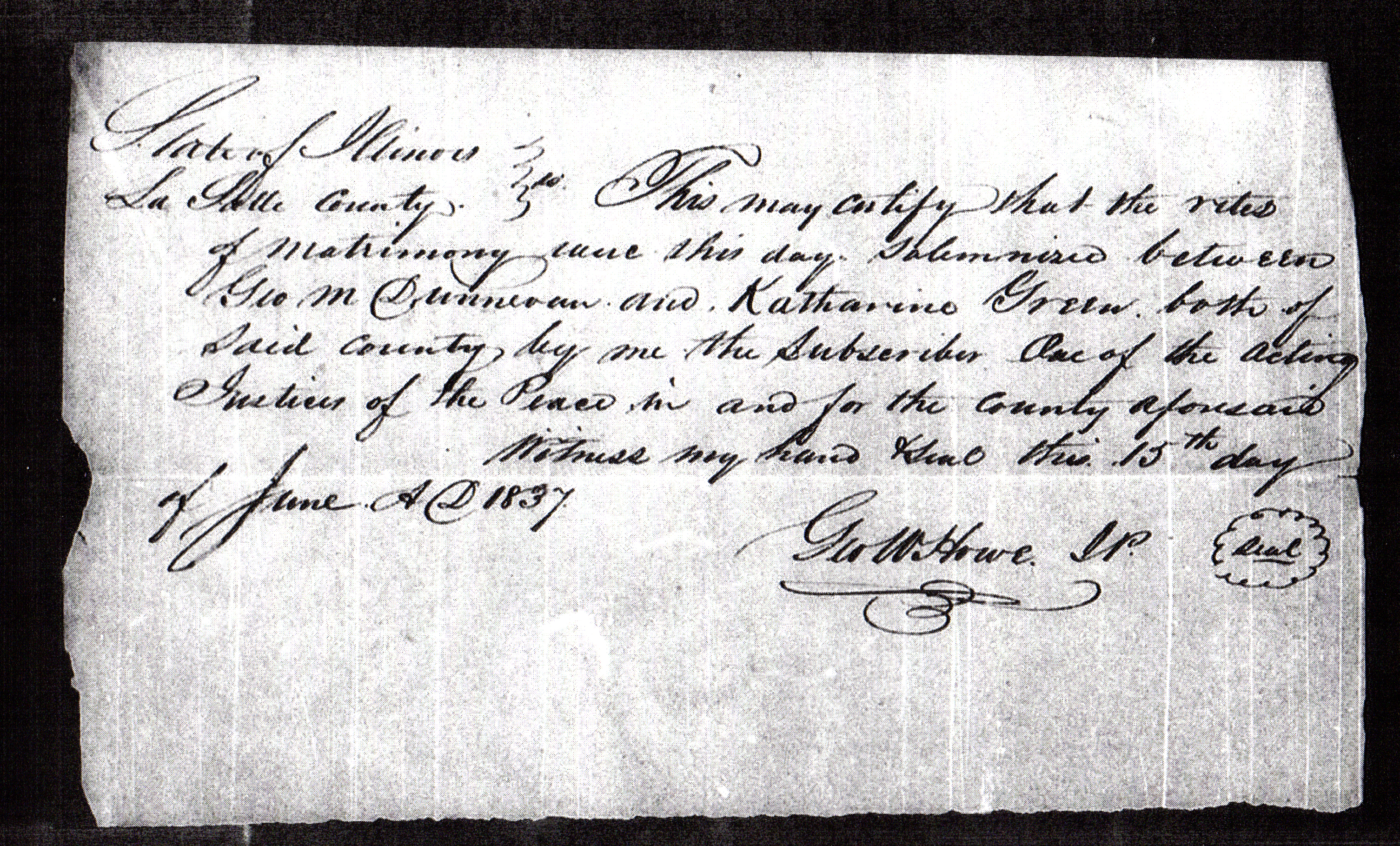
Since Katharine Green was only 15 when she married George Dunavan, her father sent this note of consent to Joseph Cloud, county clerk. The following day Katharine and George were married.

Dunavan, G - Green, K - marriage certificate

State of Illinois
La Salle County
This may certify that the rites of matrimony were this day solemnized between Geo. M. Dunavan and Katharine Green, both of said county, by me the Subscriber, One of the acting Justices of the Peace in and for the county aforesaid.
Witness my hand & Seal this 15th day of June A D 1837.
Geo W Howe, JP

WOOL! WOOL!

ad for Dayton Woolen mill

This ad for the Dayton Woolen Factory appeared in the Ottawa Free Trader on April 26, 1844. Jesse and David Green, the proprietors, advertised for people to bring their wool to be processed.

Customers could trade their wool on the spot for finished product, thereby not having to make a second trip to pick up their cloth when finished, or they could have their wool worked on shares, where the merchant took a share of the wool as his charge for making the cloth.

The customer also had a larger choice when choosing the finished material. He could also choose to only have the wool carded and/or spun, so that it could be spun or woven at home.

For cloth woven at home, it could be finished at the factory. Fulling (the scouring and thickening of the cloth), shrink-proofing, dyeing, and pressing — all would be done in a workman-like manner.

A Spring Day in 1881


house under construction

Rural Happenings

Dayton, April 21. – Good bye, old snow, good bye. Fox river has been and is at present on the “boom.” It commenced rising last Saturday and was so high by Monday morning the mills were unable to run on account of the back water. They are still unable to run. Sunday afternoon the water was up to the top of the old pier and towards evening it was carried off.

Martin Wilkie is putting an addition to his dwelling house on Canal street, at present occupied by Geo. W. Green. Mr. Wilkie is one of our most enterprising citizens and is assisting materially in improving the town.

H. B. Williams has the foundations commenced for two new tenant houses. He received three car loads of lumber from Chicago this week for his tenant houses. Mr. W. is another of our best citizens and a believer in progression.

Miss Sadie Holton, of Braidwood, Ill., is visiting at Geo W. Green’s.

Mr. John Channel and family, of St. Louis, are visiting at Geo. W. Makinson’s. John was formerly one of the boys of Dayton and it seems like old times to have him with us again.

Jackson Channel, of Marseilles, who had his arm badly injured at that place a few weeks ago, made Dayton a short visit last Wednesday.

H. B. George, Esq., of Leland, gave Dayton a short call one day this week.

The Literary Society and Musical Union have adjourned until next fall.

The Musical Union are preparing an interesting drama entitled, “The Lost Children,” which will be given at the school house Saturday evening, April 30. Admission 10 cts. This drama is full of interest and excitement and the minstrel scene is quite funny. The play opens with a fine prelude followed by an interesting chorus. Then the plot of the play commences. A small company of soldiers have been well drilled by Capt. Howard and will form a scene with their military maneuvres, army songs, &c. A band of minstrels is also introduced in the play with their instruments, darky songs, jokes and scenes, the whole forming a pleasant evening’s entertainment. You should not miss hearing it; besides this is the closing entertainment for the season of the Musical Union, and it should be well attended.

The tile factory are about ready to commence operations for the summer. They will have tile for sale again in a few weeks.

OCCASIONAL1


  1. The Ottawa Free Trader, April 23, 1881, p. 10, col. 1

100 Years Ago Today

Grade-School-Graduate

ANNOUNCE DATES FOR GRADUATIONS OF COUNTRY SCHOOLS
Rural Schools of the Entire County are to Unite for Exercises
Each Grade to be Represented in Programs

Dates for holding graduation exercises thruout the county has been set by County Superintendent of Schools W. R. Foster. It has been arranged this year to have several of the schools unite in holding their commencements. Each grade of each school is to furnish at least one number for the programs which will precede the presentation of diplomas.

Arrangements have also been made for charging 15 cents admission for the exercises this year instead of the ten cent charge of previous years. Five cents of this money will be turned into a fund to purchase stereographs for the rooms and the remaining ten cent fee for a book fund.

The complete list of dates for the holding of exercises and the committee of teachers in charge of each community unit follow:
. . .
Dayton, June 10. – Jennie Fraine, Margaret Durkee, Bessie Eaton1

Final exams for the seventh and eighth grades of the rural schools were held on May 7th and 8th. About 800 students participated. The first commencement was held at Harding on May 18th, and graduation exercises were held almost  every night until June 15th, including those in Dayton on June 10.


  1. The Ottawa Free Trader, May 6, 1920, p. 4, cols 2-3

May Baskets

May Basket (cone)        VirginiaBluebells


When I was a child, it was a tradition for Dayton children to hang May baskets. We made the baskets out of construction paper. There were two styles – one rolled into a cone, and one of heart-shaped basketweave. We picked wildflowers – bluebells and violets – for the baskets and put a handful of candy corn or popcorn in the bottom of the basket. The baskets were delivered  on May 1st by hanging a basket on the doorknob of a house, ringing the doorbell, and then running away. After all baskets had been delivered, we went home to see all the baskets that had been hung on our door. Long after I should have outgrown making and hanging May baskets I made enough for everyone in my office and hung them on the doorknobs of their offices before they came to work.

violetsMay basket (woven)

Basket Picnics

Vicinity Items

A mammoth pleasure excursion and basket picnic has been arranged to run from Streator to Dayton on Tuesday, Aug. 18th. For three years similar excursions have left there, and this promises to be the most enjoyable of all. Dayton’s beautiful scenery, fine shade, and unequaled reputation as a pleasure resort is unsurpassed, and Streator people, having no such beautiful or romantic camping out places near their city, have to come this way for such beneficial pleasures.1

A basket picnic was a popular event to raise money for charity. The women prepared picnic lunches in beautifully decorated baskets, filling them with their own personal culinary specialties. At the auction, all the baskets were anonymous, although it is possible that some husbands or beaux may have received a hint as to the identity of a desirable one. As the auction proceeded the men and boys competed to bid on baskets, and the winner would not only get the basket, but would share the lunch with the lady who created it.


  1. The Ottawa Free Trader, August 1, 1885, p. 8, col. 4

Mr. & Mrs. Moab Trumbo

Moab Trumbo

Moab Trumbo

Rebecca Kagy Trumbo

Rebecca Kagy Trumbo


Society Notes

Mr. and Mrs. Moab Trumbo, two of Ottawa’s most venerable and highly respected old people, celebrated their golden wedding anniversary last Tuesday in a most inconspicuous manner. The day was passed without any celebration to mark the event. This was due to the recent bereavement visited upon the aged celebrants in the death of their son, the late Sheriff Frank Trumbo. Despite their desire to pass the day quietly, many neighbors called informally to pay their respects and many beautiful bouquets were sent Mr. and Mrs. Trumbo. Mr. Trumbo is eighty-two years of age and his wife is seventy-six. Both enjoy the best of health and chances are bright for them to add several more years to their long and happy marital career. Moab P. Trumbo and Rebecca Kagy were united in marriage in Rutland township, February 27, 1862. Shortly after their marriage they moved to Dayton, where they resided up to the time of their coming to Ottawa to live, a few years ago. Mrs. E. F. Bradford, wife of the present mayor, is the only surviving child.


  1. The Ottawa Free Trader, 8 Mar 1912, p8, col 2

Mathias Trumbo – 1812 Veteran


Mathias Trumbo was the husband of Rebecca Grove, sister of Barbara Grove Green. He came to La Salle county in the second wave of immigrants from Licking county, Ohio, in 1830.

Mr. Trumbo came to this county in 1830, locating in Mission township, now known as Rutland township. Much of the land was still in its primitive condition and he took up a claim from the government, being one of the first settlers in this part of the county. Not a furrow had been turned nor an improvement made upon his farm and he at once began its cultivation, his labors resulting in transforming the tract into richly productive fields. His ancestors were of German birth, although the family was founded in America in early colonial days. Mathias Trumbo served his country as a soldier in the war of 1812, enlisting in Rockingham county, Virginia, which was his native country. After coming to La Salle county he gave his attention to general agricultural pursuits in Rutland township for many years and there resided until his death, which occurred November 20, 1875, when he was eighty-eight years of age, his birth having occurred on the 23rd of July, 1787. His wife bore the maiden name of Rebecca Grove and was also a native of Virginia. She removed to Ohio, where she was reared from the age of ten years and there she remained until her marriage. She, too, spent her last days in Rutland township, La Salle county, passing away in 1865, at the age of seventy-one years. In the family of this worthy couple were eight children, of whom five are now living: John, who was born in 1819, died in 1841. Lavina, born in 1820, married West Matlock, and lived near Yorkville, Kendall county, Illinois. Isabella, born in 1822, became the wife of Jesse Green, who resides in Ottawa, but her death occurred in 1854. Eliza, born in 1826, died in 1904. Elias, her twin brother, is still living in La Salle county. Barbara, born in 1829, is Mrs. Jackson. Elizabeth, born in 1833, is now Mrs. Strawn, a widow living in Ottawa. Elma Anna, born in 1838, is the widow of L. C. Robinson and resides with her sister, Mrs. Jackson, in Ottawa.1


  1. U. J. Hoffman, History of LaSalle County, Illinois (Chicago: The S. J. Clarke Publishing Co., 1906), 295-6.

APRIL FOOL!!

april-fools-day

Ottawans at play on April Fool’s Day:

They tell us a good one on Al, a south-side-of-the-square druggist, who got up a brilliant April fool speculation. He took his best business coat, and vest, and hat, down to the bank of the river on April 1st. He enclosed a note in one of the vest pockets, which read pensively to the effect that “whiskey has caused this fatal act,” and invoking the blessings of Heaven on the praying women. Giving directions on how to dispose of his body when dragged from the river bed, he then retired behind a bunch of willows and watched for a victim — someone to come along and find the clothes and give an alarm. He saw in the distance the jury, and anxious citizens, much excitement, drag robe, &c. But no one came. He waited all forenoon and rubbed his hands and kicked the ground with his feet to keep them warm, but still no one came. Then he went up town and threw out vague hints about “some one being found drowned — clothes on the willows at the river bank,” &c., but still the old thing didn’t work! At dusk he lonesomely repaired to the river and brought away his “duds” and meandered home through the back alleys. If you want to worry him just allude to his cute April fool speculation.1

If a proper observance of Fourth of July is going out of style and Christmas, New Year and Saint Valentine days are not as popular as they once were with Ottawa people, April Fool’s Day is, as the other days lessen in public esteem, receiving more attention. On Thursday all the practical jokers were on the lookout for victims. Lon Piergue furnished nicely frosted cotton cakes, and stood back and laughed while George Taylor, Gib Strawn and editor Zwanzig vied with one another in their attempts to masticate them. At the Clifton Hotel half the boarders swallowed salt in their coffee and made wry faces over bran pancakes. At the suggestion of Pat Carey, Judge Weeks spent fully five minutes at the telephone trying to talk to an imaginary somebody at the other end of the line. The day in short, was very much of an “All Fool’s Day.”2


  1. The Ottawa Free Trader, April 4, 1874, p. 4, col. 6
  2. The Ottawa Free Trader, April 3, 1886, p. 1, col. 4

Dam Across Fox River at Dayton

Dam across Fox River at Dayton

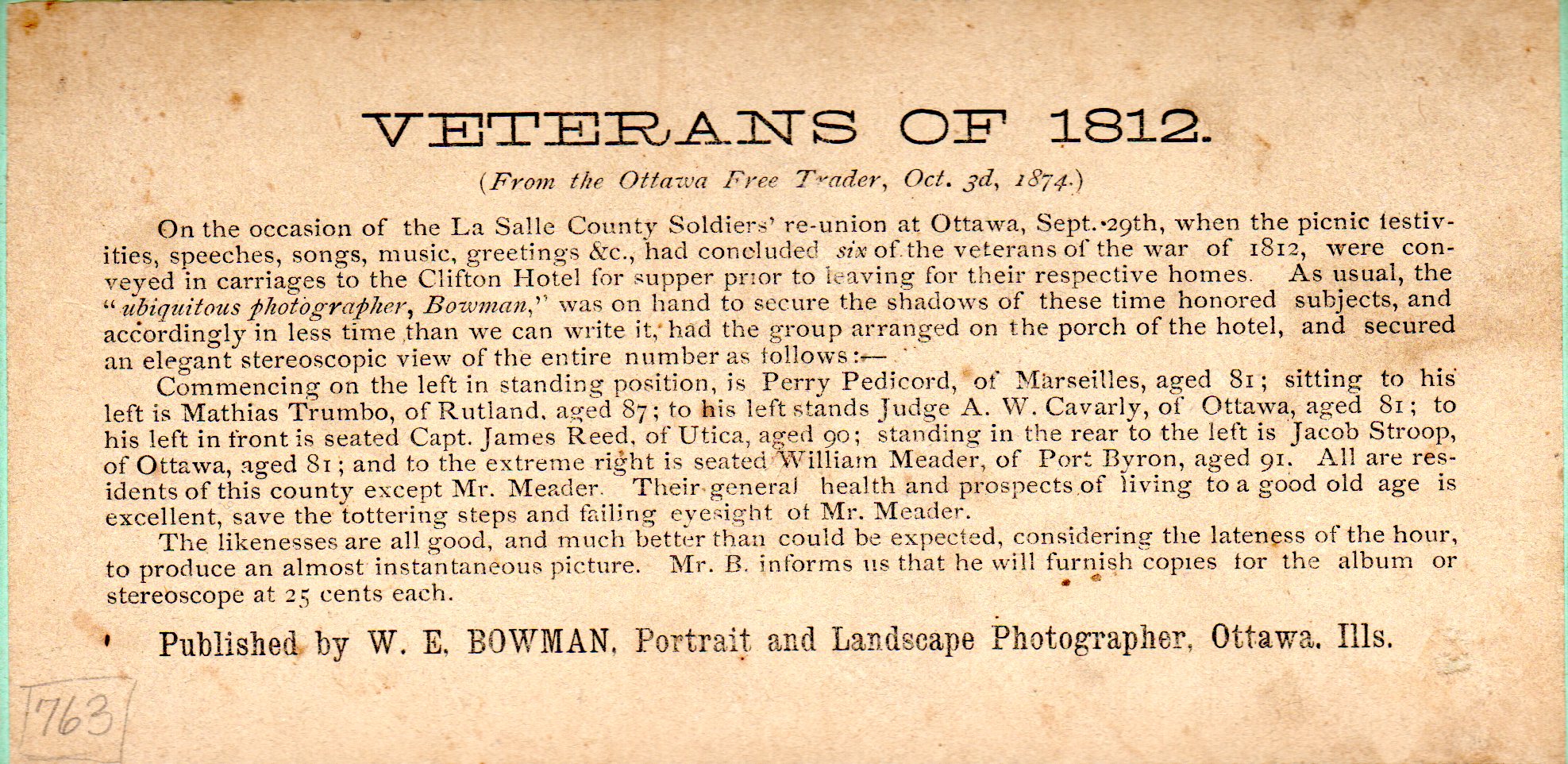
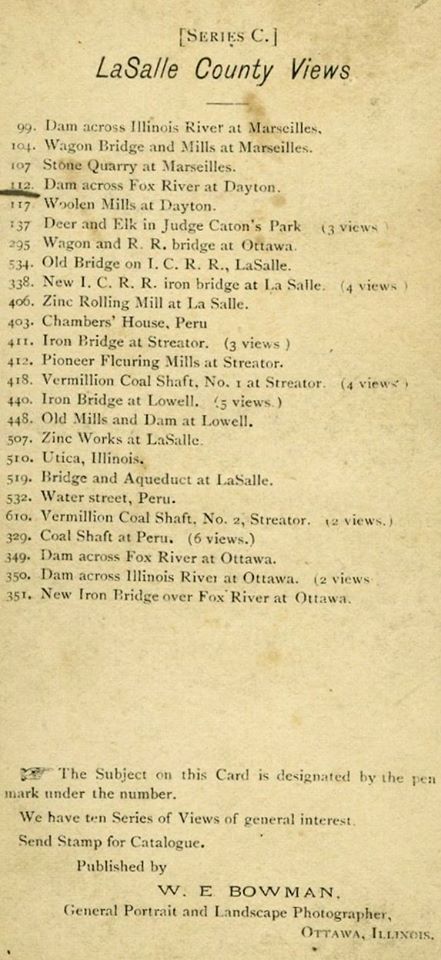
The back of this stereoscopic view of the Dayton dam lists a number of other views taken by William E. Bowman, Ottawa photographer. Although (as seen below) he dealt with historic scenes and famous people, he also took many photos of local people and places.

Ottawa’s old time photographer, W. E. Bowman, is now leading a retired life near Los Angeles, Cal. His gallery became famous for his historic faces and scenes. Thousands of eminent men and women have been before his camera, including Abraham Lincoln, William McKinley, Theodore Roosevelt, and other Presidents of the United States. He served as postmaster of Ottawa from 1882 to 1886. He was alderman in 1875-6, was the first secretary of the Riverside Driving Park Association, was trustee of the Academy of Natural Sciences, president of the District Union, which was composed of fifty temperance reform clubs, vice-president of the National Photographers’ association, president of the Memorial association, and generally active in all public affairs. Mr. Bowman was born April 28, 1834, at Huntington, Pa., coming to Illinois in 1837, and locating in Boone county. He came to Ottawa in 1865 and resided here until 1910.1

Back of stereo card


1. Ottawa: Old and New (Ottawa, The Republican Times, 1914), 129

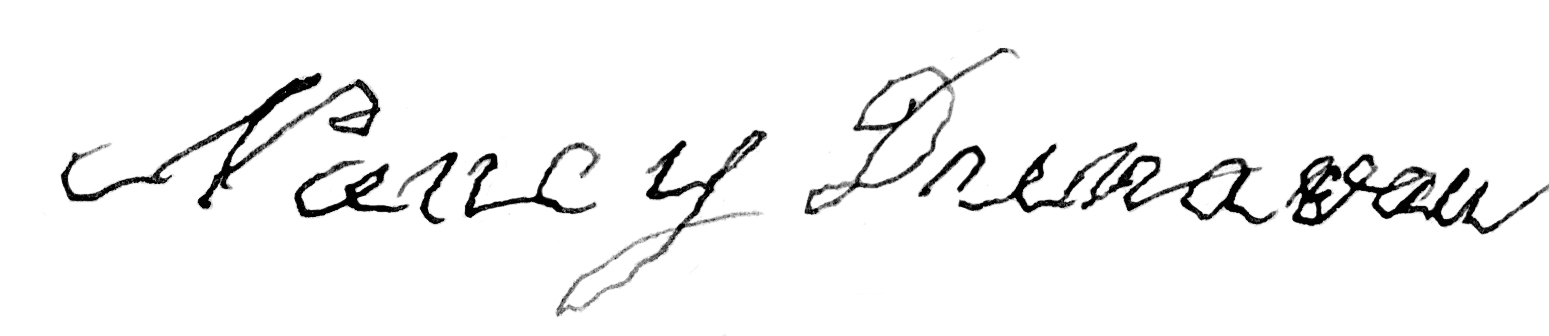
Death of Nancy Green Dunavan

Mrs. Nancy Dunavan

Mrs. Nancy Dunavan died on the 27th of February, 1905, at the home of her son, David Dunavan, near Hamilton, Mo. She was born on April 26, 1816, in Licking county, Ohio, coming to this state with her parents, John and Barbara Green, in 1829. They were pioneers of Dayton precinct. She was married to J. Albert Dunavan in 1834, and settled on a farm in Rutland township, which was at that time a part of Dayton precinct. They lived there for 55 years, until 1889, when they left there a few years later to live with their children at Hamilton, Mo. Her husband died in February, 1892. She leaves one sister, Mrs. O. W. Trumbo, of Dayton, and one brother, Jessie [sic] Green, of Ottawa. The only surviving members of a large family are two daughters, Mrs. Kate Brandon and Mrs. Jennie Howe, of Missouri, and five sons, Samuel Dunavan, of Adam, Ill., Isaac, of Minnesota, David, George and Lewis, of Missouri.1


  1. Ottawa Free Trader, March 10, 1905, p. 7, col. 6

Dam Being Built at Dayton in 1924

building the dam

A Million Dollar Dam Being Built at Dayton

 About forty men are now at work on the new dam across the Fox river at Dayton, a few miles southeast of Earlville. The project will cost in the neighborhood of a million dollars and it is planned to have power ready by next April.

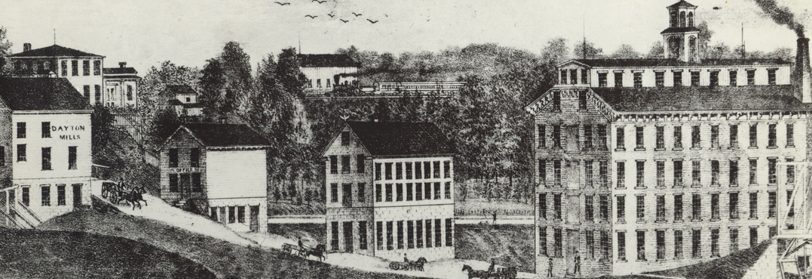
The power house will occupy a site on the west bank of the Fox, formerly occupied by an old stone structure, built almost a century ago and known then as the Green woolen mills, which has been razed to make room for the new plant.

The site of the dam is about 1,000 feet north of the highway bridge. The dam will be 625 feet in length, and will be of a type known as a multiple arch. Engineers in charge of the work say they know of but one other dam of this type. It is in Italy. The dam will be arched upstream in moderate crescent shape. Attached to this arch on the upstream side will be other arches in 25-foot units, extending from the top of the dam to the bottom. The dam will slope gradually up stream so that the body of water will rest upon the dam as well as against it.

The old feeder canal will be used to convey the water from the dam to the powerhouse. It will be dug deeper and rip-rapped with material taken from the old Green building, which was of Joliet stone.

Plans call for a 30-foot head of water, with water standing at a depth of about 25 feet at the dam. The backwater, it is said, will be only one foot at Sulphur Lick Springs, and the overflow will cover but little more than 80 acres of farm property.

Heyworth plans to carry material to the site of the dam from the Burlington railroad by electric power. A power house for the development of electricity will be constructed on the west bank of the river and an oil engine installed. Material will be taken from the cars on the Burlington switch and transported directly to the dam, dump cars being used to eliminate cost of handling.

When this dam is completed it will form one of the most beautiful spots In LaSalle county. The lake will be from a few feet in depth at Wedron to 25 feet in depth at Dayton, a length of four or five miles by a breadth of more than 600 feet.1


  1. The Earlville Leader, 12 Jun 1924, p. 9