Christmas in Dayton, 1931

Christmas greetings

Program Given at Community Party at Dayton

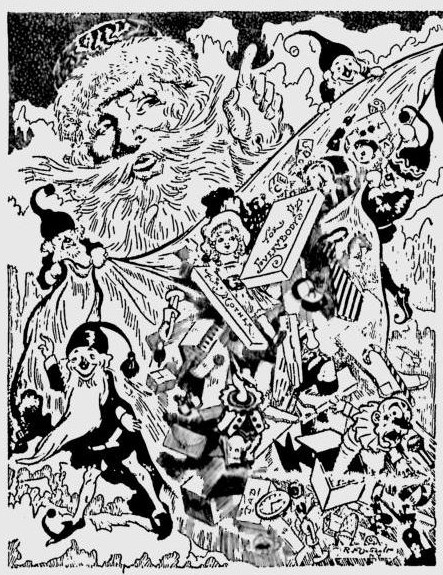
Decorated Christmas trees and red and green streamers formed an attractive setting in the Dayton Community hall, Saturday evening for the annual Christmas party sponsored by the Dayton Woman’s club.

One hundred and seventy-five guests were served cafeteria style at the community supper at 7:30 o’clock.

An interesting program of vocal, piano and dance numbers was presented by a group from the vicinity of Dayton. The program consisted of the following numbers: piano solo, Dorothy Mitchell; song, Mrs. T. J. Cruise, Miss Anna Cruise and Will Breese; solo, Will Breese; duet, Mrs. T. J. Cruise and Miss Cruise; reading, Zelda Garrow; solo, Billy Gardner; solo dance, Dorothy Mitchell; acrobatic dance, Della Tohella; Christmas song, Mrs. Benson Chamberlin; cornet solo, Walter Anderson; solo, Alden Garrow; solo, Earl Gardner; solo, Nicholas Parr.

An orchestra furnished tunes for old time and modern dances at the conclusion of the program.

The committee in charge was comprised of Mrs. Arthur Retz, Mrs. Thomas Waldron, Mrs. Alvin Hepner and Miss Emma Fraine.1


  1. Ottawa [Illinois] Republican-Times, December 28, 1931

Christmas in Dayton, 1888

Dayton Doings

Dayton, Ill., Dec. 27. – King Winter visited us last night and we find a good covering of snow on the ground this morning. A little more and we will hear the sleigh bells jungle.

Christmas day has passed and everyone has recovered his usual equilibrium – at least we should suppose so.

The Sunday school gave a very pleasant Christmas entertainment, at the school house, Monday evening. A good program was rendered, after which the children were made happy by receiving many toys, candy, as well as useful and pretty presents.

Our worthy P. M. gave a family dinner at his residence on Christmas day, which done up the post office for that day, at least.

A large family dinner was also held at the residence of Mrs. David Green in which about 35 persons happily participated.

In fact the day passed very pleasantly in our little village, although the young folks were pining for the beautiful snow, and its accompanying sleigh rides.

Frank Green came down from Chicago to spend the holidays.

W. J. Burke has gone to Penryn, Placer county, California, where he has hired out for a year to work on Mr. P. W. Butler’s large fruit farm. He writes back that he is delighted with the country.

The Brick Works have had fine weather for rebuilding, and have got a new roof on their building, new floors, &c., and will soon have it in good shape again. We understand a new company has been organized with about $30,000 capital stock, Messrs R. C. Hitt and Ed. C. Alen Jr., of Ottawa being members of the new company; also Messrs. Soule and Williams. We wish success to the new company, and see no reason why the property should not be a paying institution, if properly managed.

The Tile Works, Paper Mill and Collar Factory are running right along and doing a good business.

The Roller Mills have had a good big trade and been quite busy. The farmers are learning where to take their grists of wheat and corn to have good work done, and will patronize home industries.1


  1. Ottawa [Illinois] Free Trader, December 29, 1888, p. 5, col. 2

The First Dayton Bridge


John Green owned the west bank of the Fox river in 1837 and William Stadden owned the east bank. The following act of the General Assembly authorized them to build and operate a toll bridge.


AN ACT to authorize John Green and William Stadden, to build a Toll Bridge across Fox River.
In force 20th July, 1837

Sec. 1.             Be it enacted by the people of the State of Illinois, represented in the General Assembly, That John Green and William Stadden, their heirs and assigns, be and they are hereby authorized to build a toll bridge across Fox River; in township number thirty-four, north of range number four east, on section number twenty-nine at the town of Dayton, in La Salle county, State of Illinois.

Sec. 2.             The said John Green and William Stadden, their heirs or assigns shall commence the building of said bridge within two years, and complete said bridge within five years from and after the passage of this act; said bridge shall be built in a good and workmanlike manner, so as to give a safe and easy passage to all persons and their property wishing to cross said bridge.

Sec. 3.             After said bridge shall be completed, the said John Green and William Stadden, their heirs or assigns, are hereby authorized to place a toll gate on either end of said bridge or elsewhere, where they may ask and receive of all and every person passing said bridge such toll as the county commissioners’ court shall fix from time to time.

Sec. 4.             If said bridge shall be out of repair for more than six months at any one time, said charter shall be forfeited; Provided, That destruction of said bridge by fire, high water, other casualty shall not work a forfeiture of the privileges hereby granted, but said Green and Stadden, their heirs or assigns, shall proceed immediately to repair the same.

Sec. 5.             If any person or persons shall wilfully do or cause to be done any injury to said bridge, the person or persons so offending shall forfeit and pay to the said Green and Stadden, their heirs or assigns, double the amount of such injury or damages, to be recovered before any court having jurisdiction of the same.

Sec. 6.             The said Green and Stadden, their heirs or assigns, shall be entitled to purchase, hold and convey, as much real estate as may be necessary to construct the aforesaid bridge, and erect a toll house or whatever may be necessary for the use and purposes of said bridge.

Sec. 7.             This act to be in force from and after its passage.

Approved, 20th July, 1837.

The Hazards of Winter Travel

snowdrifts

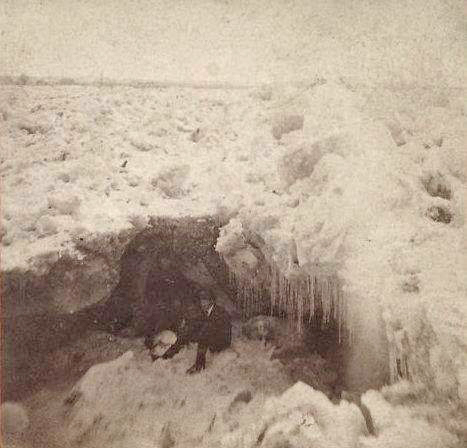
After the Fox river bridge at Dayton was washed out in the 1870s, traffic between Dayton and Rutland was difficult. There were two places where the river could be forded during low water and there were times in the winter when the ice was firm enough to allow crossing. The ice was uncertain, however, and could not be counted upon. The only other option was to go around by Ottawa and cross on the bridge there.

Dayton was isolated even further when heavy snow made the roads impassable. To make matters worse, when the snow melted, the mud was an equal obstacle to travel.

The Ottawa [Illinois] Free Trader, January 8, 1881, p. 8, col. 3
Dayton, Jan. 5. – The river is now being crossed at this place on the ice.

The Ottawa [Illinois] Free Trader, February 19, 1881, p. 8, col. 1
Dayton, Feb. 16. – The “thaw” of last week was unable to start the ice at this place, with the exception of that on the rapids above the woolen factory, which moved down and broke up our ice bridge. We are thus left without any means of communication with the other shore. The great snow storm on last Friday and Saturday has given a new impulse to sleighing and the “merry sleigh bells” are again heard all over the land. East and west lanes and the roads are, however, most of them, impassable on account of deep snow drifts. The thermometer at this place last Monday morning recorded 14 degrees below zero.

The Ottawa [Illinois] Free Trader, March 19, 1881, pp. 4-5, cols. 6 & 1
The “beautiful snow,” as far as sleighing is concerned, has departed for the last time this winter we trust. The streets and roads are left in a terrible condition, being in places almost impassable on account of the water, slush, snow and mud. The lane from Dayton to the main road to Ottawa has been blocked with snow for about five weeks, so that all travel is by the way of Mr. Olmstead’s. The thaw and light showers have not raised the water in Fox river at this place to a very noticeable degree. The ice is still in the river, and has probably become so softened that it will do no serious damage to dams or bridges.

The Ottawa [Illinois] Free Trader, June 4, 1881, p. 8, col. 2
Dayton, June 2d, 1881
The river is falling slowly, and is now being crossed at both fords. Fishermen and sportsmen are here in great numbers. The Earlville people seem to have struck a “boom” and are turning out en masse for a good time fishing and camping out.

The Ottawa [Illinois] Free Trader, February 6, 1886, p. 7, cols. 3-4
The river is all frozen over solid and teams are crossing below the paper mill.

The Dayton bridge had been out since the early 1870s and not until 1885 was a plan for its replacement finally put into action. It still took two years before it opened. (For the story of the Great Dayton Bridge Affair, click here.)

The Ottawa [Illinois] Free Trader, April 2, 1887, p. 4, col. 6
From Dayton
Dayton, Ill, April 1st, 1887. – Our bridge is finished at last and open for public travel. It is a very fine three span iron bridge, the neatest one on the river, and is a fine addition to our village. Of course every one will use it now that it is constructed, and it was noticed that about one of the first to use it was one who had fought the hardest.

Repairing the damage


In 2014 and 2015 we repaired and restored a number of the grave markers in the Dayton cemetery. The cemetery was 180 years old and over the years had suffered from vandalism and the ravages of time and weather. Some stones had fallen over and were embedded in the ground, as was the Gerret J. Harms stone seen above. Others had been knocked over or had fallen as the ground shifted beneath them. John Heider, a professional gravestone restorer, drafted a number of family members as his willing, if not terribly able, helpers. Before we were done, some of us were very able.

Some other before and after pictures may be seen here.

Thanksgiving 1901

turkey

The reporter to the Free Trader from Dayton was careful to chronicle the Thanksgiving activities of his neighbors.

DAYTON

George Galloway enjoyed his duck at his own fireside on Thanksgiving day.

Mr. Isaac Green and family were guests of Mr. and Mrs. O. W. Trumbo on Thanksgiving day.

Mr. and Mrs. George La Pere dined with Mrs. La Pere’s parents, Mr. and Mrs. William Lohr, on Thanksgiving day.

Mr. and Mrs. Ed McClary spent Thanksgiving with Mr. E. H. Pederson and wife, deputy U. S. marshal at Yorkville.

Miss Blanche McGrath and Miss Kate Hogan of Streator were guests of the Misses Colman on Thanksgiving day.

William and Walter Breese and Lowell Hoxie and wife of Aurora spent Thanksgiving with Mr. and Mrs. John Breese.

William Collamore, Jr., of Ottawa and Miss Olson of near Morris, gave Thanksgiving at the home of William Collamore, Sr., and wife, on the 28th.

Wilmot Van Etten, agent for the Q. at Batavia, with his wife and three sons, Clare, Walcott and Frank, dined with Mr. and Mrs. O. W. Trumbo on Thanksgiving day, returning on the afternoon train for Batavia.1


  1. Ottawa Free Trader, December 6, 1901, p. 12, cols. 1-2

The 225th anniversary of Barbara Green’s birth

Barbara Grove Green

Barbara Grove Green was born November 15, 1792, in Rockingham County, Virginia. She was my great-great grandmother and by the time she died, she was regarded as the grandmother of a large area of the county. Here’s what was said about her in the Free Trader on May 22, 1886:

From Dayton
Barbara Grove Green

            Died May 5th, 1886, at the age of ninety three years, five and a half months. She had been confined to bed for about two months, and gradually and gladly passed away like an infant going to sleep. It was her desire to cast off this earthly tabernacle and be present with her Lord.

She retained her faculties to the last, with the exception of her sight, of which she had been deprived for the past seven or eight years. She was never heard to murmur or complain of her misfortune, but on the contrary seemed cheerful and happy.

She was born in Shenandoah county, Virginia, November 15th, 1792. At the age of thirteen she, with her parents, removed to Licking county, Ohio, being in the year 1805, and lived there until the fall of 1829, when she and her companion, John Green and family, removed to this county. A few incidents of their journey will show the hardships and privations of those early pioneer days. We quote her own words from statements made by her to one of her grand daughters, who has recorded them:

“We started from Licking county, Ohio, on the first of November, 1829, for the state of Illinois. There were 24 in the company. Father had gone to Illinois the September before we started and bought land. He and three other men rode on horseback around by Cleveland and along the lakes. When they reached Chicago, where there were only two families besides the garrison, father bought some provisions and in paying for them pulled out quite a roll of bills. That night his brother, Wm. Green, dreamed there were robbers coming and woke the others up, but they refused to start out in the night just for a dream, and he went to sleep again only to dream the same thing again, and when he had dreamed it three times he told them they could stay there if they wanted to, he was going to leave; so they all started and soon after they saw three men following for the purpose of stealing they [sic] money.

“When we reached the ‘Wilderness,’ in Indiana, a man who lived on the edge of the woods told us it was impossible to go on, as the mud was so deep, unless we could travel on the wagons already stuck in the mud; but if we were foolish enough to try it, we must leave ‘those two smart little boys’ (Jesse and David), for we would surely freeze to death. But we did go on and the men cut a new road through the woods for sixty miles, about ten miles a day.

“The, when we got to Cicero river, we had to take the wagons over with bed cords. One wagon, loaded with mill irons and blacksmith tools, was so heavy it tipped over, and we lost a good many things.

“Then the next place we came to was Sugar creek, and it was so high we had to pull the wagons over with ropes again and cut trees for us to walk on. Then there was a swamp next to the creek that the men had to carry the women over on their backs. Between Iroquois and Nettle creek there were five days the horses had nothing to eat, as the prairie was burnt, and they became so weak they got stuck in a ravine and could hardly pull the empty carriage out.

“One evening we had only bread and tea for supper, but that night father came back with corn and beef that he had obtained at Holderman’s Grove, and we were the happiest people you ever saw. We spent the next night at the Grove and the next day home, at what is known as William Dunavan’s farm.”

She lived in the town of Rutland something over a year when she removed to Dayton, being at this place at the time of the Black Hawk war in 1832. Of this war she says: “On the 16th of May, 1832, the girls and I were at the spring, near where the feeder bridge now stands, when Eliza came down on horseback and told us that the Indians were coming, and we would have to go to Ottawa immediately. Then we went to a place a couple of miles below Ottawa and stayed there all night, and the third day returned home again. This was Sunday, and the next day the men made a stockade around the house out of plank. After it was finished they tried it to see if a bullet would go through it, and as it did, they hung feather beds all around. There were about sixty people here at the time, and we were so crowded that they had to sleep on tables, under the beds and all over the house.”

Mr. Green had intended to remain in his improvised fort during the war, but at about twelve o’clock at night, hearing of the massacre on Indian creek, and fearing there might be too many Indians, all those in the fort went to Ottawa. “When we got to Ottawa, there was no fort there, only a log cabin on the south side of the river, but they soon built a fort on top of the hill. We went to the fort, but there was so much confusion there that we had the log house moved up on the hill and lived in it. The next day a company of soldiers from the southern part of the state passed through Ottawa on the way up the river.”

Grandma Green bore all the hardships and privations incident to the settlement of two new countries and lived to see the development of this vast prairie country far, very far beyond her anticipations. When she came here she supposed that in time she might see the country settled around the skirts of timber, but never in her early days did she anticipate seeing the prairies settled up.

Dayton’s Centennial – Part 2

More description of the Dayton centennial from the Ottawa Republican-Times, September 16, 1929

woman singerThe Dayton Song

 A song composed especially for the centennial by Edith Dunavan Hamilton, a great granddaughter of John Green was sung by Miss Isobel Brown at the afternoon program. The song follows:

“Sound of the axe-man’s stroke, creaking of ox-teams yoke, bravely the young wives smile ‘though danger lurks the while. Planting the cornfields, plowing for bounteous yields, braving the winter’s cold, we honor you, dear pioneers of old.

By the river gently flowing – Dayton, mellowed by the year’s swift going – Dayton. Through days of storm and strife, through years of peaceful life for those gone these many years, we pause to shed a tear, today we gather to honor your 100 years.”

Some Old Dresses

During the afternoon, Miss Maude Green, Mrs. John Bowers, Miss Helen Hallowell and Miss Edith Reynolds donned garments of several decades ago and promenaded the streets, reviving an interesting bit of history in regard to modes and fashions. Only the marcelled hair of Miss Hallowell and Miss Reynolds which peeked from underneath their quaint old bonnets showed that they were maids of the twentieth century rather than of the days when Dayton was in its infancy.

Mementoes, relics and curios on exhibition at the celebration includes:

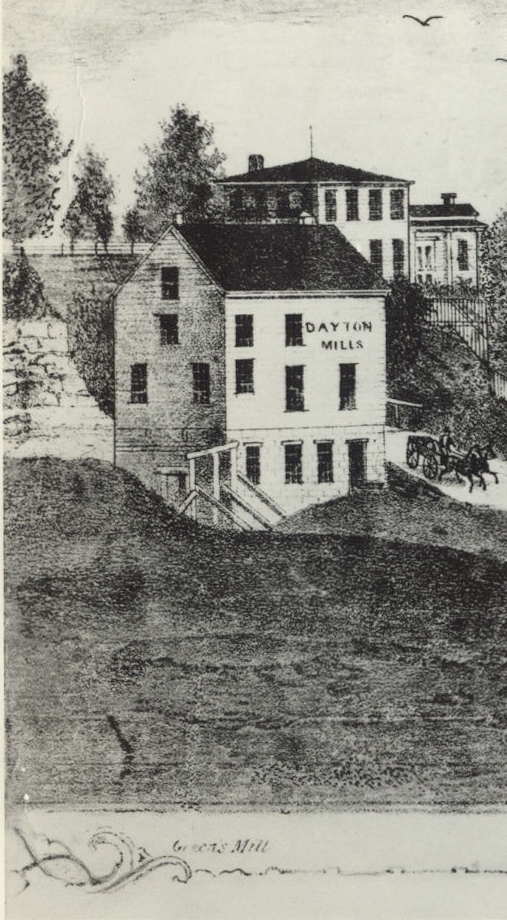
Display of arrow heads, owned by Elmer R. C. Eick, 420 Christie street, Ottawa, many of which were found in Dayton and Rutland townships; quilt made by the great, great  grandmother of Mrs. Verne Wilson; coverlet made in Virginia more than 75 years ago, the property of Mrs. Van Etten; shawl owned by Mrs. John Thompson, made by her mother, Mrs. Elizabeth Brumbach, 80 years ago; quilt made by the wife and daughters of Matthias Trumbo in 1850; straw plug hat and woman’s straw hat of the vintage of about 1800; picture of old school house on the site of the present elevator in Dayton; corn planter used by David Strawn in Livingston county, loaned by Mrs. Walter Strawn; trunk carried in a covered wagon across the plains to California by Joseph Green in 1849 and again in 1852; another trunk brought from Rockingham county, Virginia, by Matthias Trumbo; steelyards which belonged to the Hayes ancestors, sewing box, which belonged to Mary A. Boston, grandmother of G. R. Hayes of Wedron; English tea caddy loaned by Mrs. Wilcox; bedspread made by the mother of C. H. Tuttles, 65 years ago; old candle molds used by Mrs. David Strawn, loaned by Mrs. Walter Strawn; 17 year locusts gathered in 1933 by Mrs. John W. Reynolds of Dayton; piece of fancy work made by Mrs. Mary D. Bennett, 81 years ago; reproduction of Jeremiah Strawn’s lantern 100 years old, loaned by Mrs. Walter Strawn; pictures of John and Barbara Grove Green; vest worn by Mr. Hall when killed by the Indians in the Indian creek massacre in 1832; old cow bell used by David Strawn’s farm in Livingston county, loaned by Mrs. Walter Strawn; flint lock guns which belonged to Peter W. Ainsly and Tim Thompson, lantern and fork found in Wedron under C. E. Thompson’s house; mammoth tooth found near Norway in a gravel bed 30 feet underground; copper toed boots; charcoal iron belonging to Mrs. Sarah Thompson; horse pistol brought from Nebraska by Edman Thompson, half brother of George R. Hayes of Wedron; handcuffs plowed out on the old Ed. Brundage place by G. R. Hayes at Wedron; silk stovepipe hat made by Roussel in Paris and worn to the inaugural ball of President James Buchanan in 1856 by one of Rhoades family; a large map of La Salle county drawn in 1870 by M. H. Thompson and C. L. F. Thompson, showing Dayton as one of the towns of the county; pictures of the old Dayton woolen mills, collar factory and Green’s mill were shown on the map; coverlet brought from Virginia by Mrs. Frank DeBolt’s mother and one brought from Ohio by Mr. DeBolt’s mother; a black net and lace shawl owned by Mrs. Charles Hayward Reed; brown blanket made in the old mills and owned by Mrs. Cornelius Bogerd’s mother; hoop-skirts, dress, blouse and hat about 100 years old; linen, black silk and satin capes eighty years old belonging to Miss Catherine Rhoades; a spinet, 85 years old, and having twenty-nine keys and 30 inches in height; coverlet, more than 100 years old owned by David and Anna Grove and brought from Ohio; a dollman, made of English broadcloth, lined with figured silk and worn by Sidney Lowry; two woven baskets each more than 75 years of age; spiral hall tree 75 years old; sugar, and coffee scoops made of wood; spatula of wood used to remove pie plates from the old ovens; earthen bowls, pottery jugs and ladles used more than 75 years ago; a tardy bell and a call bell used at the old Waite school. which was taught at that time by Miss Susan Bailey of Ottawa. Miss Bailey taught the school when she was sixteen years of age. She is 91 years old now. There were two chairs on display, which were brought down the Ohio river to Memphis, Tenn., thence to Alton, to La Salle on the Illinois and then overland by a four-yoke ox team to the Old Fox River house at Ottawa. The chairs were the property of Miss Rhoade’s grandmother, Mrs. Sarah Collins Rhoades and were brought to Ottawa in 1843; bed quilts made in 1860; two Paisley shawls which had been in the Collins family for 75 years;  mourning shawls and hats which were loaned out at the time of funerals which were at least 65 years of age; a table of mahogany and a tidy which were wedding presents of Mrs. Catherine Rhoades in 1860.

Dayton’s Centennial – Part 1

Greene, J. Kent

The following account of the dedication of a brass plaque marking the location of the first grist mill in the Green settlement appeared in the Ottawa Republican-Times, September 16, 1929. The boulder on which the plaque was mounted can still be seen, but the plaque was stolen long ago.

Kent Greene, assistant state’s attorney of Cook county, and a grandson of John Green, who selected the ground on which Dayton was built, dedicated the impressive looking monument that was erected at the east of the Fox river to mark the spot an which the first grist mill was founded in the spring of 1830.

In an extemporaneous address that was one of the most beautiful bits of oratory Greene depicted the trials and tribulations of his grandfather and the others who were associated with him as they journeyed from Licking county, Ohio, to found the little settlement on the Fox river bank in December, 1829.

He told how they had come through Chicago1, passing Fort Dearborn and getting stuck in the mud on what is now Lake street and Wacker drive as they journeyed on to the place John Green had selected as a better site for a town when he had visited this part of the country in September, 1928 [sic: 1828].

He told how the monument had been erected to mark the site on which the first grist mill, the first saw mill and the first woolen mill in this part of the country had been established. These rugged pioneers, the speaker said, dealt in the first woolen manufacturing in Illinois and for a long time their was the only woolen mill in the state.

He paid tribute in beautifully chosen words to his grandfather and the others who were associated with him, and expressed the hope that the remembrance of their deeds would be an inspiration to those living in the community in the future.


  1. He is romancing a bit here. The trip through Chicago was made by John Green on his  September exploratory trip; the full party never got north of Kankakee. They certainly did get stuck in the mud, just not at Lake and Wacker.

Dayton’s Exhibit in the La Salle County Centennial

Family and wagon

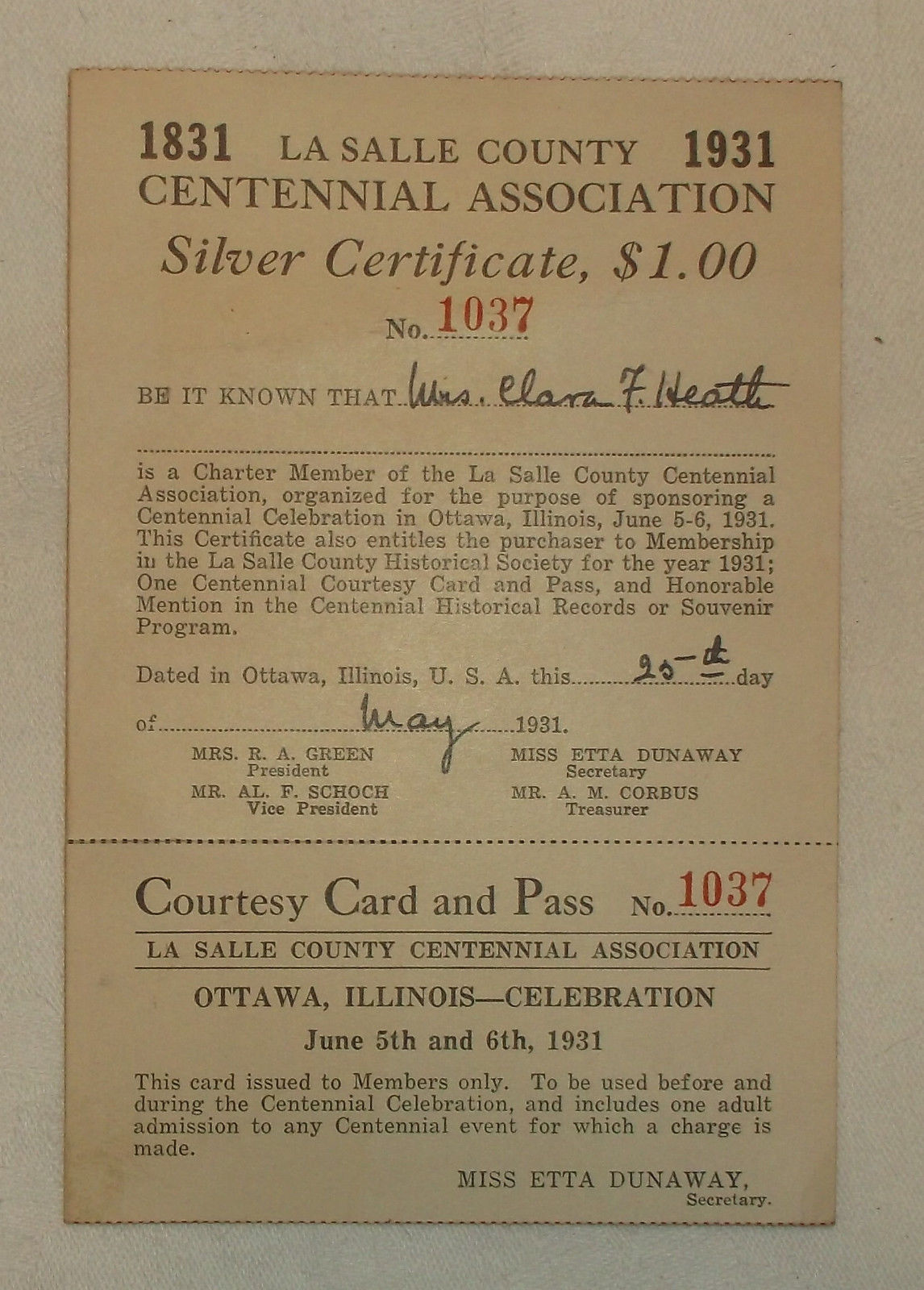
One of the exhibits in the 1931 La Salle County centennial parade was a covered wagon, drawn by oxen, that held a group representing the John Green party, arriving in 1829 from their home in Ohio. John and Barbara Green and family were played by their descendants:

John Green was represented by his grandson, Lyle Green
Barbara Green by her great-granddaughter, Mabel Myers
Their daughter Eliza by her great-niece, Ruth Mary Green
Their daughter Nancy by  her great-great-niece, Helen Myers
Their son Jesse by his great-grandson, Lewis Myers
Their son David by his great nephew, Kenneth Green
Their daughter Katherine by her great-great niece, Ruth Van Etten
Their daughter Rachel by her great-great niece, Ann Van Etten
Their son Joseph by his great-great nephew, John Van Etten

Buy Your Drain Tile Here

Tile works letterhead

Drain Tile. – We have been shown specimens of Drain Tile manufactured by the Green Brothers at the Dayton Tile Works, and if all are like these, and we are assured they are, there are no better tile made in the country. They are made in all sizes from 2 to 8 inches. Sold at Ottawa prices, with 10 per cent. off for cash. For sale at the works in Dayton or at Freeman Wheeler’s on the Chicago road, east of Dayton.


Ottawa Free Trader, September 20, 1879, p. 1, col. 2

110 Years ago today this appeared in the Ottawa Free Trader newspaper

OLD PIONEER GONE
Resided in County for Seventy-Eight Years
JESSE GREEN GONE TO HIS REWARD
The End Came Peacefully at Ryburn Hospital Saturday Night – Had Been For Years Actively Identified With Life of County

Jesse Green died at six o’clock Saturday night at Ryburn hospital. To the younger generation, and to the newcomers among us, that may not mean much. But to the old residents of the county, it will come as the notice of the close of a long eventful and useful life. As man and boy he had lived in La Salle county for almost eighty years. The notice of his death will be read with regret by a wide circle of friends.

Jesse Green was born in Newark, Ohio, in 1817. With his father, John Green, he came to Dayton in 1829. Father and son were long identified with the growth of the county in many ways. The elder Green built the first mill at Dayton, the first flour being ground there on July 4th, 1830. A sawmill was also run in connection and it furnished the lumber to build the first frame house in Ottawa in 1831.

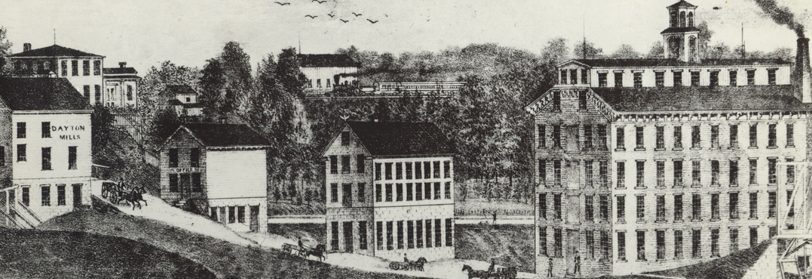
In 1840 they built the first woolen mill with power looms in the state. This ran very successfully until the close of the war. In the early 70’s they met with a series of reverses, but Jesse Green bought in the property and ran it until 1882, when it was sold to Williams and Hess. They organized a stock company for the manufacture of pressed brick.

In 1849 Jesse Green was one of an adventurous party of about fifty others who made the overland trip to California. After remaining in the west two years he returned to La Salle county to make it his home until his death.

He was married June 22, 1843, to Isabella Trumbo, daughter of Mathias and Rebecca Trumbo. His first wife died December 1, 1854, leaving five children – John B., Rollin T., Newton M., Clara J., and an infant who died soon after her mother. Mr. Green subsequently married Hannah Rhoades, a native of Brownsville, Pa. From this second marriage, nine children were born – Thomas H., Joseph, James A., Cora R., Sarah (deceased), Frank, Jesse A. (deceased), John K. and Mabel (deceased). In politics Mr. Green was a Democrat. He was a Universalist in religious faith. He has served three years and supervisor, two terms as justice of the peace, and about six years as postmaster at Dayton.

The children now surviving are Newton M., of Serena; Mrs. C. B. Hess, of this city; Thomas H., Frank, and J. Kent, of Chicago; Joseph, of Coffeyville, Kansas; James A., of Grand Junction, Col.

The funeral will be held from the C. B. Hess residence Monday afternoon at 2 o’clock. Interment in the Dayton cemetery.1


  1. The Ottawa [Illinois] Free Trader, 11 October 1907, p 5, col 3

First winter

The winter of 1829-1830, when the Green party had just arrived in Illinois, was a difficult one. Even though John Green had arranged with William Clark to plant a crop of winter wheat, they had no mill to grind it into flour. Small amounts could be ground by hand, in a coffee grinder, but this was tedious and time consuming. Jesse Green recounted in his memoir one way they tried to deal with the problem.

Soon after our arrival here father sent a team down to a mill in Tazewell County for flour and got what was supposed to be sufficient to last until we could grind some of our own wheat, but he did not take into consideration our increased appetites, which we thought had nearly doubled. Then Uncle Samuel Grove and I took a grist of frostbitten corn to Mr. Covil’s ox-mill below Ottawa on the south side of the river. We were ferried across the Illinois River just above the mouth of the Fox, by two daughters of Dr. David Walker who ran the ferry in the absence of their father. We followed an Indian trail, not a wagon track was visible. Probably owing to the fact that our corn had been caught by an early frost before reaching maturity, we did not succeed very well in grinding it in the Ox-mill, and we returned home with a good portion of our grist unground. Some time later we took another grist up to Mission Point where Rev. Jesse Walker had a similar mill in connection with his mission and school for the civilization and education of the rising generation of our Indian friends and neighbors, but his mill did not prove to be any more successful in grinding our soft corn than Mr. Covil’s mill.

They must have been very relieved when their own mill was built the following spring.

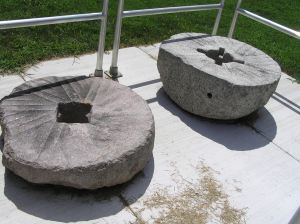
The mill  illustrated above is the type of the Dayton mill, but in Illinois the mill was built of wood, not of stone.

A New Dayton School

1 April 1882, p. 8, col. 1
The Schools are having a vacation this week. We understand the two schools are to be continued under the present competent instructors, and we hope the following summer will witness the erection of a new school building. It is something that is much needed, and as the railroad pays over one-half the school tax, the district is abundantly able to build one. Patrons of the school will do well to consider the matter, and if brought to a vote to cast their ballots intelligently.

[The votes were cast intelligently,as it turned out.]

19 Aug 1882, p1, col 3
The school directors of the town of Dayton have this summer built a new school house in the village of Dayton. It is a one story structure, but has two rooms 36 feet square, and a belfry. It is built on one of the prettiest spots in the village, and is a credit to the village and town. Mr. H. C. Furness drew the plans, which were carried out by Mr. Geo. Jekyll, builder. The heating will be done by a Ruby furnace put in by Booth & Kendall of this city.

[Someone apparently noticed that there were in fact two stories.]

30 Aug 1882, p. 4, col. 3
The new school building is rapidly nearing completion and will be one of the prettiest buildings in the country. It is a two-story frame structure, 36 feet square, and a belfry.
A petition was also extensively signed, authorizing the sale of the old school building.

January 17, 1885, p. 5, cols. 1-2
Dayton has a neat, two-story public school, presided over by Ottawa ladies – Miss Jennie Crane in the higher department, with Miss Mary Miller in the primary. About 70 pupils are in attendance.

[The school building was in heavy use for concerts, plays, Sunday school, meetings, lectures, sermons, and school programs, in addition to its educational function.]

[That schoolhouse burned to the ground the day before Thanksgiving in 1890. It was replaced by the schoolhouse shown below. It opened in September 1891, and served the children of Dayton and the area for nearly 75 years. It was closed at the end of the school year in May 1965, a victim of the new fire safety code. The old building was not up to code, so the children were bused to the newer Wallace school.]

picture of school

Opened in 1891, this school replaced the one which burned in 1890


All extracts are from the Ottawa Free Trader newspaper.

Fox River Floods

old dam built by state of Illinois                                                 Old dam built by State of Illinois

Although the records are not complete it seems to be pretty well established that there have been great floods on the Fox River in 1849, 1857, 1872, 1882 and 1902. Of all the floods, however, the one of 1857 seems to have been the most pronounced. Heavy rain on February 6, 1857, melted the accumulated snow and broke up the ice. All the bridges from Batavia to Ottawa were washed out and several dams upstream gave way.

There seems to have been many more floods in the days of the early settlement of the Fox River valley than in later years, although there were plenty of forested areas then while now there is practically no timber. In the early records frequent mention is found to washing out of dams and bridges year after year. The explanation for this is very likely due to the fact that originally the bridges were low wooden structures and the dams were crude affairs whose main reliance for stability consisted of logs across the channel. These were insecure affairs and high water floated them away. Most of the early bridges were built by private subscription and at great sacrifice of time and money to the pioneer settlers. Often they were no sooner erected than a freshet would wash them away.

Pioneers looking for homesteads were impressed by the beauties of the valley, the abundance of clear water supplied by the river and the opportunities for securing water power from this stream. One of the first thoughts of the early settler was to start a saw or grist mill, the former to cut timber for buildings for family and cattle, and the latter in order to feed both himself and his stock. Otherwise, long journeys over trackless forest and prairie were required before the early family could have flour or meal. The history of the early settlements in the Fox River valley shows that practically the first thing done in every case, after building a house, was to build a dam and put up a water-wheel-driven mill. These dams were very crude timber structures, built of logs and slabs, and generally washed out or were seriously damaged by high water.

The first dam at Dayton was built in 1830 by John Green and was erected to furnish power for a grist-mill. It is claimed that this mill was the first one in the State to be operated by water power.

The second dam built by the State in 1839 was about fourteen feet high and was constructed of stone with a wooden crest. This dam was built to divert water to the feeder of the Illinois and Michigan canal. The head of the feeder was located about half a mile north of Dayton, where the State constructed the dam. In addition to its use as a feeder for the Illinois and Michigan Canal, a reservation was made between the Canal Commissioners and the owners of the mill property at Dayton that the latter were to have the use of one-fourth the supply created by the improvement, “the same shall be drawn out of said feeder within seven-eighths of a mile from the head of the guard lock” under direction of the Canal Commissioners. This gave the required power for manufacturing interests, but with the passing of the dam and power in 1902 when the dam washed out yet again, all manufacturing in Dayton was abandoned.


From the State of Illinois Rivers and Lakes Commission, Report of Survey and Proposed Improvement of the Fox River, 1915

It was the law!

scales

If you were living in Dayton in 1845, it would be against the law:

To plant or cultivate castor beans without a good and sufficient fence;

To take up a stray animal and use it prior to advertising it, unless it be to milk cows and the like, for the benefit and preservation of such animals;

To charge for passage on a toll bridge to any public messenger or juror when going to or returning from court;

To bet on a card, dice, or any other kind of game;

To charge more that six percent interest on a loan;

For any sheriff or jailer to confine persons committed for crimes in the same room;

To sell any goods or merchandise without a license;

To have more than one ear mark or brand, or one the same as the ear mark or brand of your neighbor’s;

To marry under the age of 17 (male) or 14 (female);

For a notary public to refuse to pass on his books, papers, and other documents to his successor;

To refuse to support one’s parents, if sufficient resource is available;

To remove or pull down any barrier on a public road closing it for the purpose of repairs, except for carriers of the US Mail;

To hire a carriage driver known to be a drunkard;

For a carriage driver on any public highway to allow his horses to run;

To charge to view a performance of juggling, tightrope walking, wax figures, circus riding or the like, without a permit;

To run steamboat races;

To cut any black walnut tree without the permission of the owner;

For married women to write a will.

La Salle County Fair – 1870


curculio catcher

In 1870, a reader of the Prairie Farmer magazine submitted an account of the La Salle county fair, which mentioned the Dayton Woolen mill among the other exhibits.

After running down the list of animals (horses, cattle, swine, sheep, and poultry) and mentioning fruits and preserves, the cloth and needlework exhibits, and the races,  the correspondent got down to what really interested him – farm tools and machinery. He reported agricultural implements, too numerous to mention, were ranged on the ground. Nathan Woolsey, of Waltham township exhibited something new in fences, being an iron post and board fence, the post in two parts, the part that enters the ground being of cast iron, shaped like a lance head, and two feet long, in the top of which is a bar of wrought iron about 1 1/2 inches by 3/8 inches thick, to which the boards are fastened by bolts. An excellent invention for the prairie, he thought.

However, the attention of all was centered first and last on Dr. Hull’s curculio catcher, exhibited by J. E. Porter, of the Eagle Works, Ottawa. The plum curculio was a beetle that attacked plums, peaches and other deciduous fruits. It ruined the fruit and various methods were tried to get them off the trees. At one point a bounty of $20 for 5000 was offered.

The difficulty of removing them by hand led to various schemes to shake them out of the branches, called jarring. Striking the tree limbs with heavy sticks was fairly effective, as the beetles would fold their legs and fall to the ground when disturbed. However, when on the ground the curculio would roll up into a small ball which was hard to find and remove.

The curculio catcher, illustrated above, solved this problem by catching the beetles before they hit the ground. It is easy to see why this exhibit would have attracted the attention that it did.

Although modern chemical poisons have made the elimination of these pests easier, they have also made the process much less colorful.

To read the full account of the 1870 fair, including the reference to the Dayton Woolen mill, see this.

Albert Charlier

S S Kroonland

When Albert Charlier died in Ottawa on June 5th, 1945, his obituary, reporting his burial in the Dayton cemetery, said only that “the deceased, of whom little is known, lived in a cottage near Dayton.” He has no tombstone in the cemetery. He never married. Nonetheless, it is possible to reconstruct the outline of his life and make his history known at last.

Albert was born in Fréconrupt, La Broque, Alsace, on September 26, 1879, the son of Jean Baptiste and Marie Claire (Charlier) Charlier. The Catholic Charlier family had lived in Fréconrupt for hundreds of years.

When Albert was about 15, an older friend, Josef Beller, decided to go to America. He must have written home with good news about his prospects, because at age 25 Albert also decided to emigrate.

He left Antwerp on March 18, 1905, on the S S Kroonland [photo above] where he traveled in steerage. He arrived in New York City on March 28. He was 25 years, six months old, single, a laborer, and able to read and write. He paid his own passage and had $44 with him. He had been living in Rothau, in Alsace, which had recently changed from being part of France to belonging to Germany, so he was listed on the manifest as German, although actually Albert was French. He said his final destination was Dayton, Ill, where he was going to join his friend Josef Beller.

Apparently he found work in Dayton, as in 1908 he was able to buy lots 6 and 7 in block 13 of the original town of Dayton from Elizabeth Benoit for $175.

In 1910 he was living in Dayton working at odd jobs. He owned his house and had filed his first papers for naturalization.

In 1918, when he registered for the draft, he was a mine worker for the Dayton Clay works. He was of medium height and weight, with brown hair and eyes.

In 1920, he was living in his own home in Dayton and working as a railroad section laborer. He had not yet become a citizen.

In 1921 he sold his house and lots in Dayton to John Garcia for $450. He went back to France, probably to see how his family had fared during the war.

In 1923 he returned from Europe on the S S La Lorraine, sailing from Le Havre on April 16. His nearest relative in France was his father, Mr. Charlier in Schirmeck, Alsace. He was bound for Dayton, Illinois. He was going to join a friend, Mrs. Klari Hess Green in Dayton, Illinois. This is most likely Clara Green Hess, daughter of Jesse Green and wife of C. B. Hess.

On January 14, 1938 he went to the circuit court in Ottawa and became a naturalized citizen.

In April 1940 he had been out of work for 6 months . He had worked for 6 weeks in 1939 at the power plant in Dayton for a total of $100.

By 1942, when he registered for the WWII draft, he was again employed at the Dayton power plant. He listed Lindo Corso of Dayton as someone who would always know his address.

He died of stomach cancer June 5th, 1945, in the hospital in Ottawa, and was buried in the Dayton cemetery on June 7th.

Unknown at his death, he is unknown no longer.

Another Dayton Schoolteacher

Naomi Trent

Naomi Trent
March 2, 1902 – January 15, 1974

 Mrs. Trent was born March 2, 1902, in Norcatur, Kansas, to Charles and Mary Patanoe Pool. On Jan. 21, 1921, she married James Trent, who preceded her in death in 1963.

She was a retired school teacher and former principal of the Dayton School. She also taught at Central School. She was a member of the Ottawa and Dayton Women’s Club, the Retired Teacher’s Association, and World War I Woman’s Auxiliary.

Survivors include two daughters, Mrs. George (Dorothy) Haas of Morris and Mrs. George (Maxine) Heide of Lagos, Nig.; one son, James of Melrose Park; a brother, Clifford Pool of Clearlake Highland, Calif.; nine grandchildren; and six great-grandchildren. She was preceded in death by her parents and her husband.1

Mrs. Trent and Santa

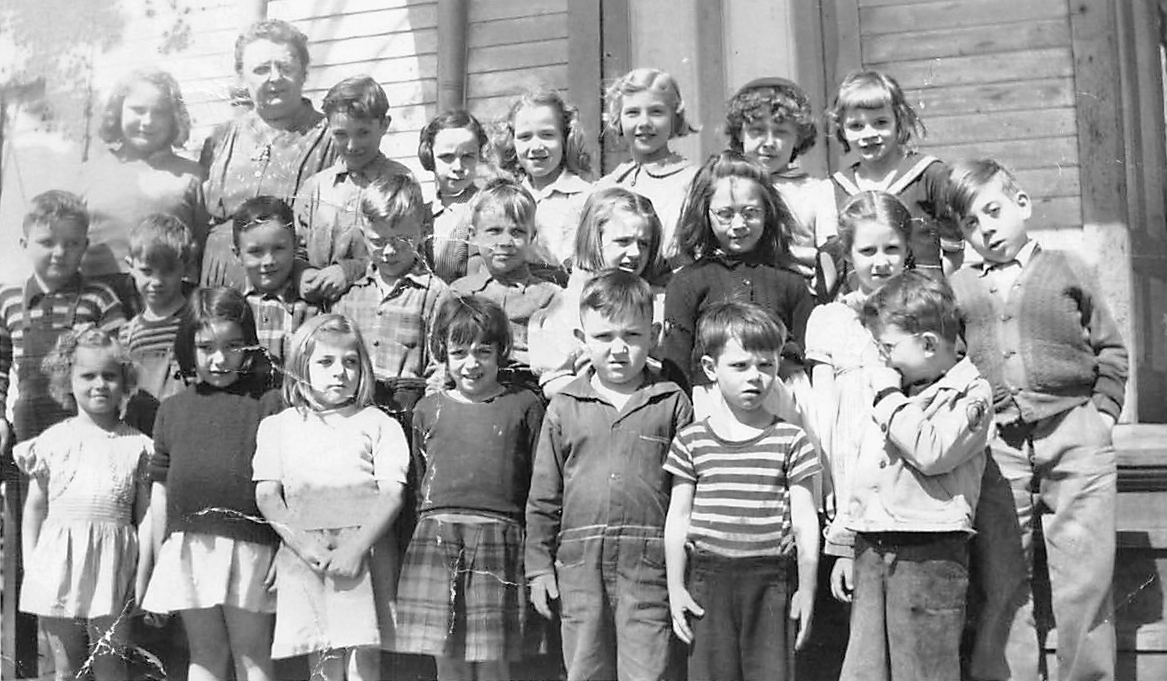
Mrs. Trent ruled over the upstairs room of the Dayton school, which held grades five through eight. In addition to her teaching duties, she was involved in many school activities, not the least of which was presiding at the annual Christmas pageant at the clubhouse.

When I was in Mrs. Trent’s room, there were around twenty students in the four grades. After listening to the other classes recite their lessons, by the time we reached eighth grade, we had heard them all several times over. Luckily Mrs. Trent realized this and the eighth graders, once their lessons were prepared, could work on a large jigsaw puzzle spread out on a table at the back of the room. We never did manage to complete it, as I recall.


  1. From her obituary in The Daily Times [Ottawa, Illinois] Jan 16, 1974, p. 10

How to Tell A Yankee from a Buckeye


prairie schooner

Dayton was largely settled by people from Ohio, but the eastern states also contributed settlers to the area. If you need to know how to tell the difference, these remarks, given by  P. A. Armstrong at the 1877 La Salle County Old Settlers’ Reunion will help:

“The state of Ohio, though comparatively speaking one of the younger states, contributed largely towards furnishing the first settlers of this county, among whom I will mention the Greens, Shavers, Groves, Debolts, Dunavans, Hupps, Brumbacks, Pitzers, Richeys, Strawns, Milligans, Trumbos, Armstrongs, Parrs, Hitts, Reynolds, Wallaces and Bruners, all of whom have left many descendants. New York also contributed handsomely to the first inhabitants, while Pennsylvania, Virginia, Kentucky, Tennessee and many of the eastern states had their representatives here at an early day. As a general rule we could distinguish whether the incoming emigrant were Yankee or from the Middle States.

The Yankee drove but one span of horses to his wagon and rode on the wagon to drive – the other drove from four to six horses to his wagon, riding the left hand wheel-horse to drive. The wagon of the Yankee was coupled longer than the other, had a flexible tongue held up by a neck yoke, and was of several inches narrower gauge and far lighter draft. The box was much lower and longer than the other’s, and of simpler construction and more easily taken apart to put on and oil.

The Buckeye or the Middle State wagon was schooner-shaped and closely coupled together. The rear wheels were some 12 inches greater in diameter than the front ones. It had a still tongue, which was ever busy pounding the legs of the wheel horses. The team was driven by a single line. Three sharp jerks to turn to the right – a steady pull to turn to the left, guided them.

The harness was both a curiosity and a monstrosity – a curiosity, how it ever came into use; a monstrosity by way of punishment to the poor horses who wore them. Great heavy blind bridles, huge collars, massive hames, broad backband and heavy trace-chains for the leaders, immense breeching that literally covered the hind-quarters of the wheel-horses, side-straps full five inches wide for tugs, and large bent-skin housings upon the wethers of each horse, were sufficient to melt anything in the shape of flesh.

The box was much higher at the ends than in the middle and was made of panel work, and so mortised together that the entire weight had to be lifted up in taking it off or putting it on the wagon. Hence it required the united effort of a whole family to handle it. These schooner wagons being about 5 inches wider than the Eastern wagon, they of course never tracked with them, and hence they made a new track, at least on one side. Being very heavy they sank to hard pan in every slough, and when planted they are “solid muldoons.”

These wagons, so dissimilar, each had their advocates for a while, but the superior advantages possessed by the Eastern wagon were so patent that the prairie schooners were abandoned and suffered, like the wonderful one-horse chaise, to tumble to pieces and were never repaired or duplicated.”1


  1. Ottawa [Illinois] Free Trader, August 18, 1877, p. 4, col. 6 – p. 5, cols. 1-5
  2. image credit: By Kevin Burkett from Philadelphia, Pa., USA (Flickr Uploaded by SunOfErat) [CC BY-SA 2.0 (http://creativecommons.org/licenses/by-sa/2.0)%5D, via Wikimedia Commons