A Family Gathering

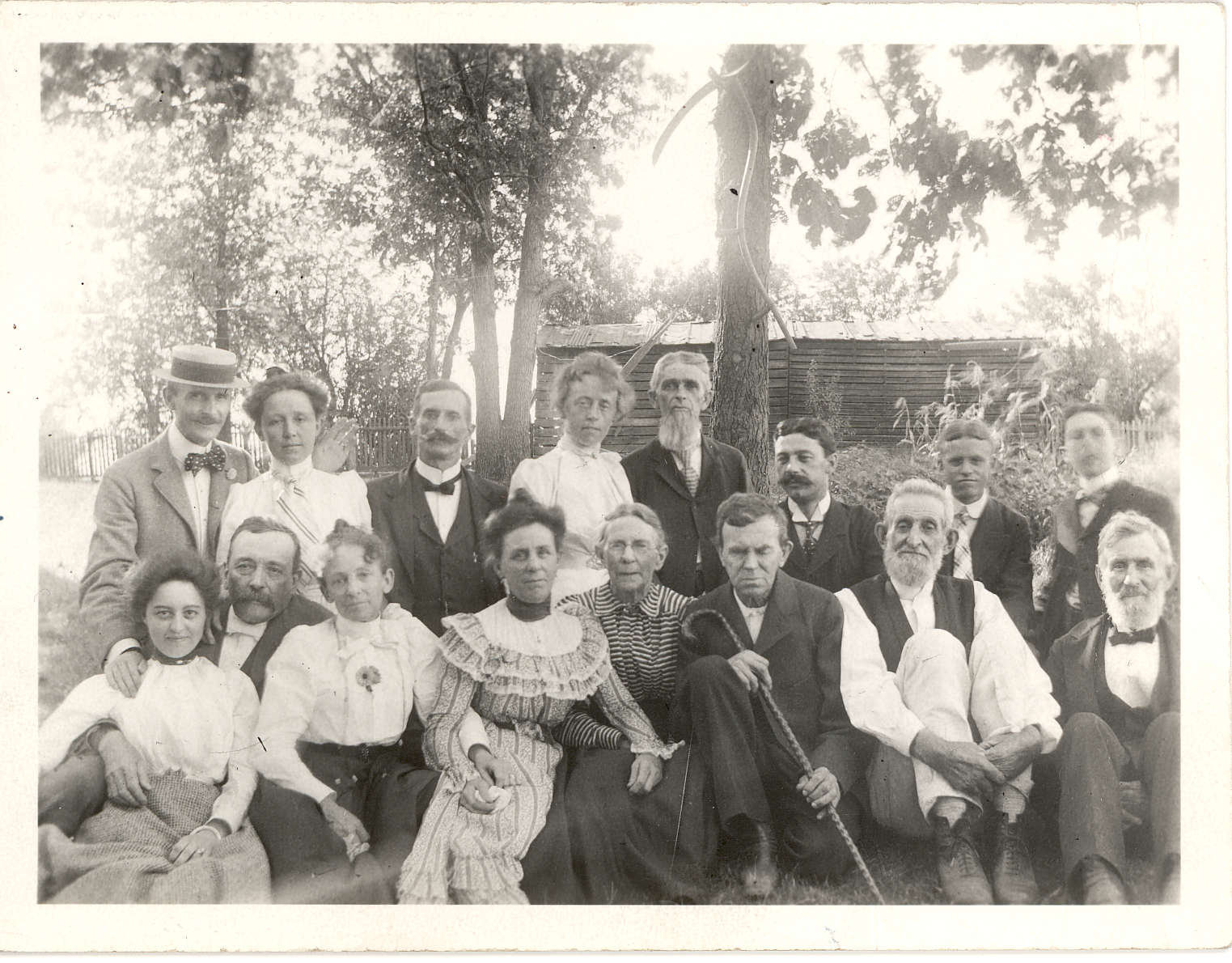
From the information on the back of the picture
This picture was taken in the yard of Oliver W. Trumbo’s house in Dayton, Ill. September 3, 1899.
The picture was taken by Burton M. Stadden.

Front row:
Edith Hess Gilman
Jas. McCartney
Sarah Swank Stadden McCartney (mother of Burton W. Stadden)
Clara (Callie) Green Hess
Rebecca Green Trumbo
Isaac Green
Oliver W. Trumbo
Jesse Green

Back row:
Burton W. Stadden
Mr. & Mrs. Ned Richardson (friends)
Julia Taylor Stadden
Benton Hess
Edwin Hess
Arthur Hess
Harry Hess

Noah Brunk and his wife Amanda? Elizabeth?

On September 24, 1857, Noah Brunk married Amanda Elizabeth Parr. Or was it Elizabeth Amanda Parr?

This form reads as follows: Noah Brunk Being duly Sworn Deposes and says he is engaged to be married to Miss Elizabeth Amanda F Parr that the said Amanda Elizabeth is under the age of Eighteen Years, and that he is above the age of Twenty-one Years. that he [has] the consent of the parents of said Amanda for her marriage with him at this time.
[signed] Noah Brunk

The form was initially written for Amanda Parr. Perhaps she was always referred to as Amanda, but she pointed out, for the record, that her first name was Elizabeth. In 1850, at age 9, she was listed in the Thomas Parr family in the census as Elizabeth A. It appears that for official records her name was Elizabeth, but that she was always called Amanda. Her obituary listed her as Amanda E. (Parr) Brunk.

Noah Brunk was born in Rockingham County, Virginia on December 14, 1828. He came to La Salle County in 1855, and settled on a farm in the north part of Dayton Township. He married Elizabeth/Amanda Parr in 1857. They had six children: three died in infancy; one, Ida Bell, died at the age of 5 and is buried in the Dayton cemetery; a son, Thomas Lafayette; and a daughter Cora Bell, who married William D. Hedrick.

Noah Brunk served a term as Dayton Road Commissioner and as Dayton Township Treasurer. He was also a Director of the Fox River Horse Collar Manufacturing Company of Dayton. He spent a few years around 1900 in Austell, Georgia, and then they moved to Peabody, Kansas, to be near their daughter, who lived in Wichita. He died there December 31, 1908. His wife continued to live in Peabody until she died there March 14, 1921.

B. Frank Trumbo

SORROW IN WAKE OF FRANK TRUMBO DEATH
COMMUNITY SHOCKED BY DEMISE OF PROMINENT MAN
END CAME TUESDAY NIGHT1

Ex-Sheriff, Leading Politician and One of County’s Best Known Farmers and Citizens’ Goes to Reward

            B. Frank Trumbo, one of La Salle county’s most prominent figures, passed away at 10 o’clock Tuesday night at his home, six miles north of Ottawa. Death was caused by valvular heart trouble, with which Mr. Trumbo had been ailing for a few weeks past.

            When his health began failing him the deceased entered the Presbyterian hospital in Chicago, where he underwent treatment until last Friday. He was removed to his home benefitted only slightly. Sunday and Monday he showed little improvement and Tuesday the change for the worse came. Late in the afternoon it was known that it was only a matter of hours and the relatives gathered at the bedside, where they remained to the end.

            Word of Mr. Trumbo’s death spread throughout the city leaving utterances of sorrow and regret no matter where the sad tidings traveled. Few men attained the success of the deceased ex-sheriff. He was a Democrat in his political views, but at no time did he permit politics or the glory of victory to interfere with friendship. Friends he had by the host and it was his loyalty to those he knew that made him such a popular favorite throughout the county.

            On the farm, in the city, campaigning, in office or wherever business called him he was just Frank Trumbo. For the past few years he had been aware of the condition that would ultimately terminate in death. He maintained the genial and jovial nature that made him such a popular favorite in this vicinity, even against these odds.

            In 1902 he was elected sheriff when large Republican majorities were the vogue. He conducted his office in the same manner he had his private business. Few officials left a record that could even be compared with his. Honesty and integrity were by-words with him and a close adherence to duty and his obligation toward the people, brought him into public favor from the start.

            He was born November 25, 1862, on the Trumbo homestead in Dayton township. His parents are Mr. and Mrs. Moab P. Trumbo, of Jackson street, this city; old pioneer residents of the county. Mr. Trumbo’s ancestry traces back to the seventeenth century when great-grandfathers located in Virginia.

            Educated in the public schools and later taking a course in business college, Mr. Trumbo followed farming as his principal vocation. He placed the land under a high state of cultivation, adding all the modern improvements. In all of his work he had been practical and energetic, displaying perseverance and keen discrimination that won him results, establishing him in a position among the leading agriculturists of the county.

            Surviving he leaves his sorrowing wife and two daughters, Helena and Josephine. He also leaves his aged parents and one sister, Mrs. Ed. F. Bradford, of this city. The deceased was a member of Occidental lodge No. 40, A. F. & A. M., Shabbona Chapter R. A. M., Ottawa Commandery No. 10, Knights Templar and Ottawa Lodge No. 588, Benevolent and Protective Order of Elks.

            The funeral was held from the home Friday morning at 10 o’clock. Interment was in the Ottawa Avenue cemetery, where Ottawa Commandery No, 10, Knights Templar, took charge of the services.

  1. Ottawa Free Trader, November 10, 1911, p7, col 1

A Bountiful Supply

slice of cakeHymeneal

Married – At Dayton, in this county, on the 31st inst. (New Year’s Eve) by the Rev. David Newton, Mr. John Stadden to Miss Ann Maria Miller, both of Dayton.

Accompanying the above notice, was that which always gladdens the poor printer’s heart – a bountiful supply of Miller’s workmanship, in the shape of delicious wedding cake. The happy couple have our best wishes for their future happiness, hoping that the evening of their days will be as pleasant as the first dawn of 1841 met them agreeable and happy.1

They stayed in Illinois long enough to have two children, but about 1846 they moved to Texas, where they lived out their lives and had several more children.


  1. Free Trader, January 1, 1841, p. 3, col. 3

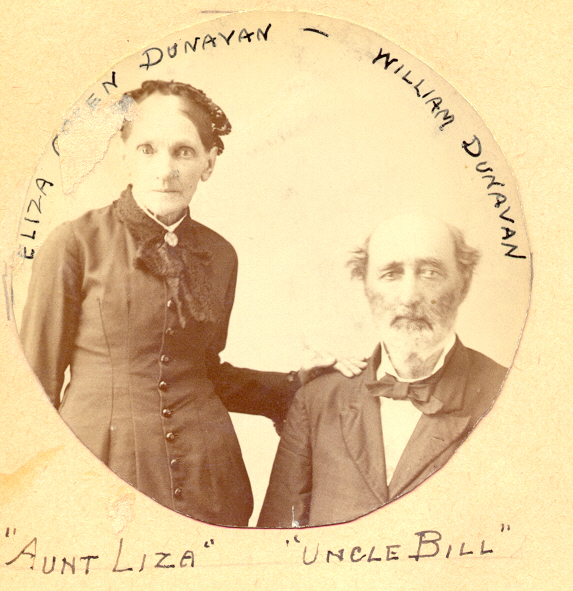
Col. William L. Dunavan

OBITUARY

Col. Wm. L. Dunavan, who was well known to all the old settlers of this county, died at Denton, Texas, on Friday last, of Bright’s disease. His last hours were painless and peaceful.

Col. Dunavan was born in Licking Co., Ohio, November 9, 1808, and in 1831 came to La Salle county, settling on Sec. 22, in what is now Rutland tp., where he lived until 1881, when he went to Texas. In 1832* he married Eliza Green, daughter of John Green, their marriage being the first held in that township. He was for over 20 years a justice of the peace for his town and served one term of four years as postmaster. He was also one of the heaviest contractors in the construction of the I. & M. canal; served in the Black Hawk war; made the overland trip to California in 1849, remaining two years, when he returned and lived in Rutland until his removal to Texas. His wife bore him six children, two sons living in Texas, two sons and a daughter in this county and a daughter in Iowa.

Wm. L. Dunavan was a type of the best class of Illinois pioneers: a man of sterling integrity, industrious, a good neighbor, a firm friend, genial, courteous, considerate. His departure for Texas in 1881 was a source of sincere regret to his old friends here, who will now so much more keenly regret his death even at the ripe age of 80 years, in that those last years were not spent here in the old home of his early manhood.

A friend in Rutland hands us the following:

In Memoriam
Col. W. L. Dunavan, Denton, Texas

Death came in with silent footsteps
At the early dawn of day,
And beckoned to our father gently,
And bore him from our midst away.

“The Savior’s arm sustains me,
I am not afraid to go;”
Oh! words of cheering comfort,
To those dear ones, on earth below.

A father dear, is taken from us;
A husband’s chair will vacant be;
Oh, faithful wife, bowed down with sorrow,
May God’s love, support and comfort thee.

For he promised us a home in heaven
Where tears and sorrow come no more,
But joy and peace will reign forever
And your loved ones meet on that golden shore.

Mrs. Eva Barkley, Rutland.1


  1. The Ottawa [Illinois] Free Trader, May 11, 1889, p. 4, col. 5
  2. *Obituaries are to be taken with a grain of salt. They were actually married November 6, 1831.

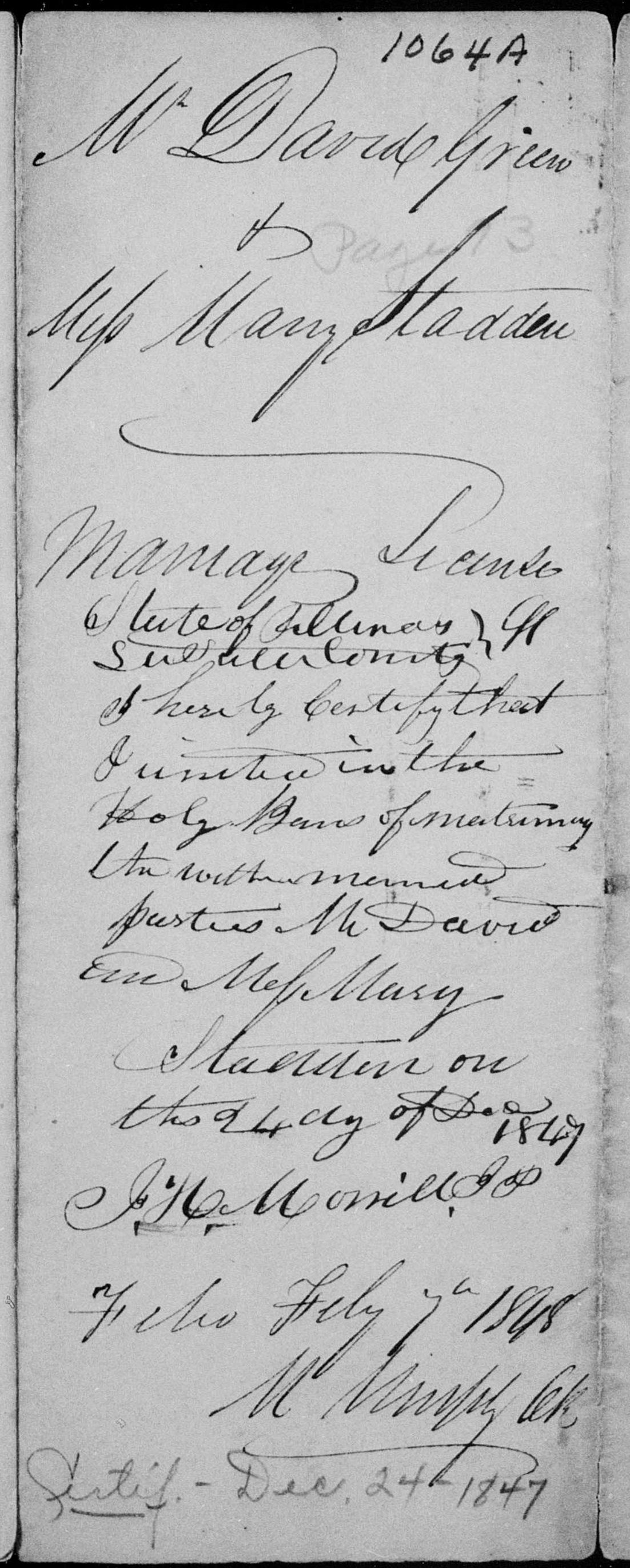
The Marriage of David Green and Mary Stadden

    Green,-Stadden marriage license

On December 24, 1847, David Green, son of John and Barbara (Grove) Green, married his cousin, Mary Stadden, daughter of William and Judah (Daniels) Stadden. They lived in Dayton, in this house.

They had ten children, five girls and five boys.

Alice Cary Green was born October 20, 1848 in Dayton. She married Jesse Clark Allen in Dayton on June 20, 1867. She died in Des Moines, Iowa, January 7, 1933.

George W. Green was born September 3, 1850 in Dayton. On September 16, 1878, he married Emma Holton. They moved to Aurora, where she died October 14, 1931.

Ella Green, born July 8, 1852, married Dr. George H. Riley. They lived in Ottawa, where she died August 25, 1945. She is buried in the Dayton Cemetery.

John William Green was born about March 25, 1854 and died May 8 of that same year. He is buried in the Dayton Cemetery.

John Green was born October 28, 1855 in Dayton. He married Clara Moore October 2, 1889, in Appleton, Wisconsin. He died June 21, 1932.

Charles Green was born August 4, 1858 in Dayton. He was married on November 25, 1885, to Etta M. Skinner. He died in California on July 24, 1936.

Ada Green, born January 17, 1859, in Dayton, married William McMillen.

William Stadden Green, born in Dayton on March 12, 1861, married Lalla Brown.

Mary (Minnie) Green was born in Dayton on April 24, 1866. She died October 4, 1882 and is buried in the Dayton Cemetery.

Carrie B. Green, born in Dayton March 25, 1868, died October 5, 1883. She is buried next to her sister in the Dayton Cemetery.

David died of consumption at the age of 60 on September 2, 1880.  His wife, Mary lived to age 91, dying in Wheaton, Illinois, on December 10, 1918. They are also buried in the Dayton Cemetery.

Support for an Elderly Mother

support clause from deed

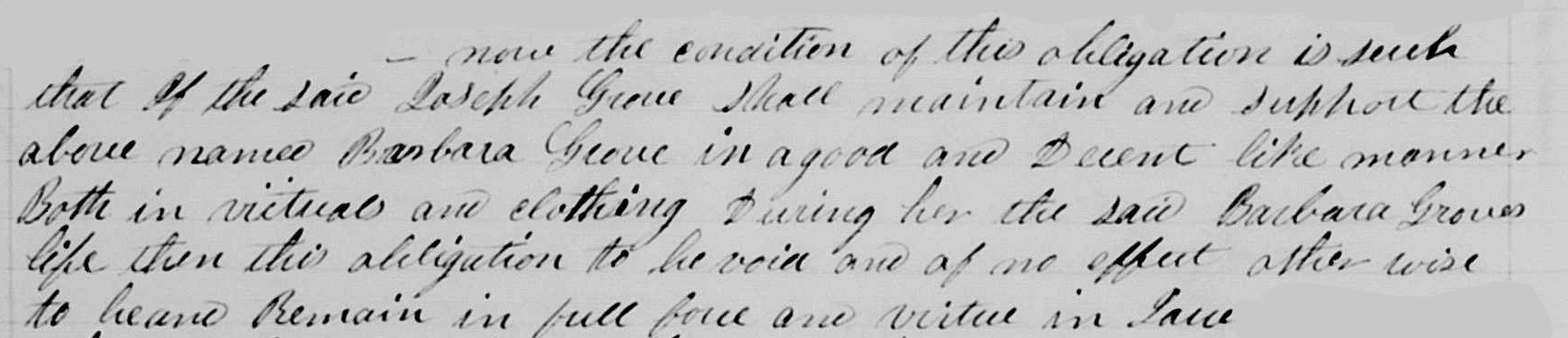
In May of 1833, widow Barbara Lionberger Grove, mother of Barbara Grove Green, came from Licking County, Ohio, to La Salle County, Illinois, with her son Elias. They joined her four daughters and two sons, who were already living in Rutland township, across the river from Dayton. She undoubtedly lived with one or more of her children, but which one is not clear until 1838. On December 12th of that year a deed was recorded from Joseph Grove to Barbara Grove, selling 40 acres of land to her for $1. The deed includes the following proviso:

now the condition of this obligation is such that If the said Joseph Grove shall maintain and support the above named Barbara Grove in a good and Decent like manner Both in victual and clothing during her the said Barbara Grove’s life then this obligation to be void and of no effect otherwise to be and Remain in full force and virtue in Law

So if Joseph did not support her “in a good and decent manner” she would own 40 acres of land she could use or sell for her support.

Why was this deed made?

Just six months before, on June 28, 1838, Joseph married Elma Jackson. By December of that year, it would have been apparent that she was pregnant. Perhaps the deed was made to reassure Barbara that the forthcoming child would not affect her status in the household.

Barbara Grove Green

Barbara Grove Green

Barbara Grove Green

Much of the information about Barbara Grove Green comes from notes written down by her granddaughter, Maud Green, which I now have. 

Barbara Grove was born near Woodstock, in Shenandoah County, Virginia, on the 15th of November, 1792, the daughter of John Grove and Barbara Lionberger. Both of her grandfathers, Christian Grove and John Lionberger, served in the Revolutionary War from Virginia.  The Lionbergers were Swiss immigrants who arrived in America in 1735. John Grove, her father, of Swiss and German ancestry, was “a large and powerful man who could pick up a barrel of flour under each arm and toss them on a wagon”.  Maud notes that Barbara had a vest which had belonged to her father, and that it was much too large for any other member of the family.

In 1805, when Barbara was thirteen, John Grove sold the land he had inherited from his father in Virginia and moved to Fairfield County, Ohio, where German and Swiss pioneers from Pennsylvania had already started a settlement.  Barbara never attended an English-speaking school until arriving in Ohio. Among the settlers already established in that part of Ohio was Benjamin Green, with his large family.

Barbara Grove and John Green were married on March 28, 1813. Sixteen years later, after the birth of nine children, and the death of two of them, they moved from Ohio to Illinois. Barbara was then 37 and her youngest child was 14 months old. The party consisted of 10 men, ten children, and four women. The other three women were Barbara’s 19 year old sister, Emma DeBolt, who had a 3 month old baby; her 24 year old sister-in-law Annie, wife of her brother David, who had a 2 year old child; and her husband’s 24-year old niece, Elizabeth Brumbach, who was 6 months pregnant with her second child. As the oldest woman in the group, Barbara was surely called upon to provide support to the entire party.

The trip from Ohio to Illinois was full of adventure. One of the county histories tells the story of how the  group was spending the night in a heavy rain (this is in November) and Barbara lay down in the wagon, trying to sleep and was frozen fast  and unable to get up in the morning.

Once they arrived in Illinois, there was also plenty of work to do to feed the family. As Jesse Green told the story:

The second and third winters we were here we had about two feet of snow, which lay on the ground most of the winter, and drifted badly and crusted over so that we could ride over fences without difficulty, and prairie chickens were so plentiful and tame that on a frosty morning, they would sit on trees so near our cabin that Father stood in the door and shot them, until some of the men said he must stop before he shot away all of our ammunition, and leave none to shoot deer and turkeys.  Our first winter here Brother David and myself trapped rising three hundred chickens, besides a large quantity of quail.  After eating all we could, Mother merely saved their breasts salted and smoked them.

“Merely” is not the word I would use for salting and smoking three hundred prairie chicken breasts, but that was “women’s work” and Jesse didn’t seem to think too much of it.

The first year must have been a lonely one for the women of that small party, but the next year more settlers  arrived from Ohio, many of them relatives. Then in 1833 Barbara’s mother and brother Elias came to Rutland,as well, so she was surrounded by family.

The Black Hawk War affected much of La Salle County. The Indian Creek Massacre may be the most well-known of the local occurances, but here is how Barbara Green related her part of the action to her granddaughter, many years later.

On the 16th of May 1832, about ten o’clock in the morning, myself and the girls were washing at the spring near where the feeder bridge now is when Eliza came down on horseback and told us that the Indians were coming & that we would have to go to Ottawa right away.  Then we went to a place a couple of miles below Ottawa (to Penbrook) and stayed there all night the next day come up to Ottawa and next day home again.  This was Sunday and the next day the men made a stockade around the house out of plank.  After it was finished they tried it to see if a bullet would go through it, and it did, so they hung up feather beds all around.  There were about sixty people here at the time, we were so crowded that they had to sleep on tables, under the beds and all over the house.

The same night George Walker came and told us that we must go to Ottawa again, so we left right away and went down to the river to get in the pirougue, but when we got there we found that Daniels’ had taken the boat and gone before we got there, so we had to walk.  As I had forgot some of Rachel’s clothes and, coming back to the house, I found Jesse and David yet in bed.  They had been waked before we started so I supposed they were with us.  We followed the river bank all the way down and I had to carry Becky all the way because she would cry when anyone else took her.

Aunt Becky Trumbo was sick so that she could not walk and she rode on the horse behind old Mr. Letts.  Eliza Trumbo was left standing on the river bank and we went off and forgot her.  Wm Dunavan came back and got her.  When we got to Ottawa there was no fort there, only a log cabin on the south side of the river, but they soon built a fort on top of the hill.  We went to the fort but there was so much confusion there that we had the log house moved up on the hill and lived in it.  We women didn’t know what the trouble was til we reached Ottawa and then they told us about the “Indian Creek Massacre” where there were sixteen people killed.  Two boys who ran away and two girls who were taken prisoners, were the only ones that escaped.

The next day (?) a company of soldiers from the southern part of the state passed through Ottawa on the way up the river and two men Hazleton and Schemerhorn who lived at Mission Settlement intended to go with them to their farms but failed to get ready in time and so were an hour or two behind the soldiers.

The duties of a housewife on the frontier must have been endless. Maud writes that she remembers her grandmother making candles for them to carry upstairs. She also wrote “Grandma spent her time knitting socks and long stockings for all of us, out of factory yarn, and we had woolen underwear, skirts and dresses made of factory flannel”. The factory referred to is the Green’s woolen mill, which made both yarn and cloth.

John and Barbara Green had 70 grandchildren and they all came frequently to visit Barbara at her home in Dayton until she died in 1886, at the age of 93. Barbara also had over 200 great-nephews and great-nieces; the grandchildren of her 3 brothers and 3 sisters who lived across the river in Rutland. She had come a long way, from the little group of 24 pioneers to the senior member of a large family.

Family Record of Joseph & Nancy (Green) Dunavan

Dunavan family register

Joseph A Dunavan was
Born march 30 1812

Nancy Dunavan his wife was Born
April 26 1816

Joseph A Dunavan and Nancy his
wife was married January 26 1834

Cathrine Dunavan was Born
May first 1835

Samuel Dunavan was Born Aprile
9th 1837

Isaac Dunavan was Born october
30th 1838

David Dunavan was Born September
10th 1840

Amanda Dunavan was Born october
19th 1843 and Died January
15 1846

Joseph Dunavan was Born January
30th 1845

George Dunavan was Born July
26th 1847

John A. Dunavan
was born Dec 14 1849

Cynthia Jane Dunavan
was born Feb 3rd 1851

Col. John Stadden

Stadden cabin

The original Stadden cabin, now in the Dawes Arboretum, Newark, Ohio

From a history of Licking County, Ohio:

In the spring of 1800 two brothers, John and Isaac Stadden, came up the Licking Valley and entered upon some bottom land, partially cleared, a mile below Newark, now on the Jones farm, and built a hut or cabin. In September, 1800, Mr. Isaac Stadden removed his family from Pennsylvania into the cabin erected for them in the spring. He drove the first wagon that passed up the Licking Valley from Zanesville to Newark. The trip occupied two days, although his brother John and another man were along to assist in clearing a path for the wagon.

During the summer, John Stadden, having made the acquaintance of Betsey Green, daughter of Benjamin, became enamored of the fair maid of Shawnee Run, and after an honest courtship of reasonable length for pioneer times, she, nothing loth, having fallen into his notions on the subject, they resolved upon matrimony, and matrimony they committed, and it was the first offense of the kind in civilized life within the limits of Licking County.

A child born to them in the latter half of the year 1801, was the second birth in what is now Licking County, and its decease before the close of said year was the first death.

John Stadden moved to “Hog Run” in 1802, and in 1808 was elected Sheriff (the first one) of Licking County, in which office he served two years. He was also for some years Collector of Taxes, and held other positions of honor and trust in military and civil life.  His son, Richard was Sheriff of this County from 1834 to 1838, and was, in the last-named year, elected a member of the Senate of Ohio.

Colonel John Stadden was a man of integrity, uprightness, and a fair degree of intelligence. Late in life he removed with his wife to Illinois, where they died. They were honored and highly esteemed while living, and died leaving a reputation untarnished. He and his wife were original members of the first Methodist society formed in this County, which was in 1804, by Rev. Asa Shinn.1

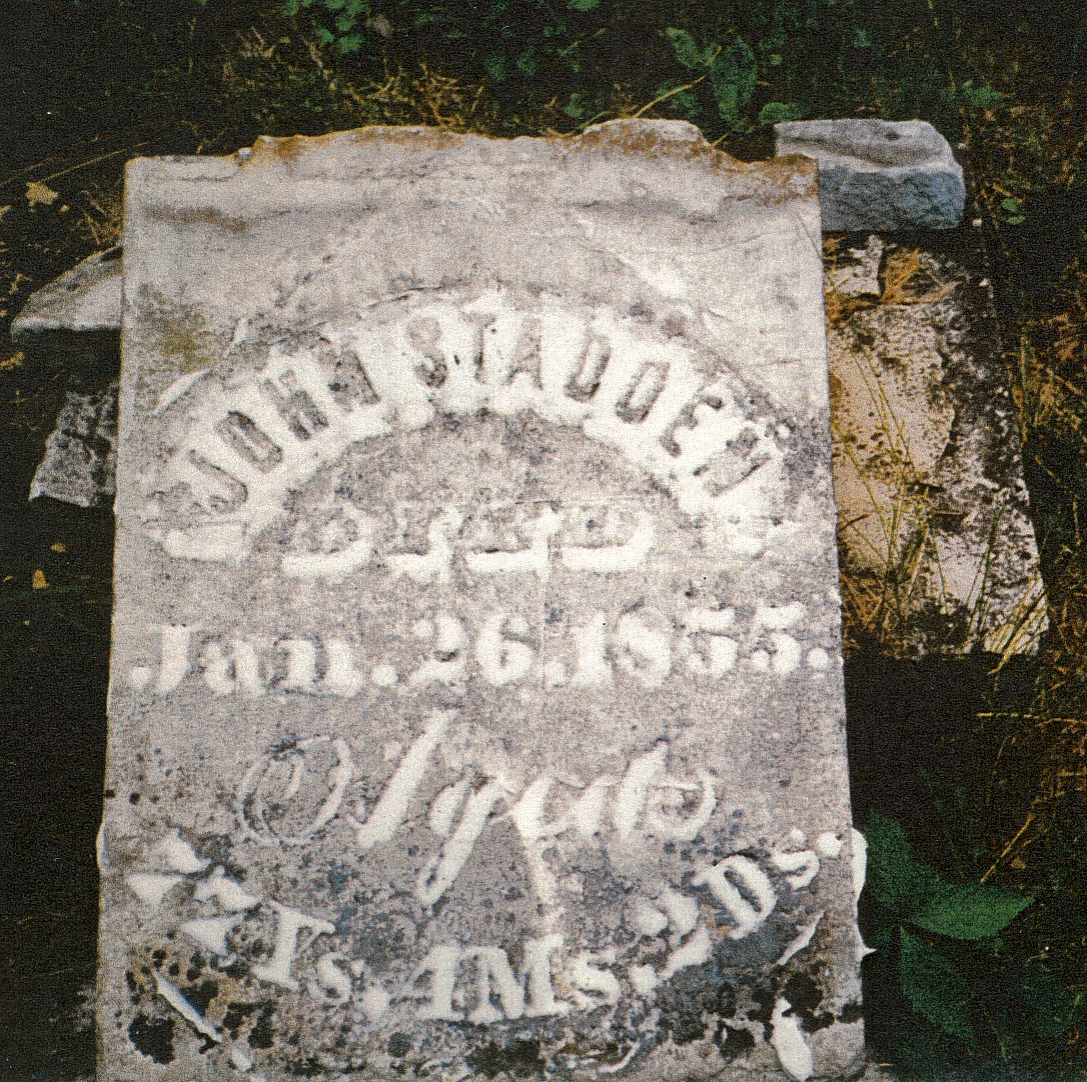
By 1840, they were living in Dayton, Illinois, where Betsey Green Stadden’s brother, John, had established a thriving settlement. John Stadden died there on January 26, 1855, at the age of 77 years, 4 months, and 2 days (as recorded on his tombstone) and was buried in the Dayton Cemetery. 


  1. L. H. Everts, 1875 History of Licking County, Ohio / Plus New Indexes / Adapted from the 1875 Atlas of Licking County (Knightstown, Indiana: The Bookmark, 1975), 48.

It Reads Like a Romance

little girl

First, a little background:

Marriages
In Dayton, Ill., Dec. 29th, 1880, by Rev. John Ustick, Mr. Alexander M. Alcorn, of Earl, and Miss Ella Courter, of Dayton, LaSalle Co., Illinois.
This marriage took place on the coldest day of the winter, the mercury that morning indicating from 20 to 24 degrees below zero according to exposure, and Elder Ustick rode 32 miles that day to keep his engagement. Irv. Smith drove out and back with him, and didn’t mind the cold until he found he’d gone two miles out of the way and to the wrong house; then he sputtered a swear or two and hurried on.1

[Son Harvey A. Alcorn, from 1900 census of Earl twp, was born Dec. 1881.]

BORN
Earl, May 29th, [1883] to Alex. Alcorn and Wife, a son. [This is Asa, died 1885.]2

BORN
On May 2nd, [1887] to Mr. and Mrs. Alex Alcorn a little daughter. Mother and child doing well.3

And now to the 1889 story from the Chicago Tribune:

IT READS LIKE ROMANCE
The Story Behind a Petition for the Possession of a Child
A. M. Alcorn, a La Salle County Farmer Appeals to the Courts to Recover his 2-year-old Daughter

A petition for habeas corpus was filed in the Circuit Court yesterday by Alexander M. Alcorn, a La Salle County farmer, to recover the custody of his little daughter May, 2 years old. Alcorn’s story read like a romance. Ten years ago he wedded a pretty young girl, who lived in Dayton, La Salle County. Their wedded life was happy for several years, until a young man named Samuel Mitchner engaged to work for Alcorn as a farm hand. The wife, Ella F. Alcorn, who had borne her husband two children, became infatuated, it is charged, with the brawny young tiller of the soil. Last Christmas Alcorn, who had business at the village near by, returned home to find that his wife had eloped with Mitchner. She had left their 7-year-old boy but took little May with her. For some time the heart-broken farmer plodded on at home, but he was not idle. Engaging the services of a detective he located the guilty pair in Chicago. Before they could be arrested they fled, leaving little May in the care of two women – Mrs. Lizzie Frazer and Mrs. Button. The women refused to surrender the child to her father, claiming that she was Mitchner’s child, so the father invoked the aid of the courts. Judge Tuley will hear the case this morning, and has ordered the production of the child in court.4

He Secured Possession of His Daughter

Alexander M. Alcorn, the La Salle County farmer who began a legal fight Wednesday to secure the possession of his 2-year-old daughter May, triumphed yesterday in the fight and bore his little one back to her country home. Alcorn’s wife eloped last Christmas with a farmhand in his employ and carried the little girl away. The father traced the guilty couple to this city [Chicago]. When they were discovered they again fled, abandoning the baby, leaving her with a woman named Mrs. Hutton, where the father found her. Mrs. Hutton refused to surrender the child, as she was not certain Alcorn was its father, but willingly gave her up when the court so ordered. The little one, so heartlessly abandoned by her mother, nestled confidingly in her papa’s arms and was seemingly quite content.5

and the Earlville Leader:

About the beginning of the present year the wife of Alexander M. Alcorn went to Chicago giving as a reason that she could make some money. She took with her their youngest child, a little girl in her second year. Their other child, a boy of about seven, was left at home with his father. About two weeks ago she returned. She claimed she was making $20 per week in the hair dressing business and that she could make more if she had more capital. Her husband let her have $200. Suspecting that all was not right she was followed into the city and found to be living with a man named Samuel Mitchner, who formerly worked for Mr. Alcorn on his farm. When the guilty couple found they were detected, they left before they could be arrested. The little girl, May, was left with two women, Mrs. Lizzie Frazer and Mrs. Button, who refused to give the girl to its father. Mr. Alcorn filed a petition of habeas corpus in the circuit court of Cook County. The writ was issued. Thursday Judge Tuly heard the case. After listening to the evidence, the Judge gave the child into his keeping. Mr. A. arrived home with her the same evening. It is not known where the guilty couple have fled.6

Another chapter in the Alcorn elopement affair occurred last Saturday when Mrs. Alcorn returned from Chicago and again installed herself as mistress of the home which she some months ago deserted. Upon her appearance, it was suspected that she returned for the little girl, therefore a warrant was sworn out for her arrest and placed in the hands of Constable Boozel to be served. When he reached there an understanding had been arrived at between husband and wife, the wife forgiven for her escapade, and henceforth in all probabilities their relations will be the same as before.  Mitchner, the hired man, made his appearance, and caused a dark blot in the history of a happy home. Mrs. Alcorn threatens the existence of young Wood, the amateur detective, who shadowed her to Chicago and then lost her, as she claims it was he who caused her acts to be made so prominent.7

with a happy ending in 1910:

Married This Afternoon
Just as we go to press we learn of the marriage of Charles Louis Wold and Miss May Alcorn, two of the well-known and highly respected young people of this vicinity, the wedding ceremony taking place at the home of the bride’s parents, Mr. and Mrs. Alex Alcorn, at 1:30 this afternoon. Rev. D. R. VonderLippe of the Presbyterian church officiated.8


  1. Earlville Gazette, January 7, 1881, p 8, col 2
  2. Earlville Gazette, June 2, 1883, p 1, col 3
  3. Earlville Leader, May 6, 1887, p 5, col 4
  4. Chicago Tribune, May 2, 1889, p. 12, col 1
  5. Chicago Tribune, May 3, 1889, p. 8, cols. 2-3
  6. Earlville Leader, May 3, 1889, p 5, col 4
  7. Earlville Leader, May 24, 1889, p 7, col 3
  8. Earlville Leader, May 19, 1910, p 4, col 3
Rev. Jesse C. Green

Jesse C. Green

Rev. Jesse C. Green

One of the Civil War veterans buried in the Dayton Cemetery is Jesse C. Green. He is buried there because he died unexpectedly while visiting his brother Basil, who lived in Dayton, but he lived his life elsewhere. He was born near Newark,  Licking County, Ohio, November 20, 1832, to Isaac and Elizabeth (Brown) Green.

In 1847 he moved to Crawford County, Illinois, with his parents, where he farmed with his father and brothers. On August 25, 1852, he married Isabel Whitmer in Crawford County, Illinois. They had one son, Hamer Herschel Green, born December 21, 1854. Isabel died in 1856 and in February 1857 he married Anne E. Brown, also in Crawford County. They had two daughters, Ida and Lula.

He didn’t remain in Illinois, though, as he was in Mississippi in 1860. He appears to have taken up his calling as a minister at that time. As the war approached, he returned to Licking County, and there enlisted as a private in the 95th Regiment of the Ohio Volunteer Infantry. At that time he was 5 feet, 8 inches tall, with a fair complexion, blue eyes and light colored hair. He was married and a minister.

The Ohio 95th was mustered in for three years service in Columbus, Ohio, on August 19, 1862. The next day they moved to Lexington, Kentucky, and then  made a rapid march to Richmond, arriving there about midnight one week before the battle at that place on August 29th and 30th. The men lay on the pavement or ground the rest of the night and the combination of over-exertion and exposure injured his health. He was sent to the Regimental hospital and was captured in the battle which followed. He was retained as a nurse to wounded men, but overworked and became ill again. After the exchange of prisoners on November 20, 1862, when ambulances arrived, he was sent home to recover his strength. He returned to the Regiment in very feeble condition and was never able to make a single march of any considerable distance afterward without being taken into the ambulance and being sick for days or weeks afterward. (This description was given by the regimental surgeon in testimony to support Jesse’s request for an invalid pension, so may be somewhat exaggerated.) He was discharged for promotion December 14th, 1864, in order to re-enlist as the chaplain. He was mustered out in Louisville, Ky., Aug. 14, 1865, and in later years received a pension for the stomach disability resulting from the forced march.

Following the war, he came back to Illinois and was admitted on trial as a Methodist minister in the  Olney District in 1865,  He was appointed to various Southern Illinois Conference churches in Macon, Richland, Edwards, Wayne & Fayette Counties, Illinois.  In 1878 he moved to Oak Grove, Florida, but stayed only a year. Due to his ill health he moved frequently, always hoping for a better climate.  He spent several years each in Alabama, Colorado, Louisiana, and Georgia, finally settling in Sutherland, Florida in 1902, where he had a thriving real estate business.

On August 20, 1910, the Tampa Tribune noted that Rev. J. C. Green had gone to Illinois to visit a brother and other relatives. The brother was Basil Green, of Dayton, whom he had not seen for thirty years. During the visit a party celebrating the 80th birthdays of Rebecca Green Trumbo (September 8) and Basil (September 17) was held at Basil’s house. A group picture was taken at the party and one of the thirty-eight attendees was identified as Jesse C. Green (see picture above). Not long after, Jesse was taken ill and after several weeks of ill health he died October 9 and was buried in the Dayton Cemetery.

His obituary in the Tampa Tribune highlighted his association with Southern College:
Word has been received here of the death of Rev. J. C. Green in Illinois, where he had been visiting a brother. He was perhaps one of the oldest residents of Sutherland, having moved here just before Southern College was opened. Since he has been one of the most ardent supporters of the college and has likewise been a benefactor of almost every other institution of the church. He has been a liberal contributor to every religious movement and was always foremost in promoting anything tending to the spiritual welfare of the community.

The Paltry Sum of One Dollar

last will and testament

When Elizabeth (Snyder) Trumbo died in Dayton on May 1, 1873, she had been a widow for twenty years. She had moved off the farm, into a house in Dayton where she died. Her will indicated that most of her children had been previously provided for, but she left specific bequests to four people:

To her daughter Mary Jane, wife of Isaac Green, two thousand dollars and the house in Dayton;

To her grandson Walter Trumbo, son of John Trumbo deceased, eight hundred dollars;

To her daughter-in-law Rebecca (Green) Trumbo, wife of her son Oliver, eight hundred dollars plus the residue of the estate;

To her daughter-in-law Delia, wife of her son Ahab Christopher deceased, one dollar.

As part of the duties of executor of the estate, Oliver W. Trumbo sent Delia Leith, living at Mason, Effingham County, Illinois, a one dollar bill and this receipt for her to sign –

Received Mason Ill December     th 1877 of Oliver W. Trumbo executor of Estate of Elizabeth Trumbo deceased the sum of one dollar in full of legacy bequeathed to me by the will of Elizabeth Trumbo deceased.

Please insert date when you sign the above Receipt.

The reason that I know this is because the envelope containing the unsigned receipt (and the dollar bill) was returned to the executor and appeared in the probate file along with the following note:

Mr. O. W. Trumbo.
Dear Sir
Enclosed I return your one dollar. I do not propose to sign my name to any papers of the Estate for the paltry sum of one dollar.
Yours Truly
Fidelia Leith

When I saw this file in the probate court office, in 1988, the dollar bill, crumpled and worn, was in the envelope. Unfortunately, it is no longer there.

George W. Gibson

GEORGE W. GIBSON

For three-score years George W. Gibson has made his home in LaSalle county, having come here from Ohio with his parents in 1838, and he is not only familiar with the history of the county, but has also contributed his part toward its growth and development.

Mr. Gibson was born in Marysville, Kentucky, March 22, 1826, and along the agnatic line traces his origin to Scotland. His grandfather, Robert Yates Gibson, was a Scotch army officer, and when a young man emigrated to this country and settled in Pennsylvania. In Cumberland, Pennsylvania, John Gibson, the father of George W., was born and reared. He was a soldier in the war of 1812. He married Elizabeth C. Yates, like himself a native of Pennsylvania and a descendant of Scotch ancestry. Some time after their marriage they removed to Marysville, Kentucky, where they remained for two years, going thence to Licking county, Ohio, and in 1838 coming to Illinois and establishing their home in LaSalle county, where the father purchased a farm and where he and his good wife passed the rest of their lives and died, her age at death being seventy-five years, while he attained the venerable age of eighty-six. She was for many years, and up to the time of her death, a devoted member of the Methodist Episcopal church. This worthy couple reared six children, as follows: Martha, wife of C. McKinley, is deceased; Maria is the widow of James Trenary; William, who died in Eldorado, Kansas, was a veteran of both the Mexican and civil wars, being colonel of the Fourth Illinois Infantry; George W., whose name graces this sketch, is also a veteran of the Mexican war; J. M. was likewise a soldier in the Mexican war; and Theodore, also a veteran of the Mexican and civil wars, was major of the Sixty-fourth Illinois Infantry, and has for years been a resident of Ottawa, Illinois.

George W. Gibson was a lad of eleven years when his parents first sought the Illinois prairies, and was reared in the vicinity of Ottawa, attending the Ottawa schools. In 1849, in company with his brother Theodore, he started westward to seek the gold fields of California; they made the trip with ox-team and were six months on the way. En route they passed large herds of buffalo and were often in terror on account of the bands of Indians along the trail. For three years he remained in the west, engaged in mining, returning to Chicago at the end of that time and thence to his home in LaSalle county. The return trip was made by way of the Isthmus of Panama and New York city. Aside from this western mining experience, Mr. Gibson’s life has been quietly devoted to agricultural pursuits. Although now seventy-three years of age, he is still active and vigorous, both physically and mentally.

Mr. Gibson was married first in 1856, to Miss Cynthia Robinson, and to them were born two children, Lewis and Clara. Lewis married Miss Flora Ditch, and they have two children, George P. and Mabel. Mrs. Cynthia Gibson died in 1861, and for his second wife Mr. Gibson married Miss Rachel Green. There were born of this marriage two children – John and Alta, who became the wife of William Miller, of Pennsylvania, and who has one child, Gertie. Mrs. Rachel Gibson died in 1883, and in 1889 Mr. Gibson was united in marriage to Mrs. Mary Ann Poole, his present companion. She was the widow of Joseph Poole, who was a native of England, and she is the mother of five children, three sons and two daughters.

While he has never been a politician in any sense of the word, Mr. Gibson has always in local affairs given his support to the men best suited for office, while in national affairs he has voted the Democratic ticket.1

George Gibson’s second wife, Rachel, was the daughter of John Green of Dayton. She is buried in the Dayton Cemetery.


  1. Biographical and Genealogical Record of La Salle County, Illinois (Chicago: The Lewis Publishing Company, 1900), 1: 281-283.

Tangled Relationships

Family_tree

Though not royal or noble, the family trees of the early settlers of Dayton bear a certain resemblance to those of the noble family above. There was a limited number of possible spouses for the young people and, as a result, many of the marriages involved familial relationships.

Among the children of John and Barbara (Grove) Green :

David Green and wife Mary Stadden were 1st cousins once removed. Mary’s grandmother, Elizabeth Green Stadden, was John Green’s sister.

Jesse Green and wife Isabella Trumbo were 1st cousins. Isabella’s mother, Rebecca Grove Trumbo, was Barbara Grove Green’s sister

Sisters Eliza, Nancy, and Katherine Green married brothers William, Albert, and George Dunavan and when their descendants grew up, there were many cousin marriages.

Rebecca Green married Oliver Trumbo, while her brother Isaac married Oliver’s sister Mary Jane.

Oliver Trumbo was also the half 1st cousin of Jesse’s wife Isabella. Isabella’s father, Matthias Trumbo, was Oliver’s half-uncle.

Rachael married George W. Gibson, who was not related to her or any of her family.

In the later generations –

Elizabeth Dunavan married Cyrus DeBolt, her 1st cousin once removed. Barbara Grove Green, Elizabeth’s grandmother, was the sister of Emma Grove Debolt, Cyrus’s mother.

Louise Dunavan married David S. Green, her 1st cousin once removed. David’s father Isaac Green, was the brother of Louise’s grandfather, John Green.

Rachael’s son John Gibson married her brother Jesse’s granddaughter Mamie Green.

No wonder I have trouble keeping everyone straight!

Cora Watts – Artist

Cora Watts - artist

Cora Belle Dunavan was born June 20, 1879, the daughter of Samuel Dunavan and Amanda Miranda Munson. She was the granddaughter of Joseph and Nancy (Green) Dunavan and the great-granddaughter of John and Barbara (Grove) Green. Her maternal grandmother was Rachel Hall, one of the sisters captured by the Indians during the Indian Creek massacre in 1832.

She married Harry Wallace Watts on October 7, 1904. They lived and farmed near Leland, until Harry’s death in 1949.

As can be seen above, Cora lived a long and productive life, dying in Ottawa May 22, 1964. She was generous with her paintings and gave them away freely. I own several. One is a copy of a picture postcard of a Bavarian castle I visited and greatly admired, but my favorite, which hangs in my living room, is a picture of the home in Dayton where I grew up.

A Father’s Consent

Dunavan, G - Green, K - marriage consent

Dayton Ill June 14th 1837
J. Cloud Esqr
            Sir I have given my Consent For you to Lisen [license] George M. Dunavan & my Daughter Katharine to be joind in motrimony
John Green

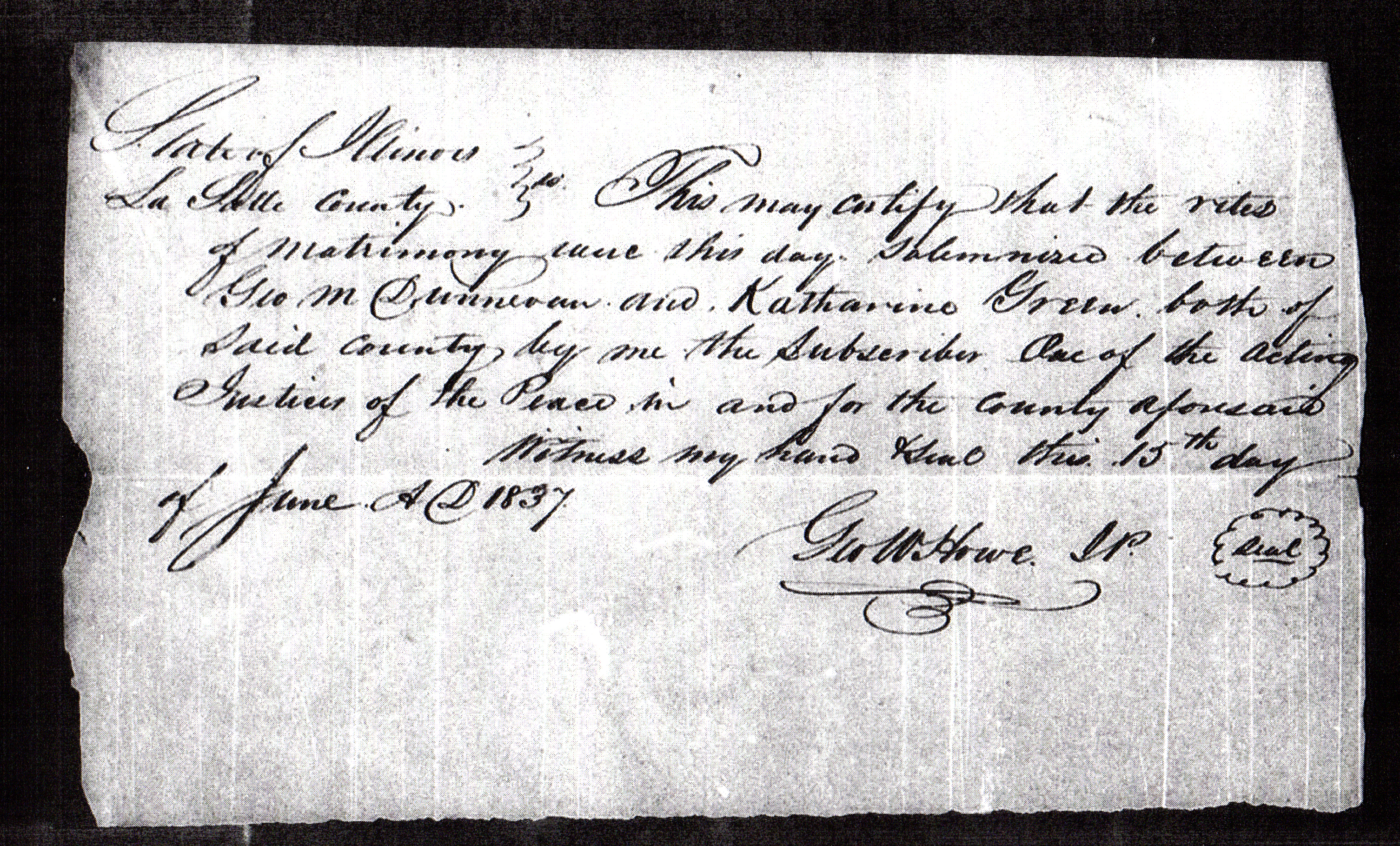
Since Katharine Green was only 15 when she married George Dunavan, her father sent this note of consent to Joseph Cloud, county clerk. The following day Katharine and George were married.

Dunavan, G - Green, K - marriage certificate

State of Illinois
La Salle County
This may certify that the rites of matrimony were this day solemnized between Geo. M. Dunavan and Katharine Green, both of said county, by me the Subscriber, One of the acting Justices of the Peace in and for the county aforesaid.
Witness my hand & Seal this 15th day of June A D 1837.
Geo W Howe, JP

Mr. & Mrs. Moab Trumbo

Moab Trumbo

Moab Trumbo

Rebecca Kagy Trumbo

Rebecca Kagy Trumbo


Society Notes

Mr. and Mrs. Moab Trumbo, two of Ottawa’s most venerable and highly respected old people, celebrated their golden wedding anniversary last Tuesday in a most inconspicuous manner. The day was passed without any celebration to mark the event. This was due to the recent bereavement visited upon the aged celebrants in the death of their son, the late Sheriff Frank Trumbo. Despite their desire to pass the day quietly, many neighbors called informally to pay their respects and many beautiful bouquets were sent Mr. and Mrs. Trumbo. Mr. Trumbo is eighty-two years of age and his wife is seventy-six. Both enjoy the best of health and chances are bright for them to add several more years to their long and happy marital career. Moab P. Trumbo and Rebecca Kagy were united in marriage in Rutland township, February 27, 1862. Shortly after their marriage they moved to Dayton, where they resided up to the time of their coming to Ottawa to live, a few years ago. Mrs. E. F. Bradford, wife of the present mayor, is the only surviving child.


  1. The Ottawa Free Trader, 8 Mar 1912, p8, col 2

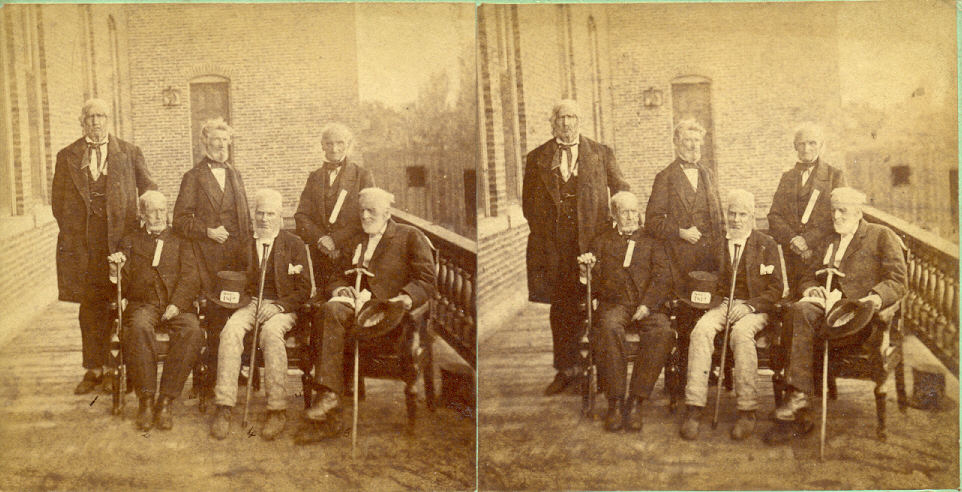
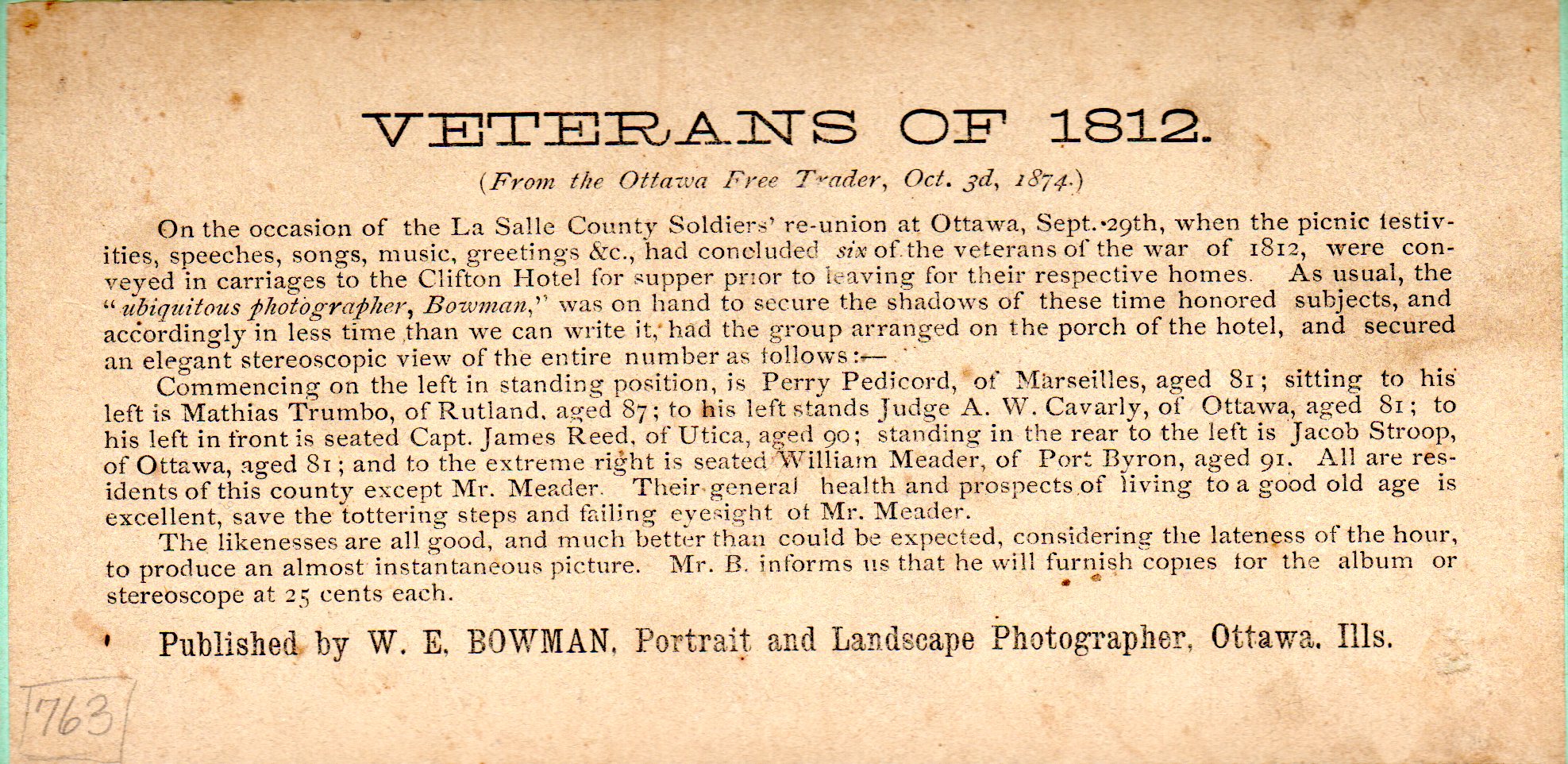
Mathias Trumbo – 1812 Veteran


Mathias Trumbo was the husband of Rebecca Grove, sister of Barbara Grove Green. He came to La Salle county in the second wave of immigrants from Licking county, Ohio, in 1830.

Mr. Trumbo came to this county in 1830, locating in Mission township, now known as Rutland township. Much of the land was still in its primitive condition and he took up a claim from the government, being one of the first settlers in this part of the county. Not a furrow had been turned nor an improvement made upon his farm and he at once began its cultivation, his labors resulting in transforming the tract into richly productive fields. His ancestors were of German birth, although the family was founded in America in early colonial days. Mathias Trumbo served his country as a soldier in the war of 1812, enlisting in Rockingham county, Virginia, which was his native country. After coming to La Salle county he gave his attention to general agricultural pursuits in Rutland township for many years and there resided until his death, which occurred November 20, 1875, when he was eighty-eight years of age, his birth having occurred on the 23rd of July, 1787. His wife bore the maiden name of Rebecca Grove and was also a native of Virginia. She removed to Ohio, where she was reared from the age of ten years and there she remained until her marriage. She, too, spent her last days in Rutland township, La Salle county, passing away in 1865, at the age of seventy-one years. In the family of this worthy couple were eight children, of whom five are now living: John, who was born in 1819, died in 1841. Lavina, born in 1820, married West Matlock, and lived near Yorkville, Kendall county, Illinois. Isabella, born in 1822, became the wife of Jesse Green, who resides in Ottawa, but her death occurred in 1854. Eliza, born in 1826, died in 1904. Elias, her twin brother, is still living in La Salle county. Barbara, born in 1829, is Mrs. Jackson. Elizabeth, born in 1833, is now Mrs. Strawn, a widow living in Ottawa. Elma Anna, born in 1838, is the widow of L. C. Robinson and resides with her sister, Mrs. Jackson, in Ottawa.1


  1. U. J. Hoffman, History of LaSalle County, Illinois (Chicago: The S. J. Clarke Publishing Co., 1906), 295-6.

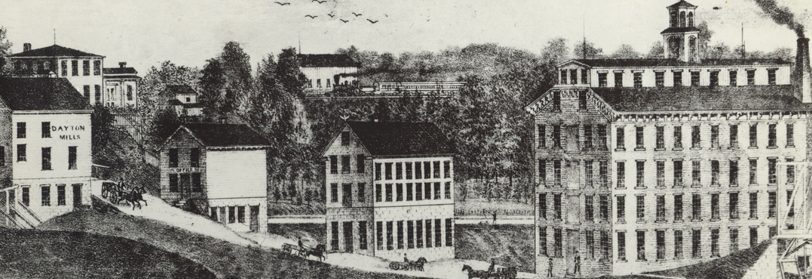
Dam Across Fox River at Dayton

Dam across Fox River at Dayton

The back of this stereoscopic view of the Dayton dam lists a number of other views taken by William E. Bowman, Ottawa photographer. Although (as seen below) he dealt with historic scenes and famous people, he also took many photos of local people and places.

Ottawa’s old time photographer, W. E. Bowman, is now leading a retired life near Los Angeles, Cal. His gallery became famous for his historic faces and scenes. Thousands of eminent men and women have been before his camera, including Abraham Lincoln, William McKinley, Theodore Roosevelt, and other Presidents of the United States. He served as postmaster of Ottawa from 1882 to 1886. He was alderman in 1875-6, was the first secretary of the Riverside Driving Park Association, was trustee of the Academy of Natural Sciences, president of the District Union, which was composed of fifty temperance reform clubs, vice-president of the National Photographers’ association, president of the Memorial association, and generally active in all public affairs. Mr. Bowman was born April 28, 1834, at Huntington, Pa., coming to Illinois in 1837, and locating in Boone county. He came to Ottawa in 1865 and resided here until 1910.1

Back of stereo card


1. Ottawa: Old and New (Ottawa, The Republican Times, 1914), 129