On Memorial Day We Honor Our Veterans

US flag

On this Memorial Day weekend, the veterans buried in the Dayton Cemetery take the spotlight. One of them is John Heath Breese, who was born October 12, 1830 in New Jersey. He was married to Elizabeth Lewis in Peoria, Illinois, on November 16, 1859.

They had seven children:
Nellie Virginia, born September 2, 1861
Ellis E., born April 14, 1867
Emmor E., born 29 June 1869
Cora, born September 19, 1871
Nora B., born March 11, 1874
William L., born October 25, 1876
Walter, born December 24, 1878.

John enrolled as a private in Company C (Houghtailing’s), 1st Regiment, Illinois Light Artillery Volunteers on August 22, 1862. At the time of enlistment he was a farmer, 5 feet 8 inches tall, with light hair and blue eyes. He joined the unit just before the march to Nashville, Tenn., September 3-12. He saw action at Murfreesboro; the Battle of Stone’s River; the Tullahoma Campaign; the Battle of Chickamauga; Mission Ridge; Rocky Faced Ridge; Buzzard’s Roost Gap; Pumpkin Vine Creek; Kenesaw Mountain; Pine Hill; Lost Mountain; the siege of Atlanta; the battle of Jonesboro; Lovejoy Station; the march to the sea; the siege of Savannah; the campaign of the Carolinas; surrender of Johnston and his army; the march to Washington, D.C., via Richmond, Va.; and the Grand Review. He was mustered out at Springfield, Illinois, June 12, 1865. He suffered from rheumatism and heart trouble as a result of a fever he contracted at Nashville in the winter of 1862-3. He spent some weeks in the hospital and suffered from rheumatism from then on. This severely limited his ability to do farm work and made him eligible for a pension.

On his return from the war, he spent 8 years in Kansas, returning to Dayton in 1874. In the summer of 1880 he was working in the paper mill in Dayton when he injured himself jumping up out of a pit without waiting for the ladder to be brought.

photo of John H. Breese tombstone

He died in Dayton, September 30, 1914. Both he and Elizabeth are buried in the cemetery, along with children Nellie Virginia, Ellis, Emmor, and Nora (wife of Lowell Hoxie).

Happy Birthday, Nancy!

Joseph Albert and Nancy Green Dunavan

Nancy Green was born 200 years ago today, April 26, 1816, in Licking County, Ohio, the second daughter of John and Barbara (Grove) Green. She was 13 years old when her family moved to what later became La Salle county, Illinois. In 1831, her older sister, Eliza, married William L. Dunavan. Three years later, on January 26, 1834, Nancy married William’s brother, Joseph Albert, and three years after that, Nancy’s sister Katherine married Albert’s brother George. Joseph and Nancy lived on a farm in Rutland township, across the Fox river from Dayton. They had twelve children:

Katherine (1835-1915) married Benjamin Frank Brandon March 21, 1857
Samuel (1837-1914) married Amanda Miranda Munson March 22, 1859
Isaac (1838/9-1914) married Mary Ann Lafferty March 9, 1880
David (1840-1910)
Amanda (1843-1846)
Joseph (1845-     )
George (1847-1922) married Kate Rogers March 4, 1877
John (1849-1854)
Jane (1852-1927) married Aaron Howe December 25, 1872
Alice C. (1854-1904)
Lewis (1856-    ) married Jennie McMichael in 1879
Anna L. (1859-1884) married William Miller February 22, 1883

Nancy’s husband went to California in the gold rush. There was no word of him for some time and the rumor spread that they had started home through Mexico (as indeed they had) and had been killed there (as they had not). The night he got home, Nancy had a headache as a result of a toothache cure she had applied. She had run a hot darning or knitting needle into the cavity of her tooth to stop the pain. When he got home she entirely forgot the tooth and headache and they sat up about all night talking and visiting.

John Green had given Nancy and Albert a quarter section of land when they married, and they had turned it into a prosperous farm, where they raised their large family. However, in 1883 disaster struck. Albert and his brother, George, had been buying and selling cattle and were in debt. They borrowed from Matilda Hogue, a wealthy widow, and her son Joshua. In order to pay this debt they speculated on the Chicago Board of Trade and lost. Albert and Nancy sold their farm to their son Lewis for $10,400. After the debt was paid they had only a thousand dollars to begin a new life in the West. They moved to Sterling, Colorado, in 1889, where Albert farmed with his sons. They later returned from Colorado to Hamilton, Missouri, where Albert died in 1892. Nancy continued to live in Hamilton with her son, David, until her death on February 27, 1905.

Joel Foster Warner in the Civil War


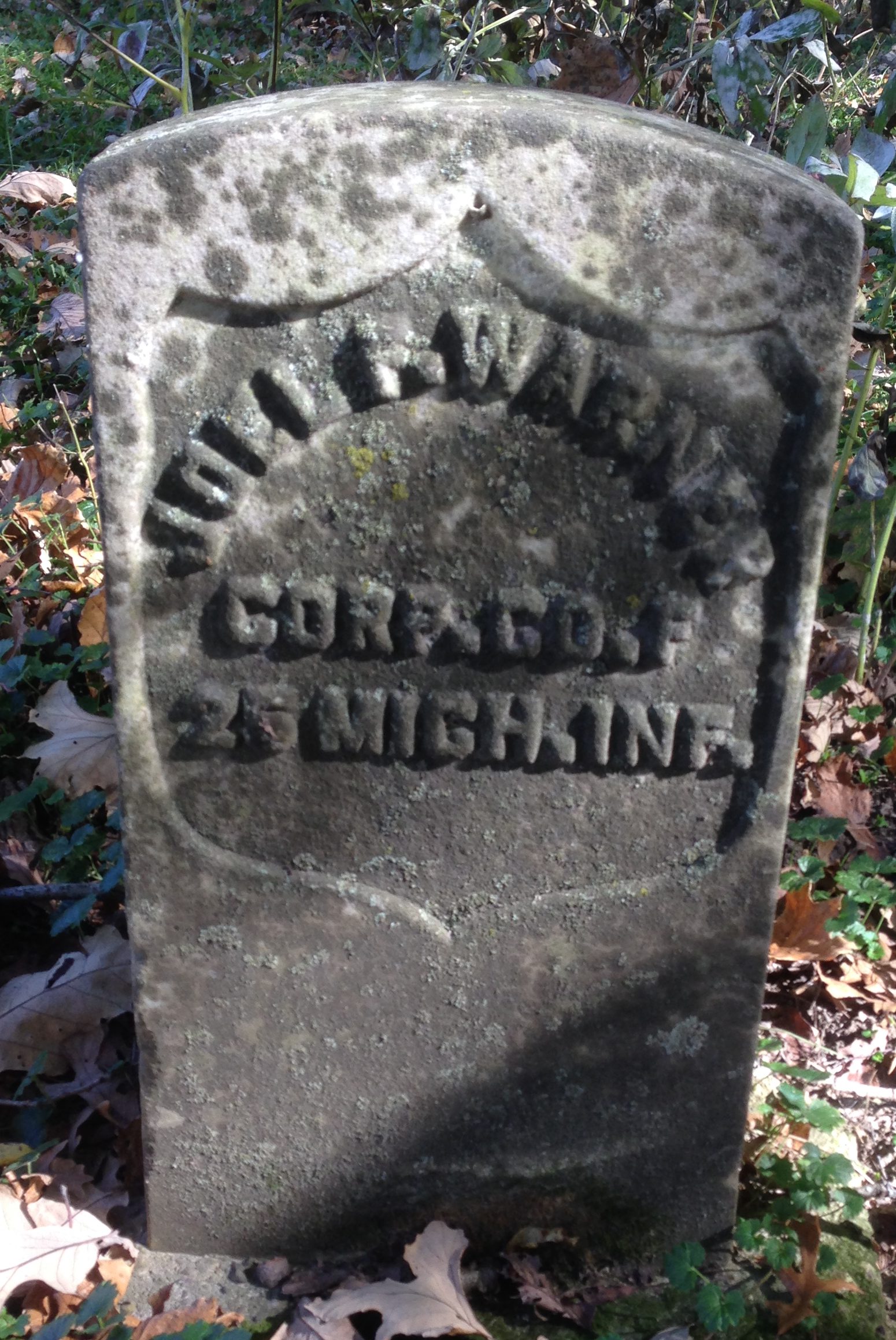
warner-joel-f - tombstone

Joel F. Warner, who is buried in the Dayton Cemetery, was born June 14, 1831, in Syracuse, New York. He enlisted August 14, 1862, in New Buffalo, Michigan, in company F of the 25th Regiment of Michigan infantry and was mustered in as a corporal on September 22, 1862, in Kalamazoo, Michigan. In the spring of 1863, the regiment joined the Georgia campaign with General Sherman from Chattanooga to Atlanta, participating in the battles of Tunnel Hill, Rocky Face and Resaca, among others. On June 12, 1864,  while the company was in action at Pumpkinvine Creek near Dallas, Georgia, Warner was injured. In the words of his sergeant:

I was first Sergt at the time. We moved up in front of the enemies line about noon of the day in question. We hurriedly threw up breastworks, had orders late in afternoon to strengthen the works that night. I made a detail from my Co, J. F. Warner being one of the number & set them to work.I then went to the rear some 10 or 15 rods & lay down for the night, The weather was warm and our line in the woods. We put up no tents. The night was very dark. Some of the men went in front of the works to dig a trench, J. F. Warner with their number. Through some mistake or neglect a gun with fixed bayonet was left leaning against the works. Some time in the night the enemy opened fire on our line with artillery. It lasted but a few minutes, did not alarm the camp to much extent. But the men in front of the works came back very hurriedly. J. F. Warner came in contact with said bayonet, which struck him somewhere in the region of the groin, and carried clear over on the point of it to the ground. He seized hold of the bayonet with both hands and being a man of superior strength kept it from going through him, twisting the shank of the bayonet around the barrel of the gun. I did not see the wound, he was immediately  moved to Hospital before I was apprised of the fact. I saw the condition of the bayonet.

He returned to duty September 16. He had two other short spells in the hospital, in October for fever and in November for neuralgia. He was mustered out with the company on June 24, 1865 at Salisbury, North Carolina. Following his discharge he returned to Three Oaks, Michigan, where he remained until 1872, when he moved to Oswego, Illinois, and then to Dayton.

In 1876, Joel Warner applied for an invalid pension since his ability to work was hampered by the effects of his old injury. He was examined by a local doctor, who estimated that he was 50 percent disabled because of a scrotal hernia on the left side. He had also suffered the loss of his right leg four inches below the knee in a railroad accident, although this happened many years after his war service.

His request for a pension was initially refused, on the grounds that he was not truly incapacitated. However, in 1890 another pension law was passed, expanding the grounds for acceptance. He reapplied, and this time received a pension of $12/month, which was later raised to $20/month.

Warner died in Dayton September 26, 1911, and was buried in the Dayton Cemetery. His widow received a pension of $12/month following her husband’s death, and in 1916 that was increased to $20/month. Mary Ann (Inman) Warner died January 20, 1918, at the age of 79, and is also buried in the Dayton Cemetery.

Who is This Man and Why is He Here?

Gerret Harms tombstone before restoration

There is a tombstone in the Dayton cemetery for Gerret J. Harms. There are no other Harms burials. He does not appear to be related to anyone else buried in the cemetery. There is no obituary for him in the Ottawa paper. Where did he come from, and how did he come to be buried in Dayton?

There were no Harms families in La Salle county, but Gerret did have family here – his wife’s family. Gerret was born in Hanover about 1839/40. He came to the United States around 1861, and went to Boston, where he met and married Marina Barends on August 22, 1863. Marina came from a Dutch family, many of whom anglicized their name to Barnes. They had two children, Hannah, born in 1865, and Gerret, born in 1868.

Whether Gerret was a farmer in Germany or not, he appears to have wanted to go into farming. Marina had four brothers who had gone west and settled in La Salle county, Illinois, in Dayton and Rutland townships. Apparently their reports were favorable, because in 1870 Gerret and Marina were living west of the city of Ottawa where Gerret did not own land, but was employed in farming.

They had another child, Frederick, born in 1873 in Ottawa, but then, on July 14, 1873, Gerret died. Although he lived some distance from Dayton, two of Marina’s brothers lived in Dayton township and they must have arranged for Gerret to be buried in the village cemetery. By 1880, Marina and the children had returned to Boston, where much of her family had settled. She never remarried but lived in Boston until her death, November 2, 1893.

While they were living in Illinois, apparently daughter Hannah made a deep, if youthful, impression on her cousin Peter Barnes, son of Marina’s brother Nicholas, as Peter came to Boston and married Hannah on March 2, 1893.

Gerret Harms, tombstone

The pieces of his tombstone have now been reassembled and stand upright. Some of the pieces of his story have now been reassembled as well.

John Heath Breese – Civil War Veteran

photo of John H. Breese tombstone

John Heath Breese was born October 12, 1830 in New Jersey. He was married to Elizabeth Lewis in Peoria, Illinois, on November 16, 1859. They had seven children: Nellie Virginia, born September 2, 1861; Ellis E., born April 14, 1867; Emmor E., born 29 June 1869; Cora, born September 19, 1871; Nora B., born March 11, 1874; William L., born October 25, 1876; Walter, born December 24, 1878.

At age 32, he enrolled as a private in Company C, 1st Regiment, Illinois Light Artillery Volunteers on August 22, 1862. He participated in a number of noted campaigns: the battles of Chicakamauga, Missionary Ridge, and Kenesaw Mountain, and Sherman’s march to the sea. He was discharged at Springfield, Illinois, June 12, 1865. He suffered from rheumatism and heart trouble as a result of a fever he contracted at Nashville in the winter of 1862-3. He spent some weeks in the hospital and suffered from rheumatism from then on.

This severely limited his ability to do farm work and made him eligible for a pension. On his return from the war, he spent 8 years in Kansas, returning to Dayton in 1874. In the summer of 1880 he was working in the paper mill in Dayton when he injured himself jumping up out of a pit without waiting for the ladder to be brought. In 1889 he applied for a pension from the federal government, claiming rheumatism and heart trouble due to the sickness he suffered in January 1863. In 1892, after the investigation into his claims, he was granted a pension of $8/month, retroactive to August 16, 1889. In 1903, he applied for an increase, claiming total disability; his pension was raised to $12/month.

He died in Dayton, September 30, 1914. Both he and  Elizabeth are buried in the Dayton cemetery, along with children Nellie Virginia, Ellis, Emmor, and Nora (wife of Lowell Hoxie).

The Terrors of Cholera

Cholera was an ever-present danger in the middle of the 19th century and the disease could strike swiftly and cruelly, as this newspaper article from 1854 shows. Aaron Daniels lived just across the Fox river from Dayton and was related to members of the Green family.

Cholera—Fearful Mortality

While there has not, during the present season, been a single case of cholera in Ottawa, originating here, and our city has been unusually healthy, the disease has on several occasions broken out in some isolated families in our vicinity, like a fire in the night, consuming every thing before it. The last family that has suffered from its terrible visitation is that of Mr. AARON DANIELS, a respectable farmer, residing about three miles north of Ottawa, east of Fox River. The disease first made its appearance in his family on Friday of last week, and up to last Thursday morning six of its members has fallen victims to the ruthless scourge, as follows:

On Saturday evening, Minerva Daniels, daughter of A. Daniels, aged about 17.
On Monday night, Jonathan Daniels, son, aged about 20 years.
Ruth Ann Daniels, daughter, aged about 14 years.
Judith Daniels, daughter, aged about 11.
Aaron Daniels, son, aged about 4 years.
And on Thursday morning Mrs. Aaron Daniels, aged about 40.

The family of Mr. Daniels being largely connected in the neighborhood, a number of persons—friends and relatives—visited and remained at the house during their affliction, nearly all of whom have since been taken with the disease, and in many instances, with fatal results, as the following melancholy list of the dead will show.

On Monday evening Geo. Head, son of Thomas Head, aged about 18 years.
Same day Louisa Parker, child of Mrs. Parker, daughter of Aaron Daniels—aged about 4 years.
On Tuesday morning, Mrs. B. Fleming, sister of Mrs. A. Daniels.
On Wednesday, Alvah Channel, living with A. Daniels—aged about 20.
On Sunday, Miss Kingsley, school teacher, lately from Mt. Palatine. She had been boarding in the family of Mr. Daniels until the cholera made its appearance, when she started for home, but was taken at Ottawa, where she died.
On Thursday, Mr. Garrett Galvin, who had assisted in burying the deceased members of the family of Mr. Daniels.

We hear of several others in the neighborhood who have taken the disease, but up to yesterday morning of no more deaths. All the persons taken thus far, we believe were at the house of Mr. Daniels, either calling or assisting there, during their affliction; and it is remarkable that the disease has spread in no families where there have been cases except that of Mr. Daniels. The only cause we have heard assigned for this fearful visitation is the fact that a few days before the disease made its appearance, Mrs. D. had used fresh pork in his family. This alone, although doubtless very unhealthy food at this season, is not believed to be of itself sufficient to account for the fatality ascribed to its use, except on the hypothesis that the pork had become tainted. Considering the extreme heat of the weather, this is not unlikely to have been the case, and although it may not have been perceptible, we are assured that the slightest taint will render such meat otherwise not unwholesome, as poisonous as strychnine.

The reports circulated in town that the family had suffered for want of attention, and that great difficulty had been found in obtaining assistance to bury the dead, &c., we know to be wholly untrue. The truth is, that during most of the time, too many persons were at the house. The family has many friends and relatives in the whole neighborhood, and frequently they gathered in so numerously that they were advised to keep away. Sufficient help was constantly at hand, and complaint on that score is neither made by Mr. D. nor, if made, would be just to his neighbors.1


  1. The Ottawa [Illinois] Free Trader, August 19, 1854, p. 3, col. 1

Elizabeth Lair

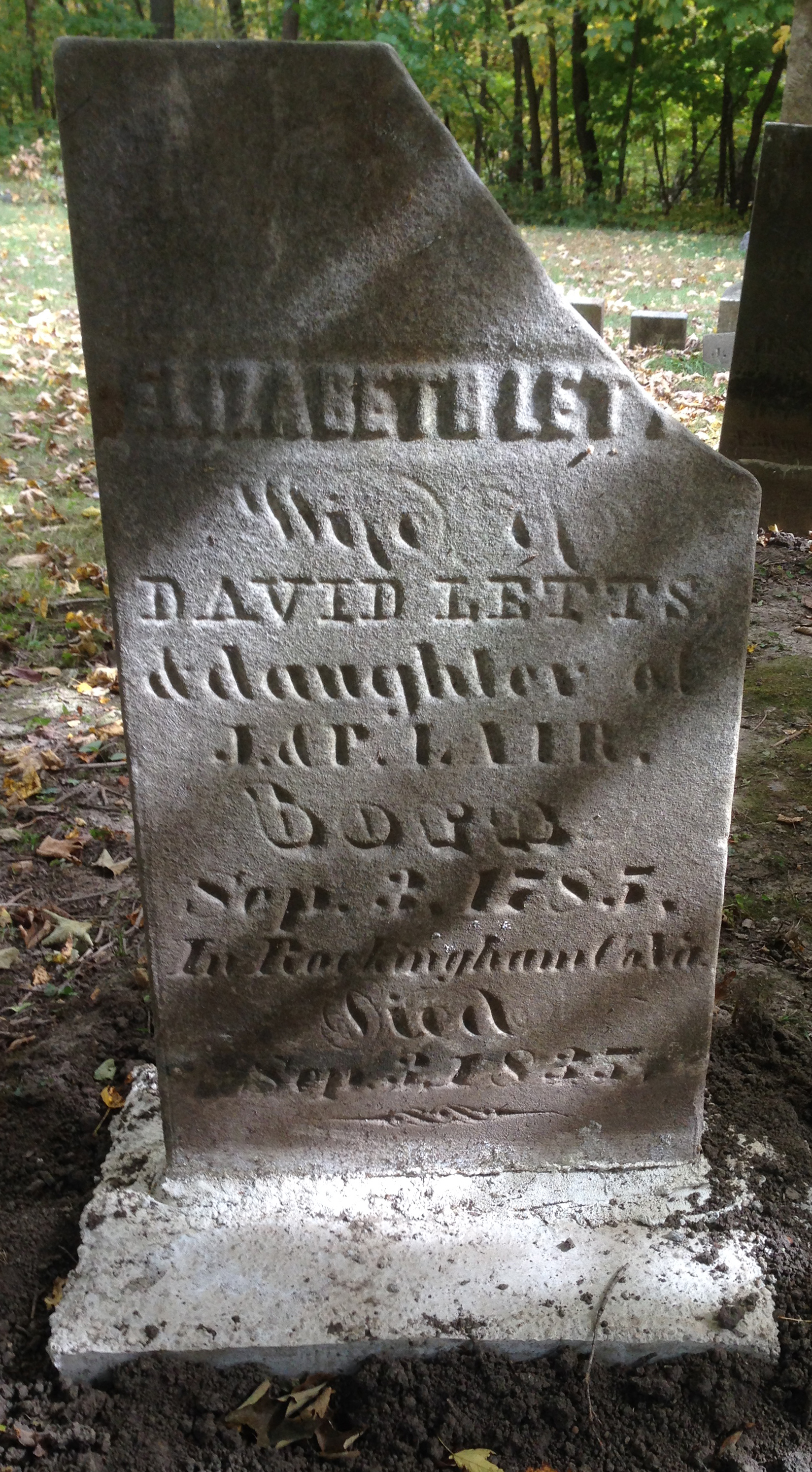
Elizabeth Letts tombstone

Elizabeth Lair was born September 3, 1785 in Rockingham county, Virginia, the daughter of Joseph and Persis Lair. She married Samuel Dunavan December 22, 1807 in Rockingham county, Virginia. They had three sons, William Lair, Joseph Albert, and George Milton. Samuel died June 22, 1816 in Licking county, Ohio and she was left with 3 small boys, aged 8, 4, and 1. The following year she married David Letts, February 27, 1817 in Licking county, Ohio. In 1830 David removed his family to the new country in Illinois, joining another group of Licking county people in La Salle county.

Her son Noah Harris Letts gave this description of his mother when, in 1900, he wrote an account of his family’s history:

“My mother at the period of time I am writing about [about 1829] was a very robust woman weighing about 150 pounds, dark hair, blue eyes and fair complexion, and I can safely say a very handsome woman and was of a very kind disposition, beloved by all that personally knew her, and was a loving mother, and idolized her children, and in return they dearly loved her. She could govern us children by kindness and never used the rod, but it was somewhat different with our father. He would use the beech limb on us, if we displeased him, but I presume not without a cause, as we were rather wild”1

“This fall [1835] on the third day of September our mother died after a short spell of sickness with the bilious fever. We were left a lonely set of children, who had lost a kind and loving mother and we felt the loss, for our mother was beloved by her children and all who knew her. She was a woman in the prime of life and had always been a very healthy, robust woman until this last spell of sickness. On the day she died she was just fifty years old. She was buried in a new graveyard on the bank of Fox River about three-fourths of a mile north of Dayton, opposite the mill dam, and I think was the first person that was buried there, and since it has been the burying ground of Dayton and quite a distance around. The graveyard is kept up very nicely but I have not had the satisfaction of visiting my mother’s grave for a number of years. But she is not lost to my memory or ever will be while I am alive.”2


  1. Paul M. Angle, editor, “PIONEERS / Narratives of Noah Harris Letts and Thomas Allen Banning / 1825-1865” (Chicago: The Lakeside Press,1972), 22-23.
  2. Ibid., 59-60.

A Handmade Gravestone

champaign-albert-john tombstone

This tiny gravestone, only 12 inches high, stands out in the Dayton Cemetery not only for its size but for its material. It is made of brick and appears to be handmade. John Champaign, the father of little Albert John, was a day laborer in the brick yards in Dayton. Whether he made the gravestone himself or had a friend at work do it for him, it almost certainly was made in Dayton.

John Champaign was born in January, 1858, in Michigan, of French-Canadian stock. In 1870 he was living with his parents and siblings in South Bend, Indiana. On September 21, 1880 he married Louise Haverley in South Bend. Sometime before 1883, John and family came to Dayton, where they were living in 1900. By 1910, they were back in South Bend, where they lived out their lives, John dying in 1938 and Louise in 1947.

One of their daughters, Grace, married James C. McGrogan of Dayton on April 30, 1900, and remained in Dayton when her parents moved back to South Bend.

A Most Distressing Accident

Fred Green

Fred Green, who survived the accident

A most distressing accident occurred at the Williams paper mill at Dayton, on yesterday morning. The unfortunate victim was Fred Green, oldest son of Mr. Basil Green, aged 14 or 15 years. He was one of the employees of the mill, and while talking with some young men, was thoughtlessly handling a rope working a spindle. Suddenly his hand was caught in the machinery, his body was caught up and he was hurled through the air until two revolutions of the spindle had been made, when the hand was torn from the arm and he fell to the floor. His left hand was torn off; the same arm broken above the elbow so that it had to be amputated; two fingers on the other hand had to be amputated at the first joint, and both his legs were broken. Dr. Hard, happening to be in the village treating diphtheria patients, was called at once. He immediately telegraphed for Drs. Dyer and McArthur, who went to his assistance, and after several hours’ work left the unfortunate lad as comfortable as could be expected. His life is in great danger.1


  1. The [Ottawa, Illinois] Free Trader, May 29, 1880, p. 1, col. 3.


Gracie Green’s school days

card & ribbon

In 1881 little Gracie Green was an eight-year-old student in the Dayton school. She was a well-behaved student, since her teacher certified that she “during the winter term of five months has not whispered once neither has she been guilty of any act of misconduct.” Grace was the daughter of Isaac and Mary Jane (Trumbo) Green. She was born in Dayton in 1873. She did not marry, and died in Dayton in 1894. She is buried in the Dayton Cemetery.

Gracie Green

Her teacher was Miss Desdemona (Dessie) Root. Miss Root taught in the Wedron school in the summer of 1881 and then moved to the Dayton school for one year, where she was responsible for the success of many of the entertainments held at the school house. She received many compliments on how well she had prepared her students for their performances. Surely little Gracie did her well-behaved best in her part, whatever it was.

An Ohio Marriage

Green, J - Grove, B. marriage1
John Green and Barbara Grove were married in Licking County, Ohio on March 28, 1813. Barbara was the daughter of John Grove and Barbara Lionbarger. In his memoir, Jesse Green described his grandfather Grove: “John Grove, the head of the Grove family was of Dutch or German descent and was a large powerful man. He could pick up a barrel of flour under each arm and toss them upon one of those old fashioned Virginia wagons with ease. He was so large that his descendants long preserved one of his vests to show his unusual girth about the breast.”

The original 1929 party that came from Ohio to Illinois, to the rapids of the Fox river, included many members of the Grove family – Barbara Grove Green, David Grove, Emma Grove DeBolt, Samuel Grove, and Joseph Grove. After the death of John Grove, his widow, Barbara, also came to La Salle county, in 1838, to live with her son Joseph.

Further information on members of the Grove family may be found at http://www.genealogycenter.info/search_grove.php


  1.  “Ohio, County Marriages, 1789-2013,” database with images, FamilySearch(https://familysearch.org/ark:/61903/1:1:XZH2-KNR : accessed 18 August 2015), John Green and Barbary Grove, 28 Mar 1813; citing Licking, Ohio, United States, reference v1,p.23; county courthouses, Ohio; FHL microfilm 384,300.

Miss Emma Clementine Fraine


Miss Fraine bookmark     1952 Class list - Dayton school     Miss Fraine

In 1952, Miss Emma Fraine retired after fifty years of teaching, most of them at the Dayton school, where she taught grades one through four. The class lists shown above include only those students whom Miss Fraine had taught, so not all of the members of the upper grades are included. Her classroom was a single large room, on the first floor of the school. Each grade had its turn at recitation, with time to prepare for the next lesson while other classes were reciting. If you listened to the recitations of the classes ahead of yours, you could get a head start on the next year’s work. She was a firm believer in teaching reading by means of phonics and when phonics fell out of favor, she asked the school board to allow her to continue her existing ways, which they were glad to approve.

Her parents were Charles and Clemence Fraine, who were married 11 May 1878 in Ranrupt, France. They immigrated to the US and came to Dayton by 1882, where they raised their family: daughters Addie, who married Richard Thompson, 31 Dec 1901; Jennie, who also taught school in Dayton and surrounding towns; and Emma, and son, Jules.

The first Dunavan-Green marriage

1831 Dunavan-Green marriage permission Rapids of Fox         November 1th 1831
Mr David Walker
Sir I autherise you to Ishue a lison to solemnise marraige betwn William L. Dunnaphan & my Daugter Eliza yours with Esteem John Green


On November 6, 1831, John Green’s oldest daughter, Eliza, married William Lair Dunavan in La Salle county, Illinois. Five days earlier, Eliza’s father wrote his permission for her to marry, as she was only 17. At this time they were living on the east side of the Fox river, in Rutland township; Dayton was laid out on the west side only in 1837. Eliza and William lived on a farm in Rutland township, where they raised a family of nine children, Albert, Emma, John, Elizabeth, James, Rachel, Celestia, Jesse, and Noah. Celestia died in childhood, Rachel at age 11, and Jesse at 26, but the others all lived to at least 65 and Albert died at age 80.  In 1881, Eliza and William moved to Denton, Texas, where William died in 1889 and Eliza in 1896.

A Bit of More Modern History

 4-H club


Thanks to a cousin, Ken Baker, who found this clipping in an old scrapbook.

First row (left to right): Ruth Schmidt, Janet Schmidt. Rachel Schmidt, Barbara McCormick, Phyllis McCormick

Second row: William Milan, Richard Pitstick, John Schmidt, Richard Schmidt, Dale McCormick, Edwin Pitstick, Gerald McCormick

Third row: Charles Clifford (leader), Bob Lattimore, Vincent Pitstick (junior leader), Emmett Baker, Hubert Pitstick, Henry Schmidt.

Please leave comments below about anything you remember about this group, particularly when this might have been taken.

Tying Two Families Tightly Together

Eliza and Wm Dunavan            Joseph Albert and Nancy Green Dunavan

Among the very early marriages in La Salle county are the marriages of three brothers, William, Joseph, and George Dunavan, with three sisters, Eliza, Nancy, and Katherine, the daughters of John Green, founder of Dayton. William and Eliza were the first to marry, on November 6, 1831. Nancy and Joseph followed on January 26, 1834, and finally, Katherine and George married on June 15, 1837. In later years, Noah Letts, the younger half-brother of the Dunavan boys, reached the age where he was thinking about acquiring a wife. His brother Madison’s wife, who was John Green’s sister-in-law, suggested a Trumbo girl, a niece of hers. Noah, knowing that several Trumbos had also married into the Green family, felt that Dayton was full of his relatives and thought that he would look elsewhere for a wife.

Who was Ann Muddamin?

picture of Ann Muddamin tombstone

There is a tombstone in the Dayton Cemetery which reads:
ANN MUDDAMIN
DIED
Apr. 17, 1843
AE 75 years

A search in three large on-line genealogical sites, Ancestry, Family Search and Mocavo, found no one with a last name of Muddamin. A search for Muddaman produced some results, mostly from the British Isles. A search for Muddiman produced many results, mostly from the US and Britain. It appears, then, that “Muddamin” may be a misspelling of the more common “Muddiman”. There is no head of household in the 1840 census of La Salle county with a name beginning MUDD, so she is not the wife or sister of a local man. Muddiman might be her married name and she might be in the household of a married daughter. There are no households in the 1840 federal or state censuses for Dayton that contain a female over seventy.

She was unlikely to have been traveling on her own. Was she with someone who came to Dayton after 1840? Perhaps she was with a group that was only passing through and she was buried at the nearest place to where she died. Tracing the families of the early residents may eventually turn up a Muddiman connection, but for the present she remains a mystery.