The School Playground

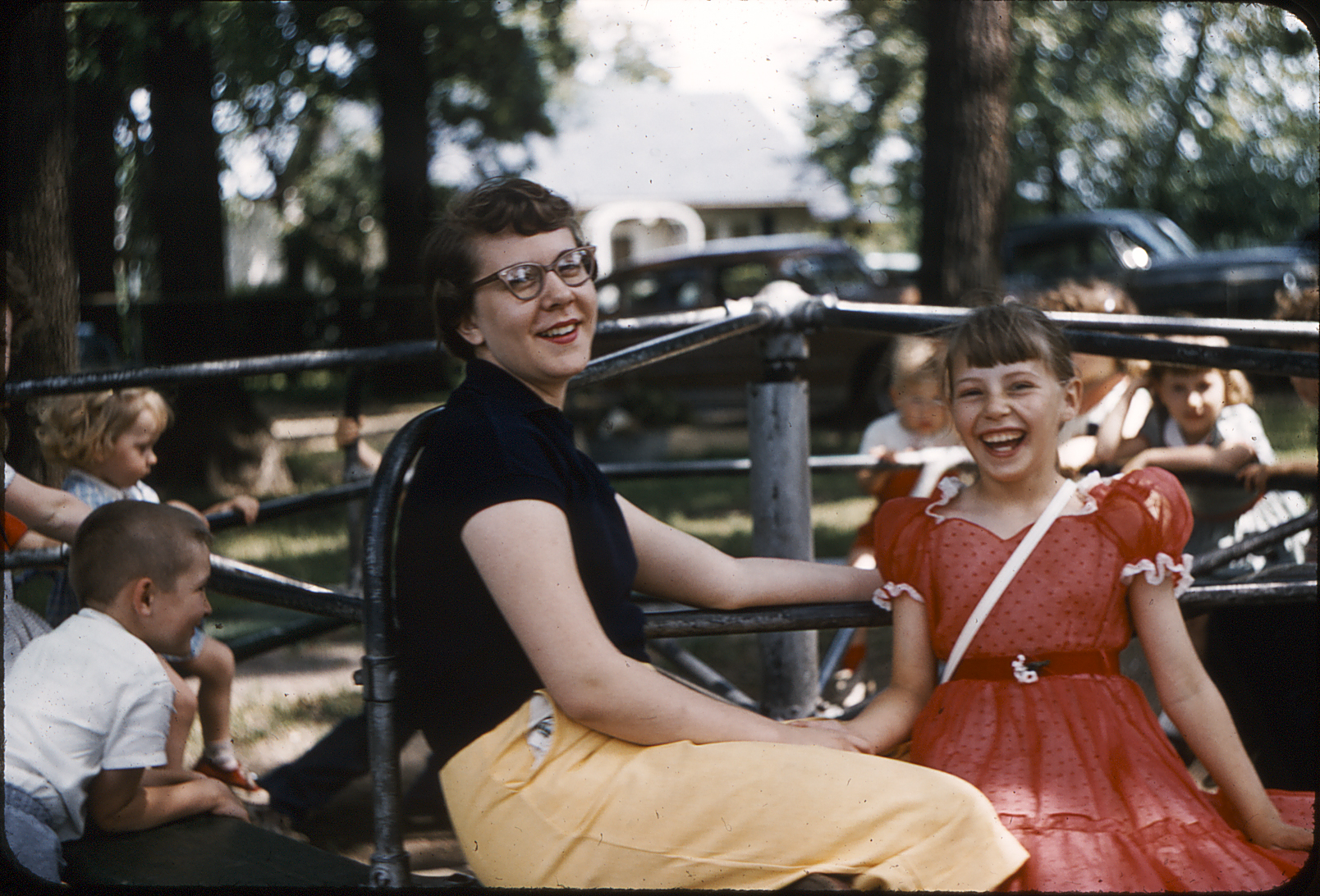
Dayton school picnic

Shirley Walleck and Judy Jackson are sitting on the merry-go-round, which is unusually stationary. The more normal state of affairs was to have several children pushing it madly around, while others clung to the bars and screamed. This picture was taken around 1949, at a school picnic held in the schoolyard.

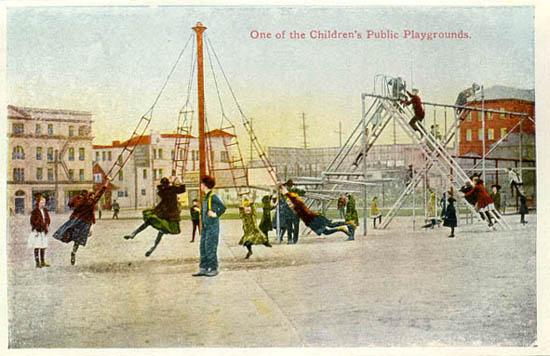
There was other playground equipment – swings, monkey bars, and that favorite of some of us – the giants. Also called a Maypole swing or an Octopus, you’ll never see one on a playground today, but we loved them. As seen in this picture, you ran around the pole holding on to the handles at the end of the chains until the centrifugal force swung you off your feet.

playground equipment

What do you remember about the playground equipment? Leave your stories in the comments.

Early Mail Delivery


newspaper listing of early mails

Mail Service to Dayton in 1842

Tri-weekly mail up Fox River, via Dayton, Northville, Pennfield, Bristol, Oswego and Aurora to Geneva, arrives every Monday Wednesday and Friday at 8 o’clock, p. m., and departs every Tuesday, Thursday & Saturday, at 3 o’clock, a. m.

The Dayton post office was established in 1837. In 1842, as this mail schedule shows, Dayton was on the Fox River route up to Geneva, in the north. Because of the relative ease of the river route as compared to the overland routes, there were three mail deliveries a week in Dayton, whereas the other routes only provided weekly service. There was no home delivery of mail, so stopping by the post office to get your mail was also a social activity for the exchange of local news.

In 1842, prior to the use of envelopes and postage stamps, letters usually consisted of one sheet, folded, with the charge (paid by the recipient) written in the corner. At this time, the charge for a letter was 25 cents, and often a letter languished at the post office until the recipient could afford to retrieve it. A story is told of a man whose letter lay in the post office for over a month because he could not collect the money to get it. He finally traded the postmaster four bushels of wheat for it and thought he had made a good deal, so anxious was he to hear from the folks back home.


Image from Illinois Free Trader, October 28, 1842, p. 3, col. 2

The Dayton Exchange

This house was once the hotel

CORRECTION: although this building is the same size and shape and on the same location as the Dayton Exchange, this building was built on the site after a fire in 1890 which destroyed the Exchange.

This building, now a private home, was originally the Dayton Exchange, a hotel. In 1870, the building was purchased by George Makinson and Joseph B. Jennings, who advertised that:

[the purchasers] have completely remodeled and refitted it in modern style, and now open it to the patronage of the public, offering all the comforts and conveniences of a first-class hotel. The rooms are comfortable and dry, and particular attention will be given toward providing the table with all the delicacies of the season. A good stable is in connection with this house, where horses will be well and properly cared for.1

A portion of the building was fitted out as a grocery store, for the convenience of the villagers, as well as the hotel guests. in 1880, James Timmons bought the Dayton Exchange and advertised that he had “re-modeled, re-painted and re-furnished from top to bottom, inside and outside”. The hotel catered particularly to fishing parties, frequent visitors in the summer. In 1902, Timmons sold the building and it ceased to be a hotel.


1. The [Ottawa, Illinois] Free Trader, July 16, 1870, p. 2, col. 6

A Tombstone Jigsaw Puzzle

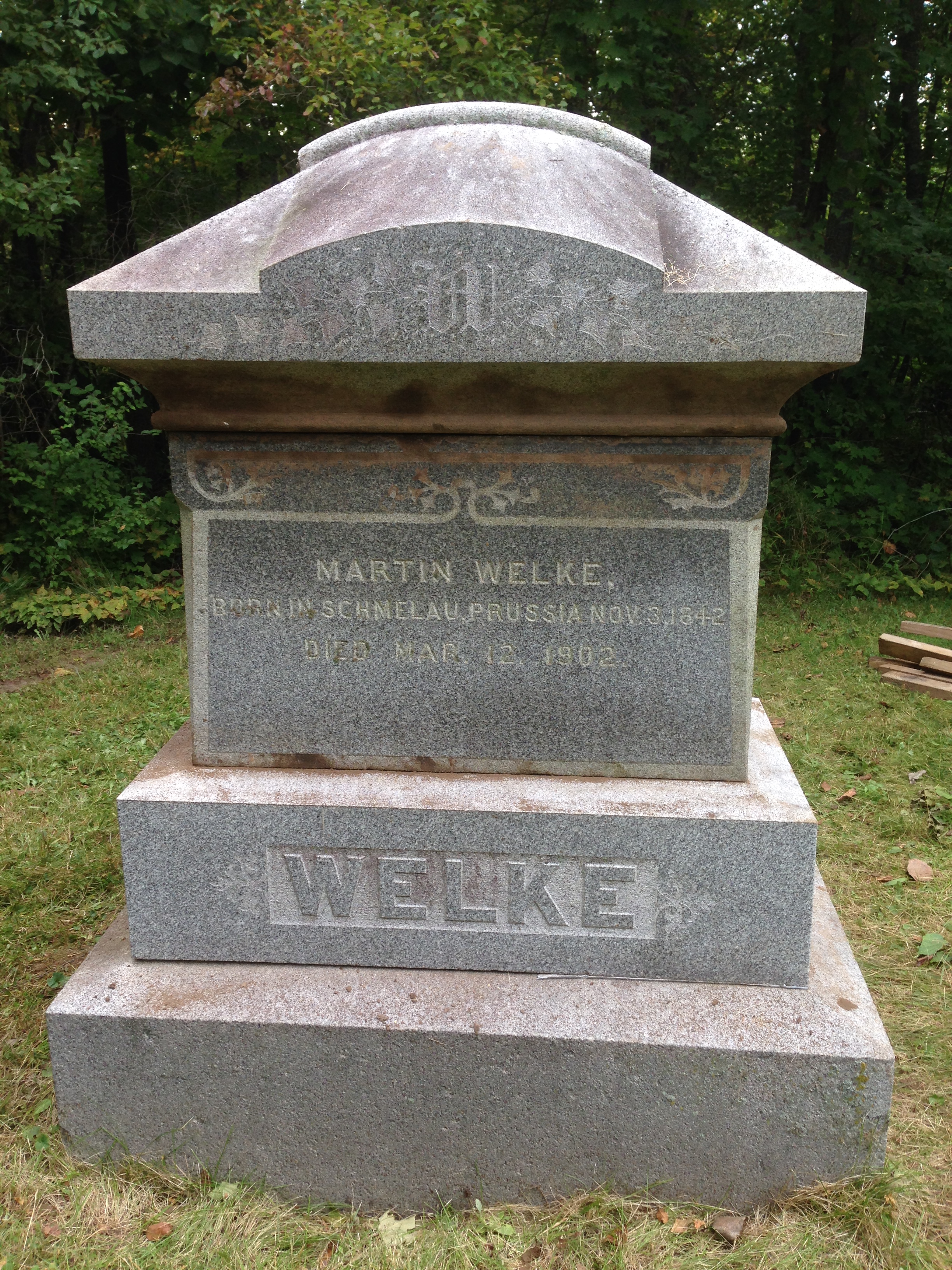
Welke tombstone in pieces

In September 2014, the Dayton Cemetery Association worked with a professional restoration expert to repair a number of monuments which had been damaged by vandals. Our first effort was the Martin Welke stone, seen above. After the middle section was replaced on the base, attention turned to replacing the top.

And here is the reassembled stone:

Welke tombstone completed

We repaired seventeen stones that week and plan to continue the work in 2015.

133 Years Ago in Dayton

camper

Our busy little neighbor, Dayton, besides becoming famous for her horse collars, woolen goods, tile and paper, is getting to be quite a popular summer resort. The stream of visitors during the few weeks since the fishing season opened must be enormous, for on every bright day at least the banks of the river are lined with people. As a sample of the size of parties: – Some 25 couples from Streator went up in a special car on Tuesday! Already the campers have begun to put in their appearance, and it is altogether likely that from this time until fall there will be no great diminution in the number of visitors. We should think the citizens would turn this flood of tourists to their advantage; and they certainly could make themselves vastly popular with the people of the Fox River Valley by lending their aid in the suppression of illegal seining in their waters.1


1. The [Ottawa, Illinois] Free Trader, May 27, 1882, p. 6, col. 1

The first Dunavan-Green marriage

1831 Dunavan-Green marriage permission Rapids of Fox         November 1th 1831
Mr David Walker
Sir I autherise you to Ishue a lison to solemnise marraige betwn William L. Dunnaphan & my Daugter Eliza yours with Esteem John Green


On November 6, 1831, John Green’s oldest daughter, Eliza, married William Lair Dunavan in La Salle county, Illinois. Five days earlier, Eliza’s father wrote his permission for her to marry, as she was only 17. At this time they were living on the east side of the Fox river, in Rutland township; Dayton was laid out on the west side only in 1837. Eliza and William lived on a farm in Rutland township, where they raised a family of nine children, Albert, Emma, John, Elizabeth, James, Rachel, Celestia, Jesse, and Noah. Celestia died in childhood, Rachel at age 11, and Jesse at 26, but the others all lived to at least 65 and Albert died at age 80.  In 1881, Eliza and William moved to Denton, Texas, where William died in 1889 and Eliza in 1896.

The Pennypacker Horse Collar

Horsecollar ad

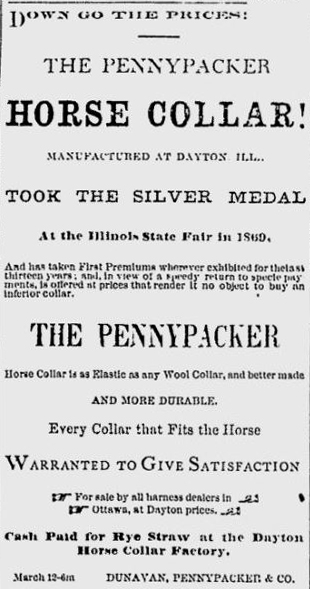
The celebrated Pennypacker horse collar was a specialty of the Fox River Horse Collar Manufacturing Co., which claimed that the general mechanical construction of this collar “has rendered it the best device of its kind known to the trade. It is so constructed that the draught is close to the horse’s neck instead of back on his shoulders, and thus an easy and comfortable fit is effected.” Their goods were widely known, from Pennsylvania, Ohio and Virginia on the east, to Kansas, Nebraska and Missouri on the west. They used about forty tons of rye straw yearly for filling horse-collars, and the hides of about 2,000 head of cattle were required yearly to supply them with leather. The Seamless Team Collar was a standard pattern, always on hand. They also advertised their willingness to make any grade or pattern to order on short notice. Their collars were for sale by any harness dealer in Ottawa and elsewhere. In 1883 the factory had a capacity of turning out 300 dozen collars per month, which were shipped throughout all of the western states and into many of the eastern states, and even, in 1886, to Sydney, Australia.

A Bit of More Modern History

 4-H club


Thanks to a cousin, Ken Baker, who found this clipping in an old scrapbook.

First row (left to right): Ruth Schmidt, Janet Schmidt. Rachel Schmidt, Barbara McCormick, Phyllis McCormick

Second row: William Milan, Richard Pitstick, John Schmidt, Richard Schmidt, Dale McCormick, Edwin Pitstick, Gerald McCormick

Third row: Charles Clifford (leader), Bob Lattimore, Vincent Pitstick (junior leader), Emmett Baker, Hubert Pitstick, Henry Schmidt.

Please leave comments below about anything you remember about this group, particularly when this might have been taken.

Products of the Dayton Woolen Factory

Woolen factory coverlet

This woven coverlet is one of my treasured family heirlooms. It was produced at the Dayton Woolen Factory and has been handed down in the family for over 150 years. The pattern is an example of an overshot pattern, where the horizontal yarn shoots over several vertical yarns at a time. The slight discontinuity in the pattern (circled) shows where two lengths woven on a 36 inch loom were joined to make the full sized coverlet.

Woolen ad

The factory made many kinds of cloth, as noted in this ad. Satinet was a satin-weave fabric made with cotton warp and wool filling; cassimere, a twill-weave, worsted suiting fabric; flannel, a fabric made in plain or twill weave, usually with carded yarns and napped for added warmth. My great-aunt remembered that the family was always well-supplied with stockings knit from factory yarn and the family clothing, as well as the blankets for their beds, were products of the factory. Fabric was obtainable in many colors, with basic grey, brown and black as well as blue, scarlet, green, and red. I also have another, light-weight, blanket from the factory which is a pale yellow. The products of the factory were of a high quality, as evidenced by the awards they won at cattle shows and county and state fairs, throughout Illinois and other states in the midwest.

Tying Two Families Tightly Together

Eliza and Wm Dunavan            Joseph Albert and Nancy Green Dunavan

Among the very early marriages in La Salle county are the marriages of three brothers, William, Joseph, and George Dunavan, with three sisters, Eliza, Nancy, and Katherine, the daughters of John Green, founder of Dayton. William and Eliza were the first to marry, on November 6, 1831. Nancy and Joseph followed on January 26, 1834, and finally, Katherine and George married on June 15, 1837. In later years, Noah Letts, the younger half-brother of the Dunavan boys, reached the age where he was thinking about acquiring a wife. His brother Madison’s wife, who was John Green’s sister-in-law, suggested a Trumbo girl, a niece of hers. Noah, knowing that several Trumbos had also married into the Green family, felt that Dayton was full of his relatives and thought that he would look elsewhere for a wife.

Who was Ann Muddamin?

picture of Ann Muddamin tombstone

There is a tombstone in the Dayton Cemetery which reads:
ANN MUDDAMIN
DIED
Apr. 17, 1843
AE 75 years

A search in three large on-line genealogical sites, Ancestry, Family Search and Mocavo, found no one with a last name of Muddamin. A search for Muddaman produced some results, mostly from the British Isles. A search for Muddiman produced many results, mostly from the US and Britain. It appears, then, that “Muddamin” may be a misspelling of the more common “Muddiman”. There is no head of household in the 1840 census of La Salle county with a name beginning MUDD, so she is not the wife or sister of a local man. Muddiman might be her married name and she might be in the household of a married daughter. There are no households in the 1840 federal or state censuses for Dayton that contain a female over seventy.

She was unlikely to have been traveling on her own. Was she with someone who came to Dayton after 1840? Perhaps she was with a group that was only passing through and she was buried at the nearest place to where she died. Tracing the families of the early residents may eventually turn up a Muddiman connection, but for the present she remains a mystery.

The early mill

Green's Mills ad

In the early days of the settlement of northern Illinois, one of the most pressing needs was for a grist mill. When the Greens built their first grist mill, in 1830, it was one of the few places where people could have their grain ground. People came from as much as fifty miles away, and because of the distance and the number of people waiting for their turn, they sometimes had to wait in line for several days. The hardships of those early days made good telling in later years, as shown by this excerpt from the Earlville Gazette of February 8, 1868

Recollections of the Early Settlement of the Town of Earl, by Charles H. Sutphen

The first two winters we were here it was very difficult to get grinding, Green’s mill, at Dayton, being the only one within fifty or one hundred miles, and this mill occasionally froze up in the winter; the mill would be so crowded sometimes in the winter, that parties going to mill would have to wait sometimes two and three days for their grist.  I have laid by the hopper some two nights in succession, in the coldest of weather, waiting for my turn.  If you left your post, some one might slip a grist in ahead of yours; but this was soon remedied by the erection of mills on the Big Vermillion, and Dr. Woodworth’s, at Marseilles.

During the Black Hawk War

One of the major events in La Salle county during the Black Hawk War was the Indian Creek Massacre, which alarmed the settlers in the area. Barbara Green was in Dayton and recounted these memories:

On the 16th of May 1832, about ten o’clock in the morning, myself and the girls were washing at the spring near where the feeder bridge now is when Eliza came down on horseback and told us that the Indians were coming & that we would have to go to Ottawa right away.  Then we went to a place a couple of miles below Ottawa (to Penbrook) and stayed there all night the next day come up to Ottawa and next day home again.  This was Sunday and the next day the men made a stockade around the house out of plank.  After it was finished they tried it to see if a bullet would go through it, and it did, so they hung up feather beds all around.  There were about sixty people here at the time, we were so crowded that they had to sleep on tables, under the beds and all over the house.

The same night George Walker came and told us that we must go to Ottawa again, so we left right away and went down to the river to get in the pirougue, but when we got there we found that Daniels’ had taken the boat and gone before we got there, so we had to walk.  As I had forgot some of Rachel’s clothes and, coming back to the house, I found Jesse and David yet in bed.  They had been waked before we started so I supposed they were with us.  We followed the river bank all the way down and I had to carry Becky all the way because she would cry when anyone else took her.

Aunt Becky Trumbo was sick so that she could not walk and she rode on the horse behind old Mr. Letts.  Eliza Trumbo was left standing on the river bank and we went off and forgot her.  Wm Dunavan came back and got her.  When we got to Ottawa there was no fort there, only a log cabin on the south side of the river, but they soon built a fort on top of the hill.  We went to the fort but there was so much confusion there that we had the log house moved up on the hill and lived in it.  We women didn’t know what the trouble was til we reached Ottawa and then they told us about the “Indian Creek Massacre” where there were sixteen people killed.  Two boys who ran away and two girls who were taken prisoners, were the only ones that escaped.

The next day (?) a company of soldiers from the southern part of the state passed through Ottawa on the way up the river and two men Hazleton and Schemerhorn who lived at Mission Settlement intended to go with them to their farms but failed to get ready in time and so were an hour or two behind the soldiers.

Dictated to Maud V. Green by her grandmother, Barbara Grove Green, December, 1884. Transcribed from the handwritten original by Candace Wilmot, gr-gr-granddaughter of Barbara Grove Green, 18 September 1990. Original in possession of Candace Wilmot.

The first few winters (1830-1832)

greater-prairie-chicken-tympanuchus-cupido

Greater Prairie Chicken

The second and third winters we were here we had about two feet of snow, which lay on the ground most of the winter, and drifted badly and crusted over so that we could ride over fences without difficulty, and prairie chickens were so plentiful and tame that on a frosty morning, they would sit on trees so near our cabin that Father stood in the door and shot them, until some of the men said he must stop before he shot away all of our ammunition, and leave none to shoot deer and turkeys.  Our first winter here Brother David and myself trapped rising three hundred chickens, besides a large quantity of quail.  After eating all we could, Mother merely saved their breasts salted and smoked them.

In those days wild bees were quite plentiful, and could be found in winter on the snow where dead bees were thrown out.  In the absence of snow our best bee hunters would bait them at different points of the compass, and time them in their flight and thus locate the tree near enough to find it

from Jesse Green’s memoir, written in 1895


Greater prairie chicken tympanuchus cupido by Menke Dave, U.S. Fish and Wildlife Service


The first year

Millstone - Shabbona Park (1)

One of the original millstones at Dayton, now on display in Shabbona Park.

When the Green party arrived in Illinois in December 1829, they moved into the cabin that William Clark had built for them. It was 18 feet by 24 feet, and in that single room, fourteen adults and ten children (four of them under two years of age) spent the first winter. As soon as possible in the spring, trees were felled to make a sawmill and the roots of the trees were used in making the dam. Jesse and David Green, ages twelve and ten, were given the task of scraping out the raceway for the mill, with a pair of oxen and a scraper each. They finished their work just as the mill was ready. The sawmill was built with enough room at one end for a pair of grindstones, and on July 4, 1830, the first wheat was ground by water power in northern Illinois. Barbara Green baked bread from that flour for their Independence Day meal. When these first mill stones were replaced, they were placed in Shabbona Park, where they may still be seen.

Arrival

The rest of their story:

The company had ordered a halt and prepared to encamp, but with the expectation of going supperless to bed, as their provisions were exhausted, when Mr. Green drove up, to the great joy of the whole party, both man and beast. From the time the corn gave out and the provisions were running short, one young man refused to eat, contending that as they were bound to starve, the provisions should be reserved for the women and children.

The next day, being the 6th of December, 1829, about four o’clock P. M. we reached our destination — except the three young men in charge of the perogue, whom we expected would reach here before us; and when night came on we were all cast down with fearful forebodings, as we thought they must have met with some serious accident. But our anxiety was soon releived. On the same day they had made the perogue fast at the grand rapids of the Illinois, now Marseilles, and crossing the prairie without any knowledge of the country, became benighted, but seeing the light from our cabin, joined us about eight o’clock, and we had a great time of rejoicing, the lost having been found. The self sacrificing brother joined us in a hearty meal, and his appetite never failed him afterward.

Closer to the Goal

The story continues:

A heavy rain came on, and we encamped in a small grove, and were obliged to cut up some of our boxes to make a fire. That night we shall never forget; most of us sat up all night. Mother laid down in the wagon, and tried to sleep, and was frozen fast so she could not rise in the morning. It took us over three days to reach the mouth of the Kankakee, a distance of thirty miles, while the perogue had to go seventy miles by water. The crew had about given up in despair of meeting us, when they fortunately heard a well-known voice calling to a favorite horse, by which they were directed to our camp. We ferried most of our goods over the Illinois on the perogue, when a friendly Indian showed us a ford where we took our teams over without difficulty. Our corn being exhausted, our teams had nothing to eat but browse, or dry prairie grass, and very little of that, as the prairie had nearly all been burned over. In the afternoon of the 5th of December, we came in sight of a grove of timber, and John Green, believing it to be Hawley’s (now Holderman’s) Grove, started on horseback to ascertain. His expectations were realized, and he found Messrs. Hawley and Beresford butchering a beef. He harnessed Beresford’s horse, a large gray one, to a light wagon of Beresford’s, and taking a quarter of the beef, and filling the wagon with corn, started for Nettle creek timber, where he supposed the party would stop.

Crossing the Prairie

Two men and wagon

Continuing Jesse’s and David’s story:

Our teams crossed a prairie that had no bottom – at least, we did not find any. The second day, found a stream too deep to cross; felled trees from either side until they formed a temporary bridge, over which we conveyed out goods and people, which was barely accomplished when the accumulated waters swept our bridge away. The teams were made to swim, one horse barely escaping drowning. One of the women became nervous, and could not be induced to walk the bridge. John Green took her on his back, and made his way over on his hands and knees. The exact position in which the lady rode is not recorded.

From Ohio to Illinois

Continuing the story of the trip from Ohio to Illinois with Jesse and David Green’s recollections:

We traveled five days by the compass, when we arrived at Parish’s Grove, Iroquois County, Illinois. From there we followed an Indian trail to Hubbard’s trading post, on the Iroquois river. Here we bought all the corn we could get – about eight bushels – and a perogue, or canoe. Loading it with about thirty hundred weight of our goods, we put Jacob Kite, Joseph Grove, and Samuel Grove, on for a crew, with directions to work down the Iroquois to the Kankakee, and through that to the Illinois, where they were to meet the teams. This was necessary, as our teams were worn, feed scarce, and roads very bad, or, rather, none at all. On the trip, Joseph Grove became so chilled that he contracted a disease from which he never fully recovered.

Starting the Journey

Family and wagon

An account of the 1829 trip from Ohio to Illinois is told by David and Jesse Green, sons of John Green, in Elmer Baldwin’s History of La Salle County, written in 1877.

On the 2d of November, 1829, the following named persons left Newark, Licking County, Ohio, for what is now La Salle County, Illinois: John Green, David Grove, Henry Brumback, and Reason Debolt, with their families, and the following named young men: Samuel Grove, Joseph Grove, Jacob Kite, Alexander McKee, and Harvey Shaver. Their outfit was one four-yoke oxen team, three two-horse wagons, and one carriage. Found the roads passable till we got into Indiana, where we lay by three days for bad weather. The streams were high, but we were bound for the West, and pressed forward. Found about forty teams weather-bound at Boxby’s, on the Whitewater, where we were told it would be impossible to proceed unless we traveled on the top of wagons and teams already swamped. From there we cut our way through heavy timber for sixty miles, averaging about ten miles per day. One of the party, with a child in his arms, was thrown from the carriage, breaking three of his ribs, and the carriage wheel passed over the child without injuring it. The wounded man pursued the journey, never complaining; so readily did those hardy pioneers adapt themselves to circumstances, and heroically face the inevitable. The streams were so high we had to head them, or, as the saying is, go around them.