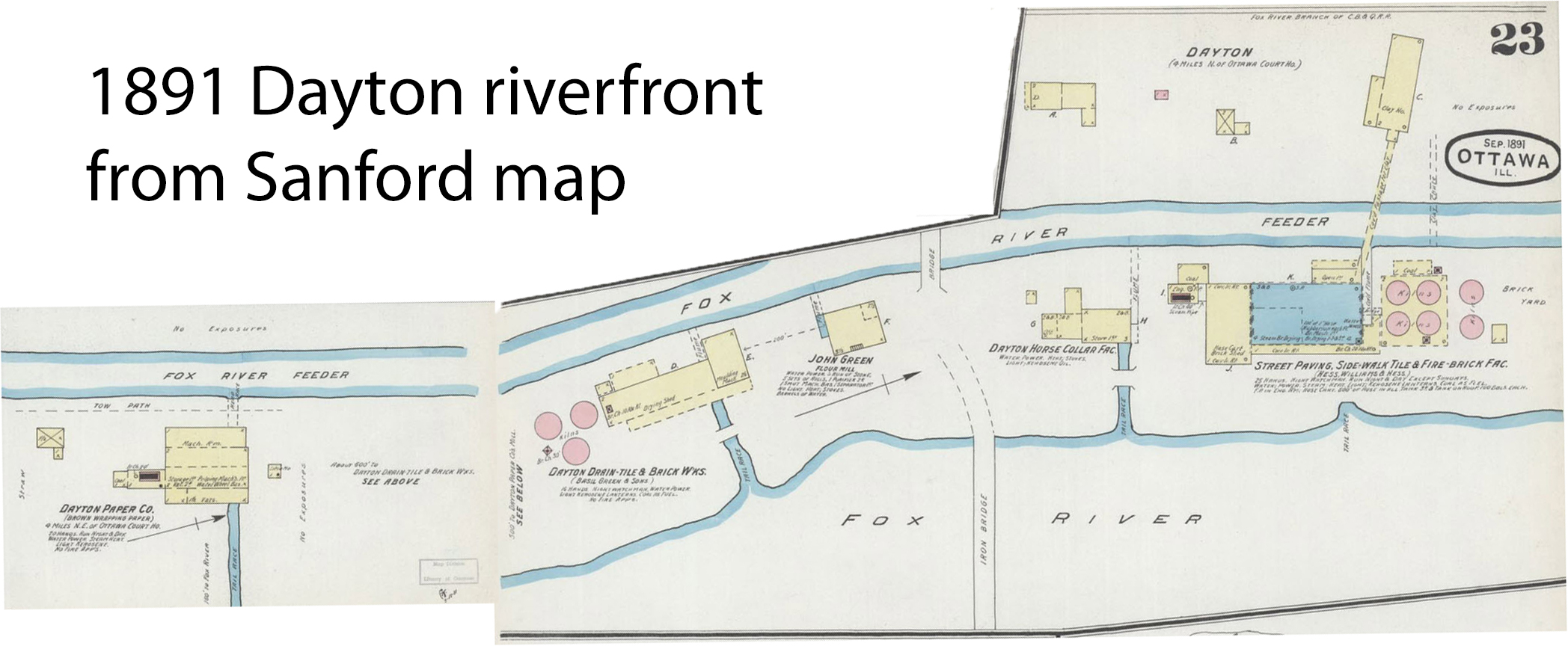
There Should be a Bridge at Dayton

There have been many bridges at Dayton over the years, as they were continually washed out by  ice and rain. They were usually replaced promptly, but at least once there was a gap of ten years with no bridge. There were several failed attempts to rebuild until this one was (eventually) successful.

Editors, REPUBLICAN:: Ten years ago the bridge across the Fox river at Dayton was carried off by high water. It had been very useful as a crossing for the public in general, and especially for farmers living in the north end of the township of Rutland, and many from the townships of Miller, Manlius and Mission on their way to and from Ottawa. Of course it was very important to the township of Dayton, and especially to the residents of the village of Dayton and vicinity. The bridge has not et been replaced. At the annual town meeting last April the voters of Dayton township authorized the commissioners of highways to borrow money to aid in building a bridge. The river is the line between Dayton and Rutland townships. Certain citizens of the village of Dayton were so desirous to have a bridge that they subscribed individually and guaranteed to the commissioners of Rutland $1,000 as an inducement to the voters of Rutland township to authorize their commissioners, at a special election, to borrow not to exceed $1500 to aid in the building of a bridge. An election was held yesterday in the township of Rutland. In the 2nd precinct, where the voters were more interested than in the 1st, the proposition was carried by a fair majority. But in the 1st precinct, which includes the village of Marseilles, it was lost by a majority sufficient to defeat the enterprise. We don’t want the public to think that we lay all the blame of our defeat at the door of Marseilles. We think the greater part attaches to certain farmers living in the eastern and southern parts of the township, who were frightened at a small increase of tax.

Let us look at the tax question for a moment. The assessor told me that the valuation of the township for the year 1884 was about $562,000. The average laboring man, so often referred to yesterday, is not assessed at to exceed $100. His share of the tax would not exceed 100-562000 of the $1500 asked for, or not more than 20 cents — about two hours work for a common laborer. The well-to-do farmer and manufacturer and capitalist would pay in the same proportion. We are unwilling to believe that the men who opposed us at the election in Marseilles yesterday would repeat it, after knowing the true situation, for such a paltry increase to their tax. We are grateful to the gentlemen who gave us their votes, and especially to those who gave us active influence. We thank those who opposed us for courtesy extended. The friction of life wakes life interesting. But unnecessary friction is expensive.
Basil Green.
Second Precinct, June 2, 18851

Dayton, Sept. Sept. 16. – At last it is settled that we are to have the bridge! The Board of Supervisors yesterday by a vote of twenty-seven to nine granted county aid to the amount of $5,000, and appointed Supervisors Anderson and Bubeck to look after the county’s interest. The bids will be opened next Monday and the contract let so that work may commence at once. The citizens are greatly rejoiced at the result and hope nothing serious may interfere with the completion of the work.
Our worthy supervisor, Mr. Basil Green, has been attending the meeting of the board at Ottawa, this week, and looking after the interests of our bridge.2

iron bridge at Dayton 1886
Dayton, Ill, April 1st, 1887. – Our bridge is finished at last and open for public travel. It is a very fine three span iron bridge, the neatest one on the river, and is a fine addition to our village. Of course every one will use it now that it is constructed, and it was noticed that about one of the first to use it was one who had fought the hardest.3


  1. Ottawa Republican, June 5, 1885, p. 8.
  2. Ottawa Free Trader, September 18, 1886, p. 5, col. 3
  3. Ottawa Free Trader, April 2, 1887, p. 4, col. 6

Another Dayton Water Power Fight

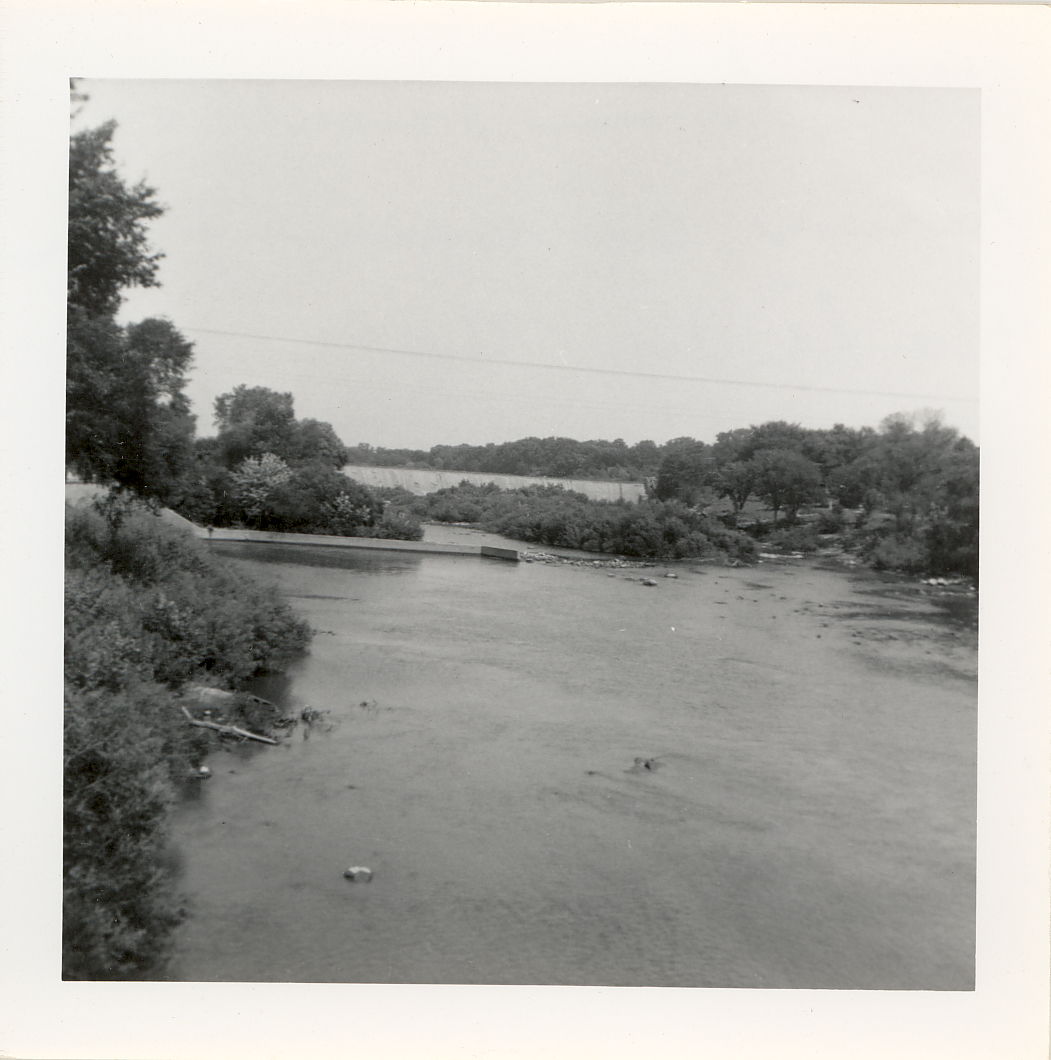
Dayton dam with feeder in the foreground

In 1899, the Merrifield Electric Light company made a proposal to the Ottawa city council to grant them a franchise to supply electric light to Ottawa, with the power to be supplied from Dayton, on wires running down the feeder bank. The source of the power would be the mill property situated on the feeder in Dayton which Louis W. Merrifield purchased from Miles Masters in 1897. One Ottawa newspaper, The Republican Times, urged caution in accepting the proposal:

Some of our city contemporaries have come out for and against the proposed granting of an electric light franchise to Mr. L. B. Merrifield, of the Organ Company. If the city council is asked for such a franchise the aldermen should take whatever time is needed to examine into the probable results of such an enterprise, not only in the matter of lights, but in its effect upon the industries using the water power furnished by the Hydraulic Company. The Republican-Times holds that a careful and impartial investigation should precede action on any application for special privileges.1

The paper then provided some historical information on the Hydraulic Basin:

Although an old institution, the people of Ottawa have very little real knowledge of the Ottawa Hydraulic Company and of the advantages in an industrial way that it has been to this city. The canal from Dayton, called the Feeder, was constructed by the state to feed the Illinois-Michigan canal. The side-cut and the oblong basin it empties into, called the hydraulic basin, were constructed by the state for commercial purposes and to regulate the level of the main canal. At one time on the banks of these artificial bodies of water were located six or eight great elevators, with a capacity of 25,000 or 30,000 bushels of grain per day. Then Ottawa was the greatest grain market in the world where the grain was handled direct from the wagon.

A number of citizens of Ottawa in the year 1852 leased of the state of Illinois the surplus water of the hydraulic basin, side-cut and canal. Heretofore that water had run to waste in a race to the Illinois river at La Salle street. The company organized was called the Ottawa Hydraulic Company.

At present the following industries are operating on leases from the Ottawa Hydraulic Company:
The Pioneer Fire-Proof Construction Company
The Illinois Valley Milling and Shipping Company
The Ottawa Electric Light Company
The Ottawa City Electric Light Company
The T. J. Nortney Manufacturing Company
The H. C. King Box Factory
The Sanderson Refrigerator Factory
The Ottawa Harness Company
The McCully and Flick Mold Factory
The Yockey Carpet Renovating Factory2

The concern voiced by the paper was that in order to supply the electricity for the proposed lighting the Merrifields would use more than their share of the Dayton water power to generate electricity, thus depriving the industries in the hydraulic basin of the water they needed. Another article laid out the history of the Dayton water power.

DAYTON WATER POWER
The Facts and Figures About the Leases of Power, the Parties and Amounts
THE MERRIFIELD CONTRACT
Ottawa Factories Would Suffer Material Damage From Lack of Water

The publication in the Republican Times of the description of the hydraulic basin and its dependent manufacturing institutions and the danger threatening them through a drawing off of the water at Dayton has created much interest among our citizens. Many inquiries have been made as to the real relations of the parties at Dayton and their rights there.

Dayton, by the terms of contract between the Illinois & Michigan Canal and Green & Stadden, is entitled to ONE FOURTH OF THE SURPLUS WATER that comes into the feeder, after the canal is provided for. From several measurements made one-fourth of the surplus water amounts to from 125 to 250 horse power, according to the stage of water. Most of the year the total surplus water power that could be legally used at Dayton is 150 to 200 horse power.

The Merrifields bought out Masters, who owned three thirty-seconds of the power, less 34 horse power, which had been sold to Basil Green. This gives the Merrifields the right to use, at the highest stage, a run of 64 horse power; at a medium stage 32 horse power, and at a minimum stage the limited amount of only 13 horse  power. The Merrifields, on taking possession, took out the Masters’ wheel of about 90 horse power and put in two wheels which will produce 218 horse power.

The past season has been a very wet one, but, notwithstanding this, a considerable more than the one-fourth they are entitled to has been drawn out at Dayton, and had the Pioneer Construction Company been running in September and October they would have suffered material damage from lack of water. Now that the Pioneer Company has built their modern factory they are prepared to and expect to run all the time, and will suffer great loss if forced to shut down. The Merrifields, it is claimed by Ottawa parties, have wheels that will use not only the power they are entitled to, but more water than all Dayton is entitled to for over six months in the year. Notwithstanding the consequent and evident injury to all Ottawa’s industries that use water power, they are asking for a franchise to use all their power.3

The Merrifields responded by denying that they had ever taken more than their share of the water. They claimed that they had made improvements which generated more power from the same amount of water. 
The Ottawa Hydraulic Company sued the Merrifields for damages. Meanwhile, the city council could not vote on the question of the Merrifield franchise because the original ordinance had been lost and Merrifield had failed to make a copy, so the vote was postponed to the next meeting of the council. 

There is likely to be a lively scrap between Lew Merrifield on one side, the Canal Commissioners, Ottawa Hydraulic Water Power Company and other owners of the water power at Dayton on the other. Under a decision of the court that Merrifield was using more than he was entitled to, the Commissioners constructed a flume leading to the Merrifield electric plant which would give him no more water than he was entitled to. Yesterday morning Mr. Merrifield tore the flume out, claiming it prevented him from getting as much water as he was entitled to. Today a gang of canal workmen went up to rebuild the flume and it is likely that an injunction will issue to prevent a repetition of the tearing out of the flume.4

The trouble between the Illinois and Michigan Canal Commissioners and the Ottawa Hydraulic Company on one side and L. W. Merrifield on the other, in which the Commissioners and Hydraulic Company claim that Merrifield uses more than his share of the water at Dayton, will most likely be settled by a bill for injunction filed in the Circuit Court this afternoon by Brewer & Strawn for the Commissioners and Hydraulic Company. It will be remembered that about two weeks ago Merrifield tore out a water gauge which had been placed in his flume by the Canal Commissioners to prevent him using more than his share of the water. The Canal Commissioners replaced the gauge and a few days ago Merrifield tore it out for the second time.5

The canal commissioners, on behalf of their patrons, the Ottawa Hydraulic Company, caused their engineer to construct a weir at Dayton which limited the quantity of water to each owner down to the amount they were entitled to. Mr. Merrifield tore this out. The canal authorities replaced it and Mr. Merrifield again removed it. The third time the weir or flume was rebuilt the court was appealed to and granted an injunction which prevented Mr. Merrifield from interfering with it. After the court enjoined him, a motion was made to have the injunction dissolved, and that matter is now being heard. There are quite a number of affidavits from engineers on the quantity of the flow and amount each is entitled to and, that used by Mr. Merrifield, and the court will undoubtedly take the matter under advisement.6

In June 1901, the court refused to dissolve the injunction. In May 1902, the matter was still in the courts. Then in March,1904, the dam at Dayton was swept away in an ice jam. In spite of this, it took another  seven months to close the books on the  Great Dayton Water Power Fight.

The Canal Commissioners’ Case

Another of the cases decided was the suit brought by the Canal Commissioners and the Ottawa Hydraulic Company to restrain L. W. Merrifield from diverting more than a certain amount of water of Fox river from the feeder at Dayton to his factory at that place. It is needless to say that the proceedings were commenced before the dam at Dayton was wrecked by ice and floods. The contention on behalf of Mr. Merrifield was that he was entitled to use two sixteenths of the water of the river while the Commissioners contended that he was entitled to only one sixteenth. Some controversy also arose as to the weir put in by the Commissioners. The Supreme Court seems to have decided that Merrifield has a right to but one sixteenth of the water but the weir interfered with his rightful use of that. Hence the cause was reversed and remanded to the Circuit Court for a new trial.7

Since the dam had been torn out , the court case died a natural death a few weeks later.

Rehearings were also denied in the case of the Canal Commissioners vs. L. W. Merrifield, which had been reversed and remanded to the trial court. The question involved related to the amount of water which Merrifield was entitled to use from the Fox river at Dayton. Since the commencement of the suit, however, a permanent injunction has been placed on any water being diverted from the natural course of the stream, the dam having been carried away by floods and ice.8


  1. Republican Times, November 24, 1898, p. 4.
  2. Ibid, January 12, 1899, p. 1.
  3. Ibid, January 19, 1899, p. 2.
  4. Free Trader, March 8, 1901, p. 7.
  5. Republican Times, March 21, 1901, p. 4.
  6. Free Trader, May 24, 1901, p. 7.
  7. Republican Times, October 29, 1904,
  8. Daily Republican Times, December 10, 1904, p. 8.

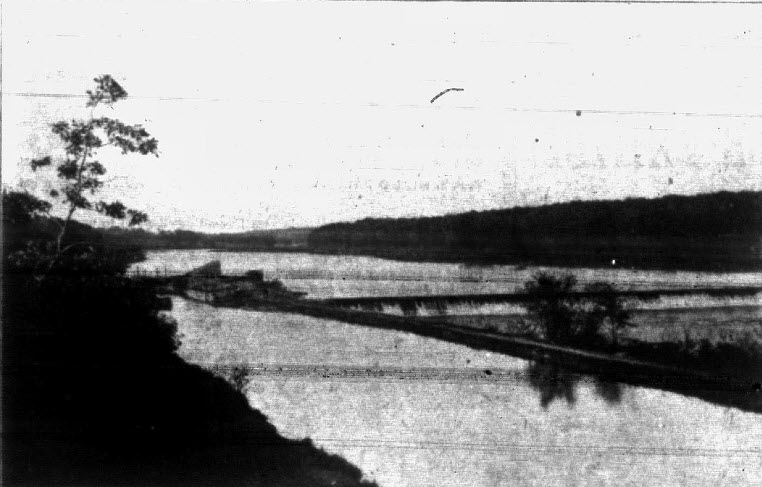
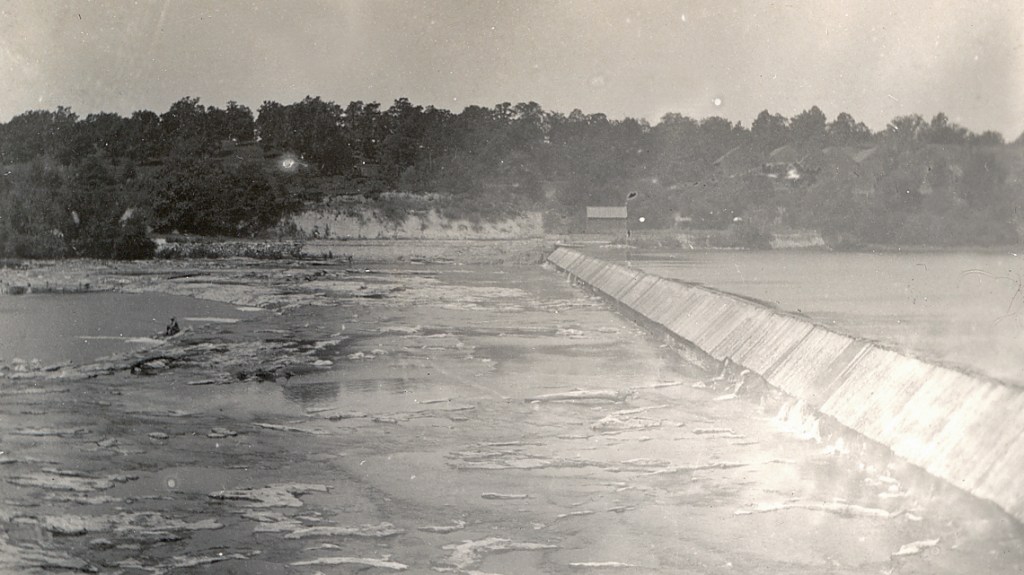
Dayton Dam and Fox River Feeder

Looking up the river toward the dam, with the feeder in the foreground

from the Ottawa Daily Republican Times, April 9, 1904:

The recent floods have overthrown the work of years, wrought destruction to property which, in all probability will never be replaced. This is undoubtedly the fate of the Fox river feeder of the Illinois and Michigan canal and the dam across the Fox river at Dayton. The recent decision of the Supreme Court seems to emphasize the fact that the usefulness of the canal is well nigh spent. The scant water which has flowed through the feeder during the summer months of each year for several years past has been the means of calling attention to the diminishing value of the Fox river as a source of water power for both Dayton and Ottawa.

With the destruction of the dam there arises thoughts of the days which have long since gone. But few now live who can remember the building of the canal feeder and the Dayton dam. Many interesting facts center around those events and a few reminiscences may be interesting, if not instructive.

Going back to the first settlement of the county it is found that one of the pioneers was John Green, father of Jesse Green, now of Ottawa, who first came in September, 1829, and finally located where Dayton now stands in December of that same year. He owned over a thousand acres of land on the west bank of Fox river, extending up and down the stream for over a mile and a half. Before the state dam was built (which was commenced in 1837) a dam was built a part of the way across the Fox river at a point about a quarter of a mile below the state dam by Mr. Green. It extended from the west bank of the Fox to an island which has long since disappeared under the influence of the floods and ice. This first dam was constructed soon after Mr. Green took up his residence at that place about 1830 or 1831. First one mill, then a second and third were built by the Greens, the last one furnishing power for six runs of burrs, or seventy-two horsepower. This first dam was used until the state dam was completed in 1838.

In those days, according to the testimony of Jesse Green given in a recent law suit, the Fox river had about three times as much water as it has had in later years. When the state took up the question of building a feeder for the canal and a dam across the river at Dayton, Mr. Green entered into an agreement whereby he was to receive power to operate his mills from the state.

It may be a matter of surprise to know that for some time after the completion of the feeder, canal boats, on several occasions, went up to Dayton, taking cargoes of grain from that point to St. Louis. This boating did not last many years, as by 1864 the feeder had only about three feet of water.

The survey of the feeder was made by William Jerome, civil engineer in charge of the western division of the canal, in 1837, and the work of construction was commenced in December of the same year. Its length is about four and a half miles. The channel was four feet deep and sixty feet wide for 1,200 feet north of the main canal, and from that point to the Dayton dam it was forty feet wide. At the time of the construction of the feeder and the hydraulic basin at Ottawa it was estimated that the water power which would be created would be sufficient to drive at least “40 pairs of millstones of four and a half feet in diameter.” It was thought that a connection might be made with the Illinois river at this point by means of a short canal and a system of lockage.

The following table was given as an estimate of the cost of the feeder and dam, when construction was about to be commenced:
218,992 yards of earth excavation ………………..$50,340.32
23,000 yards of rock excavation …………………….17,250.00
131,215 yards of embankment ………………………26,253.00
1,470 slope wall ……………………………………………..2,205.00
Dam across Fox …………………………………………….14,000.00
Guard lock …………………………………………………….12,000.00
Road bridge …………………………………………………….2,800.00
Two culverts ……………………………………………………4,300.00
Contingencies, etc. ………………………………………….6,457.41
Total ………………………………………………………..$135,605.73

In the annual report of  W. F. Thornton and Jacob Fry, Canal Commissioners, to Hon. Thomas Carlin, Governor of Illinois, in December 1838 the following language was used in regard to the construction of the feeder. “The judicious improvements, ordered at the last session of the Legislature cannot fail to advance the prosperity of Ottawa to a high degree. Strengthened and cultivated as her natural advantages now are, it is admitted by all intelligent observers that she must soon become an important manufacturing city, creating a vast amount of business for the canal, diffusing incalculable benefits through an extensive scope of country, and remunerating the state, by increased value of property. more than three-fold the amount of the additional expenditures.” The expectations of these men were realized only in part. And now, after all the advantages which the state derived from an increase in values to its then marketable lands, the economists of the state have killed the fowl which laid the golden egg.

In another report, made in 1830, when the building of the canal was first considered, the Commissioners said, in speaking of the proposed survey for a canal: “The town of Ottawa, at the mouth of Fox river of the Illinois, is advantageously situated in the heart of the most beautiful, fertile and healthy region of the country, and, as connected with the canal, deserves the legislative care of the state.”

But all these things have gone. Neglected by the state the dam became weakened and gave way before the crush of ice. Sand was washed into the entrance of the guard lock of the feeder and effectually choked that source of water to the canal and hydraulic basin.

The history of the efforts made by the canal authorities to obtain the appropriation voted by the Legislature at its last session, the injunction suit instituted at the instance of Chicago parties, the decision of the Supreme Court making perpetual that injunction and the very late order denying the prayer of the Canal Commissioners for a rehearing, all are recent events. They are disheartening facts and may be taken as an indication that the dam and its feeder for the canal will never again be used for valuable commercial purposes. They will soon become only a memory, then a few lines or a page in history, and will then be forgotten. It is, in truth, to be thus?

On This Day in 1887


iron bridge at Dayton 1886

From Dayton

Dayton, Ill, April 1st, 1887. – Our bridge is finished at last and open for public travel. It is a very fine three span iron bridge, the neatest one on the river, and is a fine addition to our village. Of course every one will use it now that it is constructed, and it was noticed that about one of the first to use it was one who had fought the hardest.

Our schools opened again Monday after a week’s vacation, with the same teacher at the helm.

The tile works are doing a rushing business, having shipped five car loads last week.

The Horse Collar works are also doing a fine business, shipping lots of collars every day. They are working day and night, and are about seventy dozen behind orders.

Mr. James Timmons, our genial landlord, is putting in a fine new maple floor in his office, also a new floor in the kitchen.

Our Sugar camp under the management of Misses Joseph and Win Green, has been turning out a lot of excellent maple syrup.

Mr. Basil Green, our worthy supervisor, has announced himself as a candidate for re-election.

The Roller Mill is about fitted up and will be running next week. It has the latest improved machinery for running on the short system and the product will no doubt be as fine as any on the market.

Farmers should take their wheat where they can get it ground into the very best flour and receive a large yield.

The Sunday school will hold an Easter Concert on Sunday evening, April 10th. A fine programme is being arranged and everyone should attend.

Occasional1


  1. The [Ottawa, IL] Free Trader, April 2, 1887, p. 4, col. 6

Of Industry – and Lack Thereof


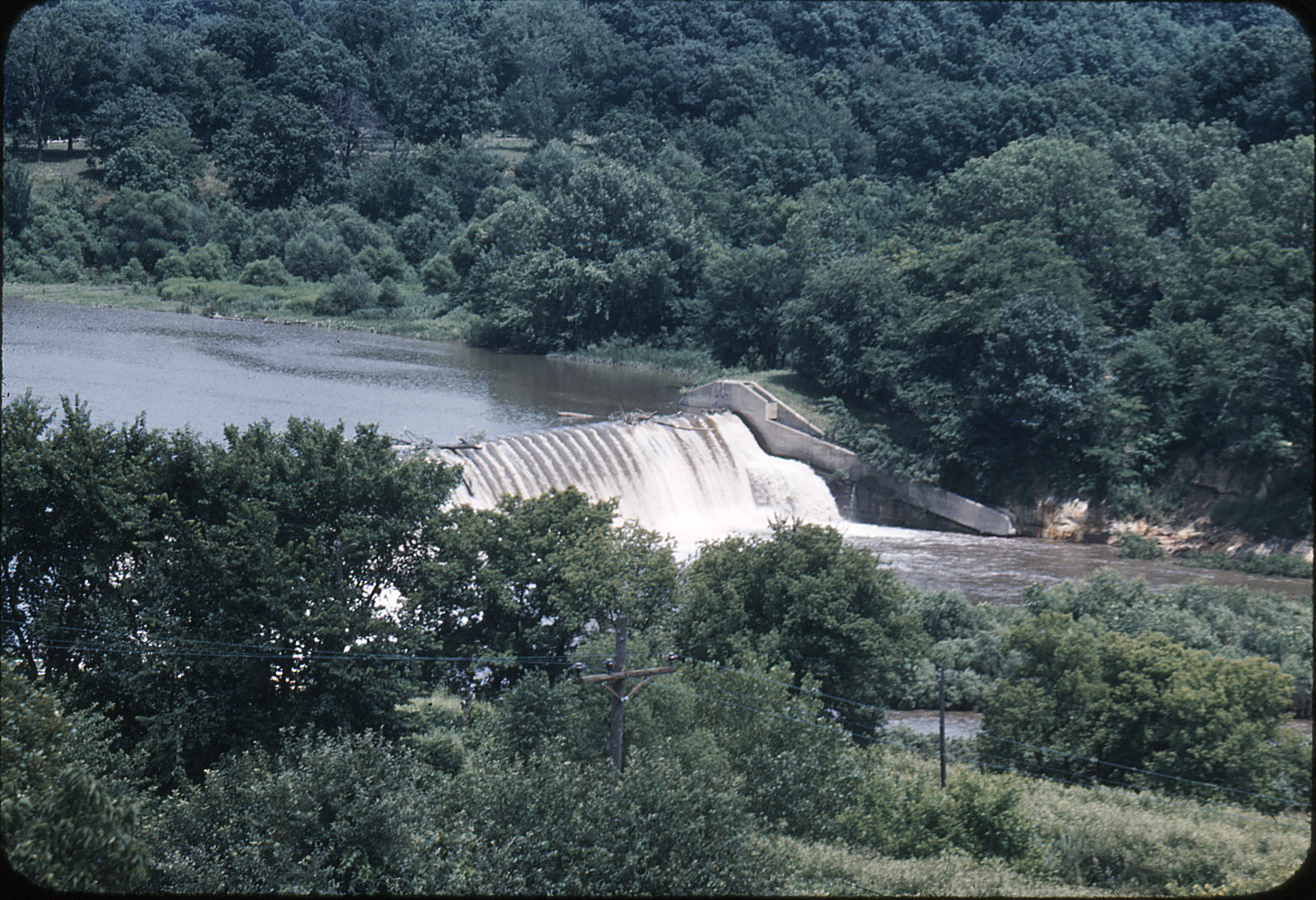
Fox river with dam in background

Dayton Items

Dayton, as a  point where the finny tribe and fishermen do most congregate has long been celebrated in this section of the country. People armed with hooks and lines, buckets of bait and togged in old clothes, come daily and nightly from far and near. They arrive on foot, in buggies, in lumber wagons, and dumped off the cars, and are landed in every shape, all bent on the same purpose, i. e., that of catching fish, not by the dozens, or in fifties, but by bushels, bagsfull, wagon loads, and in other prodigious quantities. They arrive in lofty spirits, braced up by lofty expectations of astonishing the natives. They usually depart wet, hungry, tired, disgusted, and without any fish worth speaking of. To a man whose constitution requires a vast deal of resr – long continued and complete relaxation of every muscle and nerve – fishing is just the thing. Fish, as food, may be brain food, but catching them is certainly a brain softener. It does not require a very high order of intellect in a man to fish, that is, a man of very moderate brain power ought to know enough to outwit a fish, which stands rather low in brain development. In short, fishing, to an outsider, is a very languid, sleepy sort of work.

There never has been any employment so well adapted to the wants of a lazy man as that of fishing as they do it at Dayton. To see the anglers as they line the banks and cover the rocks like so many mud turtles is a sight fit to make a person yawn. To the man to whom any kind of exercise is a bore fishing is just about exercise enough. The fellow lands upon some sequestered spot, sits down to rest and meditate awhile, then baits his hook, summons up all his energies like a man trying to ward off sleep, gets the line in the water, and then the things fishes itself! When a man gets too lazy to fish they accuse him of having a softening of the brain, and soon after he becomes too tired to draw his breath, and this ends him!

Some of the fellows we saw fishing on Friday last were half a mile from the water, under a shade tree, three of ‘em asleep and the fourth studying the sun’s altitude and position of its spots through a “pocket” telescope! Though we were in sight of a score or more of fishers for an hour, we did not see a fish hauled out, nor even hear of one being captured, though a shoal of three or four minnows were reported to have swam up among the fishers early in the morning.

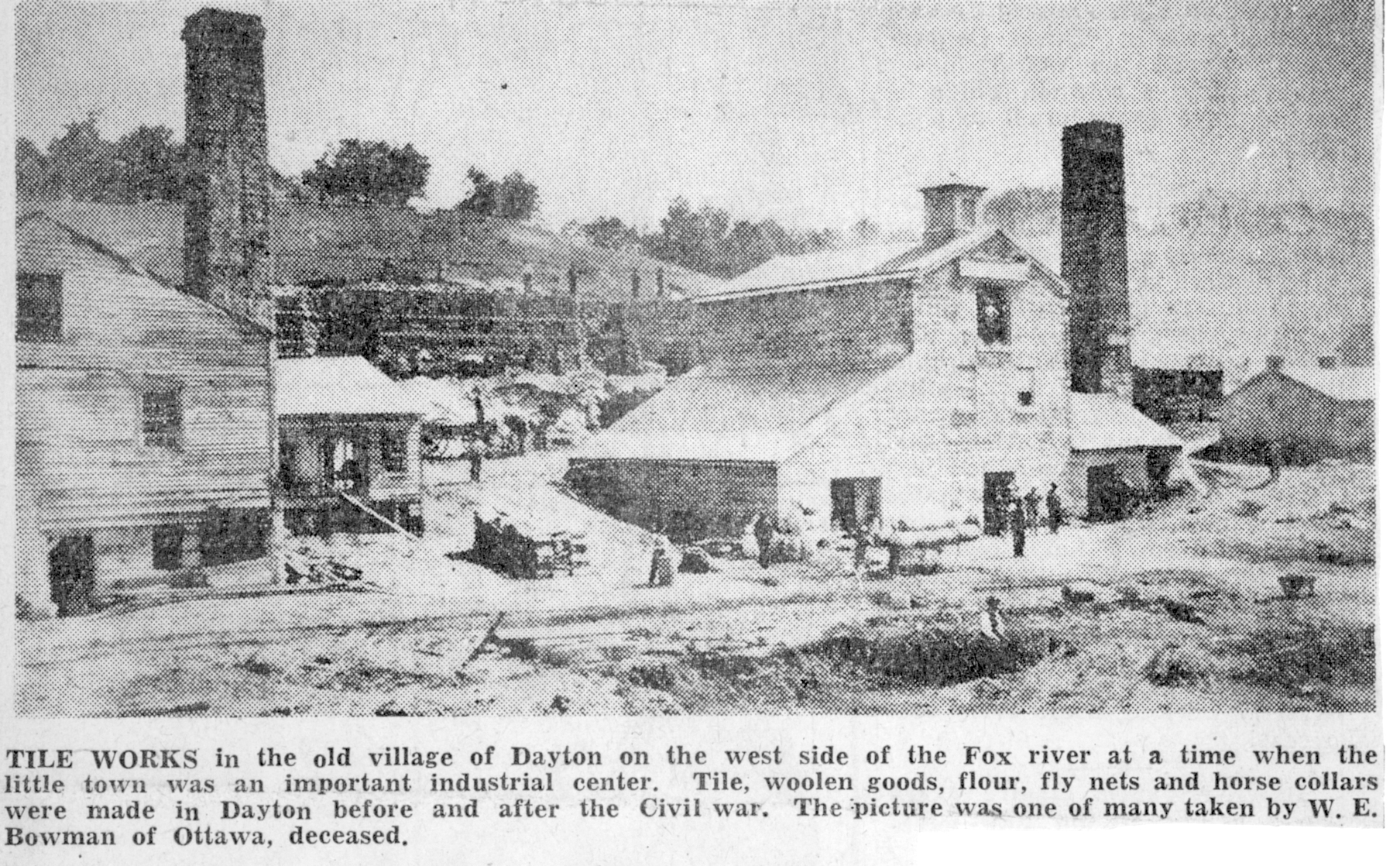
Large stone buildingDayton, however, has another point of view of far more importance to the business man and to the farmer. We refer to her woolen mills – as good as any in the state – built some years ago at great expense, and stocked with as excellent machinery as the Union anywhere could boast. Though under a cloud for a time, but now started anew by its original owners, the Greens, it will soon be working upon a large scale, and is daily turning out great quantities of yearn of various grades, also superior cloth.

Another enterprise is the collar factory, under the management of Mr. Dunavan. It employs a large force of hands, turns out the premium horse collars of the United States, and also a fine article of leather fly nets, the latter being its chief production during the summer months. The goods from this establishment find a ready market all over the country.

Another business, as yet young, but extensive and rapidly increasing in importance, is the Dayton tile works. When the factory was started it was not supposed that it would, in five years, reach the dimensions it has attained in a few months. The tile they manufacture is as good as any made in the west.

The large paper mill here next claimed our attention. This institution has long since become fixed and firmly established upon a substantial business basis. It runs exclusively on straw and manilla paper and consumes vast quantities of material. It has on hand an enormous stock of as good paper as is made anywhere. The recently senseless boom in prices of material used is happily subsiding, and the rather sluggish demand in this county for paper, has been rather unsatisfactory, but it runs ahead, looking for a fairer margin between its expenses for sock and the price of manufactured goods than has generally prevailed.

Besides, a good flouring mill and a local store and a “tavern” and good prices for farm products in general, all contribute to make Dayton a live business village.

Since the tile works were started in full operation a new industry has been developed, being coal mining operations, managed by Simpson & Welke, a couple of hard-working miners, who obtain a good quality of coal which lies on the level with the banks of the feeder, and is drifted and removed on hand card on a tramway and dumped below the woolen mills into wagons, or on the public roads as may be required.[1]


[1] Ottawa Republican, May 27, 1880, p2.

The Flood was the Big News

From Dayton

Dayton, Ill., Feb. 11th, 1887. – The little Fox became the raging Ohio during the flood of last Tuesday. Never since 1857 have we had such a heavy run of water and ice. The ice commenced running Tuesday morning, and run two hours; just before noon it run two hours, and in the evening it run five hours, making nine hours, run. And contrary to the usual manner, the last ice running, instead of being the lightest, was the heaviest, some of it being two feet thick. The fish chute was carried out, but no damage was done to the dam. One of the gates at the locks was broken, and the feeder bank was washed nearly through for quite a distance. The water was so high it ran over the locks and the surrounding embankment. The trestle work of the second span of the new bridge was carried away Monday night, and during the heavy run of ice Tuesday evening, the stone were all knocked out of the noses of the piers, leaving them in a very battered condition. The water alongside of the piers was nearly twenty feet deep. The paper mill lost six hundred dollars worth of straw, which is quite a loss to them, as it is difficult to replace it at this time of year, on account of the bad roads.

Mr. Uriah Miller, of Ottawa, and his two nephews from Salt Lake City, Utah, visited our town last week.

We understand there is to be a wedding in town next week. Will give particulars next time.

The Progressive Euchre Club met at the residence of O. W. Trumbo, last week, and had a very enjoyable time.

Mr. James Green made a second consignment of honey this week to Haven & Green, commission merchants, at Fort Scott, Kansas.

Mr. S. Hippard is building a residence on his land south of the paper mill.

The paper mill has been fitted up with new calenders, and expected to start up this week, but cannot do so on account of high water.

The rolls for the flour mill still have not arrived yet, but the mill is running on cotton work right along.1


  1. The Ottawa Free Trader, February 12, 1887, p. 4, col. 6

The Almost Inevitable Spring Flood – 1857

The Flood

The great storm and flood last week, of which we had but the beginning as our paper went to press on Friday night, appears to have been general throughout the country, and our exchanges from all quarters comes filled with accounts of disasters and hair-breadth escapes. From New York and New England, from Virginia and Maryland, Pennsylvania, Ohio, Indiana, Michigan, &c., the burden of the papers and telegraph dispatches is the same. To give anything like a full account from all directions would occupy more space than we can command, so that we shall attempt little more than a resume of disasters at and near home.

AT DAYTON. – The chief disaster at Dayton was the destruction of the fine bridge, erected by the people four or five years ago, at an expense of some $1000. It was taken off bodily, leaving nothing but the naked abutment. The dam was not seriously injured. A break in the feeder will probably stop the mills from running a month or more. Of individuals, the Messrs. Green are the only serious sufferers. Their dye house, a new building erected north of the woolen factory, has been so badly damaged as to require re-building, and the kilns, hearths, kettles, &c., in it are mostly ruined. The lower floor of the factory was also six or seven feet under water, and suffered considerable damage.

FOX RIVER FEEDER. – The Fox River feeder, leading from Dayton to Ottawa, has again, as usual, suffered serious damage. Some sixty or seventy rods of the bank at Dayton has been swept away, the lower gates and wing of the guard lock have gone out and the lock otherwise much damaged. There are also several smaller breaks in the feeder lower down, and a good deal of dirt has been washed into it. It will take a month at least to repair it.1


  1. The Ottawa Free Trader, February 14, 1857, p. 2, col. 1

Settling the Prairies

Township 34 North Range 4 East of the 3rd Principal Meridian

The map above is the original survey of the area around Dayton (starred) and indicates by the green lines the extent of the timber in the area. In his memoir, Jesse Green wrote of the impact of the open prairies on settlers from the east: –

The first settlers all came from heavily timbered country and as a consequence did not think it possible that those broad prairies would be settled in their day but expected to have unlimited range for all the stock they might desire to keep. The first settlers secured as much of the best timber as they possibly could, through pre-emptions and floats (as they were called) which were subject to transfer and sale by their holders. In the course of time they expected to have neighbors skirting the timber belts of the country but did not have the remotest idea the prairies would be occupied, however, it was not long until coal was discovered and thought to be almost inexhaustable. Lumber began to be brought across the lakes, and the problem of the feasibility of settling up the prairies was solved, and only a few years later the prairies in this section were nearly bought up, largely by eastern land speculators which retarded the settlement of the country considerably for a number of years, driving immigrants still farther west,

Dayton on the Fox

The following unidentified clipping comes from a family scrapbook.

DAYTON ON THE FOX
Mrs. John W. Fogle
Grand Ridge, Ill., R. F. D. 1

They will build a dam at Dayton,
At Dayton on the Fox,
Where the water twists and tumbles
As it flows between the rocks.

They will undertake this enterprise
If they can overcome their fears,
And bring new life to this village
Which has been asleep for years.

‘Twas a town of thrift and action
As it nestled between the hills,
For the water furnished power
For the flour and woolen mills.

‘Twas a thriving little village
As I look back o’er the years,
And the breaking up of home ties
Caused many bitter tears.

There’s a quiet little graveyard
Along the river’s brink,
Where the leaves in golden autumn
Are all colors you can think.

Where the squirrels frisk and chatter
As they hunt their winter’s store,
From trees that shade the silent homes
Of our loved ones gone before.

Broad and fertile farm lands
Surround this little place,
Where years ago the timberlands
Furnished ground for hunters’ chase.

‘Twas the stopping place of Shabbona,
And many Indian braves
Who gave their time to hunt and fish,
And the fun their spirit craves.

And now it comes to life again,
In this age of power and gold,
When even running waters
Are being bought and sold.

They will build this dam at Dayton
For the wealth of coming trade,
And harness up the waters,
Changing scenes that nature made.

When we visit scenes of childhood
In the sunset of our years,
We will praise the work of science
With everlasting cheers.

How we wish the running waters
Could talk as they go by,
They would preach a lasting sermon
Of our blessings from on high.

As the waves go splashing by you,
Listen now – they seem to say,
“Dayton takes her place in history
In the grand old U. S. A.”

Why do I love this river
As it zigzags ‘round the rocks?
Why, I was born at Dayton,
At Dayton on the Fox.

Mrs. John W. Fogle was Mary Bunna Rhoads, daughter of Thomas and Katherine Rhoads. She was born February 17, 1864 in Dayton. She married John W. Fogel August 22, 1888 in La Salle county, Illinois, and lived in Grand Ridge. She died April 11, 1926, in Ottawa.


The Great Flood of 1855

The Fox River has seen ice jams many times over the years.

The last of January, 1855, witnessed a great storm and flood, extending over several States and doing vast damage everywhere, this county not excepted. At Ottawa the principal loss was the destruction of the Illinois River bridge, then but about two years old. Up to the evening of Saturday, Jan. 31, and as long as the ice from the Illinois River came square upon the piers, they bore the pressure without sign of giving way; but on that evening, when the ice came out of Fox River, borne on a drifting current of six or seven miles an hour, and striking the piers from a quartering direction, they could resist the shock no longer, and before midnight an ominous crashing heard in that direction above the roar of the ice showed that the noble bridge had shared the fate of so many others and gone down before the flood.

Daylight on Sunday morning revealed the extent of the ruin. The trestle-work and the second pier from the north shore had entirely disappeared, taking down with them the entire bridge to the third pier, leaving the two south spans still resting on the piers so shattered as to be barely able to carry their weight. The woodwork of the bridge lodged on an island near Utica, and a portion of it was recovered.

The cost, however, of repairing the damage exceeded half the original coat of the bridge. At the time of this disaster the water rose a foot above the highest point touched since the county was settled, the point mentioned being reached in 1849.

Some damage was done to the Fox River bridge. Considerable property was injured and carried off from the low ground on the east side of Fox River. Messrs. Fredenburgh, Smeaton and Van Gaebeck, living next to the bridge, were obliged to emigrate, and lost in fences, hay, wagons, etc., seriously. Persons living on the south side of Main street, east of Fox River, who had their stables on low ground, all lost something. Below the hydraulic basin, south of the main part of the city, some damage was done. On the low ground in Ottawa Center about a dozen houses, generally small and occupied by poor people, were submerged to the roof and the contents ruined where not carried off.

The chief disaster at Dayton was the destruction of the fine bridge erected by the people four or five years before at an expense of some $4,000, It was taken off bodily, leaving nothing but the naked abutment The feeder was so injured that mills could not run for a month or so. Some sixty or seventy rods of the bank were swept away and the lock was seriously damaged.

At Peru and La Salle the damage was pretty heavy. At the latter place all the lower stories of the buildings on the canal basin were submerged, and much fear was entertained with reference to the fleet of loaded canal boats in the basin, but they appear not to have suffered much. At Peru the fine stone freight house of the Rock Island Railroad had its whole east side knocked out Several loaded canal-boats were sunk, and some warehouses and other buildings damaged in various ways.1


  1. History of La Salle County, Illinois, 2 vols. (Chicago: Inter-State Publishing Co., 1886), 1, 451-452.

There Seems to be Some Disagreement Here

Not the 1887 event, but the river was never tame in the winter.

The Ottawa [Illinois] Free Trader, February 12, 1887, p. 4, col. 6
From Dayton
Dayton, Ill., Feb. 11th, 1887. – The little Fox became the raging Ohio during the flood of last Tuesday. Never since 1857 have we had such a heavy run of water and ice. The ice commenced running Tuesday morning, and run two hours; just before noon it run two hours, and in the evening it run five hours, making nine hours, run. And contrary to the usual manner, the last ice running, instead of being the lightest, was the heaviest, some of it being two feet thick. The fish chute was carried out, but no damage was done to the dam. One of the gates at the locks was broken, and the feeder bank was washed nearly through for quite a distance. The water was so high it ran over the locks and the surrounding embankment. The trestle work of the second span of the new bridge was carried away Monday night, and during the heavy run of ice Tuesday evening, the stone were all knocked out of the noses of the piers, leaving them in a very battered condition. The water alongside of the piers was nearly twenty feet deep. The paper mill lost six hundred dollars worth of straw, which is quite a loss to them, as it is difficult to replace it at this time of year, on account of the bad roads.

The Ottawa [Illinois] Free Trader, February 19, 1887, p. 1, col. 4
Please Rise and Explain
The managers of canal affairs in this city have provoked the ire of divers and sundry of our manufacturers here, by either gross inattention to their duties or a want of due knowledge thereof, as follows:

On Sunday last an ice gorge occurred in the river and feeder of the canal at Dayton, and soon the waters there were on a level – formed a “pool,” and threatened to do considerable damage. On Sunday evening the ice broke away and the waters subsided. Then the waters in the canal were let out, why, no one knows, as all danger was then over. The canal remained dry four days, during which every manufactory in Ottawa whose power is supplied by water was idle. The canal and feeder banks were all sound and no repairs were needed, and none have been made. This withdrawing of the water and stopping the factories, as figured by the proprietors of the different establishments, resulted in damage as follows:
Victor and City Mills, per day, $70; H. C. Strawn, $10; Tile Works, $250; Weis & Wolf, $10; King, $10; Koeppler, $15; Colwell and Rugg, and the Electric Light Co., not reported. Result, a loss of $865 a day, or $1,460, to the factories that have been heard from.

The State of Illinois or its servants ought to make good this loss, in the absence of a satisfactory explanation.

The Ottawa [Illinois] Free Trader, February 26, 1887, p. 8, cols. 2-3
From Dayton
Dayton, Feb. 24. – The slush ice is slowly cutting away out of the river, but large banks of it twelve feet thick remain upon the shores. The mills all got started up again this week.

Your valuable paper last week, in an article under the heading of “Please Rise and Explain,” publishes some things in regard to the shutting out of water from the feeder and canal, which your reporter obtained from a very unreliable source, for there is hardly a word of truth in the whole article. Our manufacturers and citizens who witnessed the flood of the 18th all agree in saying that the canal authorities acted wisely in closing down the gates and thus preventing much greater damage than was actually done; and it is but just to those in authority to state the true facts. Your article stated that “on Sunday evening the ice broke away and the waters subsided.” Now, this is not true, for although the waters subsided a few feet, yet the ice did not break away, but, on the contrary, the ice remained in the same dangerous condition as it was on Sunday, and a fall of temperature, bringing down more slush ice on Monday, would have made the situation more dangerous than on Sunday. Your article further states, “Then the waters in the canal were let out, why, no one knows, as all danger was then over.” As a matter of fact, the water in the feeder and canal was let out about nine o’clock Sunday morning, and a messenger on horseback was dispatched to the canal authorities warning them of the danger to the banks. A gang of the state’s men watched the feeder banks all night Sunday ready to cut it and let the water back into the river again should the danger increase. Again we quote “The canal remained dry four days, during which every manufactory in Ottawa whose power is supplied by water was idle.” Sunday, when the current of the river was forced by the slush ice into the feeder, an ice jam was formed which completely shut off all the water and forced it over the banks into the river again. Tuesday morning, when it was thought the danger was over for the present, the lock gates were raised, and as much water was let in as could be forced through the ice jam. It required two or three days to cut out the ice, and the feeder and canal were being filled as rapidly as possible. If the gates had been left up during the flood there is no question but that a large amount of the bank would have been washed out, which would have taken at least two weeks to repair. Then, let us figure what the damage would have been to the Ottawa manufacturers had the canal authorities not taken the precautions they did: Victor and City Mills, $70 per day, 12 days, $840; H. C. Strawn, $10 per day, for two weeks, $120; Tile Works, $250 per day, for two weeks, $3,000; Weiss & Wolf, $10 per day, for two weeks, $120; King, $10 per day, for 12 days, $120; Koeppler, $15 per day, for 12 days, $180. Result, an actual loss of $1,460 – a probable loss of $4,380, leaving to the credit of the canal authorities $2,920 by reason of their taking such precautions as they did.
Occasional

The Ottawa [Illinois] Free Trader, March 5, 1887, p. 4, cols. 5-6
The Freshet and the Canal
Ottawa, Ill., March 3, 1887
Messrs. Editors: – As “Occasional” has charged in your issue of Feb 26th that the statements made in your issue of Feb. 19th were nearly every word false; and as those statements were obtained from me, in an interview with your reporter, I feel that I ought to reply briefly to the wholesale charge of falsehood.

I visited Dayton Tuesday, Wednesday and Thursday following the overflow of the canal bank at Dayton, on Sunday, the 13th of February last. I examined and inspected the canal banks, lock and floodgates each day; and I hereby declare and affirm that not a cent’s worth of damage was done to the canal banks or canal property at Dayton at that overflow, either Sunday, Monday, Tuesday, Wednesday, or Thursday, the day they finally let in the water. Nor was there one cent’s worth of work done nor material furnished or used for any repairs to the canal during that time at that place for any damage done the canal by the overflow of the Fox river into the canal.
The canal authorities declared to me Tuesday morning, standing on the bridge at Dayton, that there was no damage done to the canal.
Now, will Mr. “Occasional” inform me, or the public, why the water could not have been let into the canal as soon, at least, as its authorities were informed that no damage was done, and that no repairs were needed.

“Occasional” says that some water was let in on Tuesday. That may be true; but I measured the water in the lock at the head of the feeder every day, – Tuesday, Wednesday and Thursday, – and the water was twenty inches lower Thursday morning than Wednesday morning; so that if the gates were opened Tuesday, they must have been closed again.

“Occasional” says that the State men watched the banks all night Sunday night, and at the same time admits that the ice gorge broke below the dam, in the river, Sunday night and that the water went down. But he neglects to inform us that on Monday (notwithstanding, as he says, the danger was over) they did cut the feeder bank more than one mile below where the overflow was and when there was no water in the canal and no prospect of any. And this large hole was cut in the narrowest part of the bank and where, if a washout could have been furnished to the invitation thus made and kept open three full days (for it was not refilled until Thursday, I think it would have been later than the next planting time before the bank would have been rebuilt. “occasional,” especially in the Ottawa Republican, is very full in his charge of falsehood, but still follows each charge with an admission of facts stated in the Free Trader of the 19th of February. He says, if the weather should change, &c., &c.; as well he might say, if we should have a June freshet, or if some other awful thing should happen, it was safe to wait and see.
The canal authority that would shut the water out of the canal and keep it out for four days and cut a large hole in the canal bank and keep it open three days as a precaution against what may happen in the future, is no doubt a very prudent authority.

And now, if “Occasional” will point out, over his own signature, where one cent’s worth of damage was done to the canal on account of the overflow, or where, during the time between Sunday and Thursday, one cent’s worth of repairs was made by the canal authorities on account of the damage done by the overflow, that shall be the truth, then I will confess that I am wrong. Until that is done, no matter how many times you charge me with falsehood, the facts as stated must stand for the truth.

No, Mr. “Occasional,” the conduct up there at that time is consistent with the conduct here daily. There is hardly a day but the water in the main canal is anywhere from ten to twenty inches below navigation stage. That, Mr. Authority knows full well, taken from a six-foot head, well nigh destroys the power on that head. And all, as Mr. Authority says, because he will take no chances.
Once more, if, as “Occasional” says, it was true that an ice bar was formed across the feeder below the gates so that no water could pass if the gates were open, then, in the name of common sense, why were the State men set at work Monday cutting the canal bank one mile down the feeder, where there was no water and none could be got if his statement was true? There is an adage, that “of all men, liars ought to have good memories,” – or ought to have reason enough to see where their statements convict themselves.
Respectfully, Wm. Thomas

The Ottawa [Illinois] Free Trader, March 12 [printed; actually 19], 1887, p. 2, col. 5
The Dayton Flood Again
Dayton, March 3, 1887 – On your last issue Mr. William Thomas, an old citizen of Ottawa, came out in a lengthy article admitting that he is the author of the unjust criticisms on the action of the canal authorities, and charging your correspondent with telling falsehoods. Our citizens and manufacturers feel that Mr. Thomas has very much misrepresented the facts in this matter and desire that we should answer his article and place the facts again correctly before the public.
Why should we write anything but the truth when we are a user of the water at this place and a loser by the shutting out of the water? We are also your reporter for this vicinity and always try to give your paper nothing but the facts, and we know that we are supported by the citizens here who were eye-witnesses of the overflow, in saying that we have given the facts correctly in the matter.

In Mr. Thomas’ whole article he does not (and cannot) deny the points we made, viz.: of the danger during Sunday and Monday, Feb. 13th and 14th of a wholesale destruction of the banks, and of the fact that the canal was filled as rapidly as the water could force its way through the ice jam. There can be no denial of these facts.

Mr. Thomas charges that we admitted that the ice gorge broke below the dam Sunday night. Why does he say this, when in our last correspondence dated Feb. 24th, this was one of the points which we most emphatically denied. We claimed that the ice remained in the same dangerous condition on Monday as on Sunday.

Mr. Thomas claims that on Tuesday morning the canal authorities declared to him, standing on the bridge at Dayton, that no damage was done to the canal. We were present during that conversation, as were also three or four more responsible witnesses who testify to the same thing, and heard the canal supt. say that he did not know what damage was done to the banks. How could he tell when the ice was piled up all over the banks? Mr. Thomas acknowledged during the conversation on the bridge, that he had been up trying to examine the banks but as he had no shovel to clear away the ice, he could not tell the condition of the banks.

In regard to the big hole in the bank, he states was cut on Monday. These are the facts: the canal authorities thought the danger so great that they employed the bridgemen who were idle that day to cut the frost out of the bank below the paper mill, so that in case the river raised again and overflowed the banks, the bank could be quickly and easily cut and the water turned into the river again, and the canal would not be given more water than it could dispose of. It was not safe to cut the bank any nearer the locks as the river was too high.

We have never said or claimed that any damage was done to the banks at this time, but these are the facts: during the heavy run of ice of Feb. 8th the banks near the dam were cut about one-half through for a distance of nearly 100 feet, and the states’ men were two or three days repairing them, but the banks were still weak, however, when the flood of the 13th came on and it was only by a narrow escape that they were preserved. Instead of finding fault, Mr. Thomas should feel thankful that his electric light was not dimmed for three months instead of three days.

In regard to the measurements which he states he made at the lock, we have responsible witnesses who testify that at no time was the water more than fourteen inches low at the locks and that more water was being let in every day than could force its way through the ice jam.
We have interviewed a few of our prominent citizens and give you their opinions: A. F. Dunavan, Esq., of the Horse Collar Works, says he feels confident that the authorities did the proper thing in shutting out the water on that Sunday, and that there was great danger to the banks by the overflow. His factory was laid idle for a few days, but he feels confident that his loss would have been much greater had not the canal authorities shut out the water. J. W. Channel, of the Tile Works, says he is positive the authorities did perfectly right in shutting out the water, and that any one who would have seen the condition of the river at the dam at that time could not have a different opinion. He was an eye witness of the overflow. He had lived in Dayton a good many years, and never saw the water in as dangerous a condition to the banks as on that Sunday and Monday.
O. W. Trumbo who has lived here 30 years says he never saw the water so high. Mr. D. Moore of the paper mill thinks the authorities did the proper thing, as do Mr. Davis and Green Bros.
Occasional

————————————- AND THAT’S THAT, SO THERE!!

The Valuable Water Power at Dayton

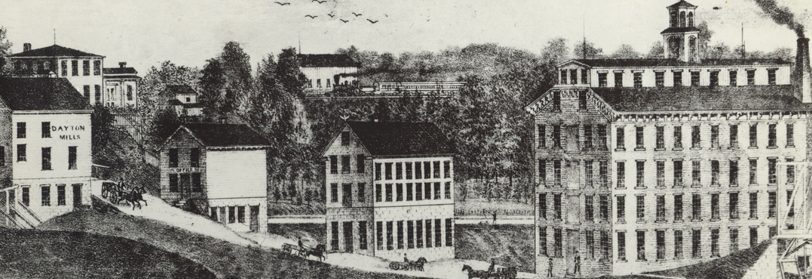
A view of the west bank of the river in the area occupied by businesses that were powered by the water from the feeder.

The Ottawa [Illinois] Free Trader, February 14, 1852, p. 4, col. 4

Water Power to Lease

The undersigned offer great inducements to capitalists and manufacturers, as they have decidedly the best water power in the state, having over 25 feet head and fall, and situated in Dayton, 4 miles above Ottawa, and drawn from the Fox river Feeder, which is kept in repair by the state, without any cost to the undersigned. They have water to lease for a term of years sufficient to drive 20 run of 4 ½ feet burrs, and will lease on very liberal terms to any good responsible company.

This is a rare chance for men of capital who may wish to go into the manufacturing business. The location is very healthy and admirably situated, as it is on a navigable feeder, within 4 miles of the contemplated Rock Island rail road, and the head of steamboat navigation. For further information, address John Green & Sons.

Dayton, may 31.

History of the Fox River at Dayton

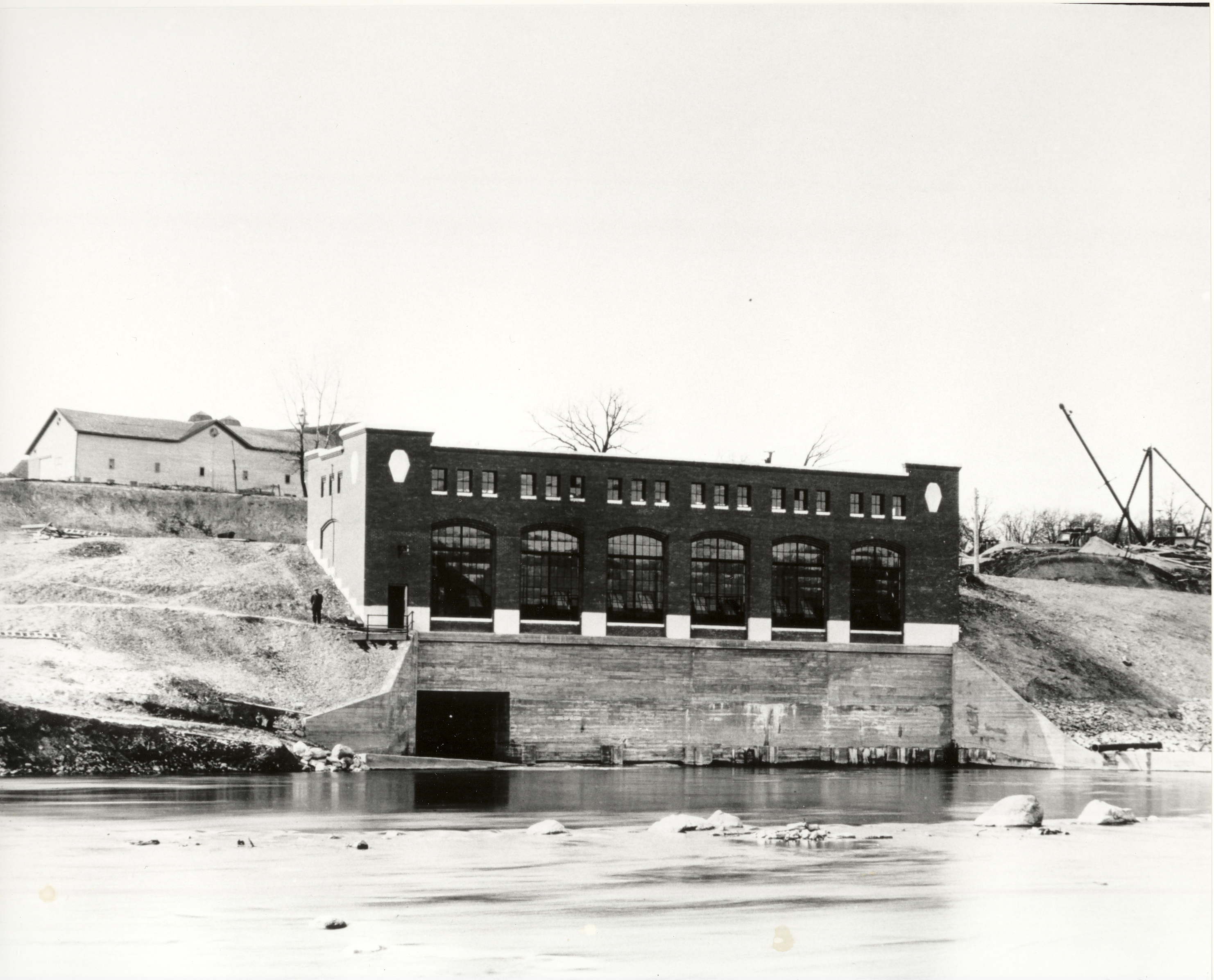
The power house at Dayton – 1925

In 1915, the State of Illinois conducted a survey of the Fox River and proposed improvements. The report traced a history of the state of the Fox River from the 1830s to the present day (1915). Much information was presented on flooding and how it affected the many structures along the length of the river. The following excerpts from the report give a look at the river at Dayton and the place’s suitability for a hydro-electric plant. Following this report, the state built a dam and power house at Dayton in 1925. 

State of Illinois Rivers and Lakes Commission
Report of Survey and Proposed Improvement of the Fox River

p. 48: Although the records are not complete it seems to be pretty well established that there have been great floods on the Fox River in 1849, 1857, 1872, 1882 and 1902.

p. 48-9: Of all the floods, however, the one of 1857 seems to have been the most pronounced. . . . Heavy rain on February 6, 1857, melted the accumulated snow and broke up the ice. All the bridges from Batavia to Ottawa were washed out and several dams upstream gave way.

p. 50: There seems to have been many more floods in the days of the early settlement of the Fox River valley than in later years, although there were plenty of forested areas then while now there is practically no timber. In the early records frequent mention is found to washing out of dams and bridges year after year. The explanation for this is very likely due to the fact that originally the bridges were low wooden structures and the dams were crude affairs whose main reliance for stability consisted of logs across the channel. These were insecure affairs and high water floated them away. Most of the early bridges were built by private subscription and at great sacrifice of time and money to the pioneer settlers. Often they were no sooner erected than a freshet would wash them away.

p. 57: The Fox River valley was settled by the white race from 1839 to 1850. Pioneers looking for homesteads were impressed by the beauties of the valley, the abundance of clear water supplied by the river and the opportunities for securing water power from this stream. One of the first thoughts of the early settler was to start a saw or grist mill, the former to cut timber for buildings for family and cattle, and the latter in order to feed both himself and his stock. Otherwise, long journeys over trackless forest and prairie were required before the early family could have flour or meal. The history of the early settlements in the Fox River valley shows that practically the first thing done in every case, after building a house, was to build a dam and put up a water-wheel-driven mill. These dams were very crude timber structures, built of logs and slabs, and generally washed out or were seriously damaged by high water.

p. 62: Of the abandoned water-power sites, that at Dayton would naturally have a greater interest than the ordinary on account of its use in diverting the water from the river to the feeder of the Illinois and Michigan canal, which connected the canal proper at Ottawa. The head of the feeder was located about half a mile north of Dayton, where the State constructed the dam. Edward B. Talcott, resident engineer, in his report of December 10, 1840, referring to the Fox River dam, lock and section of the feeder, says this work was finished in September, 1839. This improvement was maintained until 1902 when the dam was washed out, since which time the feeder has been abandoned, as well as other interests dependent on this water power. In addition to its use as a feeder for the Illinois and Michigan Canal, a reservation was made between the Canal Commissioners and the owners of the mill property at Dayton that the latter were to have the use of one-fourth the supply created by the improvement, “the same shall be drawn out of said feeder within seven-eighths of a mile from the head of the guard lock” under direction of the Canal Commissioners. This gave the required power for manufacturing interests, but with the passing of the dam and power all else was abandoned, as shown by the large four-story building stripped of all machinery.

The first dam at Dayton was built in 1830 by John Green and was erected to furnish power for a grist-mill. It is claimed that this mill was the first one in the State to be operated by water power.
The second dam built by the State in 1839 was about fourteen feet high and was constructed of stone with a wooden crest. It developed about 2,000 horse-power, part of which was distributed —
120 horse-power to paper mills
40 horse-power to tannery
34 horse power to tile factory
120 horse-power to grist mill
40 horse-power to collar factory
120 horse-power to brick factory
—-
474 horse-power

One-fourth of the power was to be used on the east bank of the river and one-half the total developed power was to be used in Ottawa. The present stone mill building was built in 1864 by Jesse Green, at a cost of $65,000, and was operated as a woolen mill until 1882, when it was sold to a pressed brick company, who operated it until 1901, when financial reverses caused the owners to close the mill.

p. 66: Mr. R. S. Feurtado, of Chicago, made a report in 1910 on the proposed hydro-electric development of the Fox River near Dayton and Wedron. This report is in considerable detail and has gone into the question of power development at these two locations thoroughly. The minimum flow of the river is taken at 620 second-feet, but by building dams across Indian and Somonauk Creeks and holding the flood waters in the reservoirs thus created and discharging same into the Fox, a minimum flow of 933 second feet is obtained. On this basis the river alone at Dayton, with a 31-foot head, would furnish 1,740 horse-power constantly. With the two reservoirs proposed and the mill pond at Wedron to add additional water during the periods of low water, Mr. Feurtado estimated the total installation at the Dayton power house would be 6,220 horse-power.

p. 67: In this proposed development it was intended to build a 19-foot dam near Dayton that would create a pond of 209½ acres and have a capacity of 80,864,000cubic feet. The Wedron mill pond would have an area of 950 acres, that at Indian Creek would have 680 acres, and that at Somonauk Creek would have 550 acres area. This would make a total reservoir of 2,370 acres.
By reference to the profile of the Fox River it will be seen that there is a sharp drop in the river bed just above Dayton, giving a large head for a dam located at the foot of this slope. Near Wedron the river bed flattens out, giving a better storage location. This, combined with the fact that Indian Creek and Somonauk Creek valleys form natural reservoir basins, tends to make this an exceptional location for power development. Owing to these natural advantages and also that there is a good district surrounding Dayton for marketing electrical power, all contribute to make this one of the best locations for the development of a hydro-electric plant in this part of the State.

A President’s Visit to Dayton

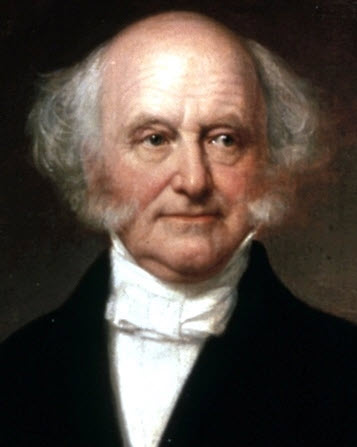
Martin Van Buren

From the Streator Free Press, 24 May 1884:

Speaking of the fine fishing at Dayton, Judge Dickey this morning told an interesting reminiscence of President Martin Van Buren’s visit to Ottawa in 1841. It was just after his defeat by Harrison, and he came here to spend a few days for relaxation. He stopped at the Fox River House and stayed ten days. With him was Spaulding, his secretary of the navy, and a celebrated novelist. Van Buren was the most polished of politicians, an uncle of J. V. A. Hoes, while Spaulding was a blunt, plain spoken man who wanted no nonsense. It was arranged for the party to go fishing at Dayton, and a procession of about 150 men on horseback piloted the distinguished party. At Dayton Col. John Green, a big democrat and friend of the party, had a big crowd assembled, and a little cannon was posted on the hill and fired a rattling salute, so much so that it nearly scared the horses to death. This made Spaulding mad, and he got madder and madder as the boss idiot at the gun kept it booming until Spaulding’s horse careered wildly. Finally the distinguished visitor could contain himself no longer and cried out that if somebody didn’t stop that infernal idiot he would go down and lick him himself. Of course the party caught no fish, and they attributed it to the fact that the secretary of the navy swore so at the gunner.

1952: The Fox River Was Acting Up Again


Ice up to the floor of the bridge

ARMY ASKED TO USE DYNAMITE ON ICE GORGE AT DAYTON DAM1
Bridge Endangered as River Continues Rise
Families Flee as Water Enters Homes
Power Plant is Shut Down

BULLETIN!

Kenneth Short, superintendent of construction of the Illinois Division of Waterways, arrived at Dayton today to make a survey of the flood situation. He informed State Rep. J. Ward Smith this afternoon he would confer immediately with other engineers on the advisability of using dynamite or some other method to break the ice gorge.

The flood situation at Dayton, caused by a huge ice gorge in the Fox River, was described as very serious today, and the U. S. Army Corps of Engineers was asked to consider the matter of dynamiting the jammed slush ice.

The ice gorge went down slightly last night at 8, then rose again today, and water flowed over the road at the east side of the bridge below the dam. Ice reached the floor of the bridge, which is in danger of being washed out or badly damaged due to the intense pressure against it. At 9:30 today the water had risen to the top of the dam, above the floor of the bridge and the power plant of the North Counties Hydro-Electric Company was put out of commission.

Water completely surrounded several of the numerous cottages on the east bank of the river, both above and below the bridge. Basements of some of the homes were flooded and water had risen above the ground level floors of others. Many of the families moved out their furniture as the water continued to rise.

Move Furniture

At the Frank Kossow Jr., home water was over the floor and half way to the windows. Furniture from this house was moved last night to the nearby home of Frank Kossow Sr., which was on higher ground. This morning the water had reached the front steps of the latter’s home and had entered the basement. Mrs. Frank Kossow Jr., and her two sons, 5 and 3 years old, have gone to Peru to reside temporarily with her mother until the flood danger is over. Her husband was called back from Chicago where he was attending a convention. Frank Kossow Sr. is vacationing in Florida.

The H. T. Mossbarger house south of the road leading to the bridge was completely surrounded, and water threatened to enter the house. The Mossbargers, who have an 8-year-old son, piled up their furniture to protect it from damage and moved out last night.

North of the road an unoccupied summer cottage owned by George Farnsworth, county engineer, was moved from its foundation, and was tilted at an angle. The water there was nearly to the windows. The Harlan Kossow home also was surrounded by water, which at 10 today was within a foot of the floor.

Auto Submerged

An automobile owned by Ted Mathews in the yard near his home was almost completely submerged.

Water was up to the front door of the Larry Marta home. Marta is at Ft. Benning, Ga., attending a National Guard training school. His wife and their four-month-old baby moved out last night, and are residing temporarily at the home of her husband’s parents, Mr. and Mrs. Dom Marta, Illinois Avenue.

The fire in the furnace at the home of Mrs. John Murphy was extinguished as water entered the basement. The family of Roy Murphy moved out as water entered their home. Another home threatened with flood damage was that of Bernard Hackler, who is employed in Ottawa by Scherer’s.

The Clyde Jeffries family left their home as the river continued to rise, and they were unable to return as the roadway leading to the house became submerged to a depth of four feet. This morning water had risen to within seven inches of the floor of the William Campbell home. The Robert Kennedy home was another which was flooded.

There are approximately 15 homes, with about 35 occupants, in the flooded area on the east side of the river.

Damaged in 1943

Robert Kennedy said today that in a similar flood in 1943, caused by an ice gorge, the river rose to about the same height that prevailed this morning. At that time the bridge was moved a couple of inches and cracks were caused in the foundation. The present bridge replaced a steel structure that collapsed in 1940 under the weight of a truck and automobile which were crossing it.

The drop in the level of the ice gorge last night apparently was due to the closing of the gates at the Starved Rock dam, causing a rise in the level of both the Illinois and Fox Rivers, and the subsequent opening of the gates, resulting in sudden dropping of the level. This action was taken at the request of George Farnsworth, county superintendent of highways. Dropping of the level presumably broke open a channel for the gorged Fox River ice. A new pileup of ice, however, in the river cause the water to rise again.

State Rep. J. Ward Smith was contacted by Dayton area residents at 3 a. m. today after the river resumed its rise. Rep. Smith telephoned to Tom Casey, chief engineer of the division of waterways, Illinois Department of Public Works and Buildings, and urged his cooperation in coping with the critical situation at Dayton. He also notified state police, who promised their assistance. After conferring with Casey, Rep. Smith notified the U. S. Army Corps of Engineers, and asked their assistance. Smith suggested that dynamite be used to open a channel.

H. McGrogan, superintendent of the North Counties Hydro-Electric plant, said this morning that the water was 24-25 feet above normal below the dam, which is 26 feet in height from base to crest. There were two feet of water on the floor of the hydro-electric plant. McGrogan said the water was still slightly below what it was on the occasion of the last gorge, but he predicted it would go higher because of the enormous amount of ice still coming over the dam. He described the bridge situation as serious, due to the tremendous pressure against the structure.


  1. Ottawa Republican-Times, January 30, 1952, p 1

Joel F. Warner – fisherman

large mouth bass

Joel Foster “Faut” Warner was a noted Dayton fisherman and his prowess received notice in the Ottawa newspaper.

May 8, 1886, p. 8, col. 3
Dayton, May 6th. – Fishing is fine here this season, and the game fish are being caught in large quantities. Our old fisherman, F. A. Warner, a short time ago caught one hundred and forty-one bass in one day, and Mr. Lewis Makinson caught seventy-five. Yesterday was a big day and scores of the finny tribe were removed from their watery homes.

May 12, 1888, p. 8, col. 2
J. F. Warner, our fisherman, caught fifty fine bass last Tuesday morning.

He is called Peg in this next item because, in 1877, he lost his left leg. He tried to get on a moving railway train, slipped and had a car wheel run over it. It had to be amputated 4 inches below the knee. He must have had a peg fitted to the stump.

8 Aug 1902, p12, col 4
                          STOLE HIS BOAT AND FISH
          “Peg” Warner of Dayton Comes To Town With a Sorrowful Tale
“Peg” Warner, an old-time fisherman at Dayton, is in the city today and with Chief of Police Westcott is making a search for his boat, fishing tackle and about fifty pounds of catfish stolen from him last night. During the summer months Peg devotes his whole time to fishing, and is kind to campers and people who visit Dayton. The boat which was stolen is a new one, especially designed and built by Peg for his own conveniences in the river. It contained a life box and also a chamber for minnows, and anybody that visited Dayton was always welcome to the use of the boat. He also had some fine reels and fishing tackle, but all were taken. It is hoped that the thief will be captured and if he is, Peg will make him suffer.

Unfortunately, there is no follow up article. I can only hope that Peg was able to get his boat back.

Dayton was a Fishing Mecca

A Trip to Dayton

    Dayton still draws fishermen to the banks of the Fox river to angle for game fish, and most any pleasant day from 30 to 50 persons can be seen between the dam and the town waiting for “a bite.” It was the pleasure of the writer in company with Ed Chapman of Freedom to visit Dayton a few days ago. Those who have been there before will be interested in knowing that Mr. Warner,1 or “old peg leg,” as they call him, is still a familiar figure there. Regardless of his 78 years of age he sits in his boat from morning till night and with a skill that only constant practice can acquire he persuades the elusive bass to “strike” his hook and skurry off in a vain endeavor to shake loose, making the water fairly foam when he happens to be landing a big one. Mr. Warner has fished there for 20 years and everybody knows him. He fishes as a business and makes quite a nice living out of it, each morning visiting his “night lines” and picking up the cat fish that fall a victim to the bait he set for them – then spending the day in silent meditation, contentedly smoking his pipe while the water ripples by him, gently stroking the side of the boat as he makes a “cast” far out to lure in a bass, pickerel or carp.

    One incident of the trip was the sight of a drunken father and three little boys, the youngest not over five who had driven there to fish and who slept in the open air with nothing but some old pieces of blanket for a cover. The reckless actions of the father were such before he sobered up that how one or more of the children escaped drowning was a mystery.

    The old four story stone mill where in war times woolen blankets were turned out by the thousands for the soldier still stands on the river bank near town. Surface coal is still mined as in years gone by, enough to supply most of the little town and sometimes the price is as low as $1.75 per ton. The dam at Dayton is each year repaired by workmen employed by the state. As fishermen stand below it they wonder what would become of them if the old dam would suddenly give way. It has stood there 25 years, but is built in sections and is strong. Those who know the river bottom can wade to almost any part of it and “cast” their line into the deep holes where the fish stay. Sun fish can be caught by hundreds and any body can catch them – they are a lovely little fish too. But the other game fish are harder to lure to the hook and not everybody lands a big string unless the “silver hook” is resorted to. Now Ed says the only way to make a sure thing of getting lots of fish is to have “peg leg” put you onto the best holes in the river and then to have him catch them for you. But we believe that as sure a way as any is to string everything that comes in sight from gars with their sword shaped mouths to “dog fish” that nobody will eat except as a last resort – then weigh in your string and tell how many pounds you caught.

    Though the weather was cold a few good sized game fish were caught and many smaller ones. The little trip was a most enjoyable one and the pleasant quarters we had to stay added much to it. Many from Earlville are planning a trip to Dayton. The fishing should be good from now on.2

  1. Joel F. Warner, Civil War veteran, lost the lower part of his leg in an accident.
  2. Earlville Leader, May 19th, 1899, p. 4

River Rampages

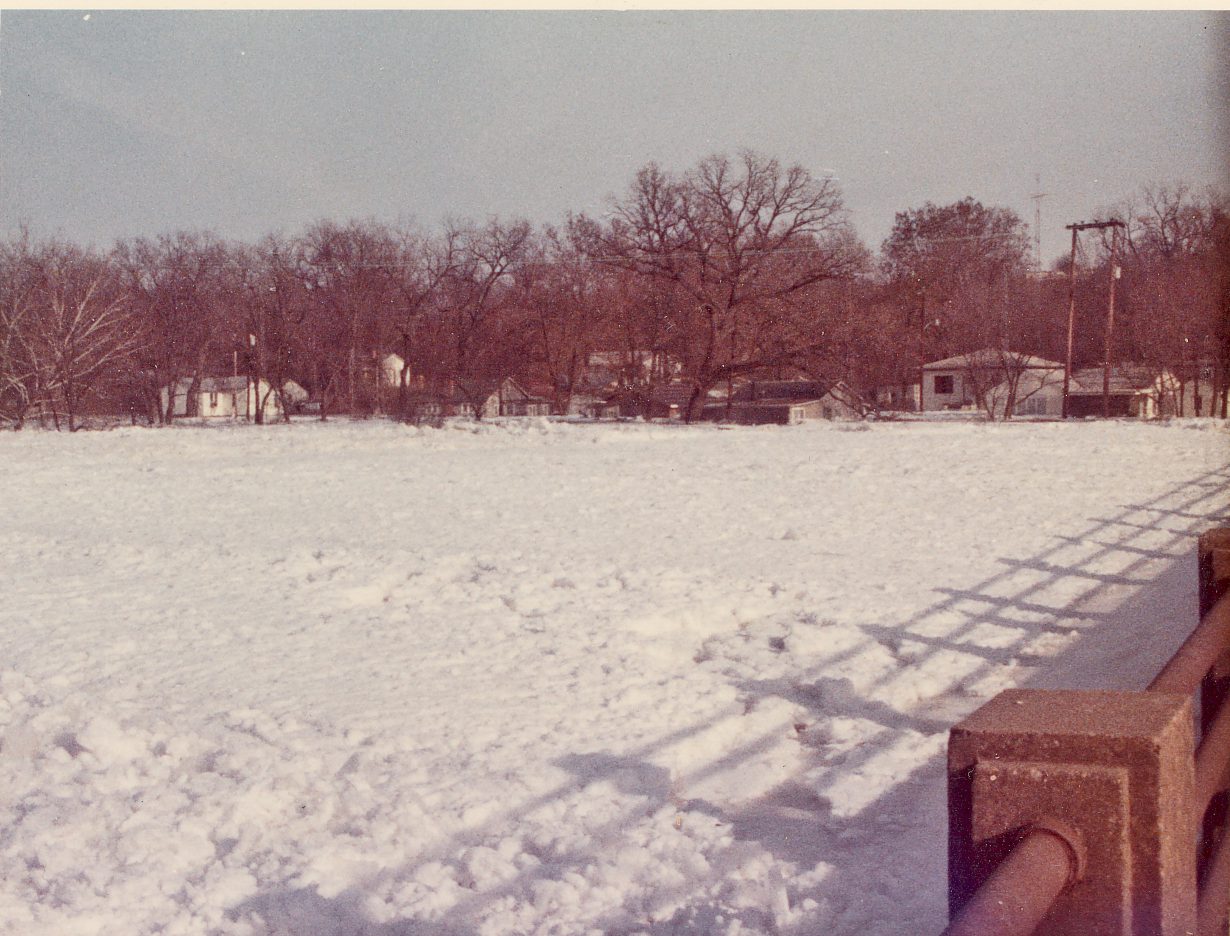
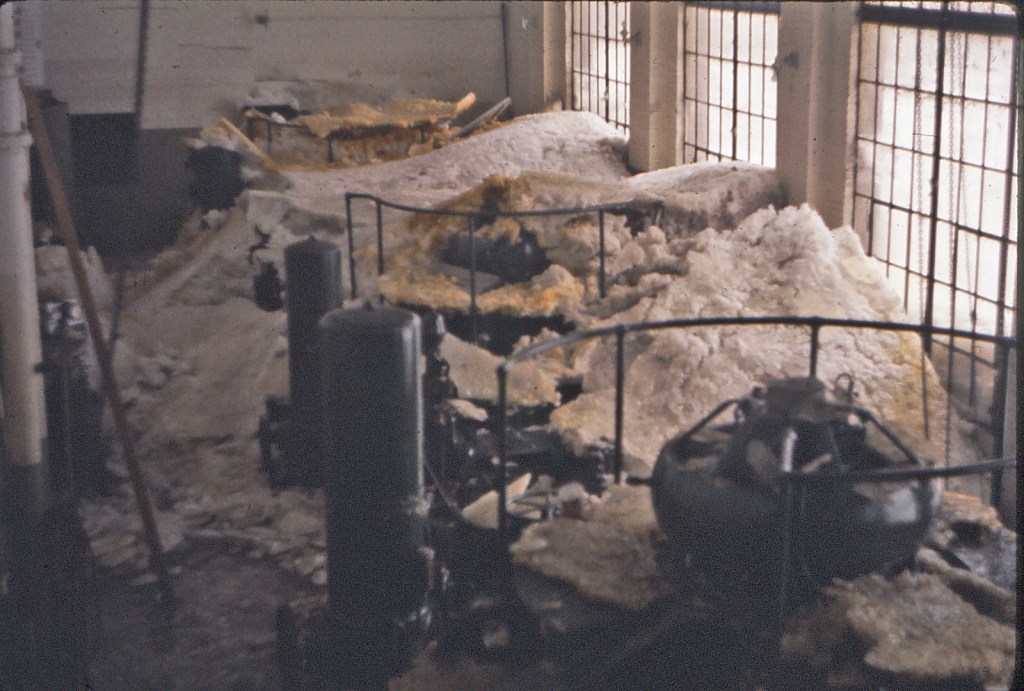
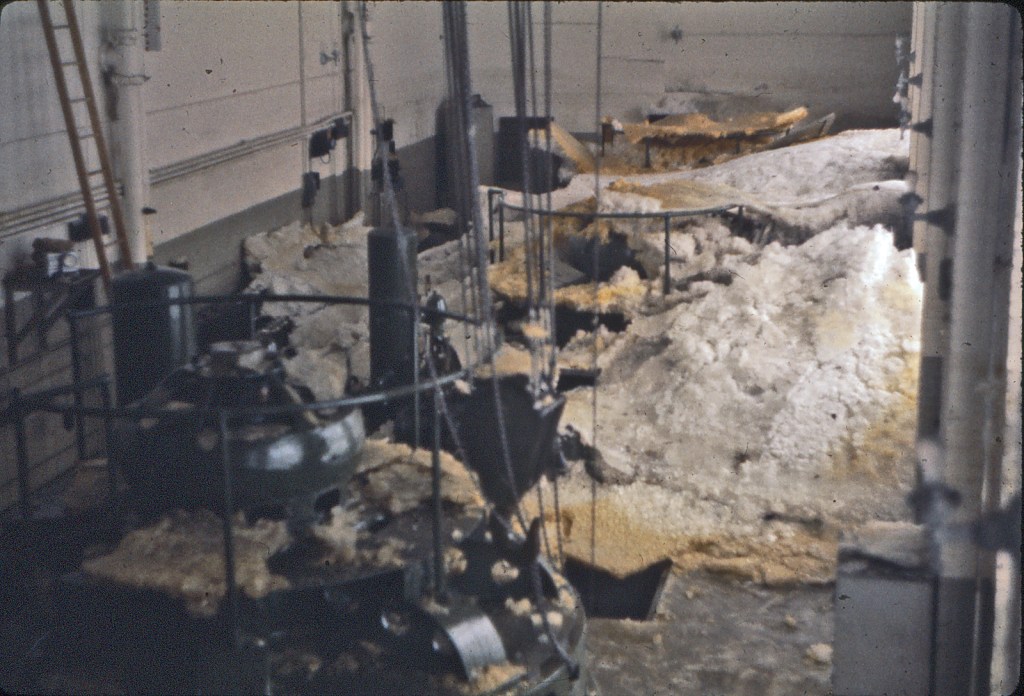
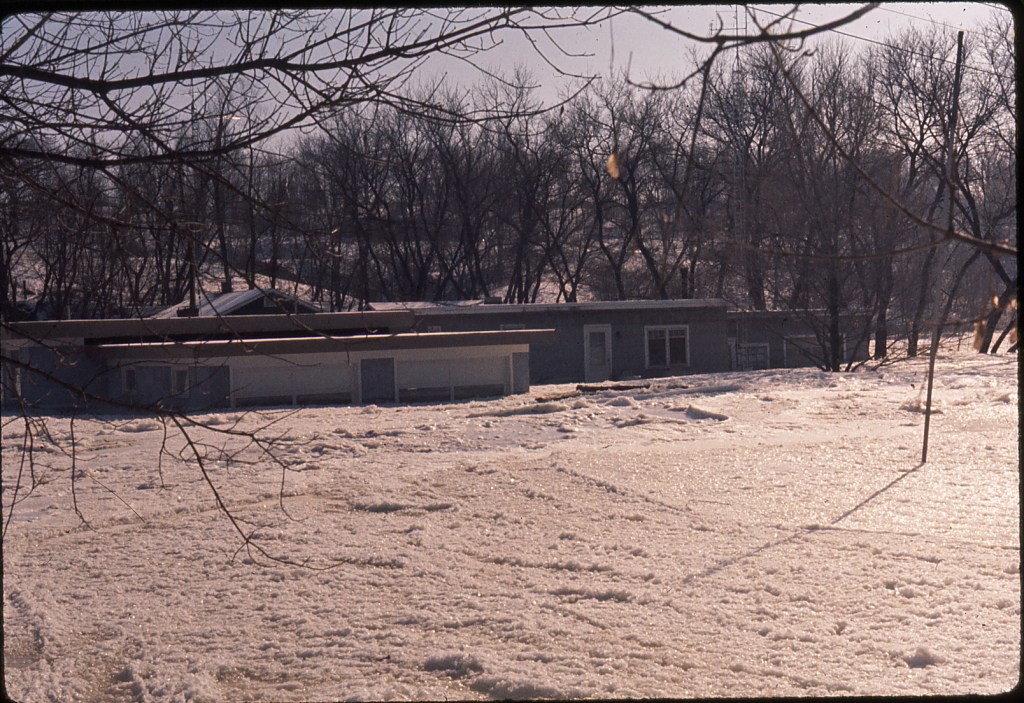
It’s winter again and the Fox River at Dayton has a history of ice jams and floods. In 1960, the river again was jammed with ice, causing flooding, as seen here in the powerhouse.

In addition, the houses along both sides of the river were engulfed by ice,

and the bridge was under pressure.

Here are some of the predecessor events for comparison. 1875, 1943, and 1952

Dayton Had Plenty of Water Power

January 27, 1855, 166 years ago today, the following notice appeared on page 4 of the Ottawa Free Trader.

Water Power To Lease

            The undersigned offer great inducements to capitalists and manufacturers, as they have decidedly the best water power in the state, having over 25 feet head and fall, and situated in Dayton, 4 miles above Ottawa, and drawn from the Fox river Feeder, which is kept in repair by the state, without any cost to the undersigned. They have water to lease for a term of years sufficient to drive 20 run of 4 ½ feet burrs, and will lease on very liberal terms to any good, responsible company.

            This is a rare chance for men of capital who may wish to go into the manufacturing business. The location is very healthy and admirably situated; as it is on a navigable feeder, within 4 miles of the contemplated Rock Island railroad, and the head of steamboat navigation. For further information, address Dayton Jny 31.

                                                                                                            John Green & Sons

When John Green bought the west side of the Fox river at the rapids, he became the owner of one half of the water power the river provided. (The other half belonged to the owner of the east bank of the river.) Green deeded one fourth of the power he owned to William Stadden. Green and Stadden then deeded one half of their water right to the Canal Commissioners for the Illinois-Michigan canal. Therefore, John Green’s share was 1/2 of 3/4 of 1/2 or 3/16 of the power of the river. He then deeded to Jesse and David Green one half of the power owned by him or 3/32 of the whole river. A government survey of the river in 1869 calculated the volume of the river was 40,000 cubic feet per minute at or near the mouth of Indian Creek. 3/32 of 40,000 equals 3750 cubic feet per minute and this is equal to 142 horse power. The use of the best wheels and machinery at the Green mills would equal 114 horse power, so John Green & Sons had excess power to lease.

Frog Hunting and Fishing in the Fox River at Dayton

DAILY EVENTS
Tuesday, June 3, 1890

A sport which is becoming quite popular with Ottawa cigar-makers is frog hunting. George Keim and Morris Flynn captured several dozen of these pet animals at Dayton on Sunday.1

Frogs were not the only sport in the Fox river at Dayton. It was known for the good fishing, attracting people from a wide area. Anglers fished for common snook, redfish, trout, bass, pike, catfish of several species, walleye, and muskellunge.

Our busy little neighbor, Dayton, besides becoming famous for her horse collars, woolen goods, tile and paper, is getting to be quite a popular summer resort. The stream of visitors during the few weeks since the fishing season opened must be enormous, for on every bright day at least the banks of the river are lined with people. As a sample of the size of parties: – Some 25 couples from Streator went up in a special car on Tuesday! Already the campers have begun to put in their appearance, and it is altogether likely that from this time until fall there will be no great diminution in the number of visitors. We should think the citizens would turn this flood of tourists to their advantage; and they certainly could make themselves vastly popular with the people of the Fox River Valley by lending their aid in the suppression of illegal seining in their waters.2

In 1884 a muskellunge was caught at Dayton with a hook and line, that weighed over 32 lbs.! It was over four feet long, and 9 inches across the body.

Fishing is all the rage here now, and a large number of game fish have been caught and carried away during the past two weeks. Good fishermen have caught all the way from 25 to 100 and over of black bass, ranging from one pound to five and six pounds in weight. The river seemed to be full of them and sportsmen are having a jolly time.3

In 1891 it was reported that over 1000 fish were caught at Dayton in a single day.


  1. Ottawa Free Trader, 7 Jun 1890, p. 3, col. 2
  2. Ottawa Free Trader, 27 May 1882, p. 6, col. 1
  3. Ottawa Free Trader, May 12, 1888, p. 8, col. 2