The David Green House

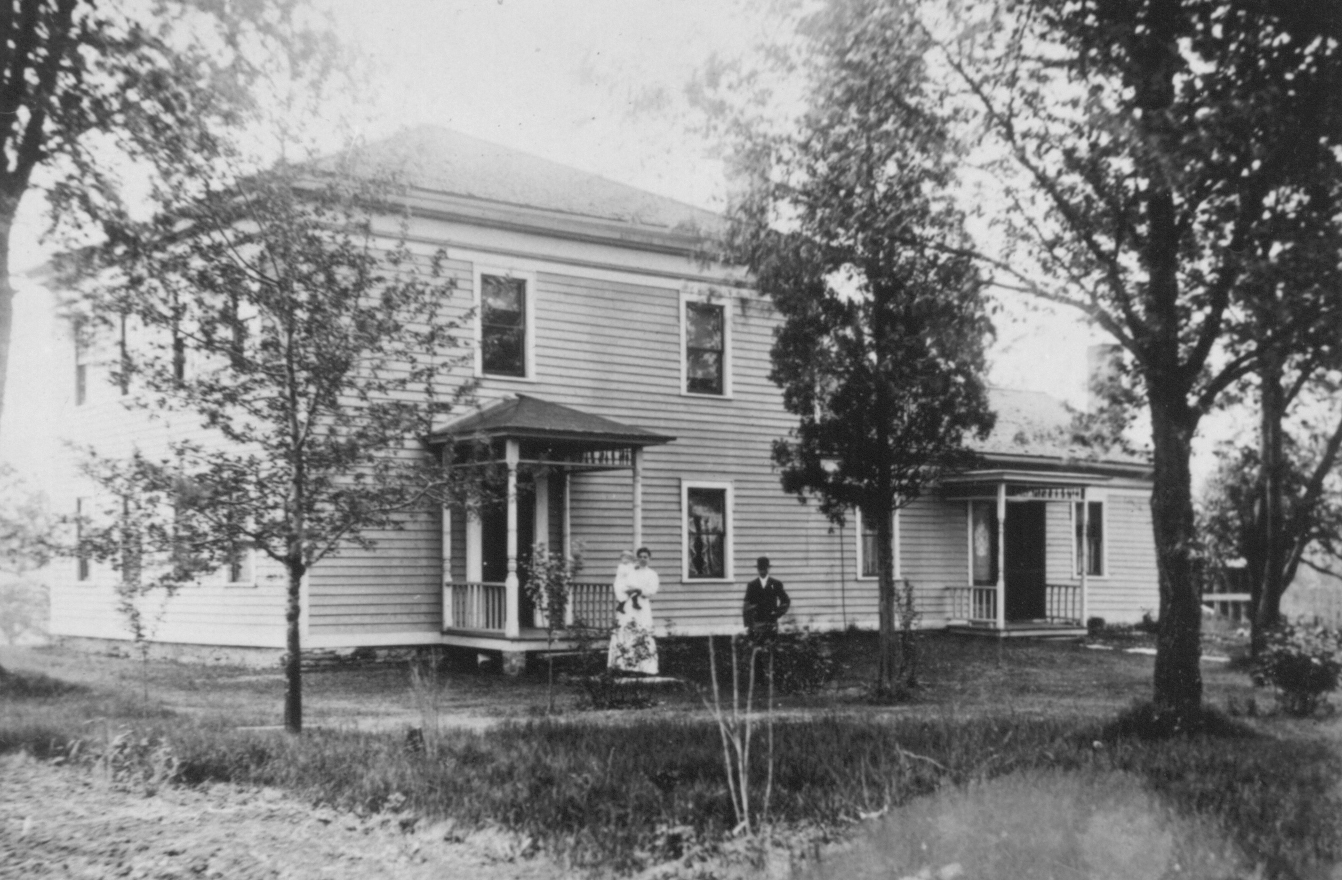
David Green house in 1907

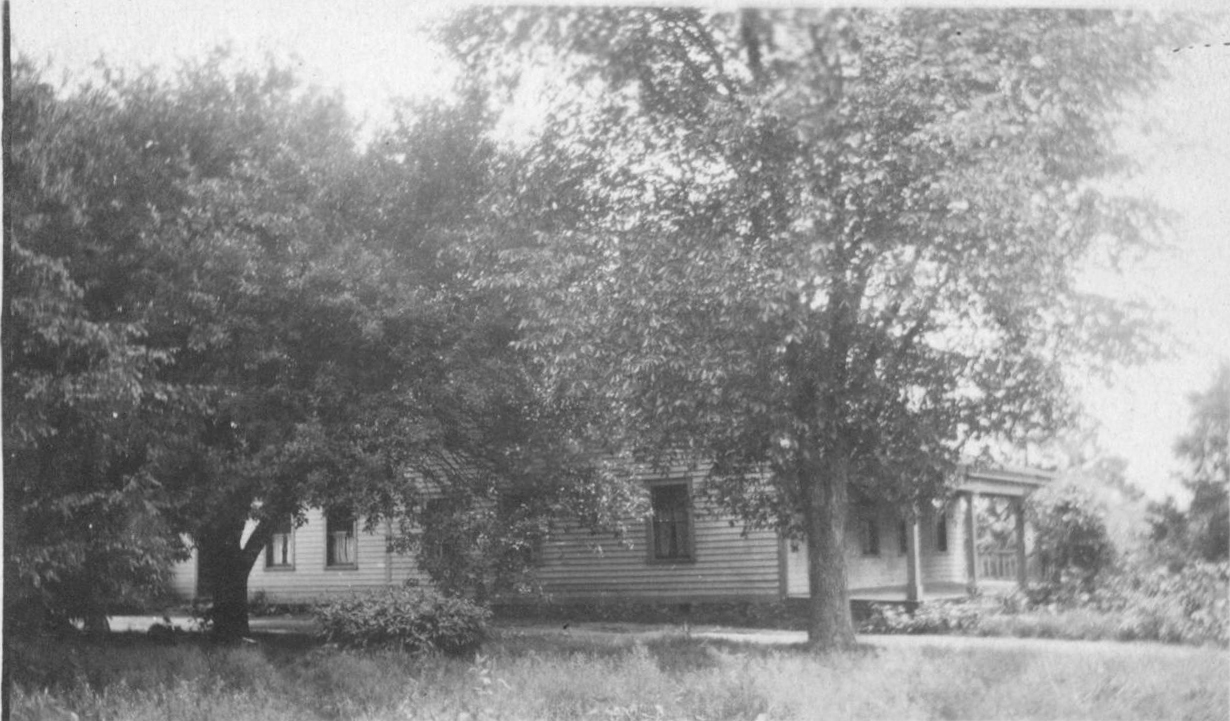
The house pictured above was built for David Green in 1853, the second in a line of three houses, all alike, built by John, David, and Jesse Green in Dayton. For biographical information on David Green, see here.

There surely was a previous house on this site. David bought the land from his father in 1842, at age 22, although he may have continued to live at home for a few years. He probably built a house for his new bride, Mary Stadden, when they married in 1847. In any case, in 1853 the house pictured above was built. It was a nine room house, four rooms per floor in the two-story portion and a kitchen extension.

When they moved into the new house they had 3 children, Alice, George, and Ella. Another seven children were born to them, who grew up living next door to their cousins, Jesse’s children.

An upstairs bedroom in this house produced Dayton’s only newspaper. One of the sons, Charles, had a little printing press and he was editor, reporter, printer & everything and he called it “The Dayton Enterprise”. There is only one known copy.

After David’s death, Mary stayed on in the house until some time in the 1890s. The house was tied up in the estate settlement of the man who had purchased the mortgage to the house. It was finally sold to E. A. Dallam in 1904.

Edward A. Dallam was born in Iowa and moved to Whiteside County, Illinois by age 13 where he worked at farming. He suffered from asthma, however, and gave up farming. He moved to Ottawa and opened a store on Main street where he sold notions, crockery, and tinware. In 1892 his wife, Lucy Ann Sapp, died. Three years later he married Winifred Talbot, in Ottawa, and they lived in South Ottawa, where he kept the store and also worked as a painter.

In 1904, when he bought the house, they moved to Dayton. Winifred was a frequent hostess, entertaining the Ladies’ Aid Society, the Dayton Womans’ Club and many other friends. When the J. S. club picnicked there, dinner and supper were served on the spacious lawn, and the day spent having a rousing good time.

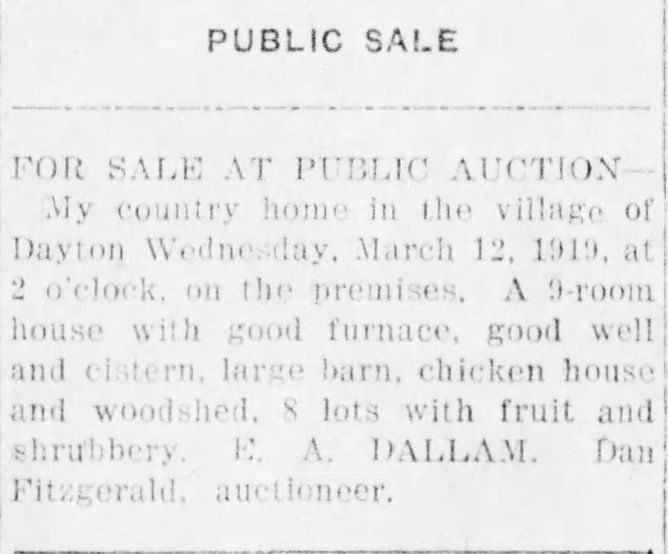
In 1919 they decided to move back to Ottawa and he advertised in the Free Trader on March 5 as follows:

ad for sale of Dayton house

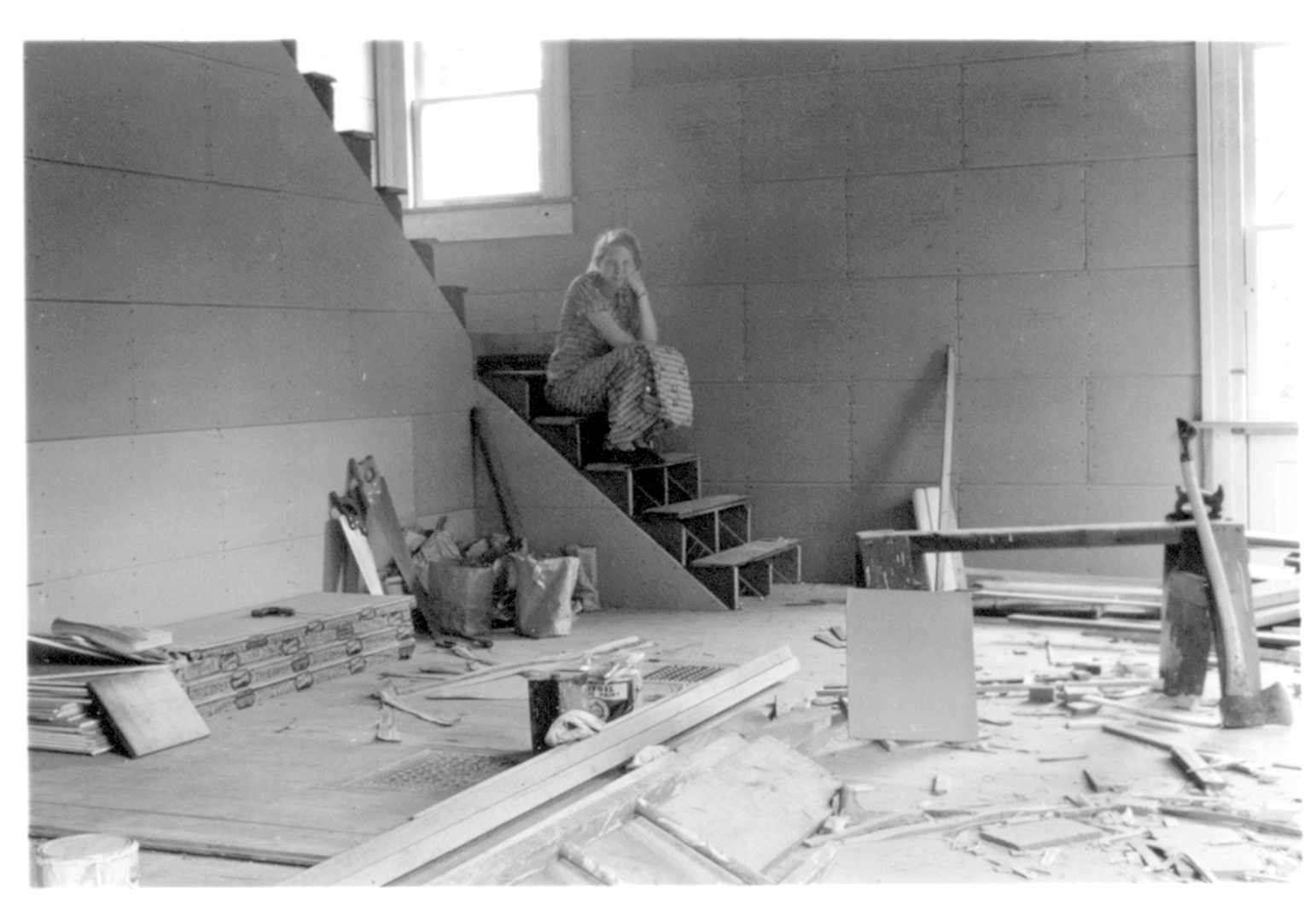
Ralph Green bought it and later gave it to his daughter, Grace, for a wedding present. The pictures below show the house as it was in 1937, when Grace and Charles Clifford began remodeling it.


They changed it extensively, throwing the two east parlor rooms into one large living room and moving the staircase from the center of the house to one side. The old kitchen was torn down and a new one added.

Grace Clifford kept up the tradition of entertaining — The Dayton Homemakers, the Dayton Womans’ Club, the Ottawa AAUW, and large family gatherings were held here at Christmas, Easter, Valentine’s Day, Memorial Day, and on many other occasions.

The Cliffords sold the house in 2000 and retired to Ottawa.

October news from Dayton

buckwheat in flower


Dayton, Oct. 3d, 1884. – Politics are quiet at present, but our town will show up on the 4th of November with a good Cleveland majority.

The Chicago and Dayton Brick Co. have three large kilns built and are laying foundations for three more kilns. They have just set up a large Eureka Dry Press Brick machine, weighing 18 tons, and will be ready to run as soon as they can get in their new water wheels.

Mr. and Mrs. J. C. Allen and family, of Des Moines, Iowa, were visiting in Dayton the fore part of the week. They took in the sights of Chicago for a few days.

Mrs. Wm. McMillan, of Clinton, Iowa, is home on a visit.

Miss Myrtle Stadden, of Chicago, who has been visiting in Dayton for a few weeks, returned home Friday morning.

Mrs. J. W. Channel and daughter will leave next Monday for the great fair and exposition at St. Louis.

O. W. Trumbo “takes the cake” on small grain. He threshed out 26 ½ bushels of wheat, machine measure, to the acre, and 180 bushels of pure buckwheat to ten acres. Who can beat that? The buckwheat is at Green’s mill where it will be ground and sold out to be made into the most delicious cakes. For good pure buckwheat you must call at the mill.

The Dayton tile are taking the load and the works are overrun with orders.

Quite a number of our young folks are attending the Ottawa High School this fall.

Occasional1


  1. The Ottawa (Illinois) Free Trader, October 4, 1884, p. 8, cols. 1-2

Image by Inn from Pixabay

The John Green House – the First in Dayton

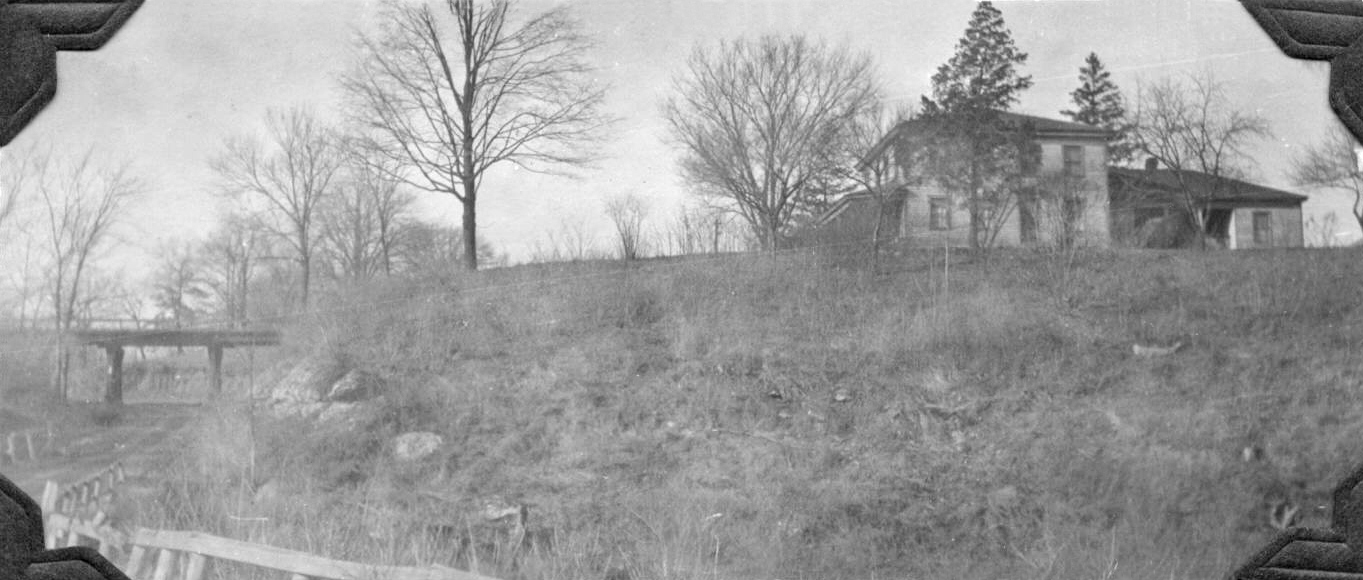
John Green built his first house on the hill overlooking the saw and grist mill that had just been built. Three other houses have subsequently been built on that spot. There are no photographs of any of the houses before the 1853 one, but Maud Green described them in her notes on Dayton, written in the 1940s:

The first house in Dayton was on the site of our present home [marked in map above] and was probably not a log cabin as Grandfather [John Green] had put a saw-mill in one end of the flour-mill in the spring of 1830, leaving his family on the farm four miles up the river until the next Fall, in the cabin 18 x 24 where they had spent the first winter.  They were still in the first house in 1832 at the time of the Blackhawk War as they made a fort of it that summer and had sixty people there just after the Indian Creek Massacre.

I never heard how long it was until the second house was built in the hillside, facing the river.  It had three stories with a spring in the basement floor running into a stone trough, parts of which are still in existence.  The spring dried up long ago but I can remember it.  The upper floor was even with the top of the hill.  It had a porch on the east side of at least one floor.  While the men were away at the California Gold Rush in 1849 the Hite family lived in this house and rented the farm, the only time any but the Green family ever lived here (in 117 years).

In the summer of 1853 John Green & his sons David and Jesse built three square frame houses in a row,  John’s where the first house stood.  In these three houses, the Jesse, David & Isaac Green families grew up.  The Jesse Green house was destroyed by fire within the last twenty years and our father’s house was torn down (in 1924) and replaced by the present structure, which is the fourth house on the original building spot.  The David Green house, owned by Charles and Grace Clifford, is the only one still standing of the three built in 1853.

This view of the third John Green house is from the southwest.

This view is from the railroad tracks, looking east.

This shows the house viewed from the end of the bridge – looking west up the hill.

In 1924 when the house was torn down, the old kitchen was moved across the road to make a house for the hired man.

Ralph Green house

This is the fourth house, built in 1924.

Celebrating the End of the School Year – 1944

graduation cap & books

Friday night, May 26, 1944, the rural schools of districts 204, 208, and 209 (Dayton) held joint graduation ceremonies.

200 at Graduation Program in Dayton Hear W. R. Foster

Eight pupils of the eighth grade received diplomas last night at a combined rural and village school commencement exercise attended by 200 at the Dayton school

Diplomas were presented by County Supt. of Schools W. R. Foster, who made the graduation address. Members of the class were Le Roy Reindel, John Edsan, Jimmie Lambert, Truman Eltrevoog, Naomi Winchester, Edward Patterson, Dorothy McLean and Francis Alvig.

Seventh grade promotion certificates were presented to Elaine Thomas, Ruth Schmidt, Marshall Claude, Dick Thomas and Dale Reindel.

The program was in charge of the teachers of the school combining for the commencement, and was opened by graduates and the audience singing “The Star Spangled Banner” and “God Bless America,” and giving the salute to the flag.

District 208 pupils under direction of Mrs. F. J. Giehler presented a sketch, “The Colonial Time.”

A playlet, “The Story of America,” was given by district 204 pupils directed by Mrs. Edith Miller.

The Dayton school primary department under direction of Miss Emma Fraine staged a skit, “All Out for Defense.” Pupils of Mrs. Naomi Trent’s room at the Dayton school staged a playlet, “Salute to the Flag.” The program closed by all pupils singing “The Victory Polka.”1


Two days later, everyone gathered at the school for the annual picnic.

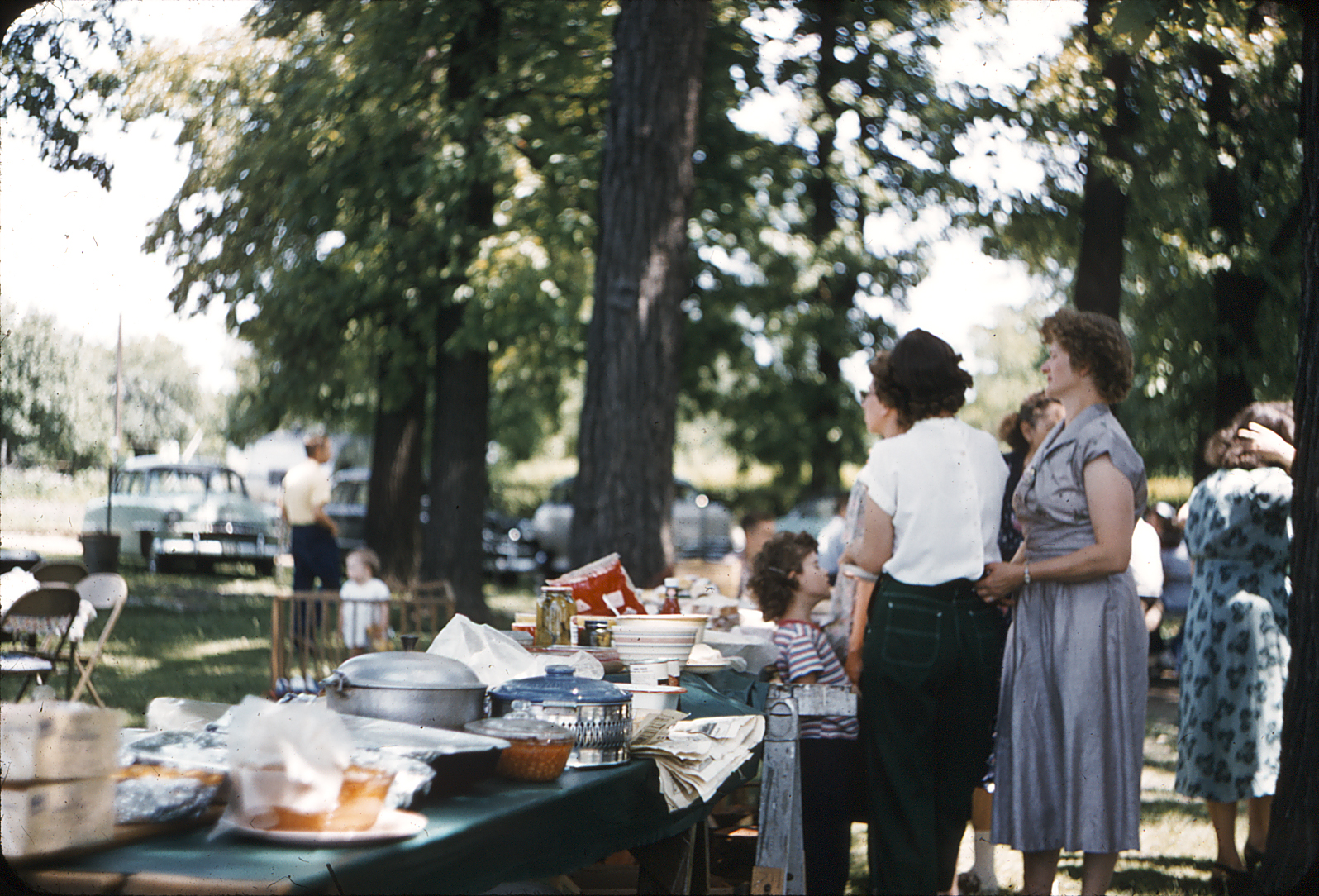
the picnic table

This is a later picnic, but I’m sure the table was just as loaded in 1943.

100 Gather for Annual Picnic at Dayton School

One hundred attended the annual picnic of the Dayton school yesterday at the school grounds.

Dinner at noon was followed by races and other sports. Later ice cream and cake were served.

Winners in races were Carl Schmidt, preschool age; Shirley Patterson, 1st grade; Sylvia Ralrick, second grade; Rosemary Patterson, third; Bobbie Buckley, fourth; Ardelle Taylor, fifth and sixth; Elaine Thomas, seventh; Edward Patterson, eighth; Teddy Mathews, high school; Mrs. Homer Matthews and Mrs. Naomi Trent, married women’s.

Mr. and Mrs. Tony Summons, Mrs. Morris Ponton, Mrs. Mayme Ryan and Miss Elizabeth Ryan of Chicago, and Mrs. Fred Ritzius of Ottawa were out of town guests.2


  1. Ottawa Republican-Times, May 27, 1944, p. 8, col. 1
  2. Ibid, May 29, 1944, p. 8, col. 6

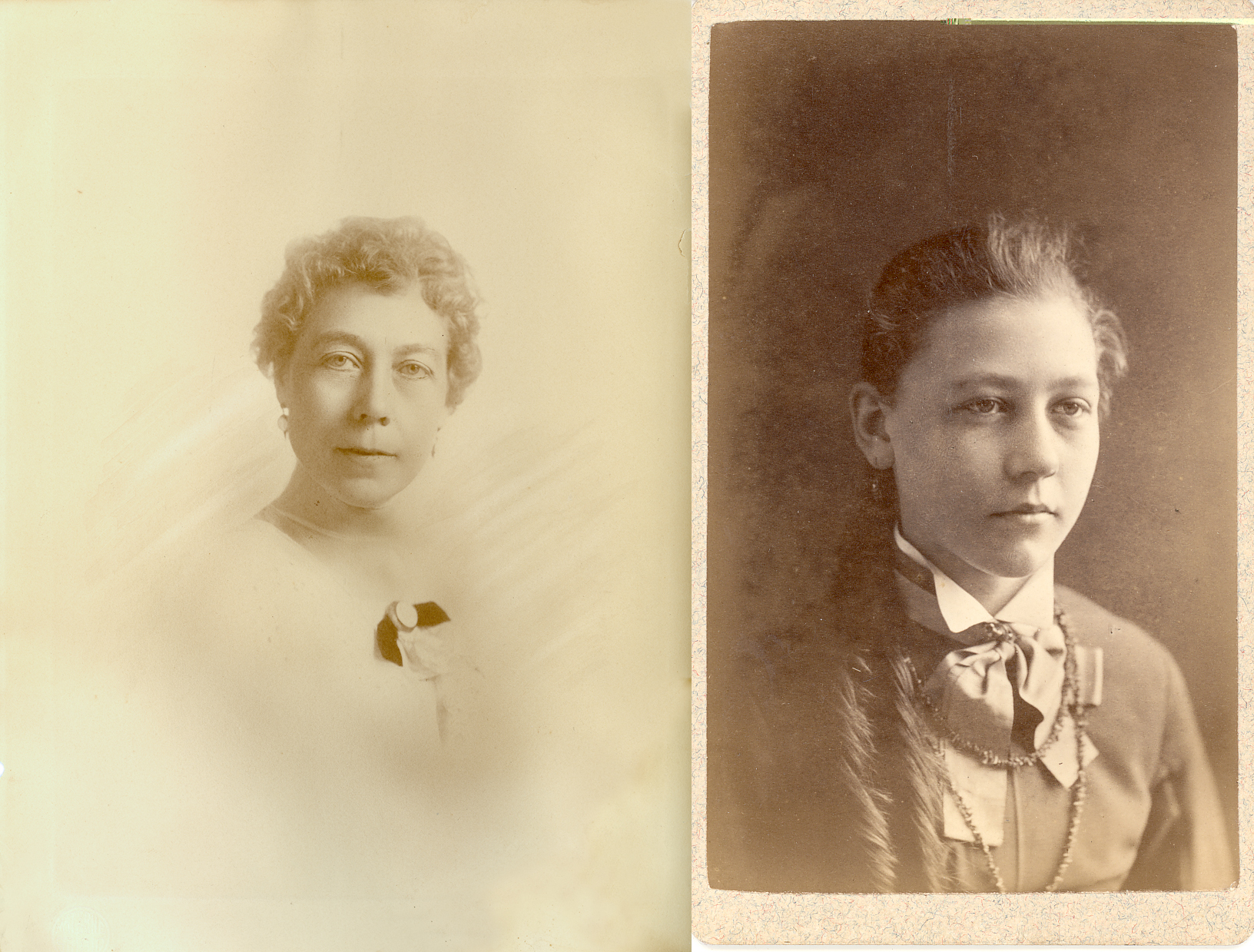
Schoolteachers Cora and Winnie Childs

Cora and Winnie Childs

In 1882 a two-story frame house with a belfry was built at the top of the hill in Dayton. It served as the schoolhouse until it burned in 1890. The first teachers in that building were Cora and Winnie Childs, the daughters of Franklin P. Childs and Margaret Price.

They were born in Marshall county, Illinois; Cora in 1860 and Winnie in 1863. In 1864, their parents moved to Ottawa to take advantage of the better educational opportunities for their daughters. Cora graduated from Ottawa Township High School in 1879 and Winnie in 1881.

Cora completed the two year program at Wesleyan Female College in Cincinnati in one year, graduating in June 1880. She taught at several other La Salle County schools and after Winnie graduated in 1881 they came to Dayton together in 1882.

They taught there for two years, until their father moved the family to a farm near Morris, in Grundy county. Cora applied for and was granted a position teaching in the Morris junior high school.

The two years spent in Dayton made many opportunities to get to know the Dayton people, and Cora and Winnie kept up friendships with many of the Green family and others into later life. One of these friendships ended in the marriage of Cora Childs and Harry Green on February 22, 1888. They lived in Morris, where Harry had a bakery and restaurant. After that building burned, they returned to Ottawa where he went to work for the Standard Brick Company, where his brother-in-law, C. B. Hess, was a partner.

In 1892 they moved to Chicago where Harry established himself as an electrical engineer. Cora was very active in various patriotic organizations. She held a number of offices with the DAR, including many years as regent. She was the first regent of the Chicago chapter of the DAC, the Daughters of the American Colonists; was a member of the Daughters of 1812 and many other similar organizations. Cora died February 1, 1951 and is buried in Ottawa, Illinois.

Winnie never married and spent most of her life on the farm near Morris or in the Chicago area. She worked at various times as a stenographer, a reporter and a music teacher. She became an invalid following a fall in1940 and in 1950 was in a private nursing home in Morris. In 1958 she was in Chicago with her niece, Mabel Greene Myers, where she died February 11, 1958.

Comings and Goings – 1928 Dayton Briefs

Dayton Briefs

Edward Raspillar of Plano, Ill., spent from Saturday until Sunday at the Fraine home.

L. A. Green and sisters, Miss Maude and Mrs. A. P. Masters of Colorado Springs, Colo. and Mr. and Mrs. Ralph Green motored to Mendota Sunday to spend the day at the N. Van Etten home.

John Gracia made a business trip to Aurora Tuesday.

Mrs. Rush Green, Mrs. Gladys Lattimore, Mrs. Addie Thompson, Misses Emma and Jennie Fraine spent Sunday evening at the home of Mrs. E. J. Dallam’s in Ottawa.

Miss Cora Tanner of Aurora spent Sunday with her mother, Mrs. A. L. Tanner.

Mrs. Keenan and Miss Edith Reynolds went to Aurora Tuesday to spend the day.

Mrs. John Reynolds was confined at her home last week. Her daughter, Mrs. A. L. Prager of Marseilles took care of her.

Mrs. Paul Schmitt has returned to her home here, after being ill with the flu at the home of her parents, Mr. and Mrs. S. Canfield in Rutland.

Mr. and Mrs. Allen Fleming and son, Marshall of Aurora spent the weekend with the former’s parents, Mr. and Mrs. W. H. Fleming.

Mrs. Addie Thompson attended the wedding of Emmett Burke and Agnes Telpher at St. Columba’s church last Monday.

Mrs. Wm. Ryan and two daughters spent Saturday in Ottawa.

John Garcia, who has been laid up the past three months with a smashed hand, is now employed with the C. B. & Q. railway in Ottawa.

Harry Loomis made a business trip to Champaign, Ill. Saturday.

Mrs. Harold Schilling of Ottawa spent Wednesday in Dayton.

Mr. and Mrs. C. Draper and family spent Sunday at their new home in Wallace.

Mr. and Mrs. M. Keenan motored to Spring Valley Thursday evening to call on Mrs. Sam Nash.

Louise, Mildred and Clarence Thorsen went to Streator Friday to spend a few days with their grandparents, Mr. and Mrs. Tobias Thorsen.

Mr. and Mrs. Danny Rieuf and Mrs. Bill Roth and son of Ottawa called at the M. Keenan home Friday evening.

Mr. and Mrs. John Reynolds and daughters, Miss Edith and Mrs. Trayer spent Sunday at the Vincent Smith home, near Ottawa.

A few from here attended the opening dance at Illini Beach Sunday evening.

L. A. Green, Miss Maude Green and Mrs. A. P. Masters called Thursday evening at the Ralph Green home in Ottawa.

Mrs. Edward Miller of west of Dayton spent Wednesday evening at the Fraine home.

Mrs. Mae Fleming and daughter, Shirley Jean of Rutland spent Sunday with Mrs. W. B. Fleming.

Miss Edith Reynolds spent Sunday evening in Ottawa with relatives, returning home Monday.

Mr. and Mrs. Mike Tracy of Streator were callers in Dayton Sunday of last week.

Mr. and Mrs. M. Keenan spent Sunday with Mr. and Mrs. Danny Rieuf of Ottawa.

Elmer Thorsen of Streator called Sunday evening at the Lormis home.1


  1. The (Ottawa, IL) Republican-Times, May 8, 1928, p. 3, cols. 2-3

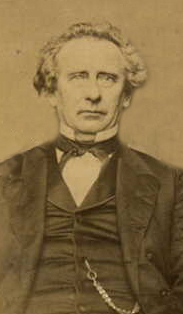
Charles Miller – Postmaster, Farmer, and Tailor in Dayton


Charles G. Miller, one of the pioneer settlers of La Salle county, and for some years engaged in the mercantile business in Ottawa, died at the residence of his son in Chicago on the 3d inst., in the 72d year of his age. He was a native of Lancaster, Pa., and had come to this county in about 1837, opening a tailoring establishment in the village of Dayton, then buying and working a farm in Dayton township for several years, and then opening a dry goods store in Ottawa.

In 1862 he closed out his business here and returned to Pennsylvania, going into business in Pittsburg, but gave that up in about 1872, and since then had lived in Chicago. He was a man of more than average education, fond of books, a wide reader, and a ready and fluent speaker. Though active in his earlier days as a democratic politician, generous and big hearted, he never sought office and, except the postmastership at Dayton, we believe never held any. Two brothers, John and Uriah Miller, who survive him, are well known prominent citizens of this county; and a third brother, Reuben, who accompanied the Mormon exodus to Utah, we believe is still living there.1


  1. The Ottawa Free Trader, September 17, 1881, p. 1, col. 2.

141 Years Ago Today the School I Attended Was Nearing Completion

picture of school

Opened in 1891, this school replaced the one which burned in 1890

From Dayton

            Dayton, Ill., Aug. 29. – Mr. John Channel, who went West to southeastern Kansas and Missouri a short time ago on a land-buying excursion, brings back unfavorable reports of that section of the country for farming purposes, but gives it as his opinion that the manufacturing of lime might be engaged in profitably.

Mrs. George W. Green, who has been visiting relatives and friends at Braidwood during the past week, returned home last Saturday.

Mr. George W. Gibson and Miss Alta start this week for Nebraska on a short visit.

Miss Jessie Trumbo returned last week from a week’s visit among relatives in Chicago.

Grandma Green, who is 90 years old, shook hands with her old friends at the Old Settlers’ picnic last week. Her health is quite good, and we hope she may have many pleasant returns of the day.

The new school building is rapidly nearing completion and will be one of the prettiest buildings in the country. It is a two-story frame structure, 36 feet square, and a belfry.

There has been a vacancy in our board of directors ever since last spring, and notwithstanding the fact that the law says it must be filled without delay, no election had been called until the people took the matter into their own hands as provided by law and petitioned the township treasurer to call such election. The two directors, however, learned of the petition, and after studying their law books concluded to call an election before they were brought to their senses by the township treasurer. The election took place at the school house last Saturday afternoon and resulted in a complete victory for the taxpayers and destruction to the one-man power. The vote stood 26 for Isaac Green and 18 for J. Wright. A petition was also extensively signed, authorizing the sale of the old school building.

Mr. James Timmons, proprietor of the Dayton Hotel, has repainted and refurnished it and put it in good shape for the convenience and accommodation of the traveling public, fishing parties, &c.1


  1. The Ottawa Free Trader, August 30, 1882, p. 4, col. 3

A Stroke of Lightning

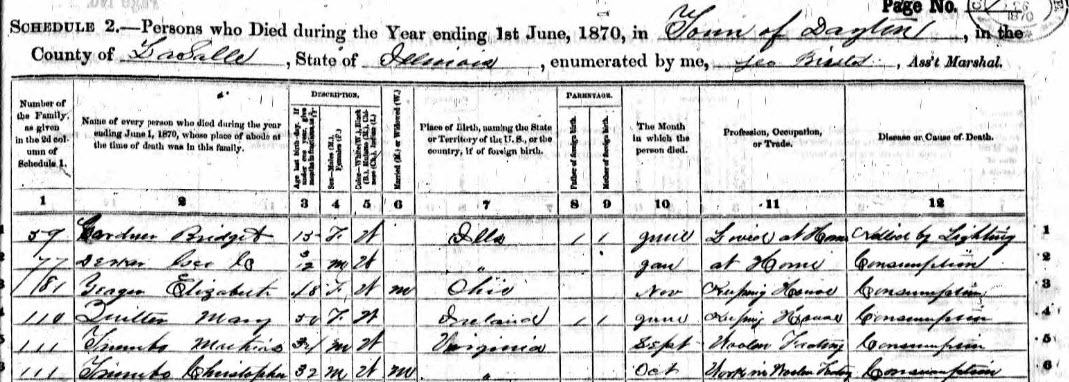
In 1870, in addition to the US population census, there is also a mortality census, which lists everyone who died in the 12 months prior to the census. The official census day for 1870 was June 1 and therefore any deaths that occurred between June 1, 1869, and May 31, 1870 should be included. The first line of this list of Dayton residents includes Bridget Gardner, age 15, who died in June, killed by lightning. This implies  a death date of June 1869.


A death by lightning was unusual enough to warrant a mention in the newspaper, and the Ottawa Free Trader printed the following notice on the front page. Clearly this refers to the same young girl listed in the mortality census, whose father was farming some of Mr. Reddick’s land,


HOWEVER, this notice appeared in the Ottawa Free Trader on Saturday, July 2, not in 1869, but in 1870.

It seems most unlikely that the newspaper would save such a notice for a year before publishing it. It is much more likely that Bridget actually died on June 30, 1870. Why, then, does she appear in the mortality census?

When the census taker arrived at the Gardner household on July 21, 1870 and asked his questions, the answers were supposed to be true as of June 1, the official census date. It is very easy, though, to imagine the following interchange:
“Has anyone in your family died in the past year?”
“Yes, my daughter Bridget”
“How old was she and how did she die?
“She was 15 and was struck by lightning.”
“What month did she die in?”
“June”

Actually, Bridget, alive on June 1, should have been listed as a 15-year-old daughter in the family census entry, but adherence to the official census day for information was often overlooked.


Willie Kibler

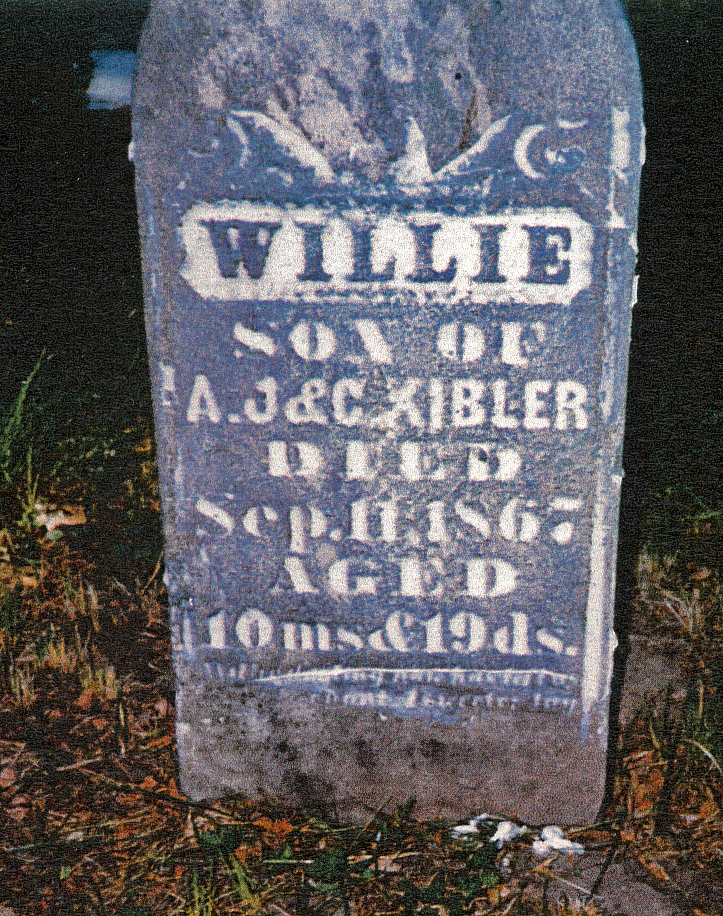
Among all the people buried in the Dayton cemetery there are 22 who appear to have no other family members buried there. One such is Willie Kibler, a baby who died before his first birthday.

The A. J. and C. Kibler listed on little Willie’s gravestone in the Dayton cemetery were Andrew Jackson and Caroline Kibler, residents of Rutland township when Willie died, on Sept 11, 1867. They lived in the Dayton area for only a short while. A, J, grew up in Virginia and married Caroline there in 1865. They must have left for Illinois very soon thereafter, as they were on a farm in Rutland when Willie died.  Andrew, a farmer, was listed as head of household in 1870, although he owned no land. However, George W. Lamb, listed as a boarder in the household, was a 20-year old who had inherited a large farm from his father. It is likely that Andrew Kibler was farming George’s land.

When Andrew died his obituary (included below) appeared in the Wellsville, Kansas, Globe on December 12,1913.

Andrew Jackson Kibler

Andrew Jackson Kibler, son of Philip and Margaret Kibler, was born August 11, 1840, in Shenandoah county, Virginia; died at Wellsville, Kans., Decenber 2, 1913, aged 73 years, 3 months and 20 days.

During the Civil War he served with the Thirty-third Virginia Infantry, in the Southern army. He was in the battle of Gettysburg, and saw many of his comrades and neighbors wounded and killed. A fragment of a flying shell struck him in the head during that battle and he was compelled to go to the hospital.

December 21, 1865, after the close of the war, he was married to Caroline Burner. To this union there were nine children, two dying in infancy.

The family moved from Virginia to Illinois, and later to Kirksville, Mo. In 1887 they came to Wellsville where they have made their home since. Mr. Kibler was engaged in the watch repairing and jewelry business until recently, when his health gave way.

His health and strength gave way gradually, and his death occurred Tuesday morning, December 2d, at 5:55. The funeral services were held at the Methodist church Friday afternoon, at two o’clock, and were conducted by the Rev. J. C. Wilson. Members of Lookout Post G. A. R. gathered at the home and acted as escort to the body, and accompanied it to the church.

Interment was in the Wellsville cemetery. The weather was inclement, and many who had expected to attend the funeral services at the church and at the grave were kept at home on account of of the rain.

The deceased is survived by the widow and seven children: Mrs. E. E. Appleton, of Louisvile, Ky.; Miss Mattie Kibler, Wellsville, Kans.; Dr. J. B. Kibler, Kansas City, Mo.; Dr. H. B. Kibler, Frankfort, Kans.; Miss Georgia Kibler, Ottawa, Kans.; Mrs. C. C. Fields, Winnipeg, Canada; Mrs. Eugene Bice, Omaha, Nebr. Besides there are seven granchildren; two sisters, Mrs. Mary E. Brunk, of Breckenridge, Mo., and Mrs. J. B. Clem, Lantz Mills, Va. and one brother, J. C. Kibler, Woodstocj, Va.

Everyday Life in Dayton at the End of August

From the Ottawa Republican-Times, August 30, 1900, p. 4, col. 5

Dayton

The pile driver of the C., B. & Q. R. R. has been busy the past few days repairing the Q bridge here.

The water in the feeder is now in a condition to furnish all the power necessary.

James O’Meara has some of the finest potatoes in this section. Jim is a hustler, and knows a good thing when he sees it.

The rain has ruined the oats in many places in this vicinity, and farmers are out of pocket.

E. McClary, our genial store-keeper, is improving his lawn by laying a new tile sidewalk around his house.

Walter Breese and George Timmons leave on Monday morning for Chicago. If they are successful in their new undertaking they will make Chicago their future home.

The river on Monday was the highest this season.

Thomas Nagle has purchased from Mrs. Martha Bagley the house adjoining his own lot, and will move it and convert it to a barn for his own use.

Mrs. Hudson and son, who have been visiting Mr. and Mrs. John Channel, returned to Chicago on Monday

H. C. Tueley has gone to Indianapolis to spend a few days.

E. Emmons and family intend moving, and will make Marseilles their future home.

It was proven on Saturday last that the hydraulic cider press here can turn out 2,000 gallons per day.

About forty persons from here attended the old settler’s picnic and Pawnee Bill’s aggregation.

Munroe Durkee, of Wedron, was a caller here this week.

The Dayton Republican Club expect a good turn-out at their meeting on Tuesday evening next.

Emory Waller has been on the sick list for the past week/

The war whoop of the juvenile Indians will soon cease to be heard on our streets, as next week school commences and they will then speak their little piece to their new teacher.

Etta Barnes visited Mr. and Mrs. E. McClary on Tuesday.

Commissioner Jas. H. Timmons is having the hill graveled just west of the feeder bridge. That’s right, Jim, keep on with your good work, and may your shadow never grow less.

Only one lone fisherman could be seen along the banks of the muddy Fox the past week. What a change from a few years ago.

Threshing has been going on at a lively rate for the past two days.

One of our enterprising young men is to start a tonsorial parlor in the near future. It will fill a long felt want. We wish him success in his new undertaking.

The rain causes lots of work on the section for the men employed by the Q. road.

Miles Masters is still very sick and will be unable to leave his bed for some time

Ira W. Davis in Wisconsin and Illinois

I started with the idea of providing some biographical information on two of the people buried in the Dayton Cemetery, Laura Davis and her infant son Ray. This required looking into her husband, Ira W. Davis, and exploring his life led to more than I anticipated, including unexpected links to the development of businesses in Dayton, so Ira became the focus of my story.

Ira W. Davis was born in Oldtown, Maine on November 4, 1835, the son of John Taber Davis and Harriet Jane Moore. He appears, unmarried, in his father’s household in 1850, 1860 and 1870. He is never shown as owning land, but in 1870 he has personal property of $6,000.  Shortly after 1870, he and Charles Noyes, another Old Town resident decided to move west. They settled in Menasha, Wisconsin, where between them, they built a large factory to produce excelsior. In 1875 they added a new branch to the factory for making clothespins.

excelsior

In Menasha, Ira met Laura Barlow Shepard, daughter of Lysander C. Shepard and Ethelinda Ann Chapman, They married in 1877 and the following year, their first daughter, Nellie, was born.

In 1878, Ira in company with a younger man, Duncan MacKinnon, formed the firm of Davis & MacKinnon, which became a successful producer of excelsior.  Ira  became a very prominent  business man in Menasha and was elected alderman from his ward.ad for Davis & MacKinnon

In 1881, Davis and MacKinnon sold a water power site to Henry Hewitt, Jr. a wealthy fellow Menasha businessman. Hewitt had invested in several businesses in Menasha and elsewhere in the Wisconsin area. In 1884 Hewitt and Ira invested in The Chicago and Dayton Brick Company, located in Dayton, Illinois, and it is through this connection that Ira took up the position of superintendent of the brick works being established in Dayton.

On November 22, 1884, the Dayton correspondent to the Free Trader reported that

“Mr. Ira Davis, the superintendent of the new brick works, has brought his family from Wisconsin and moved into G. W. Gibson’s residence, on the hill.”

His family at that time consisted of wife Laura, daughters Nellie, 6, and Harriet, 3, and son Taber, 1. In April of 1885 his son Ray was born, but he died three months later and was buried in the Dayton Cemetery.

Despite his position with the Chicago and Dayton Brick Company, his principal interest appeared still to be with paper making. In 1886 he sold out his interest in the brick works and in that year Ira and 2 others (Moore & Hewitt) rented the paper mill from H. B. Williams. Ira kept in touch with the business atmosphere in Wisconsin, however, making several trips back to the Menasha area. In 1887 his brother-in-law, E. E. Bolles, was preparing to erect a $50,000 paper mill in De Pere, Wisconsin,  and Ira planned to move back and join him.

In December 1887, his wife, Laura, died, leaving three small children. She, too, is buried in the Dayton Cemetery, as shown on her death certificate. If there ever was a stone marking her grave, it has since disappeared.

Ira’s widowed mother, Harriet, and his unmarried sister, Emily, came from Maine to keep house for Ira’s family, arriving in Dayton in February, 1888. They left Dayton for Menasha, Wisconsin fairly soon, and lived there until Ira moved to Wausau in 1893. It may be about this time that the two girls, Nellie and Harriet, went to live with their mother’s sister Alice, the wife of E. E. Bolles, in De Pere, Wisconsin. Tabor continued to live with his father, grandmother and aunt in Wausau.

Ira engaged in business with a Milwaukee firm and, with W. W. Abbott, established an Excelsior Manufactury in Wausau. He is last seen in Wausau in 1895. When and why he went to California is not clear, but in the 1900 census, he appears in Scott Valley, Siskiyou County, California. He died August 15, 1902. His death was reported back in Bangor, Maine, more than 30 years after he left for “The West”.

News has been received here of the death at Orlans, Cal., on Aug. 15, of Ira W. Davis, formerly a well-known Oldtown lumberman. He was the son of John T. Davis of Oldtown and was a brother-in-law of Judge Charles A. Bailey of this city. He went west many years ago, and had been engaged in the manufacture of excelsior in California.
from The Bangor (Maine) Daily News, September 1, 1902, p. 3, col. 2.

A Shocking Event

Bloomington Pantagraph 16 May 1878

Thomas J. Parr was born in Ohio, March 13, 1814. He came to La Salle county in 1834 and the following year bought 160 acres of land in Dayton township. He married John Green’s niece, Sarah Ann Pitzer on May 26, 1836. Sarah was the daughter of John’s sister, Anna. For Thomas and Sarah’s memories of early Dayton, see here and here.

Thomas and Sarah had eight children, six of whom lived to adulthood :

Jesse N. born January 24, 1839; married January 31, 1867, to Anna Cain; died November 28, 1886

Elizabeth Amanda, born August 5, 1841; married September 24, 1857 to Noah Brunk; died March 14, 1921, in Peabody, Kansas

Joseph Brumbach, born January 8, 1843; married December 28, 1865 to Sarah Knickerbocker; died October 1, 1900, La Salle county, IL.

Francis Marion, born June 10, 1845; married Julia Curyea December 31, 1868; died July 12, 1928

Martha A., born August 1848; married May 26, 1867, to Lyman N. Cole; died November 2, 1902, in Le Mars, Iowa

William Howard, born December 12, 1853; married December 31, 1874 to Mary Ruger; died June 24,1923, in Ottawa; bur  W. Serena

Thomas J. Parr lived another 20 years and died February 19, 1898. Sarah died the next year, August 5, 1899. They are buried in the West Serena Cemetery, near Serena, La Salle County.

Planning for the Old Settlers’ Annual Reunion in 1876

Old Settlers

The Old Settlers’ Association met at the Court House on last Saturday afternoon to elect officers, set a day for the Annual Reunion, and general business. Not a very large number were present.

The meeting was called to order by the President, Mr. Jno. Miller, of Freedom, and the minutes of previous meetings were read and approved.

Mr. Munson moved that the old officers be re-elected, which was carried; and Messrs. Elmer Baldwin, Philip Watts and Jesse Green were added as vice-presidents. Following is the list of officers: John Miller, President; Ransom Pulmer, W. Bushnell, John Hoxie, E. S. Leland, I. H Fredenburg, D. F. Hitt, E. Baldwin, P. Watts, Jesse Green, Vice Presidents; A. M Ebersol, Secretary and Treasurer, J. H. Pickens, General Superintendent.

On motion it was decided to hold the Annual Pic-Nic in Hoes’ grove on the 21st of August next.

Messrs. J. Bachellor, J. Pembrook and S. H. Miller were appointed a committee to secure the grove and make arrangements for freeing the Illinois River bridge on that day.

Messrs. E. Baldwin, R. Palmer, and Jno. Miller were appointed a committee on speakers.

The committee appointed at the last meeting on History reported no action.

A resolution was presented and adopted as follows:

Resolved, That the Hon. Elmer Baldwin be elected to procure from the most reliable sources the statistics of the earliest settlers of the several towns of La Salle county, including all matters of general interest, with a view of the publication of a history of the early settlement of the county, this society to have the first claim to the copyright by paying a reasonable amount for the same.

Jesse Green, Cyrus Shaver, O. O. Wakefield, S. R. Lewis and Wm. Munson were appointed as committee on Finance.

After considerable discussion it was decided instead of increasing the number of committees, to appoint one committee of J. H. Pickens, J. Bachellor, and J. R. Shaver with full power to act on questions of privileges, seats, stands, refreshments, etc.

J. Miller was appointed a committee of one on policy and A. M. Ebersol on concert, programme, etc.

Adjourned to meet at call of Secretary.1

It’s interesting to note that some good plans do, indeed, come to fruition. Elmer Baldwin’s book, History of La Salle County, Illinois, was published in 1877 and has long been the source of information on the early days of the county. It appears, however, that Baldwin retained the copyright to his work.


  1. The Ottawa [IL] Free Trader, June 10, 1876, p8, col 2

144 years ago today in Dayton


tile factory about 1864

paper mill and other businesses

flour mill and tile factory

Flour mill (built 1855) and tile factory


DAYTON
One of La Salle County’s Flourishing Manufacturing Centers

            Dayton, as some of your readers may not know, is located four miles from Ottawa, on the Fox River branch of the C., B. & Q. R. R. Its most solid attraction is one of the best water powers to be found in the West. The dam that supplies the power is owned and kept in repair by the state, so that lessees of power feel assured that if the dams or locks should ever be impaired by the ravages of time or floods, the damages will be speedily repaired, without tax or expense to them.

The paper mill of Williams & Co., situated at the lower end of the manufacturing portion of the town, is one of the best in the state. Their products are so favorably known that running night and day the year round they are unable to supply the demand.

The Tile and Brick Works of D. Green & Sons are yet in their infancy, yet the perseverance of its proprietors, and the excellence of the material close at hand, is sufficient evidence that the surrounding country can soon be supplied with the very best tile and brick to be found anywhere.

The grist and merchant mill of D. Green & Sons is presided over by Mr. Stover, widely known for many years as one of the best millers in the state,

The Fox River Horse Collar Manufacturing Co. is an incorporated company, composed of a body of modest and unassuming men, their modesty being only equaled by the superior quality of their goods, which are widely known from Pennsylvania, Ohio and Virginia on the east, to Kansas, Nebraska and Missouri on the west, to be the best in the world. They use about forty tons of rye straw yearly for filling horse-collars, and the hides of about 2,000 head of cattle are required yearly to supply them with leather.

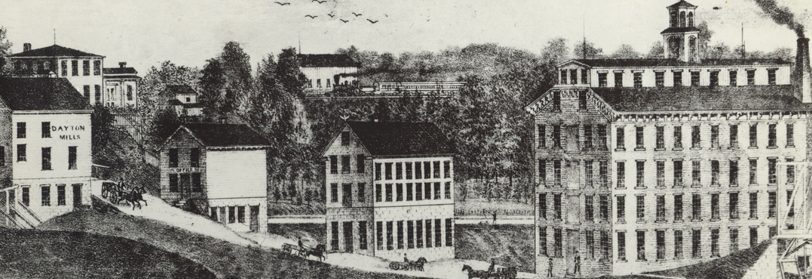
The elegant massive building known as the Dayton Woolen Mill is now owned and run by J. Green & Sons. They are so well known for the excellence of their goods and their honorable dealing that the simple announcement that they are again in business is sufficient to flood them with orders.

Adjoining the town is the splendid grain and stock farm of Isaac Green. Mr. Green makes a specialty of raising Norman and Clydesdale horses and thoroughbred cattle, and can show some of the finest in either class to be found in the state. Among the minor attractions are many fine driving teams, single and double. I would like to give you the names of the owners, but their objections to seeing their names in print forbid it.

And last, though not least, we have the nicest girls, the most dashing beaux and the most enchanting Groves to be found anywhere. Go a fishing and come and see us.

Full Stop


  1. The Ottawa Free Trader, July 12, 1879, p. 8, col. 1

4th of July 1912

SANE 4TH POPULAR WITH LOCAL PEOPLE
Small Gatherings the Popular Idea with Mercury Climbing Skyward and Heat Suffocating

  The Dayton Home Makers

            Although the surrounding country a number of family picnics were held, and some of them were very largely attended. None of these was more successful than that given by the Dayton Home Makers’ Circle. It was held at the home of Henry Schmidt, north of the city. The attendance was large, a splendid dinner was served, and a program and sports rounded out a very enjoyable day.1


The Ottawa Free Trader, 12 Jul 1912, p5, col 3

Trumbo Reunion – 128 Years Ago Today

Trumbo reunion

A smaller reunion of the Trumbo family eleven years later

TRUMBO FAMILY REUNION
Over One Hundred Members Present at the Picnic of Thursday

The members of the Trumbo family have been prominent in La Salle county for the past half century, and more especially in Rutland and Dayton townships, by reason of their industry, good citizenship and last but not least, their numbers. Thursday, at the pleasant home of Frank Trumbo, in Dayton township, they gathered to the number of over one hundred; and, with their relatives of the families of Green, Shaver, Grove and Gibson and their guests, over two hundred. Photographer W. E. Bowman was on the ground and took several pictures of the assembly at noon. At one o’clock the dinner was served and all did full justice to the viands before them. The baseball enthusiasts organized two nines and played a game, the score being about 28 to 19.

Mrs. Grace Parr gave a recitation and W. F. Heath and others rendered solos.

President Elias Trumbo called the family to order for the sixth annual meeting and told the younger members of some of the difficulties and privations which ensued when their ancestors turned the prairie into a garden. Secretary McKinlay then gave a resume of what had been done in further tracing of family history and the collection of data since the last meeting, stating that the descendants of the Trumbos in America now numbered at least 2,500, all descendants of the three brothers who came to Virginia about the middle of the last century, and a facsimile of the oldest document of the family was shown. The original, dated June 23, 1752, is owned by O. W. Trumbo of Dayton, and the land acquired by it is still in the Trumbo family, at Brock’s Gap, Va. The services of the family in the revolution, war of 1812, the Black Hawk war and the civil was were alluded to.

The election of officers was then held and resulted as follows:

President                     Elias Trumbo
Treasurer                     M. P. Trumbo
Secretary                     W. E. MacKinlay
Executive Committee Mesdames Lavina Mattock, Clara T. Hess, Barbara Jackson, Eliza Gibson, Anna Robison and Elizabeth Strawn and Mr. Elias Trumbo.

After a hearty supper the gathering dispersed, after the most largely attended and successful reunion ever held by the “Trumbo Family Association.” Those present were:
C. B. Hess and family, J. N. Strawn and family, Joe Gay and family, Mrs. Susan G. Trenary, Fred and Ralph Trenary, H. B. Robison and wife, Al. F. Schoch and family, W. C. Riale and family, W. E. W. MacKinlay, Wm. Pafiot, Misses Marie Briggs, Roberta Hammond, Katie Gleim; Grant Conard, Jesse, James and Joe Green, L. N. Hess and family, H. B. Williams and family, O. N. Butterfield and wife, H. G. Cotton and daughter, W. D. Strawn and family, C. W. Irion and family, Art. Scott, Jackson Shaver and family, Mrs. Wm. Bradford, Katie Bradford, Maude Sanderson, D. L. Dunavan, S. E. Parr and wife, Mrs. W. H. Hull, jr., Prene Shaver, Ottawa; Mrs. Lavinia Matlock, John Matlock and family, Joseph Harris and family, Mrs. John Crum, Jessie Crum, Eugene Matlock and family, John Harris and family, Yorkville; Joseph Jackson and wife, E. W. Jackson and wife, F. Mizener, Millington; H. D. Barber and family, Sheridan; H. K. Parr and wife, Serena; W. M. Brown and family, M. P. Trumbo and family, Mrs. H. Ruger, Bernice Ruger, Samuel Dunavan and family, O. W. Trumbo and wife, J. Green and family, H. Hall, Mr. Angevine, James Angevine, Dayton; Lee Robison and Matthew Robison and family, Elias Trumbo and family, Donald MacKinley, Maud Shaver, Charles Shaver and family, G. D. Shaver and family, Rou Shaver, V. Canfield and wife, S. Milliken and wife, Mrs. John Parr and family, Mrs. Emma Parrott, Miss Sadie Parrott, George W. Gibson and wife, Rutland; Mrs. Dorothy Hess, Cleveland, Kas.; Mrs. Ed. Bradford, Chicago; Mrs. A. B/ Henderson, Siler, N. C.; Mrs. Harry Green, Chicago; and many others.1


  1. The Ottawa Free Trader, June 28, 1895, p. 3, col. 4

The Importance of Good Roads

DAYTON ROAD INTEREST
Business Men Are Awakening to the Importance of the Inlet

The importance of good roads leading into Ottawa was never so urgent as in the fall of 1895. A considerable portion of the city’s usual population having been deprived of employment and departed to other centers of activity, it has become necessary that every effort be put forth by the business men and citizens in general to attract a larger trade from the country.

Some weeks ago Supervisor Perkins and the road commissioners of the township of Dayton began to agitate the subject of an inlet to the city from the north. A good gravel road now leads to the northern villages and hamlets, but the country north of the Ottawa line, taking in the townships lying directly north of the city, as far as Earlville, cannot be reached save in very dry weather. As a consequence all of the trade north of Dayton goes to Earlville over the new gravel road in Freedom township.

Dayton is too poor to pay the cost of the six miles gravel needed to connect Ottawa with these northern townships, but her people are willing and have already contributed $1,500 in work and money. The exact cost of the road cannot at this time be closely estimated, but it is probably that it can be built for less than $5,000.

Supervisor Perkins and a committee are now soliciting subscriptions among local business men. They should meet with every encouragement, as Ottawa is the natural market for the farmers and can have their trade if she makes it possible for them to reach her at all times.1


  1. The Ottawa Free Trader, October 11, 1895, p. 10, col. 3

Dayton’s Industries in 1879


DAYTON
One of La Salle County’s Flourishing Manufacturing Centers

Dayton, as some of your readers may not know, is located four miles from Ottawa, on the Fox River branch of the C., B. & Q. R. R. Its most solid attraction is one of the best water powers to be found in the West. The dam that supplies the power is owned and kept in repair by the state, so that lessees of power feel assured that if the dams or locks should ever be impaired by the ravages of time or floods, the damages will be speedily repaired, without tax or expense to them.

The paper mill of Williams & Co., situated at the lower end of the manufacturing portion of the town, is one of the best in the state. Their products are so favorably known that running night and day the year round they are unable to supply the demand.

The Tile and Brick Works of D. Green & Sons are yet in their infancy, yet the perseverance of its proprietors, and the excellence of the material close at hand, is sufficient evidence that the surrounding country can soon be supplied with the very best tile and brick to be found anywhere.

The grist and merchant mill of D. Green & Sons is presided over by Mr. Stover, widely known for many years as one of the best millers in the state,

The Fox River Horse Collar Manufacturing Co. is an incorporated company, composed of a body of modest and unassuming men, their modesty being only equaled by the superior quality of their goods, which are widely known from Pennsylvania, Ohio and Virginia on the east, to Kansas, Nebraska and Missouri on the west, to be the best in the world. They use about forty tons of rye straw yearly for filling horse-collars, and the hides of about 2,000 head of cattle are required yearly to supply them with leather.

The elegant massive building known as the Dayton Woolen Mill is now owned and run by J. Green & Sons. They are so well known for the excellence of their goods and their honorable dealing that the simple announcement that they are again in business is sufficient to flood them with orders.

Adjoining the town is the splendid grain and stock farm of Isaac Green. Mr. Green makes a specialty of raising Norman and Clydesdale horses and thoroughbred cattle, and can show some of the finest in either class to be found in the state. Among the minor attractions are many fine driving teams, single and double. I would like to give you the names of the owners, but their objections to seeing their names in print forbid it.

And last, though not least, we have the nicest girls, the most dashing beaux and the most enchanting Groves to be found anywhere. Go a fishing and come and see us.

Full Stop1


  1. The Ottawa [IL] Free Trader, July 12, 1879, p. 8, col. 1