Remember the old school desks?

Embed from Getty Images

When I started at the Dayton school in 1945, we had desks that looked like this, although not quite so heavily defaced. In first grade there was no ink bottle in the ink well provided for it, and I don’t recall having one even in the higher grades. By then we had ball point pens, but the hole for the ink well remained. What I do remember about this desk is how we learned to write our names in first grade. Miss Fraine, who taught grades one through four, would write our names in chalk, in her beautiful flowing handwriting, on the top of our desks. We each had a jar of corn kernels and would outline the name with the corn, to learn the shape of our names.

The desks were fastened in rows, with the back of one seat supporting the desk for the person behind. Seven or eight rows of these seats held the four grades in each room. Miss Fraine moved from row to row as each grade was called on for their lessons. By the time you reached fourth grade, you had heard those lessons several times over.

A Handmade Gravestone

champaign-albert-john tombstone

This tiny gravestone, only 12 inches high, stands out in the Dayton Cemetery not only for its size but for its material. It is made of brick and appears to be handmade. John Champaign, the father of little Albert John, was a day laborer in the brick yards in Dayton. Whether he made the gravestone himself or had a friend at work do it for him, it almost certainly was made in Dayton.

John Champaign was born in January, 1858, in Michigan, of French-Canadian stock. In 1870 he was living with his parents and siblings in South Bend, Indiana. On September 21, 1880 he married Louise Haverley in South Bend. Sometime before 1883, John and family came to Dayton, where they were living in 1900. By 1910, they were back in South Bend, where they lived out their lives, John dying in 1938 and Louise in 1947.

One of their daughters, Grace, married James C. McGrogan of Dayton on April 30, 1900, and remained in Dayton when her parents moved back to South Bend.

A Most Distressing Accident

Fred Green

Fred Green, who survived the accident

A most distressing accident occurred at the Williams paper mill at Dayton, on yesterday morning. The unfortunate victim was Fred Green, oldest son of Mr. Basil Green, aged 14 or 15 years. He was one of the employees of the mill, and while talking with some young men, was thoughtlessly handling a rope working a spindle. Suddenly his hand was caught in the machinery, his body was caught up and he was hurled through the air until two revolutions of the spindle had been made, when the hand was torn from the arm and he fell to the floor. His left hand was torn off; the same arm broken above the elbow so that it had to be amputated; two fingers on the other hand had to be amputated at the first joint, and both his legs were broken. Dr. Hard, happening to be in the village treating diphtheria patients, was called at once. He immediately telegraphed for Drs. Dyer and McArthur, who went to his assistance, and after several hours’ work left the unfortunate lad as comfortable as could be expected. His life is in great danger.1


  1. The [Ottawa, Illinois] Free Trader, May 29, 1880, p. 1, col. 3.


Gracie Green’s school days

card & ribbon

In 1881 little Gracie Green was an eight-year-old student in the Dayton school. She was a well-behaved student, since her teacher certified that she “during the winter term of five months has not whispered once neither has she been guilty of any act of misconduct.” Grace was the daughter of Isaac and Mary Jane (Trumbo) Green. She was born in Dayton in 1873. She did not marry, and died in Dayton in 1894. She is buried in the Dayton Cemetery.

Gracie Green

Her teacher was Miss Desdemona (Dessie) Root. Miss Root taught in the Wedron school in the summer of 1881 and then moved to the Dayton school for one year, where she was responsible for the success of many of the entertainments held at the school house. She received many compliments on how well she had prepared her students for their performances. Surely little Gracie did her well-behaved best in her part, whatever it was.

Ice Jam on the Fox River

Ice jam on the Fox River 1943

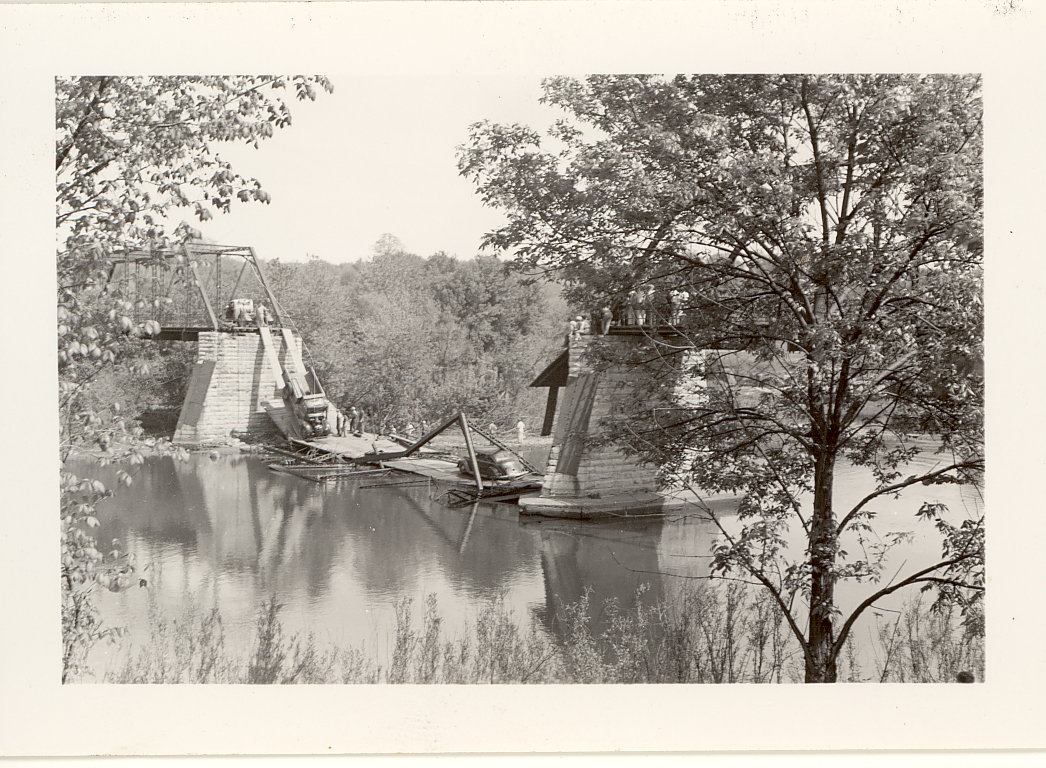
The Fox River at Dayton has been the site of a number of washed-out dams and swept-away bridges over the years. In 1943, a large ice jam in the river between Dayton and Ottawa caused the slush ice to pile up on both sides of the bridge. The pressure of the ice moved the bridge a few inches, but it went back into place as the ice melted. The houses and cottages along the east side of the river, above the bridge, were flooded as well.

houses flooded in 1943


The Dayton Enterprise

Dayton Enterprise

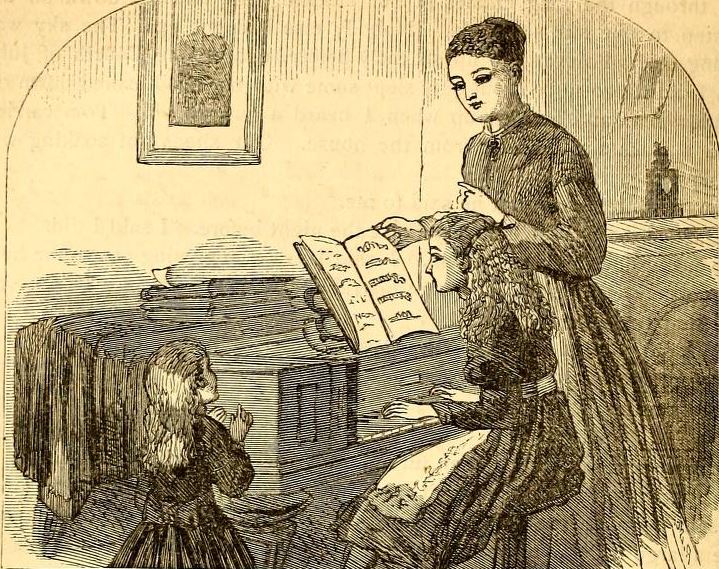
For a brief period of time, Dayton had its own newspaper, the Dayton Enterprise. It was the product of Charles Green, son of David Green. With his own small printing press, Charlie was reporter, editor, printer, and publisher. He was also a musician, giving lessons and conducting a singing school at the schoolhouse

The October 18, 1878, edition contains local and area news, humor, advertising, and an editorial about the poor condition of the sidewalks. A year’s subscription could be had for 40 cents, and it is a great loss that only this one issue has survived.

A few excerpts:

Wit and Humor
A poor relation – a carb-uncle.
Why is an insensible man like a wicked man? Because they both need to be revived.
What is the difference between a gas tube and a silly Dutchman? One is a hollow cylinder, and the other is a silly Hollander.
The first thing in a boot is the last.
Is it right for young ladies to smoke? – Yes, there can be no harm in taking a lady-like cigar – a she-root, for instance.
Query for naturalists: If a bird in the hand is worth two in the bush, is a mole on the face worth two in the ground?

Population of Dayton, latest census, 204.
Number of young men, actual count, 12.
”      ”         ”     ”      ladies,   ”       ”           6.
Boys, a half a dozen of us will have to go,
so as to give the other six a chance.
No. of dwelling houses in the town, 41.
”    ”   manufacturing establishments, 4.
”    ”   Hotels,                                      2.
1 Store.
1 Meat-market.
and 1 Printing Office,
Don’t forget that!

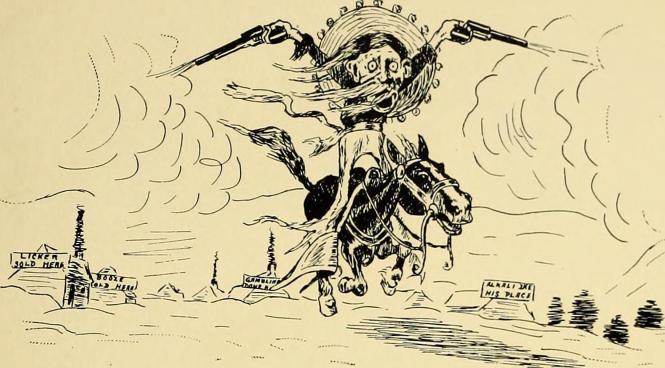
Counterfeiters, Thieves, and Outlaws

bandits

Nathaniel Proctor ran the general store in Dayton in the late 1830s. Jesse Green’s memoir has this story about his time in Dayton:

Proctor had a very nice and amiable family, and was apparently a high minded and honorable man, he had a great faculty for gaining friends and did a very successful business for a year or two. One cold winter day father went from the mill up to his store, and put his feet up against the stove to warm them, having his pocket-book containing between five and six hundred dollars wanted for buying wheat in his pants pocket. Returning home he soon discovered he had lost it, and thinking it might have dropped out of his pocket at the store, he returned immediately to look for it, but not finding it, he offered Mr. Proctor’s boys five dollars if they would find it for him, saying he must have lost it between the mill and store; seeing they made no effort to find it, he concluded they had found it, and that probably he would see no more of it.

Not long after this occurrence Mr. Proctor went to St. Louis for some goods, and on his return, and probably in St. Louis passed some counterfeit money, and learning by some means that he was liable to be arrested, he never returned to Dayton. Father being security for him to the amount of twelve or fifteen hundred dollars, and other creditors gobbling up his goods, it fell to fathers lot, to take his book accounts and notes, nearly covering the amount he was held for provided collections could be made. They were scattered over a great extent of country. It was afterwards learned that he had dealt quite heavily with members of his gang of outlaws, that infested the whole north western portion of the state.

His book accounts and notes were put in legal shape for me to collect and I was sent out with his books in a pair of saddle bags, and calling one night on one of his principal creditors, who was keeping a Hotel on the Pickamesoggin not far from Belvidere, I found a crowd of ruffians, all armed with pistols and bowie knives, and I could scarcely make up my mind, which would be best under the circumstances, to try and find another stopping place for the night, or boldly face the trying ordeal which I felt sure I was doomed to for the night. I finally concluded that if they might have any intention to rob, or molest me, they would do so in either event, and I determined to put on as bold a front as it was possible for a little boy of 18 and concluded to seek no farther. When I went in and threw down my saddlebags containing the books, there were a dozen fierce roguish eyes cast upon me, which almost made the hair on my head stand on end, and young and defenseless as I was, my situation can be better imagined than I can tell it.

I concluded to retire to bed soon after supper, as my company did not seem at all entertaining to me, and about twelve o’clock at night the landlord brought up a great burly fellow and put him in bed with me, he first laid a big pistol under his pillow, and then a large bowie knife. My sleep from then on until morning was somewhat disturbed, as they all knew my business, and I had a bill of $250.00 against the landlord, they would naturally suspect that I had collected some money, such thoughts as these kept crowding upon me before I could sleep, in fact I do not think I did sleep any that night, the more I would think of my situation as it occurred to me, among (as I thought) a den of thieves, the more would I think, that they probably would destroy my books and possibly me too. So my stay there was anything but pleasant, but fortunately no demonstrations were made or harm done and next morning as soon as I heard any movements below, I left my bedfellow pretty early sleeping soundly on his arms, and after breakfast had a settlement with the landlord. He gave me no money, but I took his note with which I was more than glad to leave him, but his note was never paid. I suspect that most of Proctor’s customers in that far away region were members of the gang of outlaws called the bandits of the prairies, and the Driscols who were summarily punished near Mount Morris in early times were of the same gang.

Whilst invoicing Proctor’s goods, his dies for making bogus coin were discovered, and secretly laid aside until going home at noon when it was the intention to secure them; but when they put their fingers upon them, like the Irishman’s flea, they were not there, removed by his clerk probably.  In digging out a cellar to the store, he [the new owner] found father’s old pocketbook minus the money lost with it. A little later the old store building was torn down, and inside the plastering was found a ten dollar copper plate on a Michigan bank for making counterfeit money. All sympathized deeply with the disgraced family, who remained in Dayton but a short time after this unfortunate circumstance. But where they went and their subsequent identity, we never learned as they probably were no longer known by the name of Proctor.
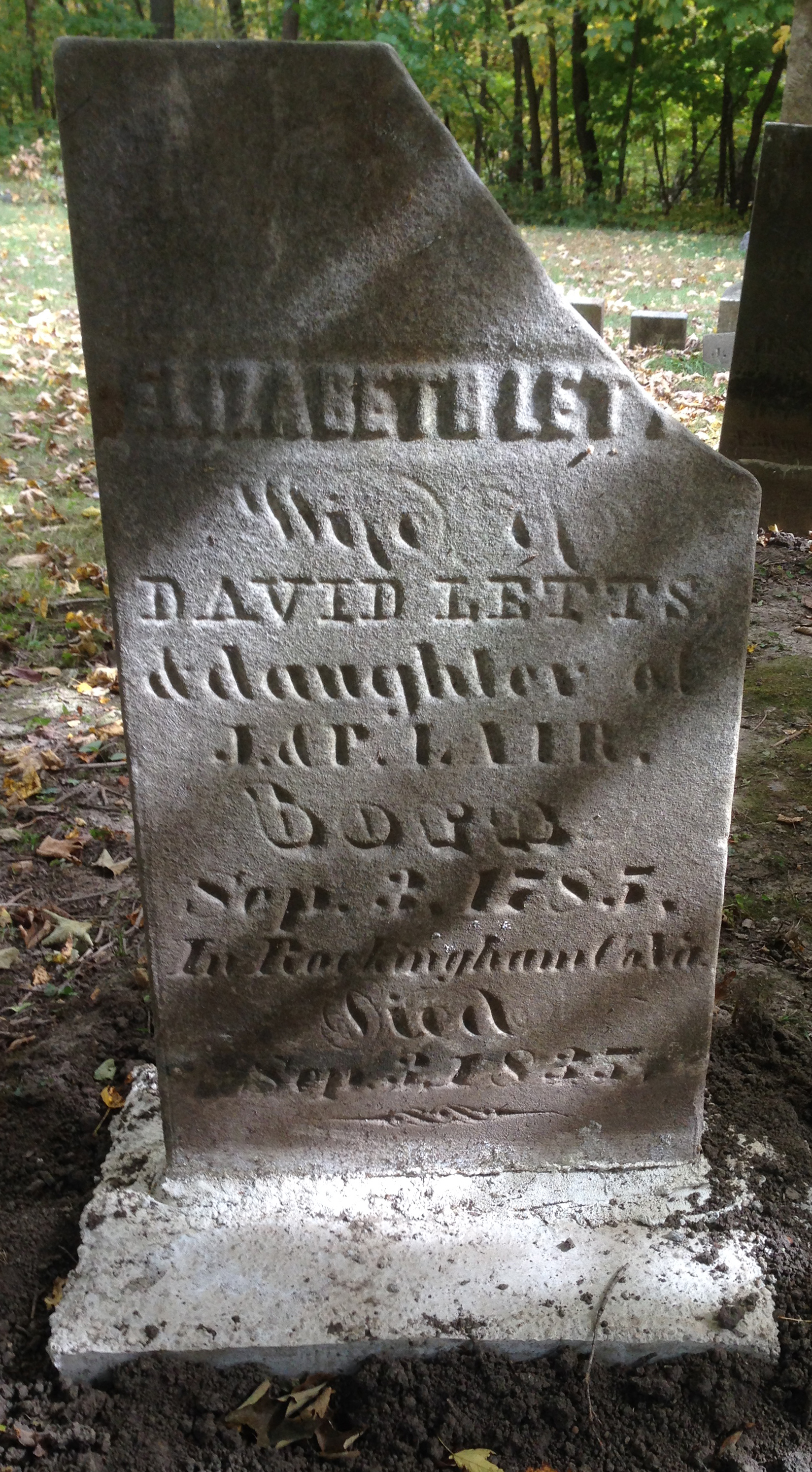
An Ohio Marriage

Green, J - Grove, B. marriage1
John Green and Barbara Grove were married in Licking County, Ohio on March 28, 1813. Barbara was the daughter of John Grove and Barbara Lionbarger. In his memoir, Jesse Green described his grandfather Grove: “John Grove, the head of the Grove family was of Dutch or German descent and was a large powerful man. He could pick up a barrel of flour under each arm and toss them upon one of those old fashioned Virginia wagons with ease. He was so large that his descendants long preserved one of his vests to show his unusual girth about the breast.”

The original 1929 party that came from Ohio to Illinois, to the rapids of the Fox river, included many members of the Grove family – Barbara Grove Green, David Grove, Emma Grove DeBolt, Samuel Grove, and Joseph Grove. After the death of John Grove, his widow, Barbara, also came to La Salle county, in 1838, to live with her son Joseph.

Further information on members of the Grove family may be found at http://www.genealogycenter.info/search_grove.php


  1.  “Ohio, County Marriages, 1789-2013,” database with images, FamilySearch(https://familysearch.org/ark:/61903/1:1:XZH2-KNR : accessed 18 August 2015), John Green and Barbary Grove, 28 Mar 1813; citing Licking, Ohio, United States, reference v1,p.23; county courthouses, Ohio; FHL microfilm 384,300.

Walking on the Desks

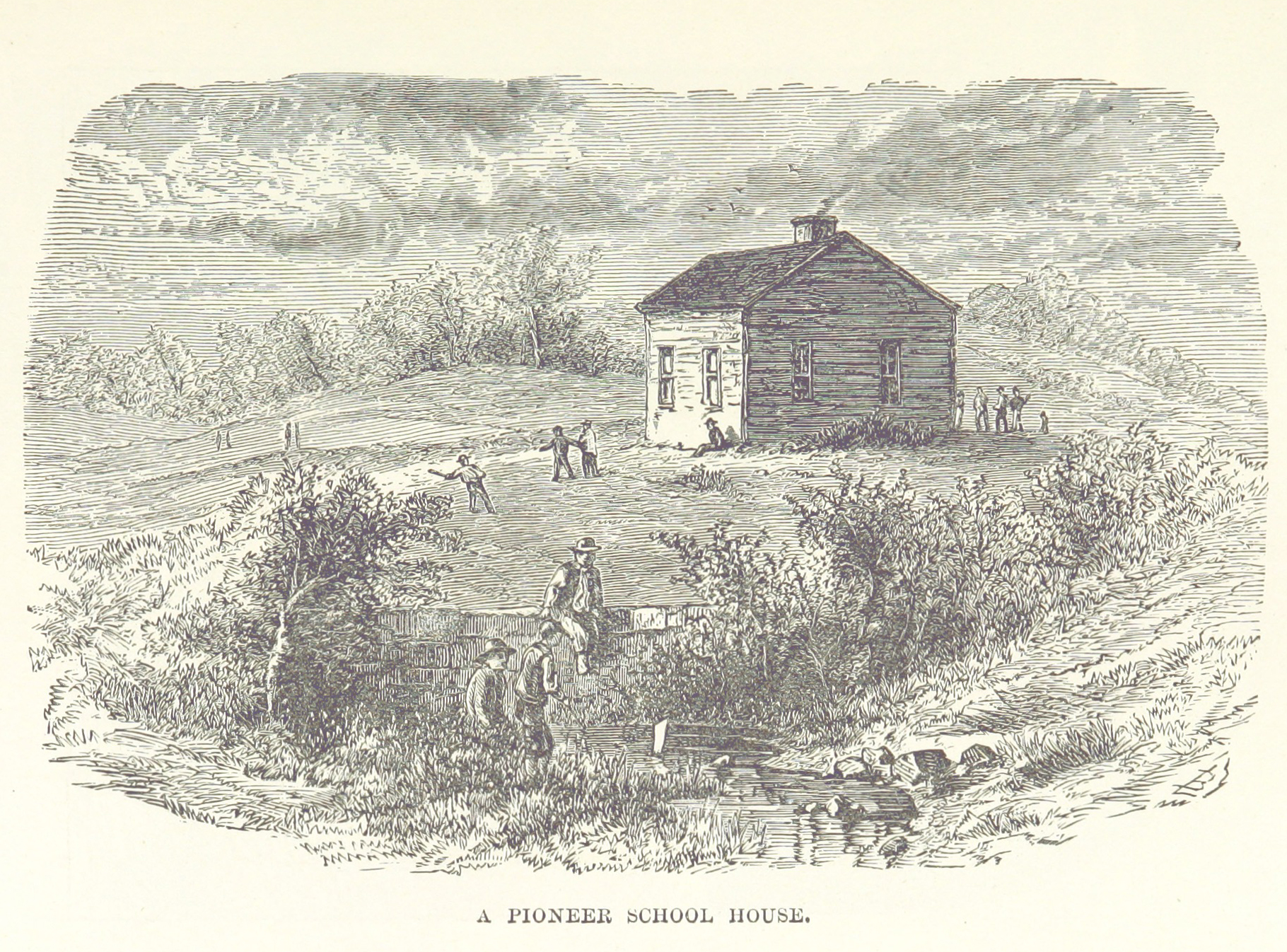
A Pioneer School

Maud Green told her memories of school life in Dayton in the 1870s and 1880s. The school would not have been as isolated as the one shown above, as it was right in the heart of the village.

The desk tops were hinged and when the boys walked on them mischievously they sometimes dropped unexpectedly with disastrous results.  A bench ran around three sides of the room to accomodate more pupils.  The other furniture consisted of the teacher’s desk and a small organ. There was always something extra for Friday afternoon.  One teacher read us chapters of “The Swiss Family Robinson” each week and we spoke pieces and sometimes had a treat.  Once it was oyster soup!  We all had slates instead of tablets and our slate pencils came covered with gold or silver paper.  Once we girls put boards over the corner of the fence to make a play-house at school & we all took rag-dolls to play with at recess.  Our best “play house” at home was when the oats-bin was empty in what we called the “little barn” north of the house.  Of course we all wore sun bonnets.

The Dayton Literary Society

Book label - Dayton Literary Society

The Dayton Literary Society was founded in February of 1881,  with Isaac Green as President, Charles Green as Secretary and Harry Green as Librarian. Harry was the librarian because the library, all one hundred volumes of it, was housed at his store. You paid a monthly fee and then you could borrow any book. This label, found in every book, listed some of the rules governing the library:

ART. 4. The Time of Keeping a Book shall be Two Weeks, and any person failing to return said book inside the specified time, shall be fined the sum of 5 cts. for each day until returned. Also, any person returning a book unnecessarily soiled, shall be fined the sum of 10 cts.

ART. 6. The Librarian shall not issue Books to any person who is known to be in arrears of monthly dues or fines.

ART. 7. No person shall be allowed more than ONE Book at a time.

Unfortunately, no record of the complete “Rules to Govern Library” has survived. Did it contain guidelines for what books to include? Were books purchased, or donated from town residents? What was the most popular subject matter?


Shopping at the Dayton store

Spooner

This piece of glass was purchased at the Dayton store about 1880. It was made by the La Belle Glass Company of Bridgeport, Ohio. The company was founded in 1872 and its Queen Anne pattern, of which this piece is an example, was first being advertised in the trade journals in the fall of 1879. It would have been one piece of a fairly extensive set. This piece is a spooner, used on the table to hold dessert spoons. They often resemble short-stemmed goblets or vases. Some have handles, as this one does, but some do not. Other pieces in the set might have been a butter dish, cream and sugar, salt cellar, celery vase, and of course, plates and goblets. Harry Green, the proprietor of the Dayton store at that time, obviously made an effort to have the most up-to-date stock. In the Ottawa newspaper’s account of the wedding of David Green’s daughter, Ada, in 1881, among the gifts received was a set of glassware from her cousin, Harry Green. There’s no way of knowing if it was a set of this pattern, but it might have been, as it was a new and popular pattern then.

Miss Emma Clementine Fraine


Miss Fraine bookmark     1952 Class list - Dayton school     Miss Fraine

In 1952, Miss Emma Fraine retired after fifty years of teaching, most of them at the Dayton school, where she taught grades one through four. The class lists shown above include only those students whom Miss Fraine had taught, so not all of the members of the upper grades are included. Her classroom was a single large room, on the first floor of the school. Each grade had its turn at recitation, with time to prepare for the next lesson while other classes were reciting. If you listened to the recitations of the classes ahead of yours, you could get a head start on the next year’s work. She was a firm believer in teaching reading by means of phonics and when phonics fell out of favor, she asked the school board to allow her to continue her existing ways, which they were glad to approve.

Her parents were Charles and Clemence Fraine, who were married 11 May 1878 in Ranrupt, France. They immigrated to the US and came to Dayton by 1882, where they raised their family: daughters Addie, who married Richard Thompson, 31 Dec 1901; Jennie, who also taught school in Dayton and surrounding towns; and Emma, and son, Jules.

The Great Dayton Bridge Affair

iron bridge at Dayton 1886

The new iron bridge at Dayton, opened in 1887

In 1885 a new bridge was needed at Dayton. It was estimated to cost $10,000 and the county would pay half the cost. As the bridge connected Dayton and Rutland townships, the share for each was $2500. Rutland balked at paying this, so Dayton agreed to pay $3500, but even this offer met with resistance, as shown in the newspaper extracts below. The bridge was built eventually and it was noted that one of the first to make use of the new bridge was one who had most vehemently opposed spending the money for it.

Dayton Bridge. –
The people of the town of Rutland vote next Monday, Aug. 31st, on the question of taxing themselves $1,500 towards building a good bridge at Dayton. The bridge is to cost $10,000, Dayton agreeing to pay $3,500 towards it, the county paying the other half. Considering that the bridge will be really a convenience to a larger proportion of the people of Rutland than of the town of Dayton, the offer of Dayton to bear so large a share of the expense is a very liberal one and ought to be met by Rutland in a spirit of like liberality. There is no point on the Fox River in this county where a bridge is so pressingly needed as at Dayton. The ford there is so precarious and unavailable most of the time that not only are Rutland people cut off from the advantages of the mills at Dayton, but to many of them the distance to Ottawa, Wallace, Utica, &c., is increased from two to half a dozen of miles. It does look as if Rutland could not afford to let this chance go by of getting a permanent bridge at Dayton at so small a cost.1

Dayton, Sept. Sept. 16. – At last it is settled that we are to have the bridge! The Board of Supervisors yesterday by a vote of twenty-seven to nine granted county aid to the amount of $5,000, and appointed Supervisors Anderson and Bubeck to look after the county’s interest. The bids will be opened next Monday and the contract let so that work may commence at once. The citizens are greatly rejoiced at the result and hope nothing serious may interfere with the completion of the work.2

Dayton, Sept. 23. – Our town was full of bridge men last Monday, and every bridge company in the west and a few eastern companies were represented. Nineteen bids were handed in. The board of commissioners, consisting of Messrs. Nichols and Grove, of Rutland, and Messrs. Dunavan, Brown and Green, of Dayton and the county represented by Supervisor Anderson, of Adams, met in the afternoon at the office of A. F. Dunavan & Son, and examined the numerous bids, but were unable to reach any conclusion by evening, so adjourned. The contract for the stone work was then let to John Joslyn, of Batavia, for $7.20 per cubic yard, and the superstructure to the Chicago Bridge and Iron Co. for $5,490. The superstructure will consist of three spans of 121 feet each, and the whole bridge when completed will cost about $10,000. The time for the completion of the work is Dec. 21st.
Bridge Notes
The Batavia man who has secured the contract for the stone work says he has plenty of stone on hand and will commence work on the piers immediately.
There was quite a lively competition between the Joliet and Batavia stone men, but the latter took the “persimmons” this time.
Landlord Timmons says he furnished forty-seven meals for bridge men Monday.
The river is low now and in good shape for laying the foundations for the piers.
The Bridge Co. says we will have the prettiest and most substantial iron bridge on the river.3

Dayton, Nov. 11. – The piers of the new bridge are progressing slowly, one being about one-third up and the other about two-thirds. The weather has been fine for putting up stonework and it is to be regretted that the work could not be done more rapidly.4

Dayton, Feb 3. – Our bridge is having rather bad luck. One span was swung just in time to avoid all danger from the thaw of Jan. 22d, but the trestle work of two spans was carried out by the ice and two iron floor beams were dropped into the river. The water has been so high and do much slush ice floating that work on the bridge has been practically stopped. It is hoped that the present cold weather will continue, so that work may be resumed and the bridge completed.5

Dayton, Ill, April 1st, 1887. – Our bridge is finished at last and open for public travel. It is a very fine three span iron bridge, the neatest one on the river, and is a fine addition to our village. Of course every one will use it now that it is constructed, and it was noticed that about one of the first to use it was one who had fought the hardest.6


1. The Ottawa [Illinois] Free Trader, August 29, 1885, p. 4, col. 4
2. Free Trader, September 18, 1886, p. 5, col. 3
3. Free Trader, September 25, 1886, p. 8, col. 3
4. Free Trader, November 13, 1886, p. 8, col. 1
5. Free Trader, February 5, 1887, p. 8, col. 2
6. Free Trader, April 2, 1887, p. 4, col. 6

Floods – Tornadoes – There’s Nothing New Under the Sun

Disaster-Whirlwind-Tornado

Dayton, June 19, 1879. – Our town and the surrounding country was visited last Saturday by a terrible strong wind and rain storm, almost a tornado. Old residents say it was the hardest storm that has visited our place for many years. Trees by the score were blown down, fences demolished, and a general confusion ensued, The new residence of Mr. Wilkie, almost completed, was moved six or eight feet off the foundation. Mr. W. happened to be on top of the building at the beginning of the storm, and judging his position to be too perilous, got inside when without a word of warning his building commenced sailing off. It is needless to state that our teutonic friend was somewhat frightened. About one half of our centennial flag pole was broken off and blown down into the street. Three or four large cherry trees and as many apple trees, on the Stadden property, were broken down. But the most destructive feat of the storm was the almost entire destruction of a crab apple grove on Mr. Jos. Barnes’ place southwest of town on the lane leading to Ottawa. Here large trees were broken and hurled with great force across the pasture, over the fence to the other side of the road. Mr. Barnes had a great deal of fence blown down and eight or ten nice large trees on his place broken off. Mr. Eisenhuth’s barn south of town was completely demolished, not a stick left standing. Nearly all of the roof of Mr. Stadden’s barn east of town was blown off. In fact from all accounts our place seems to have been in the centre of the tornado.1


1. The [Ottawa, Illinois] Free Trader, June 21, 1879, p. 8, cols. 1-2

The Temperance Movement in Dayton in 1842

temperance pledge

Temperance Meeting at Dayton1

Pledge

We, whose names are hereunto subscribed, being thoroughly convinced that the use of intoxicating liquors is pernicious to health and good morals, therefore pledge to each other, in the presence of God, and our country, our most sacred honor to abstain, in all time to come, from the use of all intoxicating liquors, except as a medicine; and that we will use our influence, on all proper occasions, to cause our friends to unite with us in this pledge.

Wm Stadden                                                  Lars Harrison
C G Miller                                                       Isaac Miller
W L Dunavan                                                 Morris Laupher
Joshua Fairchild                                             James Thompson
Z H Baxter                                                      Lars Larson
Jesse Green                                                    Isaac Hayes
Jacob Leavens                                                Stephen Donohoe
David Green                                                   Elizabeth Miller
Peley Frink                                                      L W Abbot
A T Marr                                                          Mrs Elvira Laupher
John Lewis                                                       Jefferson Weatherford
E G Janes                                                         Mrs Mary Weatherford
Z A Kelly                                                          Francis Weatherford
Z Preston                                                        Rachael Weatherford
Uriah Miller                                                    Rebecca Green
Joseph Green                                                  Elizabeth Jacobs
John A Quick                                                   Isaac Green
Jonathan Stadden                                          Mrs. Mary Ann Fairchild
Albert Dunavan                                              Mrs Eliza Dunavan
Hardin Weatherford                                      Emma Dunavan
H Fairchild                                                      Mrs E Baxter
J M Laurence                                                  Mrs Eliza Miller
John Miller                                                      Mrs Tobitha Bockorn
John Combs                                                    Chilson McKurley


1. The Illinois Free Trader, February 25, 1842, p. 2, col. 6