The 75 Club

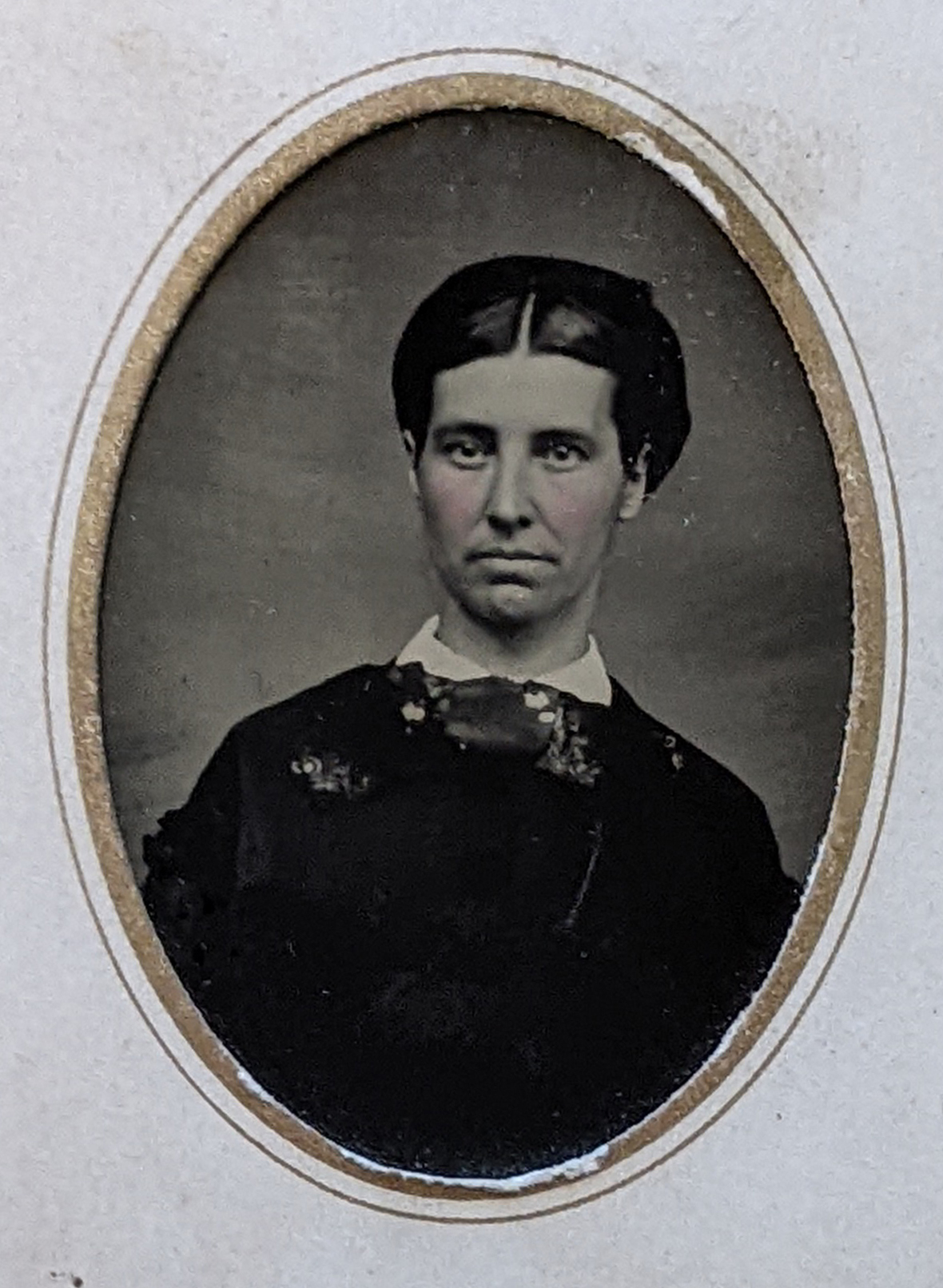
Barbara (Trumbo) Jackson

Mrs. Barbara Jackson, 97 Years Old, is Elected Head of 75 Club

Mrs. Barbara Jackson, 97 years old, of Dayton, today was elected temporary president of the Republican-Times “75 club,” an organization composed of residents of La Salle county who are upwards of 75 years of age.

Under the rules previously announced, the oldest member of the club is declared head of the organization, so Mrs. Jackson will have that honor until someone older than 97 is reported.

Mrs. Jackson was born September 19, 1829, in Licking county, Ohio, but came to La Salle county at the age of one year, and has lived here ever since. Her only living descendant is one child.

Others received into the “75 club” today are:

Mrs. Annie Hayer, 75 years old, R. 60, Seneca, who was born September 26, 1851, in Miller township, and who during her entire lifetime has been a resident of La Salle county. She has 16 living descendants, six children and ten grandchildren.

Mrs. Katherine Hess Brown of Dayton, 89 years old, born July 1, 1837, in Brock’s Gap, Virginia. She has been a resident of La Salle county for 75 years. Her living descendants are five in number, two of them being children, two grandchildren and one great grandchild.

Mrs. Belinda Jones, 86 years old, of Millington, claims La Salle county for 75 years. Her living descendants are five in number, two of inside the county line, although part of her yard is in Kendall county. She was born January 1, 1841, in Norway, Europe, and has lived in La Salle county 80 years. She has three children.

Everett Angell, 78 years old, 707 First avenue, Ottawa. He was born January 28, 1848 in Vermillionville, and has been a life-long resident of this county.

A. C. Baldwin of Deer Park township, 78 years  old. Mr. Baldwin was born in that township, and has always resided there. He has five children and 18 grandchildren.

Mrs. Anna J. Flanagan, 76 years old, who resides at 439 Fourth avenue, was born in South Ottawa, April 1, 1850, and this city has always been her home. She has four children, two grandchildren, and two great grandchildren.

For the convenience of other 75ers who have not as yet sent in their names, the membership application blank is herewith republished. Clip it out and mail it to “75 club,” in care of the Republican-Times. Membership is free to all who are eligible.1


  1. The Ottawa Daily Republican Times, October 4, 1926, p. 2.

Just Another Day in a Small Illinois Town

From Dayton

Dayton, Ill, Aug. 26, 1883. – Corn is looking well in this vicinity and will probably yield at least two-thirds of a crop. Small grain has done well, and hay turned out a good crop.

The tile works shipped out six carloads of tile last week, and are having a good home trade.

The paper company are putting in a new pulp engine and a new bleach tub.

Miss Jennie Dunavan has returned from her visit among relatives in Michigan.

Mr. Burt W. Stadden, of Chicago, a reporter of the Wholesalers’ Agency and Exchange, No. 175 Dearborn street, is spending his vacation among relatives and friends in Dayton.

Mr. Isaac Green and Mr. O. W. Trumbo have greatly improved their residences with fresh coats of paint. The school house has also received a painting.

The young folks will hold a picnic at Deer Park and Starved Rock next Saturday.

The State has been widening and strengthening the feeder bank, and is now engaged in repairing the dam.

Mr. William Dunavan started out this week on a business trip for his firm.

Miss Eva Channel has been visiting over the river all week.

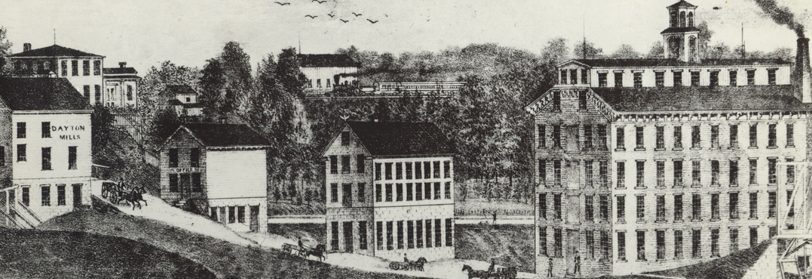
The flour mill is doing some good work now on custom grinding, and considerable new wheat is now coming in. Farmers will do well to patronize this mill, where they can get a good yield of first class flour.

Rev. J. Straub, of Marseilles, preached two very excellent sermons at the school house last Sabbath morning and evening.

The news of the result of the anarchist trial in Chicago was received with great satisfaction.

The brick works are hauling large quantities of brick to Ottawa.

Our station agent, T. S. Bunn, we understand, is to go to Sheridan.

Mr. Mark Brown, formerly agent at this place, is at Ottawa for a few weeks during the vacation of the Ottawa agent, Mr. Ros.

The miller, Mr. Chas. Newman, of Montgomery, tells of a sad case of poisoning which occurred in his town last week. A lady had spread arsenic on a cookie and took it down cellar to poison the rats. She ran upstairs for something, and while gone her little child took the cookie and ate it, and died in two hours.

Occasional1


  1. Ottawa Free Trader, August 28, 1886, p. 8, col. 1

The Funeral of Cyrus Hoag

The funeral services of Cyrus Hoag, which were conducted by Henry Parr, were held at the home of his parents in Serena, at 10 A. M., Thursday, Oct. 17. The sermon being preached by Rev. Hilster, of Sheridan.

Only a few months ago one could have seen a bright young man, just in the bloom of youth, bidding the last farewell to parents, to brothers and sisters, and as he boards the train, he casts one lingering look upon the faces of his friends and companions from whom he is carried far away to try the stern realities of western life. If the veil of futurity could have been lifted, and one could have read the pages of a few coming months, we would have hardly believed that one so vigorous in health, in so short a time, with scarcely a moment’s warning, would be brought back cold in death.

Although the family had been informed of his illness, no serious thoughts were entertained until Monday morning, when a telegram was received, informing them that he was rapidly growing worse. Mrs. Hoag commenced making preparations at once, intending to take the first train. But ere it arrived the second message was received saying that Cyrus was beyond all earthly help.

He had crossed the dark river of death and entered, we trust, the bright haven of rest, where there is one bright summer always and storms do never come. One, and the most consoling thought, is that he was known as one whose character was beyond reproach, and was respected by all who knew him. Our eulogy is too feeble to give due honor to his memory, but those who knew him well say they never knew him to do a wrong act. Notwithstanding the short notice there was a long procession which followed the remains to its last resting place in Dayton cemetery.

Were we to offer an epitaph we might write —-
“Breath soft ye winds, ye waters gently flow,
Shield them ye trees, sweet flowers round them grow;
Ye sons of men in silence pass them by,
For ‘neath this sod our loved asleep doth lie.”

At the time of his death he was 22 years, 6 months and 6 days old.1

Cyrus Hoag was the son of Charles H. and Mary (Wells) Hoag who married November 5, 1857, in La Salle County. They are also buried in the Dayton Cemetery.


  1. Ottawa Republican, 25 Oct 1889, p. 4.

The Civil War Pension File for James Timmons

his signatures from 1898, 1904, and 1907 show his advancing age

To receive benefits under the Pension Act of June 27, 1890, the veteran must have served at least 90 days in the Union military during the Civil War and have received an honorable discharge. He must also be physically disabled and unable to work. The disability did not need to be service-related.

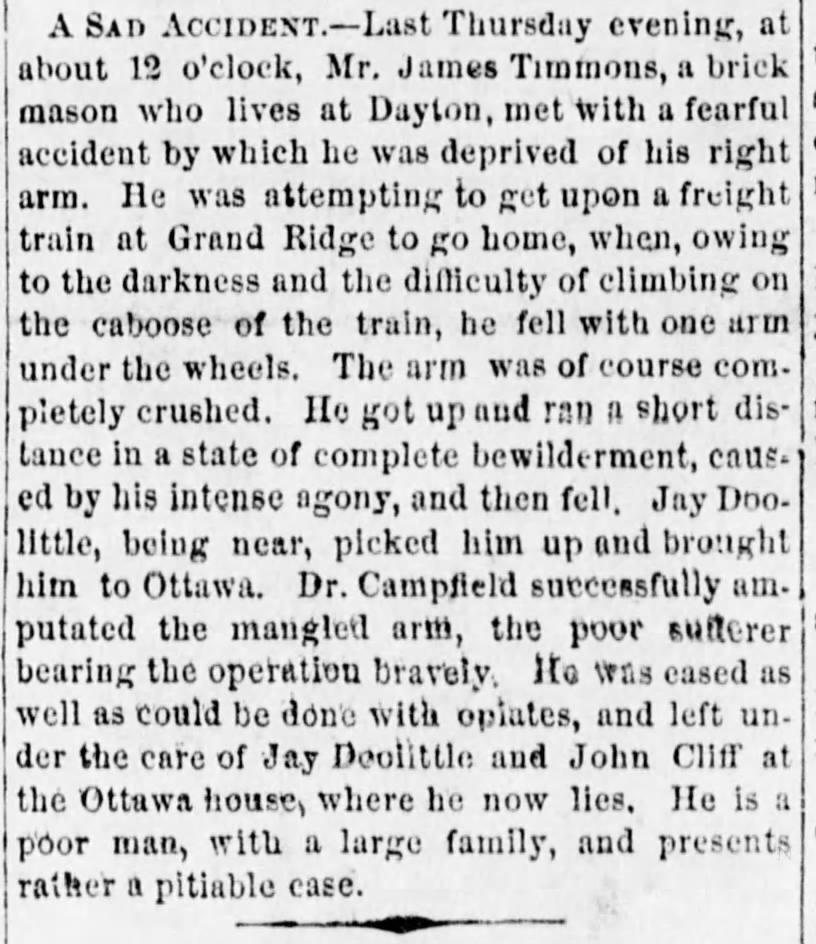
James Timmons, of Dayton, applied for a pension July 24, 1890. His name appears in the records as both Timons and Timmons. He appears to have preferred Timons. He submitted that he was unable to earn his support because of the loss of his right arm and rheumatism. His right arm was amputated about 4 inches from shoulder as a result of a railway accident.

He provided the following information to the pension office:
He enlisted February 21, 1865 in Company C, 53rd Regiment, Illinois Infantry, and was discharged July 22, 1865 in Louisville, KY.
He was married to Zilpha Welton, in Jefferson, New York, December 25, 1852
He has a son, James Henry Timons, born March 21, 1857.

Based on this, he got a pension of $12 per month.


The Pension Act of February 6, 1907, again required 90 days service and an honorable discharge, but there was no disability requirement. Instead the pension was based on age: 62–69: $12 per month; 70–74: $15 per month; 75 and older: $20 per month. Many men who had received pensions under the 1890 Act reapplied in 1907 if they qualified for the larger amount.

From James’s application we learn that he was a stone mason, born in County Armagh, Ireland, on April 9th, 1832. His claim to be at least 70 years old was accepted, but the claim to be over 75 was not accepted, so he was awarded a pension of $15 per month.

To support the over 75 years old claim, he says that his sister, Mary McCune, fifty years ago gave him a Bible that contains the record of his birth, the only record he knows of. He brought this record to the local JP who wrote, testifying to its authenticity. The pension office then said, that’s nice, but send us the Bible. He replied that he couldn’t as he had sent the Bible to Ireland to find more information on his birth. His pension stayed at $15/month.

He was removed from the pension rolls when he died, April 15, 1911.

Elaborate Society Wedding

JACOBS-BEACH
Elaborate Society Wedding Yesterday Noon in Serena Township

Miss Nellie Jacobs, daughter of Mr. and Mrs. Peter W. Jacobs, of Serena township, and Mr. Frank L. Beach, son of Mr. and Mrs. A. E. Beach, of Dayton township, and a member of the class of ’86 of the Ottawa High School, were married at the home of the bride’s parents in Serena at noon yesterday, Rev. P. D. Perkins, of Harding, officiating. The bride wore a handsome gray traveling dress. After the ceremony a bounteous wedding dinner was spread in the dining room, and at four o’clock the bride and groom left for Chicago and the north on their wedding tour. They will reside on the Beach homestead in Dayton.

The entire lower floor of the house was beautifully decorated with golden rod, and a great floral bell, made of golden rod, with a clapper of roses, was suspended over the central dining room table. Tony Simon officiated at the piano. Those present from Ottawa were Geo. Grove and wife, Misses Shaver, Sanders, Conard, and Fox; and Messrs. L. W. Brewer, Grant Conard, Chas. Wilcox, Leo Stockley and John O’Kane.1


  1. Ottawa Free Trader, September 24, 1892, p. 1, col. 4

Railroad Accident Near Dayton

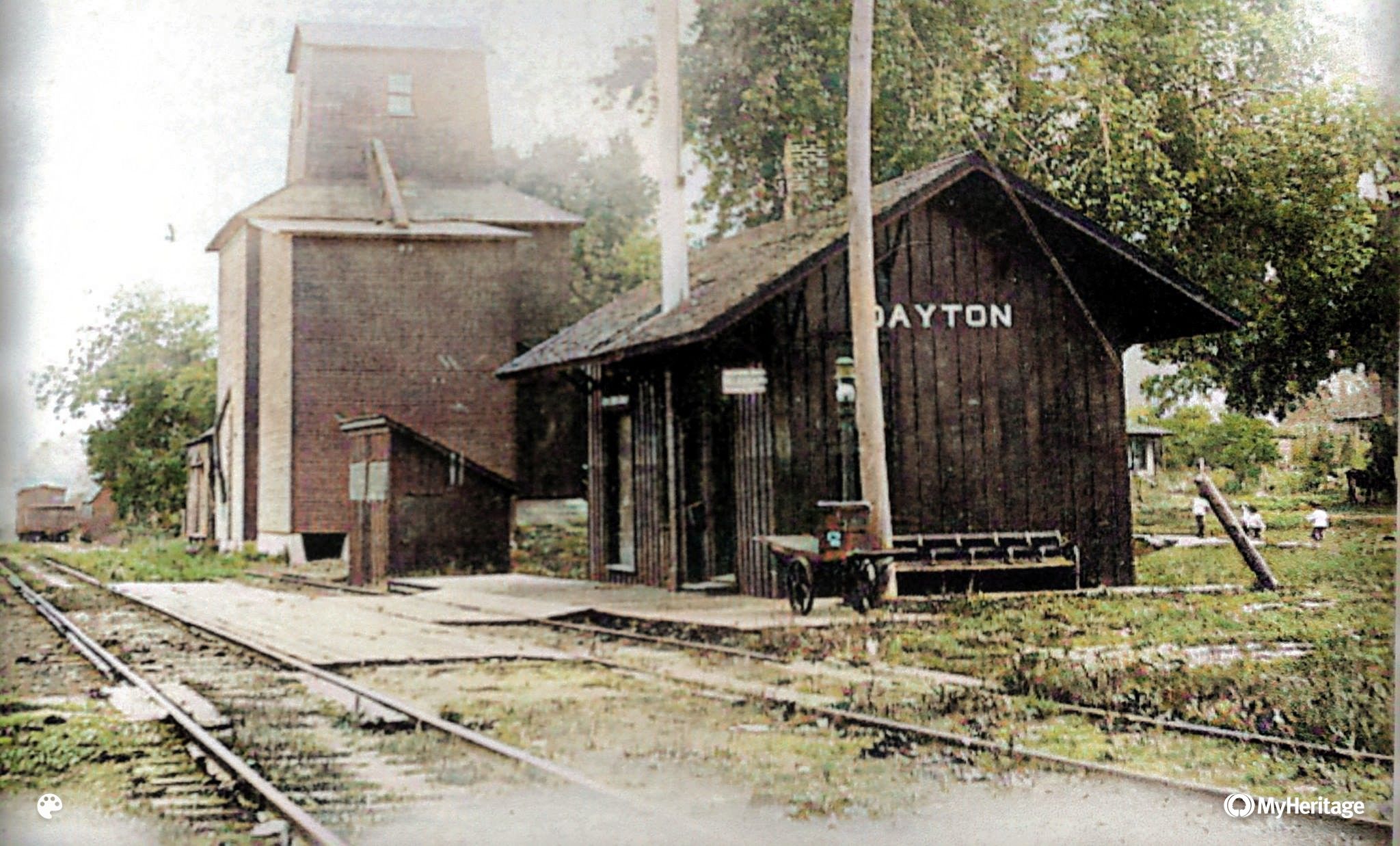
The Dayton depot

BURLINGTON KILLS MAN NEAR DAYTON
Dead Man is Believed to be Oscar Classon of Danway
Mutilated Body is Found on Tracks
Parts of Body Strewn Along the Tracks for Almost a Mile–Identification is Next to Impossible — Body was Brought to Ottawa Saturday

The mutilated body of a man, supposed to be Oscar Classon, aged 47 years, married, of Danway, was found on the Burlington track shortly after 5:30 a. m. Saturday by Robert Burch, a resident of Dayton. The body was found one mile north of the Dayton depot and was horribly mangled. The Kellman Undertaking Co., of this city, was called and took charge of the body and removed it to this city.

The identification of the body is almost impossible, but circumstances surrounding the case lead the residents of Dayton to believe it to be the body of Oscar Classon. The indications are that he was struck by the south bound freight train, due in this city at 2:30 o’clock that morning.

Mr. Classon was in this city Friday and was seen by a number of people. He purchased a ticket at the local station for Millington and departed on the north bound passenger train, leaving this city at 3:05 p. m. It is reported that Mr. Classon had been drinking and that he was put off the train at Dayton at 3:15 o’clock. He was seen on several occasions late Friday afternoon by residents of Dayton wandering about the village. Classon, it is reported, made several attempts to walk the tracks and between 6 and 7 o’clock was found lying in the middle of the tracks by a man walking to the village. He was aroused and led off the tracks just previous to the passing of the passenger at 7:05 o’clock Friday evening.

It is presumed that Classon wandered back onto the tracks after the 8:30 o’clock north bound freight passed by and that he was struck by the south bound freight shortly after midnight.

Robert Burch, a resident of Dayton, while walking north on the tracks this morning, found a portion of the body a short distance from the depot. The remainder of the body was found one mile north of the depot.

The identification of the body is almost impossible. An Ingersoll watch and a ticket, bearing the date of April 8th, for Millington, were found in the pocket of the deceased.

He is reported to have been a married man and worked on a farm near Danway. He has one brother, T. B. Classon, residing east of Wedron, who has been notified to identify the body, if possible.1


  1. Ottawa Republican Times, April 14,1910, p. 7.

The Bovine Aristocracy

Isaac Green’s handsome Durham bull ‘Clifton’ would have looked a lot like this.

BLOODED CATTLE

La Salle county may well be proud of her splendid stock of cattle. Her enterprising and wealthy farmers have spent thousands and thousands of dollars in improving the breed of stock of all kinds and especially short-horned Durhams.

Desirous of doing equal and exact justice to all we began at the north end of the cattle stalls, after looking at some fine lots of cattle exhibited by Isaiah Strawn. We found, first: Mr. Isaac Green’s blooded stock. First, his handsome Durham bull “Clifton,” 3 year old, weight 5,000 lbs; is brown and white spotted; :Jenny June,” six months old, weight 500; both having a No. 1 record in the herd books.1


  1. Ottawa Free Trader, September 10, 1870, p. 4, col. 3.

September News

Dayton

Martin Wilkie has picked his grapes and expects to make about forty gallons of wine.

Mrs. Chas. Frein, while attending the funeral of Mrs. Coleman on Saturday last, met with a painful, but not serious, accident. When near the cemetery the horse, which her son was driving, became frightened at some brush which was being burnt, and she suddenly grabbed one of the lines and turned the horse so short that the occupants were thrown to the ground. Mrs. Frein’s face was cut near the temple, and she was taken at once to Ottawa, where Dr. Roberts sewed up the wound.

Henry Glodt, employed on the Q. section here, has been on the sick list the past few days.

August Kruger, wife and son, of Serena, spent Sunday with Mr. and Mrs. Charles Glodt.

Miles Masters is still very weak, but is able to leave the house.

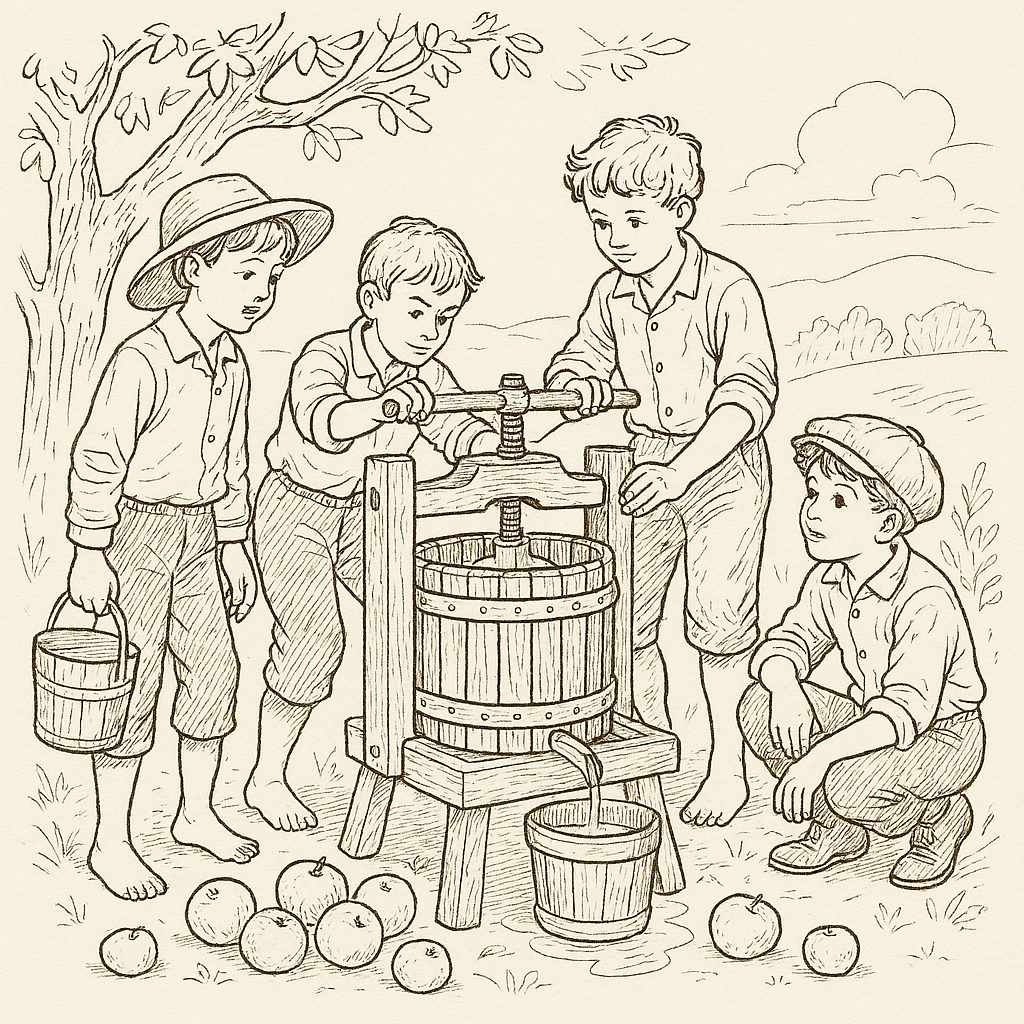
Cider pressing goes merrily on, much to the delight of our school boys.

Mrs. Peter Coleman, 89 years of age, and a resident here since 1872, died at her home on Thursday last after an illness of fifteen months. Three daughters, Misses Mary and Meggie and Mrs. Nellie McGraw, of Streator, and one son, Richard, survive her. The interment took place at St. Columbo cemetery.

Miss Josie Shields has returned, and is now visiting Mr. and Mrs. James Timmons.

The river is still high and the feeder furnishes plenty of water to run the mills.

A. W. S.1


  1. Ottawa Republican Times, September 13, 1900, p. 9.

Let’s Include the Gentlemen

Society Notes

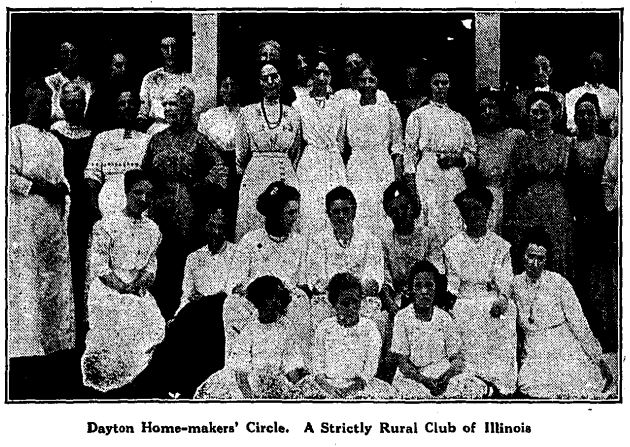
Last fall the ladies of Dayton township organized a little club and christened it “Dayton Home Makers’ Circle.” Since that time they have held monthly meetings at the various homes of the members and have been perfecting themselves in all the arts known to the latter day home makers. The husband did not accompany his wife, but when she was gone he washed the dinner dishes, took care of the children and had supper ready upon her return.  Although, at times, it seemed almost more than he could accomplish, he worked faithfully and has now come to his reward. Last Thursday evening the gentlemen were invited to come with the ladies to the beautiful home of Mr. and Mrs. Louis Chally, where they were most royally entertained. To Henry Smith fell the honor of opening the evening’s entertainment by bringing to view a beautiful sofa pillow which had been created in some mysterious way and become the property of Miss Dwyer’s school in District No. 198. He commented upon it in a very creditable manner, and, after assuring all the money would be well taken care of by the directors, the pillow was “raffled off,” bringing to the school treasury thirteen dollars. Mrs. Ed. McCleary held the lucky number.

The following program was then given:
Piano solo – Miss Dwyer
Vocal solo – Mrs. Frank Beach
Recitation – Mrs. Frank Funk
Piano solo – Miss Barrett
Vocal solo – Mr. Chally

After this came a luncheon, such as is known only to the ladies of Dayton township which included ice cream made from pure Jersey cream. After this brief glimpse of the wonderful, the beautiful and the eatable, the husbands felt encouraged to remain faithfully at their posts of duty. Even though disappointments may sometimes arise at noon tide and a feeling of loneliness creep o’er them in the gathering twilight hour, they realized as never before that the “Dayton Home Maker’s Circle” is still in its infancy and time alone can reveal the things that are to be. As the guests bade Mr. and Mrs. Chally goodnight they assured them heartily that the evening had been most enjoyable. Those present were Messrs and Mesdames: Donavan, La Salle; W. J. Butler, Ottawa; Wm. O’Donnell, Wallace; Silas Kain, Edward Barrett, John McCormick, Charles Eels, Frank Beach, Willis Clark, Frank Trumbo, Richard Schmidt, Masters Frank Funk, E. C. McCleary, Mesdames Olmstead, Ward, Trucker, Krug and McGrath, Misses Dwyer, Woodlock, Krug, Barnes, Baker and Barrett, Messrs. Toombs, Furr, Krug, Schmidt and Lucas, Dayton.1


  1. Ottawa Free Trader, 24 Mar 1911, p8, cols 1-2

A Correction

The errors which are corrected below are highlighted in the biographical sketch, which may be seen here.

Editors Free Trader:–In your issue of the 5th of February, Under the title of “Biographical Sketches,” you—or the types—have made three small errors which I have been requested, by a relative of the persons named, to ask you to correct. The first and second occur in the nineteenth and twentieth lines from your quotation from history of La Salle county, and should read, Mathias Trumbo and Rebecca (Grove) Trumbo, David Shaver and Nancy (Grove) Shaver. The third occurs in the thirteenth line from the closing sentence, and should read, Isabel (Parr) Potts, &c.

Mary (Parr) Grove is still living near Utica, with her husband, Ex Supervisor Samuel Grove. The daughter Isabel was the literary one of the family, and in her girlhood days contributed an occasional poem to the Free Trader. She was an estimable young lady—“fair as a lilly,” modest and retiring in her manner, yet intelligent and charming in her conversation. I have never had the pleasure of perusing any of her poems, as I was not then a subscriber to the Free Trader, but I have often thought I would be most happy could I gaze upon an emanation from her youthful pen.

A lady friend of deceased tells me that her last published literary effort was a poem written upon the death of her father, Wm. Parr, and was very pathetic and exhibited a fair degree of poetic talent. If you have the time, and it would not be asking too much, I would suggest that you look among the files of your paper for January and February, 1858, and if you can find it, to republish it. I am sorry to say I cannot give you the title, nor the “nom de plume” subscribed to her poem.1

As this reader suggested, I looked among the January-February 1858 issues (available at Chronicling America) and did indeed find the poem.

DIED–At his residence, in Rutland, Jan. 11, William Parr, aged 50 years, 1 month, 16 days.

Farewell! dear father, thou art gone,
Thy loss we feel most deep,
But though ’tis thy eternal gain,
We can but grieve and weep.

Farewell! within this world of care,
Thy form we’ll see no more,
But trust in Heaven thy spirit rests
With loved ones gone before.

Farewell! ’tis Jesus called thee home,
And we must be resigned;
But, oh! we miss thy words of love,
For thou wast ever kind.

Farewell! we dare not wish thee back,
Thy troubles now are o’er;
Sickness and sorrow, pain and death
Will ne’er disturb thee more.

Farewell! and may we not forget
Thy dying, last request,
To be prepared when death shall come
And meet thy spirit, blest.              I. D. P.2


  1. Ottawa Free Trader, February 12, 1887, p. 8, col. 2.
  2. Ottawa Free Trader, January 16, 1858, p. 3, col. 3.


There Should be a Bridge at Dayton

There have been many bridges at Dayton over the years, as they were continually washed out by  ice and rain. They were usually replaced promptly, but at least once there was a gap of ten years with no bridge. There were several failed attempts to rebuild until this one was (eventually) successful.

Editors, REPUBLICAN:: Ten years ago the bridge across the Fox river at Dayton was carried off by high water. It had been very useful as a crossing for the public in general, and especially for farmers living in the north end of the township of Rutland, and many from the townships of Miller, Manlius and Mission on their way to and from Ottawa. Of course it was very important to the township of Dayton, and especially to the residents of the village of Dayton and vicinity. The bridge has not et been replaced. At the annual town meeting last April the voters of Dayton township authorized the commissioners of highways to borrow money to aid in building a bridge. The river is the line between Dayton and Rutland townships. Certain citizens of the village of Dayton were so desirous to have a bridge that they subscribed individually and guaranteed to the commissioners of Rutland $1,000 as an inducement to the voters of Rutland township to authorize their commissioners, at a special election, to borrow not to exceed $1500 to aid in the building of a bridge. An election was held yesterday in the township of Rutland. In the 2nd precinct, where the voters were more interested than in the 1st, the proposition was carried by a fair majority. But in the 1st precinct, which includes the village of Marseilles, it was lost by a majority sufficient to defeat the enterprise. We don’t want the public to think that we lay all the blame of our defeat at the door of Marseilles. We think the greater part attaches to certain farmers living in the eastern and southern parts of the township, who were frightened at a small increase of tax.

Let us look at the tax question for a moment. The assessor told me that the valuation of the township for the year 1884 was about $562,000. The average laboring man, so often referred to yesterday, is not assessed at to exceed $100. His share of the tax would not exceed 100-562000 of the $1500 asked for, or not more than 20 cents — about two hours work for a common laborer. The well-to-do farmer and manufacturer and capitalist would pay in the same proportion. We are unwilling to believe that the men who opposed us at the election in Marseilles yesterday would repeat it, after knowing the true situation, for such a paltry increase to their tax. We are grateful to the gentlemen who gave us their votes, and especially to those who gave us active influence. We thank those who opposed us for courtesy extended. The friction of life wakes life interesting. But unnecessary friction is expensive.
Basil Green.
Second Precinct, June 2, 18851

Dayton, Sept. Sept. 16. – At last it is settled that we are to have the bridge! The Board of Supervisors yesterday by a vote of twenty-seven to nine granted county aid to the amount of $5,000, and appointed Supervisors Anderson and Bubeck to look after the county’s interest. The bids will be opened next Monday and the contract let so that work may commence at once. The citizens are greatly rejoiced at the result and hope nothing serious may interfere with the completion of the work.
Our worthy supervisor, Mr. Basil Green, has been attending the meeting of the board at Ottawa, this week, and looking after the interests of our bridge.2

iron bridge at Dayton 1886
Dayton, Ill, April 1st, 1887. – Our bridge is finished at last and open for public travel. It is a very fine three span iron bridge, the neatest one on the river, and is a fine addition to our village. Of course every one will use it now that it is constructed, and it was noticed that about one of the first to use it was one who had fought the hardest.3


  1. Ottawa Republican, June 5, 1885, p. 8.
  2. Ottawa Free Trader, September 18, 1886, p. 5, col. 3
  3. Ottawa Free Trader, April 2, 1887, p. 4, col. 6

Support of a Family Burying Ground

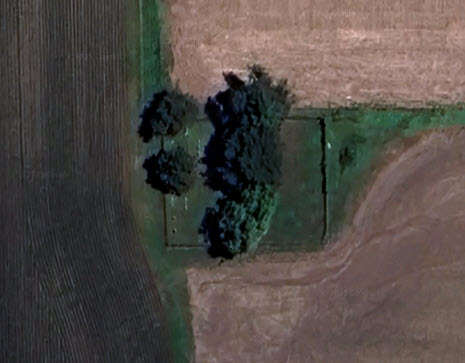
The red circle indicates the location of the Trumbo burying ground

When Mathias Trumbo wrote his will in 1865 he had thought carefully of how his estate was to be divided and had left explicit instructions. However, in 1874, just a year before his death, he realized that there was something else he wanted done at his death. In order to accomplish this, he created a codicil to his will stipulating that out of the proceeds of his estate, one hundred dollars should be invested for ornamenting and keeping in good order the grave yard located in Section Twenty Seven, Township Thirty four North in Range Four East in the Town of Rutland LaSalle County, Illinois.

An overhead view of the burying ground in 2025.

It appears that when Mathias wrote this codicil no trustees for the grave yard had yet been appointed. He directed that at his demise, if no trustees had yet been appointed, his executors should invest the one hundred dollars and hold it in trust until trustees were appointed, at which time the money would be paid to them. He further stipulated that the trustees were to spend only the interest on the investment and that the said principal of one hundred dollars was to be held by the said trustees and their succession forever.1

Mathias’s care for the burying ground did not end there. When he conveyed the land around it to his daughter in 1870 in return for her care of him for his lifetime, he stipulated that she must grant a right of way 2 rods wide from the Chicago road to the burying ground.

In 1988 when my father took me to see this tiny cemetery, we had to walk through a field to reach it (so much for the 2 rods right-of-way). It was totally overgrown and it was difficult to see the stones, although I was able to photograph the one I had come to see.  Unfortunately, I did not know of Mathias Trumbo at that time, so I missed seeing his stone. Now the cemetery is being cared for, as you can see in the photograph above. I don’t have any information though as to whether the interest on that hundred dollars is still accumulating somewhere.

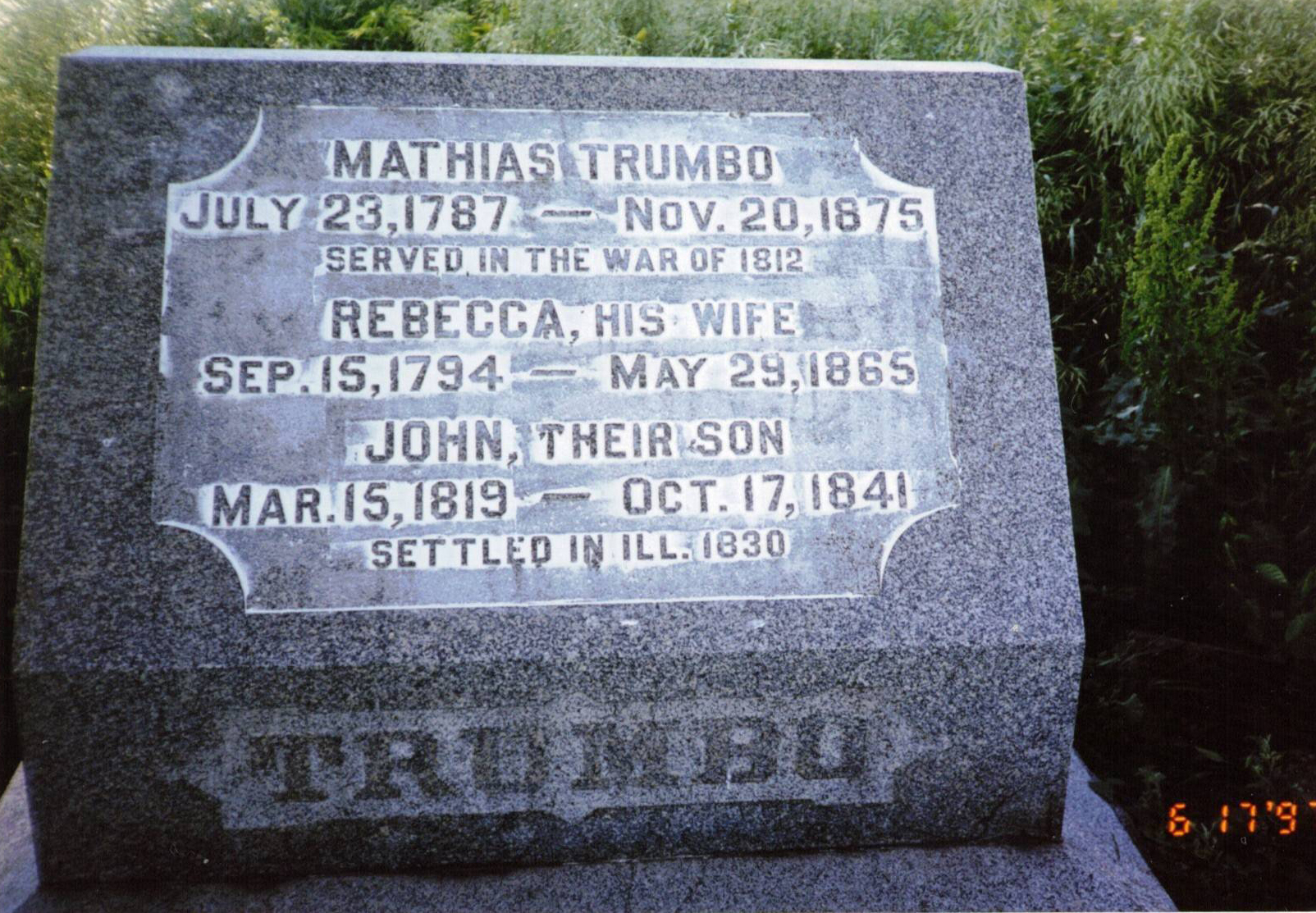
Thanks to the folks at the La Salle County Genealogy Guild (lscgg.org) for this picture of Mathias Trumbo’s tombstone. They have a wealth of information on La Salle County families and are wonderful at sharing it.


  1. You can see the complete text of Mathias’s will and codicil here.

News of a Crime Spree – 108 Years Ago Today

1917 Oakland 5-passenger

TWO MORE AUTOS ARE STOLEN; ONE MACHINE RETURNED

LYLE GREEN, DAYTON DAIRYMAN LOSES CAR – FORD OWNED BY MILLINGTON MAN FOUND ON CENTER OTTAWA STREET – POLICE HAVE CLEWS

BULLETIN
Mr. Green’s machine was found a little before noon today near the Grand Ridge Cemetery, five miles south of Ottawa, where it had been abandoned by the thieves, after the tank became exhausted of gasoline. Mr. Petty recognized the car as belonging to Mr. Green and drove it into Ottawa. He turned it over to Sheriff Davis who in turn notified the owner of the recovery of his property.

Auto thieves, apparently of the juvenile variety, plied their game in Ottawa Saturday and Sunday evening when two machines were stolen from the loop district. One of the cars taken was owned by Lyle Green of Dayton. The Green car was an Oakland five passenger. No trace of the machine has been found. The other car was the property of George Wilson, of Millington and was recovered by the police last evening.

Police today say they have a line on the youths wanted for the theft, but refused to divulge any of their names. Information which will prove of much value, has been furnished the police and arrests of the youths, it is believed, will put an end to a crime wave that has been sweeping over the city the past few weeks.

Theft Saturday Night

The Wilson Ford was taken Saturday evening between 10 and 12 o’clock. Early Sunday morning a machine was abandoned in front of the residence of Bert Rose on Post street at 5 o’clock and the police were notified that a car had been left there. It was taken to the station and is being held there pending the arrival of Mr. Wilson from Millington to claim his property.

Take Dairyman’s Car

Lyle Green, Dayton dairyman, lost his Oakland car Sunday evening when he stopped in Geiger’s bakery. The machine was taken about 8:30 o’clock, a few minutes after Mr. Green went into the confectionery store. It is apparent the thieves were watching for Mr. Green to leave his car. Thus far no trace of the missing machine has been found.

Give Police Clew

That four Ottawa youths have keys that will start any machine in the city was learned today by Chief of Police Eurich. Whether or not the police have the names or identity of the youths, could not be learned.

Hundreds of cars are parked on the streets here at night and it is practically impossible for the police to know when the theft of a machine is being committed. Owners of cars are asked to take extra precautions to put an end to the trouble.1

Ford touring car

2 AUTOS STOLEN HERE ARE FOUND
Two “Joyriders” Run Cars Until Gasoline Gives Out

Ottawa’s bold gang of automobile joyriders kept the police busy over Saturday night and Sunday by stealing two machines, riding both until they ran out of gasoline, ending their hilarious sport each time by abandoning the cars, the first one on Post street and the second in Summit View cemetery in South Ottawa. Neither machine was damaged by the joyriders. Both were returned to their owners today.

Several suspects are under surveillance by the police and Sheriff’s office as the perpetrators of the theft of these cars and other machines from the streets of this city this summer for a little impromptu ride around the nearby country. It is also hinted by authorities that a couple of girls have participated in these rides with stolen machines.

Deserted on Street

George Wilson, of Millington, Ill., was the first to report his machine stolen to the police. Wilson came to Ottawa with a party of friends Saturday evening. He parked his car in front of the Orpheum theater about 10 o’clock. When he returned for it at midnight the machine was gone. The police searched diligently for the auto, which was a Ford touring car, throughout the night, but no trace of the machine was found.

All day Sunday persons residing in the vicinity of Post and Superior streets wondered at the deserted Ford car standing along the curb. Last evening Bert Rose reported the abandoned car at the police headquarters. The machine turned out to be Wilson’s, and was hauled to the police station. The owner said there was about enough gasoline to drive the car 30 miles when he left it. The gasoline tank was empty when the Ford was found.

Found By Garage Man

The second car taken was a five-passenger Oakland, and was owned by Lyle Green, prominent dairy farmer at Dayton, Ill. Green’s machine was apparently taken by the same band and stolen about 8:30 Sunday evening from the side of Geiger’s bakery on Jefferson street. At the time the car was pilfered Green was inside the bakery making a purchase.

When he found his car missing he reported the matter to the police, and a search was instigated for the stolen auto. No trace of it was found, although the police scoured the city from one end to the other in the police patrol.

George Petty, garage man, found Green’s car abandoned in Summit View cemetery at 11 o’clock this morning. He reported his find to the police, and the car proved to belong to the Dayton farmer.

The gasoline tank was dry in Green’s automobile, as had been the case with the other stolen machine.2


  1. Free Trader, July 30, 1917, p. 1, col. 2.
  2. Daily Republican Times, July 30, 1917, p.1, col 6.

Re-Rebuttal

For background read part 1 and part 2 of this discussion.

In a former letter I exposed the action of a board of trustees of a certain church. That letter was answered, or rather an attempt was made to answer it, by one of the trustees. Now I owe it to the public, to myself, and to the editor, as a local correspondent of the Free Trader, to say a final word in regard to this matter. The parties to whom I owe my information are prominent and responsible men in the town. Among them I may mention Supervisor Beach, Messrs. Henderson, Brower, Hess, Debolt and others. If Wm. A. Greenlees desires satisfaction, let him go to these men, for from them I obtained my facts and information. They stand willing, every one, to substantiate everything said on this subject. That the public may not be deceived about the affair, these parties have sent me for publication the following statements:

First. – We are prepared to prove by prominent members and trustees of the church, and by the pastor in charge at the time the church was built, who circulated the petition for aid in its erection, that it was especially understood that it was to be used by other denominations when not conflicting with M. E. appointments, and two trustees were appointed to represent the outside interests. By this means some nineteen hundred dollars were raised outside of its members, and members gave on the above condition. The word “ORthoDOX” was not made use of at the time.

Second. – Wm. A. Greenlees, as trustee, also started out with a subscription paper stating that none but Methodists should use the house. But we have not heard that he succeeded in raising a dollar on those terms. And his own subscription and labor for it do not prove him to be so much more magnanimous than his neighbors, against whom he would bar its doors.

Third. – The present acting trustees seem to be fifty years behind the times in regard to religious liberty, as the following communication from one of them would show:
Serena, March 29, ’79
A. S. Henderson – Sir: I have Been wanting to see you for some time, But have not had time. So I’ll write you and aske you if you heled out the ida thet any and all denomenations could preach in the new M. E. Church when the subscription paper was precented, or did you say ORthoDOX” Now Mr. Henderson if the Unaverseles come under the head of ORthoDOX, then I am with you and will not hesetate to say the church shal be had, but if not you have no right to make the demand you have for I can tell you thet it was expresley understood that the church could be had when not used and it was all so understood it should be to some ORthoDOX denomenations. If I am right you went to far in saying we got money under fals pretence.
plese Answer this
yours Respectfully
Peter Jacobs.

(Mr. Henderson enclosed the above letter in this statement, sent us by the parties above mentioned, and we have it in our possession at the present time.) The statement continues: “If Wm. A. Greenlees had heeded the advice of King Solomon, which he quoted, we think he would never have written his article of April 10, and we would recommend his perusal of other quotations from the same source: “The eyes of the Lord preserve knowledge, and He overthroweth the words of the transgressor.” “Be not a witness against they neighbor without cause; and deceive not with thy lips.”

Occasional1

So there!


  1. Ottawa Free Trader, May 3, 1879, p. 2, cols. 2-3

A Rebuttal

This rebuttal is in response to this letter.

DAYTON, April 10. – In last weeks’ Free Trader I noticed a communication from Dayton signed “O. C.” purporting to give an explanation of a little difficulty which occurred at the church in West Serena. His informant has either stated a malicious falsehood or has undertaken to explain a matter without understanding the facts of the case.

In the first place, there is no such thing as a “union church” in West Serena, neither has any one ever contributed money to erect one, nor has any member of a Universalist church contributed money to build a church in West Serena to my knowledge. If there has, will your correspondent please give the names. It is true that the people generally contributed liberally to build a church, but it was certainly with an understanding that it was to be a Methodist church and there was no chance for deception with any one who read the subscription paper, nor were the men who signed the preamble and resolution demanding the use of the house for Mrs. Gibb deceived in the least, as their own resolution shows. Furthermore, their own lady minister requested them not to apply for the use of the church and announced her appointment for that day at the new schoolhouse in Dist. No. 1.

Secondly, our minister has not, on any public occasion, said one word against Mrs. Gibb to my knowledge. What was said publicly was by the presiding elder.

Thirdly, there has no christian denomination been refused the use of the house, nor will there be if it does not conflict with regular appointments. Fourthly, as regards these “conscientious swindlers” who deceived their neighbors when money was wanted to build a church, I may state that Mr. Hall was not a member of the board at the time the church was built; therefore no blame can attach to him. As regards the other two, we challenge your correspondent or any one to show that we used deception to raise money to build the church or made one promise that has not been faithfully kept. We do not deny that the promise was made that the church should be free to other orthodox denominations when not conflicting with the M. E. appointments and this promise will be kept. Had your correspondent read what wise men had said in sacred writ instead of Shakespeare, he would not have troubled you to publish such a slanderous article, nor would he have troubled those of your readers who love truth rather than slander, for Solomon says, “Lying lips are an abomination to the Lord, but they that deal truly are his delight.”
WM. A. GREENLEES.1

It’s not over yet – see next week for the final installment.


  1. Ottawa Free Trader, April 12, 1879, p. 8, col. 2

The Principles of Christianity and an Explanation

A case of – what shall we call it – stubborn selfishness (?) occurred last Sabbath not far from this place. A church was solicited by parties who had paid liberally towards its erection, as a Union church, for preaching in it by our lady minister, Mrs. Gibb. The idea was hooted at and members of the congregation who were in favor of it were not allowed to speak. Certainly there could have been no gallantry among the gentlemen of the congregation or they would not have so violently opposed the lady’s speaking. Query: Is their action based on the principles of Christianity.1

As it happened, that question was answered soon after:

In our last letter (of March 19) we raised the Query, “Is their action based on the principles of Christianity?” We now have an answer, but that the reader may better understand the whole matter we will endeavor to explain:

When the “Union” church was erected at West Serena, the Universalists and people of no church, contributed liberally with the expressed promise that when not in use by the Methodist Episcopal people, the church should be free to any other Christian denomination or people, (the Mormons, I believe, excepted.) Up to this date no denomination but the M. E. has had any control or use of the house.

The Universalist denomination have been holding meetings at the school-house in Wedron during the past winter, but the United Brethren of that place wishing to hold a quarterly meeting at the regular appointment, Rev. Mrs. Gibb, pastor of the Universalist church at Sheridan, and congregations at Wedron and Dayton, very properly, in the true Christian spirit, gave way to accommodate them. It then became necessary to find another place to hold their meetings, and it was suggested that the West Serena church would be the place provided it could be obtained for a single service. Messrs. Debolt and Henderson made the request, but were flatly denied by the minister and people generally and the minister took occasion to use very harsh and unbecoming language toward Rev. Mrs. Gibb.

Messrs. Brower, Hess and others having contributed very liberally to the building, with the above named stipulation as to the use of the same, after being refused applied in writing to the Trustees for a compliance with the agreement or a return of the money which they had contributed under the agreement.

To this the Trustees, Messrs. Peter Jacobs, James Hall and Wm. A. Greenlees, replied over their own signatures: “We, as Trustees of the Methodist Episcopal church of West Serena, feel that we cannot conscientiously comply with your request.”

So it is altogether a matter of conscience. A case of official conscience! These men of very tender conscience found no difficulty in deceiving their neighbors when money was wanted for the church, but find this meddler conscience, which Shakespeare says “makes cowards of us all,” an impediment to common honesty when there is an opportunity to redeem a promise.

No their action is not based on Christianity, but is of that character of pious fraud that is giving strength to infidelity by exhibiting the hypocrisy of so much that professes to be so pure and Christlike. No use for skeptics to invite Ingersoll to West Serena. These trustees and their minister will drive men further from the cause they so luminously misrepresent, than Bob can persuade them.2

As you might expect, this response did not go unnoticed. Tune in next week for the next installment.


  1. Ottawa Free Trader, March 29, 1879, p. 2, col. 4
  2. Ottawa Free Trader, April 5, 1879, p. 4, col. 6

Alternatives to Cash

In the 1840s cash was relatively scarce, and much of the local economy still operated on barter and informal credit systems, as shown by this advertisement from the Greens’ woolen factory.

Wheat Wanted

The subscribers would say to those indebted to them, either by note or book account, that they will receive wheat in payment for their dues, if delivered soon at John Green’s Mills, Dayton, for which the highest market prices will be given.

They have an assortment of good grey, brown and black fulled clothes; satinette; jeans; tweeds; red, white and pressed flannels, of a superior quality, which they are offering at prices that will make it an object for persons desirous of encouraging domestic manufactures to give us a call, and examine the goods we are now making.

The highest price will be allowed for wheat, in exchange for our cloths.

J. & D. GREEN
Dayton Factory, Aug. 15


  1. The Ottawa Free Trader, August 15, 1845, p. 3, col. 1

Give Credit Where Credit is Due

Richard Veale, of Dayton, while chopping wood in the timber last Monday about two miles from his house, felled a tree which partially lodged, and not being a very large one, and having fallen in such a manner as to need moving, he took hold of it at the butt end to slide it around, when it slipped and caught his left hand, crushing the inner half to a pulp and breaking the bones of the little finger. He started home, and while on his way the hand was frozen.

Arriving at Dayton, he took a train and came to Ottawa and Dr. Hatheway dressed the wound, having to remove the broken bones from the hand. Mr. Veale is a poor hard-working man and has a sick family at present, and will be laid up for several weeks to come. He was here again yesterday and Dr. Hatheway examined the wound and says it is doing as well as it possible can for so serious an injury.1

The FREE TRADER, the other day, in speaking of an injury done to the hand of Mr. Veale, of Dayton, gave the name of a certain physician as healing it, which was wrong. As Dr. Downs was the actual attending physician, Mr. Veale thinks he ought to have the credit for the successful treatment of a hand which was very badly crushed, but which is now, under Dr. Downs’ treatment, getting well as fast as any reasonable man ought to expect.2


  1. Ottawa Free Trader, January 24, 1890, p, 3.
  2. Ibid, January 28, 1890, p. 1.

Baby Claire and Friends

This picture was taken when the house was no longer occupied. The house was built into the side of the hill. The upper yard refers to the large flat area at the top of the hill at the back of the house.  The front yard sloped steeply to the street.

A pretty sight was presented at the residence of O. W. Trumbo, in Dayton township, last Thursday. The beautiful grounds which overlook the town were the scene of a novel and pleasing affair. Clare [sic] Van Ettan, 15 months old, son of Mr. and Mrs. Will Van Ettan, was master of the occasion, and with the aid of seventeen of his baby friends managed to make the woods echo and re-echo with their joyous shouts of glee. All the little ones were about the same age, none being older than nineteen  months, and, with one or two exceptions, all were cousins. The picnic dinner was served in the upper yard and each baby, accompanied by its mother, took a seat on the lawn and, it is needless to say, the sight was indeed laughable and pleasant. There were also present about twenty older children, friends of Baby Clare.

Claire and younger brother Walcott Van Etten

The ladies present, whose babies were honored guests, were: Mrs. M. Peddicord, Mrs. Will Newell, Mrs. N. M. Green, Mrs. T. E. MacKinlay, Mrs. J. G. Gay, Mrs. John Parr, Mrs. Charles Shaver, Mrs. Ed Vernon, Mrs. W. N. Bagley, Mrs. H. B. Williams, Mrs. Frank Shaver, Mrs. Frank Trumbo, Mrs. Will Van Ettan, Mrs. John Gibson (Denver, Col.), Mrs. Wm. Martell (Syracuse, N. Y.), Mrs. T. H. Green (Morris, Ill.) The same babies held a party one year ago and it is the intention of the parents to have them assemble annually whenever possible.1

I’ve ben able to identify these baby guests:
Lulu, daughter of Newton M. and Ella (Pool) Green
Harold, son of John and Lucy (Milliken) Parr
Ida Mae, daughter of Charles and Nellie (Watson) Shaver
Sadie, daughter of Edward and Adelaide (Benoit) Vernon
Jesse, son of William N. and Cynthia (Smith) Bagley
Frank, son of Hosea B. & Cora (Green) Williams
Claire, son of Wilmot and Jessie (Trumbo) Van Etten
Frederic, son of John T. and Josephine (Green) Gibson
Albert, son of William and Edith (Dunavan) Martell
Mabel, daughter of Thomas Henry and Cora (Childs) Green


  1. Ottawa [Illinois} Free Trader, July 26, 1890, p. 7, col. 3

Death of Rebecca (Mrs. Matthias) Trumbo

DIED
At their residence in Rutland, on the 29th ult., Mrs. REBECCA TRUMBO, wife of Matthias Trumbo.

Thus, one more of the early settlers of this part of the state, has closed a long and useful life. Thirty-five years ago they settled on the place where they have since lived, and where she died, and is buried.

They had their share of the hardships and privations of a new country. But through them all she had been brought and she came down to her grave in a good old age. She was born in the Shenandoah Valley in the state of Virginia, in 1794, and removed with her parents to Ohio in 1811 So that she had passed through the early settlement of two of what was then known as Western States. Her last illness was a lingering one, attended with much bodily pain.

But for nearly fifty years her trust and confidence had been alone in the finished work of her Redeemer, and a religion whose virtues she had illustrated so eminently by a strong faith and a meek and quiet spirit afforded her abundant consolation and support in her last sickness and in the prospect of death.

On the last day of May a large concourse of people gathered at the old family residence to sympathize with the afflicted husband, the bereaved children, and a large circle of kindred, and to pay their last tribute of respect to one that many of them had long known and that all respected and loved. The Rev. Z. Colman improved the occasion in some remarks from the very appropriate passage in Job 5

“Thou shall come to thy grave in a full age, like as a shock of corn cometh in his season.”

We learn that it is probable a much fuller sketch of this excellent woman’s life, will appear in a different form with the sermon delivered at her funeral.1

If the fuller sketch ever did appear, it was not published in the Free Trader, so perhaps this additional information will be of interest.

Rebecca Grove was born September 15, 1794, in Shenandoah county, Virginia, the daughter of John and Barbara (Lionberger) Grove. She went to Licking county, Ohio with her parents and there married Matthias Trumbo on March 5, 1818. Seven children, John, Lavina, Isabella, the twins, Eliza & Elias, Barbara, and Elizabeth, were born to them in Ohio. They moved to Rutland township, La Salle county, Illinois, where their last child, Elma Ann, was born in 1838,

Rebecca was related to a great many of the Green/Grove families of early La Salle county. Her sister Barbara was the wife of John Green. Her daughter Isabella was the first wife of Jesse Green, son of John. Her daughters, Nancy (married David Shaver), and Emma (married Rezin Debolt) and her sons David and Joseph were all early residents of Rutland township.

Rebecca died on May 29, 1865 and Matthias on November 20, 1875, . They are both buried in the Trumbo cemetery in Rutland township.


  1.  Ottawa (Illinois) Free Trader, June 10, 1865, p. 3, col. 4