CONCUSSION OF THE BRAIN C. B. Hess Sustains Some Serious Injuries At Dayton
Mr. C. B. Hess met with a very serious accident at his works in Dayton Tuesday afternoon. The bricks that are made on the top floor of the building are lowered to the drying room through a chute. Mr. Hess was standing close to the chute, talking to one of the workmen, and a brick fell from the chute and struck him on top of the head. The brick weighed seven pounds and fell a distance of twelve feet and fell with such force that it produced concussion of the brain. Mr. Hess was brought to his home in this city in an unconscious condition, and Dr. Dyer was summoned.
He examined Mr. Hess’s injuries and found that he was not only suffering from concussion of the brain in serious form, but also neuralgia, which was greatly aggravated by the concussion of the brain. He was very restless and suffered intense pain last night, but today he rested very comfortably and is considered out of danger by his physician.
Ottawa Free Trader, 14 Apr 1905, p7, col 1
C. B. HESS INJURED Falls Through Skylight to Floor of Porch
C. B. Hess met with an accident yesterday that at the best must be a severe one to a man of his years. He was upon the porch engaged in fixing some windows. He stepped backwards accidentally upon a skylight. Through this he crashed and fell to the floor of the porch, eighteen feet below.
He was cut on the back of the head and his back injured. It is also feared that there may be internal injuries. The latter fact is not yet definitely known. His many friends will hope to hear of his speedy and complete recovery from the effects of the fall.
He lived many years after this with no further report of accident. Although his death was not accidental, it was unexpected and therefore newsworthy.
September 23, 1918, p. 1, col. 5
SUDDEN ILLNESS IS FATAL TO C. B. HESS, PIONEER RESIDENT Taken Suddenly Ill While Working in Field, Mr. Hess Passed Away Few Hours Later – Buried Tuesday
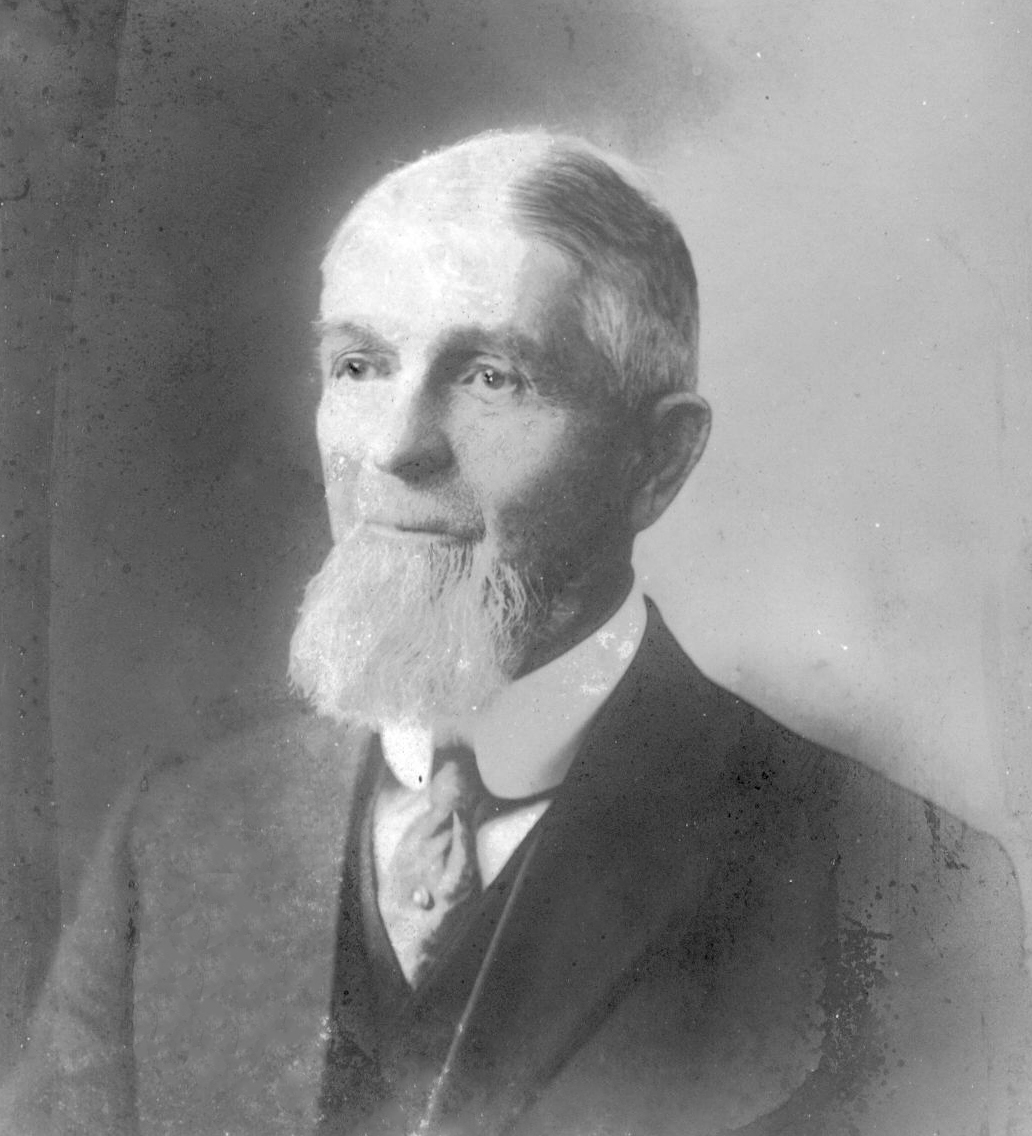
Followed by an illness of only a few hours duration death Sunday morning claimed Charles Benton Hess, one of Ottawa’s oldest and best known residents. The end came at 4 o’clock at the home of Mr. and Mrs. Albert E. Gilman, 526 Congress street, to where Mr. Hess was removed after having been taken ill while at his farm north of the city.
The deceased spent the greater part of Saturday helping on the farm. Late in the afternoon he was suddenly taken ill, the symptoms either indicating paralysis or hardening of the arteries. A hurried call to members of his family brought help on the scene and Mr. Hess was rushed to Ottawa. His condition showed rapid decline, and, because of the deceased’s advanced years, it was known the end was not far away.
Dayton still draws fishermen to the banks of the Fox river to angle for game fish, and most any pleasant day from 30 to 50 persons can be seen between the dam and the town waiting for “a bite.” It was the pleasure of the writer in company with Ed Chapman of Freedom to visit Dayton a few days ago. Those who have been there before will be interested in knowing that Mr. Warner,1 or “old peg leg,” as they call him, is still a familiar figure there. Regardless of his 78 years of age he sits in his boat from morning till night and with a skill that only constant practice can acquire he persuades the elusive bass to “strike” his hook and skurry off in a vain endeavor to shake loose, making the water fairly foam when he happens to be landing a big one. Mr. Warner has fished there for 20 years and everybody knows him. He fishes as a business and makes quite a nice living out of it, each morning visiting his “night lines” and picking up the cat fish that fall a victim to the bait he set for them – then spending the day in silent meditation, contentedly smoking his pipe while the water ripples by him, gently stroking the side of the boat as he makes a “cast” far out to lure in a bass, pickerel or carp.
One incident of the trip was the sight of a drunken father and three little boys, the youngest not over five who had driven there to fish and who slept in the open air with nothing but some old pieces of blanket for a cover. The reckless actions of the father were such before he sobered up that how one or more of the children escaped drowning was a mystery.
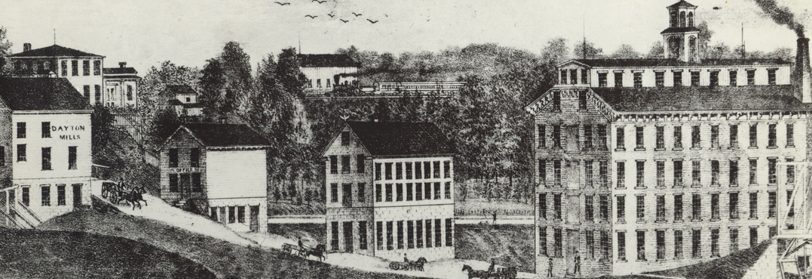
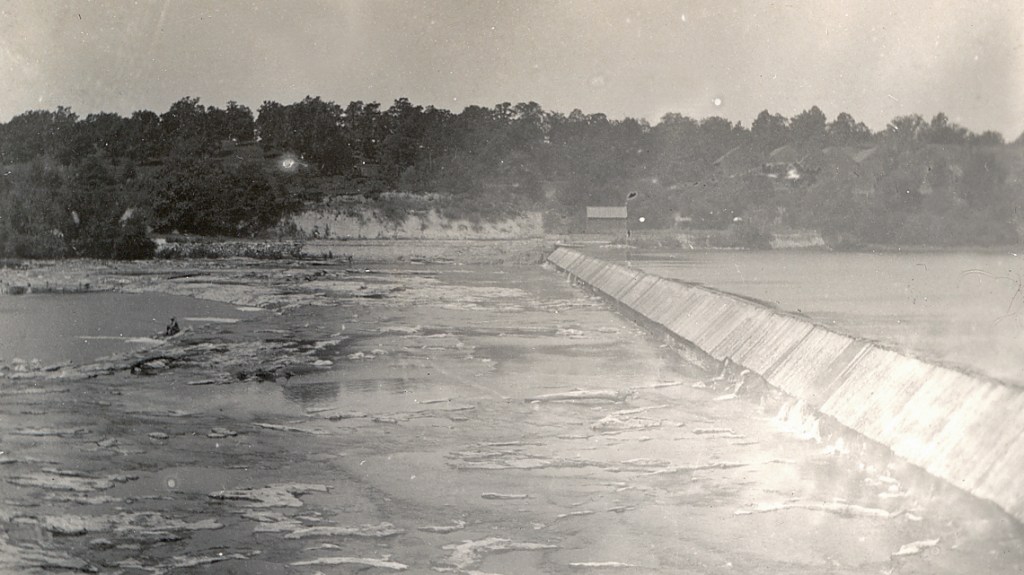
The old four story stone mill where in war times woolen blankets were turned out by the thousands for the soldier still stands on the river bank near town. Surface coal is still mined as in years gone by, enough to supply most of the little town and sometimes the price is as low as $1.75 per ton. The dam at Dayton is each year repaired by workmen employed by the state. As fishermen stand below it they wonder what would become of them if the old dam would suddenly give way. It has stood there 25 years, but is built in sections and is strong. Those who know the river bottom can wade to almost any part of it and “cast” their line into the deep holes where the fish stay. Sun fish can be caught by hundreds and any body can catch them – they are a lovely little fish too. But the other game fish are harder to lure to the hook and not everybody lands a big string unless the “silver hook” is resorted to. Now Ed says the only way to make a sure thing of getting lots of fish is to have “peg leg” put you onto the best holes in the river and then to have him catch them for you. But we believe that as sure a way as any is to string everything that comes in sight from gars with their sword shaped mouths to “dog fish” that nobody will eat except as a last resort – then weigh in your string and tell how many pounds you caught.
Though the weather was cold a few good sized game fish were caught and many smaller ones. The little trip was a most enjoyable one and the pleasant quarters we had to stay added much to it. Many from Earlville are planning a trip to Dayton. The fishing should be good from now on.2
Joel F. Warner, Civil War veteran, lost the lower part of his leg in an accident.
School began Monday for the spring term with an enrollment of thirty-five pupils. The 7th and 8th grade pupils received from the county superintendent their record in the central examination. All passed satisfactory grades.
Mrs Chas Temple of Serena, visited Mrs Ed McClary Monday.
Mr Trumbo and Miss Maud Green attended the funeral of Mrs Bradford at Ottawa Monday.
James O’Meara Jr has recovered from a case of the mumps.
Mr Beck is enlarging and improving the appearance of his house.
Reports are that Dayton is to have an elevator.
Newton Connors is working at Wedron.
Dayton school has a base ball nine averaging 13 years of age that would like to arrange some games.
Mr McBrearty is laid up with rheumatism. His son Roy has charge of the depot.
The school trustees met with Treasurer McClary Monday.
Jas O’Meara is preparing to grind clay at the brick mill.
second correspondent
Mr Elsbury has been quite sick the past few days, but is better now.
Mr and Mrs McBrearty returned home from Marseilles Saturday where they have been visiting their daughter, Mrs Ed Emmons.
Steve Koenig returned home Friday from Ottawa where he has been visiting his aunt.
Bessie Davis is quite sick with the la grippe.
Some of the people of this place were very much excited Thursday evening. Old lady Keough started a bonfire. It got into the dry grass and was making a fair way toward her house. While she was putting it out some of her clothes got pretty badly burnt. If it had not been for the neighbors she would have been burnt up alive.
from the Ottawa Fair Dealer, April 11, 1902, p 8, col 3
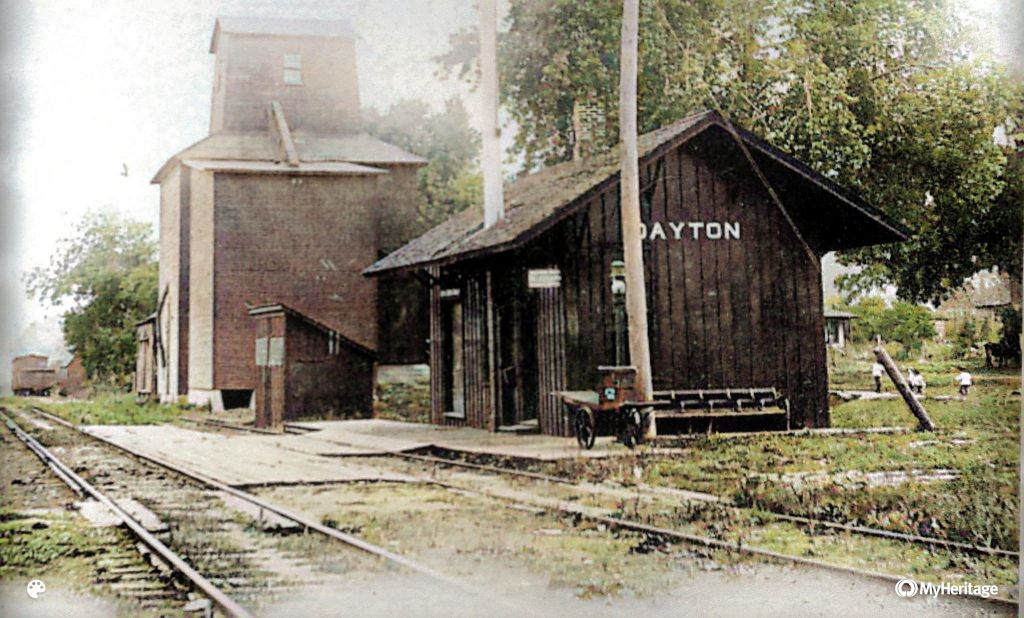
The older picture (left) was taken before the elevator was built.
The Chicago, Burlington & Quincy branch railroad line through Dayton began in Aurora and went through to Streator. We know the names of a few of the station agents who manned the Dayton depot. See below for mention of Wilmot Van Etten, Thomas Belrose, and Roy McBrearty in the Ottawa newspaper..
The route ran as follows: Aurora Montgomery Oswego Yorkville Fox Millbrook Millington Sheridan Burgess Junction Serena Wedron Dayton Ottawa Grand Ridge Streator
Ottawa Free Trader, 10 Sep 1881, p5, col 1 An appalling accident took place at the C., B. & Q. railroad crossing on Columbus street in this city on Wednesday last, resulting in the death of Bernard Dougherty [description of accident omitted] We believe the time allowed on the card for making the run to Ottawa depot from Dayton is too short. The time for leaving Dayton is 11:16 and Ottawa 11:28 – 12 minutes; distance four miles, one and a half of which is through the city, further the engine takes water and crosses a railroad track and a swing-bridge.
Free Trader, March 3, 1888, p. 8, col. 4 James Ryan, our Cornet Virtuoso, is studying telegraph with [Wilmot] Van Etten at the depot. Jimmie is always on the key and we hope he will become an expert and get big pay.
Free Trader, January 24, 1891, p. 8, cols. 2-3 Thos. Belrose, Jr., has now taken charge of the station at Fox. He has been a student at the depot here for a long time, and we all wish him success in his new quarters.
Free Trader, April 11, 1902, p. 8, col. 3 Mr McBraerty is laid up with rheumatism. His son Roy has charge of the depot.
Married Wednesday, June 13th by the Rev. Gault, of Aurora, Illinois, at the residence of Mr. and Mrs. Oliver W. Trumbo, Dayton, Illinois, their daughter Jessie to Wilmot Van Etten.
The large and commodious residence of the bride’s parents was neatly and tastefully decorated for the occasion with flowers and evergreens, and a large number of relatives and friends of the bride and groom were present to participate in the wedding ceremonies.
At one p. m. during the familiar tones of Mendelsohn’s wedding march, rendered on the piano by Miss Davis, the wedding party consisting of the ushers, Messers A. E. Butters and John Green, flower bearers, Barbie Green and George Wright, the bride and groom entered the parlor and presented themselves before the Rev. Gault, who in a short and impressive manner repeated the marriage service.
The congratulations to the newly wedded pair were many and sincere, and all wished them much joy and a life full of happiness and prosperity.
The wedding feast was a grand affair, and the tables were loaded with choice and tempting viands. The bride and groom departed on the 3:50 p. m. accommodation for Chicago, from whence they will go east to make a short visit among the groom’s relatives and friends in New York.
The bride is one of Dayton’s fairest daughters, and we trust will not be obliged to leave our midst.
The groom has been station agent here for a couple of years, and has formed a large circle of friends and acquaintances who hope he and his fair bride may make their future home among them.
The wedding presents were many and elegant, and showed the respect and esteem in which Mr. and Mrs. Van Etten are held by their many friends and acquaintances. About eighty guests were present.
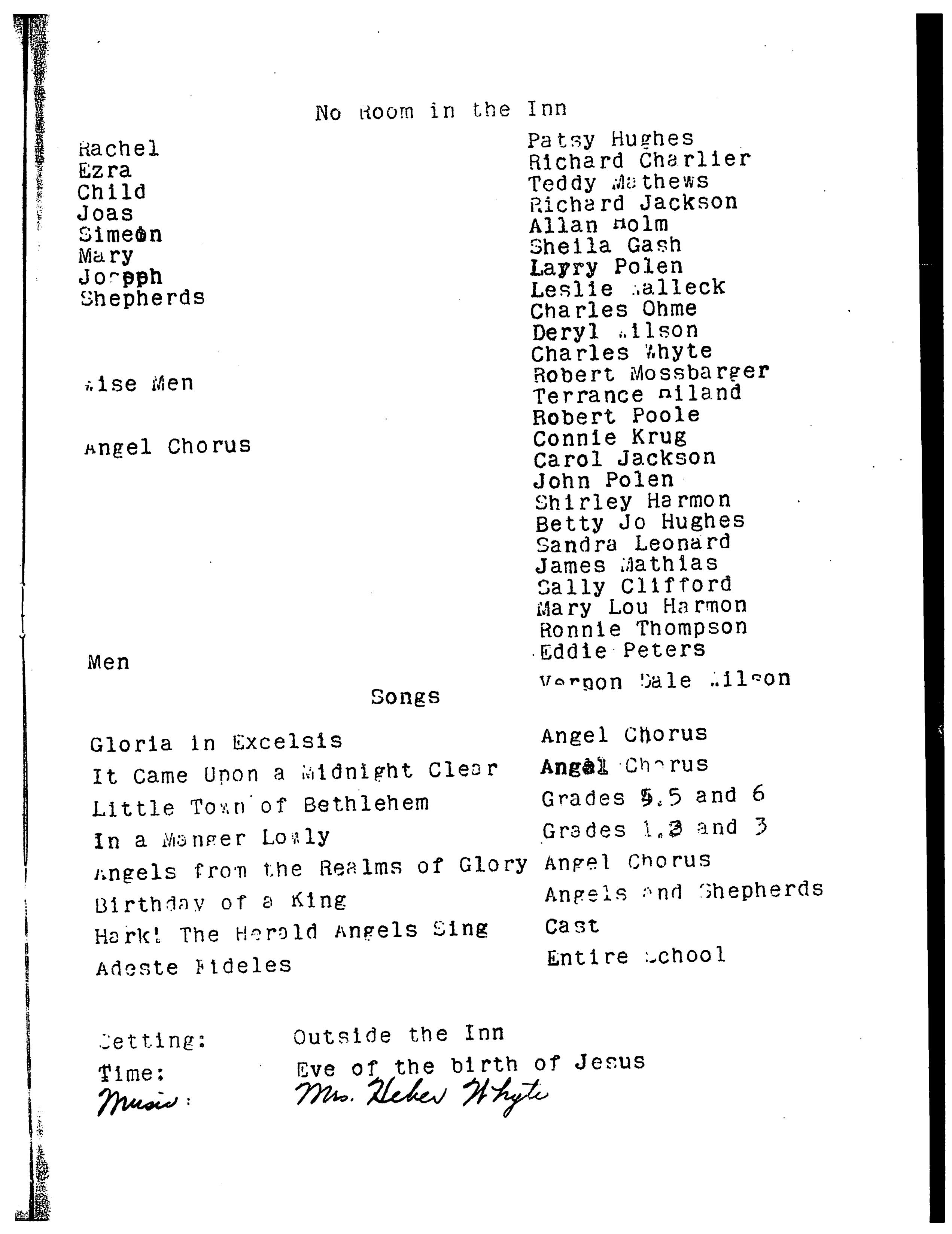
The 1954 Christmas program at the Dayton school had a star-studded cast and a very appreciative audience. All in all, the evening was a resounding success!
A. F. Dunavan, eldest of seven children of William L. and Eliza G. (Green) Dunavan, was born Oct. 29, 1832, in Rutland Township, La Salle County, Ill., where he was reared on a farm. He went to California, being six months on the road, going with eight teams and six yoke of oxen and cows, and worked in the gold mines in a place called Volcano for three years. He then, in 1855, returned to his home in Rutland and bought a farm of 160 acres of land, where he followed agricultural pursuits till 1870, when he engaged in his present business. This business was first conducted under the firm name of George H. Pennypacker & Brunk until 1870 when Mr. Dunavan was admitted to the firm. In 1873 it was made a joint stock company, but was bought out in 1877 by A. F. Dunavan & Son, who are carrying on a successful business. They employ on an average twelve men and manufacture annually 1,500 dozen horse collars and fifty dozen fly nets, beside other articles pertaining to their business. Their business is exclusively wholesale. He was married July 4, 1860, to Emma R. Cooper, of Kalamazoo, Mich. They have three children – W. J., in business with his father; Jennie C., attending school at Ottawa, Ill.; and Herbert L., attending high school at Ottawa. Politically Mr. Dunavan is a Democrat. In his religion he is liberal. He has held the office of School Director. His father is a native of Licking County, Ohio. He left Ohio in 1829 and lived a year and a half near Peru, Ill., where he was married. His wife is also a native of Licking County. They are now living on a ranch in Texas engaged in the cattle business. His father was a Colonel in the was of 1812.1
History of La Salle County, Illinois, 2 vols. Chicago: Inter-State Publishing Co., 1886, 2: 92.
Mrs. Ostrander spent Saturday in Ottawa. Mrs. Sam Hippard is very slightly better just now. Mrs. C. G. Wilson visited Mrs. Ostrander Friday. Mr. Chas. Ballou was a passenger to Ottawa Saturday. Mrs. Edward Dallam was a passenger to Ottawa Friday. Mr. Birch is to work for Mr. McClary this coming summer. Mr. Frain is doing considerable improving to his residence, including a new veranda. Mr. Tom Maher and Townsend Fullerton are doing some tiling for Mr. Frank Trumbo. The Dayton township school trustees met with the clerk, Mr. Ed McClary, Monday morning and transacted business. Mr. Joe Hogan will move Tuesday to the farm of Mr. Frank Trumbo, to whom he has hired out for the coming year. Mr. Clarence Doran, who has been in Joliet for the past year, is now home and will work the home farm this year. Mrs. Rush Green and daughter Gladys went to Chicago Saturday via the Rock Island to visit her mother and sister. Mr. Collamore and wife and grandson, Willie Kelly, went to Montgomery last Monday, probably to stay permanently.
Mrs. R. G. Trumbo came down from Mendota last Monday, where she has spent the winter with her daughter, Mrs. Will Van Etten and family.
Mr. Ray Doran and family have moved to Joliet, where he has a position with the Rock Island railroad. Mr. and Mrs. Jim Collison have moved to Joliet, also. Mr. Collison has the same work as Ray.
Mrs. Edward Dallam entertained a select party of eight last Thursday – Miss Ruth Haight and Ralph Green, Mr. and Mrs. Rush Green, Mr. and Mrs. Edward McClary. Five hundred was played and ice cream and cake were served.
Mr. Geo. Makinson, who died at the home of his daughter, Mrs. G. M. Pedersen, at Yorkville, was buried in Dayton on Saturday, March 30th. He left Dayton about 16 years ago. Previous to that he had been postmaster of Dayton for forty years. He was 81 years of age.
What narrowly escaped being a tragedy occurred in Dayton as a result of the usual April fool joke. Miss Cora Tanner, only daughter of Mr. and Mrs. Al Tanner, was accidentally shot by her cousin, Willie Luce. The shot entered at the knee, struck the patella, glanced off and is buried in the flesh. She was hastily brought to Ottawa and Dr. Hathaway made a careful examination, but says no bones are broken. They will make another examination with the X-ray on Wednesday and remove the bullet if possible. She is resting as comfortably as can be expected.
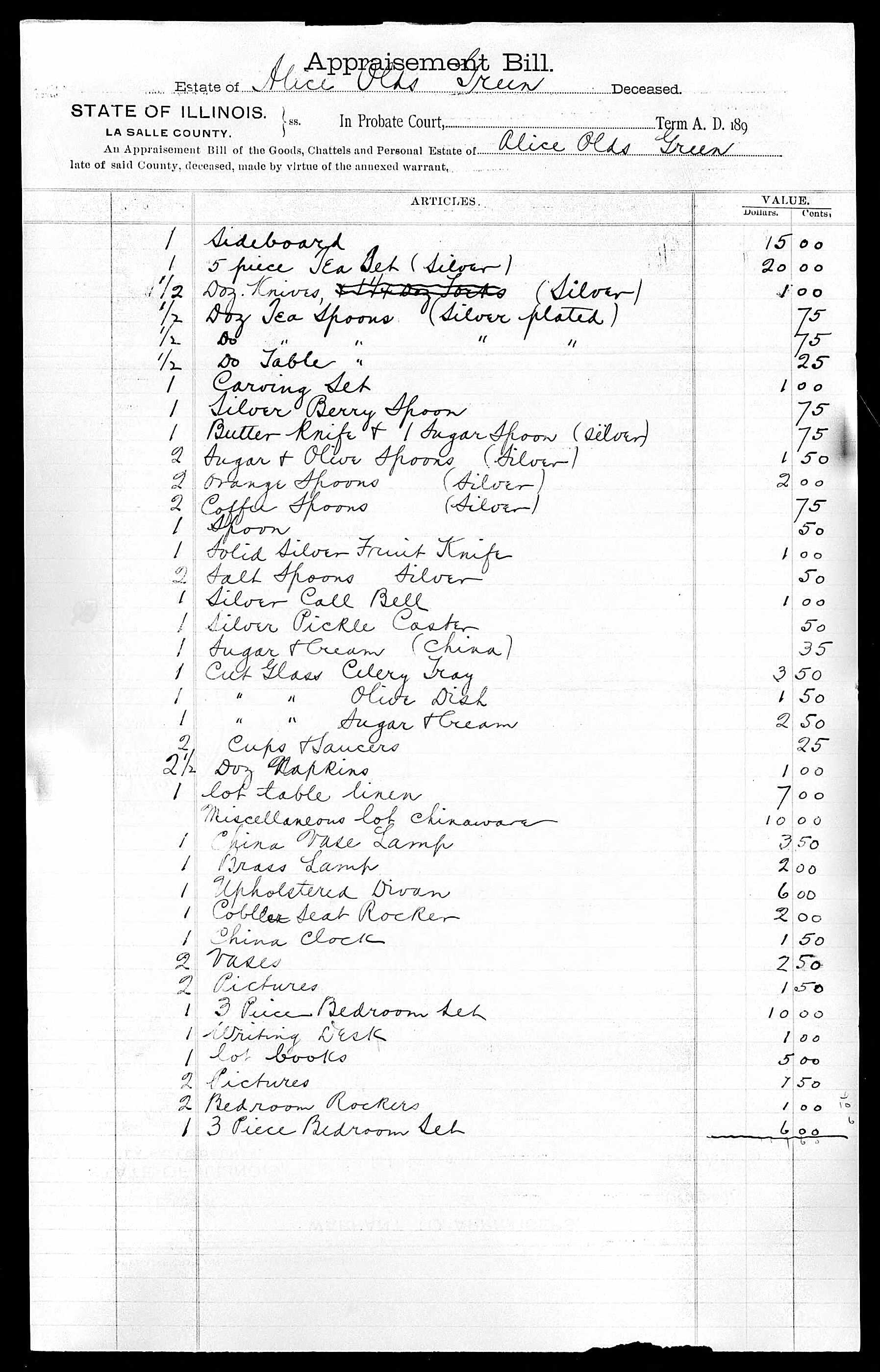
Alice May Olds was born May 7, 1871, in Mendota, the daughter of Jeremiah E. Olds and his wife, Sarah Jane Zimmerman. On November 6, 1895, she married James Arthur Green of Dayton (she was 24, he was 35). Their son, Rollin Olds Green was born a year later, on September 2. Unfortunately, Alice died 2 weeks later, on September 16, 1896. To further add to this sad situation, baby Rollin died in August 1897.
A year and a half later, in March 1898, James married Alice May’s sister, Lucy Mabel. They went on to have 5 children: Raymond, born May 19, 1900; Arthur, born April 26, 1902; Katherine, born October 15, 1905; Alice, born November 30, 1907 and David, born February 12, 1910.
James and Lucy moved to Grand Junction, Colorado, in 1902, and remained there for the rest of their lives. James died there in 1934 and Lucy in 1943.
HE HAD SEEN CONNORS How a Dayton Man Was Licked Despite a Peace Warrant
William Brown and John Conners, of Dayton, had a difference of opinion over some matters yesterday, and, this morning William came to Ottawa and swore out a peace warrant before Justice Weeks. Dick Norris was chosen to serve the paper, and, accompanied by Brown, at once proceeded to Dayton to do so. When they came within the town lines, Brown stepped out of the buggy and walked along the towpath of the canal, while Dick whipped up his horse and trotted to the factory where Conners is employed. He did not know Conners, and, when a man passed him on a brisk walk, did not consider it his business to question his freedom.
Arrived at the factory he was informed that Conners was not present, and, turning, drove back along the towpath to find Brown. Presently Brown came in sight holding his nose and mouth, while his face and clothing showed signs of trouble.
“Conners wasn’t at the factory,” said Dick, “have you seen him?”
“Yes!” exclaimed Brown, from a battered face, “I’ve seen him.”1
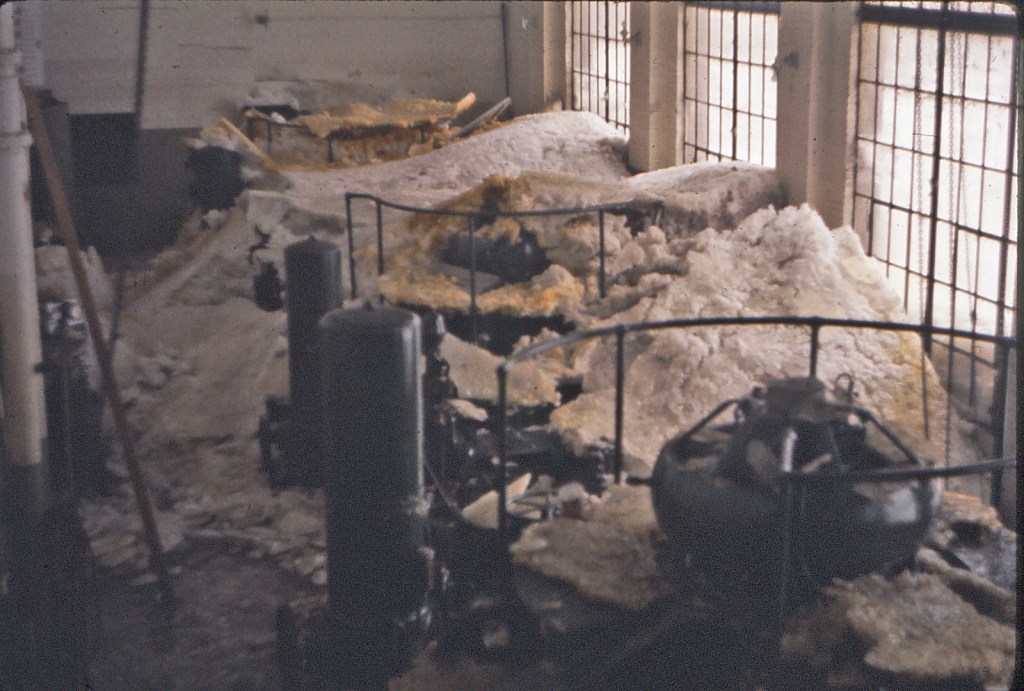
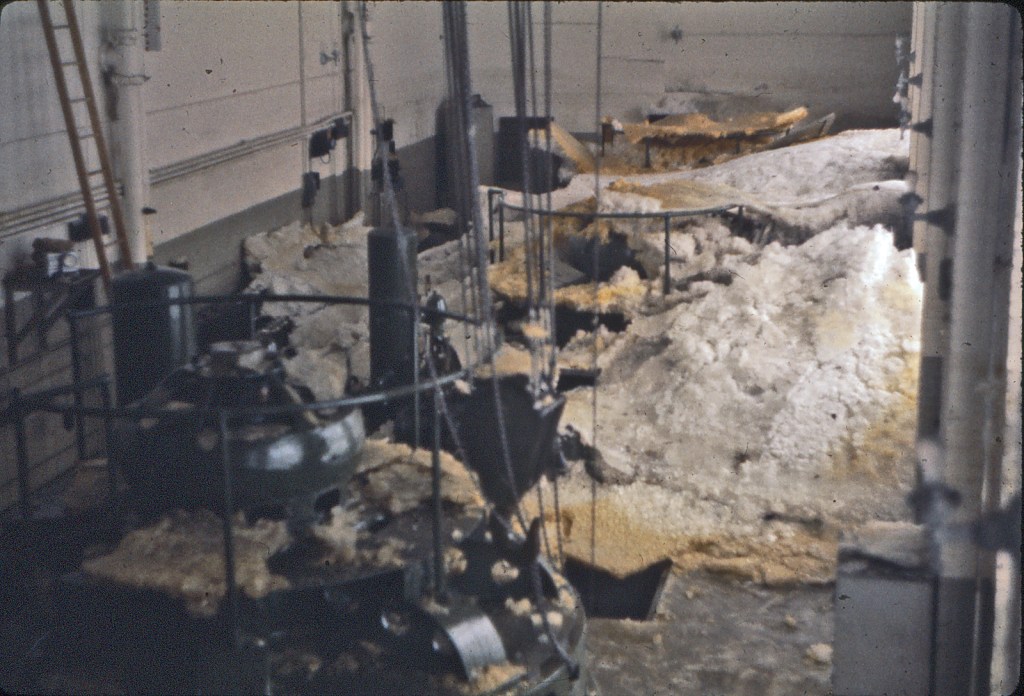
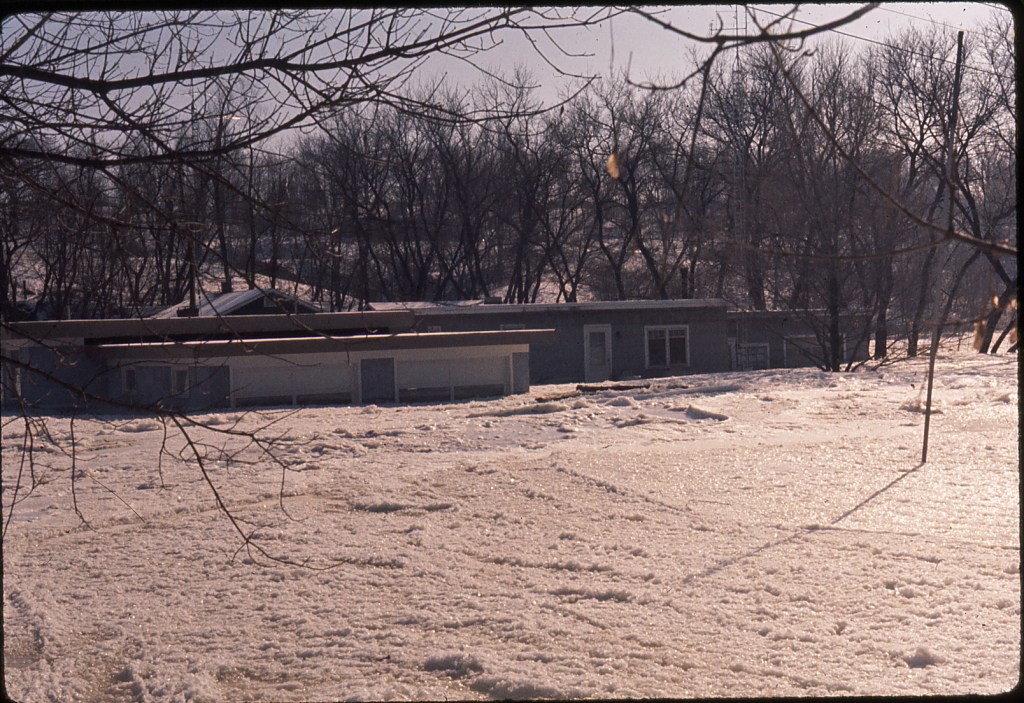
It’s winter again and the Fox River at Dayton has a history of ice jams and floods. In 1960, the river again was jammed with ice, causing flooding, as seen here in the powerhouse.
In addition, the houses along both sides of the river were engulfed by ice,
and the bridge was under pressure.
Here are some of the predecessor events for comparison. 1875, 1943, and 1952
January 27, 1855, 166 years ago today, the following notice appeared on page 4 of the Ottawa Free Trader.
Water Power To Lease
The undersigned offer great inducements to capitalists and manufacturers, as they have decidedly the best water power in the state, having over 25 feet head and fall, and situated in Dayton, 4 miles above Ottawa, and drawn from the Fox river Feeder, which is kept in repair by the state, without any cost to the undersigned. They have water to lease for a term of years sufficient to drive 20 run of 4 ½ feet burrs, and will lease on very liberal terms to any good, responsible company.
This is a rare chance for men of capital who may wish to go into the manufacturing business. The location is very healthy and admirably situated; as it is on a navigable feeder, within 4 miles of the contemplated Rock Island railroad, and the head of steamboat navigation. For further information, address Dayton Jny 31.
John Green & Sons
When John Green bought the west side of the Fox river at the rapids, he became the owner of one half of the water power the river provided. (The other half belonged to the owner of the east bank of the river.) Green deeded one fourth of the power he owned to William Stadden. Green and Stadden then deeded one half of their water right to the Canal Commissioners for the Illinois-Michigan canal. Therefore, John Green’s share was 1/2 of 3/4 of 1/2 or 3/16 of the power of the river. He then deeded to Jesse and David Green one half of the power owned by him or 3/32 of the whole river. A government survey of the river in 1869 calculated the volume of the river was 40,000 cubic feet per minute at or near the mouth of Indian Creek. 3/32 of 40,000 equals 3750 cubic feet per minute and this is equal to 142 horse power. The use of the best wheels and machinery at the Green mills would equal 114 horse power, so John Green & Sons had excess power to lease.
Funeral services for Mrs. Barbara T. Jackson will be held at the home of L. A. Green in Dayton at 1 o’clock tomorrow afternoon, conducted by Rev. Hugh MacKenzie, pastor of the Congregational church. Interment will be in the family burying lot in Millington cemetery.
The death of Mrs. Jackson marks the passing of another of the county’s pioneers. She came to La Salle county with her parents from Ohio, where she was born almost a century ago. She knew La Salle county when Ottawa was only a settlement in a wilderness, long before the day of the railroads or the canal.
Mrs. Jackson was a daughter of Mr. and Mrs. Mathias Trumbo, who came to La Salle county when there were less than a dozen houses in Ottawa, and who shortly afterwards went to Dayton, four miles northeast of Ottawa to reside.
The pall bearers at tomorrow’s funeral will be L. A. Green, Roy Grove, Frank Brown, Elias Trumbo, Glenn Matlock and Benton Harris.
Mrs. Jackson died at 11:15 yesterday morning.
[Barbara Jackson died February 21, 1927. Her obituary appeared the following day in one of the Ottawa newspapers.]
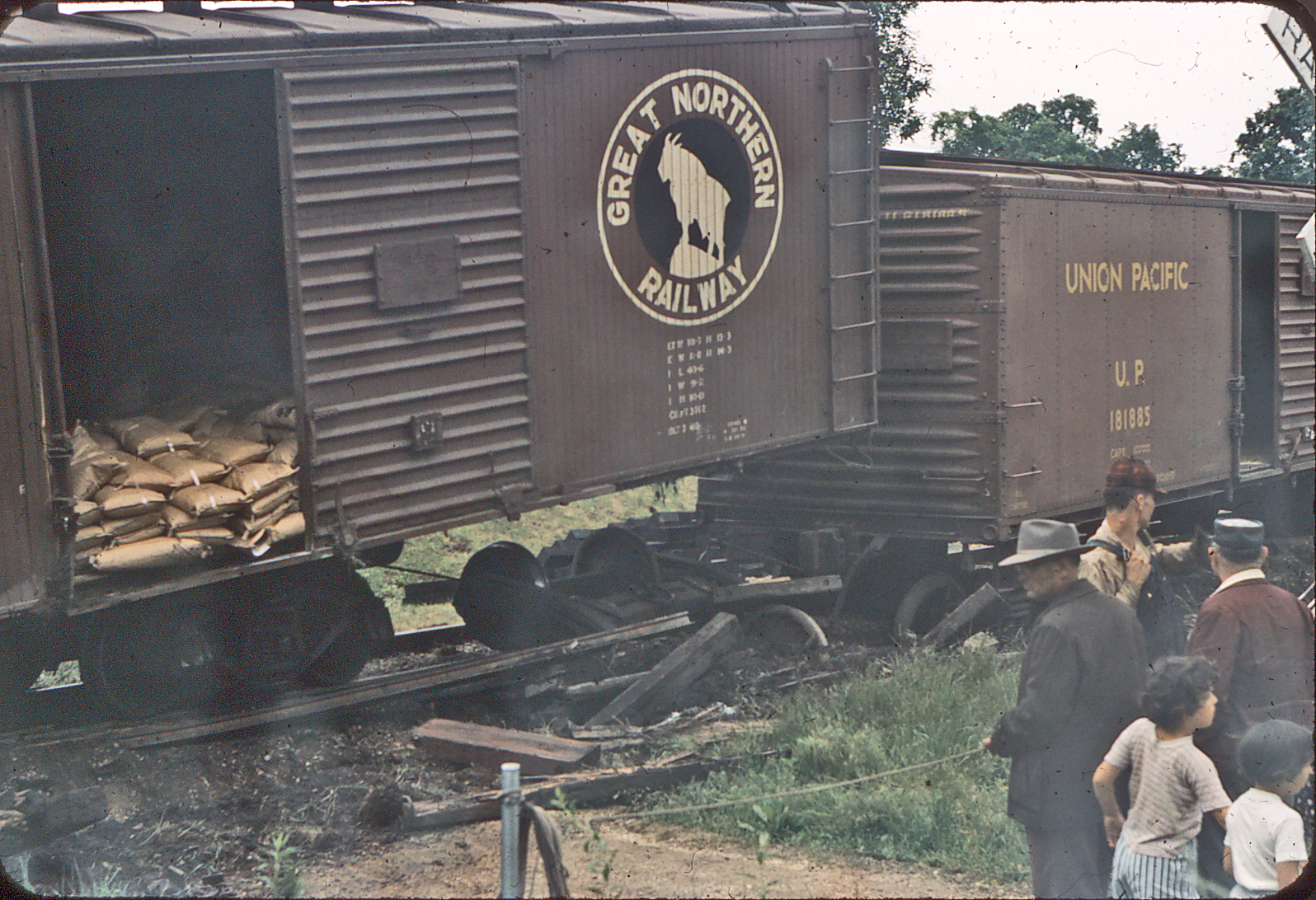
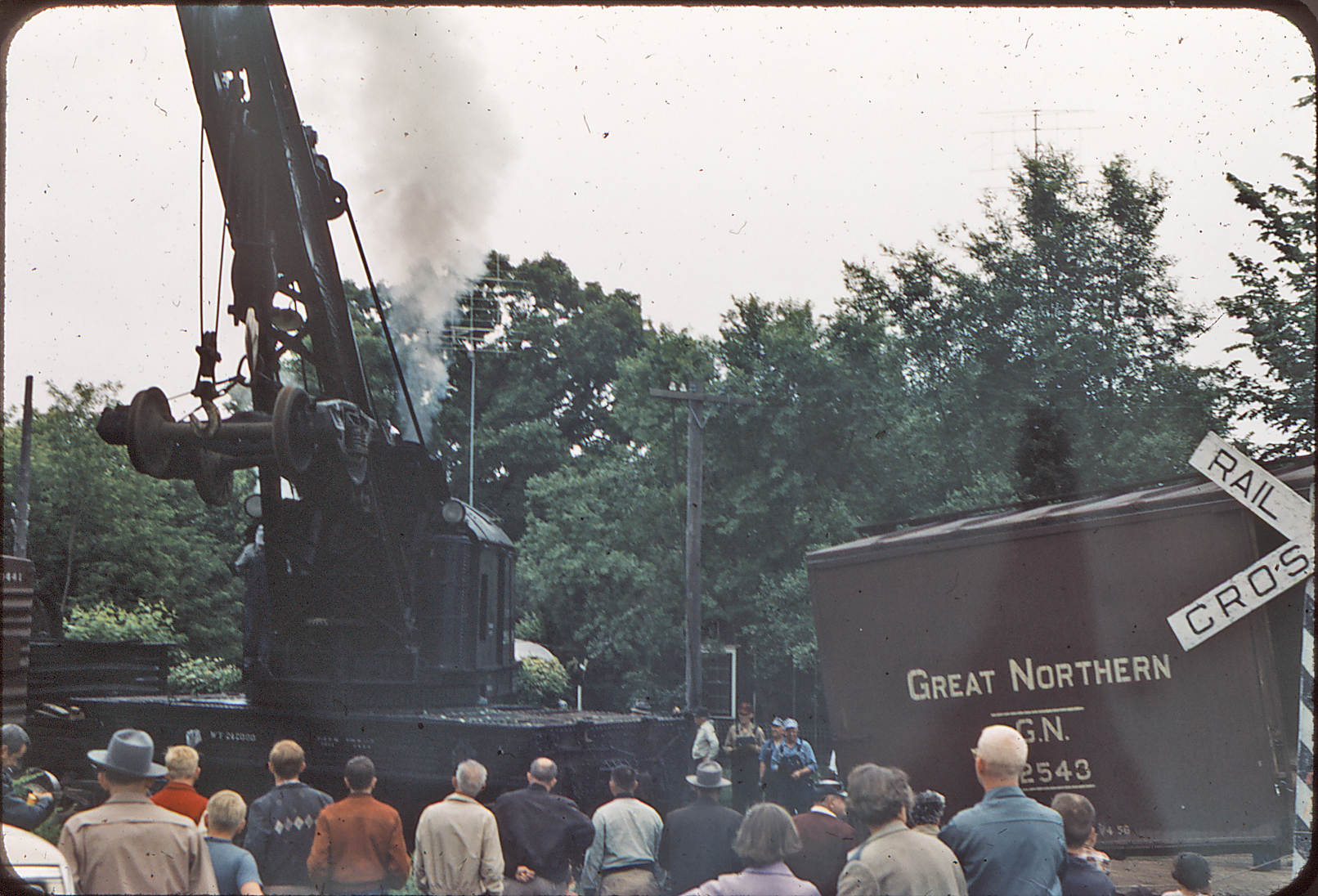
These pictures of a train derailment in Dayton were taken about 1958-59. I need to get back to reading the newspaper to see if I can find the exact date. Maybe someone seeing this will know exactly when it happened. If so, please leave the date in the comments.
In any case, you may recognize some of the bystanders, even if you can only see their backs. Click on the picture to see the full size version.
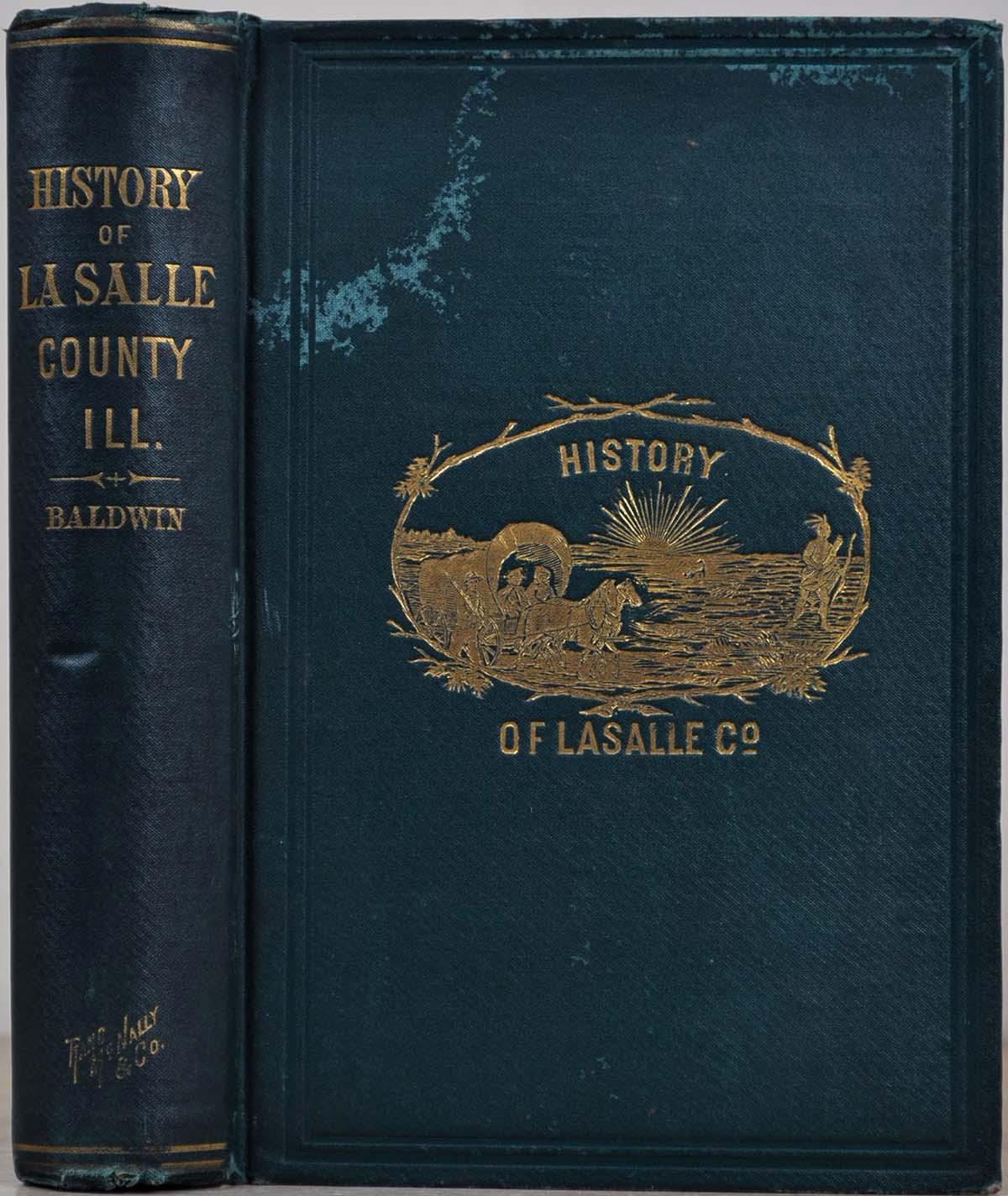
The bible of early Dayton history is Elmer Baldwin’s History of La Salle County, which attempted to give a sketch of the pioneer settlers of each town up to 1840. In a comprehensive work of this nature, it is no surprise that occasional errors crept in. I have my great-aunt’s copy of Baldwin’s book where she handwrote corrections into the Dayton-Rutland sections. She was writing about her family and neighbors, correcting errors that she saw.
Here are two paragraphs from the account of Dayton, with her additions and corrections in italics:
William Stadden* and wife, Elizabeth Hoadley [Judith Daniels], from Licking County, Ohio, in May 1830, settled on S. 33, T. 34, R. 4; sold to Jonathan Daniels, and moved to Dayton in 1831; built a flouring mill; was twice elected Sheriff of La Salle County, and twice to the State Senate. He was a prominent and useful citizen, and died in 1848. Children: Jonathan, married Elizabeth Long, in Rutland; Mary, married David Green; William; Elizabeth, married Horace B. George; Richard, married Sally Sevant [Swank]. [*His son William Stadden Jr. married Elizabeth Hoadley.]
Nathan Proctor bought the store and goods of David* Letts, [David Letts bought this store from Jas. McFadden who was shot through the ankle by Indians on Indian Creek when Robert Beresford was killed]. in the spring of 1836; he had a very interesting family, and was himself a genial, able and popular man, and did a prosperous business for about one year and was noted for his honorable and upright business habits. On his way to St. Louis to purchase goods, he was detected in passing counterfeit money. He avoided arrest, but never returned. He was found to be a member of the notorious band that then infested the country from the Illinois to Wisconsin, called the Bandits of the Prairies, who were horse thieves, counterfeiters, robbers, burglars, and murderers. Dies, and plates for counterfeiting, were found in his store, and years after, when the building was torn down, a copperplate engraving was found behind the plastering. If his former or subsequent history should be written, it is probable the name of Nathan Procter would not appear. [*David Letts had one child – Rhoda Ann Miller – (went to Utah). 2nd wife’s children: Madison, Noah, Amanda & James.]
Dayton Cemetery Association holds its annual meeting on Memorial Day weekend and there is always a historical program following the meeting. On May 27, 1973, Ruth Brown Baker presented the following information on the Dunnavan family.
As broad as the United States is wide, so the Family Tree of Samuel Dunnavan spreads its branches from the Atlantic to the Pacific, covering the quick and the dead, the old and the young who have struggled or are striving to survive in an ever changing world.
Colonel (or Captain, there seems to be some discrepancy in the records) Samuel Dunnavan was born in the year 1780, probably in the Shenandoah Valley of Virginia. No definite information has yet been found regarding his parents.
On December 22, 1807, he was married to Elizabeth Lair, daughter of Persis and Joseph Lair. This marriage was solemnized in the Parish and County of Rockingham, Virginia. It is supposed that they moved to Licking County, Ohio, the following year and there they resided on a farm which they owned in Newton Township. Elizabeth and Samuel were parents of three sons, – Joseph Albert, William, and George Milton.
Samuel served in Williamson’s Ohio Militia during the Was of 1812 and returned home in a poor state of health. He died on June 22, 1816 at the age of 36 and is buried in the Evans Cemetery near St Louisville, Ohio. In the research notes of the late David Dunnavan he remarked that “To have attained a Colonelcy at such an early age bespeaks unusual qualities of leadership which might have carried him far had he been permitted to live.”
Some time later Elizabeth Dunnavan married David Letts, a widower with one daughter, Rhoda Ann. In 1830 they and their family joined the westward trek of pioneers to Illinois. Theirs may have been a rather sizable group by that time since it included some of all of the five children born to their marriage as well as her three sons and his daughter.
Their first years in La Salle County were spent in Eden Township near Cedar Point. Living conditions were primitive in those days with furniture consisting of three and four legged stools and tables all made of split timber. Records tell us the winter of 1830-31 was “remarkable for its severity, snow fell to a depth of three feet, drifting to stop all travel. Potatoes, hominy and wild honey were the rations of the settlers.”
David Letts became a very prominent citizen of La Salle County. He was the School Commissioner, a Judge, the first Road Commissioner authorizing the building of the first road from Ottawa east to the State line and the first Precinct election was held at his house. He kept store in Dayton and Ottawa. His fine character, no doubt, had a lasting influence on the lives of his family. He died in Lettsville, Louisa County, Iowa, in 1852.
Since I am mainly interested in George Milton Dunnavan, my great grandfather, I will leave the stories of the rest of the family for someone else to write.
George’s mother died in 1835 and is buried in the Dayton cemetery. In that year he settled on a farm which eventually encompassed over five hundred acres on Buck Creek Timber in Dayton Township. Following his brothers’ examples, George, too, married a daughter of John and Barbara Grove Green. He and Katherine Green were married on June 15, 1837. Their first child, Milton, was born June 24, 1838 but he lived less than three years. The mortality rate for small children was so high it is probably remarkable that they raised ten of their fourteen children.
Early in the year 1849, when Lucien, their sixth child, was about a year old, the “Gold Fever” hit George. This quotation I read recently in a Reader’s Digest book seems to describe it best. “The most important contribution to the opening up of the West was the discovery of gold in California. The rumor and the fact of gold had the effect of almost literally lifting men up out of their chairs, out of their homes, to leave their farms, their jobs, and families behind for the dangers and hardships of the Gold Rush.”
We are fortunate to have some of the letters written by George Dunnavan to his wife Katherine while enroute and after arriving in California. While we do not know exactly when the trip took place or with whom he traveled, one La Salle County History book describes the trip of A. F. Dunnavan, a nephew, as “being of six months on the road, going with eight teams and six yoke of oxen and cows and working in the gold mine in a place called Volcano.” They must have left home in the spring of 1849 since they arrived there before Christmas.
Although George left when the excitement caught him up along with the rest, he may have had second thoughts about it after he was on the road. With sickness, death, rainy weather and drought to contend with, the glamour of the adventure wore off quickly. He was concerned about his wife and family and good to write to them. His second letter written enroute ended with the admonition to “write to the boy.” Do you suppose he was getting a little homesick even before he crossed the Missouri?
In December of that year, news, written on July 6th, reached George in California. He was about to become a father again. In reply he wrote “I shall now wait with no little anxiety for the letter that will bring me the happy news of your good health after December. I shall be glad to see the little prize. I am sorry I can not be with you in such times but we are a great distance apart I hope the kind providence will protect you. Had I known the situation you were in the gold fever mite have raged for all me I should not have left.” He had the desire to send her some money but there was no way. Since George had heard from Esp. Pitzer that the baby had red hair he wrote “If the baby had red hair don’t name him George.” I guess she did anyway. He only lived about two years but I think that was long enough for his father to get home to see him.
George planned to return home in September of 1850because he was getting tired of the hard way of living and provisions were so high that he had to make money fast to save any. In October he still had not started because the cholera was so bad en route and he thought it advisable to stay in the mountains a few months more. He had opened a little store i Volcano and was hauling goods up there from Sacramento City. His Feb. 1851 letter set a departure date of the first of March. They had been making too much money lately to leave any sooner and he was hoping to hear how the Greens got along on their way home before he started. This might determine the route they would take.
We really don’t know whether he came back a wealthy man or not. He did have some of the gold he mined made into plain gold bands for his daughters and he is known to have sported a gold headed cane. Any wealth he may have had was later lost in the grain market, I have heard. However he did leave a heritage in his family of children.
Silas, born in 1840, was the oldest one left behind when his father went west. He must have inherited some of his father’s pioneering spirit. He is known to have traveled to Alaska and South America as well as mined in Butte, Montana. Frank, Charles, Silas, Ella Belle and Cora all went to the Butte-Walkerville area where they are listed in the city directories of the 1890’s. The men worked in the Alice copper mine and Cora taught school. She was married at one time to James Mc Fadyen and had one daughter who married and moved to Ashland, Oregon. Frank and Belle later moved out there to live with her. Katherine Dunnavan, after she was widowed, also lived in Butte during part of that decade.
Daughter Louisa married David, son of Isaac, and they had four sons. Their home was in Colorado.
Daughter Emma, my grandmother, married Andrew J. Brown. They had two daughter and three sons of which my father was the youngest. He (Walter Dunnavan Brown) now has 27 descendants as represented by my family and those of my sisters, Ethel Holmes and Helen Pottenger.
Mary E. Dunnavan married Rev. John Edmonson. They had four daughters, two of them married and each had four daughters. The Davenport girls are from one of these families.
Lucien and Edwin Dunnavan were the only sons to marry and have sons to carry on the family name. Lucien lived in Central City, Colorado.
Edwin Dunnavan had two daughters and one son and raised his family in Seattle, Washington.
George and Katherine Dunnavan were buried in un-marked graves in the Dayton Cemetery, he at the age of 79 and she at the age of 77. They were from sturdy American stock and while their way of living seemed rugged and full of danger, they lived in an era of many changes. One Judge, speaking at an Old Settler’s Picnic in 1869 remarked that “these past thirty or forty years will forever remain more memorable in the history of the whole world than will any equal period that has ever preceded it. Our progress during these forty years which would have been an incredible miracle a hundred years ago is only an illustrious and magnificent fact today.” Strangely enough, we can make the same remark today, a hundred years later, with just as much feeling.
As a follow-up to last weeks post, here is another letter the sisters sent to their brother in California. This one, written May 28, 1850, shows how badly they missed the adventurers.
My dear Brother
We received Father’s and Jesse’s letters. Father’s was written the 13th of March and Jesse’s the 4th. The first that we have heard from you since the last of December. We got them day before yesterday, It was the happiest day that we have had since you are gone. We have heard so many reports this spring so did not think we could have such good news. It was all good but one thing. Oh, Joseph, do give that up. Father wrote that you talked of staying and going round the oceans but if you do think of any such thing do come home first and then there will be time enough to travel all round the world and when you go I want to go with you. It would kill us to hear you have gone so much farther before you would come home. Do all come home together. Next fall we are going to look for you the last of October. Father wrote you would start the first of September he thought. We all feel happy now but Eliza she did not get a letter from William and not one of them mentioned him. When you write again be sure and tell us where he is. Uncle trumbo got a letter from Elisha how he said he had seen Dunavan in San Francisco but did not say when. David, Isabella, Nancy, Catherine and Mrs. Goodrich all got letters the 15th of this month. We all rejoiced with Mrs. Goodrich. We had heard that he was dead. She never expected to hear from him again. Now she says she is perfectly happy. We had a letter from Martha a few days ago. She said they had heard that Uncle William was going to appoint an agent to go in his place and he would come home but nothing certain.
We are all well. The friends are all [well]. There has been a good many deaths around this winter but none amongst our relatives. I think we are among the favored few. We have all enjoyed good health since you left. I will close and [give] Rebecca a chance. Give my love to all enquiring friends. Father, Jesse and yourself in particular. Your loving sister,
Rachael Green
Dear Bro Joseph
I write you again feeling much better than when I wrote last Sunday from having such good news. For it was certainly much better than we had reason to hope for from the fact of our not hearing from you for 4 months and a half and the hearing of deaths in all letters received in Ottawa. Since you must know that our minds were ill at ease until we heard from you again but we now feel much relieved. Mrs. Goodrich in particular. She had no hope of ever seeing him from what Jesse had written to Richard Stadden. He told them not to let her hear of it but such things will leak out you know. We have a very good news carrier – Stickly stoped to hear our letters read and then reports accordingly.
Joseph you don’t know how we feel that you don’t get letters from us. We write once in 2 weeks without fail and very often once a week. If you don’t get them I beg of you not to lay the blame on us. David writes to you all and Rachel, Isaac and me write to you particularly every few weeks at farthest. It appears strange what the cause can be of your not receiving when the others do. But we will be particular and send them together hereafter. See if that will make any difference. We write so often that we many times send one at a time. We receive yours very irregular. Mrs. Snelling got hers of the same date some two or three days before we did and sometimes we receive one from one of you the middle of the month and another by the same steamer the middle of the next month so you see they are very uncertain but Joseph, do write often. You certainly know how much more good it would do us when we receive letters to get from you all. Elias Trumbo, Jonathan Stadden and Tom Jenkins write to you regularly, besides many others.
I do hope you will abandon the idea of going the journey Father speaks of till you come home first. Then we will give our consent for you to go see China and all the curiosities of the world if you promise not to be gone more than a year at a time.
We stood it pretty well till the first year you were gone but now time goes slowly. Folks told us after you started that our anxiety would soon wear off – it would get to be an old thing but, believe me instead of wearing off it increases daily. I know if you want to see us as bad as we want to see you you will not think of anything but coming home the quickest possible way. I hope you will find all the gold you want in the stream that you were turning till you are ready to start for home. Don’t too much. For we have considerable here – none of it wasted since you left. David does very good business both in the factory and mill and the farm is all let to good tenants. Daddy Hite still lives here. He is now hunting a farm but is rather hard to please. He has been around considerable but has now concluded to buy near here as he can find nothing to please him better. His money troubles him more, I expect, than your gold does among theives. He wants to get rid of it as soon as possible which I think is a good plan as I should hate to be in hot water as he is all the time.
You may think me particular in writing nonsense but I write so often that I can’t always talk sense. I would be glad to get a little nonsense from you once in a while and think probably you will from me if I have nothing else to write. If you were here a while I would have enough to say no doubt but writing is different. I must close by giving my love to all. Mother sends her love to you and says you must not think of staying longer than the rest. She don’t want to see any till she sees you all. So, Joseph, I again beg of you to come with them and travel after you have made us a long visit.
Rachel and me have our miniatures, very natural, I would like to send them to you but can’t very well. We take a great deal of comfort looking at yours. My love to all from your loving sister,
Rachael and Rebecca were daughters of John and Barbara (Grove) Green. Rachael was born in 1826 in Licking County, Ohio and came to Illinois with her family in 1829. Rebecca was born in 1830 in Rutland township, La Salle County, Illinois.
Their three older sisters were all married by 1837, so Rachael, then age 11, and her sister Rebecca, age 7, helped care for their younger brothers, Joseph, and Isaac, at age 4 the baby of the family. We know some of the events that took place in Dayton during the absence of the men in California in 1849-1850 because Rachael and Rebecca wrote to their father and brothers.
Christ Stickley is postmaster now. he come hollering there is california letters before daylight. we was glad to get a specimen of the gold. it has to be showed to a great many as all are anxious too see what it was that took you away from your friends. Elias Trumbo Jonathan and Tom all got your letter to them with the gold in it.
we have had some ferstrate sleighing this winter and have improved it pretty well but we miss you every where. we have cotillion parties at our house every saturday night performance commences at six oclock and quits at ten we have verry pleasant parties there is some very nice smart folks living over in fords house they attend the parties Hites Boys have got to be good dancers Ben Hite lives with us this winter. Rachael
Letter to Joseph Green, dated January 1, 1850, transcription in possession of Candace Wilmot
I am going to school this winter to pass time as much as any thing else. we have a very good school. I have not time to write much I have just got home from school and the mail will go out in a few minutes. I see Rachel has been praising Ben Hite up at a great rate. they are very gracious. he is living with us this winter doing chores and working for himself
O Joseph if you could only be here next saturday night we have first rate cotillion parties. last saturday evening we had three musician’s and first rate music (and some pretty good dancing) but o how we miss you at them. do hurry and satisfy yourself and come back to gladden our hearts. dont be too hard to satisfy either for it is to hard for near and dear friends to be seperated for gold or anything else aint it. Joseph I must close by giving my love to all yourself in particular Mother sends her love to you all and says write often and make haste and return so good bye Rebecca
same letter
In 1854, Rebecca married Oliver Walcott Trumbo, and they had two daughters, Jessie and Frankie Rae. Frankie died of malarial fever at the age of seven. Jessie married Walcott Van Etten and they had three sons, Claire, Walcott, and Frank.
Rachael remained at home caring for her parents until, in 1863, at the age of 37, Rachael married George W. Gibson. He was a widower with 2 small children. He and Rachael had 2 children, John and Alta.
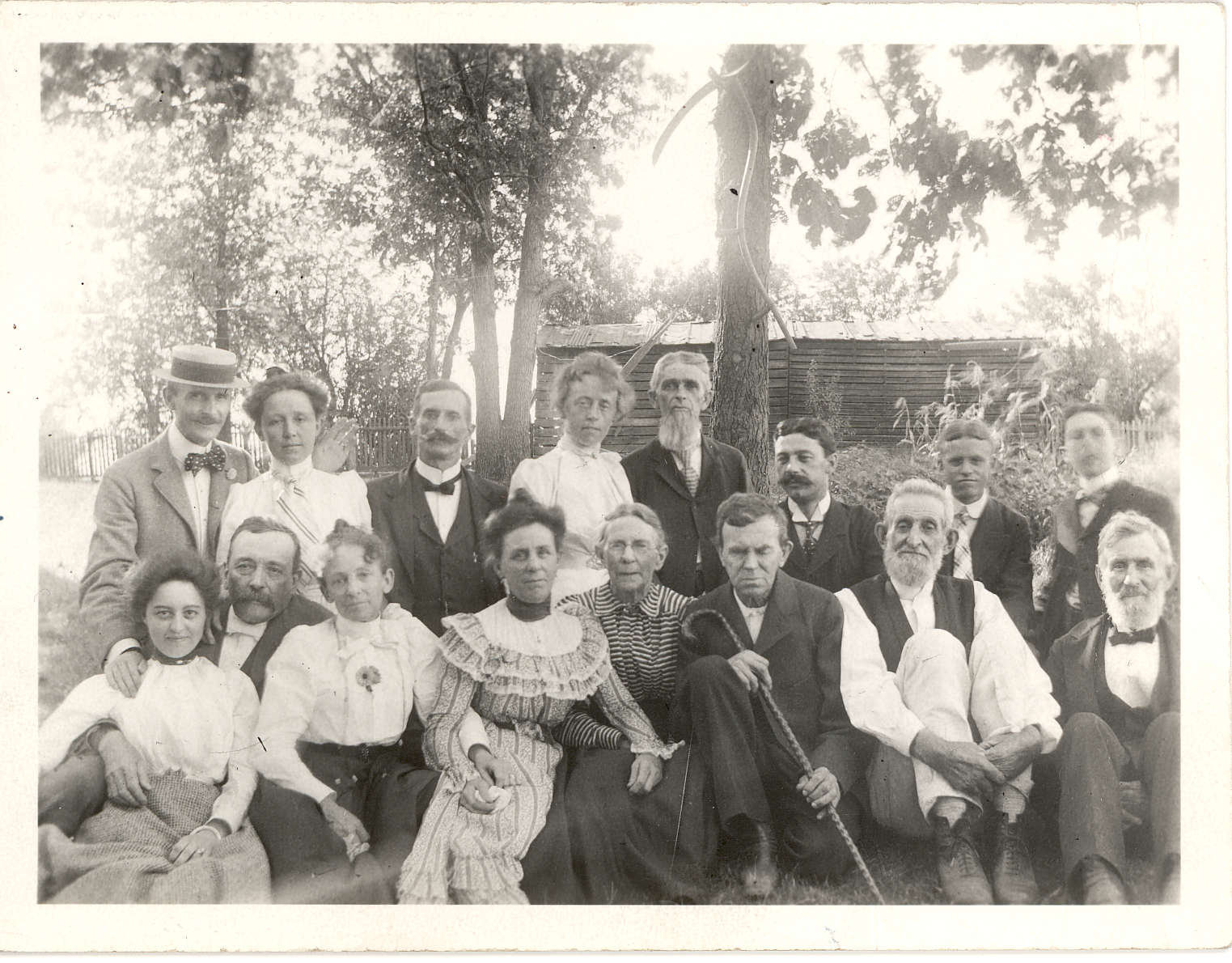
From the information on the back of the picture This picture was taken in the yard of Oliver W. Trumbo’s house in Dayton, Ill. September 3, 1899. The picture was taken by Burton M. Stadden.
Front row: Edith Hess Gilman Jas. McCartney Sarah Swank Stadden McCartney (mother of Burton W. Stadden) Clara (Callie) Green Hess Rebecca Green Trumbo Isaac Green Oliver W. Trumbo Jesse Green
Back row: Burton W. Stadden Mr. & Mrs. Ned Richardson (friends) Julia Taylor Stadden Benton Hess Edwin Hess Arthur Hess Harry Hess
















 Dayton and the Greens