A President’s Visit to Dayton

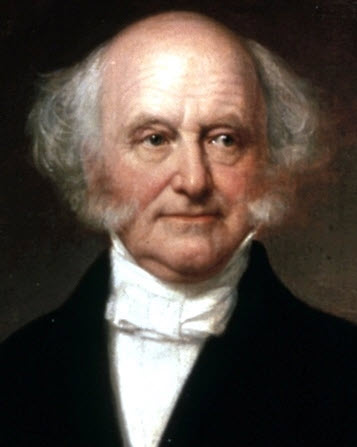
Martin Van Buren

From the Streator Free Press, 24 May 1884:

Speaking of the fine fishing at Dayton, Judge Dickey this morning told an interesting reminiscence of President Martin Van Buren’s visit to Ottawa in 1841. It was just after his defeat by Harrison, and he came here to spend a few days for relaxation. He stopped at the Fox River House and stayed ten days. With him was Spaulding, his secretary of the navy, and a celebrated novelist. Van Buren was the most polished of politicians, an uncle of J. V. A. Hoes, while Spaulding was a blunt, plain spoken man who wanted no nonsense. It was arranged for the party to go fishing at Dayton, and a procession of about 150 men on horseback piloted the distinguished party. At Dayton Col. John Green, a big democrat and friend of the party, had a big crowd assembled, and a little cannon was posted on the hill and fired a rattling salute, so much so that it nearly scared the horses to death. This made Spaulding mad, and he got madder and madder as the boss idiot at the gun kept it booming until Spaulding’s horse careered wildly. Finally the distinguished visitor could contain himself no longer and cried out that if somebody didn’t stop that infernal idiot he would go down and lick him himself. Of course the party caught no fish, and they attributed it to the fact that the secretary of the navy swore so at the gunner.

The One Left Behind

photo of Brunk, Ida Bell - tombstone

The Dayton cemetery is full of family groups. Among the graves are more than seventy members of the Green family, eleven Hippards, nine Hites and seven Makinsons. There are only a few instances of a burial that appears to be a solitary one. Perhaps the youngest of these is little Ida Bell Brunk, who died in 1868, at the age of five years, four months and ten days. There are no other Brunk monuments in the Dayton cemetery

Ida’s father, Noah Brunk, was born December 14, 1828 in Rockingham County, Virginia. He moved to La Salle county, Illinois, in 1855, where, on September 24, 1857, he married Amanda Elizabeth Parr, daughter of Thomas J. and Sarah Ann (Pitzer) Parr. 

In 1860 Noah and Amanda had a one-year old son, Thomas. Also in their household was Jesse Parr, Amanda’s 21 year old brother, who helped Noah with the farm work.

Between 1860 and 1870, little Ida was born in 1863 and died in 1869, so that in 1870 the household still consisted of Noah, Amanda, and Thomas, now age 11. They were living in Dayton township, where Noah was a Director of the Fox River Horse Collar Manufacturing Company, in partnership with J. A. Dunavan. He also served several terms as road commissioner and township treasurer. 

In 1880, the household had expanded to include an eight year old daughter, Cora, and Amanda’s parents.

In 1899, Cora married William D. Hedrick and they moved to Kansas. Thomas had graduated from Cornell University and was a professor at Texas A. & M. None of Ida’s family remained in the area, as Noah and Amanda went to Austell, Georgia for a few years, before moving to Kansas to be near Cora.

It is very possible that Ida is not the only member of her family buried in the Dayton cemetery. Her parents lost three children who died in infancy in the 1860s, when the Brunks were living in Dayton township. The probability is high that they, too, were buried in Dayton, but there are no stones and no other evidence has been found to verify this.

The following epitaph appeared on Ida’s tombstone. It is no longer readable, but luckily it was copied in 1967, when the stone was less worn:
          Dearest Ida, thou hast left us.
          Here thy loss we deeply feel.
          But ’tis God that hath bereft us.
          He can all our sorrow heal.
If other Brunk children were buried here too, surely this sentiment also applies to them.

The Standard Fire Brick Company

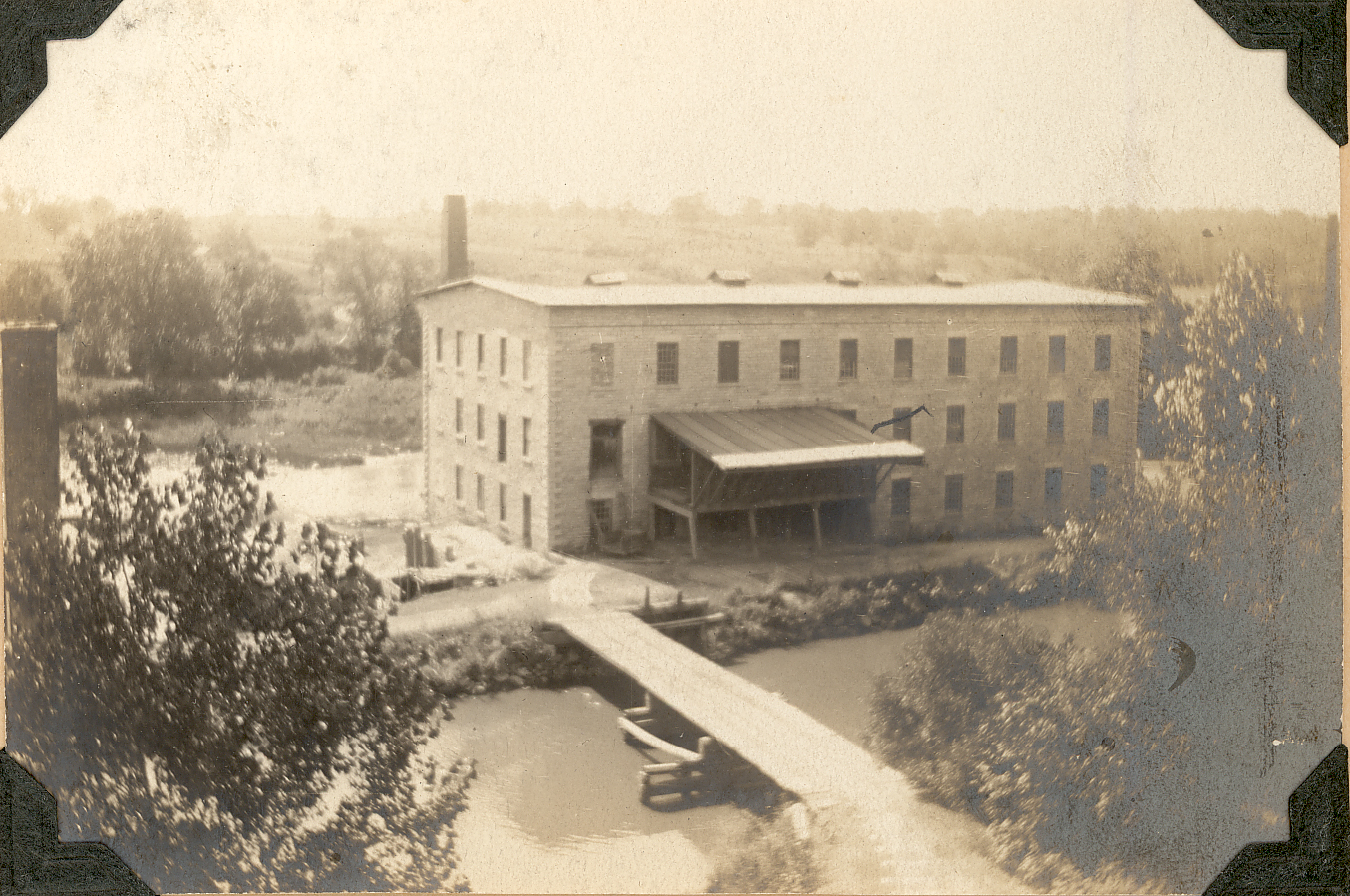
After the 1888 fire the remaining building was bought for the fire brick factory.

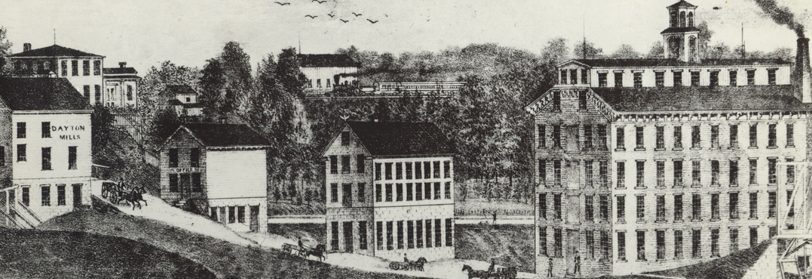
In August, 1892, the Ottawa Paving Brick Company, under the management of John W. Channel, who, for several years prior to this date, had been superintendent of Hess, Crotty & Williams brick factory, leased the brick works at Dayton, Ill. For three years this plant was run successfully, when, in November, 1895, the Standard Fire Brick Company, of Ottawa, Ill., was organized by Thomas D. Catlin, John W. Channel, M. W. Bach and E. W. Bach, with $25,000 capital stock. The company bought the Dayton property, consisting of the large, substantial, four-story stone building, formerly used as a woolen mill, and also the three-story frame building, used for many years as a horse collar factory, together with all the clay lands, water-power and machinery. John W. Channel was made president and general manager, Thomas D. Catlin, vice-president and treasurer, and E. W. Bach, secretary.

Shortly after the Standard Fire Brick Company had been legally organized and had commenced business, negotiations were entered into with the firm of Hess, Crotty & Williams for the purchase of their brick factory, located about a mile east of Ottawa, at a station called “Brickton.” The capital stock of the Standard Fire Brick Company was increased to $50,000, and the purchase of the plant of Hess, Crotty & Williams effected, and the company assumed control in May, 1896, with the same set of officers that the original Standard Fire Brick Company had, each private individual of the old firm of Hess, Crotty & Williams taking an interest in the company which purchased their plant.

The Dayton plant is situated four miles north of Ottawa, on the Fox river branch of the Chicago, Burlington & Quincy railroad system, and has its own sidetrack along the yards, and the Ottawa factory is located on the Chicago, Rock Island & Pacific main line, with a side track at the factory also. Thus the company has double the shipping facilities that any concern located on a single system would have, saving, of course, a great deal of annoyance and the expense caused by transferring from one road to the other. The company is a member of the Western Railway Weighing Association, from which a great benefit is derived.

At the Dayton factory the company has abundant water-power, and at Ottawa steam-power is used. Both places are heated thoroughly by a complete system of steam pipes, and they are also amply equipped with the usual dry pans, pug mills, clay crushers, conveyors, hand and power presses, clay bins and auger machines; no steam process being used in the manufacture of their wares.

The company has 65 acres of clay land, all underlaid with a vein of fire clay, most of it within 8 to 16 feet of the surface. At Ottawa, on top of this fire clay, there is a vein of coal about 22 inches in thickness, and above this coal a vein of common clay, varying from common yellow clay to one having the nature of soapstone. This yellow clay, properly mixed with a proportion of fire clay, is used in making their sidewalk tiles. At Dayton, on the west side of the river, there is, above the fire clay, besides a vein of coal, an extensive bed of valuable shale about 30 feet in depth. This makes good common ware, and mixed with a little fire clay, makes as fine a sidewalk tile as one will find anywhere in the country. On the east side of the river, where the main supply of the company’s fire clay is obtained, there is nothing above the fire clay except a bed of excellent gravel about five to eight feet in thickness. This gravel makes is possible to maintain the roads to the factory in excellent condition.

Fire brick and fire clay articles are the company’s main product. The market for this material is, besides Chicago, the great trade center of the West, all of the northern part of this State, Iowa, Wisconsin, Minnesota and Michigan, all of them great manufacturing states. Their competitors in the fire clay materials are very few, while the competitors in the common clay products are many, nearly every location of any size at all having its own common brick yard.

Many of our people do not realize the vast diversity of clay deposits in the close proximity to Ottawa, and their immense wealth that would result from their proper development, and in order to show the great variety of clay we have at Ottawa, as well as at Dayton and Brickton, it is well to take note of the principal kinds of clay, and their divisions. The term clay, as ordinarily used, means any earthy substance which, when worked up with water into a plastic mass, will retain whatever shape it is made into. Varying and ever changing proportions of iron oxide, lime and organic matter are found in conjunction with different beds of clay material, and the term, clay, is used to denote them all, including shale. Strictly speaking, however, “clay” means silicate of alumina, or kaolin, said to be derived from two Chinese words (Kau-ling), meaning high ridge, reference being made probably to some location where vast quantities of clay material were found. The greater per cent of silica and alumina (forming kaolin) there is in a clayey substance the more valuable it is, and the nearer it comes to being pure kaolin or true clay. All clays are the result of decomposition, mostly of feldspar, which was a large proportion of the ancient granite rocks, combined with quartz and other minerals, and in the course of decomposition the deposits have been washed and transported for long distances, together with particles of sand and deposited in vast beds, thus forming clay deposits; particularly is this true of fire clay.

At Dayton they have an extensive bed of excellent shale, which is a term also applied to certain clays, not so much because it is composed of different substances or different proportions than other clays, but because it has a thinly laminated structure, the stratification in its formation being well marked. Of this deposit there are none at Ottawa.

There are two classes of clays, viz., high grade and low grade clays. Of the low grade clays they have five of the six subdivisions present upon their properties. 1. Argillaceous shale (present in Dayton only). 2. Silicous clays. 3. Tile Clays. 4. Brick clay. 5. Calcereous clay, and all of the last four at both places. Each kind has its particular adaptability. For instance, the first mentioned is not to be excelled in making paving blocks, the second is adapted to sewer pipes, the third and fourth for roofing and drain tile, and the fifth for common brick. All these varieties exist, and to one accustomed to clay it is not difficult to distinguish the various kinds.

Of the high grade clays, of which there are also six subdivisions, they have two at both places, viz.: 1. Hard fire clay. 2. Plastic fire clay, used for the manufacture of refractory material. These fire clays are a composition of about 59 parts silica, 27 parts alumina, 11 parts water, and 3 parts of iron and other fixing properties. The term, fire clay, is applied without restriction to all clays found immediately underlying coal beds, although the extremely low grade of composition of many of these deposits of so-called fire clays do not warrant their being called fire clays at all. They have the true fire clay, viz., a refractory clay which becomes white upon calcination, i. e., burning the crude clay as it comes direct from the bed.

This fire clay is the material out of which they manufacture their most important products. The upper stratum of common clay and coal is removed and the beds of fire clay exposed, they being from six to ten feet in depth. The clay is then blasted out in large quantities, and conveyed to the dry pan and ground very fine and run over screens, and often shipped in this state to be used as mortar in laying up brick used for refractory purposes. In making brick, after being ground fine it is run through pug mills and then auger machines, and here it comes forth in streams of varying size, depending on the dies used, and cut off by wires into the size and shape desired, except very large or special shapes which have to be hand-moulded or hand-pressed.

They can well be proud of the reputation their brick have attained in Chicago and the Northwest, which is un-paralleled by any of their competitors. They supply material for stack linings, boiler settings, iron cupolas, furnaces, foundries, lime and brick kilns, retorts, and any purpose requiring refractory brick. The beds of plastic fire clay at Brickton, and also to a limited extent at Dayton, have not been touched in recent years, although they are very valuable deposits, as they are adapted for the manufacture of stone ware and articles of that kind.

As to the sidewalk tile and small pavers they cannot be discounted by anyone. They are made from a mixture of the shale at Dayton, or the top clay at Brickton, with a certain per cent of the clay; then the process of manufacture is the same as fire brick, only having a design of some kind pressed on the surface. In order to obtain an even and smooth surface the sidewalk tiles are treated to a salt glaze, which gives them a very pleasing appearance. Miles of their sidewalk tile can attest their usefulness, in Ottawa alone, to say nothing of the great quantities recently shipped to cities and villages in this state where the idea of using tile for sidewalk has just taken effectual hold upon the people. They are cheaper and more lasting than cement walks, less expensive than stone, better in appearance, more desirable than wood, and when properly laid make the most durable walks that can be had. Although the atmosphere and its destructive agencies decomposed the massive rocks from which comes the clay used to make these tile, yet if it is properly vitrified and placed where it will not be broken or destroyed by abrasion, it will be a tablet that will last forever, absolutely indestructible by the atmospheric agencies or the elements. Making articles from clay was the first manufacturing industry in the world, and it is to-day the second largest industry in the United States; and it can be said that as long as the earth lasts, brick will be made, and the future inhabitants will be able, 4,000 years hence, to find remains and specimens of the products of this age, as we today can and do look upon authentic specimens of brick made over 4,000 years ago.

from the Ottawa Republican-Times, date unknown
Was Mysteriously Shot

WAS MYSTERIOUSLY SHOT

August Morrel, of Dayton, Lying at the Hospital – Revolver Bullet Near His Heart

Was Returning Home from Ottawa When Accident Occurred – May Have Stumbled While Carrying it in His Pocket – May Recover

August Morrel, whose home is in Dayton, was mysteriously wounded while returning home from Ottawa at an early hour this morning. That it was an accident is very probable from the location and direction of the wound. The bullet, evidently discharged from the man’s own revolver, which he claims was in his pocket, entered the left breast and passed through the right chamber of the heart, and finally lodged under the left shoulder blade. This occurred on the railroad about a half mile south of Dayton, from which point the man succeeded in crawling home, when Dr. Herzog, of this city, was notified and went to the assistance of the wounded man.

Morrel was then brought to the Ryburn hospital, where he is in a fair condition but the final results are not known.1


  1. Ottawa Daily Republican-Times, November 20, 1905, p. 8, col. 3

Charles Fraine Funeral


Charles Fraine Funeral

            Funeral services were held Saturday morning with a requiem mass for Charles Fraine, aged 83, who died at his home here Thursday, following a short illness. The mass was sung by Rev. Barrett, assistant pastor of the St. Columbus [sic] Catholic church. The pall bearers were James MacGrogan, James Kelly, Rush Green, Wm. Buckley, Sr., Edward Zellers, and James Collison.

            The deceased is survived by three daughters, Misses Emma and Jennie Fraine and Mrs. Addie Thompson of Dayton, one son Jules Fraine and three grandchildren, Roy, Kenneth and Lola of Ottawa.

            Mr. Fraine was preceded in death by his wife. He was a member of the Catholic order of Foresters and interment was made in St. Columba cemetery.

            Those from a distance who attended were: Mr. and Mrs. Ray Doran, Mr. and Mrs. George Graves of Aurora, Mr. Ed. Raspillar and Mrs. Josephine Mansfield, Plano, Mrs. Mamie Fraine and son Elmer, Miss Edna Parrisot, Mrs. John Florent, Joe Colbe, John Colbe and C. Aldrich, all of Somonauk; Mr. and Mrs. Ernest Raspillar and Mrs. G. Marco of Shridan Junction, Chas. Claude, Sr., and Chas. Claude, Jr., and two daughters of Serena, Ill.1


  1. Ottawa Republican-Times, November 13, 1928, p. 10, cols 6-8

The Winter of the Deep Snow

snowdrifts

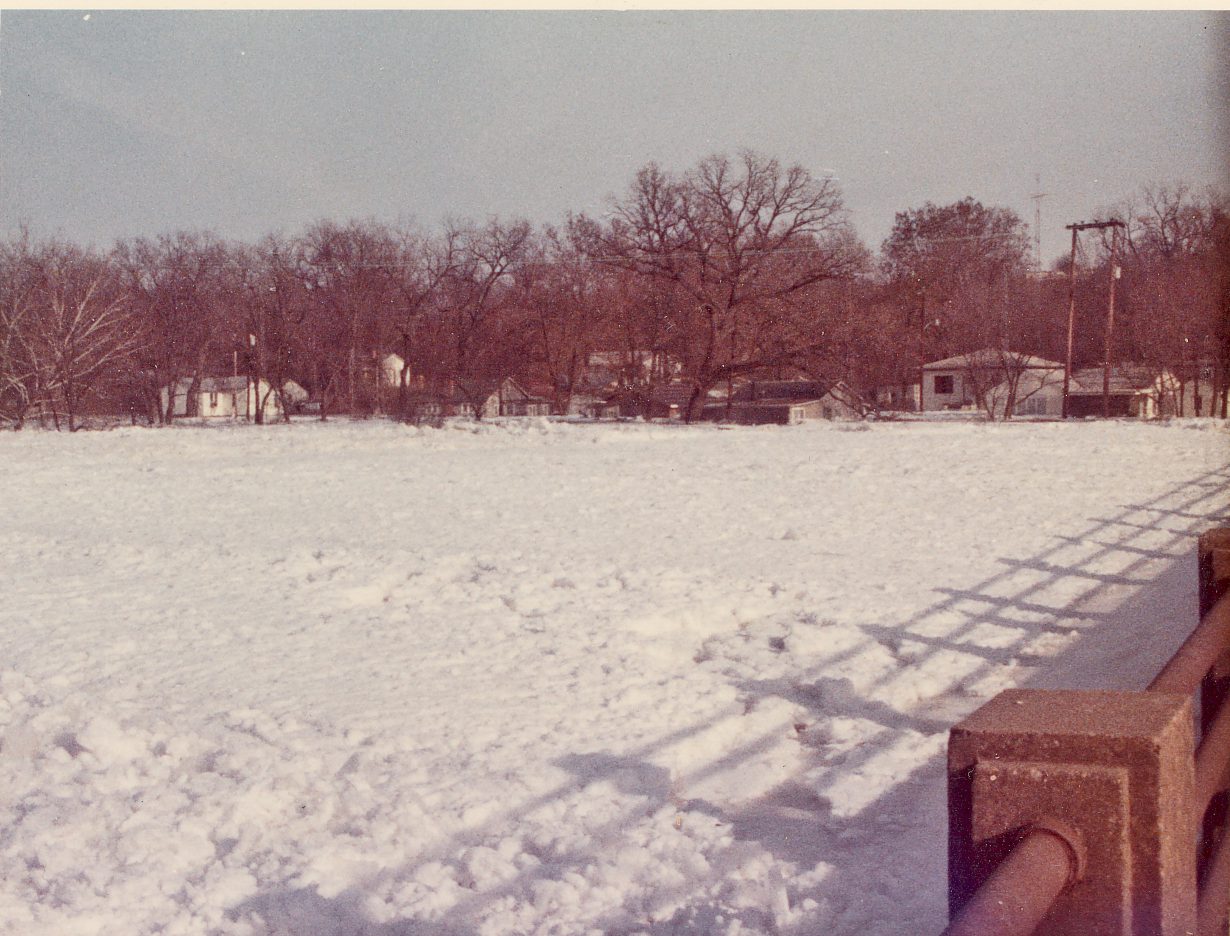
Since there are no pictures of the 1830 deep snow, here is a newer one.

There have been many hard winters in Dayton – plenty of snow, ice in the river, icy long-lasting cold – but none can surpass the Deep Snow of 1830, at least in the memories of the hardy pioneers who lived through it.

The snow blanked Illinois to a depth of three feet, with drifts of four to six feet. Storms with high winds continued for two months.  Many families were snowbound for the duration, and travelers were stuck wherever they happened to be when the heavy snow started. This is before the weather records begin, so there is nothing but anecdotal evidence, but there is plenty of that.

The winter of the Deep Snow became a legendary dating point and those who came to Illinois before that date qualified for membership in the Old Settlers Association. When the Sangamon County Old Settlers Society was formed there was a special designation for all those who were in Illinois before then – they were Snow Birds. Among the list of members of that first group is the name of Abraham Lincoln.

La Salle County was among the first, if not the first, county in Illinois to establish an Old Settlers  Society. They met on February 22, 1859, in La Salle. The meeting was mentioned in the Ottawa Free Trader, with the note that a fuller writeup of the meeting appeared in the Peru Herald. Unfortunately that newspaper does not survive.

Jesse Green, in his memoir, recalls memories of their first few winters in Dayton:

The second and third winters we were here we had about two feet of snow, which lay on the ground most of the winter, and drifted badly and crusted over so that we could ride over fences without difficulty, and prairie chickens were so plentiful and tame that on a frosty morning, they would sit on trees so near our cabin that Father stood in the door and shot them, until some of the men said he must stop before he shot away all of our ammunition, and leave none to shoot deer and turkeys.  Our first winter here Brother David and myself trapped rising three hundred chickens, besides a large quantity of quail.  After eating all we could, Mother merely saved their breasts salted and smoked them.

For more information, illinoishistory.com has this page devoted to the stories of the Winter of the Deep Snow.

A far-traveled Dayton girl


Emma May Rhoads

[When I go trawling the Internet for mention of Dayton people, I sometimes find rather tenuous connections. In this case, she was born in Dayton township, but the family moved to Ottawa almost immediately. However, her story was so interesting I am claiming her as a Dayton person.] 

Emma May Rhoads was born in Dayton township on September 19, 1874, the daughter of Thomas Rhoads and Kathrine Bardouner. The family moved to Ottawa shortly thereafter, where Emma went to school, graduating from Ottawa Township High School in 1893.

She attended the University of Illinois in Champaign-Urbana, working on the Daily Illini, the student newspaper, and graduating in 1899. She was a member of Kappa Kappa Gamma, the Aletheni Literary Society, and was president of the Y.W.C.A. in 1898/99. It was here that she became acquainted with her future husband, Edward Nickoley.

After graduating from the U of I in 1898, Edward departed for missionary work in Beirut, Syria, at the Syrian Protestant College, later the American University of Beirut. Emma taught in New York for several years after she graduated, and on August 12, 1903, they were married in Champaign, Illinois. She returned with him to Beirut, Syria, where he was a teacher in the Commerce department. For several years she was the general secretary of the Y.W.C.A. for Syria and Palestine.

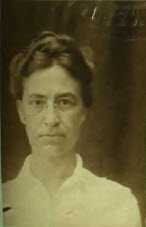
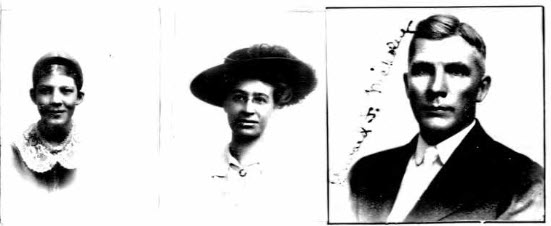
Kathrine, Emma, and Edward Nickoley

In 1914 Edward had a furlough year and Emma and their daughter, Kathrine, returned to spend the time in Urbana while he was occupied elsewhere. Emma enrolled in the University of Illinois, in the graduate school of literature, making a special study of Journalism.

The situation in Europe was becoming increasingly dangerous, and in August, Edward landed at New York in the last ship to leave Hamburg, Germany. The ship was chased by French cruisers, but escaped capture and landed safely in New York. Edward joined his wife and daughter in Urbana and enrolled at the University. In June 1915, both received master’s degrees: Edward in economics and Emma in English.

They had planned to return to Beirut in September, 1915, but owing to the war conditions existing in the East, they were unable to. They stayed in Urbana and registered in the Graduate School again, pending the bettering of war conditions and the assurance of reasonable safety on the seas in the return trip to the college at Beirut.

By January, it appeared possible to make the attempt to return to Syria. They left New York on January 24 on the Greek liner Vasilef Constantinos. French, English and German ambassadors gave every assurance that the passage of the neutral liner would be safe. They planned to remain in Athens for a week for the purpose of visiting the ruins and the other points of interest about the city. From Athens , they would go on the U. S. man-of-war Des Moines to Beirut in Syria.

They had plenty of time to sightsee, as they were still in Athens in April, awaiting special passports from the French to allow them to pass the blockade into Syria. By fall they still had not been able to get to their destination. In October, Emma and Kathrine returned to Urbana, where she gave the following interview:

We left for Athens last January, where we expected to go on board the U. S. gunboat Des Moines for Beirut, but the Turkish government absolutely forbade our landing at any ports on the Mediterranean. So we spent the next nine months in Greece in the hopes of finding some means by which we might get into Beirut. Finally, my husband was ordered to make the trip overland, which he is now attempting to do. Although it is only a two days trip by water, the journey overland involves going through France, Switzerland, Austria, Constantinople and lastly a long trip across country to Beirut, which will take at least three weeks. According to newspaper accounts, however, it will be impossible to get into Austria at all, in which case he will return home at once. I do not think that my daughter and I will be able to return to Syria until the war is over.

Edward did succeed in his overland trip, but Emma was correct that it would be some time before she and Kathrine could return. She again enrolled in the university, studying library science. It was not until February 1919 that Emma and Kathrine sailed from New York for Beirut, with a unit of missionaries and relief workers. They arrived in April, after being held at Port Said several weeks awaiting the arrival of a coastwise steamer.

At this time, Edward was dean of the School of Commerce and professor of economics at the American University at Beirut. From 1920 to 1923 he served as acting president, in the absence of the president. Emma did relief work in Beirut and assisted in reorganizing the University library, and daughter Kathrine taught in the home economics department.  In 1923 Edward had another sabbatical leave and they returned to Illinois, to study library science (Emma) and economics (Edward). They planned that after his retirement they would return to Urbana to live.

Sadly, this was not to happen, as Edward died in 1937 in Beirut. Emma, who was then dean of women at the university, and her daughter, who taught at the school,  returned to Urbana and were much in demand as speakers, telling of their experiences in Syria. As reported in the Belvidere, Illinois, Daily Republican, Emma gave a lecture to schoolchildren in Belvidere in which she told of archeologists she met while in Syria:

History students of Belvidere high school heard interesting anecdotes about archeology from Mrs. Edward Nickoley, former resident of Beirut, Syria, who gave a classroom lecture at 2 p.m yesterday in the high school.

Mrs. Nickoley explained the work of noted archeologists who she had met in Syria during her 34-year-residence at the Beirut college where her husband was professor. She described the work of James Henry Breasted of Rockford, who is considered one of the most outstanding men in his field.

Other archeologists included in Mrs. Nickoley’s talk included Lord and Lady Petrie, famous British scientists; Gertrude Bell, T. E. Lawrence, who is the author of “The Seven Pillars of Wisdom,” and Leonard Wooley.

Mrs. Nickoley knew these scientists personally. Lady Petrie gave her a priceless vase that is 2,000 years old. Mrs. Nickoley displayed the vase and other archeological specimens.

Sometime between 1958 and 1966, Emma moved from Urbana to Minnesota. She died in Rochester, Minnesota, in January, 1972, at the age of 97.

1952: The Fox River Was Acting Up Again


Ice up to the floor of the bridge

ARMY ASKED TO USE DYNAMITE ON ICE GORGE AT DAYTON DAM1
Bridge Endangered as River Continues Rise
Families Flee as Water Enters Homes
Power Plant is Shut Down

BULLETIN!

Kenneth Short, superintendent of construction of the Illinois Division of Waterways, arrived at Dayton today to make a survey of the flood situation. He informed State Rep. J. Ward Smith this afternoon he would confer immediately with other engineers on the advisability of using dynamite or some other method to break the ice gorge.

The flood situation at Dayton, caused by a huge ice gorge in the Fox River, was described as very serious today, and the U. S. Army Corps of Engineers was asked to consider the matter of dynamiting the jammed slush ice.

The ice gorge went down slightly last night at 8, then rose again today, and water flowed over the road at the east side of the bridge below the dam. Ice reached the floor of the bridge, which is in danger of being washed out or badly damaged due to the intense pressure against it. At 9:30 today the water had risen to the top of the dam, above the floor of the bridge and the power plant of the North Counties Hydro-Electric Company was put out of commission.

Water completely surrounded several of the numerous cottages on the east bank of the river, both above and below the bridge. Basements of some of the homes were flooded and water had risen above the ground level floors of others. Many of the families moved out their furniture as the water continued to rise.

Move Furniture

At the Frank Kossow Jr., home water was over the floor and half way to the windows. Furniture from this house was moved last night to the nearby home of Frank Kossow Sr., which was on higher ground. This morning the water had reached the front steps of the latter’s home and had entered the basement. Mrs. Frank Kossow Jr., and her two sons, 5 and 3 years old, have gone to Peru to reside temporarily with her mother until the flood danger is over. Her husband was called back from Chicago where he was attending a convention. Frank Kossow Sr. is vacationing in Florida.

The H. T. Mossbarger house south of the road leading to the bridge was completely surrounded, and water threatened to enter the house. The Mossbargers, who have an 8-year-old son, piled up their furniture to protect it from damage and moved out last night.

North of the road an unoccupied summer cottage owned by George Farnsworth, county engineer, was moved from its foundation, and was tilted at an angle. The water there was nearly to the windows. The Harlan Kossow home also was surrounded by water, which at 10 today was within a foot of the floor.

Auto Submerged

An automobile owned by Ted Mathews in the yard near his home was almost completely submerged.

Water was up to the front door of the Larry Marta home. Marta is at Ft. Benning, Ga., attending a National Guard training school. His wife and their four-month-old baby moved out last night, and are residing temporarily at the home of her husband’s parents, Mr. and Mrs. Dom Marta, Illinois Avenue.

The fire in the furnace at the home of Mrs. John Murphy was extinguished as water entered the basement. The family of Roy Murphy moved out as water entered their home. Another home threatened with flood damage was that of Bernard Hackler, who is employed in Ottawa by Scherer’s.

The Clyde Jeffries family left their home as the river continued to rise, and they were unable to return as the roadway leading to the house became submerged to a depth of four feet. This morning water had risen to within seven inches of the floor of the William Campbell home. The Robert Kennedy home was another which was flooded.

There are approximately 15 homes, with about 35 occupants, in the flooded area on the east side of the river.

Damaged in 1943

Robert Kennedy said today that in a similar flood in 1943, caused by an ice gorge, the river rose to about the same height that prevailed this morning. At that time the bridge was moved a couple of inches and cracks were caused in the foundation. The present bridge replaced a steel structure that collapsed in 1940 under the weight of a truck and automobile which were crossing it.

The drop in the level of the ice gorge last night apparently was due to the closing of the gates at the Starved Rock dam, causing a rise in the level of both the Illinois and Fox Rivers, and the subsequent opening of the gates, resulting in sudden dropping of the level. This action was taken at the request of George Farnsworth, county superintendent of highways. Dropping of the level presumably broke open a channel for the gorged Fox River ice. A new pileup of ice, however, in the river cause the water to rise again.

State Rep. J. Ward Smith was contacted by Dayton area residents at 3 a. m. today after the river resumed its rise. Rep. Smith telephoned to Tom Casey, chief engineer of the division of waterways, Illinois Department of Public Works and Buildings, and urged his cooperation in coping with the critical situation at Dayton. He also notified state police, who promised their assistance. After conferring with Casey, Rep. Smith notified the U. S. Army Corps of Engineers, and asked their assistance. Smith suggested that dynamite be used to open a channel.

H. McGrogan, superintendent of the North Counties Hydro-Electric plant, said this morning that the water was 24-25 feet above normal below the dam, which is 26 feet in height from base to crest. There were two feet of water on the floor of the hydro-electric plant. McGrogan said the water was still slightly below what it was on the occasion of the last gorge, but he predicted it would go higher because of the enormous amount of ice still coming over the dam. He described the bridge situation as serious, due to the tremendous pressure against the structure.


  1. Ottawa Republican-Times, January 30, 1952, p 1

David Green

David Green (1819-1880)


David Green was ten years old when he came to Illinois in 1829 with his family. His father, John Green, had organized a party of settlers to move from Ohio to Illinois. David and his older brother, Jesse, were doing men’s work from the very start. Jesse later described some of their efforts in the initial building of a dam to drive the mill:

Whilst the men were getting out the timber for the mill and dam, which had to be built to intersect a small island, brother David and myself took the contract of scraping out the race or waterway for a distance of about a half mile (he being ten, and I twelve years old). We each had a pair of oxen and an old fashioned scraper. I sometimes had to help him load and dump his scraper and vice versa. We had the race completed by the time the mills were ready to draw their gates.

The winter of 1838-9 David and Jesse went back to Ohio, intending to go to school but their uncle Isaac Green persuaded them to take a room in his house where the school teacher boarded. They both claimed that the boys would make better progress than by attending school, as the teacher would give them his entire attention when not in school. This one term of school in Ohio and one other back home under Reuben Miller was the extent of their formal education.

David and brother Jesse, under the name of J. & D. Green, ran the first woolen mill, built in 1840. It was a building 32 by 60 feet, three stories high.  It at first contained but one set of machinery consisting of three separate carding machines, a jack of 126 spindles, and four power looms, and two broad, and one narrow hand loom. Later, when the large stone mill was built, they took into partnership their brother-in-law, Oliver W. Trumbo. In 1844, David took over the additional position of manager of the Green grist mill from his father.

On Christmas Eve 1847 David married Mary Stadden, the daughter of William and Judah (Daniels) Stadden. William and his family arrived in the Dayton area in 1830. He built a flour mill at Dayton and became a prominent figure in La Salle County, serving as sheriff for two terms and elected twice to the State Senate.

When William Stadden died in November, 1848, David was named the executor of his will. The estate had many uncollected receipts and outstanding debts, which required many court appearances to resolve. It was at this time that word of the discovery of gold in California arrived and brother Jesse resolved to go West himself, with a party of Dayton men.

I’ve always felt sorry for David being left at home while his brothers went off to California, but someone had to stay home and manage the farm and the mills. Since David was deeply involved in settling his father-in-law’s estate, he also dealt with the necessary changes at home. The farm was rented to the Hite family, who moved into the Green house. Barbara Green and the younger children, Rachel, Rebecca, and Isaac, moved to the hotel, where they were joined by daughter Katherine Dunavan, whose husband, George, was one of the gold-seekers.

David was therefore left in charge of the woolen mill, the grist mill, and the store, as well as the “Golden Widows”. As the only man of the family his responsibilities were large. His sisters, Nancy and Katherine, were also golden widows.

In 1852 David was proud to advertise that the mills had just undergone thorough repairs and were now so arranged that six run of burrs could be turned on custom work or merchant either, which made the “Old Pioneer” one of the best custom mills in the state; as the four run of merchant burrs, bolts, &c., could be used for custom work whenever required.   

By the 1870s, David had taken one of his sons in business with him. The Ottawa Free Trader reported:
The mill at Dayton, rebuilt a few years ago and lately put in thorough repair is well known as one of the best in Northern Illinois. It has always been popular and famous for the excellence of its work, and with its present management, in the hands of D. Green & Son, it will more than sustain its old reputation.

In 1879 David repaired the old shop south of the flouring mill in order to use it to manufacture drain tile. A tile machine with brick attachment was ordered and installed and the firm of D. Green & Son announced that they would be making brick in short order. The clay around Dayton was of an excellent quality and made good substantial brick and tile.

By then, David had retired from active participation in the day to day business of D. Green & Sons. He may have suffered from depression, as the 1880 census listed him as “melancholy”. That census was taken in June and on September 2, David died.

Thoughts About Trains

In addition to passenger service, engine 4960 provided freight service on the railroad line through Dayton. We lived right next to the railroad tracks (the bush on the right is in our back yard) so passing freight trains shook everything in the house. Living so close, you became deaf to the noise and it was not unusual for someone to ask if the train had come through yet. My mother had a set of glass shelves which hung on the dining room window. One of the ways to answer the question was to see if any of the trinkets on the shelf had fallen over.

Other people were not quite so complacent about the noise. Once a guest who had spent the night in our guest room, which was on the side next to the tracks, came down to breakfast asking “WHAT was that thing that came through my room in the night?”

As children we left coins on the track or crossed pins, which made scissor shapes when squashed by the wheels. We always waved to the red caboose, regardless of whether anyone was there to wave back..

The track ran uphill going north out of Dayton. In bad weather, when the track was icy, it seemed to take forever for the train to pass our house. It seemed to slip back one foot for every two it gained.

The passenger service ended in 1952, (see here and here for the end of the “Dinky”) but engine 4960 continued a freight run twice a day until newer engines took over in 1966.

Joel F. Warner – fisherman

large mouth bass

Joel Foster “Faut” Warner was a noted Dayton fisherman and his prowess received notice in the Ottawa newspaper.

May 8, 1886, p. 8, col. 3
Dayton, May 6th. – Fishing is fine here this season, and the game fish are being caught in large quantities. Our old fisherman, F. A. Warner, a short time ago caught one hundred and forty-one bass in one day, and Mr. Lewis Makinson caught seventy-five. Yesterday was a big day and scores of the finny tribe were removed from their watery homes.

May 12, 1888, p. 8, col. 2
J. F. Warner, our fisherman, caught fifty fine bass last Tuesday morning.

He is called Peg in this next item because, in 1877, he lost his left leg. He tried to get on a moving railway train, slipped and had a car wheel run over it. It had to be amputated 4 inches below the knee. He must have had a peg fitted to the stump.

8 Aug 1902, p12, col 4
                          STOLE HIS BOAT AND FISH
          “Peg” Warner of Dayton Comes To Town With a Sorrowful Tale
“Peg” Warner, an old-time fisherman at Dayton, is in the city today and with Chief of Police Westcott is making a search for his boat, fishing tackle and about fifty pounds of catfish stolen from him last night. During the summer months Peg devotes his whole time to fishing, and is kind to campers and people who visit Dayton. The boat which was stolen is a new one, especially designed and built by Peg for his own conveniences in the river. It contained a life box and also a chamber for minnows, and anybody that visited Dayton was always welcome to the use of the boat. He also had some fine reels and fishing tackle, but all were taken. It is hoped that the thief will be captured and if he is, Peg will make him suffer.

Unfortunately, there is no follow up article. I can only hope that Peg was able to get his boat back.

Mail to California

In April, 1850, David Green wrote to his father and brothers in the gold fields near Sacramento. The postage to California and Oregon was 40 cents and it was paid by the sender. This letter was folded and sealed to create its own envelope. Note the red blob of sealing wax still adhering to the paper. The postmark reads “Ottawa Ill. APR 28”. How did this letter get to California?

Mail to California began in November, 1848, when Postmaster General Cave Johnson dispatched a special agent to California to establish Post Offices. By Christmas, steamships were carrying mail from New York to California via the Isthmus of Panama. This was before the construction of the canal. When the ships reached Panama, the mail was taken off and transported in canoes or on pack animals – and later by railroad – about 50 miles to the Pacific coast. Another steamship collected the mail on the Pacific side and headed north. The total journey took about three weeks. See here for map.

Since the first overland mail service to California was not until the spring of 1851, this letter likely went by boat from Ottawa to St. Louis and then by steamboat to New Orleans. From there it joined the main mail route from New York, crossing Panama and continuing up the coast to San Francisco.

This second letter came in its own (hand-made) envelope. Note that in this case the sender paid only 10 cents, leaving 30 cents to be collected upon arrival. Was David thinking the miners would have plenty of gold to pay the amount due?

Mail to and from California was eagerly awaited and all the letters stressed the fact that they had not heard from the other in a long time. Then a batch of letters would appear all at once and news was relayed to everyone for miles around, in hopes that their people would be mentioned. Many of the letters from La Salle county people were published in the Ottawa Free Trader.

Mail from home was not only eagerly awaited, it was treasured. These two letters, mailed to California and received there, were put away safely and brought home with them. The fragile originals are now treasured as evidence of how important the mail was to the adventurers.

Mr. and Mrs. C. B. Hess

Charles Benton Hess was born November 13, 1839, in Forrestville, Virginia, the son of Henry H. Hess and Mahala Hammond. He came to La Salle county in 1854. He took up farming as a career but later decided to complete his education. He attended and graduated from Lombard University at Galesburg and later studied law in Chicago, but never asked admission to the bar. After finishing his studies he returned to La Salle County and again took up farming.

In 1877 he owned 220 acres of land, valued at $11,000; and 4 houses and lots in Dayton, valued at $3,000. Later he gave up the agricultural field to enter Green’s Woolen Mills at Dayton. Later he came to Ottawa and entered the real estate business, with offices over the post office, and from there branched out into the clay and tile industry. He served as a Justice of the Peace and as town clerk of Dayton.

In 1880, with his brother-in-law H. B. Williams, they erected a plant, known as the Standard Brick Company’s works, at Brickton, about one mile east of Ottawa, along the north bank of the canal, and commenced the manufacture of brick. This appears to have been the first clay manufacturing concern of Ottawa. In 1882, finding traveling to Dayton every day after the close of business tiresome, he removed his residence to Ottawa.

Clara Isabella “Callie” Green was the daughter of Jesse Green and Isabella Trumbo. She was born in Dayton December 12, 1849, while her father was away at the gold fields of California. She married C. B. Hess May 12, 1869. in Dayton.

They had 5 children:
Edwin Jesse was born in Dayton, June 28, 1871. He married Edith Powell of Coffeeville, Kansas, in Coffeeville in January of 1905.

Gertrude Noel was born in 1874 and died the following year.

Glenn Raymond was born in 1876 in Dayton. At the age of five he slipped from the rocks just above the Fox river bridge in Ottawa and drowned.

Edith May was born in October 1880 in Dayton. She married Albert E. Gilman, assistant superintendent of the King & Hamilton Co., factory in Jan 1905.

Harry Charles was born after the move to Ottawa, on August 16, 1883. He married Dell M. Terry at the bride’s home in Harding in October 1910.

C. B. died September 23, 1918, in Ottawa and Callie died July 25, 1930, also in Ottawa.

Will of Hannah Rebecca (Rhoads) Green

Hannah Rebecca Rhoads, the second wife of Jesse Green

On May 3rd, 1894, Hannah Rebecca (Rhoads) Green signed her will, only a few days before her death on May 23rd. She named her son J. Kent Green as executor and trustee of her estate. He was directed to use the income from the property for her husband, Jesse Green, during his lifetime. If not all the income was needed by Jesse, the trustee was directed to pay off the debt owing on the estate. At the death of her husband, the property was to be divided among her sons, Thomas Henry Green, Joseph Green, James A. Green, Frank Green and J. Kent Green and her grandchildren Ethel May Williams and Frank Roger Williams, children of her deceased daughter, Cora, wife of H. B. Williams.

You can see the full text of the will here.

Marriage of Charles Brown and Minnie Furr

Charles Brown and Minnie Furr on their wedding day
Marriage application

On December 29th, 1890, Charles Brown and Minnie Furr, both of Dayton township, applied for a marriage license. Charles was 25 years old, a butcher, born in Freedom township, son of George R. Brown and Isabella W. Hosford. It was his first marriage.

Minnie was 20 years old, born in Seneca, daughter of Squire Furr and Mary Bruner. It was her first marriage, also.

Marriage Affidavit

Charles Brown filled out the affadavit swearing that they were of age, unmarried, and could legally make a marriage contract.

Marriage License

Patrick Finlen, the county clerk of La Salle County from 1882-1894, filled out the license on the 29th of December, granting permission for the marriage to be celebrated.

N. O. Freeman, minister of the First Methodist Church of Ottawa, performed the ceremony in Dayton on December 31st.

Marriage Certificate

John Samuel Hippard


John S. Hippard, who is buried in the Dayton Cemetery, died August 25, 1905, in Dayton Township. He was 29, unmarried and left no will, so his estate went to his siblings. The proof of heirship in the probate papers1 attests to the following relationships:

John Samuel Hippard’s parents, Stephen William and Frances Rebecca Hippard, had 5 children: Charles William, John Samuel, Mary Elizabeth, Jacob Henry, and Frances May.
    Mary Elizabeth died about 1891. She was about 13 years old and unmarried.
    Jacob Henry is unmarried and living with his parents in Dayton township .
    Frances May (Fannie) is married to Newton Conner, living in Wedron in Dayton Township.
    Charles William lives in Dayton township and is the administrator of the estate.

John Samuel, Jacob Henry, and Frances (Conner) Ackerman are all buried in the Dayton Cemetery. See the index on this site.

At his death, John owned no land, and no tangible personal property. His only asset was a health insurance policy which provided that in case of ill health he would be paid $35/month. He had been sick for a little over seven months and was entitled to $223. However, the policy had a clause that in the case of tuberculosis they would pay only one fifth of the amount. John did suffer from tuberculosis, so was not entitled to the full amount The estate negotiated with the insurance company and the claim was settled for $100.

The cost of administration of the estate was $37 and other claims (doctor and funeral costs) came to $125. Thus there was a balance due the administrator of $62 and no funds to pay it, so Charles Hippard petitioned the court to accept the report and declare the estate settled.


  1. John Samuel Hippard probate file, 1905, box 464, file 12, La Salle County Genealogy Guild, 115 W. Glover, Ottawa, IL 61350

It Was Hot 140 Years Ago Today, Too

Rural Happenings1

Dayton, Aug. 3. – Hot, hotter, hottest, 100 in the shade.

The tile works shipped three car loads of tile to Serena this week. They are building up a fine reputation for first class hard drain tile, and have an ever-increasing demand for them.

The vote at the school house last Saturday evening on the question of authorizing the directors to issue bonds for the construction of a new school building, was lost by a small majority. Goodbye, new school house.

Misses Hattie and Belle Brown of Newark, Ill., were visiting Miss Cora Green last week.

A frenchman working on the section had his finger badly mashed while coming home on a late train last Saturday evening. The car door was closed on his finger, and the noise of the train prevented him from being heard until the bone was broken and the finger badly crushed.

Mr. H. B. Williams started last Tuesday on a trip to northern Iowa.

Miss Hattie Edwards, of Mendota, is visiting Miss Cora Green.

Mr. and Mrs. C. B. Hess departed yesterday for Macomb, to attend the golden wedding of a cousin.

Miss Dessie Root closed her school at Wedron last Saturday with a pleasant little picnic in the grove.

The young folks picnicked at Deer Park last week. Notwithstanding the dust and heat they claim to have had a very enjoyable time.

The woolen mill runs a few hours in the evening besides their day’s work.

The river falls quite slowly. A few nice fish are being caught.


  1.  Ottawa Free Trader, August 6, 1881, p. 8, col. 2

That’s Some Bull!

Glenwood Farm Gets Fine Bull

            Straight Island bred bulls, out of 800-lb. cows with over forty daughters rapidly going under test are not picked up evey day. Mrs. Katherine E. Letchworth of Buffalo has, however, secured just such a bull for her “Glenwood Farm” at Ensenore, N. Y. She has bought of Dr. H. J. Reynolds of Chicago the great bull, Viola’s Golden Prince 111180.

            This bull has until recently been in the herd of Mr. L. A. Green of Dayton, Ill. where his many daughters are already distinguishing themselves. Seven are making a fine showing on Register of Merit test, one not yet in milk sold to Ravine Farm, Highland Park, Ill. For $600, and $500 apiece could be had for nine others if they were for sale. This will greatly add to the present popularity of this fine bull and lend increased value to every daughter he will have from now on. He is a son of Bright Prince, out of the well known cow, Cowslip’s Fawn Beauty, 806 lbs. 8 oz butter in one year, and has a good show record to his credit.

from The Jersey Bulletin and Dairy World, v. 39, no. 37, 1920 p. 2446

The Heirs of Alcinda Hite

When Alcinda Hite died in 1924, she had outlived 7 of her brothers and sisters. She never married and therefore her deceased siblings’ children were among her heirs. In order to prove Alcinda’s will, testimony was given to identify all the heirs. The following is true as of Feb. 2, 1926

Children of David Hite and Elizabeth Stickley:

Alex (died in infancy)

Isaac (died in Infancy)

Kittie Ann (died in infancy)

Benjamin married Emma Dunavan (both died before Alcinda)
2 children:
William, widower, 117 S. Monroe St., Streator
Dora, married Gillispie, Reinbeck, Iowa

James married Martha Jones (both died before Alcinda)
10 children:
baby boy (died in infancy
Martha E., married O. H. Thompson, 6 Gridley Place, Ottawa
Alcinda, married John McGrath, 432 E. Main St., Ottawa
Elsie, married John Whisler, Hutchinson, Minnesota
Elnora, married Thomas Collins, Wedron
Minerva, married William D. Whisler, Hinckley
Fidelia, married William Rabe, Belmond, Iowa
Rae, married William Osborn, McVeytown, Pennsylvania
Edward, married Gertrude Elwood, Mildred, Kansas
Elmer, married Lucy Trimble, Bayard, Kansas

David, widower, O’Neill, Nebraska

Albert (died before Alcinda)
3 children:
Calvin, married Etta Belrose (died before Alcinda)
—-1 child, Albert C., age 15-16, lives with uncle, William Temple
Vina Maude, married William Temple, Serena, Illinois
James Edward, married Jeans _____, Dayton Township““`

Fidelia (died before Alcinda), married Benjamin Babcock
6 children:
Albert, married, Schuyler, Nebraska
Jennie, married ___ Smith, Council Bliffs, Iowa
Elizabeth, married ___ Schwartz, Councill Bluffs, Iowa
Maude, married ___ Clatterbuck, Council Bluffs, Iowa
Cora, married ___ Hill, 202 Ninth Ave, Council Bluffs, Iowa
Olive, married ___ Messner, Council Bluffs, Iowa

Alcinda (the deceased)

Library Books, Oyster Suppers, and More

From the Ottawa Free Trader, December 7, 1878

                                                            Dayton, Nov. 27, 1878

            Since “Sleesel” has stopped writing, Dayton has been without representation in your valuable paper, and we think it is time for an article from our quiet town.

            Perhaps it is generally known that the woolen mill has been sold, and that Mr. Jesse Green was the buyer, so it is needless to say anything about that. Mr. Green is taking out the lower floor, and will fill in with dirt and stones.

            The public school, under the management of Miss F. A. Mott, is progressing finely. Our people consider her a No. 1 teacher.

            Although our town has no churches, yet for the past two months we have had religious services averaging once a week, and for the past year Universalist services every two weeks. Last week we were treated to an excellent discourse by Rev. M. Barnes, Congregationalist minister at Ottawa. An effort is being made to have him preach in this place next year as often as he can come.

            Last Saturday evening an oyster supper was held at the commodious residence of Mr. Geo. Dunavan, northwest of town, for the benefit of Mrs. Gibb. A large number were in attendance, about eighty-four taking supper. A notable feature of the evening’s entertainment was Prof. (ess) Mott’s Art Gallery, which, through the pluck and perseverance of the Prof., netted eight dollars for the church. It is seldom so many people get together and have such a good time as all seemed to have on that occasion. The Universalist people were well satisfied with their entertainment, as it netted them thirty-seven dollars.

            Harry, Joseph and James Green leave next week for Aurora, where they are to attend school.

            The Literary meets Friday evening to re-organize and adopt a new constitution. A committee has been appointed to procure more books for the library.

                                                                        Occasional