
Charles Miller – Postmaster, Farmer, and Tailor in Dayton


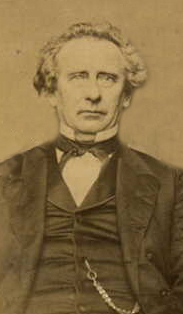
Charles G. Miller, one of the pioneer settlers of La Salle county, and for some years engaged in the mercantile business in Ottawa, died at the residence of his son in Chicago on the 3d inst., in the 72d year of his age. He was a native of Lancaster, Pa., and had come to this county in about 1837, opening a tailoring establishment in the village of Dayton, then buying and working a farm in Dayton township for several years, and then opening a dry goods store in Ottawa.

In 1862 he closed out his business here and returned to Pennsylvania, going into business in Pittsburg, but gave that up in about 1872, and since then had lived in Chicago. He was a man of more than average education, fond of books, a wide reader, and a ready and fluent speaker. Though active in his earlier days as a democratic politician, generous and big hearted, he never sought office and, except the postmastership at Dayton, we believe never held any. Two brothers, John and Uriah Miller, who survive him, are well known prominent citizens of this county; and a third brother, Reuben, who accompanied the Mormon exodus to Utah, we believe is still living there.1


  1. The Ottawa Free Trader, September 17, 1881, p. 1, col. 2.

141 Years Ago Today the School I Attended Was Nearing Completion

picture of school

Opened in 1891, this school replaced the one which burned in 1890

From Dayton

            Dayton, Ill., Aug. 29. – Mr. John Channel, who went West to southeastern Kansas and Missouri a short time ago on a land-buying excursion, brings back unfavorable reports of that section of the country for farming purposes, but gives it as his opinion that the manufacturing of lime might be engaged in profitably.

Mrs. George W. Green, who has been visiting relatives and friends at Braidwood during the past week, returned home last Saturday.

Mr. George W. Gibson and Miss Alta start this week for Nebraska on a short visit.

Miss Jessie Trumbo returned last week from a week’s visit among relatives in Chicago.

Grandma Green, who is 90 years old, shook hands with her old friends at the Old Settlers’ picnic last week. Her health is quite good, and we hope she may have many pleasant returns of the day.

The new school building is rapidly nearing completion and will be one of the prettiest buildings in the country. It is a two-story frame structure, 36 feet square, and a belfry.

There has been a vacancy in our board of directors ever since last spring, and notwithstanding the fact that the law says it must be filled without delay, no election had been called until the people took the matter into their own hands as provided by law and petitioned the township treasurer to call such election. The two directors, however, learned of the petition, and after studying their law books concluded to call an election before they were brought to their senses by the township treasurer. The election took place at the school house last Saturday afternoon and resulted in a complete victory for the taxpayers and destruction to the one-man power. The vote stood 26 for Isaac Green and 18 for J. Wright. A petition was also extensively signed, authorizing the sale of the old school building.

Mr. James Timmons, proprietor of the Dayton Hotel, has repainted and refurnished it and put it in good shape for the convenience and accommodation of the traveling public, fishing parties, &c.1


  1. The Ottawa Free Trader, August 30, 1882, p. 4, col. 3

A Stroke of Lightning

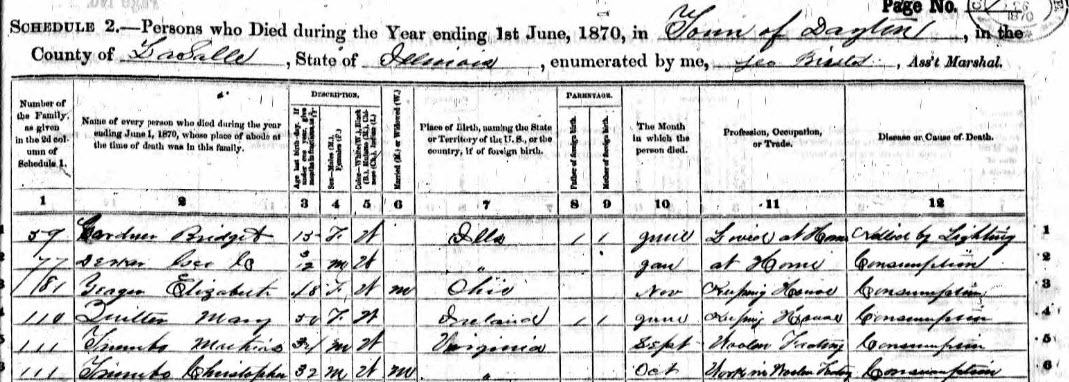
In 1870, in addition to the US population census, there is also a mortality census, which lists everyone who died in the 12 months prior to the census. The official census day for 1870 was June 1 and therefore any deaths that occurred between June 1, 1869, and May 31, 1870 should be included. The first line of this list of Dayton residents includes Bridget Gardner, age 15, who died in June, killed by lightning. This implies  a death date of June 1869.


A death by lightning was unusual enough to warrant a mention in the newspaper, and the Ottawa Free Trader printed the following notice on the front page. Clearly this refers to the same young girl listed in the mortality census, whose father was farming some of Mr. Reddick’s land,


HOWEVER, this notice appeared in the Ottawa Free Trader on Saturday, July 2, not in 1869, but in 1870.

It seems most unlikely that the newspaper would save such a notice for a year before publishing it. It is much more likely that Bridget actually died on June 30, 1870. Why, then, does she appear in the mortality census?

When the census taker arrived at the Gardner household on July 21, 1870 and asked his questions, the answers were supposed to be true as of June 1, the official census date. It is very easy, though, to imagine the following interchange:
“Has anyone in your family died in the past year?”
“Yes, my daughter Bridget”
“How old was she and how did she die?
“She was 15 and was struck by lightning.”
“What month did she die in?”
“June”

Actually, Bridget, alive on June 1, should have been listed as a 15-year-old daughter in the family census entry, but adherence to the official census day for information was often overlooked.


Willie Kibler

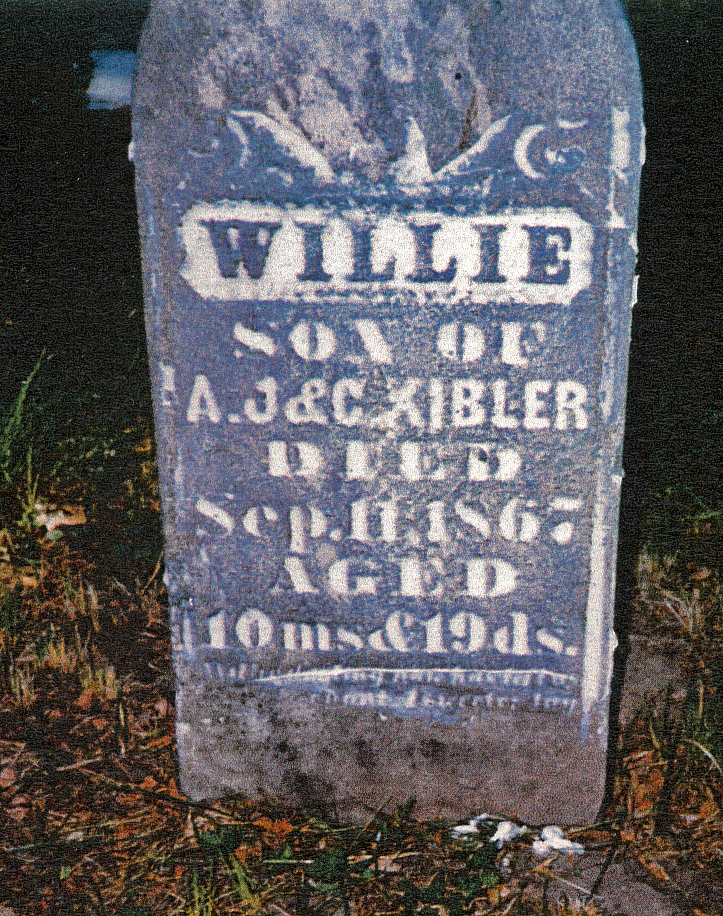
Among all the people buried in the Dayton cemetery there are 22 who appear to have no other family members buried there. One such is Willie Kibler, a baby who died before his first birthday.

The A. J. and C. Kibler listed on little Willie’s gravestone in the Dayton cemetery were Andrew Jackson and Caroline Kibler, residents of Rutland township when Willie died, on Sept 11, 1867. They lived in the Dayton area for only a short while. A, J, grew up in Virginia and married Caroline there in 1865. They must have left for Illinois very soon thereafter, as they were on a farm in Rutland when Willie died.  Andrew, a farmer, was listed as head of household in 1870, although he owned no land. However, George W. Lamb, listed as a boarder in the household, was a 20-year old who had inherited a large farm from his father. It is likely that Andrew Kibler was farming George’s land.

When Andrew died his obituary (included below) appeared in the Wellsville, Kansas, Globe on December 12,1913.

Andrew Jackson Kibler

Andrew Jackson Kibler, son of Philip and Margaret Kibler, was born August 11, 1840, in Shenandoah county, Virginia; died at Wellsville, Kans., Decenber 2, 1913, aged 73 years, 3 months and 20 days.

During the Civil War he served with the Thirty-third Virginia Infantry, in the Southern army. He was in the battle of Gettysburg, and saw many of his comrades and neighbors wounded and killed. A fragment of a flying shell struck him in the head during that battle and he was compelled to go to the hospital.

December 21, 1865, after the close of the war, he was married to Caroline Burner. To this union there were nine children, two dying in infancy.

The family moved from Virginia to Illinois, and later to Kirksville, Mo. In 1887 they came to Wellsville where they have made their home since. Mr. Kibler was engaged in the watch repairing and jewelry business until recently, when his health gave way.

His health and strength gave way gradually, and his death occurred Tuesday morning, December 2d, at 5:55. The funeral services were held at the Methodist church Friday afternoon, at two o’clock, and were conducted by the Rev. J. C. Wilson. Members of Lookout Post G. A. R. gathered at the home and acted as escort to the body, and accompanied it to the church.

Interment was in the Wellsville cemetery. The weather was inclement, and many who had expected to attend the funeral services at the church and at the grave were kept at home on account of of the rain.

The deceased is survived by the widow and seven children: Mrs. E. E. Appleton, of Louisvile, Ky.; Miss Mattie Kibler, Wellsville, Kans.; Dr. J. B. Kibler, Kansas City, Mo.; Dr. H. B. Kibler, Frankfort, Kans.; Miss Georgia Kibler, Ottawa, Kans.; Mrs. C. C. Fields, Winnipeg, Canada; Mrs. Eugene Bice, Omaha, Nebr. Besides there are seven granchildren; two sisters, Mrs. Mary E. Brunk, of Breckenridge, Mo., and Mrs. J. B. Clem, Lantz Mills, Va. and one brother, J. C. Kibler, Woodstocj, Va.

Everyday Life in Dayton at the End of August

From the Ottawa Republican-Times, August 30, 1900, p. 4, col. 5

Dayton

The pile driver of the C., B. & Q. R. R. has been busy the past few days repairing the Q bridge here.

The water in the feeder is now in a condition to furnish all the power necessary.

James O’Meara has some of the finest potatoes in this section. Jim is a hustler, and knows a good thing when he sees it.

The rain has ruined the oats in many places in this vicinity, and farmers are out of pocket.

E. McClary, our genial store-keeper, is improving his lawn by laying a new tile sidewalk around his house.

Walter Breese and George Timmons leave on Monday morning for Chicago. If they are successful in their new undertaking they will make Chicago their future home.

The river on Monday was the highest this season.

Thomas Nagle has purchased from Mrs. Martha Bagley the house adjoining his own lot, and will move it and convert it to a barn for his own use.

Mrs. Hudson and son, who have been visiting Mr. and Mrs. John Channel, returned to Chicago on Monday

H. C. Tueley has gone to Indianapolis to spend a few days.

E. Emmons and family intend moving, and will make Marseilles their future home.

It was proven on Saturday last that the hydraulic cider press here can turn out 2,000 gallons per day.

About forty persons from here attended the old settler’s picnic and Pawnee Bill’s aggregation.

Munroe Durkee, of Wedron, was a caller here this week.

The Dayton Republican Club expect a good turn-out at their meeting on Tuesday evening next.

Emory Waller has been on the sick list for the past week/

The war whoop of the juvenile Indians will soon cease to be heard on our streets, as next week school commences and they will then speak their little piece to their new teacher.

Etta Barnes visited Mr. and Mrs. E. McClary on Tuesday.

Commissioner Jas. H. Timmons is having the hill graveled just west of the feeder bridge. That’s right, Jim, keep on with your good work, and may your shadow never grow less.

Only one lone fisherman could be seen along the banks of the muddy Fox the past week. What a change from a few years ago.

Threshing has been going on at a lively rate for the past two days.

One of our enterprising young men is to start a tonsorial parlor in the near future. It will fill a long felt want. We wish him success in his new undertaking.

The rain causes lots of work on the section for the men employed by the Q. road.

Miles Masters is still very sick and will be unable to leave his bed for some time

Ira W. Davis in Wisconsin and Illinois

I started with the idea of providing some biographical information on two of the people buried in the Dayton Cemetery, Laura Davis and her infant son Ray. This required looking into her husband, Ira W. Davis, and exploring his life led to more than I anticipated, including unexpected links to the development of businesses in Dayton, so Ira became the focus of my story.

Ira W. Davis was born in Oldtown, Maine on November 4, 1835, the son of John Taber Davis and Harriet Jane Moore. He appears, unmarried, in his father’s household in 1850, 1860 and 1870. He is never shown as owning land, but in 1870 he has personal property of $6,000.  Shortly after 1870, he and Charles Noyes, another Old Town resident decided to move west. They settled in Menasha, Wisconsin, where between them, they built a large factory to produce excelsior. In 1875 they added a new branch to the factory for making clothespins.

excelsior

In Menasha, Ira met Laura Barlow Shepard, daughter of Lysander C. Shepard and Ethelinda Ann Chapman, They married in 1877 and the following year, their first daughter, Nellie, was born.

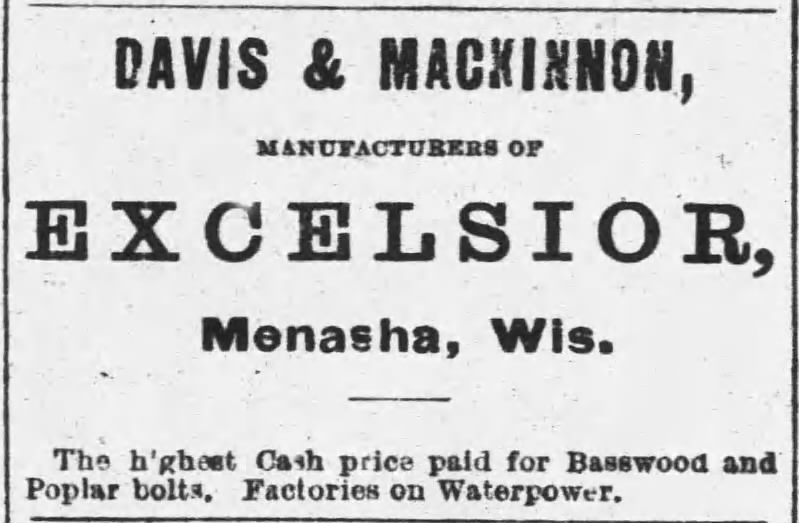
In 1878, Ira in company with a younger man, Duncan MacKinnon, formed the firm of Davis & MacKinnon, which became a successful producer of excelsior.  Ira  became a very prominent  business man in Menasha and was elected alderman from his ward.ad for Davis & MacKinnon

In 1881, Davis and MacKinnon sold a water power site to Henry Hewitt, Jr. a wealthy fellow Menasha businessman. Hewitt had invested in several businesses in Menasha and elsewhere in the Wisconsin area. In 1884 Hewitt and Ira invested in The Chicago and Dayton Brick Company, located in Dayton, Illinois, and it is through this connection that Ira took up the position of superintendent of the brick works being established in Dayton.

On November 22, 1884, the Dayton correspondent to the Free Trader reported that

“Mr. Ira Davis, the superintendent of the new brick works, has brought his family from Wisconsin and moved into G. W. Gibson’s residence, on the hill.”

His family at that time consisted of wife Laura, daughters Nellie, 6, and Harriet, 3, and son Taber, 1. In April of 1885 his son Ray was born, but he died three months later and was buried in the Dayton Cemetery.

Despite his position with the Chicago and Dayton Brick Company, his principal interest appeared still to be with paper making. In 1886 he sold out his interest in the brick works and in that year Ira and 2 others (Moore & Hewitt) rented the paper mill from H. B. Williams. Ira kept in touch with the business atmosphere in Wisconsin, however, making several trips back to the Menasha area. In 1887 his brother-in-law, E. E. Bolles, was preparing to erect a $50,000 paper mill in De Pere, Wisconsin,  and Ira planned to move back and join him.

In December 1887, his wife, Laura, died, leaving three small children. She, too, is buried in the Dayton Cemetery, as shown on her death certificate. If there ever was a stone marking her grave, it has since disappeared.

Ira’s widowed mother, Harriet, and his unmarried sister, Emily, came from Maine to keep house for Ira’s family, arriving in Dayton in February, 1888. They left Dayton for Menasha, Wisconsin fairly soon, and lived there until Ira moved to Wausau in 1893. It may be about this time that the two girls, Nellie and Harriet, went to live with their mother’s sister Alice, the wife of E. E. Bolles, in De Pere, Wisconsin. Tabor continued to live with his father, grandmother and aunt in Wausau.

Ira engaged in business with a Milwaukee firm and, with W. W. Abbott, established an Excelsior Manufactury in Wausau. He is last seen in Wausau in 1895. When and why he went to California is not clear, but in the 1900 census, he appears in Scott Valley, Siskiyou County, California. He died August 15, 1902. His death was reported back in Bangor, Maine, more than 30 years after he left for “The West”.

News has been received here of the death at Orlans, Cal., on Aug. 15, of Ira W. Davis, formerly a well-known Oldtown lumberman. He was the son of John T. Davis of Oldtown and was a brother-in-law of Judge Charles A. Bailey of this city. He went west many years ago, and had been engaged in the manufacture of excelsior in California.
from The Bangor (Maine) Daily News, September 1, 1902, p. 3, col. 2.

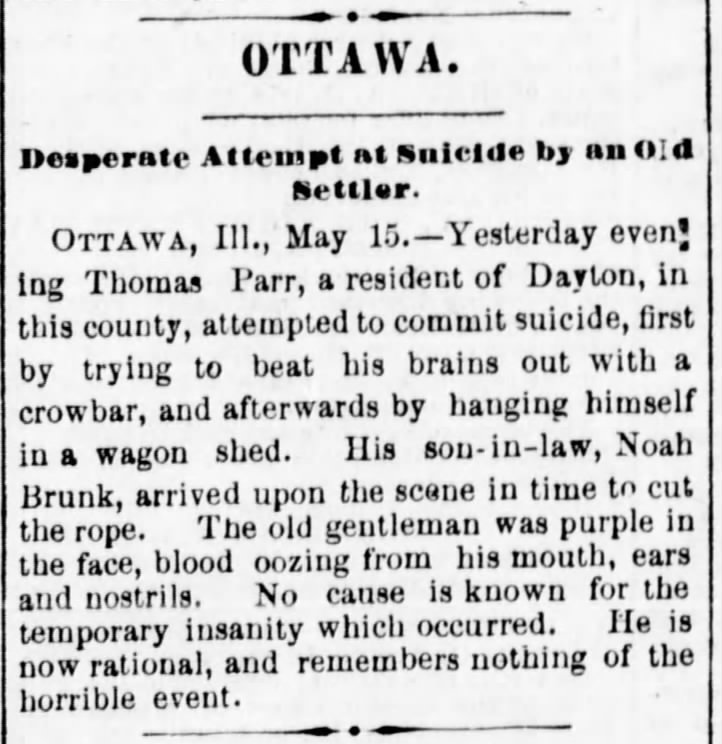
A Shocking Event

Bloomington Pantagraph 16 May 1878

Thomas J. Parr was born in Ohio, March 13, 1814. He came to La Salle county in 1834 and the following year bought 160 acres of land in Dayton township. He married John Green’s niece, Sarah Ann Pitzer on May 26, 1836. Sarah was the daughter of John’s sister, Anna. For Thomas and Sarah’s memories of early Dayton, see here and here.

Thomas and Sarah had eight children, six of whom lived to adulthood :

Jesse N. born January 24, 1839; married January 31, 1867, to Anna Cain; died November 28, 1886

Elizabeth Amanda, born August 5, 1841; married September 24, 1857 to Noah Brunk; died March 14, 1921, in Peabody, Kansas

Joseph Brumbach, born January 8, 1843; married December 28, 1865 to Sarah Knickerbocker; died October 1, 1900, La Salle county, IL.

Francis Marion, born June 10, 1845; married Julia Curyea December 31, 1868; died July 12, 1928

Martha A., born August 1848; married May 26, 1867, to Lyman N. Cole; died November 2, 1902, in Le Mars, Iowa

William Howard, born December 12, 1853; married December 31, 1874 to Mary Ruger; died June 24,1923, in Ottawa; bur  W. Serena

Thomas J. Parr lived another 20 years and died February 19, 1898. Sarah died the next year, August 5, 1899. They are buried in the West Serena Cemetery, near Serena, La Salle County.

Planning for the Old Settlers’ Annual Reunion in 1876

Old Settlers

The Old Settlers’ Association met at the Court House on last Saturday afternoon to elect officers, set a day for the Annual Reunion, and general business. Not a very large number were present.

The meeting was called to order by the President, Mr. Jno. Miller, of Freedom, and the minutes of previous meetings were read and approved.

Mr. Munson moved that the old officers be re-elected, which was carried; and Messrs. Elmer Baldwin, Philip Watts and Jesse Green were added as vice-presidents. Following is the list of officers: John Miller, President; Ransom Pulmer, W. Bushnell, John Hoxie, E. S. Leland, I. H Fredenburg, D. F. Hitt, E. Baldwin, P. Watts, Jesse Green, Vice Presidents; A. M Ebersol, Secretary and Treasurer, J. H. Pickens, General Superintendent.

On motion it was decided to hold the Annual Pic-Nic in Hoes’ grove on the 21st of August next.

Messrs. J. Bachellor, J. Pembrook and S. H. Miller were appointed a committee to secure the grove and make arrangements for freeing the Illinois River bridge on that day.

Messrs. E. Baldwin, R. Palmer, and Jno. Miller were appointed a committee on speakers.

The committee appointed at the last meeting on History reported no action.

A resolution was presented and adopted as follows:

Resolved, That the Hon. Elmer Baldwin be elected to procure from the most reliable sources the statistics of the earliest settlers of the several towns of La Salle county, including all matters of general interest, with a view of the publication of a history of the early settlement of the county, this society to have the first claim to the copyright by paying a reasonable amount for the same.

Jesse Green, Cyrus Shaver, O. O. Wakefield, S. R. Lewis and Wm. Munson were appointed as committee on Finance.

After considerable discussion it was decided instead of increasing the number of committees, to appoint one committee of J. H. Pickens, J. Bachellor, and J. R. Shaver with full power to act on questions of privileges, seats, stands, refreshments, etc.

J. Miller was appointed a committee of one on policy and A. M. Ebersol on concert, programme, etc.

Adjourned to meet at call of Secretary.1

It’s interesting to note that some good plans do, indeed, come to fruition. Elmer Baldwin’s book, History of La Salle County, Illinois, was published in 1877 and has long been the source of information on the early days of the county. It appears, however, that Baldwin retained the copyright to his work.


  1. The Ottawa [IL] Free Trader, June 10, 1876, p8, col 2

144 years ago today in Dayton


tile factory about 1864

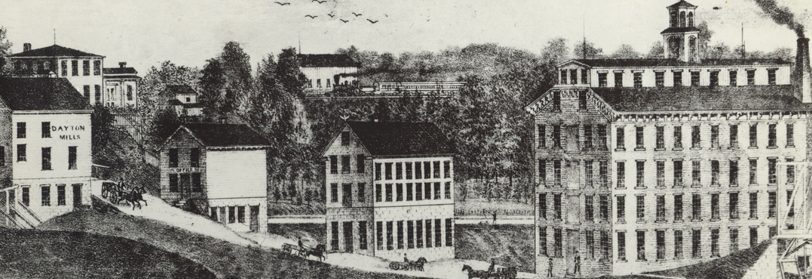
paper mill and other businesses

flour mill and tile factory

Flour mill (built 1855) and tile factory


DAYTON
One of La Salle County’s Flourishing Manufacturing Centers

            Dayton, as some of your readers may not know, is located four miles from Ottawa, on the Fox River branch of the C., B. & Q. R. R. Its most solid attraction is one of the best water powers to be found in the West. The dam that supplies the power is owned and kept in repair by the state, so that lessees of power feel assured that if the dams or locks should ever be impaired by the ravages of time or floods, the damages will be speedily repaired, without tax or expense to them.

The paper mill of Williams & Co., situated at the lower end of the manufacturing portion of the town, is one of the best in the state. Their products are so favorably known that running night and day the year round they are unable to supply the demand.

The Tile and Brick Works of D. Green & Sons are yet in their infancy, yet the perseverance of its proprietors, and the excellence of the material close at hand, is sufficient evidence that the surrounding country can soon be supplied with the very best tile and brick to be found anywhere.

The grist and merchant mill of D. Green & Sons is presided over by Mr. Stover, widely known for many years as one of the best millers in the state,

The Fox River Horse Collar Manufacturing Co. is an incorporated company, composed of a body of modest and unassuming men, their modesty being only equaled by the superior quality of their goods, which are widely known from Pennsylvania, Ohio and Virginia on the east, to Kansas, Nebraska and Missouri on the west, to be the best in the world. They use about forty tons of rye straw yearly for filling horse-collars, and the hides of about 2,000 head of cattle are required yearly to supply them with leather.

The elegant massive building known as the Dayton Woolen Mill is now owned and run by J. Green & Sons. They are so well known for the excellence of their goods and their honorable dealing that the simple announcement that they are again in business is sufficient to flood them with orders.

Adjoining the town is the splendid grain and stock farm of Isaac Green. Mr. Green makes a specialty of raising Norman and Clydesdale horses and thoroughbred cattle, and can show some of the finest in either class to be found in the state. Among the minor attractions are many fine driving teams, single and double. I would like to give you the names of the owners, but their objections to seeing their names in print forbid it.

And last, though not least, we have the nicest girls, the most dashing beaux and the most enchanting Groves to be found anywhere. Go a fishing and come and see us.

Full Stop


  1. The Ottawa Free Trader, July 12, 1879, p. 8, col. 1
4th of July 1912

SANE 4TH POPULAR WITH LOCAL PEOPLE
Small Gatherings the Popular Idea with Mercury Climbing Skyward and Heat Suffocating

  The Dayton Home Makers

            Although the surrounding country a number of family picnics were held, and some of them were very largely attended. None of these was more successful than that given by the Dayton Home Makers’ Circle. It was held at the home of Henry Schmidt, north of the city. The attendance was large, a splendid dinner was served, and a program and sports rounded out a very enjoyable day.1


The Ottawa Free Trader, 12 Jul 1912, p5, col 3

Trumbo Reunion – 128 Years Ago Today

Trumbo reunion

A smaller reunion of the Trumbo family eleven years later

TRUMBO FAMILY REUNION
Over One Hundred Members Present at the Picnic of Thursday

The members of the Trumbo family have been prominent in La Salle county for the past half century, and more especially in Rutland and Dayton townships, by reason of their industry, good citizenship and last but not least, their numbers. Thursday, at the pleasant home of Frank Trumbo, in Dayton township, they gathered to the number of over one hundred; and, with their relatives of the families of Green, Shaver, Grove and Gibson and their guests, over two hundred. Photographer W. E. Bowman was on the ground and took several pictures of the assembly at noon. At one o’clock the dinner was served and all did full justice to the viands before them. The baseball enthusiasts organized two nines and played a game, the score being about 28 to 19.

Mrs. Grace Parr gave a recitation and W. F. Heath and others rendered solos.

President Elias Trumbo called the family to order for the sixth annual meeting and told the younger members of some of the difficulties and privations which ensued when their ancestors turned the prairie into a garden. Secretary McKinlay then gave a resume of what had been done in further tracing of family history and the collection of data since the last meeting, stating that the descendants of the Trumbos in America now numbered at least 2,500, all descendants of the three brothers who came to Virginia about the middle of the last century, and a facsimile of the oldest document of the family was shown. The original, dated June 23, 1752, is owned by O. W. Trumbo of Dayton, and the land acquired by it is still in the Trumbo family, at Brock’s Gap, Va. The services of the family in the revolution, war of 1812, the Black Hawk war and the civil was were alluded to.

The election of officers was then held and resulted as follows:

President                     Elias Trumbo
Treasurer                     M. P. Trumbo
Secretary                     W. E. MacKinlay
Executive Committee Mesdames Lavina Mattock, Clara T. Hess, Barbara Jackson, Eliza Gibson, Anna Robison and Elizabeth Strawn and Mr. Elias Trumbo.

After a hearty supper the gathering dispersed, after the most largely attended and successful reunion ever held by the “Trumbo Family Association.” Those present were:
C. B. Hess and family, J. N. Strawn and family, Joe Gay and family, Mrs. Susan G. Trenary, Fred and Ralph Trenary, H. B. Robison and wife, Al. F. Schoch and family, W. C. Riale and family, W. E. W. MacKinlay, Wm. Pafiot, Misses Marie Briggs, Roberta Hammond, Katie Gleim; Grant Conard, Jesse, James and Joe Green, L. N. Hess and family, H. B. Williams and family, O. N. Butterfield and wife, H. G. Cotton and daughter, W. D. Strawn and family, C. W. Irion and family, Art. Scott, Jackson Shaver and family, Mrs. Wm. Bradford, Katie Bradford, Maude Sanderson, D. L. Dunavan, S. E. Parr and wife, Mrs. W. H. Hull, jr., Prene Shaver, Ottawa; Mrs. Lavinia Matlock, John Matlock and family, Joseph Harris and family, Mrs. John Crum, Jessie Crum, Eugene Matlock and family, John Harris and family, Yorkville; Joseph Jackson and wife, E. W. Jackson and wife, F. Mizener, Millington; H. D. Barber and family, Sheridan; H. K. Parr and wife, Serena; W. M. Brown and family, M. P. Trumbo and family, Mrs. H. Ruger, Bernice Ruger, Samuel Dunavan and family, O. W. Trumbo and wife, J. Green and family, H. Hall, Mr. Angevine, James Angevine, Dayton; Lee Robison and Matthew Robison and family, Elias Trumbo and family, Donald MacKinley, Maud Shaver, Charles Shaver and family, G. D. Shaver and family, Rou Shaver, V. Canfield and wife, S. Milliken and wife, Mrs. John Parr and family, Mrs. Emma Parrott, Miss Sadie Parrott, George W. Gibson and wife, Rutland; Mrs. Dorothy Hess, Cleveland, Kas.; Mrs. Ed. Bradford, Chicago; Mrs. A. B/ Henderson, Siler, N. C.; Mrs. Harry Green, Chicago; and many others.1


  1. The Ottawa Free Trader, June 28, 1895, p. 3, col. 4

The Importance of Good Roads

DAYTON ROAD INTEREST
Business Men Are Awakening to the Importance of the Inlet

The importance of good roads leading into Ottawa was never so urgent as in the fall of 1895. A considerable portion of the city’s usual population having been deprived of employment and departed to other centers of activity, it has become necessary that every effort be put forth by the business men and citizens in general to attract a larger trade from the country.

Some weeks ago Supervisor Perkins and the road commissioners of the township of Dayton began to agitate the subject of an inlet to the city from the north. A good gravel road now leads to the northern villages and hamlets, but the country north of the Ottawa line, taking in the townships lying directly north of the city, as far as Earlville, cannot be reached save in very dry weather. As a consequence all of the trade north of Dayton goes to Earlville over the new gravel road in Freedom township.

Dayton is too poor to pay the cost of the six miles gravel needed to connect Ottawa with these northern townships, but her people are willing and have already contributed $1,500 in work and money. The exact cost of the road cannot at this time be closely estimated, but it is probably that it can be built for less than $5,000.

Supervisor Perkins and a committee are now soliciting subscriptions among local business men. They should meet with every encouragement, as Ottawa is the natural market for the farmers and can have their trade if she makes it possible for them to reach her at all times.1


  1. The Ottawa Free Trader, October 11, 1895, p. 10, col. 3

Dayton’s Industries in 1879


DAYTON
One of La Salle County’s Flourishing Manufacturing Centers

Dayton, as some of your readers may not know, is located four miles from Ottawa, on the Fox River branch of the C., B. & Q. R. R. Its most solid attraction is one of the best water powers to be found in the West. The dam that supplies the power is owned and kept in repair by the state, so that lessees of power feel assured that if the dams or locks should ever be impaired by the ravages of time or floods, the damages will be speedily repaired, without tax or expense to them.

The paper mill of Williams & Co., situated at the lower end of the manufacturing portion of the town, is one of the best in the state. Their products are so favorably known that running night and day the year round they are unable to supply the demand.

The Tile and Brick Works of D. Green & Sons are yet in their infancy, yet the perseverance of its proprietors, and the excellence of the material close at hand, is sufficient evidence that the surrounding country can soon be supplied with the very best tile and brick to be found anywhere.

The grist and merchant mill of D. Green & Sons is presided over by Mr. Stover, widely known for many years as one of the best millers in the state,

The Fox River Horse Collar Manufacturing Co. is an incorporated company, composed of a body of modest and unassuming men, their modesty being only equaled by the superior quality of their goods, which are widely known from Pennsylvania, Ohio and Virginia on the east, to Kansas, Nebraska and Missouri on the west, to be the best in the world. They use about forty tons of rye straw yearly for filling horse-collars, and the hides of about 2,000 head of cattle are required yearly to supply them with leather.

The elegant massive building known as the Dayton Woolen Mill is now owned and run by J. Green & Sons. They are so well known for the excellence of their goods and their honorable dealing that the simple announcement that they are again in business is sufficient to flood them with orders.

Adjoining the town is the splendid grain and stock farm of Isaac Green. Mr. Green makes a specialty of raising Norman and Clydesdale horses and thoroughbred cattle, and can show some of the finest in either class to be found in the state. Among the minor attractions are many fine driving teams, single and double. I would like to give you the names of the owners, but their objections to seeing their names in print forbid it.

And last, though not least, we have the nicest girls, the most dashing beaux and the most enchanting Groves to be found anywhere. Go a fishing and come and see us.

Full Stop1


  1. The Ottawa [IL] Free Trader, July 12, 1879, p. 8, col. 1
Memories of Early Dayton

Memories of early Dayton by Maud V. Green (1866-1952)

There used to be “basket meetings” at the Sulphur Spring on Sundays in the summer.  Preaching in the morning & afternoon with a picnic dinner and visiting between.  Also we met our friends at the Old Settlers’ picnic, and at the County Fair when we always took our dinners & ate on the ground.  Reunions at home were not so pleasant for the children, who had to wait for the “Second Table.”  Times have changed for the better, for the children!

In the summer (before we had screens), the fly-broom was a useful thing.  Paper was sewed around a long stick and slit into strips and inch or so wide & this was waved over the table to chase the flies.  Also we had wire covers for some of the dishes (like a round strainer) and a glass cover for the butter dish, jelly, etc.

We had wood-stoves until in the nineties we got a hard-coal heater for the two front rooms.  Always a big wood-pile and plenty of chips for starting fires.

We had a Singer sewing machine as long ago as I can remember & Mother got a bolt each of bleached & unbleached muslin & sewed and sewed all through January.  Then in February it was carpet-rag time and we all sewed & wound carpet-rags & sent them to the weaver.  The new carpet went in the “sitting room” and the others were moved back until at last they reached the kitchen & were worn out there.

I can just remember Grandma [Barbara Green] making candles for us to carry upstairs.  They were afraid to have us carry a lamp, but we had lamps as long ago as I remember.

Grandma spent her time knitting socks and long stockings for all of us, out of factory yarn, and we had woolen underwear, skirts and dresses made of factory flannel.

Uncle David’s house had the only Franklin stove I ever saw and the only trundle bed. A trundle bed was a low bed that rolled under the mother’s bed in daytime & was drawn out at night for two or three little folks who had outgrown the cradle. The “Franklin stove” was a little stove in the living room & had two doors that when opened made it like an open fire.

(see here for more information on Maud)

May 31, 1890 – Dayton Was Very Much in the News

DAILY EVENTS

Thursday, May 29

Judge C. B. Smith, of the Appellate Court, Judge F. P. Snyder, Wright Adams and Duncan McDougall were in Dayton this afternoon on a fishing excursion. It is safe to say that they came home heavily loaded – with fish.

Friday, May 30

The Dayton tile factory is closed for the present and will remain closed until the present difficulty has been settled. It has been rumored that Manager Williams is on his return home from the eastern trip.1

La Salle Co. Pomona Grange No. 61

Will hold its next quarterly session on Thursday and Friday, June 12th and 13th, with Dayton Grange in Wm. A. Greenlees’ Grove.

First day will be an open meeting with picnic dinner. All are cordially invited. Let everybody and their families turn out for a day’s rest and profitable recreation.

Thursday evening Grange will be held in West Serena church, with closed doors. All fourth degree members in good standing are cordially invited. Friday open meeting in the church.

PROGRAMME
10 a. m. first day – Call to order by W. M., G. A. Wilmarth
Song by Dayton Grange choir
Prayer by Rev. Frederick
Welcome address of Dayton Grange by Miss Zelora Beach
Response of County Grange by Miss V. S. Ashley
Song by Dayton Grange choir

11 a. m., Discussion on the following subject:
Resolved, That it is more profitable to feed beef cattle in summer than in winter. Leaders – E. Howland, C. Mudge, M. Trumbo, L. N. Hess, Wm. Chapman and L. G. Douglass.
Duet by Mrs. Howland and Crumpton.

12 m., Take a recess for dinner

1:30 p. m., Call to order
Song by Freedom Grange choir
Address by the W. M. of Ill. State Grange, Maj. J. M. Thompson, of Joliet. Subject – The Patrons of Husbandry, past, present and future.

2:45 p. m., Recitation by Miss Nellie Howard
Song by Pomona Grange choir

3 p. m., Resolved, That a Protective Tariff is a question of locality, non-partisan, and detrimental to the north western states. Leaders – B. Hess, W. A. Greenlees, T. E. MacKinlay, Geo. DeBolt, J. L. Barber, Douglass, Donevan, J. R. Shaver, C. N. Rolph.
Song by Freedom Grange choir
“What I Know about Farming,” by Dr. Frederick
Song by Dayton Grange
Prayer by the Chaplain
Essay by Mrs. E. Howland
Instrumental music by Miss Cora Brunk

10 a. m., Question – Is it possible and practicable to restrict from farm products, and by controlling the supply regulate the price. If so, how? Leaders – E. Howland, Frank Whitmore, J. S. Armstrong, F. Wheeler, Wm. Poole, D. Snelling
Song by Pomona Grange choir

11 a. m., Essay by Mrs. E. Chapman.
On Women’s Work in the Grange. Speakers – Mrs. J. R. Shaver, Mrs. L. G. Douglass, Mrs. Sarah Hall and Mrs. C. Ida Bowman
Recitation by Miss Aggie Jacobs
Essay by Mrs. George Debolt.
On the Ideal Farmer’s Home, for convenience, beauty and comfort. Leaders – Mrs. E. Howland, Mrs. Beach, Mrs. J. R. Shaver, Mrs. M. Olmstead, Mrs. W. A. Bosworth.
Song by Freedom Grange choir.2

SEVERAL NEW CASES
Work for the Next Term of Court – Summary of a Week’s Doings

About fifteen employees of the Fox River brick Company at Dayton quit work Wednesday and came to Ottawa, consulted an attorney and had the plant attached. The company is in arrears to the men from $75 to $350 each. Two suits were started in the County Court by James Timmons and E. P. Luce for $500 and $348 respectively. Thirteen other suits were begun in Esquire Weeks’ court for sums amounting to $1,500.

A bill to foreclose a mortgage on the plant was filed on Monday, and the workmen, becoming alarmed, concluded to take immediate steps to procure their wages.3

SOME FORECLOSURE SUITS
General Grist of the Courts and Court House Offices

Henry Huitt, Jr., has commenced a suit to foreclose a mortgage on land in Dayton township. The defendants are Betsey B. Soule, Chas. Soule, Chicago & Dayton Brick company, H. B. Williams, C. B. Hess, Jesse Green and Ira W. Davis. Some years ago Soule gave the plaintiff four promissory notes – two for $641.71, each payable in six and eight months; one for $3,302.69, in five years; and one for $12.75, in five years. To secure the payment of these sums mortgages were given on the plant of Green’s woolen factory, the 90-horse water power, the ten acres near Green’s mill and part of the section of land between the feeder and the Ottawa, Oswego & Fox River Valley railroad. The other defendants claim some interest in the mortgaged property. D. B. Snow represents complainant.4


1. The Ottawa [IL] Free Trader, 31 May 1890, p1, col 2
2.      31 May 1890, p1, col 4
3.      31 May 1890, p4, col 6
4.      31 May 1890, p7, col 3

Maria Stadden Hollenbeck

Maria was the fifth child and third daughter of William Stadden and Judah Daniels. There is some uncertainty as to the year of her birth. Her tombstone says that she died November 2, 1874, at age 32 years, 7 months and 10 days, which implies a calculated birth date of March 23, 1842. 

From the censuses, we get the following implied birth years:
1850 census: born about 1839
1860 census: born about 1841
1870 census: born about 1845
(She appears to have aged more slowly the older she got.)

However, when her father died in 1848 his younger children had to have a guardian appointed for them as they inherited from their father. In the guardianship file the ages of all the children are given. “Mariah Stadden age 10 on 22nd March 1849”, therefore she was born March 22, 1839.

She lived with her widowed mother until, at age 32, she married Chauncey Hollenbeck, November 6, 1871.

Chauncey was born in New York in December of 1840 and grew up on a farm in Will county, near Naperville, Illinois. In August 1861 he enlisted in Company I of the 15th Illinois Cavalry in Aurora, Illinois. He was mustered out in August 1864, Company A, 36th Illinois Infantry. He probably returned to the northern Illinois area, although he has not been located in the 1870 census. However, he was certainly in the area in November 1871, when he and Maria were married

Unfortunately their married life was cut short when Maria died on November 2, 1874 at age 35. She is buried in the Dayton cemetery, near her parents and other members of the Stadden family.

Chauncey moved west to a farm in Franklin County, Nebraska. He married again, September 4, 1878, to Katie Perrine.  They had four children. By 1920 they had moved from the farm into town in Franklin, Nebraska, where Chauncey died April 12, 1925.


Another Immigrant from England to Dayton

Peter W. Ainsley was born November 11, 1839, in England. He arrived in the United States in October of 1857, at the age of 17. In 1870 he appears in East Liverpool, Columbiana County, Ohio, working in a pottery. The pottery industry was well established in West Liverpool and had attracted many English workers. It is possible that Peter went there because he knew someone working there.

In 1869 he met and married Mary Graften. She was born in England in March 1850, the daughter of James and Mary Graften. Peter and Mary’s first child, James, was born in 1870.

By 1874 the family had moved to Jefferson County, Ohio, where Peter applied for citizenship at the probate court. He was accompanied by Joseph Robertson, who attested to his character and his  residence in Ohio. Peter then renounced his allegiance to Queen Victoria and became a citizen of the United States.


The family moved to Illinois by 1884 and Peter was employed in Dayton as a brick burner in 1900. He probably worked for the Chicago and Dayton Brick Company, newly established in the old woolen  mill building.

Peter and Mary had four children –

  1. James Henry Ainsley was born July 7, 1870, in East Liverpool, Ohio; he died September 16, 1946, in Ottawa, Illinois. He was married June 24, 1896, in La Salle County, to Jane “Jennie” Doyle. She was born in March 1872 in Pennsylvania and died May 26, 1953 in Ottawa.

2. Alice Ainsley was born about 1873 in Ohio; she died March 18, 1895, in Dayton and is buried in the Millington-Newark Cemetery in Millington, Illinois.

3. William Ainsley was born about 1876 in Ohio; he died July 26, 1894, in Dayton and is also buried in Millington.

4. Albert Joseph Ainsley was born February 7, 1884, in Illinois; he died September 19, 1937. On April 19, 1911, in La Salle County,  he was married to Helen Caroline Jacobs. She was born February 7, 1887, in Jerauld County, South Dakota and died August 31, 1976, in Ottawa.

Peter’s wife, Mary, died in 1908 and was buried in St. Columba Cemetery in Ottawa. Peter died in Dayton October 12, 1913 and was also buried in St. Columba Cemetery. On his death certificate, his occupation was listed as kiln-burner and janitor, as he had been janitor for the local school in his later years.

News from Dayton – May 1879

Dayton, May 15, 1879. – The rain of yesterday was a blessing to the land. The earth had become very dry, vegetation was beginning to wither, and all nature called for rain. The river is as low as it usually is in July and August, scarcely any water running over the dam. Nearly all the game fish that were up have been caught or seined out, so that fishing as a success is over with this season unless perhaps we have a good heavy rain.

A three year old colt was stolen last Monday night from Mrs. Furr, a widow lady living a mile west of Dayton. A reward of forty dollars is offered for the return of the horse and the capture of the thief.

We are glad to see D. L. Grove up and around again.

Mr. James Green has gone into the bee business quite extensively this summer. He has over fifty swarms.

Mr. L. Jackson and friend of Millington were down fishing last week.

A new organ was purchased last week for the school house.

Last Sunday a number of parties amused themselves at the river by fishing – a little, drinking beer – a good deal, and having a big time generally. Then more beer. Good people of Dayton, here is a chance for home missionary work.

A good joke is going the rounds this week. A certain married man in town, whose wife wished to go to Ottawa to procure some household necessities, gave her what he supposed was a check for fifty dollars. Having arrived in Ottawa, she thought she would take a look at the paper and see what bank to go to. Taking it from her pocket, she found her husband, by mistake, of course, had given her a meat bill! Rumor says she borrowed fifteen cents to pay her car fare home, and then gave her man a ——- talking to.

On account of the sickness of Mrs. Gibb, Rev. S. F. Gibb filled the appointment at this place last Sunday evening.

Occasional1


  1. The Ottawa (Illinois) Free Trader, May 17, 1879, p. 8, col. 1

Today is the 137th Anniversary of Barbara Grove Green’s Death – or is it?

This post started out to be a celebration of  Barbara Green’s death on May 3, 137 years ago today. Her death date is clear on her tombstone and has been generally accepted. However, when I came to include the newspaper accounts of her death (see below), I found a different story.  On May 8th, 1886 (which was a Saturday) the Free Trader item said that she died on Wednesday (therefore the  5th of the month).

Also, on May 22, 1886, the Free Trader published a column of Dayton news which stated that she died on May 5th. The writer, known as Occasional, clearly knew her well. I suspect he was her son Jesse.

It just proves that you can’t believe everything you read, even (or especially) when it is carved in stone.

Barbara Grove Green (1792-1886)


GREEN, BARBARA

Granma Green, the oldest settler in the county, died Wednesday morning, at the age of 84 year. She was of a kind, benevolent disposition and was well beloved by her wide circle of relatives, friends and acquaintances by whom she will be greatly missed.1


From Dayton
Barbara Grove Green

Died May 5th, 1886, at the age of ninety three years, five and a half months. She had been confined to bed for about two months, and gradually and gladly passed away like an infant going to sleep. It was her desire to cast off this earthly tabernacle and be present with her Lord.

She retained her faculties to the last, with the exception of her sight, of which she had been deprived for the past seven or eight years. She was never heard to murmur or complain of her misfortune, but on the contrary seemed cheerful and happy.

She was born in Shenandoah county, Virginia, November 15th, 1792. At the age of thirteen she, with her parents, removed to Licking county, Ohio, being in the year 1805, and lived there until the fall of 1829, when she and her companion, John Green and family, removed to this county. A few incidents of their journey will show the hardships and privations of those early pioneer days. We quote her own words from statements made by her to one of her grand daughters, who has recorded them:

“We started from Licking county, Ohio, on the first of November, 1829, for the state of Illinois. There were 24 in the company. Father had gone to Illinois the September before we started and bought land. He and three other men rode on horseback around by Cleveland and along the lakes. When they reached Chicago, where there were only two families besides the garrison, father bought some provisions and in paying for them pulled out quite a roll of bills. That night his brother, Wm. Green, dreamed there were robbers coming and woke the others up, but they refused to start out in the night just for a dream, and he went to sleep again only to dream the same thing again, and when he had dreamed it three times he told them they could stay there if they wanted to, he was going to leave; so they all started and soon after they saw three men following for the purpose of stealing they [sic] money.

“When we reached the ‘Wilderness,’ in Indiana, a man who lived on the edge of the woods told us it was impossible to go on, as the mud was so deep, unless we could travel on the wagons already stuck in the mud; but if we were foolish enough to try it, we must leave ‘those two smart little boys’ (Jesse and David), for we would surely freeze to death. But we did go on and the men cut a new road through the woods for sixty miles, about ten miles a day.

“Then, when we got to Cicero river, we had to take the wagons over with bed cords. One wagon, loaded with mill irons and blacksmith tools, was so heavy it tipped over, and we lost a good many things.

“Then the next place we came to was Sugar creek, and it was so high we had to pull the wagons over with ropes again and cut trees for us to walk on. Then there was a swamp next to the creek that the men had to carry the women over on their backs. Between Iroquois and Nettle creek there were five days the horses had nothing to eat, as the prairie was burnt, and they became so weak they got stuck in a ravine and could hardly pull the empty carriage out.

“One evening we had only bread and tea for supper, but that night father came back with corn and beef that he had obtained at Holderman’s Grove, and we were the happiest people you ever saw. We spent the next night at the Grove and the next day home, at what is known as William Dunavan’s farm.”

She lived in the town of Rutland something over a year when she removed to Dayton, being at this place at the time of the Black Hawk war in 1832. Of this war she says: “On the 16th of May, 1832, the girls and I were at the spring, near where the feeder bridge now stands, when Eliza came down on horseback and told us that the Indians were coming, and we would have to go to Ottawa immediately. Then we went to a place a couple of miles below Ottawa and stayed there all night, and the third day returned home again. This was Sunday, and the next day the men made a stockade around the house out of plank. After it was finished they tried it to see if a bullet would go through it, and as it did, they hung feather beds all around. There were about sixty people here at the time, and we were so crowded that they had to sleep on tables, under the beds and all over the house.”

Mr. Green had intended to remain in his improvised fort during the war, but at about twelve o’clock at night, hearing of the massacre on Indian creek, and fearing there might be too many Indians, all those in the fort went to Ottawa. “When we got to Ottawa, there was no fort there, only a log cabin on the south side of the river, but they soon built a fort on top of the hill. We went to the fort, but there was so much confusion there that we had the log house moved up on the hill and lived in it. The next day a company of soldiers from the southern part of the state passed through Ottawa on the way up the river.”

Grandma Green bore all the hardships and privations incident to the settlement of two new countries and lived to see the development of this vast prairie country far, very far beyond her anticipations. When she came here she supposed that in time she might see the country settled around the skirts of timber, but never in her early days did she anticipate seeing the prairies settled up.

Occasional2


  1. Ottawa Free Trader, May 8, 1886, p. 8, col. 3.
  2. Ottawa Free Trader, May 22, 1886, p. 5, col. 2

A Double Birthday Remembrance

Today, April 26, is the birthday anniversary of two members of the Green family; Benjamin, born 1855, and his granddaughter Nancy, born 1816.

Benjamin is the progenitor of the Dayton branch of the Green family. He was born in New Jersey in 1755. During the Revolutionary War, he served in the Virginia militia from Loudoun County on three separate occasions. He entered the service about the last of June 1777 as a volunteer and marched to a place then called Bellhaven in the State of Virginia , now Alexandria in the District of Columbia and left the service about the last of August at the expiration of his two months service and returned home.

In September 1778 he was drafted into the service and served two months at Leesburg in Virginia guarding prisoners and again in the month of August 1781 he was drafted into the service and marched to the siege of Cornwallis, was at the taking of Cornwallis, and marched as a guard to prisoners to Nolens ferry on the Potomac river. There he was discharged in October 1781, having served two months in his last tour.

After the war he moved his family, first to western Maryland and then to Ohio. He was in Ohio by 1799, settling near Marietta for a year and then moving up to settle on the Licking river, near what is now Newark, Ohio. It was from this area that his son John in 1829 organized the expedition to Illinois that resulted in the settlement of Dayton. Benjamin’s wife, Catherine, died in 1821 and Benjamin moved to Moscow, Licking County, to live with his son Daniel. Benjamin remarried in 1823 to Mrs. Martha (Rees) Lewis. He died in 1833, at age 78. Both he and Catherine are buried in the Beard-Green Cemetery in the Dawes Arboretum near Newark, Ohio.

Nancy was born in 1816 in Ohio, the daughter of Benjamin’s son John and his wife, Barbara Grove. She was 13 when John brought his family to La Salle County, Illinois in 1829. She married Joseph Albert Dunavan on January 26, 1834, and they raised a family of twelve, only two of whom died as children. In 1889 they left Illinois to live in Missouri, near some of their children. Joseph died in 1892 and Nancy in 1905. They are both buried in the Highland Cemetery in Hamilton, Missouri.

A search for Nancy Green on this web site will turn up much more information.