Support of a Family Burying Ground

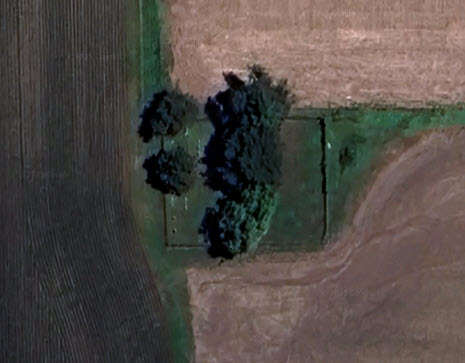
The red circle indicates the location of the Trumbo burying ground

When Mathias Trumbo wrote his will in 1865 he had thought carefully of how his estate was to be divided and had left explicit instructions. However, in 1874, just a year before his death, he realized that there was something else he wanted done at his death. In order to accomplish this, he created a codicil to his will stipulating that out of the proceeds of his estate, one hundred dollars should be invested for ornamenting and keeping in good order the grave yard located in Section Twenty Seven, Township Thirty four North in Range Four East in the Town of Rutland LaSalle County, Illinois.

An overhead view of the burying ground in 2025.

It appears that when Mathias wrote this codicil no trustees for the grave yard had yet been appointed. He directed that at his demise, if no trustees had yet been appointed, his executors should invest the one hundred dollars and hold it in trust until trustees were appointed, at which time the money would be paid to them. He further stipulated that the trustees were to spend only the interest on the investment and that the said principal of one hundred dollars was to be held by the said trustees and their succession forever.1

Mathias’s care for the burying ground did not end there. When he conveyed the land around it to his daughter in 1870 in return for her care of him for his lifetime, he stipulated that she must grant a right of way 2 rods wide from the Chicago road to the burying ground.

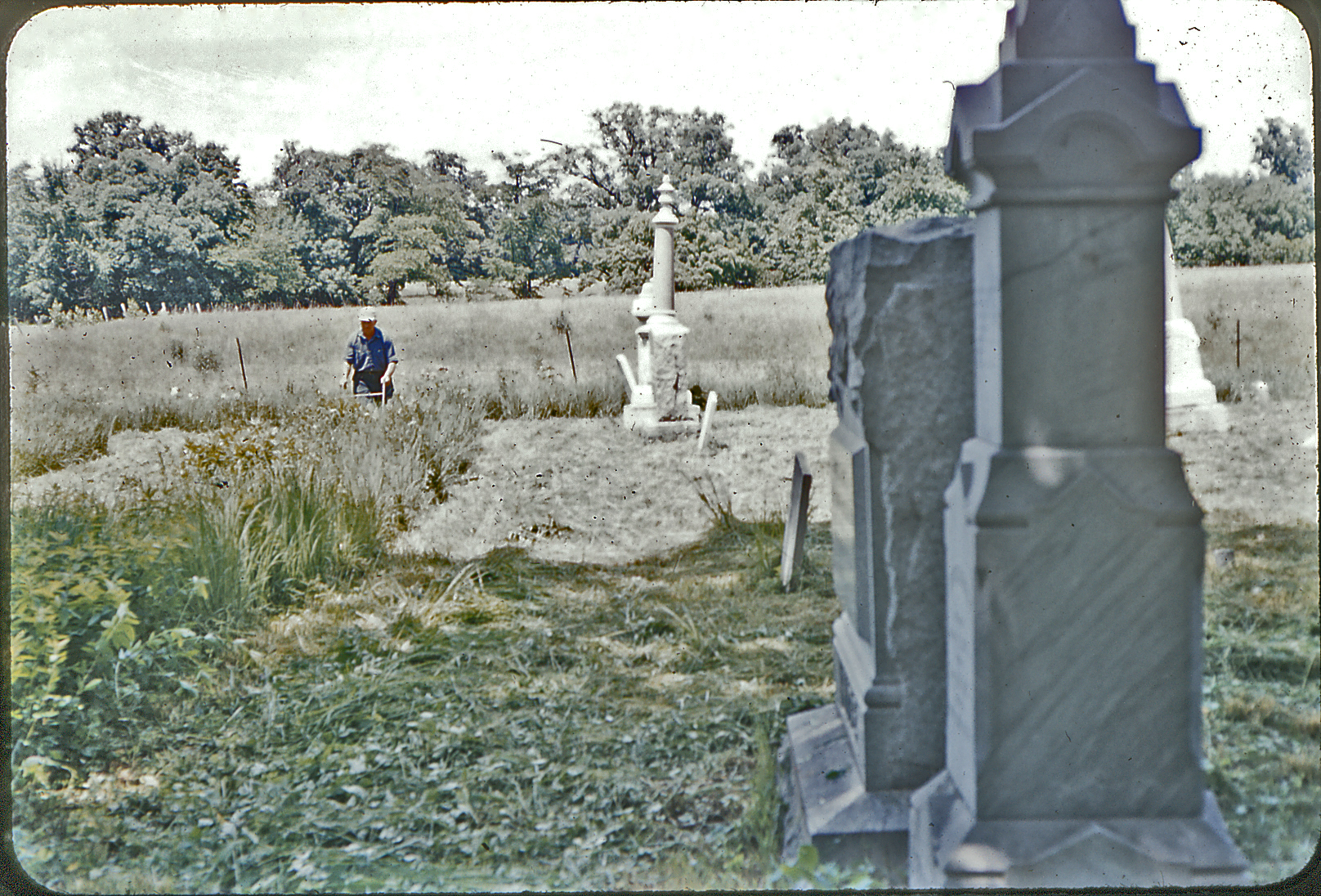
In 1988 when my father took me to see this tiny cemetery, we had to walk through a field to reach it (so much for the 2 rods right-of-way). It was totally overgrown and it was difficult to see the stones, although I was able to photograph the one I had come to see.  Unfortunately, I did not know of Mathias Trumbo at that time, so I missed seeing his stone. Now the cemetery is being cared for, as you can see in the photograph above. I don’t have any information though as to whether the interest on that hundred dollars is still accumulating somewhere.

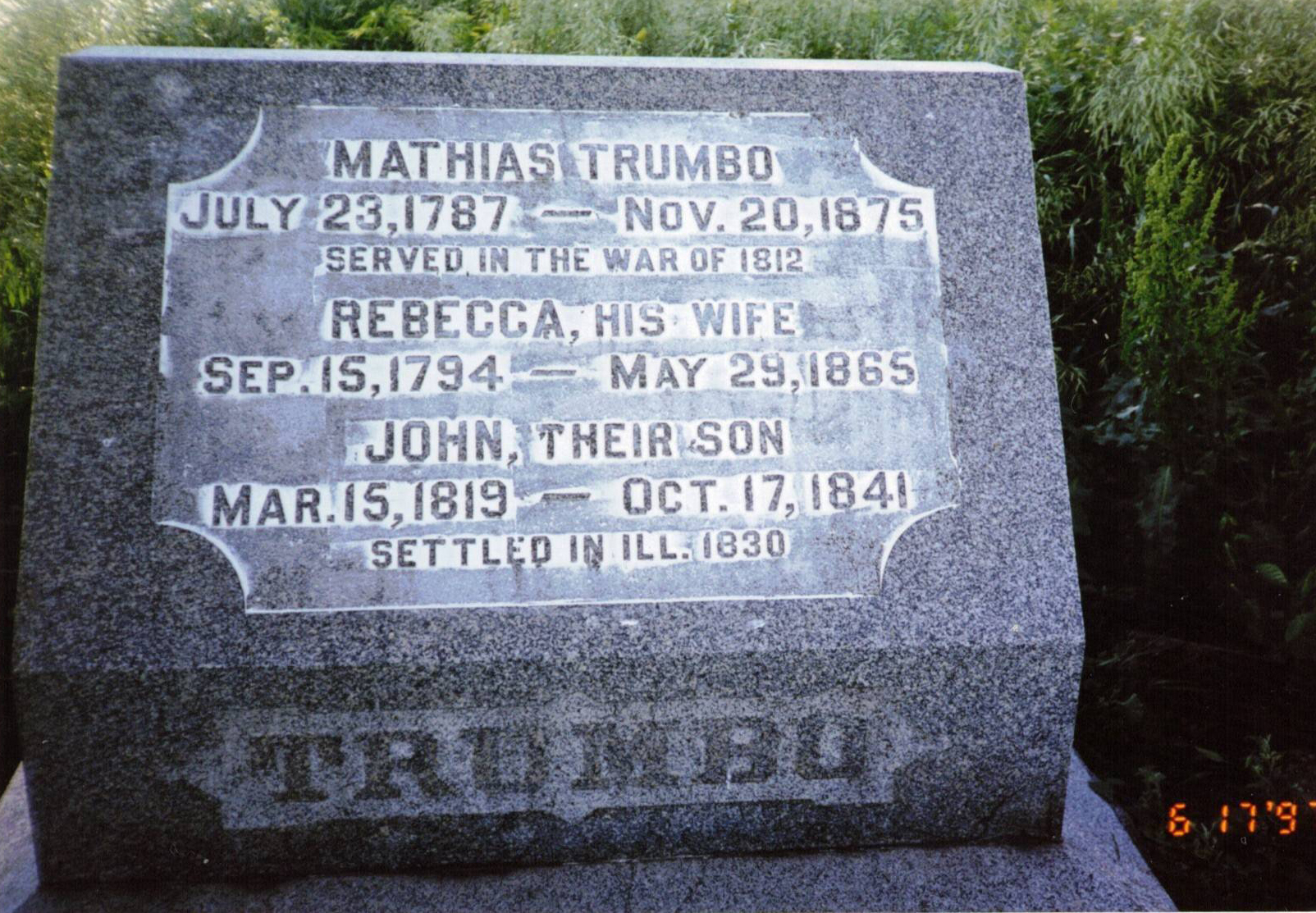
Thanks to the folks at the La Salle County Genealogy Guild (lscgg.org) for this picture of Mathias Trumbo’s tombstone. They have a wealth of information on La Salle County families and are wonderful at sharing it.


  1. You can see the complete text of Mathias’s will and codicil here.

The Old Plank Road Needs to be Upgraded

An example of a plank road

The old plank road, which ran north out of Ottawa, was built in 1847; a direct line from Earlville to Ottawa, by way of Harding. It was in such poor shape by the 1890s that farmers in the north of the county were doing their trading in Earlville rather than in Ottawa. It was clear that something needed to be done. By 1895 the road from Earlville to Harding had been improved and Freedom township had graveled the road to the Dayton township line but the six miles through Dayton remained unimproved.

Ottawa Republican Times, 26 Sep 1895, p2

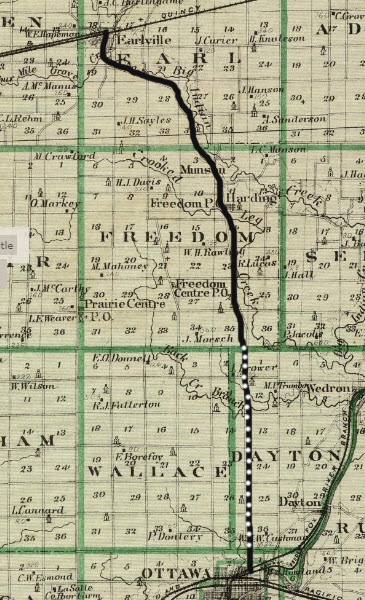
It was to the advantage of Ottawa to get this portion of the road completed and plans were made to share the work. The portion of the road to be graveled is shown below.

Residents of Dayton, Ottawa, Troy Grove and Wallace were asked to contribute money or labor to finish the final six miles of the road. The merchants of Ottawa contributed significantly in view of the increased trade they would see.

Ottawa Republican Times, 26 Sep 1895, p1

The joint effort appears to have succeeded. There is no further mention of the state of the road north out of Ottawa in the newspapers. It is hoped that the Ottawa merchants saw the increased trade they expected.

Fact or Fiction? History or Poetry?

POETRY VERSUS FACT
FICTION AND HISTORY

The following letter was written by David Green in reference to the wide-spread article about his brother Joseph, which was covered here previously in “He Wasn’t the One”. Apparently a collection of poems by a Nebraska poet, which referenced this event, provoked an article in The Platte Journal attempting to correct the story. Here is David Green’s response to the inquiry, as printed in the paper.

Dayton, Ill., March 31st, 1871
J. G. Higgins, Esq., Columbus, Neb –

Dear Sir: — Yours of the 7th inst. asking for information was duly received, in which you give some extracts from a poem written by the Rev. Orsamus C. Dake, entitled the “Raw Hide,” which is found in a recent publication entitled “Nebraska Legends,” with the following preface:

“A certain man, of a small company moving up the great plain of the Platte, in a spirit of bravado, said he would shoot the first Indian he met; which he did, having shortly afterward found a Pawnee woman a little separated from her tribe. But a band of warriors, pursuing, demanded from his companions the surrender of that man, which being refused, the Pawnees made ready to slay the whole company of whites, whereupon the offender being given into their hands, they flayed him alive. From this circumstance the little stream, on whose banks it occurred takes the name of the ‘Raw Hide.’”

The Rev. Mr. Drake has given in the above, the substance of a report which in 1849 found its way into nearly every newspaper in the United States, and no doubt but he together with many others, in good faith and very innocently believes that such a tragedy did really take place as stated, but the whole story is a base and unmitigated falsehood from beginning to end, as there never was the least foundation for said report. The hoax was gotten up in Magnolia, Putnam county, Illinois, in a bar-room to gull a gaping crowd, without any thought of its going any further, but someone present took it to be true and communicated it to the editor of a paper published in Lacon, Marshall county, Illinois, from which it was, as stated, very extensively copied.

On receipt of yours I wrote to Hon. Wm. E. Parret now of Winona, Illinois, but at the time the hoax was gotten up he resided in Magnolia, Illinois, and in reply he says, “That two men by the name of D. P. Fyffe and David Law, of Magnolia, got up the hoax out of whole cloth. The said Mr. Fyffe of Magnolia, over his signature of the 27th inst, says “It (referring to said hoax) originated here and was known to be a hoax.” I merely give you the above that you may know where said report originated.

My Father, two Brothers and some twenty or thirty others from this county were the company referred to, and my brother Joseph Green was the reported victim, who would have been the last man in the world to make any such threat, or be guilty of any such rash act.

The said company went out to California in the spring of 1839 – he Joseph Green returned in 1851 – went out to California again in 1852, returned in 1853, and died in this place in 1855, with the consumption. A more noble, kind-hearted and generous man never lived, and I hope you will use your best efforts to correct this infamous slander upon his fair name.

I am, very respectfully,
D. Green1


  1. The Platte [Nebraska] Journal, April 12, 1871, p2, col2.

A Very Fishy View of Dayton and its Industries in 1880

Dayton Items.

Dayton, as a point where the finny tribe and fishermen do most congregate, has long been celebrated in this section of the country. People armed with hooks, and lines, buckets of bait and togged in old clothes, come daily and nightly from far and near. They arrive on foot, in buggies, in lumber wagons, and dumped off the cars, and are landed in every shape all bent on the same purpose, i. e., that of catching fish, not by the dozens, or in fifties, but by bushels, bagsfull, wagon-loads, and in other prodigious quantities.

They arrive in lofty spirits, braced up by lofty expectations of astonishing the natives. They usually depart wet, hungry, tired, disgusted and without any fish worth speaking of. To a man whose constitution requires a vast deal of rest — long continued and complete relaxation of every muscle and nerve — fishing is just the thing. Fish, as food, may be brain food, but catching them is certainly a brain softener. It does not require a very high order of intellect in a man to fish, that is, a man of very moderate brain power ought to know enough to out-wit a fish, which stands rather low in brain development. In short, fishing, to an outsider, is a very languid, sleepy sort of work. There never has been any employment so well adapted to the wants of a lazy man as that of fishing as they do it at Dayton. To see the anglers as they line the banks and cover the rocks like so many mud turtles [illegible] is a sight fit to make a person yawn.

To the man to whom any kind of exercise is a bore fishing is just about exercise enough. The fellow lands upon some sequestered spot, sits down to rest and meditate awhile, then baits his hook, summons up all his energies like a man trying to ward off sleep, gets the line in the water, and then the thing fishes itself. When a man gets too lazy to fish they accuse him of having a softening of the brain and soon after he becomes too tired to draw his breath and this ends him.

Some of the fellows we saw fishing on Friday last were half a mile from the water, under a shade tree, three of ‘em asleep and the fourth studying the sun’s altitude and position of its spots through a “pocket” telescope. Though we were ln sight of a score or more of fishers for an hour, we did not see a fish hauled out, nor even hear of one being captured, though a shoal of three or four minnows were reported to have swam up among the fishers early in the morning.

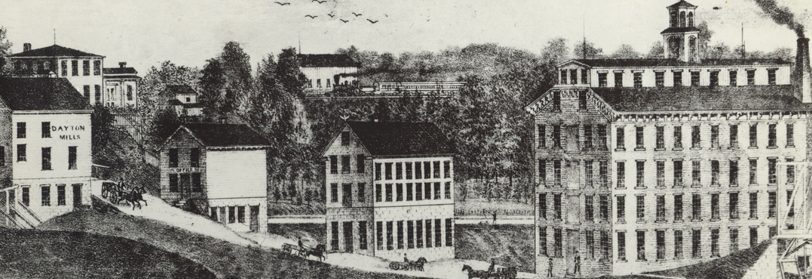
Dayton, however, has another point of view of far more importance to the business man and to the farmer. We refer to her woolen mills — as good as any in the state built some years ago at great expense, and stocked with as excellent machinery as the Union anywhere could boast. Though under a cloud for a time, but now started anew by its original owners, the Greens, it will soon be working upon a large scale, and is daily turning out great quantities of yarn of various grades, also superior cloth.

Another enterprise is the collar factory, under the management of Mr. Dunavan. It employs a large force of hands, turns out the premium horse collars of the United States and also a fine article of leather fly nets, the latter being its chief production during the summer months. The goods from this establishment find a ready market all over the country.

Another business, as yet young, but extensive and rapidly increasing in importance, is the Dayton tile works. When the factory was started it was not supposed that it would, in five years, reach the dimensions it has attained in a few months. The tile they manufacture is as good as any made in the west.

The large paper mill here next claimed our attention. This institution has long since become fixed and firmly established upon a substantial business basis. It runs exclusively on straw and manilla paper and consumes vast quantities of material. It has on hand an enormous stock of as good paper as is made anywhere. The recently senseless boom in prices of material used is happily subsiding, and the rather sluggish demand in this county for paper, has been rather unsatisfactory, but it runs ahead, looking for a fairer margin between its expenses for stock and the price of manufactured goods than has generally prevailed.

Besides, a good flouring mill and a local store and a “tavern” and good prices for farm products in general, all contribute to make Dayton a live business village.

Since the tile works were started in full operation a new industry has been developed, being coal mining operations, managed by Simpson & Wilke, a couple of hard-working miners, who obtain a good quality of coal which lies on the level with the banks of the feeder, and is drifted and removed on hand cars on a tramway and dumped below the woolen mills into wagon, or on the public roads as may be required.1


  1. Ottawa Republican, 27 May 1880, p2, col 3

The Dayton Cemetery Association – a retrospective

There have been several different Dayton Cemetery Associations over the years since the first burial in 1835, The current group was organized in 1956, with the object of cleaning up the cemetery, which had been allowed to go wild, and building a fund for providing on-going maintenance and support.

The first job was to mow the tall weeds.

Cleaned around the stones and trimmed branches

The annual meeting of the Association is held on the Sunday of Memorial Day weekend, and for many years met at the home of Grace and Charles Clifford, in Dayton.

Mabel Myers, Sandra Dunavan, and the 10th anniversary cake – 1966

As the years went by, the group grew larger.

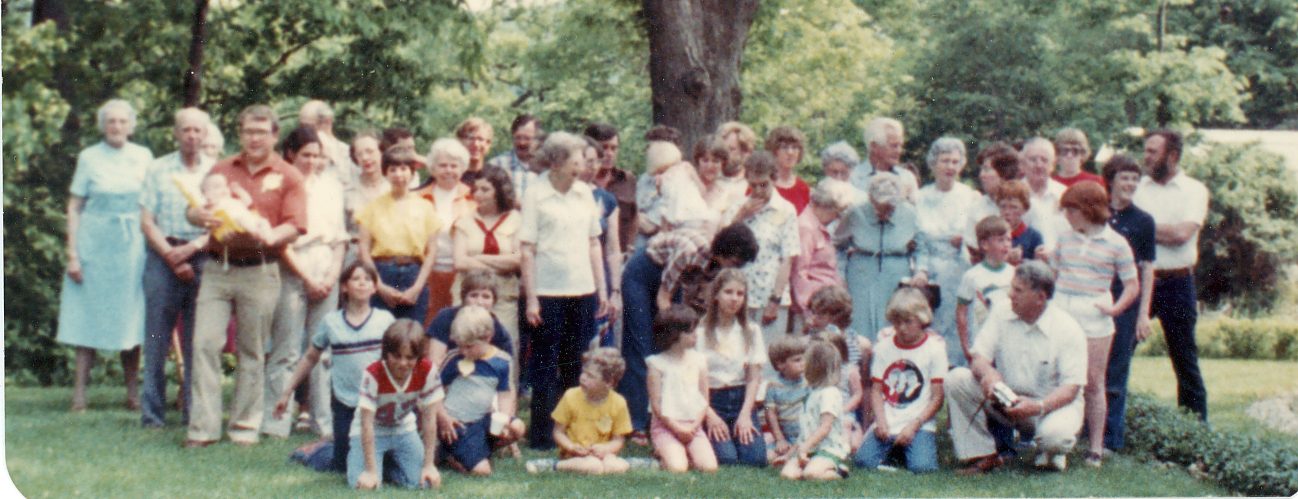
1980 – taken on the Clifford lawn

In 1996 Secretary Carrie Ann Green searched through the minutes and created a timeline of the organization up to that point. The timeline and the program Carrie gave in 1996, can be seen here.

Every year the meeting concluded with a historical program, frequently a story of families buried in the cemetery. More of the old programs will be added to this site as I get around to it.

In 2000, after the Cliffords moved from Dayton to Ottawa, the annual meetings were held at Skydive Chicago.  The traditional potluck meal and the historical program following the business meeting carried on the traditions, regardless of location.

2007 – We had to draft someone from the skydivers to take our picture.

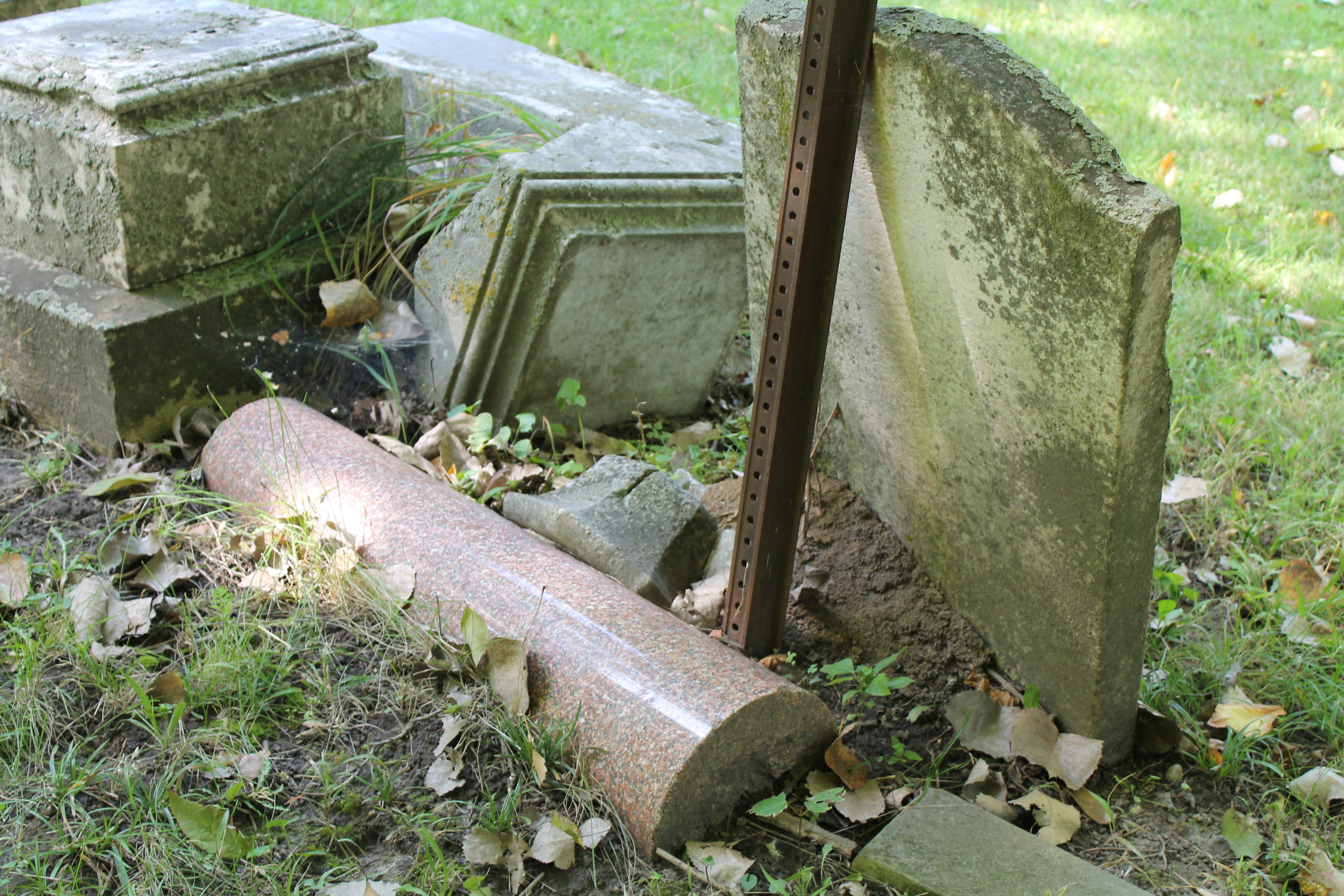
In 2014 we worked with John Heider, a professional cemetery restoration expert. That year we restored 20 stones and the following year he came back and we did another 30 or so.


In 2020 Covid changed everything and we went to Zoom for meetings (though not for the pot-luck meals). In 2024 we are returning to Skydive Chicago and a more normal existence.

A view to the west

An Anniversary

Today, April 2, is the 175th anniversary of the day John, Jesse, and Joseph Green started for the gold mines.

Californians

At least fifty persons from this county, left this place during the past week for California. The company from Dayton left on Monday, on board the Timoleon, which boat we understand they chartered to take them through to St. Joseph, on the Missouri river. All Dayton precinct was down to see them off, which gave our landing altogether the most crowded and bustling appearance we have ever seen it bear. The company is composed of as good men as there are in the county, and we are sorry to lose them. May their brightest anticipations be realized!

Our Ottawa boys, although there is quite a number of them, have been leaving for a week or two, in parties of two or three. There are among them some of the best of men, and a few whose loss we shall probably be able to survive. May they all have the best of luck, and come back with gold enough to improve the river to Ottawa, and build a bridge across the Illinois!1

1. The [Ottawa IL] Free Trader, April 6, 1849, page 2, col.2

The Time of the Big Snow

snowdrifts

Since there are no pictures of the 1830 deep snow, here is a newer one.

THE “TIME OF THE BIG SNOW”

Sixty five Years Ago Great Suffering Was Caused by the “Beautiful”

Old settlers who were little boys and girls in the winter of 1830-’31 tell of the “big snow” with as great emphasis as does the old time Irishman of the “big wind” that is popularly, though erroneously, supposed to have assisted St. Patrick to “shoo” the snakes and frogs off Irish soil. An old settler says of the “time of the big snow:’

“About Christmas time, 1830, and continuing at short intervals from that date until late in January following, a snow storm raged in Central and Northern Illinois which the settlers called the “Deep Snow.” No such snow had fallen before that time within the memory of the white settlers and no such snow has fallen since. It formed an epoch in the history of Illinois, and men were accustomed to refer to it as fixing the time for occurrences which took place long afterward. Old settlers even now occasionally refer to it. The snow began falling after noon on the day before Christmas. Prior to that time it had rained for a considerable time, and the ground was saturated with moisture. The corn had little of it been gathered; the cattle and hogs had until that time managed to get most of their feed in the woods. The corn meal, then the chief food of the settlers, was getting low, but not low enough to cause any particular uneasiness. Fuel was plenty in the woods but little was at the houses. The settlers, accustomed to the open winters of preceding years, saw nothing to cause alarm, either in their exposed condition, or in the lack of fuel and provisions.

“The storm continued with slight intermission until it was, on a level, about three feet deep all through this part of the country.

“After a few days of snow, the rain fell enough to wet the top of the snow, which then froze, forming a crust which was strong enough to bear up a wolf or a dog, but was not strong enough to bear up a horse, and in places was not strong enough to bear up a man. The deer were unable to run on the snow, as their sharp hoofs would cut through and the animal would then be wallowing helplessly in three feet of snow, unable to get out. The consequence was the wolves destroyed multitudes of them. The deer were almost all of them exterminated in that way. Perhaps the worst consequences were felt by the early settlers. Their corn was not much of it harvested, and it was impossible to harvest it then, or at least, not enough could be harvested to feed cattle or hogs.

“A man could by hard work gather enough to feed himself and family, but the question of supplying any fire wood, to cook or keep warm, became serious.”1


  1. The Ottawa Free Trader, December 27, 1895, p. 3, col. 3

The Centennial Reenactment

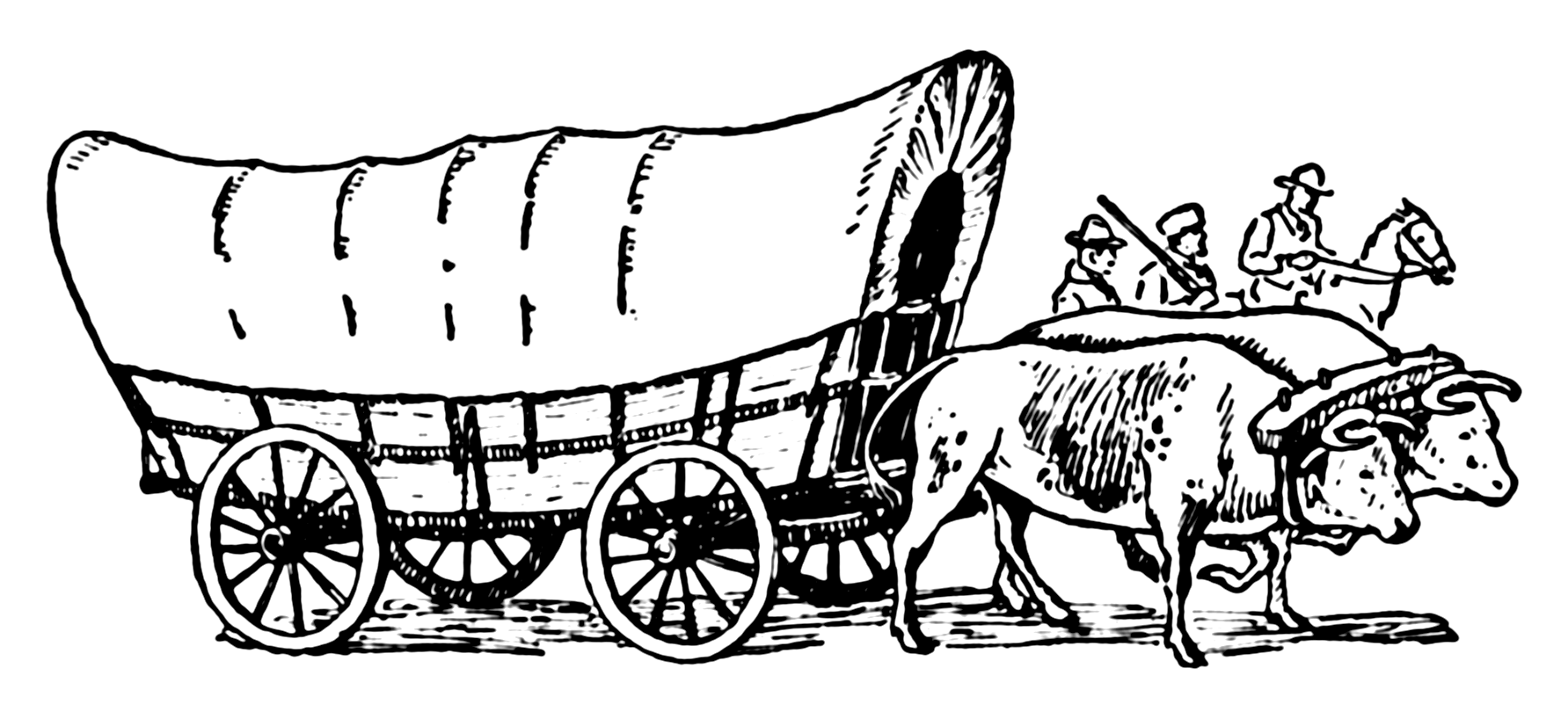
Covered WagonThe following comes from the hand-written notes of Maud Green about the Dayton exhibit in the La Salle county centennial celebration.

The 24 people who came from Licking County, Ohio in 1829 to La Salle County, Illinois

  1. John Green
  2. Barbara Grove Green
  3. Eliza Green (m Wm Dunavan)
  4. Nancy Green (m Albert Dunavan)
  5. Jesse Green
  6. David Green
  7. Katherine Green (m Geo. Dunavan)
  8. Joseph Green d. 1854
  9. Rachel Green (m Geo W. Gibson)
  10. David Grove
  11. Anna Howser Grove d. 1849
  12. Elizabeth Grove (m. David Conard)
  13. Henry Brumbach
  14. Elizabeth Pitzer Brumbach
  15. David Brumbach
  16. Rezin DeBolt
  17. Emma Grove DeBolt d. 1843
  18. Barbara DeBolt d. 1851 (m David Conard)
  19. Jacob Grove [Grove crossed out in pencil and DeBolt written in]
  20. Samuel Grove
  21. Joseph Grove d. 1858
  22. Jacob Kite
  23. Alex. McKey
  24. Harvey Shaver

Of these 24 – two returned to Ohio.  Of the 22 who remained, only seven died in 41 years.
“Jacob Kite never married.  A sort of Nimrod, he lived by hunting and went West.” (Baldwin)  He is the man who refused to eat when the provisions ran short on the way from Ohio, as he was afraid the women and children would not get enough food.  Thinking to tempt him, they put eatables in a box on the back of the wagon where he was in the habit of walking, but they were untouched.


List of people who represented the 1929 party and rode in a covered wagon drawn by oxen in the Dayton exhibit at the La Salle Co centennial in 1931.

John Green                  40        Lyle Green
Barbara Green             37       Mabel Myers
Eliza                            15         Ruth Mary Green
Nancy                          14        Helen Myers
Jesse                            12        Lewis Myers
David                          10        Kenneth Green
Katie                           7          Ruth Van Etten
Rachel                         3          Ann Van Etten
Joseph                         1          John Van Etten
Rezin DeBolt              23        Floyd Smith
Emma Grove DeBolt  19        Lona DeBolt
Barbara                        3 months
David Grove               25        Henry Grove
Anna Grove                24        Nellie Grove Geen
Elizabeth                     1          & Louise Geen
Henry Brumbach                    Howard Smith
Eliz. Pitzer Brumbach             Myrna McMichael
David Brumbach                     Boy baby
Young men
Joseph Grove                          Billy Grove
Samuel Grove                         Elias Trumbo
Jacob Kite                                Donald Gardner
Alex McKey                             Donald Ainsley
Harvey Shaver                        Howard Shaver
Jacob Grove                            Leon Maynard

Planning for the Old Settlers’ Annual Reunion in 1876

Old Settlers

The Old Settlers’ Association met at the Court House on last Saturday afternoon to elect officers, set a day for the Annual Reunion, and general business. Not a very large number were present.

The meeting was called to order by the President, Mr. Jno. Miller, of Freedom, and the minutes of previous meetings were read and approved.

Mr. Munson moved that the old officers be re-elected, which was carried; and Messrs. Elmer Baldwin, Philip Watts and Jesse Green were added as vice-presidents. Following is the list of officers: John Miller, President; Ransom Pulmer, W. Bushnell, John Hoxie, E. S. Leland, I. H Fredenburg, D. F. Hitt, E. Baldwin, P. Watts, Jesse Green, Vice Presidents; A. M Ebersol, Secretary and Treasurer, J. H. Pickens, General Superintendent.

On motion it was decided to hold the Annual Pic-Nic in Hoes’ grove on the 21st of August next.

Messrs. J. Bachellor, J. Pembrook and S. H. Miller were appointed a committee to secure the grove and make arrangements for freeing the Illinois River bridge on that day.

Messrs. E. Baldwin, R. Palmer, and Jno. Miller were appointed a committee on speakers.

The committee appointed at the last meeting on History reported no action.

A resolution was presented and adopted as follows:

Resolved, That the Hon. Elmer Baldwin be elected to procure from the most reliable sources the statistics of the earliest settlers of the several towns of La Salle county, including all matters of general interest, with a view of the publication of a history of the early settlement of the county, this society to have the first claim to the copyright by paying a reasonable amount for the same.

Jesse Green, Cyrus Shaver, O. O. Wakefield, S. R. Lewis and Wm. Munson were appointed as committee on Finance.

After considerable discussion it was decided instead of increasing the number of committees, to appoint one committee of J. H. Pickens, J. Bachellor, and J. R. Shaver with full power to act on questions of privileges, seats, stands, refreshments, etc.

J. Miller was appointed a committee of one on policy and A. M. Ebersol on concert, programme, etc.

Adjourned to meet at call of Secretary.1

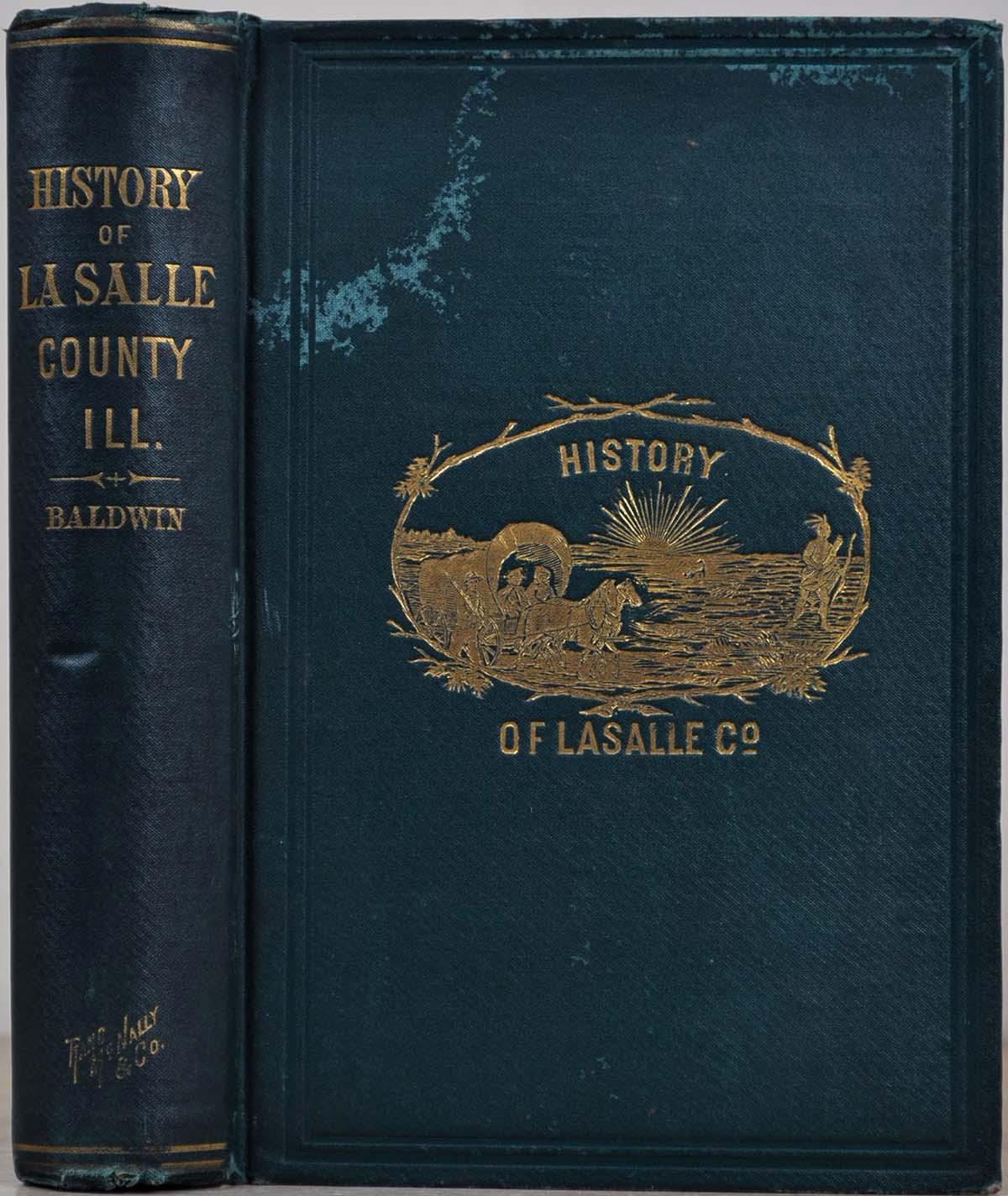
It’s interesting to note that some good plans do, indeed, come to fruition. Elmer Baldwin’s book, History of La Salle County, Illinois, was published in 1877 and has long been the source of information on the early days of the county. It appears, however, that Baldwin retained the copyright to his work.


  1. The Ottawa [IL] Free Trader, June 10, 1876, p8, col 2

Dayton’s Industries in 1879


DAYTON
One of La Salle County’s Flourishing Manufacturing Centers

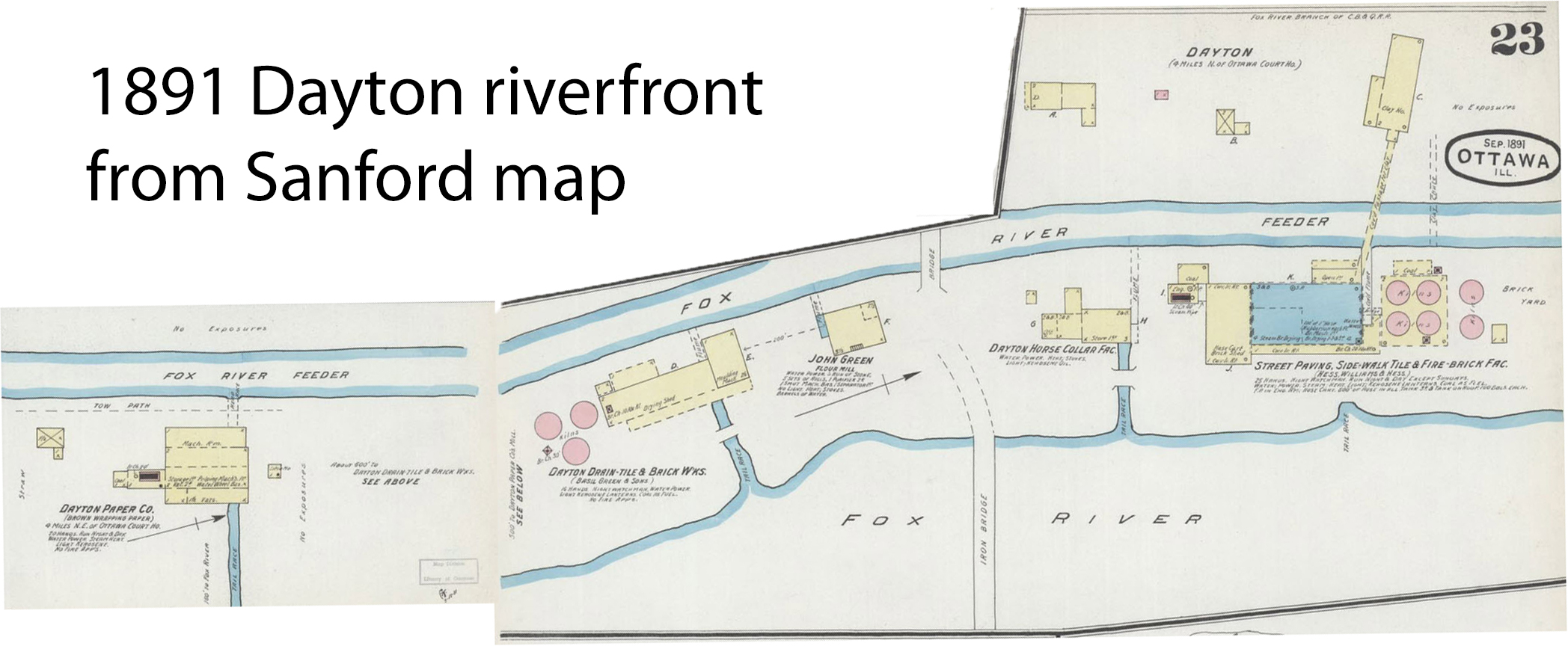
Dayton, as some of your readers may not know, is located four miles from Ottawa, on the Fox River branch of the C., B. & Q. R. R. Its most solid attraction is one of the best water powers to be found in the West. The dam that supplies the power is owned and kept in repair by the state, so that lessees of power feel assured that if the dams or locks should ever be impaired by the ravages of time or floods, the damages will be speedily repaired, without tax or expense to them.

The paper mill of Williams & Co., situated at the lower end of the manufacturing portion of the town, is one of the best in the state. Their products are so favorably known that running night and day the year round they are unable to supply the demand.

The Tile and Brick Works of D. Green & Sons are yet in their infancy, yet the perseverance of its proprietors, and the excellence of the material close at hand, is sufficient evidence that the surrounding country can soon be supplied with the very best tile and brick to be found anywhere.

The grist and merchant mill of D. Green & Sons is presided over by Mr. Stover, widely known for many years as one of the best millers in the state,

The Fox River Horse Collar Manufacturing Co. is an incorporated company, composed of a body of modest and unassuming men, their modesty being only equaled by the superior quality of their goods, which are widely known from Pennsylvania, Ohio and Virginia on the east, to Kansas, Nebraska and Missouri on the west, to be the best in the world. They use about forty tons of rye straw yearly for filling horse-collars, and the hides of about 2,000 head of cattle are required yearly to supply them with leather.

The elegant massive building known as the Dayton Woolen Mill is now owned and run by J. Green & Sons. They are so well known for the excellence of their goods and their honorable dealing that the simple announcement that they are again in business is sufficient to flood them with orders.

Adjoining the town is the splendid grain and stock farm of Isaac Green. Mr. Green makes a specialty of raising Norman and Clydesdale horses and thoroughbred cattle, and can show some of the finest in either class to be found in the state. Among the minor attractions are many fine driving teams, single and double. I would like to give you the names of the owners, but their objections to seeing their names in print forbid it.

And last, though not least, we have the nicest girls, the most dashing beaux and the most enchanting Groves to be found anywhere. Go a fishing and come and see us.

Full Stop1


  1. The Ottawa [IL] Free Trader, July 12, 1879, p. 8, col. 1

Settling the Prairies

Township 34 North Range 4 East of the 3rd Principal Meridian

The map above is the original survey of the area around Dayton (starred) and indicates by the green lines the extent of the timber in the area. In his memoir, Jesse Green wrote of the impact of the open prairies on settlers from the east: –

The first settlers all came from heavily timbered country and as a consequence did not think it possible that those broad prairies would be settled in their day but expected to have unlimited range for all the stock they might desire to keep. The first settlers secured as much of the best timber as they possibly could, through pre-emptions and floats (as they were called) which were subject to transfer and sale by their holders. In the course of time they expected to have neighbors skirting the timber belts of the country but did not have the remotest idea the prairies would be occupied, however, it was not long until coal was discovered and thought to be almost inexhaustable. Lumber began to be brought across the lakes, and the problem of the feasibility of settling up the prairies was solved, and only a few years later the prairies in this section were nearly bought up, largely by eastern land speculators which retarded the settlement of the country considerably for a number of years, driving immigrants still farther west,

The Great Flood of 1855

The Fox River has seen ice jams many times over the years.

The last of January, 1855, witnessed a great storm and flood, extending over several States and doing vast damage everywhere, this county not excepted. At Ottawa the principal loss was the destruction of the Illinois River bridge, then but about two years old. Up to the evening of Saturday, Jan. 31, and as long as the ice from the Illinois River came square upon the piers, they bore the pressure without sign of giving way; but on that evening, when the ice came out of Fox River, borne on a drifting current of six or seven miles an hour, and striking the piers from a quartering direction, they could resist the shock no longer, and before midnight an ominous crashing heard in that direction above the roar of the ice showed that the noble bridge had shared the fate of so many others and gone down before the flood.

Daylight on Sunday morning revealed the extent of the ruin. The trestle-work and the second pier from the north shore had entirely disappeared, taking down with them the entire bridge to the third pier, leaving the two south spans still resting on the piers so shattered as to be barely able to carry their weight. The woodwork of the bridge lodged on an island near Utica, and a portion of it was recovered.

The cost, however, of repairing the damage exceeded half the original coat of the bridge. At the time of this disaster the water rose a foot above the highest point touched since the county was settled, the point mentioned being reached in 1849.

Some damage was done to the Fox River bridge. Considerable property was injured and carried off from the low ground on the east side of Fox River. Messrs. Fredenburgh, Smeaton and Van Gaebeck, living next to the bridge, were obliged to emigrate, and lost in fences, hay, wagons, etc., seriously. Persons living on the south side of Main street, east of Fox River, who had their stables on low ground, all lost something. Below the hydraulic basin, south of the main part of the city, some damage was done. On the low ground in Ottawa Center about a dozen houses, generally small and occupied by poor people, were submerged to the roof and the contents ruined where not carried off.

The chief disaster at Dayton was the destruction of the fine bridge erected by the people four or five years before at an expense of some $4,000, It was taken off bodily, leaving nothing but the naked abutment The feeder was so injured that mills could not run for a month or so. Some sixty or seventy rods of the bank were swept away and the lock was seriously damaged.

At Peru and La Salle the damage was pretty heavy. At the latter place all the lower stories of the buildings on the canal basin were submerged, and much fear was entertained with reference to the fleet of loaded canal boats in the basin, but they appear not to have suffered much. At Peru the fine stone freight house of the Rock Island Railroad had its whole east side knocked out Several loaded canal-boats were sunk, and some warehouses and other buildings damaged in various ways.1


  1. History of La Salle County, Illinois, 2 vols. (Chicago: Inter-State Publishing Co., 1886), 1, 451-452.

The Missing Marker

It has long been known, from memories and newspaper accounts, that a marker was erected on the east side of the river at Dayton during the centennial celebration in 1929, commemorating the arrival of the Green party. However, the brass marker disappeared years ago and no one remembered exactly what it said.

I was looking through some old family stuff recently and I came across this snapshot. If blown up, it’s possible to read the text, which says:

1829        1929
ERECTED BY THE DESCENDANTS OF
JOHN GREEN
WHO ARRIVED HERE
WITH THE FOLLOWING PARTY ON
DECEMBER 6, 1829
JOHN GREEN AND FAMILY
REZIN DEBOLT AND FAMILY
DAVID GROVE AND FAMILY
HENRY BRUMBACH AND FAMILY
JACOB KITE      ALEXANDER MCKAY
HARVEY SHAVER   SAMUEL, JOSEPH
AND JACOB GROVE
THEY IMMEDIATELY BEGAN THE
CONSTRUCTION OF A DAM, SAW AND
FLOURING MILL WHICH WERE THE
FIRST IN NORTHERN ILLINOIS
THE GREENS ERECTED THE FIRST
WOOLEN MILL IN ILLINOIS ON THE
OPPOSITE BANK OF THE RIVER IN
1840

This picture was taken at the 1929 dedication.  From information on the back , these people are-
Back row: Harold Dunavan, Herberta Schabes holding her daughter Dolores, Harold’s wife Marie, Clara “Coe” Dunavan, Herbert L. Dunavan
Front: Muriel, Marion and Buddie

Agreement to Adventure

In February of 1849, the Greens had decided to go to the California gold fields. Young Torkel Erickson was drawn by the idea of adventure and wanted to join the westward rush. The problem  was how to afford the trip and how to travel with others for protection.

This was solved when the Greens offered to include him in their party, providing he would work his way. The result was an agreement signed by both parties wherein the Greens agreed to furnish provisions and ammunition to get to the Sacramento valley of California, furnish provision, tools, and ammunition for one year after commencing work at gathering gold, and pay all necessary expenses on the trip.

In return Torkel Erickson, in the document above, agrees to assist in driving the teams going to California, and to give the Greens one half of the proceeds of his earnings or labor for one year after they commence work, at gathering gold or any other business in California.

He additionally agrees to compensate the Greens if he is unable to work for any considerable length of time due to sickness or any other cause; the compensation to be based on the price for labor in the immediate area. The agreement was written up and signed in the presence of two witnesses.

The Greens proceeded with their arrangements for the trip and were ready to set out for California leaving Ottawa on April 2 on the Timoleon which they chartered to take them through to St. Joseph, on the Missouri river. No other men had yet offered to work for their passage, but three men must have decided at the last minute to go along. The agreements with Jackson Beem, Erick Erickson, and Alanson Pope were written and signed on April 3, presumably on the boat.

An Unexplained Explosion

SHACK NEAR DAYTON IS DESTROYED
Charge of Dynamite Resulted in Injury to Two

Two men were injured, and the lives of two others endangered when the three room shack of William Hibbard located along the banks of the old feeder and just outside of Dayton, was dynamited by an unknown assailant early Tuesday morning. The injured, William Hibbard and Albert Charlery are now confined to the Hibbard home and are being attended by an Ottawa physician. Neither of the other two men, Frank Davis and Arthur Gosney, were badly injured and they did not need medical attention.

The matter has not been reported to the authorities, but it was learned that Hibbard and his three friends who are employed at the James Funk coal beds near Dayton had entered the house, a little three room shack, located on the trestle road from Dayton and the north bank of the feeder late in the evening. According to their own story, it is said they became engaged in a card game and did not hear or see anyone about the place.

Shortly after midnight there came a deafening crash that could be heard for some distance from the house. Every one of the quartet was knocked from his chair and onto the floor, Hibbard being rendered unconscious while his three companions were dazed.

So great was the force of the explosion that every bit of glass in the house was shattered. The stove was blown clear across the room, pictures were knocked from the wall and all of the furniture damaged as well as the exterior of the house.

The alleged charge of dynamite from all appearances was dropped along the side of the house where Albert Charlery was sitting. When the explosion came he was hurled clear across the room.

While the explosion occurred between midnight Sunday and 1 o’clock Monday authorities have not received any notification of the mysterious occurrence. Residents of Dayton are unable to throw any light on the affair and all they can tell is of the mute evidence of the happenings of the night and the roar of the explosion.

The Hibbard shack was built by Hibbard after his other house had been destroyed by fire and was used as a kind of hang-out by men working in the coal beds and clay pits near Dayton. Why anyone would attempt to blow up the house and murder or injure the occupants is a question that the residents of Dayton are asking one another.

from the Streator Times, 22 November 1923

[It’s frustrating that there is never a follow-up to stories like these. Who blew up William Hibbard’s shack? and why?]

Mail to California

In April, 1850, David Green wrote to his father and brothers in the gold fields near Sacramento. The postage to California and Oregon was 40 cents and it was paid by the sender. This letter was folded and sealed to create its own envelope. Note the red blob of sealing wax still adhering to the paper. The postmark reads “Ottawa Ill. APR 28”. How did this letter get to California?

Mail to California began in November, 1848, when Postmaster General Cave Johnson dispatched a special agent to California to establish Post Offices. By Christmas, steamships were carrying mail from New York to California via the Isthmus of Panama. This was before the construction of the canal. When the ships reached Panama, the mail was taken off and transported in canoes or on pack animals – and later by railroad – about 50 miles to the Pacific coast. Another steamship collected the mail on the Pacific side and headed north. The total journey took about three weeks. See here for map.

Since the first overland mail service to California was not until the spring of 1851, this letter likely went by boat from Ottawa to St. Louis and then by steamboat to New Orleans. From there it joined the main mail route from New York, crossing Panama and continuing up the coast to San Francisco.

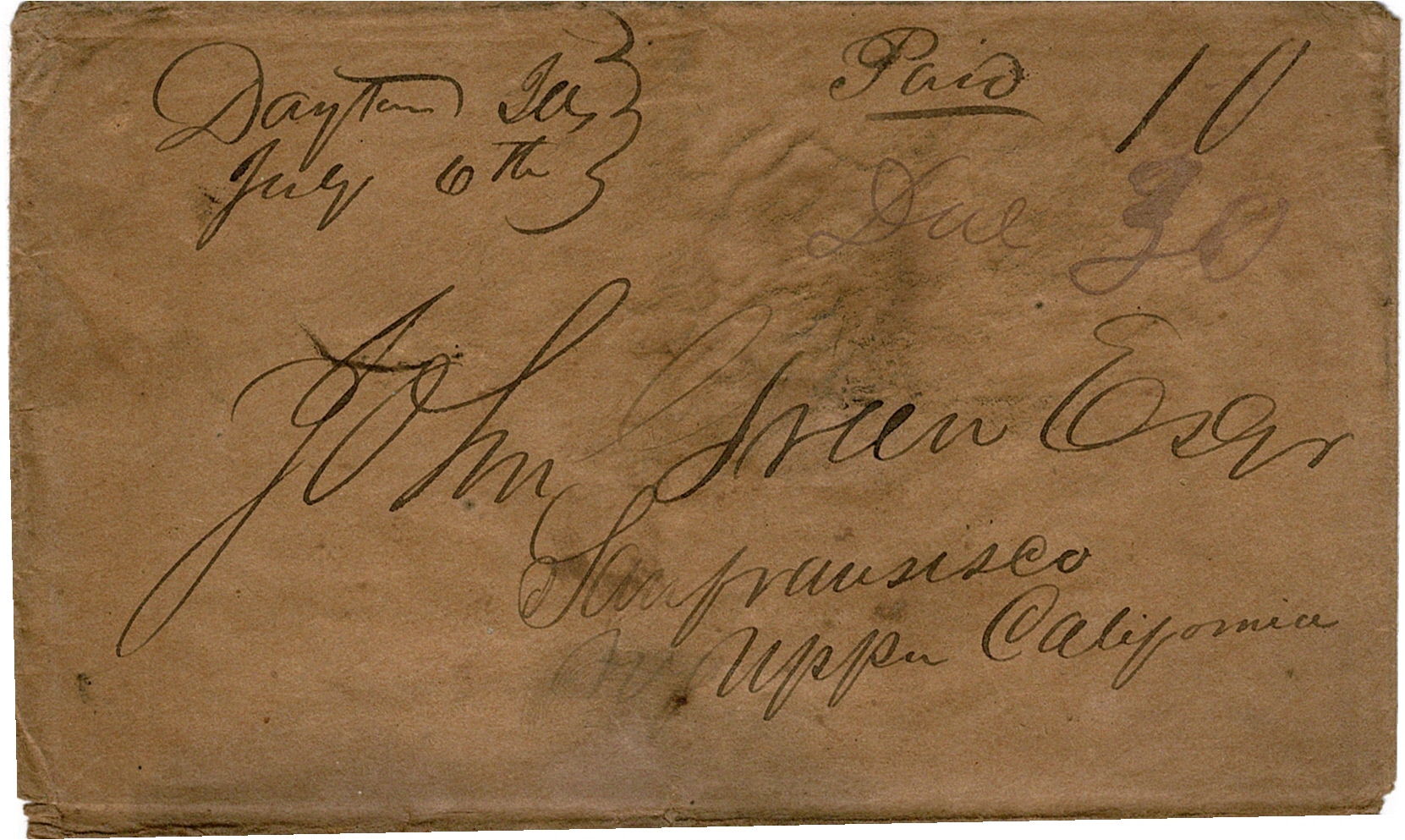
This second letter came in its own (hand-made) envelope. Note that in this case the sender paid only 10 cents, leaving 30 cents to be collected upon arrival. Was David thinking the miners would have plenty of gold to pay the amount due?

Mail to and from California was eagerly awaited and all the letters stressed the fact that they had not heard from the other in a long time. Then a batch of letters would appear all at once and news was relayed to everyone for miles around, in hopes that their people would be mentioned. Many of the letters from La Salle county people were published in the Ottawa Free Trader.

Mail from home was not only eagerly awaited, it was treasured. These two letters, mailed to California and received there, were put away safely and brought home with them. The fragile originals are now treasured as evidence of how important the mail was to the adventurers.

1829 home of the Green party

When the Green party arrived in Illinois in December 1829, they moved into the cabin that William Clark had built for them. It was 18 feet by 24 feet, and in that single room, fourteen adults and ten children (four of them under two years of age) spent the first winter.  In the picture above, the small extension on the back of the house is the original cabin.

News of Dayton – 1850

Pages 1 and 4 of a letter from Josiah Shaver to Jesse Green

                                                                                                                                                Ottawa, Illinois Feb 6th 1850

Mr. Jesse Green Esqr.

                Dear Cousin

                                I am seated for the first time to address you since you left us. But we were very sorry to see in your last of Nov. 8 ’49 to E. Trumbo stating that up to that time you had not heard a word from home. (which letter came in Ottawa on the 26th of Jan ’50 with many more, one for your wife of an earlier date, and some for the Mrses Dunavans) I hardly know where to commence in giving you the news, for I expect that your folks have written of events as they transpired, and much that I may write will likely be no news to you but thinking that perhaps you will not receive all I will commence back at the time of your departure and come up as near correct as my memory will serve me. The first item of importance is the cholera which scared the folks more than it hurt them. It made its appearance in Ottawa in the fore part of June. Never was there such a cleaning of the St.s and renovating and white-washing of houses & cellars before in that place which fortunately cept it from raging very much about, but 30 or 40 died with it there and many of them caught it on the canal. The Country folks never stoped going in on buissiness. The folks in Dayton were perty badly scared at one time being so many in one house. They feared if it got among them that it would make bad work. But fortunatley they were joyfully disappointed (for they expected it) for there was but one case in Dayton and that was Cousin David thought that he had every symptom of it, but by using the cholera medicine he soon was as well as ever. It did not cramp him. Aunt Anna Groves died with it Aug 8th ’49. She took it and had not been exposed to it in any way, and in a few days Aunt Trumbo took it but was soon relieved. That is all of the connections that suffered any with it. Colman Olmstead’s wife and two oldest daughters died with it, also Jesse Johnson’s wife and oldest girl. (Colman is married again to his wife’s cister, an old maid)

It was much worse in Peru at one time in July it was nearly deserted all kinds of buissiness stopped for a few days. Here it was but a short time that they feared it. Your son Byron died on the 6th of may ’49. He was sensible until the last he wanted to be carried across the room but a few minutes before he expired. We had great trouble with the seed corn, almost all had to plant over from once to three times, which cept very backward until quite late but we had such an extraordinarily good fall that corn was first rate, wheat on an average both Spring and winter was scarcely a half crop. Potatoes, tolerable good, rot doing but little damage. Corn market last summer ranged at one time from .30 to .37 cts pr. Bush, and came down to 2 shillings at which price it readily sells for now in the ear. Wheat market was up last fall to 5 and 6 shillings pr. Bushl and then fell and was very low until lately. It is worth now best qual .75 cts pr. B. Pork was very dull from $1.75 to 2.50 pr. Hund. Lbs. Ottawa has improved very fast this last summer. We had a delightful warm and dry fall until the 25th of Nov. when winter set in but we have had a pleasant winter this far. Some snow which made good sleighing for two or three weeks. For the last two weeks it has been quite warm and windy, but it is colder today. The ice has started in the river. W. Irwin, Commision merchant of Ottawa (Eaton Goodel’s brother-in-law) went to Chicago last June and there entered his passage on a vessel for the lumber country, as he intended to purchase some lumber to bring home with him, and that was the last track that could be got of him all supposed that he was murdered or fell overboard in the night as the officers of the boat could tell nothing about him, all was mystery until lately when a Mr. Kellog returned from California and said that he saw him in Sanfrancisco, and a few days ago they got a letter from him. It is supposed that he got scared too soon. (he ran from debt.) A. W. Magill of Ottawa failed this fall. His store was sold at auction. The California Fever is raging this winter as bad as last if not worse, although Elias Trumbo and David and I have not got it so bad but I do sincerely wish that I had of went with you. George & Theodore Gibson are going. Aaron Daniels & John Holkan are using every effort to make a raise to go, the Connord boys are going. All intend to go with the oxen. In fact they are going from all over the country. Alison & Ralph Woodruff & Jo. Hall started a month ago, and Ralph died in Peoria in a drunken fit, and the others came back on account they say that they would have to lay too long at the isthmus. George Galloway with a number of them on that side are going to start soon. Our Township Organization caried unaminous. The commissioners are now laying out their boundaries, and in April we elect our officers which is some 14 or 15 in each town. I can’t give you the boundaries of them as they are fractions and will be attached, to some other and the commissioners have not got this far along. The banc of Marseilles has gone the way of all the living. Old L. Kimble died this last fall with an old complaint. Jack Trumbo had been in Cincinatti over a year, studying to be a physician when the cholera broke out there and he started for home, and died with it near the mouth of the Ohio river, and his father went in the fall and took him up and brought him to Ottawa for interment. The connections here have been unusually healthy since you left, your folks have got along very well as far as I know. They all remain in the big brick house. Their greatest anxiety is for your welfare which is often increased by the long space of time between letters, as I will tell you by and by. You will have to try for a large lump or your wife will beat you, as she found over a 7 pounder. The married part of the emigrants have generally left their representatives they range from a month to 8 weeks of age, yours is a fine daughter about 6 weeks old wife and child well. Tell George & Albert that their wives can present them with a Son each

Tell Snelling that his wife has a daughter also. All are well and doing well. Mrs. Zeluff is in the same fix. (Surely the idea of California is quite prolific.) Eliza Gibson had a young daughter. So much for the live stock. Rachel & Rebecca have been on a visit to their Unkle William Greens this winter for 6 or 8 weeks. They were all well and his oldest daughter come home with them and is there now. David is not running the factory this winter and he thinks that it will hardly quit expense in the winter. Old man Hite gets along very well. They all think a great deal of him the girls say he is so good and fatherly that they can’t help but like him. Ben is living with David and talks some of California. Feb 13th river closed up again roads have been excellent for the last 2 weeks neither snow nor rain, excellent, winter weather. Winter wheat looks fine yet. Grain is on the raise wheat 80 cts corn 28 cts They say that the California gold has made quite a visible change on real estate and in the markets in N.Y.

                We but seldom hear from you. We heard tolerably regular from you until you left Fort Hall and then it was over 3 months before we got any more, which you wrote about 300 miles from the diggings, then the next was when you got through which was some 8 weeks after incoming. We were glad to hear of your success in getting through, and in your first adventures in the diggings, and may you continue to be successful until, as the song goes “now I’ve got all I want I cannot lift any more &.c.” Tell Snelling his folks are all well and John gets along as well as well as could be expected. I will write to him soon. Please write soon. Tell Joseph a line from him would be thankfully received. My respects to you all.

                                                                                From your affectionate cousin   J. R. Shaver

Mr. Jesse Green Esqr

Feb 20 This leaves us all well. I have not got a line from any since you left.  J. R. Shaver    write soon

Baldwin Didn’t Get Everything Right

The bible of early Dayton history is Elmer Baldwin’s History of La Salle County, which attempted to give a sketch of the pioneer settlers of each town up to 1840. In a comprehensive work of this nature, it is no surprise that occasional errors crept in. I have my great-aunt’s copy of Baldwin’s book where she handwrote corrections into the Dayton-Rutland sections. She was writing about her family and neighbors, correcting errors that she saw.

Here are two paragraphs from the account of Dayton, with her additions and corrections in italics:

William Stadden* and wife, Elizabeth Hoadley [Judith Daniels], from Licking County, Ohio, in May 1830, settled on S. 33, T. 34, R. 4; sold to Jonathan Daniels, and moved to Dayton in 1831; built a flouring mill; was twice elected Sheriff of La Salle County, and twice to the State Senate. He was a prominent and useful citizen, and died in 1848. Children: Jonathan, married Elizabeth Long, in Rutland; Mary, married David Green; William; Elizabeth, married Horace B. George; Richard, married Sally Sevant [Swank].
[*His son William Stadden Jr. married Elizabeth Hoadley.]

Nathan Proctor bought the store and goods of David* Letts, [David Letts bought this store from Jas. McFadden who was shot through the ankle by Indians on Indian Creek when Robert Beresford was killed]. in the spring of 1836; he had a very interesting family, and was himself a genial, able and popular man, and did a prosperous business for about one year and was noted for his honorable and upright business habits. On his way to St. Louis to purchase goods, he was detected in passing counterfeit money. He avoided arrest, but never returned. He was found to be a member of the notorious band that then infested the country from the Illinois to Wisconsin, called the Bandits of the Prairies, who were horse thieves, counterfeiters, robbers, burglars, and murderers. Dies, and plates for counterfeiting, were found in his store, and years after, when the building was torn down, a copperplate engraving was found behind the plastering. If his former or subsequent history should be written, it is probable the name of Nathan Procter would not appear.
[*David Letts had one child – Rhoda Ann Miller – (went to Utah). 2nd wife’s children: Madison, Noah, Amanda & James.]

Death of Nancy Green Dunavan

Mrs. Nancy Dunavan

Mrs. Nancy Dunavan died on the 27th of February, 1905, at the home of her son, David Dunavan, near Hamilton, Mo. She was born on April 26, 1816, in Licking county, Ohio, coming to this state with her parents, John and Barbara Green, in 1829. They were pioneers of Dayton precinct. She was married to J. Albert Dunavan in 1834, and settled on a farm in Rutland township, which was at that time a part of Dayton precinct. They lived there for 55 years, until 1889, when they left there a few years later to live with their children at Hamilton, Mo. Her husband died in February, 1892. She leaves one sister, Mrs. O. W. Trumbo, of Dayton, and one brother, Jessie [sic] Green, of Ottawa. The only surviving members of a large family are two daughters, Mrs. Kate Brandon and Mrs. Jennie Howe, of Missouri, and five sons, Samuel Dunavan, of Adam, Ill., Isaac, of Minnesota, David, George and Lewis, of Missouri.1


  1. Ottawa Free Trader, March 10, 1905, p. 7, col. 6