The State of the Village in 1885

OLD DAYTON
Some Reminiscences of the Ancient Village on the Banks of the Fox River

A representative of The Free Trader visited the village of Dayton last Tuesday, drawn thither by the report that considerable damage had been done in that place by the remarkable rise of the Fox river during the recent freshet. Very few of the readers of this paper are not acquainted with the history of the early days of this historic village, which had it not been for the legislative blunder of William Stadden, state senator from this district during the canal agitation, the place, instead of containing 300 inhabitants, as it does today, might be a manufacturing city with a population as large as that of this city.

It was principally through Stadden’s advocacy that the canal terminus was made at La Salle, instead of Ottawa. He was a nephew of John Green, the founder of Dayton, and believed that by having the canal terminate at La Salle he was working for the interests of himself and Dayton. It was his intention to have a navigable feeder from Dayton to Ottawa, which would afford abundant water power for manufactories. Had the canal terminated at Ottawa there would, of course, be no necessity for a feeder. Had the canal ended at the latter city, as it probably should have done, there would be no La Salle or Peru today, and Ottawa would be a city of 50,000 inhabitants and Dayton a large manufacturing point. Lots that sold in that village in 1836 for $500 can now be purchased for $5. In canal days Dayton was a larger place than Ottawa. The cost of running the canal to La Salle would have improved the river to this point, making it navigable for Mississippi river steam boats; and the Illinois Central Railroad would have [illegible] here. But Stadden and those he won over to advocate his views willed all those things otherwise through a huge-sized mistake, which was practically the death-knell of Dayton.

Jesse Green, who is the oldest settler in La Salle county, came to the place with his father in the winter of 1829, from Newark, O. They brought with them mill wrights and mill-irons, and the following July had a grist and saw mill in operation, the mill stones being made form two large boulders. On the east side of the Fox river was then a lodge of the friendly Pottawattomies. At the time of the Blackhawk was, in 1832, John Green was obliged to erect a palisade fort around his dwelling. It was at this time the massacre occurred on Indian Creek by the Sacs and Foxes, in which 15 white people were tomahawked and scalped. During this period the supplies for the Green family were obtained at the store of Geo. E. Walker, located where now are the mineral springs.

At the close of the first year of its settlement Dayton had but 21 inhabitants. Resin Debolt, Henry Brumbach, uncle of the deceased county surveyor George Brumbach, and Daniel Grove, father of Samuel Grove of Utica township, had moved into the vicinity, making in all but three neighbors of the infant colony. In those days there were plenty of wild animals in this region, such as deer and wolves, but only one bear was ever seen hereabouts by the old settlers.

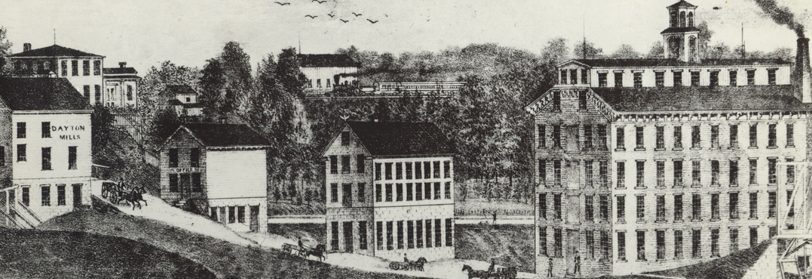
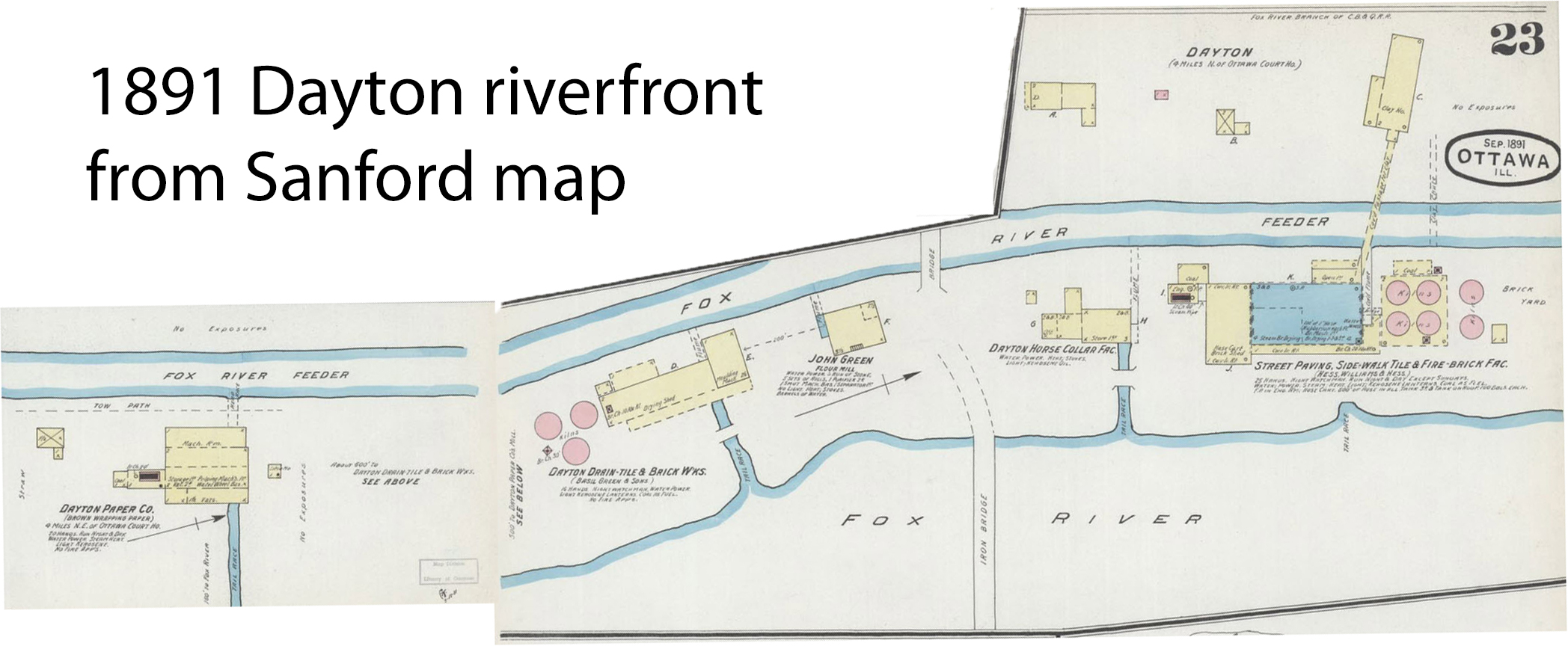
The fame of Green’s Mills from 1834 to 1875 was extensive throughout this region. In the early years of Dayton’s history teams traveled 100 miles to these mills. In the last ten years the flour business has greatly fallen off. John and Charley Green, the proprietors, also run a tile factory. The woolen mills were run by the Greens since 1842. A few years ago they were closed and a pressed brick factory started in the large stone building. The fitting up for this business cost $15,000. The pressed brick factory is in the hands of a stock company; capital, $50,000. One machine has already been put in which weighs 17 tons and cost $3,500, having a capacity of 25,000 brick per day. More machines will be put in during the season, making the total capacity 100,000 per day and giving employment to 50 men. The flood of Jan. 6 has delayed the starting of these works, which would have been in operation this week but for this occurrence. Considerable damage was done to the works by the freshet.

The old woolen mill was erected by J. & D. Green in ’40, and two years later manufacturing commenced. This mill had the first power loom of any in the state. The Greens did a thriving business until 1864 when they erected a new woolen mill — the building which is now the pressed brick factory. The erection of the mill far exceeded their expectations, costing them $65,000.

The next year they bought 60,000 pounds of wool, averaging a cost of $1 per pound. The next season wool dropped from 45 to 50 cents per pound and the firm lost between $30,000 and $40,000, and later on the firm met with another heavy disaster by the burning of $22,000 worth of wool stored in Chicago, and which went up in the great fire. The result of these heavy losses was that the firm was obliged to close its doors, and the woolen industry then was over.

The paper mill owned by H. B. Williams is closed for the winter, having at this time a large surplus stock on hand. It gives employment to 15 men.

The Horse-collar factory was established in 1865. In ’70 A. F. Dunavan & Son purchased the business, which employs about ten hands. It has a capacity of 12 dozen collars per day, manufacturing 25 different grades, ranging in price from $6 to $25 per dozen. The firm has, piled up in its storerooms, $8,000 worth of horse-collars awaiting shipment. The demand is principally in the spring months, and the collars manufactured here are sold throughout this and adjoining states, and in New York, Pennsylvania, Virginia, and California. The firm buys for cash, getting inside prices on material, and by struct and honest dealings the firm sends its goods over a wide area of territory, competing in price and quality with any factory in the United States. This the Dunavans are enabled to do, as they make collars a specialty. In the summer season leather fly-nets are manufactured here. The junior member and another agent are on the road in the interest of the business. The firm have $15,000 invested in their manufactory. A. F. Dunavan, a very courteous and obliging person to met, kindly showed the Free Trader man through the building, where every person was busy as a nailer in the manufacture of that portion of the collar entrusted to him. This factory was also damaged by the high water, which flooded the basement, tearing up portions of the floor.

Dayton has a neat, two-story public school, presided over by Ottawa ladies — Miss Jennie Crane in the higher department, with Miss Mary Miller in the primary. About 70 pupils are in attendance.

A Sabbath school of 75 members is one of the worganizations of the viallage. The superintendent, Basil Green, being absent, his place is supplied by Jas. A. Green.

Itis the proud boast of the little village that it never had a saloon within its borders.

Chas. Miller, Jesse Green, O. W. Trumbo and Geo. W. Makinson are the only names on the roster of postmasters of this place. The latter is probably the oldest postmaster in this state, having been appointed by President Buchanan in ’54. Thirty years of continuous service as postmaster at Dayton will, unquestionably, give him a reappointment under the new administration. The office is a little structure — 2×4 feet, in the only store the village possesses.

Jas. Timmons runs the Dayton Hotel and has a monopoly of that business, and he fears no rival.

In the first few months of its existence Dayton had more inhabitants than the Chicago of those past days. Yet it is pleasantly and very romantically situated, and will always from its traditional and historic associations be an object of much curiosity and interest to the tourist. In the summer weather it is a popular fishing resort and the stamping ground of many a picnic party.

Tuesday night,  Jan 6, the Fox river at Dayton reached its highest point in the memory of the oldest inhabitants. Within 50 years, with one notable exception — the rise of ’59 — the river had not reached such a height. In a few hours, by the gorging of the ice at Howland’s Rapids, about a mile from its mouth, the river at Dayton rose 30 feet about high water mark, reaching to the second floor of the old woolen mills. The chimney of the pressed brick works was demolished and a large lot of lumber swept away. The river banks on both sides were strewn with ice, thousands of tons being piled up by the flood. Tuesday last there were fears entertained of another freshet, as the ice was beginning to gorge as it had done the night of the 6th.

One of the oldest roads laid out by the state was the one which crossed the Fox river at Dayton. Ten years ago the bridge was carried away by the ice, and since that time no means has been provided to cross the river at that point. The county agreed some time ago to pay half the expense, leaving to the township of Dayton and Rutland one-fourth of the cost each. It is not at all probable that this bridge will be rebuilt for some years, unless the townships named take a more active interest in the agitation of the project.

The representative of the Free Trader is indebted to Mr. and Mrs. Jesse Green for courtesies while in the village, for which he thanks them kindly. Mr. Green’s father, the original settler of the place, once owned 1,000 acres of land in that vicinity.1


  1. The Ottawa Free Trader, January 17, 1885, p. 5.
The Meat Cleaver Bandits

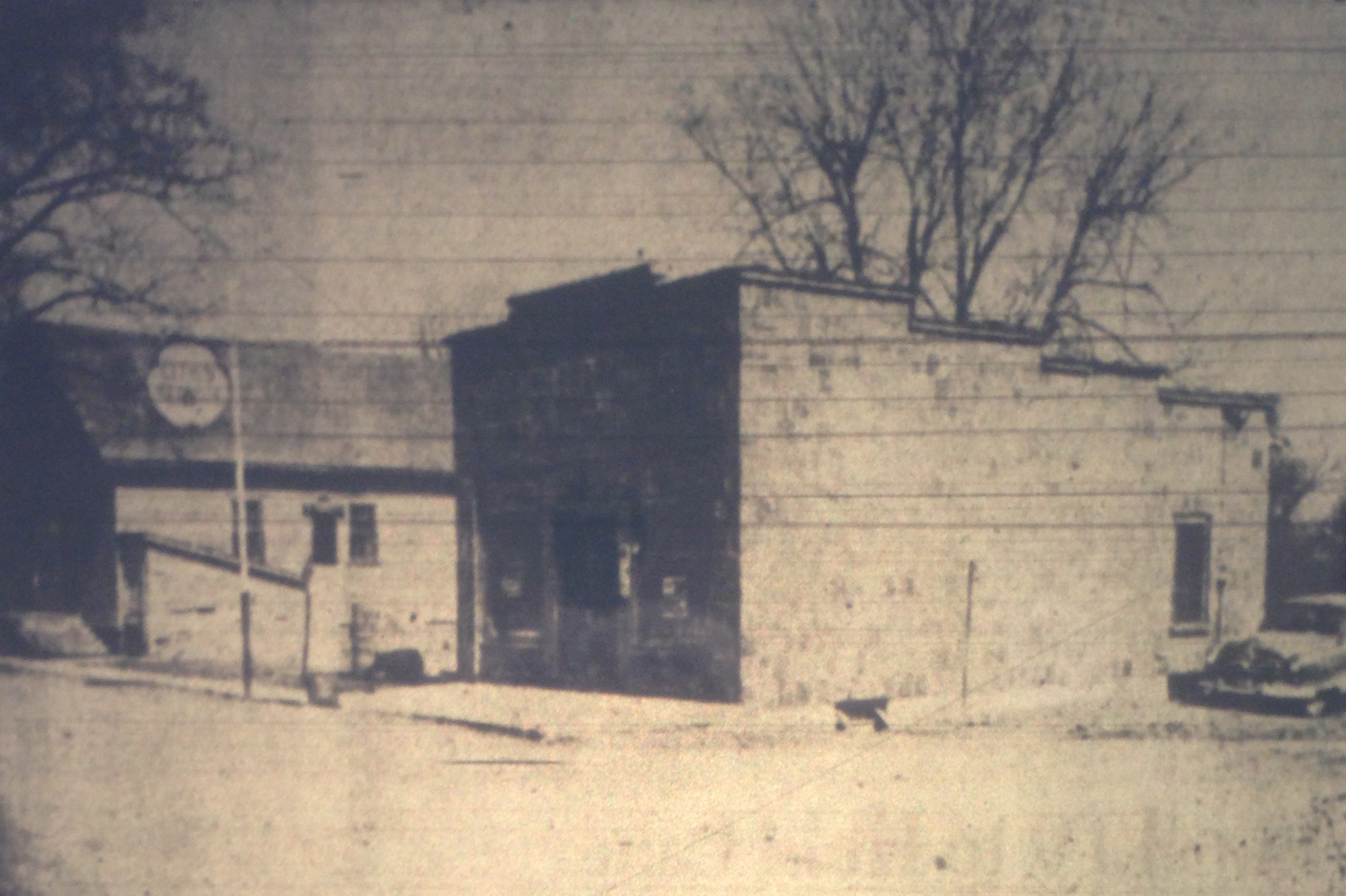
Dayton store

The Dayton store/post office/gas station

from the January 26, 1922 Free-Trader Journal

DAYTON P. O. ROBBED BY MEAT CLEAVER BANDITS; GET $7.25

Thieves Use Butcher’s “Weapon” to Break Open Strong Box Containing
Funds Belonging to Uncle Sam and Store Keeper

Running a risk of facing a term in the federal prison to secure a few dollars of government money, thieves last night robbed the Dayton postoffice, making way with $5.25 in postal funds and $2 in pennies from the W. B. Fleming grocery store. The robbery is believed to have been pulled by the rankest kind of amateurs, so kiddish did the traces left behind by the robbers seem.

The postoffice which is located in one corner of the Fleming grocery store, was closed shortly before 9 o’clock last night. This morning at 7 o’clock Mr. Fleming opened his place of business and built a fire before he discovered that the place had been burglarized.

A small safe, which is more in the nature of a strong box, twelve by twenty-four inches in dimensions, which held the postoffice funds, had been smashed open by a meat cleaver, which was taken from the butcher shop. The supply of stamps was passed over, the robbers evidently searching only for cash. The money from the store was taken from a cash drawer and from a dish in the candy counter.

The meat cleaver was found where it had been hidden by the robbers, after the theft in the coal pile, in the basement.

Entrance to the building was gained by breaking out a basement window. The robbers then went upstairs by an inside stairway. They worked with the door, until they succeeded in getting the wooden bar lock that fastened it from the arm that held it.

A trail of burnt matches which were strewn on the floor around the room, showed that the burglars had taken their time in making the search. The robbers were evidently of a hungry frame of mind, for they stopped long enough to have a lunch, opening a can of peaches, and scattering crackers all around the cracker box, Some bars of candy are also believed to have been devoured by the hungry boys or men.

The candy and cigarette case was evidently overlooked for it is not believed to have been touched.

The thieves left the building by a side door which they unlocked from the inside of the building. The door was carefully closed after the robbers and it was not until a careful investigation was made that it was learned that the exit had been made that way.

Deputy Sheriff Fred E. Stedman went to Dayton this morning to make an investigation.1


  1. Ottawa Free Trader-Journal, January 26, 1922, p 1, col 2

Counterfeiters, Thieves, and Outlaws

bandits

Nathaniel Proctor ran the general store in Dayton in the late 1830s. Jesse Green’s memoir has this story about his time in Dayton:

Proctor had a very nice and amiable family, and was apparently a high minded and honorable man, he had a great faculty for gaining friends and did a very successful business for a year or two. One cold winter day father went from the mill up to his store, and put his feet up against the stove to warm them, having his pocket-book containing between five and six hundred dollars wanted for buying wheat in his pants pocket. Returning home he soon discovered he had lost it, and thinking it might have dropped out of his pocket at the store, he returned immediately to look for it, but not finding it, he offered Mr. Proctor’s boys five dollars if they would find it for him, saying he must have lost it between the mill and store; seeing they made no effort to find it, he concluded they had found it, and that probably he would see no more of it.

Not long after this occurrence Mr. Proctor went to St. Louis for some goods, and on his return, and probably in St. Louis passed some counterfeit money, and learning by some means that he was liable to be arrested, he never returned to Dayton. Father being security for him to the amount of twelve or fifteen hundred dollars, and other creditors gobbling up his goods, it fell to fathers lot, to take his book accounts and notes, nearly covering the amount he was held for provided collections could be made. They were scattered over a great extent of country. It was afterwards learned that he had dealt quite heavily with members of his gang of outlaws, that infested the whole north western portion of the state.

His book accounts and notes were put in legal shape for me to collect and I was sent out with his books in a pair of saddle bags, and calling one night on one of his principal creditors, who was keeping a Hotel on the Pickamesoggin not far from Belvidere, I found a crowd of ruffians, all armed with pistols and bowie knives, and I could scarcely make up my mind, which would be best under the circumstances, to try and find another stopping place for the night, or boldly face the trying ordeal which I felt sure I was doomed to for the night. I finally concluded that if they might have any intention to rob, or molest me, they would do so in either event, and I determined to put on as bold a front as it was possible for a little boy of 18 and concluded to seek no farther. When I went in and threw down my saddlebags containing the books, there were a dozen fierce roguish eyes cast upon me, which almost made the hair on my head stand on end, and young and defenseless as I was, my situation can be better imagined than I can tell it.

I concluded to retire to bed soon after supper, as my company did not seem at all entertaining to me, and about twelve o’clock at night the landlord brought up a great burly fellow and put him in bed with me, he first laid a big pistol under his pillow, and then a large bowie knife. My sleep from then on until morning was somewhat disturbed, as they all knew my business, and I had a bill of $250.00 against the landlord, they would naturally suspect that I had collected some money, such thoughts as these kept crowding upon me before I could sleep, in fact I do not think I did sleep any that night, the more I would think of my situation as it occurred to me, among (as I thought) a den of thieves, the more would I think, that they probably would destroy my books and possibly me too. So my stay there was anything but pleasant, but fortunately no demonstrations were made or harm done and next morning as soon as I heard any movements below, I left my bedfellow pretty early sleeping soundly on his arms, and after breakfast had a settlement with the landlord. He gave me no money, but I took his note with which I was more than glad to leave him, but his note was never paid. I suspect that most of Proctor’s customers in that far away region were members of the gang of outlaws called the bandits of the prairies, and the Driscols who were summarily punished near Mount Morris in early times were of the same gang.

Whilst invoicing Proctor’s goods, his dies for making bogus coin were discovered, and secretly laid aside until going home at noon when it was the intention to secure them; but when they put their fingers upon them, like the Irishman’s flea, they were not there, removed by his clerk probably.  In digging out a cellar to the store, he [the new owner] found father’s old pocketbook minus the money lost with it. A little later the old store building was torn down, and inside the plastering was found a ten dollar copper plate on a Michigan bank for making counterfeit money. All sympathized deeply with the disgraced family, who remained in Dayton but a short time after this unfortunate circumstance. But where they went and their subsequent identity, we never learned as they probably were no longer known by the name of Proctor.

The Dayton Literary Society

Book label - Dayton Literary Society

The Dayton Literary Society was founded in February of 1881,  with Isaac Green as President, Charles Green as Secretary and Harry Green as Librarian. Harry was the librarian because the library, all one hundred volumes of it, was housed at his store. You paid a monthly fee and then you could borrow any book. This label, found in every book, listed some of the rules governing the library:

ART. 4. The Time of Keeping a Book shall be Two Weeks, and any person failing to return said book inside the specified time, shall be fined the sum of 5 cts. for each day until returned. Also, any person returning a book unnecessarily soiled, shall be fined the sum of 10 cts.

ART. 6. The Librarian shall not issue Books to any person who is known to be in arrears of monthly dues or fines.

ART. 7. No person shall be allowed more than ONE Book at a time.

Unfortunately, no record of the complete “Rules to Govern Library” has survived. Did it contain guidelines for what books to include? Were books purchased, or donated from town residents? What was the most popular subject matter?


Shopping at the Dayton store

Spooner

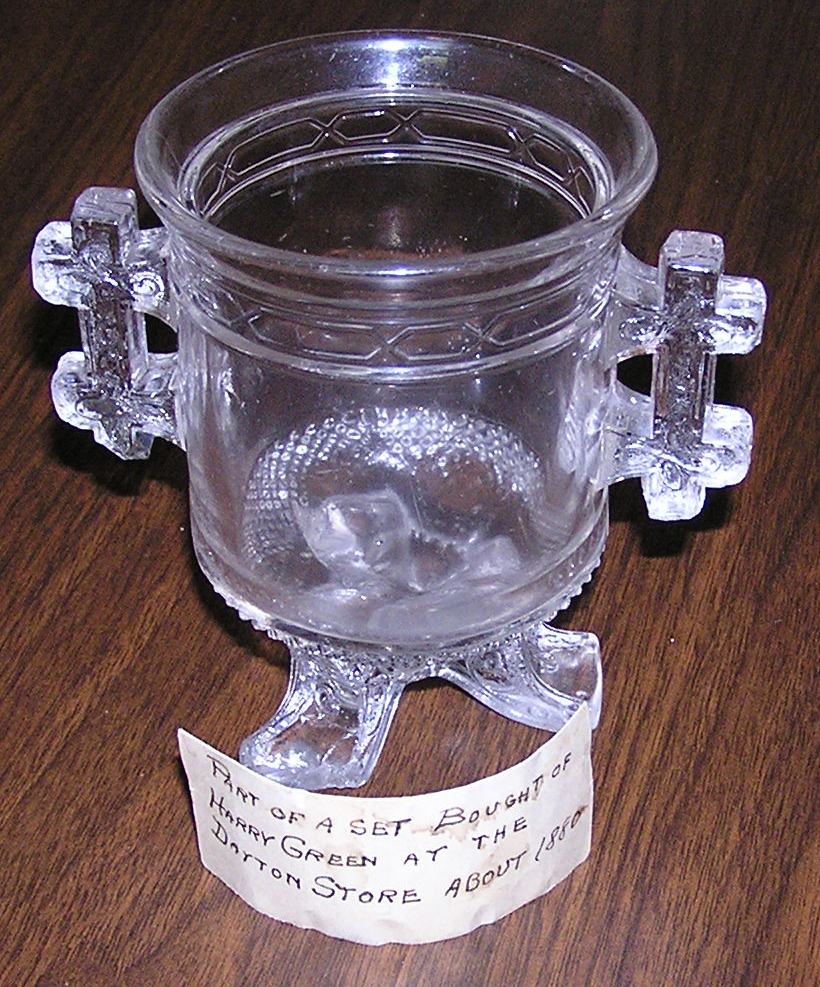
This piece of glass was purchased at the Dayton store about 1880. It was made by the La Belle Glass Company of Bridgeport, Ohio. The company was founded in 1872 and its Queen Anne pattern, of which this piece is an example, was first being advertised in the trade journals in the fall of 1879. It would have been one piece of a fairly extensive set. This piece is a spooner, used on the table to hold dessert spoons. They often resemble short-stemmed goblets or vases. Some have handles, as this one does, but some do not. Other pieces in the set might have been a butter dish, cream and sugar, salt cellar, celery vase, and of course, plates and goblets. Harry Green, the proprietor of the Dayton store at that time, obviously made an effort to have the most up-to-date stock. In the Ottawa newspaper’s account of the wedding of David Green’s daughter, Ada, in 1881, among the gifts received was a set of glassware from her cousin, Harry Green. There’s no way of knowing if it was a set of this pattern, but it might have been, as it was a new and popular pattern then.