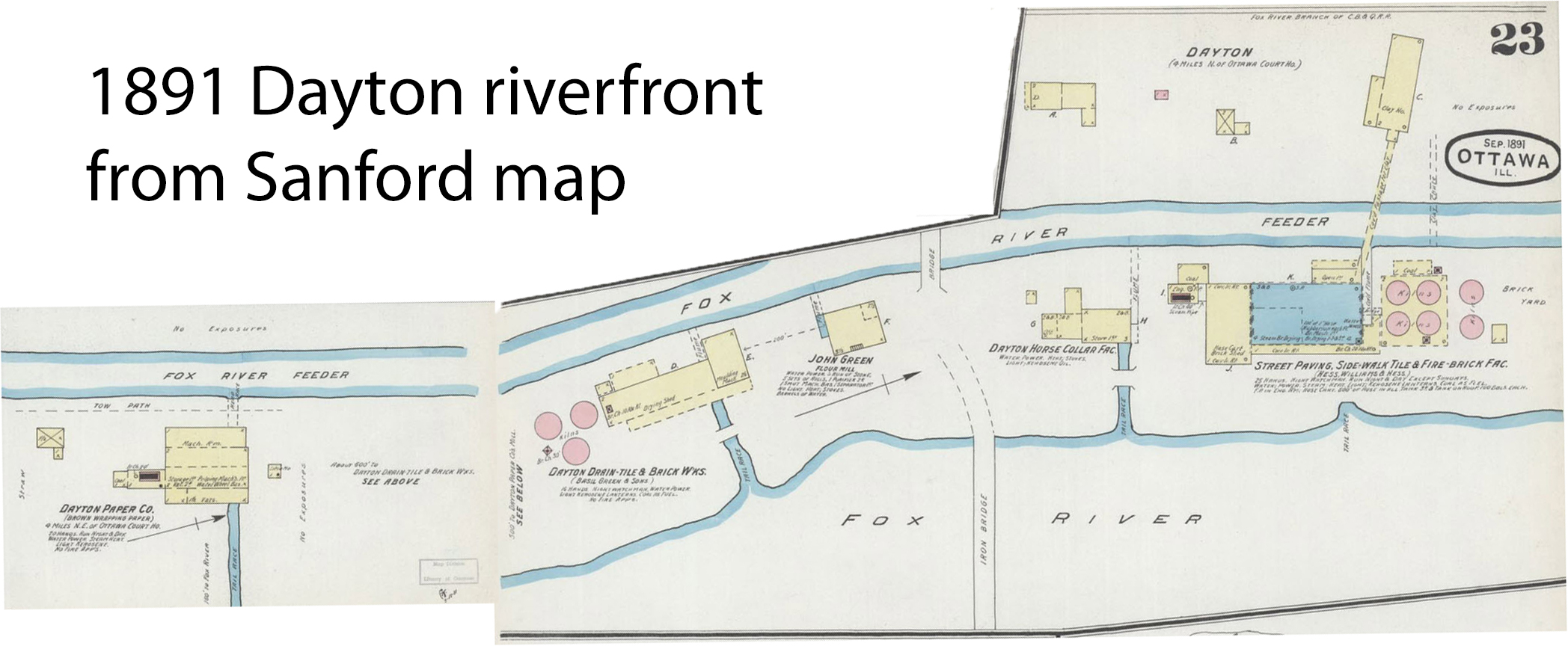
Status Report on the Dayton Industries


The following is from The Ottawa Free Trader, June 2, 1888, p. 8, cols. 2-3

Dayton

Times are a little livelier now in this vicinity than they have been for some time past.

The paper mill has started up again, and is getting a number of car loads of baled straw.

The tile works are running right along and are shipping a considerable quantity of drain tile of the very best quality. They are also shipping a lot of fire clay, having received an order for one hundred tons to be shipped immediately to Chicago. Users of clay are beginning to learn that we have the very best quality of fire clay in the county, and no doubt in the near future Dayton will contain a number of good substantial fire clay manufactories.

The roller mills are running on custom and merchant work as usual, and are manufacturing a first class article of straight grade roller flour. Try a sack and be convinced.

The horse collar works have cut down on their working force, as this is their usual dull season, and are manufacturing fly nets. With good crops this season, this firm anticipate a good trade during the fall and winter.

The old woolen mill property which has been run as a pressed brick factory by the Chicago and Dayton Brick Co., has been sold to an eastern firm who are putting it in shape for manufacturing purposes. We have not learned yet the intentions of the new company, but hope they have sufficient capital to do an extensive business.

The town is full of fishermen at present, and Landlord Timmons, of the Dayton Hotel, says he has had a good run of custom during the past two or three weeks.

Harding turned out a good sized fishing party last Saturday.

Mr. and Mrs. T. H. Green, and Miss Winnie Childs, of Morris were in Dayton over Sunday.

Mr. Bert W. Stadden and Miss Taylor, of Chicago, were in Dayton a few hours Sunday afternoon.

The river is a little higher on account of the late heavy rains.

Mr. William Hewitt is greatly improving the appearance of his piece of property by a coat of paint.

We find there is considerable interest taken in our extracts from California letters among various readers of your valuable paper in the county, as this information is reliable and not highly colored like the usual real estate men’s information. We wrote Mr. Butler of Puryn, Place Co., California, in regard to the fruit business being overdone in that State, and will give you his reply and other information: [content of letter not transcribed]

Occasional

Ira W. Davis in Wisconsin and Illinois

I started with the idea of providing some biographical information on two of the people buried in the Dayton Cemetery, Laura Davis and her infant son Ray. This required looking into her husband, Ira W. Davis, and exploring his life led to more than I anticipated, including unexpected links to the development of businesses in Dayton, so Ira became the focus of my story.

Ira W. Davis was born in Oldtown, Maine on November 4, 1835, the son of John Taber Davis and Harriet Jane Moore. He appears, unmarried, in his father’s household in 1850, 1860 and 1870. He is never shown as owning land, but in 1870 he has personal property of $6,000.  Shortly after 1870, he and Charles Noyes, another Old Town resident decided to move west. They settled in Menasha, Wisconsin, where between them, they built a large factory to produce excelsior. In 1875 they added a new branch to the factory for making clothespins.

excelsior

In Menasha, Ira met Laura Barlow Shepard, daughter of Lysander C. Shepard and Ethelinda Ann Chapman, They married in 1877 and the following year, their first daughter, Nellie, was born.

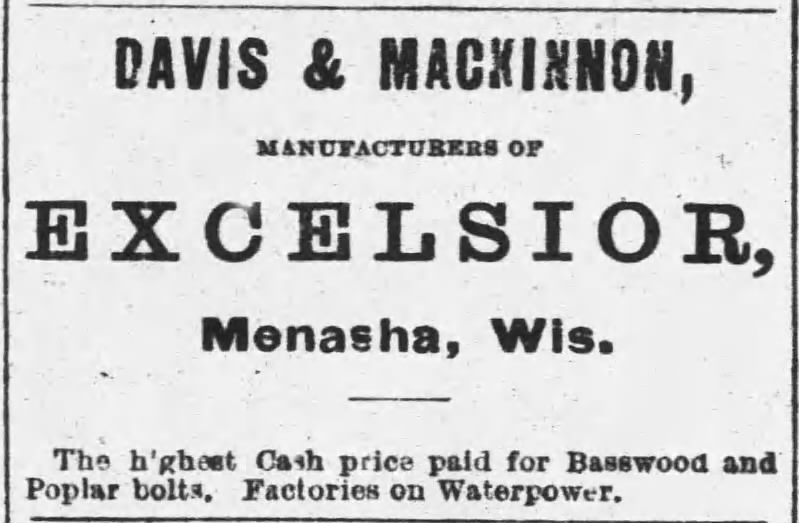
In 1878, Ira in company with a younger man, Duncan MacKinnon, formed the firm of Davis & MacKinnon, which became a successful producer of excelsior.  Ira  became a very prominent  business man in Menasha and was elected alderman from his ward.ad for Davis & MacKinnon

In 1881, Davis and MacKinnon sold a water power site to Henry Hewitt, Jr. a wealthy fellow Menasha businessman. Hewitt had invested in several businesses in Menasha and elsewhere in the Wisconsin area. In 1884 Hewitt and Ira invested in The Chicago and Dayton Brick Company, located in Dayton, Illinois, and it is through this connection that Ira took up the position of superintendent of the brick works being established in Dayton.

On November 22, 1884, the Dayton correspondent to the Free Trader reported that

“Mr. Ira Davis, the superintendent of the new brick works, has brought his family from Wisconsin and moved into G. W. Gibson’s residence, on the hill.”

His family at that time consisted of wife Laura, daughters Nellie, 6, and Harriet, 3, and son Taber, 1. In April of 1885 his son Ray was born, but he died three months later and was buried in the Dayton Cemetery.

Despite his position with the Chicago and Dayton Brick Company, his principal interest appeared still to be with paper making. In 1886 he sold out his interest in the brick works and in that year Ira and 2 others (Moore & Hewitt) rented the paper mill from H. B. Williams. Ira kept in touch with the business atmosphere in Wisconsin, however, making several trips back to the Menasha area. In 1887 his brother-in-law, E. E. Bolles, was preparing to erect a $50,000 paper mill in De Pere, Wisconsin,  and Ira planned to move back and join him.

In December 1887, his wife, Laura, died, leaving three small children. She, too, is buried in the Dayton Cemetery, as shown on her death certificate. If there ever was a stone marking her grave, it has since disappeared.

Ira’s widowed mother, Harriet, and his unmarried sister, Emily, came from Maine to keep house for Ira’s family, arriving in Dayton in February, 1888. They left Dayton for Menasha, Wisconsin fairly soon, and lived there until Ira moved to Wausau in 1893. It may be about this time that the two girls, Nellie and Harriet, went to live with their mother’s sister Alice, the wife of E. E. Bolles, in De Pere, Wisconsin. Tabor continued to live with his father, grandmother and aunt in Wausau.

Ira engaged in business with a Milwaukee firm and, with W. W. Abbott, established an Excelsior Manufactury in Wausau. He is last seen in Wausau in 1895. When and why he went to California is not clear, but in the 1900 census, he appears in Scott Valley, Siskiyou County, California. He died August 15, 1902. His death was reported back in Bangor, Maine, more than 30 years after he left for “The West”.

News has been received here of the death at Orlans, Cal., on Aug. 15, of Ira W. Davis, formerly a well-known Oldtown lumberman. He was the son of John T. Davis of Oldtown and was a brother-in-law of Judge Charles A. Bailey of this city. He went west many years ago, and had been engaged in the manufacture of excelsior in California.
from The Bangor (Maine) Daily News, September 1, 1902, p. 3, col. 2.

The Standard Fire Brick Company

After the 1888 fire the remaining building was bought for the fire brick factory.

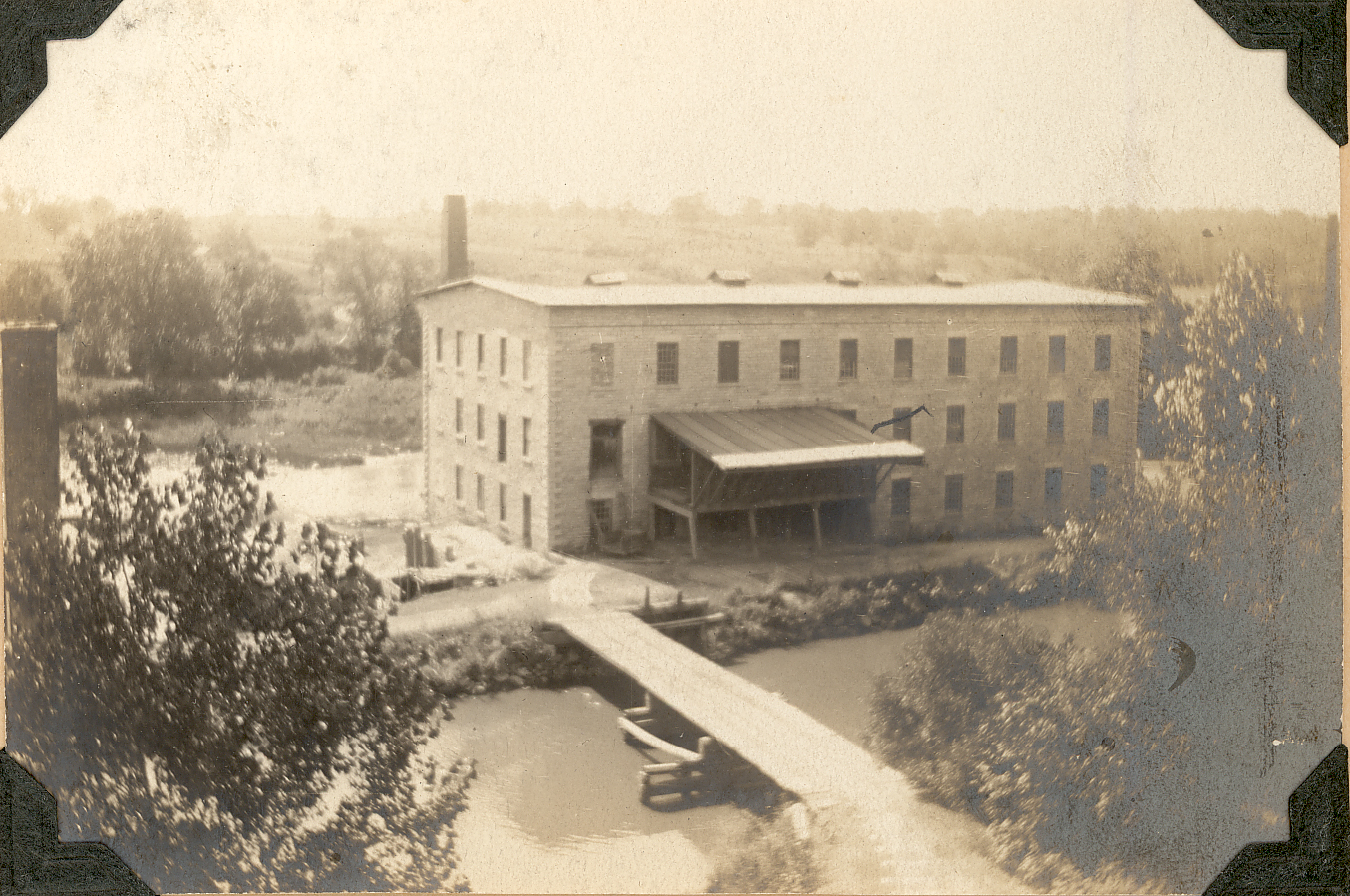
In August, 1892, the Ottawa Paving Brick Company, under the management of John W. Channel, who, for several years prior to this date, had been superintendent of Hess, Crotty & Williams brick factory, leased the brick works at Dayton, Ill. For three years this plant was run successfully, when, in November, 1895, the Standard Fire Brick Company, of Ottawa, Ill., was organized by Thomas D. Catlin, John W. Channel, M. W. Bach and E. W. Bach, with $25,000 capital stock. The company bought the Dayton property, consisting of the large, substantial, four-story stone building, formerly used as a woolen mill, and also the three-story frame building, used for many years as a horse collar factory, together with all the clay lands, water-power and machinery. John W. Channel was made president and general manager, Thomas D. Catlin, vice-president and treasurer, and E. W. Bach, secretary.

Shortly after the Standard Fire Brick Company had been legally organized and had commenced business, negotiations were entered into with the firm of Hess, Crotty & Williams for the purchase of their brick factory, located about a mile east of Ottawa, at a station called “Brickton.” The capital stock of the Standard Fire Brick Company was increased to $50,000, and the purchase of the plant of Hess, Crotty & Williams effected, and the company assumed control in May, 1896, with the same set of officers that the original Standard Fire Brick Company had, each private individual of the old firm of Hess, Crotty & Williams taking an interest in the company which purchased their plant.

The Dayton plant is situated four miles north of Ottawa, on the Fox river branch of the Chicago, Burlington & Quincy railroad system, and has its own sidetrack along the yards, and the Ottawa factory is located on the Chicago, Rock Island & Pacific main line, with a side track at the factory also. Thus the company has double the shipping facilities that any concern located on a single system would have, saving, of course, a great deal of annoyance and the expense caused by transferring from one road to the other. The company is a member of the Western Railway Weighing Association, from which a great benefit is derived.

At the Dayton factory the company has abundant water-power, and at Ottawa steam-power is used. Both places are heated thoroughly by a complete system of steam pipes, and they are also amply equipped with the usual dry pans, pug mills, clay crushers, conveyors, hand and power presses, clay bins and auger machines; no steam process being used in the manufacture of their wares.

The company has 65 acres of clay land, all underlaid with a vein of fire clay, most of it within 8 to 16 feet of the surface. At Ottawa, on top of this fire clay, there is a vein of coal about 22 inches in thickness, and above this coal a vein of common clay, varying from common yellow clay to one having the nature of soapstone. This yellow clay, properly mixed with a proportion of fire clay, is used in making their sidewalk tiles. At Dayton, on the west side of the river, there is, above the fire clay, besides a vein of coal, an extensive bed of valuable shale about 30 feet in depth. This makes good common ware, and mixed with a little fire clay, makes as fine a sidewalk tile as one will find anywhere in the country. On the east side of the river, where the main supply of the company’s fire clay is obtained, there is nothing above the fire clay except a bed of excellent gravel about five to eight feet in thickness. This gravel makes is possible to maintain the roads to the factory in excellent condition.

Fire brick and fire clay articles are the company’s main product. The market for this material is, besides Chicago, the great trade center of the West, all of the northern part of this State, Iowa, Wisconsin, Minnesota and Michigan, all of them great manufacturing states. Their competitors in the fire clay materials are very few, while the competitors in the common clay products are many, nearly every location of any size at all having its own common brick yard.

Many of our people do not realize the vast diversity of clay deposits in the close proximity to Ottawa, and their immense wealth that would result from their proper development, and in order to show the great variety of clay we have at Ottawa, as well as at Dayton and Brickton, it is well to take note of the principal kinds of clay, and their divisions. The term clay, as ordinarily used, means any earthy substance which, when worked up with water into a plastic mass, will retain whatever shape it is made into. Varying and ever changing proportions of iron oxide, lime and organic matter are found in conjunction with different beds of clay material, and the term, clay, is used to denote them all, including shale. Strictly speaking, however, “clay” means silicate of alumina, or kaolin, said to be derived from two Chinese words (Kau-ling), meaning high ridge, reference being made probably to some location where vast quantities of clay material were found. The greater per cent of silica and alumina (forming kaolin) there is in a clayey substance the more valuable it is, and the nearer it comes to being pure kaolin or true clay. All clays are the result of decomposition, mostly of feldspar, which was a large proportion of the ancient granite rocks, combined with quartz and other minerals, and in the course of decomposition the deposits have been washed and transported for long distances, together with particles of sand and deposited in vast beds, thus forming clay deposits; particularly is this true of fire clay.

At Dayton they have an extensive bed of excellent shale, which is a term also applied to certain clays, not so much because it is composed of different substances or different proportions than other clays, but because it has a thinly laminated structure, the stratification in its formation being well marked. Of this deposit there are none at Ottawa.

There are two classes of clays, viz., high grade and low grade clays. Of the low grade clays they have five of the six subdivisions present upon their properties. 1. Argillaceous shale (present in Dayton only). 2. Silicous clays. 3. Tile Clays. 4. Brick clay. 5. Calcereous clay, and all of the last four at both places. Each kind has its particular adaptability. For instance, the first mentioned is not to be excelled in making paving blocks, the second is adapted to sewer pipes, the third and fourth for roofing and drain tile, and the fifth for common brick. All these varieties exist, and to one accustomed to clay it is not difficult to distinguish the various kinds.

Of the high grade clays, of which there are also six subdivisions, they have two at both places, viz.: 1. Hard fire clay. 2. Plastic fire clay, used for the manufacture of refractory material. These fire clays are a composition of about 59 parts silica, 27 parts alumina, 11 parts water, and 3 parts of iron and other fixing properties. The term, fire clay, is applied without restriction to all clays found immediately underlying coal beds, although the extremely low grade of composition of many of these deposits of so-called fire clays do not warrant their being called fire clays at all. They have the true fire clay, viz., a refractory clay which becomes white upon calcination, i. e., burning the crude clay as it comes direct from the bed.

This fire clay is the material out of which they manufacture their most important products. The upper stratum of common clay and coal is removed and the beds of fire clay exposed, they being from six to ten feet in depth. The clay is then blasted out in large quantities, and conveyed to the dry pan and ground very fine and run over screens, and often shipped in this state to be used as mortar in laying up brick used for refractory purposes. In making brick, after being ground fine it is run through pug mills and then auger machines, and here it comes forth in streams of varying size, depending on the dies used, and cut off by wires into the size and shape desired, except very large or special shapes which have to be hand-moulded or hand-pressed.

They can well be proud of the reputation their brick have attained in Chicago and the Northwest, which is un-paralleled by any of their competitors. They supply material for stack linings, boiler settings, iron cupolas, furnaces, foundries, lime and brick kilns, retorts, and any purpose requiring refractory brick. The beds of plastic fire clay at Brickton, and also to a limited extent at Dayton, have not been touched in recent years, although they are very valuable deposits, as they are adapted for the manufacture of stone ware and articles of that kind.

As to the sidewalk tile and small pavers they cannot be discounted by anyone. They are made from a mixture of the shale at Dayton, or the top clay at Brickton, with a certain per cent of the clay; then the process of manufacture is the same as fire brick, only having a design of some kind pressed on the surface. In order to obtain an even and smooth surface the sidewalk tiles are treated to a salt glaze, which gives them a very pleasing appearance. Miles of their sidewalk tile can attest their usefulness, in Ottawa alone, to say nothing of the great quantities recently shipped to cities and villages in this state where the idea of using tile for sidewalk has just taken effectual hold upon the people. They are cheaper and more lasting than cement walks, less expensive than stone, better in appearance, more desirable than wood, and when properly laid make the most durable walks that can be had. Although the atmosphere and its destructive agencies decomposed the massive rocks from which comes the clay used to make these tile, yet if it is properly vitrified and placed where it will not be broken or destroyed by abrasion, it will be a tablet that will last forever, absolutely indestructible by the atmospheric agencies or the elements. Making articles from clay was the first manufacturing industry in the world, and it is to-day the second largest industry in the United States; and it can be said that as long as the earth lasts, brick will be made, and the future inhabitants will be able, 4,000 years hence, to find remains and specimens of the products of this age, as we today can and do look upon authentic specimens of brick made over 4,000 years ago.

from the Ottawa Republican-Times, date unknown

A Landmark Gone

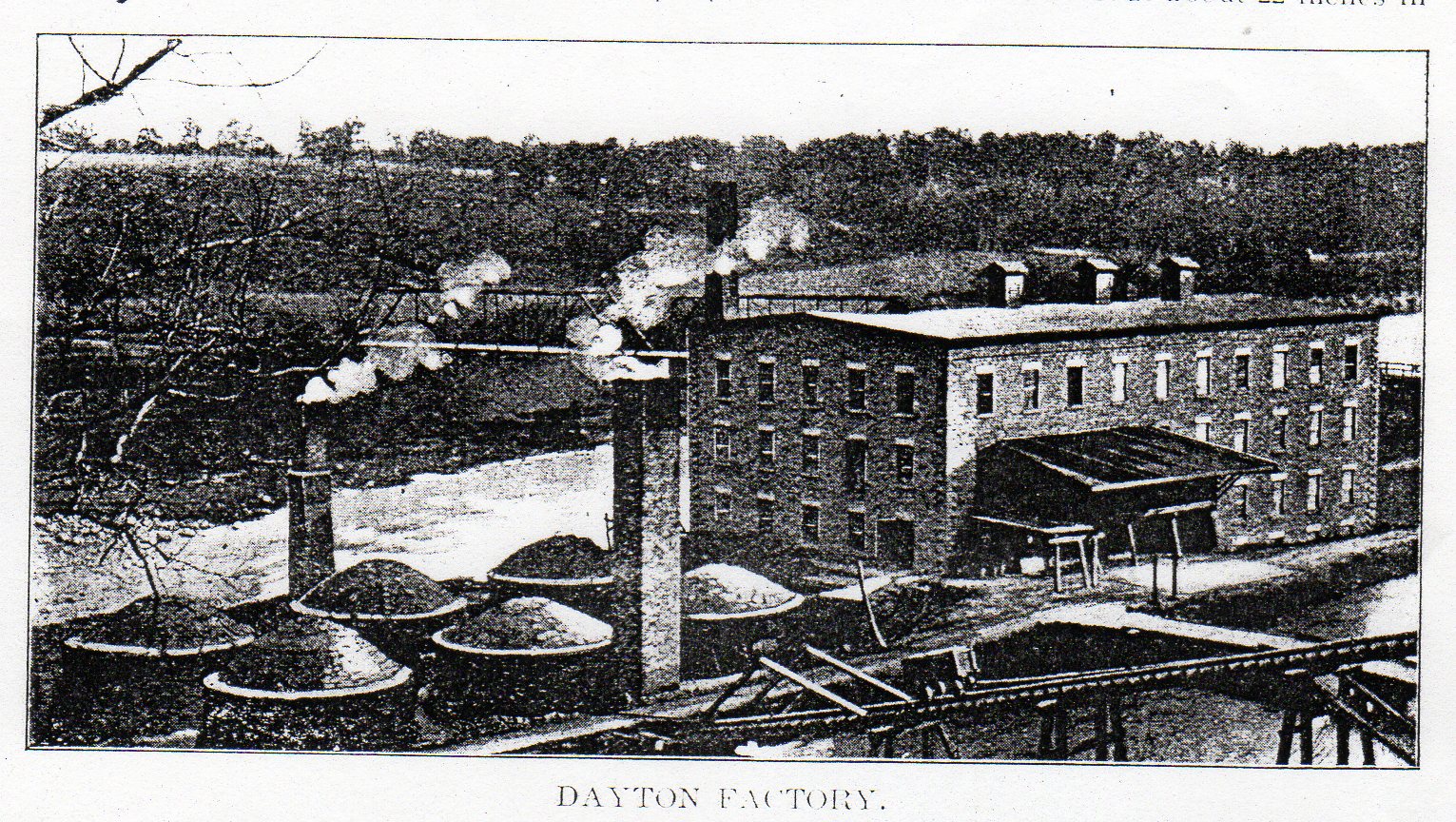
The brick works – rebuilt after the fire

A Land Mark Gone

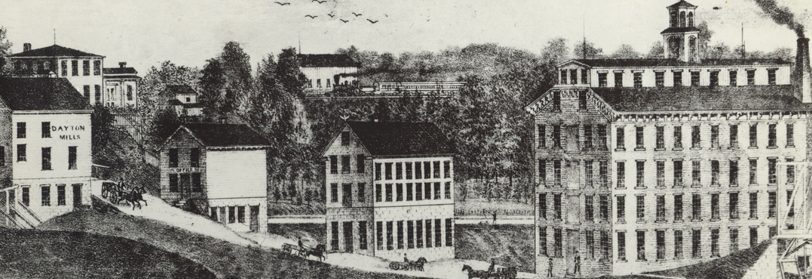
Dayton, Ill., Nov. 15. – Last Sunday evening about twelve o’clock the old woolen mill property was discovered to be on fire, flames leaping out at the roof and the whole building was soon engulfed in flames. Most of the people in town were soon aroused by the bright light and by the noise of the falling timbers, but the fire had gained too much headway to warrant any attempt at checking or extinguishing it. The floor being saturated with oil it burned very rapidly and soon the roof fell in, flames shot out of every door and window, floor after floor tumbled in, and the magnificent stone building was reduced to ashes in a few hours, nothing remaining but the empty walls. A flue runs from one of the brick kilns to the large chimney in the corner of the building, and it is supposed the fire originated in some way from this chimney which was built originally for a boiler. This fine building was constructed of Joliet or Lemont stone, was 50×100 feet square, five stories in height, the roof being surmounted by a cupola, &c. It was built in 1864 by the firm of J. Green & Co. at a cost of $32,000 and filled with woolen machinery worth $33,000. This firm run it as a woolen mill until 1878 when they failed in business and the building remained idle for a number of years. Mr. Jesse Green then purchased it and ran it for a few years but finally sold off the woolen machinery to various parties, and the building and water power to his son-in-laws Messrs Williams and Hess who in 1884 organized a brick company. This firm put in brick machinery, built kilns, &c. and manufactured brick for a number of years, but this season sold the whole property to Messrs Soule & Williams who have been continuing the manufacture of brick. The total loss by fire to the last named firm is about $10,000 and we understand there is no insurance. They will probably put a roof over the walls erect two floors, and continue business.1


  1. Ottawa [Illinois] Free Trader, November 17, 1888, p. 8, col. 2

The Standard Fire Brick Company

standard-fire-brick-company

The Standard Fire Brick Company1
Fire Brick and Fire Clay Articles

            In August, 1892, the Ottawa Paving Brick Company, under the management of John W. Channel, who, for several years prior to this date, had been superintendent of Hess, Crotty & Williams’ brick factory, leased the brick works at Dayton, Ill. For three years this plant was run successfully, when, in November 1895, the Standard Fire Brick Company, of Ottawa, Ill., was organized by Thomas D. Catlin, John W. Channel, M. W. Bach and E. W. Bach, with $25,000 capital stock. The company bought the Dayton property, consisting of the large, substantial four-story stone building, formerly used as a woolen mill, and also the three-story frame building used for many years as a horse collar factory, together with all the clay-lands, waterpower and machinery. John W. Channel was made president and general manager, Thomas D. Catlin, vice-president and treasurer, and E. W. Bach, secretary.

            Shortly after the Standard Fire Brick Company had been legally organized and had commenced business, negotiations were entered into with the firm of Hess, Crotty & Williams for the purchase of their brick factory, located about a mile east of Ottawa, at a location called “Brickton.” The capital stock of the Standard Fire Brick Company was increased to $50,000 and the purchase of the plant of Hess, Crotty & Williams effected, and the company assumed control in May, 1896, with the same set of officers that the original Standard Fire Brick Company had, each private individual of the old firm of Hess, Crotty & Williams taking an interest in the company which purchased their plant.

            On May 1, 1900, the Standard Fire Brick Company assumed control of the plant of the Ottawa Fire Clay & Brick company, whose interests are now merged in the Standard’s. The plant, an immense one, is located east of Ottawa, and east of the Standard Fire Brick Company’s original Brickton plant, and is on the line of the C., R. I., & P. Ry.

            With these three factories the capacity of the Standard Fire Brick Company, as regards fire brick and fire clay, is practically unlimited. It is the largest fire brick plant in the United States, and will produce 100,000 fire brick per day. The officers are T. D. Catlin, president and treasurer; M. W. Bach, vice-president; E. W. Bach, secretary. The Dayton plant is situated four miles north of Ottawa, on the Fox River branch of the Chicago, Burlington & Quincy railroad system, and has its own side-track along the yards, and the Ottawa factory is located on the Chicago, Rock Island & Pacific mainline, with a side-track at the factory also. Thus the company has double the shipping facilities that any concern located on a single system would have, saving, of course, a great deal of annoyance and the expense caused by transferring from one road to the other. The company is a member of the Western Railway Weighing Association, from which a great benefit is derived.

            At the Dayton factory the company has abundant water-power, and at Ottawa steam-power is used. Both places are heated thoroughly by a complete system of steam pipes, and they are also amply equipped with the usual dry pans, pug mills, clay crushers, conveyors, hand and power presses, clay bins and auger machines, no steam presses being used in the manufacture of their wares.

            The company has 65 acres of clay land, all underlaid with a vein of fire clay, most of it within 8 to 16 feet of the surface. At Ottawa, on top of this fire clay, there is a vein of coal about 22 inches in thickness, and above this coal a vein of common clay, varying from common yellow clay to one having the nature of soapstone. This yellow clay, properly mixed with a proportion of fireclay, is used in making their sidewalk tile. At Dayton, on the west side of the river, there is, above the fire clay, besides a vein of coal, an extensive bed of valuable shale about 30 feet in depth. This makes good common ware, and mixed with a little fire clay, makes as fine a sidewalk tile as one will find anywhere in the country. On the east side of the river, where the main supply of the company’s fire clay is obtained, there is nothing above the fire clay except a bed of excellent gravel about five to eight feet in thickness. This gravel makes it possible to maintain the roads to the factory in excellent condition.

            Fire brick and fire clay articles are the company’s main product. The market for this material is, besides Chicago, the great trade center of the West, all of the northern part of this state, Iowa, Wisconsin, Minnesota and Michigan, all of them great manufacturing states. Their competitors in the fire clay materials are very few, while the competitors in the common clay products are many, nearly every location of any size at all having its own common brick yard.

            This fire clay is the material out of which they manufacture their most important products. The upper stratum of common clay and coal is removed and the beds of fire clay exposed, they being from six to ten feet in depth.

            They can well be proud of the reputation their brick have attained in Chicago and the Northwest, which is unparalleled by any of their competitors. They supply material for stack linings, boiler settings, iron cupolas, furnaces, foundries, lime and brick kilns, retorts, and any purpose requiring refractory brick. The beds of plastic fire clay at Brickton, and also to a limited extent at Dayton, have not been touched in recent years, although they are very valuable deposits, as they are adapted for the manufacture of stone ware and articles of that kind.


  1. Ottawa in Nineteen Hundred (1900; reprint, Ottawa, Illinois: La Salle County Genealogy Guild), 20. viewed on Google Books

A Handmade Gravestone

champaign-albert-john tombstone

This tiny gravestone, only 12 inches high, stands out in the Dayton Cemetery not only for its size but for its material. It is made of brick and appears to be handmade. John Champaign, the father of little Albert John, was a day laborer in the brick yards in Dayton. Whether he made the gravestone himself or had a friend at work do it for him, it almost certainly was made in Dayton.

John Champaign was born in January, 1858, in Michigan, of French-Canadian stock. In 1870 he was living with his parents and siblings in South Bend, Indiana. On September 21, 1880 he married Louise Haverley in South Bend. Sometime before 1883, John and family came to Dayton, where they were living in 1900. By 1910, they were back in South Bend, where they lived out their lives, John dying in 1938 and Louise in 1947.

One of their daughters, Grace, married James C. McGrogan of Dayton on April 30, 1900, and remained in Dayton when her parents moved back to South Bend.