Alternatives to Cash

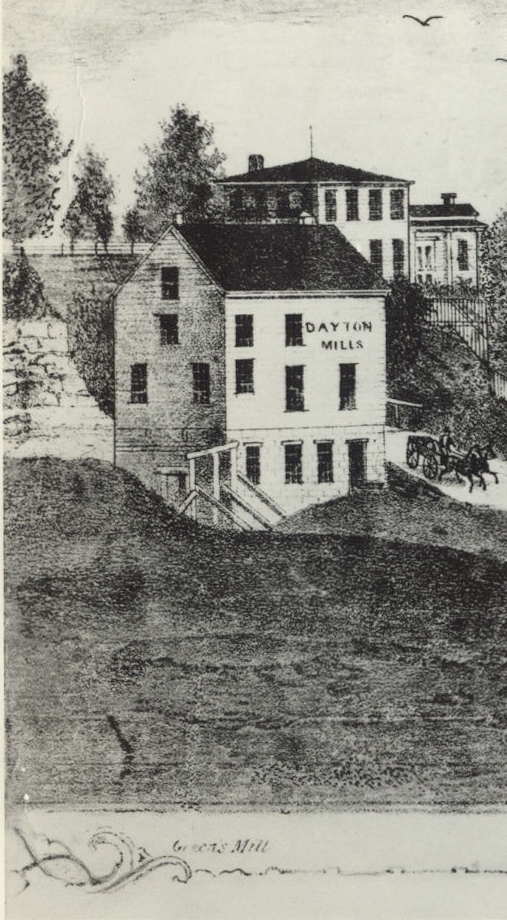
In the 1840s cash was relatively scarce, and much of the local economy still operated on barter and informal credit systems, as shown by this advertisement from the Greens’ woolen factory.

Wheat Wanted

The subscribers would say to those indebted to them, either by note or book account, that they will receive wheat in payment for their dues, if delivered soon at John Green’s Mills, Dayton, for which the highest market prices will be given.

They have an assortment of good grey, brown and black fulled clothes; satinette; jeans; tweeds; red, white and pressed flannels, of a superior quality, which they are offering at prices that will make it an object for persons desirous of encouraging domestic manufactures to give us a call, and examine the goods we are now making.

The highest price will be allowed for wheat, in exchange for our cloths.

J. & D. GREEN
Dayton Factory, Aug. 15


  1. The Ottawa Free Trader, August 15, 1845, p. 3, col. 1

A Resurrection at Dayton

A General Revival of Business in Our Northern Suburb
C. B. Hess Practices What He Preaches
The Dayton Tile Factory Will Resume Operations Next Week

The little town of Dayton has again struck its gait. The grist mill is running at full blast, the collar factory has its hands full, the paper mills are behind in orders, and now comes C. B. Hess, one of Ottawa’s most enterprising citizens and to-day leases the brick and tile works for a year commencing Feb. 1st, with an option for further time and will open up on Monday next full blast with forty hands, the works to run night and day. The firm name will be Hess, Williams & Hess, and Ed J. Hess, junior partner, will have full charge.

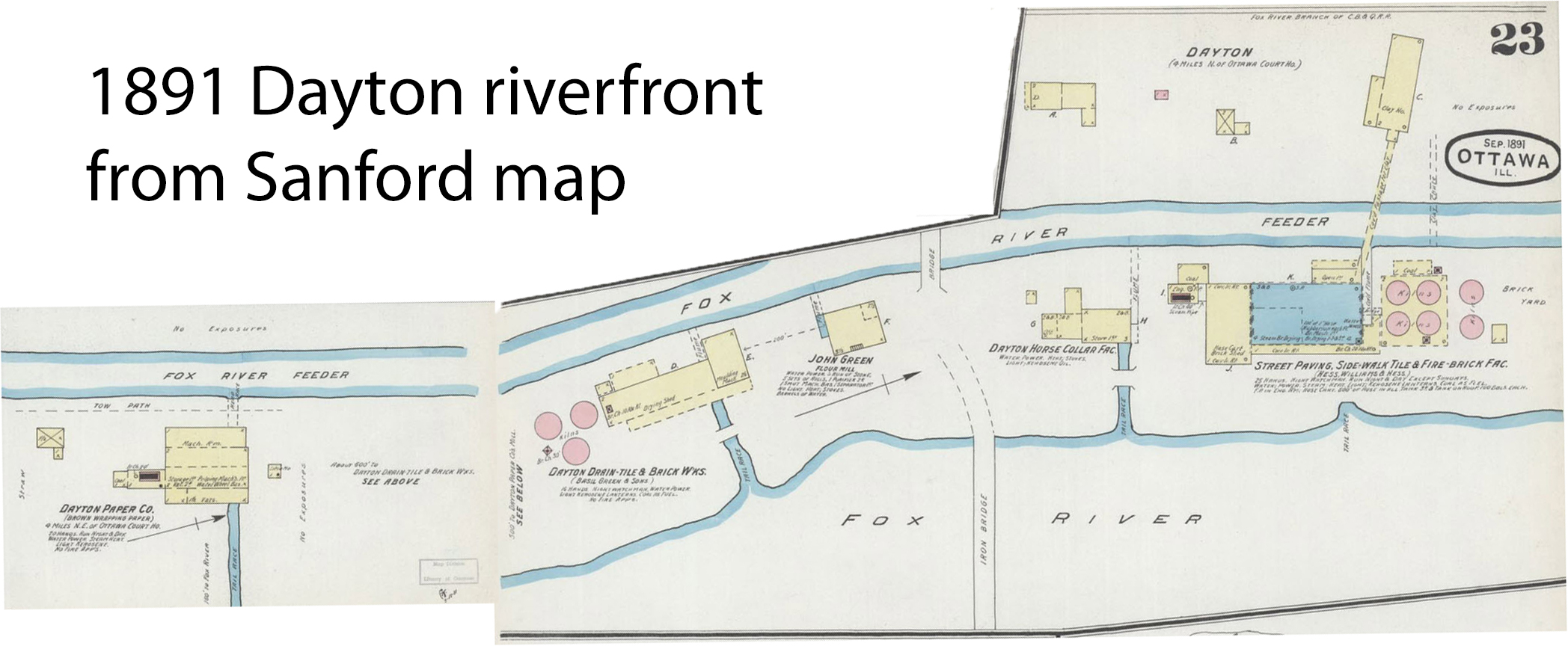
These works will put out paving brick, fire brick and drain tile, and will be run in a measure in connection with the Ottawa factory. The capacity will be 50,000 brick or 10 car loads, and 200 tons of clay will be used every day. The works have six kilns, with every facility for increasing the capacity if found practicable. The water-power used is of 200 hundred [sic] horse power. The firm will build a tramway across Fox river to its beds of fire clay, which are 7 foot veins, while the common clay will be taken from a 30 foot band just across the feeder from the works. Probably an inclined railway will be put in from the works to the “Q.” tracks to increase the shipping facilities.

Hitherto the difficulty at these works has been in getting the clay properly united, but Mr. Hess has been experimenting with it for the past six weeks and is satisfied that he has at last found the right thing.

These works will make their drain tile for the local trade, but the paving tile and fire brick will, most of it, find its way to Chicago and Peoria.

Mr. Hess says he intends to make this a “go,” and we have no doubt but he will.1


  1. The Ottawa Republican Times, January 29, 1891, p. 8.

Dayton in 1858-59

In 1858 the Chicago publisher, John C. W. Bailey, decided to publish a directory of La Salle County. In his introduction to the work, he explains that he had no material from any previous publication to aid him and that, therefore, it took a long time to collect the information. He states that in the farming districts he relied on the postmaster for a list of the persons in their district. Because of this the lists are sometimes incomplete and at other times duplicate other lists. For instance, the townships of Dayton and Rutland are closely connected, both by residence and relationships. In many cases names appear on both lists, so caution is needed. Also, the lists are certainly incomplete, so lack of a name does not imply lack of residence.

Here are the pages that refer to Dayton township.

DAYTON
TOWN 34, range 3
The Post Office Dayton. O. W. Trumbo, Post Master

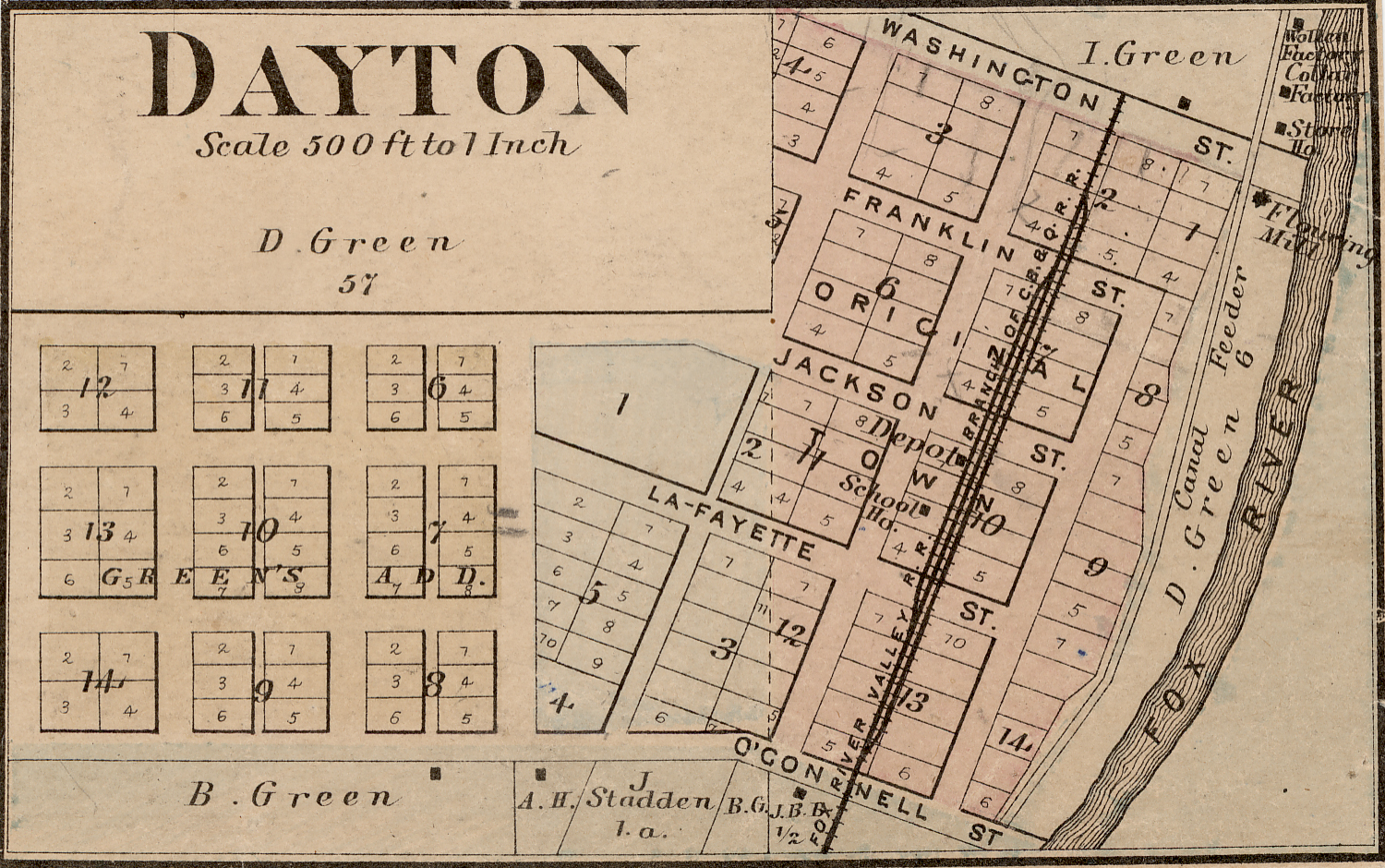
The village of Dayton, in the township of the same name, is situated on the west bank of the Fox River, four miles above Ottawa, and is destined to be one of the greatest manufacturing places in the west. The water is drawn from the Fox River Feeder, under a twenty foot head; there is sufficient water unoccupied to drive fifty run of burrs. It contains two large flouring mills, one woolen factory, one wool carding establishment, one machine shop, one cloth store, one saw mill and one tavern, all owned by John Green, who located here in 1829 as an extensive farmer and stock grower. He possesses some of the best blood stock, both Durham and Spanish.

Two school houses and churches are within 1 1/2 miles of this place, also two miles distant on the east bank of the river, is the largest white sulphur spring in the State, and is a great place of public resort; the water contains great medical qualities, and probably will become the principal watering place in the west. It is also owned by John Green, of this place.

Col. Wells Wait, school commissioner for La Salle county; resides at Dayton.
Office, in the Sheriff’s room, Ottawa city.

John Green, principal landed proprietor.      Andrew Thompson, blacksmith.

FARMERS

Albert, Thomas B, S W qr. Sec. 1.

Bagley John
Bennett Enoch
Black Samuel
Bly Frederick A.
Breese David K.
Breese Silas
Brisco, Patrick, S W qr. Sec. 35
Brown Enos, N W qr. Sec. 2.
Brown Silvester, S W qr. Sec. 3.
Brownfield K., S W qr. Sec. 3.
Burke Daniel, N E qr. Sec. 9

Carton Thomas, N E qr. Sec. 18.
Carpenter George W.
Chapman Samuel, S E qr. Sec. 4.
Clark W. O., N E qr. Sec. 2.
Connelly John G.
Conway Michael, S E qr. Sec. 9.
Cowper Mary, S W qr. Sec. 20.
Curyea Cincinatti
Curyea Henry
Curyea John H.

Daniels Aaron
Delevan E. C., N E qr. Sec. 21.
Dixon James, N W qr. Sec. 15.
Dobbins John, N W qr. Sec. 3.
Dunovan J. A.
Dunovan George M.
Dunovan W. L.

Erwin Wm., N E qr. Sec. 34.

Fisher Charles A., N W qr. Sec. 24.
Fielding John, S E qr. Sec. 33.

Gedney H. E., S E qr. Sec. 30.
Groove Davis
Groove Joseph

Hall Joseph
Harrington Robert
Hess Henry H.
Hess, Levi, N W qr. Sec. 12.
Hite David
Howard Humphrey, S E qr. Sec. 2.
Howland Ezekial, S E qr. Sec. 6.

Jacobs Peter

Kenny Christopher, N W qr. Sec. 18.
Kennedy Francis, S E qr. Sec. 33.
Kleiber Joseph

Lamb John F.
Laning Jacob, S E qr. Sec. 21.
Larkin Martin
Lawrence Daniel G.
Leland Lorenzo, S E qr. Sec. 21.
Lowell Calvin
Lyghthall Joseph

McCarthy Timothy, N E qr. Sec. 5.
McNeal William
Miller Edmund, N W qr. Sec. 13.
Miller John
Morgan Rees
Montgomery John H., S E qr. Sec. 2.
Monroe James, S W qr. Sec. 9.

O’Donnell Edward, S W qr. Sec. 4.
O’Donnell John, S E qr. Sec. 3

Pakenham Joseph, N E qr. Sec. 35.
Parr Thomas, N W qr. Sec. 1.
Pembroke Richard
Pennell Dwight
Pickings James, S E qr. Sec. 19.
Platt Joseph, N E qr. Sec. 5.

Reddick Hon. William
Reed Henry J.
Reigart Wm. H.
Rhodes Samuel
Robson Thomas, N E qr. Sec. 14.
Rowen James
Rumery William
Russell John

Sage Seth S., S W qr. Sec. 12.
Scovill Palmer F.
Sizer Randolph, N E qr. Sec. 35.
Stodden Jonathan

Thompson G. L., S W qr. Sec. 13.
Thorne Isaac
Thorne Richard, S W qr. Sec. 31.
Trumbo Elias
Trumbo Mathias
Trumbo Moab P.
Turner Benjamin

Wait Wells
Webb B. E., N E qr. Sec. 8.
White James
Wightman James D.
Wright Samuel
Wolsey Nathan. N E qr. Sec. 10
Woodlock Patrick, S W qr. Sec. 24.

The Woolen Mill in 1870

Large stone building

The Dayton Woolen Mills

La Salle County, and Dayton especially may refer with just pride to the factory of J. Green & Co., as turning out a quality of woolen goods, cassimeres, doeskins, flannels, etc., that is not excelled anywhere in the west. Although this firm has made no attempt to push the goods upon the market by puffing in the newspapers, depending entirely on the quality of the articles to effect sales, yet the Dayton goods are widely known, and the dry goods merchant need only, as many of them do, offer the article with the single remark, “Dayton goods,” to call the attention of the purchaser to the beautiful texture and finish of the cloths manufactured in this establishment.

The rapid strides made in the west, within the past ten years, is producing a superior article of woolen goods, is admitted even by the older establishments of the East, and no man, at this day, need look for any finer article than is made at home, as he surely cannot find a better. To show the public appreciation of the Dayton goods, it need only be dais that the agent of the firm recently took orders in the city of Davenport, in one day, for goods to the amount of $1500, and the sale is all the more important when it is considered that that city has mills of its own.

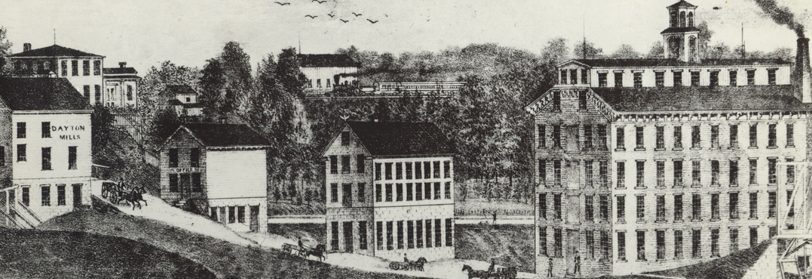
The present factory building is of stone, built in the most substantial manner, situated on the right bank of the Fox river just above the bridge. Its dimensions are 50 by 100 feet in the clear, and four stories high, besides the attic. It was built in 1864, when the old mill was found to be too small for the increase of the business. Entering on the lower floor, the wool is seen on the left hand, the dressing machines on the right, and the fulling and carding apparatus at the opposite end, while an addition beyond contains the steam works used in heating the building and furnishing the necessary hot water used in the various processes of manufacture.

The machinery is driven by a turbine wheel placed under this floor, and propelled by the water from the feeder that flows past the mill/ The floors above are used for carding, weaving and spinning, there being two sets of carding machines of three in each set, making nine in all, besides a machine that turns out the rolls that feed the housewife’s spinning wheel. The third floor contains fourteen looms in all, eleven of them for double fold, and three making cloth of treble width; these wide machines being a great saving over the loom making cloth, but one yard wide, since both require the same attendance. These looms, when in full blast, make a music peculiarly their own, the nail machine being the only contrivance that beats it in racket.

Of spinning machines there are six, four of them having 2540, and two running 216, spindles each, making an aggregate of 1,392 spindles, tended by six men. Just think how many women it would take with the old family concern to twist all this yarn, that is done so easily by these six men. And these machines can be set so as to make yarn coarse or fine, nor can they fail in spinning it absolutely even throughout. About fifty hands are employed, a dozen of them being females, the rest men and boys.

The factory will consume this year about 120,000 lbs of wool. The carding machine is supplied with teasels, imported from the State of New York, which seems to be unnecessary, as they might be produced here, and the transportation saved to the company or put into the pockets of our farmers. Why has this not been done?

The sales of the firm show that manufacturing efforts in the West are appreciated. Still the mill is not run up to its full capacity.1


  1. Ottawa Republican, Thursday, August 18, 1870, p. 2.

January 1891 -The State of the Village


A RESURRECTION
At Dayton! — A General Revival of Business in Our Northern Suburb
C. B. Hess Practices What he Preaches — The Dayton Tile Factory Will Resume Operations Next Week

The little town of Dayton has again struck its gait. The grist mill is running at full blast, the collar factory has its hands full, the paper mills are behind in orders, and now comes C. B. Hess, one of Ottawa’s most enterprising citizens and to-day leases the brick and tile works for a year commencing Feb. 1st, with an option for further time and will open up on Monday next full blast with forty hands, the works to run night and day. The firm name will be Hess, Williams & Hess, and Ed. J. Hess, junior partner, will have full charge.

These works will put out paving brick, fire brick and drain tile, and will be run in a measure in connection with the Ottawa factory. The capacity will be 50,000 brick, or 10 car loads, and 200 tons of clay will be used every day. The works have six kilns, with every facility for increasing the capacity if found practicable. The water power used is of 200 hundred [sic] horse power. The firm will build a tramway across Fox river to its beds of fire clay, which are 7 foot veins, while the common clay will be taken from a 30 foot bank just across the feeder from the works. Probably an inclined railway will be put in from the works to the “Q.” tracks to increase the shipping facilities.

Hitherto the difficulty at these works has been in getting the clay properly united, but Mr. Hess has been experimenting with it for the past six weeks and is satisfied that he has at last found the right thing.

These works will make their drain tile for the local trade, but the paving tile and fire brick will, most of it, find its was to Chicago and Peoria.

Mr. Hess says he intends to make the a “go,” and we have no doubt but he will.1

C. B. Hess was a member of the large Green clan. He was married to Clara “Callie” Green, the daughter of Jesse Green and Isabella Trumbo.


  1. Ottawa Republican Times, January 29, 1891, p. 8.

Of Industry – and Lack Thereof


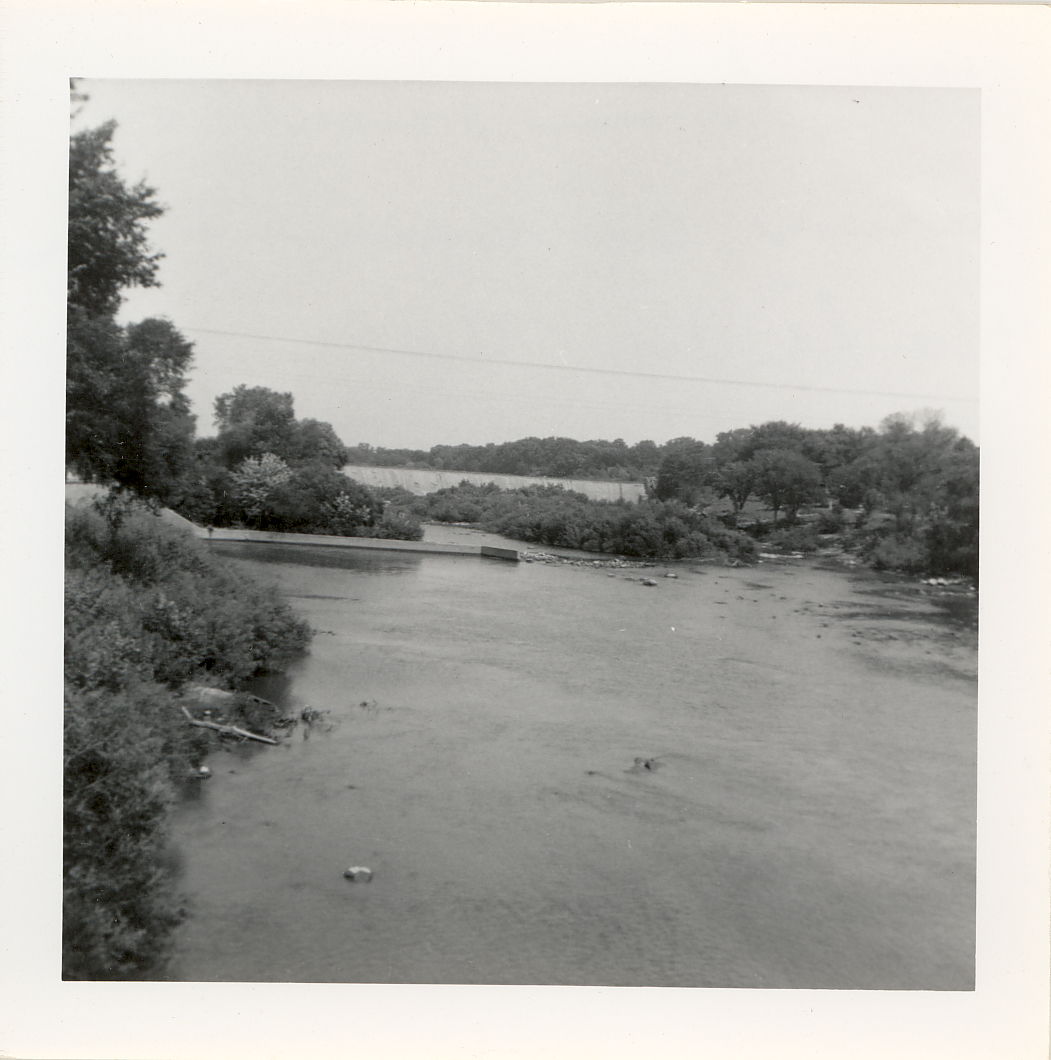
Fox river with dam in background

Dayton Items

Dayton, as a  point where the finny tribe and fishermen do most congregate has long been celebrated in this section of the country. People armed with hooks and lines, buckets of bait and togged in old clothes, come daily and nightly from far and near. They arrive on foot, in buggies, in lumber wagons, and dumped off the cars, and are landed in every shape, all bent on the same purpose, i. e., that of catching fish, not by the dozens, or in fifties, but by bushels, bagsfull, wagon loads, and in other prodigious quantities. They arrive in lofty spirits, braced up by lofty expectations of astonishing the natives. They usually depart wet, hungry, tired, disgusted, and without any fish worth speaking of. To a man whose constitution requires a vast deal of resr – long continued and complete relaxation of every muscle and nerve – fishing is just the thing. Fish, as food, may be brain food, but catching them is certainly a brain softener. It does not require a very high order of intellect in a man to fish, that is, a man of very moderate brain power ought to know enough to outwit a fish, which stands rather low in brain development. In short, fishing, to an outsider, is a very languid, sleepy sort of work.

There never has been any employment so well adapted to the wants of a lazy man as that of fishing as they do it at Dayton. To see the anglers as they line the banks and cover the rocks like so many mud turtles is a sight fit to make a person yawn. To the man to whom any kind of exercise is a bore fishing is just about exercise enough. The fellow lands upon some sequestered spot, sits down to rest and meditate awhile, then baits his hook, summons up all his energies like a man trying to ward off sleep, gets the line in the water, and then the things fishes itself! When a man gets too lazy to fish they accuse him of having a softening of the brain, and soon after he becomes too tired to draw his breath, and this ends him!

Some of the fellows we saw fishing on Friday last were half a mile from the water, under a shade tree, three of ‘em asleep and the fourth studying the sun’s altitude and position of its spots through a “pocket” telescope! Though we were in sight of a score or more of fishers for an hour, we did not see a fish hauled out, nor even hear of one being captured, though a shoal of three or four minnows were reported to have swam up among the fishers early in the morning.

Large stone buildingDayton, however, has another point of view of far more importance to the business man and to the farmer. We refer to her woolen mills – as good as any in the state – built some years ago at great expense, and stocked with as excellent machinery as the Union anywhere could boast. Though under a cloud for a time, but now started anew by its original owners, the Greens, it will soon be working upon a large scale, and is daily turning out great quantities of yearn of various grades, also superior cloth.

Another enterprise is the collar factory, under the management of Mr. Dunavan. It employs a large force of hands, turns out the premium horse collars of the United States, and also a fine article of leather fly nets, the latter being its chief production during the summer months. The goods from this establishment find a ready market all over the country.

Another business, as yet young, but extensive and rapidly increasing in importance, is the Dayton tile works. When the factory was started it was not supposed that it would, in five years, reach the dimensions it has attained in a few months. The tile they manufacture is as good as any made in the west.

The large paper mill here next claimed our attention. This institution has long since become fixed and firmly established upon a substantial business basis. It runs exclusively on straw and manilla paper and consumes vast quantities of material. It has on hand an enormous stock of as good paper as is made anywhere. The recently senseless boom in prices of material used is happily subsiding, and the rather sluggish demand in this county for paper, has been rather unsatisfactory, but it runs ahead, looking for a fairer margin between its expenses for sock and the price of manufactured goods than has generally prevailed.

Besides, a good flouring mill and a local store and a “tavern” and good prices for farm products in general, all contribute to make Dayton a live business village.

Since the tile works were started in full operation a new industry has been developed, being coal mining operations, managed by Simpson & Welke, a couple of hard-working miners, who obtain a good quality of coal which lies on the level with the banks of the feeder, and is drifted and removed on hand card on a tramway and dumped below the woolen mills into wagons, or on the public roads as may be required.[1]


[1] Ottawa Republican, May 27, 1880, p2.

A Very Fishy View of Dayton and its Industries in 1880

Dayton Items.

Dayton, as a point where the finny tribe and fishermen do most congregate, has long been celebrated in this section of the country. People armed with hooks, and lines, buckets of bait and togged in old clothes, come daily and nightly from far and near. They arrive on foot, in buggies, in lumber wagons, and dumped off the cars, and are landed in every shape all bent on the same purpose, i. e., that of catching fish, not by the dozens, or in fifties, but by bushels, bagsfull, wagon-loads, and in other prodigious quantities.

They arrive in lofty spirits, braced up by lofty expectations of astonishing the natives. They usually depart wet, hungry, tired, disgusted and without any fish worth speaking of. To a man whose constitution requires a vast deal of rest — long continued and complete relaxation of every muscle and nerve — fishing is just the thing. Fish, as food, may be brain food, but catching them is certainly a brain softener. It does not require a very high order of intellect in a man to fish, that is, a man of very moderate brain power ought to know enough to out-wit a fish, which stands rather low in brain development. In short, fishing, to an outsider, is a very languid, sleepy sort of work. There never has been any employment so well adapted to the wants of a lazy man as that of fishing as they do it at Dayton. To see the anglers as they line the banks and cover the rocks like so many mud turtles [illegible] is a sight fit to make a person yawn.

To the man to whom any kind of exercise is a bore fishing is just about exercise enough. The fellow lands upon some sequestered spot, sits down to rest and meditate awhile, then baits his hook, summons up all his energies like a man trying to ward off sleep, gets the line in the water, and then the thing fishes itself. When a man gets too lazy to fish they accuse him of having a softening of the brain and soon after he becomes too tired to draw his breath and this ends him.

Some of the fellows we saw fishing on Friday last were half a mile from the water, under a shade tree, three of ‘em asleep and the fourth studying the sun’s altitude and position of its spots through a “pocket” telescope. Though we were ln sight of a score or more of fishers for an hour, we did not see a fish hauled out, nor even hear of one being captured, though a shoal of three or four minnows were reported to have swam up among the fishers early in the morning.

Dayton, however, has another point of view of far more importance to the business man and to the farmer. We refer to her woolen mills — as good as any in the state built some years ago at great expense, and stocked with as excellent machinery as the Union anywhere could boast. Though under a cloud for a time, but now started anew by its original owners, the Greens, it will soon be working upon a large scale, and is daily turning out great quantities of yarn of various grades, also superior cloth.

Another enterprise is the collar factory, under the management of Mr. Dunavan. It employs a large force of hands, turns out the premium horse collars of the United States and also a fine article of leather fly nets, the latter being its chief production during the summer months. The goods from this establishment find a ready market all over the country.

Another business, as yet young, but extensive and rapidly increasing in importance, is the Dayton tile works. When the factory was started it was not supposed that it would, in five years, reach the dimensions it has attained in a few months. The tile they manufacture is as good as any made in the west.

The large paper mill here next claimed our attention. This institution has long since become fixed and firmly established upon a substantial business basis. It runs exclusively on straw and manilla paper and consumes vast quantities of material. It has on hand an enormous stock of as good paper as is made anywhere. The recently senseless boom in prices of material used is happily subsiding, and the rather sluggish demand in this county for paper, has been rather unsatisfactory, but it runs ahead, looking for a fairer margin between its expenses for stock and the price of manufactured goods than has generally prevailed.

Besides, a good flouring mill and a local store and a “tavern” and good prices for farm products in general, all contribute to make Dayton a live business village.

Since the tile works were started in full operation a new industry has been developed, being coal mining operations, managed by Simpson & Wilke, a couple of hard-working miners, who obtain a good quality of coal which lies on the level with the banks of the feeder, and is drifted and removed on hand cars on a tramway and dumped below the woolen mills into wagon, or on the public roads as may be required.1


  1. Ottawa Republican, 27 May 1880, p2, col 3

Status Report on the Dayton Industries


The following is from The Ottawa Free Trader, June 2, 1888, p. 8, cols. 2-3

Dayton

Times are a little livelier now in this vicinity than they have been for some time past.

The paper mill has started up again, and is getting a number of car loads of baled straw.

The tile works are running right along and are shipping a considerable quantity of drain tile of the very best quality. They are also shipping a lot of fire clay, having received an order for one hundred tons to be shipped immediately to Chicago. Users of clay are beginning to learn that we have the very best quality of fire clay in the county, and no doubt in the near future Dayton will contain a number of good substantial fire clay manufactories.

The roller mills are running on custom and merchant work as usual, and are manufacturing a first class article of straight grade roller flour. Try a sack and be convinced.

The horse collar works have cut down on their working force, as this is their usual dull season, and are manufacturing fly nets. With good crops this season, this firm anticipate a good trade during the fall and winter.

The old woolen mill property which has been run as a pressed brick factory by the Chicago and Dayton Brick Co., has been sold to an eastern firm who are putting it in shape for manufacturing purposes. We have not learned yet the intentions of the new company, but hope they have sufficient capital to do an extensive business.

The town is full of fishermen at present, and Landlord Timmons, of the Dayton Hotel, says he has had a good run of custom during the past two or three weeks.

Harding turned out a good sized fishing party last Saturday.

Mr. and Mrs. T. H. Green, and Miss Winnie Childs, of Morris were in Dayton over Sunday.

Mr. Bert W. Stadden and Miss Taylor, of Chicago, were in Dayton a few hours Sunday afternoon.

The river is a little higher on account of the late heavy rains.

Mr. William Hewitt is greatly improving the appearance of his piece of property by a coat of paint.

We find there is considerable interest taken in our extracts from California letters among various readers of your valuable paper in the county, as this information is reliable and not highly colored like the usual real estate men’s information. We wrote Mr. Butler of Puryn, Place Co., California, in regard to the fruit business being overdone in that State, and will give you his reply and other information: [content of letter not transcribed]

Occasional

D. Green and Sons – Grist Mill Statistics

Green's Mill with house behind

In addition to the population census, in 1880 the census also collected information on grist mills, on Special Schedule of Manufactures #7, which included only mills producing more than $500 in goods. The mill in Dayton was operated by David Green’s sons. It was the only grist mill of that size in Dayton Township. From the enumeration we learn the following:

The mill was operated by D. Green and Sons, who had invested $10,000 in the business. The greatest number of hands employed at any one time was two. The average number was also two, described as 2 males over 16. These would be David’s sons.

The ordinary working day was 10 hours long, year round. The average day’s wages for skilled workers was $2.50, for unskilled, $1.00. The total amount paid in wages for the year was $110. The mill was in operation on half time for 6 months and idle for 6 months.

They had four runs of stone, which could produce a maximum of 550 bushels per day. Eighty percent of their business was grinding for customers who brought their grain to the mill. The miller retained a portion of the output as a toll for his work. For the other 20 percent the Greens purchased grain and sold the resulting products in their store.

The mill was located on the Fox river, which flows into the Illinois river. The height of the fall of water was 18 feet. They had five wheels producing 120 horsepower.

Products for the year: 80 barrels of wheat flour; no rye flour; 500 pounds of buckwheat flour; no barley meal; 6000 pounds of feed; no hominy; total value of all products, $1500.

from November 22, 1884 edition

A Thriving Dayton Business

On July 12, 1879, The Ottawa Free Trader had this to say about the paper mill at Dayton:

The paper mill of Williams & Co., situated at the lower end of the manufacturing portion of the town, is one of the best in the state. Their products are so favorably known that running night and day the year round they are unable to supply the demand.

In the 1880 census, twelve people were listed as associated with the paper mill –
owner H. B. Williams, age 40
Arthur Dunavan, 12
Mary Coleman, 15
William Ryan, 17
Emma Geduldig, 17
Frank Benoit, 19
William Rust, 24
James Lanegan, 25
George Smith, 30
John H. Lyle, 34
Charles Burch, 34
John G. Dunavan, 42

For comparison, in the same census the paper mill at Valparaiso, Indiana, where Charles Burch received his training, had a staff of 7, all male.

There should have been one more worker at the Dayton mill, 15 year old Fred Green, but 3 days before the official census day, he was seriously injured through being caught in the machinery. His left arm had to be amputated and he lost the first joint of two fingers on his right hand. Luckily, he survived and went on to an interesting life, including such experiences as directing brick makers in the Rocky mountains, suffering malaria fever in the Louisiana bayous and superintending several hundred laborers in ceramics work at Knoxville, Tenn.

Ira W. Davis in Wisconsin and Illinois

I started with the idea of providing some biographical information on two of the people buried in the Dayton Cemetery, Laura Davis and her infant son Ray. This required looking into her husband, Ira W. Davis, and exploring his life led to more than I anticipated, including unexpected links to the development of businesses in Dayton, so Ira became the focus of my story.

Ira W. Davis was born in Oldtown, Maine on November 4, 1835, the son of John Taber Davis and Harriet Jane Moore. He appears, unmarried, in his father’s household in 1850, 1860 and 1870. He is never shown as owning land, but in 1870 he has personal property of $6,000.  Shortly after 1870, he and Charles Noyes, another Old Town resident decided to move west. They settled in Menasha, Wisconsin, where between them, they built a large factory to produce excelsior. In 1875 they added a new branch to the factory for making clothespins.

excelsior

In Menasha, Ira met Laura Barlow Shepard, daughter of Lysander C. Shepard and Ethelinda Ann Chapman, They married in 1877 and the following year, their first daughter, Nellie, was born.

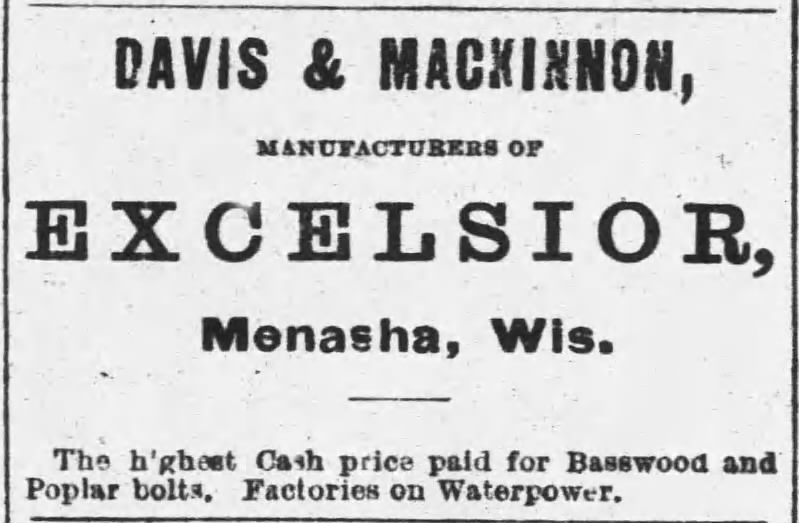
In 1878, Ira in company with a younger man, Duncan MacKinnon, formed the firm of Davis & MacKinnon, which became a successful producer of excelsior.  Ira  became a very prominent  business man in Menasha and was elected alderman from his ward.ad for Davis & MacKinnon

In 1881, Davis and MacKinnon sold a water power site to Henry Hewitt, Jr. a wealthy fellow Menasha businessman. Hewitt had invested in several businesses in Menasha and elsewhere in the Wisconsin area. In 1884 Hewitt and Ira invested in The Chicago and Dayton Brick Company, located in Dayton, Illinois, and it is through this connection that Ira took up the position of superintendent of the brick works being established in Dayton.

On November 22, 1884, the Dayton correspondent to the Free Trader reported that

“Mr. Ira Davis, the superintendent of the new brick works, has brought his family from Wisconsin and moved into G. W. Gibson’s residence, on the hill.”

His family at that time consisted of wife Laura, daughters Nellie, 6, and Harriet, 3, and son Taber, 1. In April of 1885 his son Ray was born, but he died three months later and was buried in the Dayton Cemetery.

Despite his position with the Chicago and Dayton Brick Company, his principal interest appeared still to be with paper making. In 1886 he sold out his interest in the brick works and in that year Ira and 2 others (Moore & Hewitt) rented the paper mill from H. B. Williams. Ira kept in touch with the business atmosphere in Wisconsin, however, making several trips back to the Menasha area. In 1887 his brother-in-law, E. E. Bolles, was preparing to erect a $50,000 paper mill in De Pere, Wisconsin,  and Ira planned to move back and join him.

In December 1887, his wife, Laura, died, leaving three small children. She, too, is buried in the Dayton Cemetery, as shown on her death certificate. If there ever was a stone marking her grave, it has since disappeared.

Ira’s widowed mother, Harriet, and his unmarried sister, Emily, came from Maine to keep house for Ira’s family, arriving in Dayton in February, 1888. They left Dayton for Menasha, Wisconsin fairly soon, and lived there until Ira moved to Wausau in 1893. It may be about this time that the two girls, Nellie and Harriet, went to live with their mother’s sister Alice, the wife of E. E. Bolles, in De Pere, Wisconsin. Tabor continued to live with his father, grandmother and aunt in Wausau.

Ira engaged in business with a Milwaukee firm and, with W. W. Abbott, established an Excelsior Manufactury in Wausau. He is last seen in Wausau in 1895. When and why he went to California is not clear, but in the 1900 census, he appears in Scott Valley, Siskiyou County, California. He died August 15, 1902. His death was reported back in Bangor, Maine, more than 30 years after he left for “The West”.

News has been received here of the death at Orlans, Cal., on Aug. 15, of Ira W. Davis, formerly a well-known Oldtown lumberman. He was the son of John T. Davis of Oldtown and was a brother-in-law of Judge Charles A. Bailey of this city. He went west many years ago, and had been engaged in the manufacture of excelsior in California.
from The Bangor (Maine) Daily News, September 1, 1902, p. 3, col. 2.

144 years ago today in Dayton


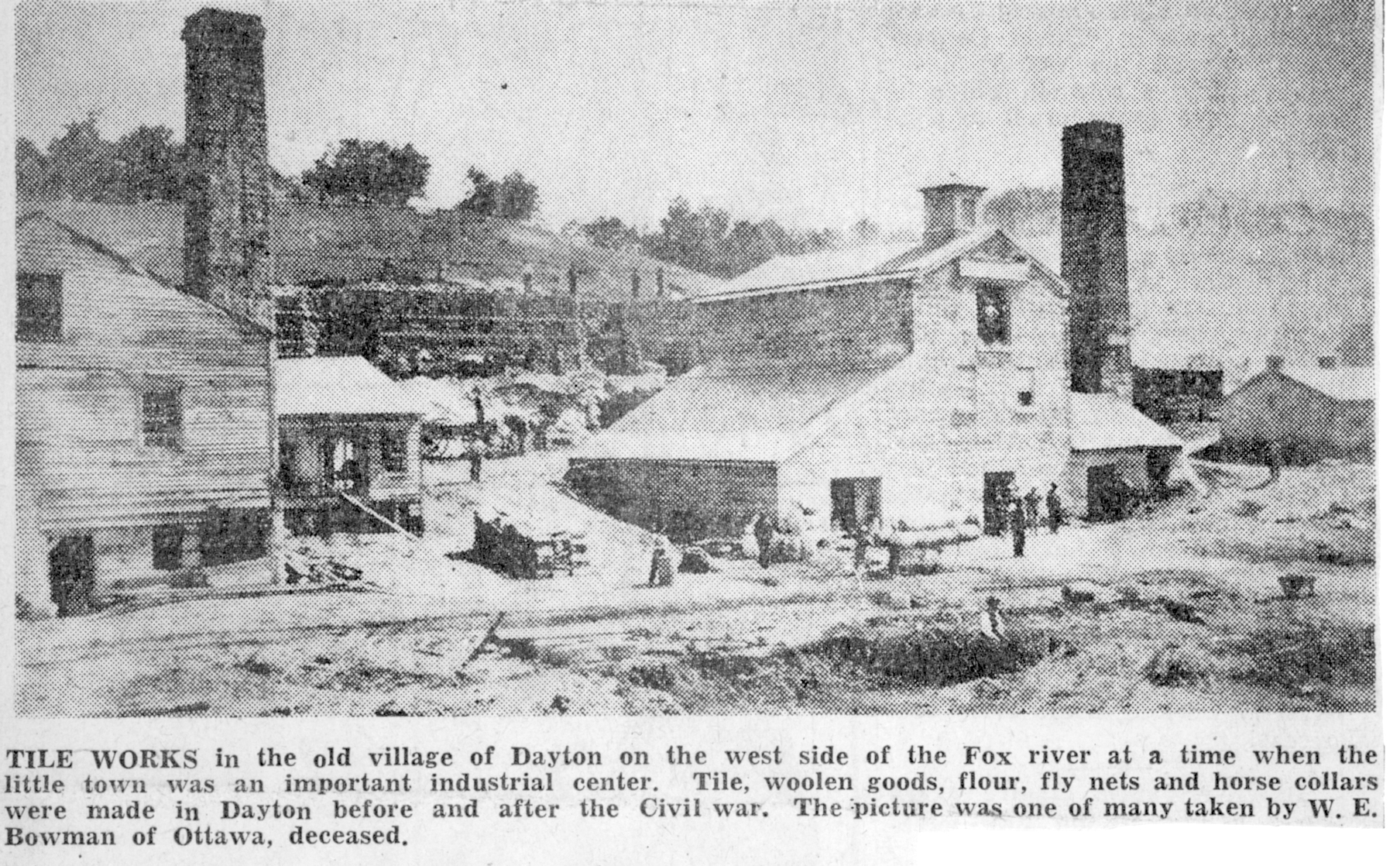
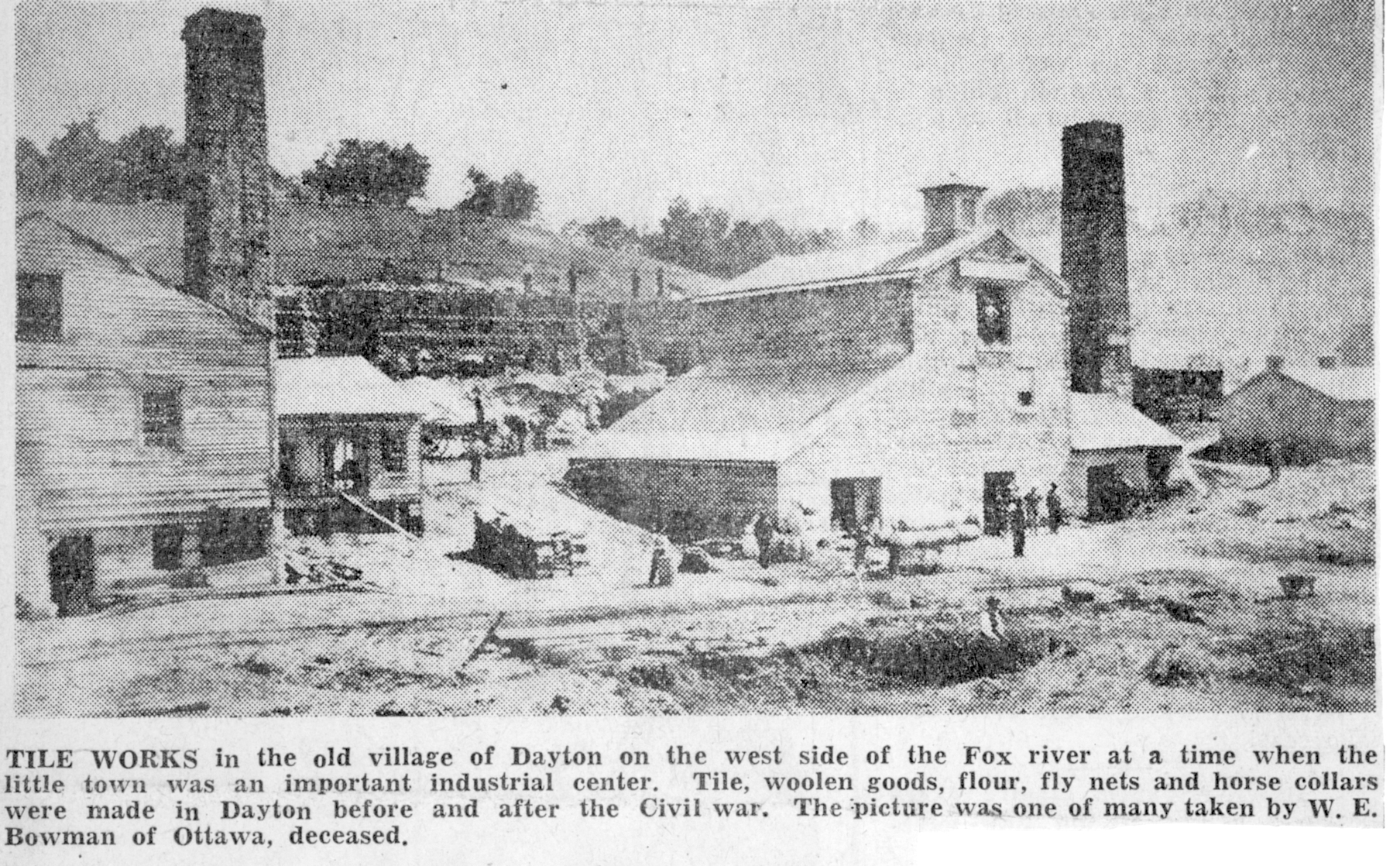
tile factory about 1864

paper mill and other businesses

flour mill and tile factory

Flour mill (built 1855) and tile factory


DAYTON
One of La Salle County’s Flourishing Manufacturing Centers

            Dayton, as some of your readers may not know, is located four miles from Ottawa, on the Fox River branch of the C., B. & Q. R. R. Its most solid attraction is one of the best water powers to be found in the West. The dam that supplies the power is owned and kept in repair by the state, so that lessees of power feel assured that if the dams or locks should ever be impaired by the ravages of time or floods, the damages will be speedily repaired, without tax or expense to them.

The paper mill of Williams & Co., situated at the lower end of the manufacturing portion of the town, is one of the best in the state. Their products are so favorably known that running night and day the year round they are unable to supply the demand.

The Tile and Brick Works of D. Green & Sons are yet in their infancy, yet the perseverance of its proprietors, and the excellence of the material close at hand, is sufficient evidence that the surrounding country can soon be supplied with the very best tile and brick to be found anywhere.

The grist and merchant mill of D. Green & Sons is presided over by Mr. Stover, widely known for many years as one of the best millers in the state,

The Fox River Horse Collar Manufacturing Co. is an incorporated company, composed of a body of modest and unassuming men, their modesty being only equaled by the superior quality of their goods, which are widely known from Pennsylvania, Ohio and Virginia on the east, to Kansas, Nebraska and Missouri on the west, to be the best in the world. They use about forty tons of rye straw yearly for filling horse-collars, and the hides of about 2,000 head of cattle are required yearly to supply them with leather.

The elegant massive building known as the Dayton Woolen Mill is now owned and run by J. Green & Sons. They are so well known for the excellence of their goods and their honorable dealing that the simple announcement that they are again in business is sufficient to flood them with orders.

Adjoining the town is the splendid grain and stock farm of Isaac Green. Mr. Green makes a specialty of raising Norman and Clydesdale horses and thoroughbred cattle, and can show some of the finest in either class to be found in the state. Among the minor attractions are many fine driving teams, single and double. I would like to give you the names of the owners, but their objections to seeing their names in print forbid it.

And last, though not least, we have the nicest girls, the most dashing beaux and the most enchanting Groves to be found anywhere. Go a fishing and come and see us.

Full Stop


  1. The Ottawa Free Trader, July 12, 1879, p. 8, col. 1

The Importance of Good Roads

DAYTON ROAD INTEREST
Business Men Are Awakening to the Importance of the Inlet

The importance of good roads leading into Ottawa was never so urgent as in the fall of 1895. A considerable portion of the city’s usual population having been deprived of employment and departed to other centers of activity, it has become necessary that every effort be put forth by the business men and citizens in general to attract a larger trade from the country.

Some weeks ago Supervisor Perkins and the road commissioners of the township of Dayton began to agitate the subject of an inlet to the city from the north. A good gravel road now leads to the northern villages and hamlets, but the country north of the Ottawa line, taking in the townships lying directly north of the city, as far as Earlville, cannot be reached save in very dry weather. As a consequence all of the trade north of Dayton goes to Earlville over the new gravel road in Freedom township.

Dayton is too poor to pay the cost of the six miles gravel needed to connect Ottawa with these northern townships, but her people are willing and have already contributed $1,500 in work and money. The exact cost of the road cannot at this time be closely estimated, but it is probably that it can be built for less than $5,000.

Supervisor Perkins and a committee are now soliciting subscriptions among local business men. They should meet with every encouragement, as Ottawa is the natural market for the farmers and can have their trade if she makes it possible for them to reach her at all times.1


  1. The Ottawa Free Trader, October 11, 1895, p. 10, col. 3

Dayton’s Industries in 1879


DAYTON
One of La Salle County’s Flourishing Manufacturing Centers

Dayton, as some of your readers may not know, is located four miles from Ottawa, on the Fox River branch of the C., B. & Q. R. R. Its most solid attraction is one of the best water powers to be found in the West. The dam that supplies the power is owned and kept in repair by the state, so that lessees of power feel assured that if the dams or locks should ever be impaired by the ravages of time or floods, the damages will be speedily repaired, without tax or expense to them.

The paper mill of Williams & Co., situated at the lower end of the manufacturing portion of the town, is one of the best in the state. Their products are so favorably known that running night and day the year round they are unable to supply the demand.

The Tile and Brick Works of D. Green & Sons are yet in their infancy, yet the perseverance of its proprietors, and the excellence of the material close at hand, is sufficient evidence that the surrounding country can soon be supplied with the very best tile and brick to be found anywhere.

The grist and merchant mill of D. Green & Sons is presided over by Mr. Stover, widely known for many years as one of the best millers in the state,

The Fox River Horse Collar Manufacturing Co. is an incorporated company, composed of a body of modest and unassuming men, their modesty being only equaled by the superior quality of their goods, which are widely known from Pennsylvania, Ohio and Virginia on the east, to Kansas, Nebraska and Missouri on the west, to be the best in the world. They use about forty tons of rye straw yearly for filling horse-collars, and the hides of about 2,000 head of cattle are required yearly to supply them with leather.

The elegant massive building known as the Dayton Woolen Mill is now owned and run by J. Green & Sons. They are so well known for the excellence of their goods and their honorable dealing that the simple announcement that they are again in business is sufficient to flood them with orders.

Adjoining the town is the splendid grain and stock farm of Isaac Green. Mr. Green makes a specialty of raising Norman and Clydesdale horses and thoroughbred cattle, and can show some of the finest in either class to be found in the state. Among the minor attractions are many fine driving teams, single and double. I would like to give you the names of the owners, but their objections to seeing their names in print forbid it.

And last, though not least, we have the nicest girls, the most dashing beaux and the most enchanting Groves to be found anywhere. Go a fishing and come and see us.

Full Stop1


  1. The Ottawa [IL] Free Trader, July 12, 1879, p. 8, col. 1

Highly Recommended

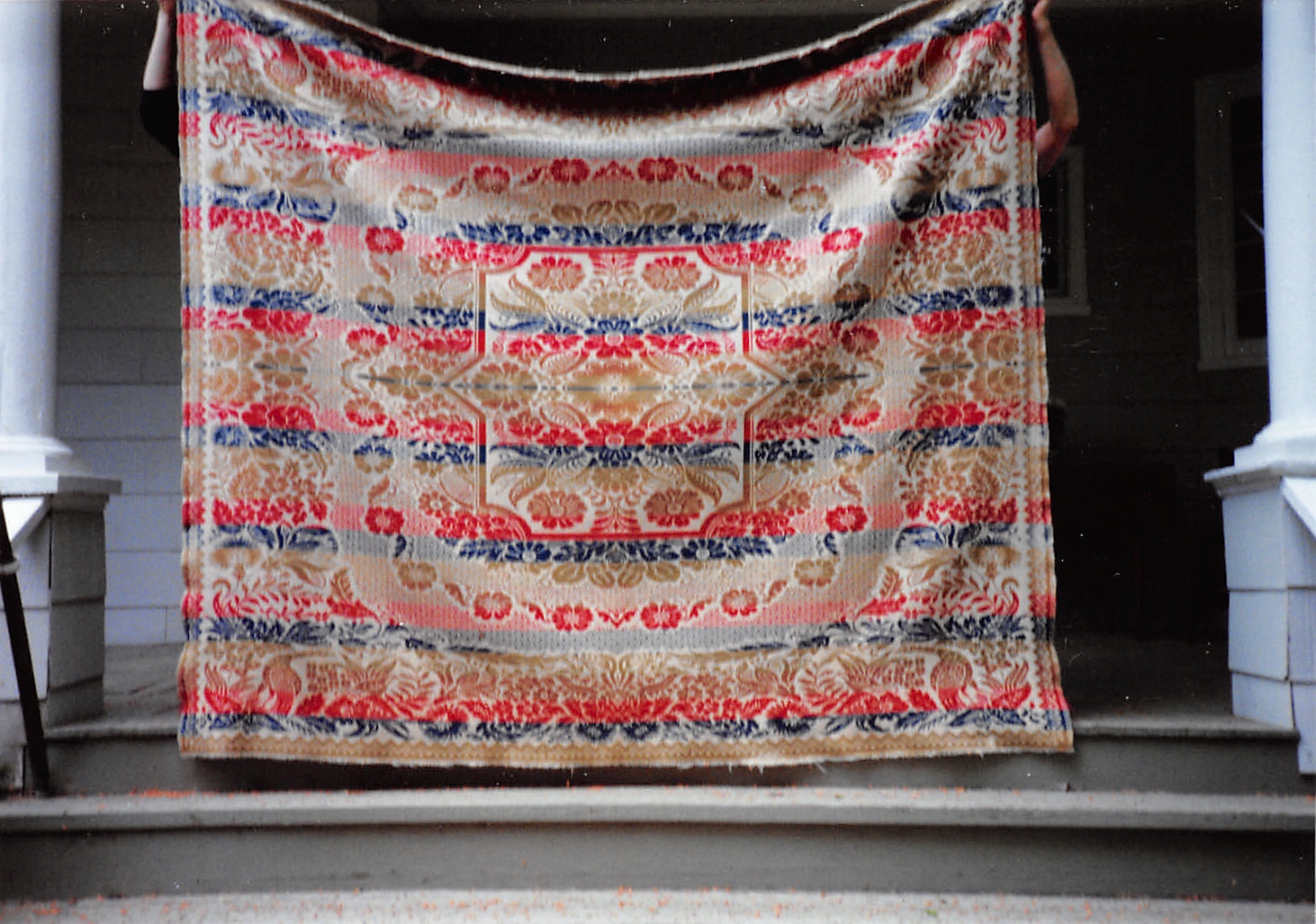
blanket from the Dayton woolen factory

This blanket may be more elaborate than the ones described in this clipping, but it comes from the same woolen factory in Dayton.

DAYTON GOODS. – We have now in daily use, and have had so for twenty-five years, several pairs of blankets made by the Greens at Dayton, and they are apparently good for a dozen years more. This accords with a recent incident at the mill. An old friend of the Greens ordered six pairs of blankets, saying that the four pairs he had bought thirty years ago began to show wear, and as the present would probably last him the rest of his days, he took enough to go ‘round. We have never seen “store” blankets that equaled those made by Jesse Green & Sons at Dayton, in point of either finish or durability, at so low a price.1


  1. The Free Trader, 22 Sep 1877, p1, col 2

The First Mills

An example of a water-driven mill. The ones described below may have looked similar.

From Jesse Green’s Memoir

Early in the spring of l830 development of the water power was commenced by using the stumps from the timber from which the mill was being constructed. Economy was sought to a greater extent than it is at the present time. The saw mill was built with sufficient room to put a pair of stones in one end of it to do our grinding until a better mill could be erected, having brought with us the necessary mill irons, black-smith tools etc. Whilst the men were getting out the timber for the mill and dam, which had to be built to intersect a small island, brother David and myself took the contract of scraping out the race or waterway for a distance of about a half mile (he being ten, and I twelve years old). We each had a pair of oxen and an old fashioned scraper. I sometimes had to help him load and dump his scraper and vice versa. We had the race completed by the time the mills were ready to draw their gates.

On the morning of the 4th day of July 1830 the first wheat was ground by water power in the northern portion of Illinois. We did not at this time have a bolt for separating the flour from the bran but we thought that graham flour was good enough to celebrate that Natal day with a double purpose that will never be forgotten by the latest survivor of the memorable event. It marked the first and greatest step in the alleviation of the hardships and suffering of the early settlers, and they soon all had plenty of graham flour and corn dodgers. Up to this time we were obliged to grind our grain in a coffee mill, or pound it in a mortar improvised by burning out a hole in the top of a stump, and attaching an iron wedge to a handle to use as a pestle which was operated in a manner similar to the old fashioned well sweep.

Our second flouring mill was built in 1831. Having plenty of lumber at this time, a good frame building was erected but before we had got fully acquainted with the pranks of old “Fox”, we found that we had encroached too closely on her banks, and by way of admonition a gorge of ice shoved the mill back a little, sufficient for a warning, the damage not being so great but that it was soon repaired so as to do our grinding until a third mill could be built.

The third mill was built in 1834 of much greater dimensions containing five pairs of “flint ridge burrs” gotten in Ohio together with the old Pioneer [grindstones], which were used for grinding corn and buck-wheat. This mill did a very extensive business in the manufacture of flour which found a ready market in St. Louis at that time, and a little later Chicago became our market.

The Valuable Water Power at Dayton

A view of the west bank of the river in the area occupied by businesses that were powered by the water from the feeder.

The Ottawa [Illinois] Free Trader, February 14, 1852, p. 4, col. 4

Water Power to Lease

The undersigned offer great inducements to capitalists and manufacturers, as they have decidedly the best water power in the state, having over 25 feet head and fall, and situated in Dayton, 4 miles above Ottawa, and drawn from the Fox river Feeder, which is kept in repair by the state, without any cost to the undersigned. They have water to lease for a term of years sufficient to drive 20 run of 4 ½ feet burrs, and will lease on very liberal terms to any good responsible company.

This is a rare chance for men of capital who may wish to go into the manufacturing business. The location is very healthy and admirably situated, as it is on a navigable feeder, within 4 miles of the contemplated Rock Island rail road, and the head of steamboat navigation. For further information, address John Green & Sons.

Dayton, may 31.

Another Dayton Business

PLOUGH FACTORY

Jacobs & Co. would inform the Farming Public that they are manufacturing at Dayton several kinds of Ploughs, which have been heretofore approved, to which they invite the attention of those wishing to buy. These ploughshare – made of the best material, and warranted to be perfect in every respect – They are also manufacturing the improved revolving Colter, which is acknowledged to be far superior to the common straight ones. Call and examine for yourselves.

Old ploughs will be repaired to order on reasonable terms.1

The revolving colter was an improvement on the previous form, which was a vertical knife edge to cut through roots and vines. A fixed knife collects roots and vines and tends to plug up. The rolling blade greatly reduces the friction through the ground and does not gather rubbish on its edge. 

Another Dayton company in the forefront of technological advancement!


The Ottawa Republican, April 29, 1854, p4, c4

Dayton Post Office Will Close on April 1, 1954

DAYTON’S Post Office, located in the grocery store, top photo, will be abandoned by the federal government April 1. The post office, serving La Salle County’s earliest settled community, is over 90 years old. Lower photo, Dominic DeBernardi, present postmaster, points to the closing notice. Note the old type boxes. (Daily Republican-Times photos.)

Old Dayton Post Office Ends Existence April 1
County’s First Settled Village Victim of U. S. Economy Drive

            As part of an economy move by the U. S. Postal Department, Dayton, oldest settled village in La Salle County, is about to lose its post office, which was set up at least 90 years ago.

            The office is located in a grocery store now run by Dominic DeBernardi who also is postmaster.

            The office will be closed April 1 and its 69 patrons will be served from the Ottawa Post Office by rural free delivery. Victor Boissenin of Ottawa will be carrier.

            The new patrons will add 1.9 miles to his daily route, according to the Ottawa Post Office. Boissenen, however, will be paid for only one extra mile in accordance with the complex figuring under postal rules and regulations.

            The Dayton Post Office patrons are all village residents. They now will have to install rural mail boxes near their homes to receive mail.

By April 15

            Postmaster Frank J. Mulholland of Ottawa said Dayton People will have until April 15 to erect such boxes, which must be of a certain height from the ground and maintained by the patron in accordance with postal regulations.

            Mulholland also said Dayton people will have to register their address at the Ottawa Post Office by April 1. The names of residents, names of their children and others who receive mail at the residence must be on the registration list.

            The Ottawa postmaster Tuesday met with about 30 Dayton residents to explain the new mail system for the village located four miles northwest [sic] of Ottawa.

            The carrier, Boissenin, will enter the village from the east via State Highway 71 and the Dayton rural road, circle the town, and leave on the road west of the village leading to Ottawa.

            The post office at Dayton has a fourth-class rating and pays between $1,200 to $1,500 per year to the federal government.

Four Deliveries

            There was a time when the Dayton Post Office received mail four times a day via the Burlington Railroad. The service was cut to two deliveries per day several years ago and on Feb. 2, 1952, the last passenger train with mail aboard passed north through the town.

            Since then mail has come into and gone out of the village twice a day via truck serving the Aurora and Streator area. The truck service will be discontinued when the rural free delivery service goes into effect.

            Dayton was settled in 1829 by a party of Ohio immigrants who saw riches in the water power of the Fox River. Mills were established to grind corn and wheat.

Water Power

            Later, water power ran other mills in the hamlet, making it a prosperous place before and after the Civil War. The postmaster was an important figure then but his political head was sheared off with a change of national administration.

            The postmaster in Civil War days was an Englishman, G. W. Makinson, born in England, July 15, 1826, and who came to La Salle County in 1844. An old county history says of him, “He is an Independent (voter), Universalist; own house and two lots in Dayton, valued at $1,500; wife was Charlotte Evans, born Feb. 28, 1828; were married in Ottawa Sept. 22, 1847; have seven children, Anna, Josephine, Jesse, Lewis, Edgar and Lottie; he was appointed postmaster during the administration of James Buchanan; after two years he resigned; was reappointed and has held the office ever since.”

            Makinson must have been the exception to the rule that village postmasters were subject to dismissal when political administrations shifted at Washington. Buchanan was a Democrat, but the history was published in 1877 and the Republicans had held sway for 16 years.

from The (Ottawa, Illinois) Daily Republican-Times, March 19, 1954, p. 1, cols. 2-4