Charles G. Miller

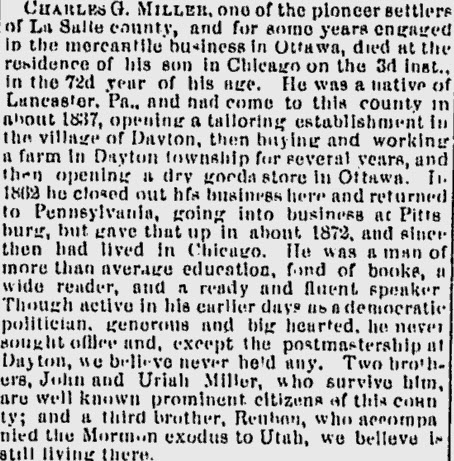
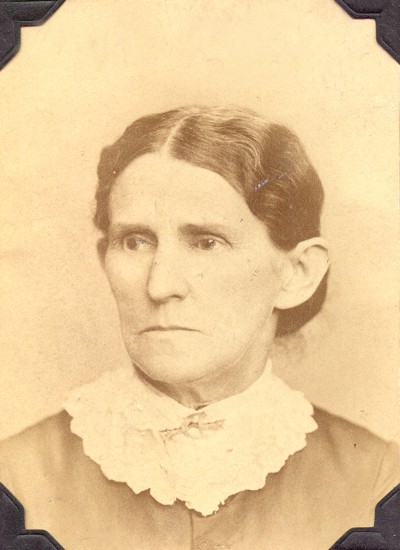
Charles G. Miller, one of the pioneer settlers of La Salle county, and for some years engaged in the mercantile business in Ottawa, died at the residence of his son in Chicago on the 3rd inst., in the 72nd year of his age. He was a native of Lancaster, Pa., and had come to this county in about 1837, opening a tailoring establishment in the village of Dayton, then buying and working a farm in Dayton township for several years, and then opening a dry goods store in Ottawa. In 1862 he closed out his business here and returned to Pennsylvania, going into business at Pittsburg, but gave that up in about 1872, and since then had lived in Chicago. He was a man of more than average education, fond of books, a wide reader, and a ready and fluent speaker. Though active in his earlier days as a democratic politician, generous and big hearted, he never sought office and, except the postmastership at Dayton, we believe never held any. Two brothers, John and Uriah Miller, who survive him, are well known prominent citizens of this county; and a third brother, Reuben, who accompanied the Mormon exodus to Utah, we believe is still living there.1

Charles was the son of Isaac and Esther (Gleim) Miller. He was born in 1809 in Lancaster, Pennsylvania. He and his wife, Eliza Smith, had four sons and a daughter: Mary, born abt 1834; William born about 1839; Milton B, born October 25, 1841 in Dayton; Edgar S born abt 1844; and Edward, born abt 1845. Charles was a justice of the peace in addition to serving as Dayton’s postmaster from1839 to 1845.

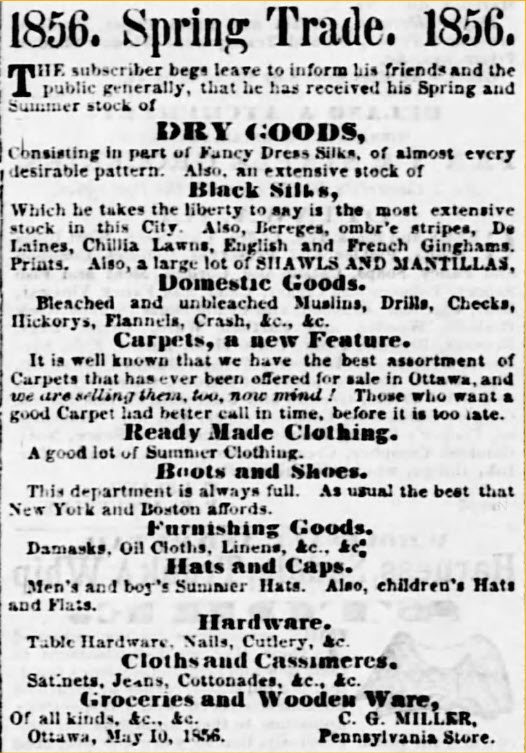
This is an ad for Charles’ dry goods store in Ottawa, showing the variety of items he offered. Note that the name of the store is the Pennsylvania Store, in honor of Charles’ home state. In 1857 ads appeared in the Ottawa Free Trader where Charles was selling his business in Ottawa and his farm prior to his move back to Pennsylvania. Charles never lived in La Salle county again, though he may well have visited his brothers after he (Charles) returned to live in Chicago.


  1. The Ottawa Free Trader, September 17, 1881, p. 1, col. 2.

In Memory of John W. Rhoads

In Memory of John W. Rhoads

Died – At the homestead, in the town of Dayton, June 19th, 1891, John W. Rhoads, aged 69 years.

Born in Brownsville, Pa., came to Ottawa with his widowed mother and settled in Dayton township. Shortly afterwards he left his home for St. Louis, to work at his trade of a carpenter; the mother remaining with her small children founded the old homestead from which all the family have gone out one by one. In 1846 he enlisted for the Mexican war, in the Company of Captain Hudson, attached to the famous regiment of Col. Doniphan, sharing all its trying marches and participating in the battle of Sacramento, where 1500 fell on the Mexican side and less than a dozen on the American.

After this war he was at home for a short time and then went with the early gold seekers to California. Three times he crossed the plains, returning home once the same way and twice by water. Later on he went to Montana, stopping at Helena City. Here again he was successful as a miner, and was sent twice to the territorial legislature. Then he came home and a year afterwards went to the Black Hills, and remaining there but a short time, finished up his wanderings.

At the old home his life flowed along quietly, amid friends. He was intelligent and of a pleasant, social, turn. Had a wide knowledge of people and places and knew the world, its fluctuating scenes and cares, and was content. He came to the old home after the death of his dearly beloved mother in 1874, and in quiet gathered strength for the world to come, his life flowing on in the peaceful intercourse with friends, a well woven chain from manhood to middle life and then to old age, with silver locks – a crown of glory – the river of life flowing at his feet. A friend to the unfortunate, a brother in adversity, faithful and kind to all – his works do follow him and it is well.

Over the river a boatman pale
Dips his hand in the silvery stream.
Deeper and deeper than earth his voice:
“Come rest thee and bathe thee, O tempest tossed.”1


John W. Rhoads was born November 13, 1821 in Brownsville, Pennsylvania, the son of Thomas R. and Sarah (Collins) Rhoads. His father died in Pennsylvania, and Sarah afterward brought the family to La Salle county, securing a farm near Dayton. There were six children in the family – John, the eldest; Elizabeth, who married Robert Strawn; Samuel; Hannah, who was Jesse Green’s second wife; Mary Jane; and Thomas.

John never married. At his death in 1891 the inventory of his estate listed the assets as 120 acres of real estate, 105 lambs, 138 sheep, 43 swarms of bees, farm implements, growing crops, notes, credits, accounts, cash on hand, etc., of the value of about $4100. He may have led an adventurous early life, but he ended his days as a prosperous Illinois farmer.


  1. Ottawa Free Trader, September 19, 1891, p. 8, col. 3.

Dayton Teenagers Who Registered in the Civil War Draft

Unidentified young drummer boy in Union uniform

About Civil War Draft Registrations Records

There were four drafts between 1863 and 1865, which produced 3.175 million records. The Enrollment Act of 1863 required the enrollment of every male citizen between 20 and 45 years of age, unless exempted by the Act. These records are basically lists of individuals who registered for the draft.

This list of the young men from Dayton who registered for the draft must be from 1864, when men as young as 17  were drafted for the first time. Appearance on this list does not prove they actually served, only that they were registered.


Enrollment Record of Names Between the Ages of 17 and 20 Years
in the 6th Congressional Dist., State of Illinois.
Sub Dist #19
Residence: Dayton

Name                                    Age        Occupation         Birth date                            Birth place

Ames, James                      18           Farmer                  3 May 1846                        N. Y.
Buckaleb, John S.              17           Farmer                  4 Feb 1847                          Penn
Bidgood, Chas W.             18           Farmer                  30 Aug 1848                       Ohio
Brown, Perry                      18           Farmer                  28 Oct 1848                        N. Y.
Conley, William                  18           Farmer                  15 Aug 1846                       N. Y.
Carlon, James M.              17           Farmer                  24 Jun 1847                        Ireland
Carton, John Thomas      19           Farmer                  24 Dec 1845                       Ireland
Calloway, Alonzo              19           Farmer                  29 Apr 1845                       Illinois
Collins, DeKalb                   17           Farmer                  10 Jun 1847                        Ilinois
Curtis, Wm H.                     19           Farmer                  6 Mar 1845                         Illinois
Clark, George L.                 18           Farmer                  25 Oct 1845                        Ohio
Deweese, John                  19           Farmer                  29 Dec 1945                       Penn.
Donlevy, Francis                 18           Student                19 July 1846                       Mass
Donahue, Walthen           17           Farmer                  10 May 1847                      Ireland
Feely, James                       17           Farmer                  Oct 1846                              Ills.
Grove, David                      18           Farmer                  14 Apr 1846                       Ohio
Greenless, Wm A.             17           Farmer                  16 Nov 1846                       N. Y.
Hinkey, John                       18           Farmer                  1 Oct 1846                          Germany
Hays, Jesse                          18           Farmer                  Nov 1845                             Ills
Kain, Simeon C.                 17           Farmer                  8 Jun 1847                          Penn.
Marvin, George                 19           Farmer                  16 Aug 1845                       Penn
Nelson, Lewis                     18           Farmer                  Dec 1846                             Norway
Parr Francis M.                  19           Farmer                  10 Jun 1845                        Ills
Ruhl, Peter                          18           Farmer                  1 May 1846                        Penn
Smith, George                    18           Farmer                  30 Aug 1845                       Ills
White, Walthen                 17           Laborer                 4 Mar 1847                         Ireland
Yeager, Francis                   17           Farmer                  10 June 1847                     Ills
Miller, Gottzeni                 17           Farmer                  18 Apr 1847                       France

Death of Mrs. Sarah Lewis

photo from FindAGrave

Wedron

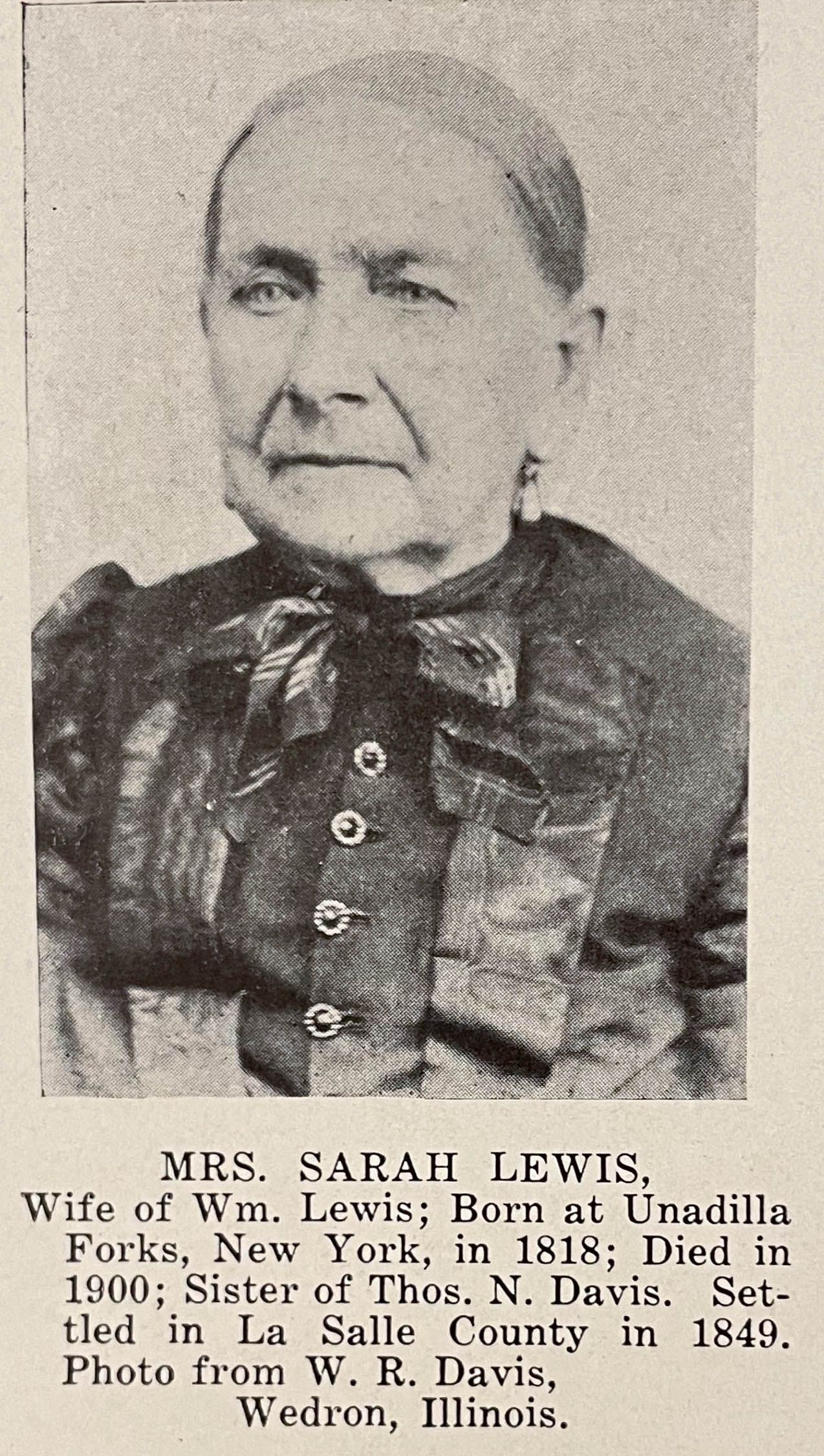
Passed to spirit life, March 19th, Mrs. Sarah Lewis, aged 81 years, at the home of her son, Park Cole. Deceased was an old settler and resident of the town of Dayton. She had been sick for about a year and her demise was not unexpected. Five sons survive her. The funeral occurred from the school-house on Wednesday, at 11 a. m., Rev. Baird, of Ottawa, officiating. As we write a large concourse of friends are gathering to pay last respects to the memory of one who was loved and esteemed while living and mourned in death.1

The above obituary gives little information about Sarah Lewis’s life, so this is an attempt to expand on the few facts in the obituary.

Sarah Davis Cole Lewis was born abt 1818/19 in New York. She married William Cole on February 4th, 1838, in Plainfield, Otsego County, New York. They had 6 children: Lyman, Leroy, Jay, Marian, Parke, and Burt. The family moved to La Salle county about 1849 and settled in Serena township, north of Dayton. By 1860 they had moved to Marseilles, Illinois.  On November 18, 1861, William Cole enlisted in the 53rd regiment, Illinois Infantry at Ottawa, Illinois. Unfortunately, his part in the war was of short duration. He died at Pittsburg Landing, Tennessee, on April 6th, 1862. As reported by the Regiment Major:

He was breaking teams consisting of six mules, was thrown from the one he was riding on, was run over by the wagon and his back broken and otherwise injured.

William is buried in the West Serena Cemetery. Sarah applied for a widow’s pension and there were two young children who were also entitled to support. She was appointed guardian for her two young sons, Parke and Burt. She got a pension of $8/month from William’s service.

In June 1865 Sarah Cole and William Lewis, of Dayton, were planning to marry. Because her widow’s pension would end at her remarriage, she wanted some assurance that she would be provided for should her husband predecease her.  On June 13, the two of them signed an agreement in which Sarah says that without such a contract she would not have married Lewis. The provisions for her children are that Lewis will support, clothe and educate her two sons until the age of twenty and when they reach twenty-one he will give each a horse, saddle, bridle and suit of clothes. Should Lewis die before Sarah, she will have all his real and personal property and, in addition to maintaining herself and her sons, she will provide for the younger Lewis children until they reach the age of twenty.

With the contract signed and registered with the county court, the marriage took place the next day, June 14th, 1865. The two Cole boys worked alongside the Lewis men on the farm and Sarah kept house for the blended family.

William Lewis died October 9th, 1874 and was buried in the Dayton Cemetery next to his first wife, Eliza Ann Holman. Sarah lived on the dower tract of her husband’s farm until her death on March 19th, 1900. She was buried in the West Serena Cemetery, next to her first husband, William Cole.


  1. Ottawa Republican-Times, March 22, 1900, p. 5, col. 2


An Amateur Mesmerist

Forty-five years after the incidents related here, Jesse Green wrote this article about his experience with hypnotism:

“An Amateur Mesmerist”
“How I became interested in the investigation of Mesmerisn”

In the fall of 1848 one Doctor Underhill visited Dayton where I then resided, with a Mesmeric subject and claimed that through him he could among other things find lost property.  He undertook to find a pair of buggy wheels lost in fording the River during a high stage of water a short time previous.  The buggy wheels were lost by Dr. Ward of Marseilles.

He started in at the ford, and when in the River opposite my house, the subject said “he saw no buggy wheels, but there lay an old saddle under a ledge of rocks in deep water”.  There had not been a word said about a saddle being lost.

But I had lost my saddle during the same rise in the River, and he described it as well as if lying before him, which was an easy matter as I had started hastily to cross the River, and found one of my stirrups gone, and took an odd one in its place.  We then went under his directions, in a boat with a lantern, and persons on the bluff overlooking the River, and in communication with the subject (Jockey Smith) who directed us to the spot.  We did not find the saddle but found the ledge of rocks in about ten feet of water.

This so impressed me that I together with a number of others got the Doctor to deliver us a course of lectures on Mesmerism, and the night of the third lecture he had us all take a subject and see what success we might have.  I selected my sister and succeeded in getting her Mesmerised, before the Doctor got his, and gave her up to him, not yet knowing how to proceed farther, but soon became familiar with all the Doctor knew on the subject.  During that winter I Mesmerised eight or ten different persons.  My first experience worthy of note was with my first subject.  Father requested me to send her to Newark, Ohio, and from there up the Ohio Canal, and see if she could name the Towns she would pass through (he being familiar with the whole length of the canal, having built fifteen miles of it).  She would name places in their regular order (apparently by reading some sign giving the name) and when she reached Cleveland she exclaimed “Oh! what a great body of water”.  Father was fully satisfied that she either read the signs correctly or read his mind.  This much I know they can do.  My best subject being the best clairvoyant I had outstripped this all hollow.  He would personate anyone, in speech, actions, and in every way.  I had him sing by exciting the organ of tune, and have thrown it off, at the highest pitch in the tune, with the word half uttered, and in a half minute or so would excite the organ again when he would start in again where he left off with the same pitch of tune, and the other half of the word as perfect as if there had been no intermission.

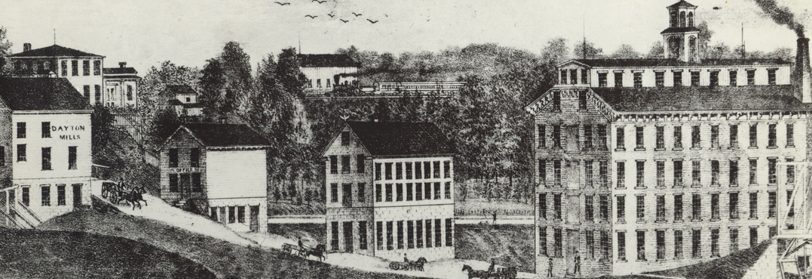
During one evening some one suggested that I “have him look ten years into the future and see what he would say about Dayton”.  Of course I had no faith that he could tell anything reliable, but did so.  He looked around a little and said it had not improved much “but they have a new mill down there and Uncle Johnny is up in the third story”.  Uncle Johnny was my Father and lived a number of years after that mill was built, and I believe that this clairvoyant saw it seven years previous to its being built.  It may be said that he guessed it.

I will relate another experience that will show too much complication to admit of guess work.  This all occurred during the winter of 1848 and ’49, and we were calculating to go to California in the Spring (and in the clairvoyant state) I sent him there to see what he would say about it.  We did not get much information only that there seemed to be a great rush to that country, and they were getting plenty of gold”.  It seemed to him in returning that he met our train going in the spring and his first exclamation on meeting it was “See that wagon, how they have fixed it up”.  I inquired about the wagon and he said it was “George Dunavans wagon and that they had broken the coupling pole, and had it wound with ropes and chains, and Uncle Johnny is behind carrying some birds”.  When he told this Father had no idea of going to California with us.  The Company employed him to go to Missouri and buy oxen for the outfit and return home, but there being so much cholera on the River he preferred crossing the Plains, rather than risk getting the cholera on his return.  Our company consisting of forty nine men with twenty wagons, left Ottawa April 2, 1849.  Myself being elected captain of the Company, one day on the route a short distance East of Fort Kearney, my clairvoyant (Daniel Stadden) borrowed a horse from one of the company and rode ahead with me, when we were a mile ahead of the train we saw that they had stopped, and by the time we rode back to see what was the matter, here was George Dunavans wagon reach broken and wound with both ropes and chains and Father was behind carrying a sage hen he had shot.  Stadden said to me “that is just how I saw it when I was mesmerised”.

Had it been any other wagon we probably should not have thought anything further about his prophecy, but every circumstance connected with it, being literally fulfilled brought it vividly to the minds of both of us.

I have often regretted that on my return home I had not further investigated it, I did very little in California but on our return home via Mexico one of our Company had a horse stolen and having faith in Mesmerism he wanted me to Mesmerize Mr. A.B.Goodrich (one of my former subjects) and one of our Company to see if he could find his horse.  I was a little afraid to do so there knowing the superstition of that people, but we had an interpretor who went and saw the Alcalde of the place and found that he had seen it before, and was anxious that I should Mesmerize Goodrich, he being present with our interpretor.  He soon described the thief and pointed out the direction he had taken, describing minutely every crook and turn in the road, and where the thief had stopped for the night.  The Alcalde had such confidence in everything that he said he would send next morning to recover the horse and thief if possible.  We were driving five hundred horses, and did not wait to see the result.

I think the possibilities of Mesmerism are very imperfectly understood even at the present time.  I have frequently seen accounts published of what seemed a little strange, but nothing equal to my experience with it.

I should have taken up the further investigation of it, but my second wife thought she could see the cloven foot of his Satanic Majesty in it, and on her account I gave it up, but my experience was entirely the reverse, and with evil intentions I was taught and believed it would prove a deserved failure.

It may be asked by some, why did you not have your clairvoyant find gold for you in California.  I do not pretend to say whether he could have done so or not.  The poor fellow died of scurvy soon after reaching California.

Should this seem a little too fishy, I would say that there are still living witnesses to corroborate the facts stated.

Ottawa
October 17th 1894,
Jesse Green.
A May Dayton Marriage

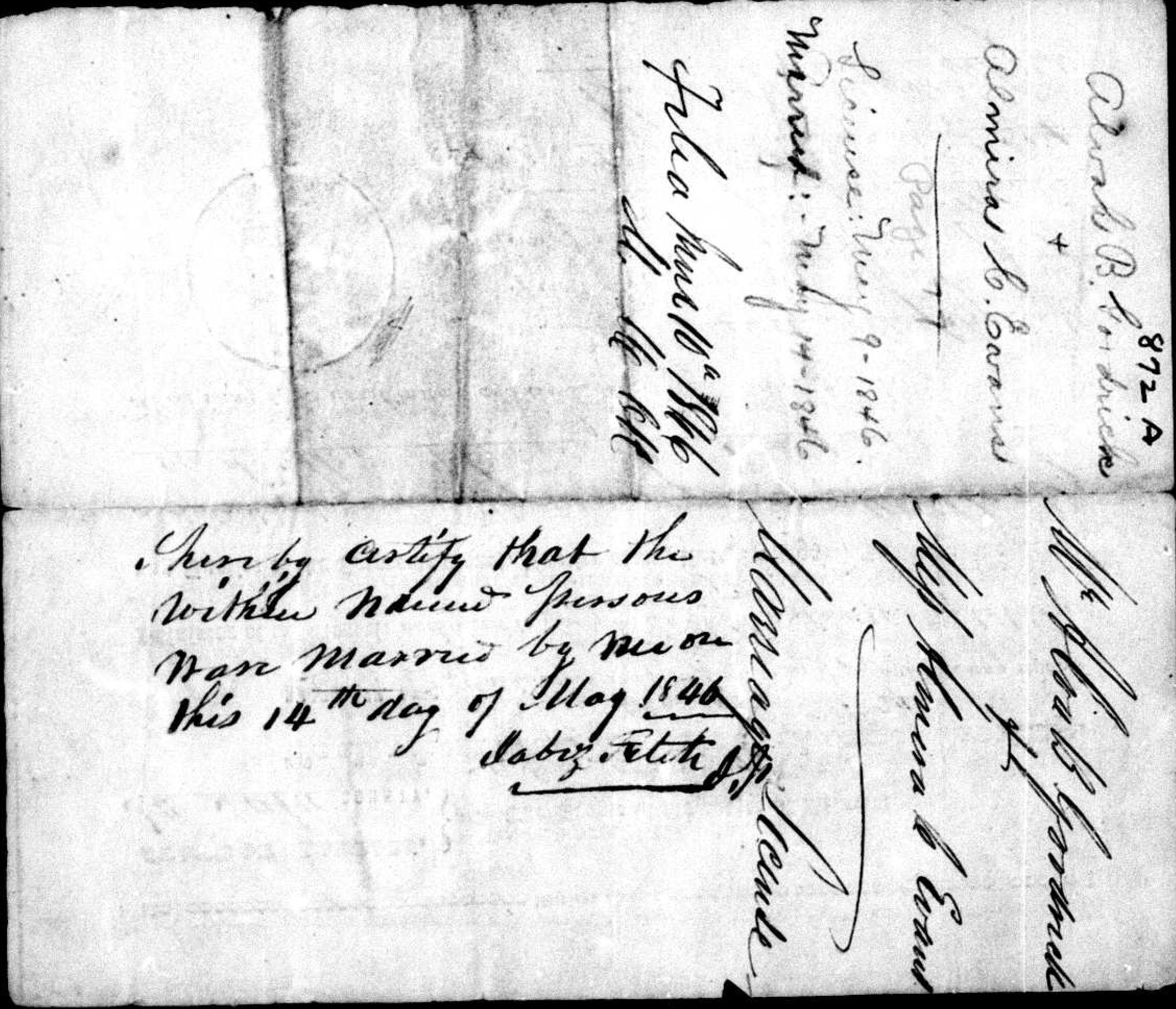
On the 9th of May, 1846, Alva B. Goodrich and Almira C. Evans applied for a marriage license in Ottawa.

Five days later they made good use of it, as reported in the Ottawa newspaper:

MARRIED – At this place, on the 14th inst, by J. Fitch, Esq., Mr. A. B. Goodrich to Miss Almira C. Evans, all of Dayton.1

Alvah Goodrich came to La Salle county in 1844. He worked in the Greens’ woolen mill in Dayton, having learned the trade in the woolen mills of his hometown. In 1849 he went with the Green party to California and spent two years working in the mines. He returned to Dayton and spent an additional year working in the woolen mill. He then bought 88 acres and turned to farming. After he retired, he lived in Miller township, where he died on February 3, 1893

Obituary

DIED. – At his home in Miller township, Friday morning, the 3d inst., Alvah B. Goodrich, at the advanced age of nearly 76 years. Mr. Goodrich was born in Clinton county, New York, February 14, 1817, and passed his boyhood days in his native state, emigrating to Illinois nearly fifty years ago and settling in Dayton township, where he married Miss Almira Evans in May, 1846. Of this union two children were born, Emma L. and Willis J., who both survive, the daughter living on the old homestead and the son in Macon county, Missouri. During the gold excitement in 1849 Mr. Goodrich accompanied the Green expedition to California in search of gold and after nearly two years’ absence returned to his wife and little daughter and settled on a farm near where the village of Wedron now stands.

Here he resided for five years, removing to his late home in Miller township in 1857, where he spent the remainder of his days, honored and respected by all. Ten years ago last September the wife of his youth was laid to rest in the “churchyard on the hill,” leaving her companion and family nearly brokenhearted. Now they sleep side by side awaiting the last call. So one by one the “old settlers” are passing to the great beyond.2


  1. The Ottawa Free Trader, Friday, May 15, 1846, p. 3, col. 1.
  2. ibid, 18 Feb 1893, p5, col 2

Fidelia, youngest child of David and Elizabeth Hite

Fidelia Hite was born in 1844 in Licking County, Ohio. She was the 6th and youngest child of David and Elizabeth (Stickley) Hite. The family moved to Dayton township in 1848 and lived on their farm on Buck Creek. On April 26, 1870, she married 22 year old Benjamin G. Babcock, a substantial farmer from Wallace township.

Benjamin had to certify that they were both of marriageable age, as shown below.

They lived on the farm until around 1885, when Benjamin decided to go into business with his brother Calvin, who arranged the purchase of an implement store in Schuyler, Nebraska. Soon after that, Benjamin moved his family to Schuyler. Later he was a representative of the Lightning Hay Press Company of Kansas City. By 1902, he was afflicted with rheumatism and retired, moving to Council Bluffs, Iowa. In 1904 he served as the janitor to the Thirty-second Street school building, at a salary of $40 per month. Benjamin was active in the Republican party, while Fidelia was a member of the W.C.T.U.

Their home was a frequent gathering place for family. In 1903 it was the site of their daughter Cora’s marriage to E. M. Hill. In 1908 Fidelia’s nephew Calvin Hite and his wife Henrietta, from Ottawa, Illinois, spent the Christmas holidays and their honeymoon with them in Council Bluffs.

Benjamin and Fidelia had six children:
Elizabeth, born about 1873, in Illinois
Albert F., born June 9, 1875, in Illinois
Jennie Fidelia, born December 3, 1877, in Illinois
Maude G., born March 26, 1880, in Illinois
Cora, born March 1883, in Illinois
Olive E., born December 1888, in Nebraska

Fidelia died December 30, 1909 in Council Bluffs and was buried in Walnut Hill Cemetery in Council Bluffs. Her obituary appeared in the Evening Nonpareil, December 31, 1909.

Mrs. Fidelia A. Babcock, aged 65 years, died of cancer of the stomach at 7:45 o’clock Thursday evening at her home, 2531 Avenue B. She is survived by her husband, B. G. Babcock; five daughters — Mrs. A. M. Swart, Mrs. W. L. Smith, Mrs. E. M. Hill, Miss Olive Babcock, all of this city, and Mrs. P. J. Clatterbuck of Marsland, Neb. — and one son, A. L. Babcock of Schuyler, Neb. The funeral will be held from the family residence at 3 o’clock Saturday afternoon, but no further arrangements have been made.

Benjamin died February 19, 1930, in Richmond, California. He was buried in Walnut Hill Cemetery beside his wife.

The Hite Twins – Albert and Alcinda

Albert and Alcinda Hite were the fourth and fifth children of David and Elizabeth (Stickley) Hite. They were born May 8, 1840, in Licking County, Ohio, and came to Illinois in 1848 with their parents. They grew up on the family farm that their father bought in 1850. The picture above shows the family farmhouse, though it is not known if it is the original building or a later one on that site.

By 1865, Albert’s older brothers had married and established their own families. Albert remained and farmed with his father, taking over the full management as his father aged. When his father died, Albert was named the executor of his will. The will left everything to the widow, Albert’s mother, for her lifetime. Following her death the property would be divided evenly between the children. Elizabeth did not die until 1890, so Albert’s duties as executor could not be completed until then. He was also named the executor of Elizabeth’s will, but declined to serve, probably due to the complications of administering both estates, so Alcinda was named as administratrix for her mother’s estate.

On February 22, 1881, Albert married Ida Bell Durkee, the daughter of Lewis M. and Zeruah J. Durkee, of Serena township. They had three children:

1. Calvin Wallace, born December 16, 1881; married December 23, 1907, to Henrietta Belrose; died October 11, 1923 in Ottawa.
2. Lavina Maud, born July 10, 1893; married September 9, 1918 to William Temple; died October 15, 1987.
3. James Edward, born July 5, 1897; married June 7, 1922 to Jeanne Hisler; died March 27, 1961 in Ottawa.

Albert died September 26, 1905, and was buried in the West Serena Cemetery, where many of his wife’s Durkee relatives can be found. Ida died in Ottawa, December 23, 1938 and was buried beside her husband.

Alcinda never married. She continued to live at the farm with  her mother and brother after her father’s death.  Sometime before 1900, Alcinda moved to Ottawa. She appears to have rented out the land she inherited, as her occupation in the 1900 census is given as “landlord”. She was a frequent visitor to Schuyler, Nebraska, where she had relatives, and she invested in land in that area.  Around 1912 or 1913 she moved from Ottawa to Council Bluffs, Iowa, where she had relatives. In 1917 she was committed to the state hospital at Norfolk, Nebraska, where she died July 17, 1924. Her remains were returned to Illinois and she was buried in the Dayton Cemetery.

It is the probate of Alcinda’s estate that provides much information about her family. Because Alcinda outlived all but one of her siblings, her heirs, her nephews and nieces, had to be identified in court. One niece, another Alcinda, testified to the names and addresses of all her aunt’s siblings and their children, including the three who died young and others who predeceased Alcinda. The court proceedings are a veritable goldmine for family historians.

David Hite, Jr.

To continue the enumeration of David Hite’s children, his second son, David, Jr., was born in July 1831 in Licking County, Ohio, and came with his father’s family to Dayton in 1848. On December 23, 1851, he married Mary Ann Curyea, the daughter of John and Lydia (Sager) Curyea, whose family had come to Dayton in 1843. The license clearly states that David is not yet 21 and that his father has given consent, as can be seen below.

David and Mary Ann lived in Dayton for thirty-five years and raised their family of 3 boys and 5 girls. One other son, John William, died at the age of three. In 1881 the family moved to Nebraska, where David died in 1928. His obituary  appeared in The Frontier, the O’Neill Nebraska newspaper on April 5, 1928. Barring the errors in his birth information, it gives a good idea of his life in Nebraska.


DAVID HITE
Holt County’s Oldest Citizen Passed Away Monday

David Hite was born July 15, 1830, in Lincoln County, Ohio, and died at the home of his daughter, Mrs. Flora B. Lewis, April 23, 1928, at O’Neill, Nebraska, aged 97 years, 9 month and 8 days.

He was united in marriage to Mary A. Coryea, December 23, 1851. To this union were born nine children, three of which are living.

When sixteen years of age he moved from Ohio to Illinois, and in 1881 with his family to Cass County, Nebraska; in 1912 he moved to Holt county and made his residence in O’Neill. By occupation he was a farmer and gardner. He loved the soil and was a sincere lover of nature.

Mr. Hite was Holt county’s oldest citizen and took keen delight in political conditions. He was an ardent “Dry” and his two aims seemed to be to live to be 100 years old and to vote as often as given an opportunity to make America dry.

His beloved wife passed away February 22, 1905. “Grandpa Hite was the last of seven children in his family to pass away. He leaves to mourn his going one son and two daughters, T. J. Hite, of Ottawa, Illinois; Mrs. Flora B. Lewis, of O’Neill, Nebraska, and Mrs. Nellie B. Ryan, of Denver, Colorado. Twenty-two grandchildren, twenty-seven great grandchildren, and one great, great grandchild (Donna Rae Cooper, of Lincoln, Nebraska, age seven years) are mourning his going. He will be laid to rest beside his beloved wife in the cemetery near Elmwood, Nebraska. His funeral was held Wednesday, April 25th, in the Methodist Episcopal church at Elwood.

So has fallen one of our best known men. He was in good health until October 16, 1927, and since that time has steadily grown weaker. He was confined to his bed for the last few weeks where his daughter and granddaughter gave him the most loving care. The community extends their heartfelt sympathy to these bereaved ones.1


  1. The Frontier, O’Neill, Nebraska, April 25, 1928, p. 7, col 6.

David Hite and Son Benjamin

The tallest monument in the Dayton Cemetery is that of David Hite, but for many years the top part was lying in a heap next to the base. In 2014 a restoration effort restored a number of monuments in the cemetery and David’s was one of the stars of the project.

David Hite was born in Strasburg, Virginia, on July 30, 1798. as calculated from his age at death. He was apprenticed to the blacksmith trade and at the age of 21 was given $15.00 and a suit of clothes for his work. He decided to go to Newark, Ohio, arriving there late in 1819. There he met Elizabeth Stickley, whose family was also from Virginia. Elizabeth was born April 5, 1798, in Cedar Creek, Virginia. She and David were married August 28, 1820, in Licking County, Ohio.

A number of their friends and neighbors moved to the Dayton-Rutland area in La Salle County, Illinois, and in 1848 David and Elizabeth joined the migration. In 1850 David bought 160 acres of land on Buck Creek in Dayton township, where he moved with his family.  David and Elizabeth lived here until their deaths, he dying April 22, 1881, and she, January 4, 1890.

David and Elizabeth had nine children. Three, Alexander, Isaac, and Catherine “Kittie” Ann all died young. This site seems a good place to write about each of the six who lived to adulthood, so I will begin with Benjamin, as he has a special connection to the Greens.

The usual beginning to an account of someone is to start with their birth date, if known. The source that has been used for his birth date is that calculated from the death date on the tombstone and the age at death.

Benjamin Hite, tombstone

The death date is May 26, 1863 and his age was 38 years, 3 months, and 26 days, for a calculated birth date of January 30, 1825.  However, Benjamin’s probate file at the La Salle County Genealogy Guild in Ottawa clearly states that Benjamin died 26 May 1865, and his death notice was published in The Free Trader on June 10, 1865. The upshot is that he was probably born sometime around the end of January 1827.

Benjamin was 22 in 1849, when John and Jesse Green were leaving for the gold fields of California. They needed to make provision for the farm while they were away and Benjamin rented it from them. My aunt Maud always said that was the only time someone other than the Greens lived there. This stayed true up until the time my grandmother, Ruth Haight Green, sold or rented the house in the 1950s.

On February 22, 1853, Benjamin married Emma L. Dunavan, the daughter of William Lair Dunavan and Eliza Green. They had two children, Willard and Dora.

Emma Dunavan Hite went to live with a daughter in Cedar Rapids, Iowa, where she died on November 19, 1905. She, too, is buried in the Dayton cemetery.

Jesse Green’s 73rd Birthday


Yesterday was the seventy-third anniversary of the birthday of Jesse Green of Dayton, and to properly celebrate that event his relations from far and near gathered to wish the old gentleman and his estimable wife a happy New Year and many pleasant returns of the day and consequent similar gatherings. Including the relations in Dayton and from abroad, the residence of Mr. Green was crowded but all present enjoyed themselves to the fullest extent. After all the guests had assembled, Thomas E. MacKinlay in behalf of the company, presented Mr. Green with a very handsome easy chair and Mrs. Green with a table. Mr. Green was taken completely by surprise, but managed to express his thanks. An elegant dinner was served, and a fine time was had by all present.

Those from abroad were Attorney General McCartney and wife of Hutchison, Kan.; Ed. Jackson, Cincinnati; Joseph Jackson, Millington; L. C. Robinson and wife, Rutland; N. M. Green and wife, Serena; Kent Green, Chicago; Mrs. Craig, Jacksonville; Mrs. John Crum, Mrs. Joseph Harris and Mrs. L. Matlock, Misses Ray Harris and Mertie Crum, Yorkville, and T. E. MacKinlay and wife, C. B. Hess and wife, H. B. Williams and wife, T. H. Green and wife, W. N. Bagley and wife. Will and Don MacKinlay, Ed. Hess and Theodore Strawn, of Ottawa.1


  1. The above unidentified clipping, found among other Green papers, can be dated to 22 Dec 1890, as Jesse Green was born 21 Dec 1817. Assuming it came from an Ottawa newspaper, it probably appeared in the Ottawa Free Trader. The Fair Dealer did not begin publication until 1901. The Free Trader microfilm is missing the issues for this period, so the paper cannot be firmly identified.

One Hundred and One Years Ago Today in Dayton

Green-Lattimore

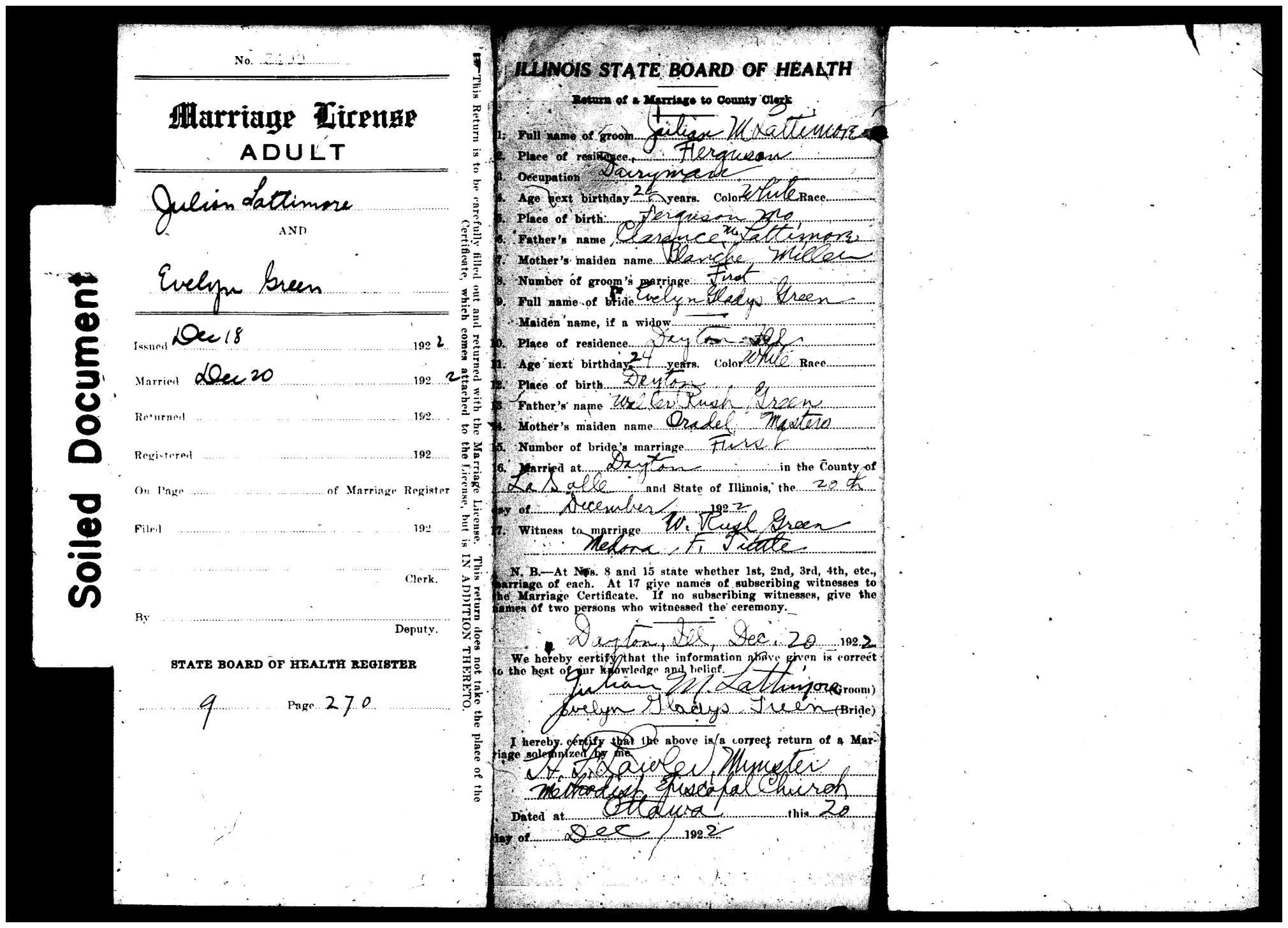
            A large number of Ottawans went to Dayton today to attend the wedding of Miss Evelyn Gladys Green, only daughter of Mr. and Mrs. Rush Green, and Julian M. Lattimore of Ferguson, Mo., which occurred at 1:30 o’clock this afternoon at the Green residence near Dayton. Eighty guests were in attendance. The Christmas idea was carried out in the decorations, Christmas greens and red being used in very effective manner.

The wedding service was read in the living room by Rev. H. P. Lawler, pastor of the First Methodist church.

Miss Mildred Masters of Dayton acted as the maid of honor, and W. R. Cornell of Cottonplant, Miss., served as Mr. Lattimore’s best man.

The bride wore a gown of white crepe de chine, made over white satin and a long tulle veil, which was held in place with orange blossoms. She carried a formal bridal bouquet of white sweet peas.

Miss Masters also wore a frock of white crepe de chine and carried white sweet peas.

At the close of the wedding service a two-course wedding dinner was served in the dining room. In keeping with the Christmas season, red and green decorations were used on the tables.

Mr. Lattimore and his bride left this afternoon for a honeymoon trip, the destination of which they are keeping a secret from their friends.

They will make their future home in Jackson, Miss.

The bride has a large circle of friends both here and in Dayton. She attended the Ottawa High school and was graduated from there in the class of 1919.

The groom is the son of Mr. and Mrs. C. M. Lattimore of Ferguson, Mo. He was raised in that city and is a graduate of the University of Missouri. Since finishing school he has been making his home in Jackson, Miss., where he is engaged as a dairy herdsman.

Among the guests from a distance also attending the wedding were Mr. and Mrs. A. E. Green of Peoria and Mr. and Mrs. W. A. Holmes of Chicago.1


  1. The Ottawa Free Trader, December 20, 1922, p. 4, col. 1

A Family Reunion at Christmas

Mr. and Mrs. Green came to Dayton from Licking county, Ohio, in 1829. Mrs. Green died in 1886 at the advanced age of 93 years, having been preceed[ed] by her husband some six years. Up to the last Grandma Green could delight the young members of her family with her accounts of the Black Hawk war and many thrilling incidents and personal experiences in her life as an early settler.

Yearly family reunions have been the custom for some time and have been continue[d] since the death of the old people. Many of their descendants have scattered, but Christmas cheer and the good things of the earth are bountifully dispensed at these family reunions. Those present at the reunion on Wednesday were Mrs. O. W. Trumbo and daughter and Messrs. Jesse and Isaac Green, sons of the deceased, with their children, grandchildren and a few other relatives, exceeding fifty in number. Three other daughters – Mrs. Albert Dunavan, Mrs. Wm. Dunavan, and Mrs. Geo. Dunavan – are living in the far West.

from The Ottawa Free Trader, January 3, 1891, p. 3, col. 4.

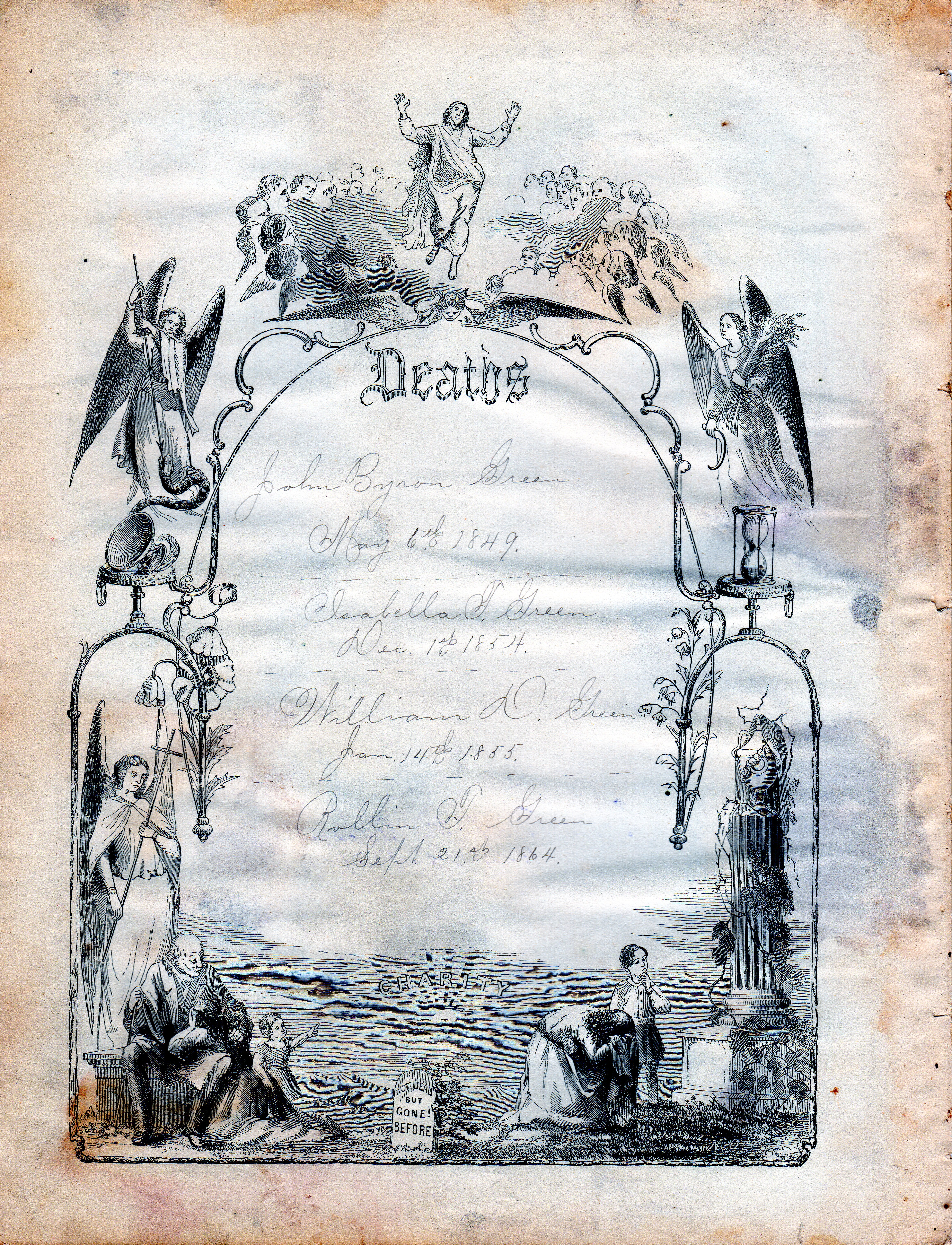
Pages from the Jesse Green Bible – Births

His family with his first wife, Isabella Trumbo

Jesse Green
Dec. 21st 1817

Isabella T. Green
Dec 7th 1822


John Byron Green               July 23rd 1844
Rollin Trumbo Green          Jan 31st 1847
Clara Isabella Green           Dec 21st 1849
Newton Mathias Green      May 6th 1852
William Douglas Green       Nov 14th, 1854


His family with his second wife, Hannah Rhoads Green

Hannah R Green
November 26th 1831


Thomas Henry              Jan 9th 1857
Joseph                           Nov. 29th, 1858
James Arthur                 Oct. 20th 1860
Cora                                Sept 21st 1862
Sarah                              July 1st 1864
Frank                             Nov 17th 1866
Jesse Alvin                     Oct 18th, 1868
Kent                                June 9th 1870
Infant Son                      March 2nd 1872
Mabel                             Sept. 23rd 1873

Today is the 231st anniversary of Barbara Grove Green’s birth


Barbara Grove Green

Died May 5th, 1886, at the age of ninety three years, five and a half months. She had been confined to bed for about two months, and gradually and gladly passed away like an infant going to sleep. It was her desire to cast off this earthly tabernacle and be present with her Lord.

She retained her faculties to the last, with the exception of her sight, of which she had been deprived for the past seven or eight years. She was never heard to murmur or complain of her misfortune, but on the contrary seemed cheerful and happy.

She was born in Shenandoah county, Virginia, November 15th, 1792. At the age of thirteen she, with her parents, removed to Licking county, Ohio, being in the year 1805, and lived there until the fall of 1829, when she and her companion, John Green and family, removed to this county. A few incidents of their journey will show the hardships and privations of those early pioneer days. We quote her own words from statements made by her to one of her grand daughters, who has recorded them:

“We started from Licking county, Ohio, on the first of November, 1829, for the state of Illinois. There were 24 in the company. Father had gone to Illinois the September before we started and bought land. He and three other men rode on horseback around by Cleveland and along the lakes. When they reached Chicago, where there were only two families besides the garrison, father bought some provisions and in paying for them pulled out quite a roll of bills. That night his brother, Wm. Green, dreamed there were robbers coming and woke the others up, but they refused to start out in the night just for a dream, and he went to sleep again only to dream the same thing again, and when he had dreamed it three times he told them they could stay there if they wanted to, he was going to leave; so they all started and soon after they saw three men following for the purpose of stealing they [sic] money.

“When we reached the ‘Wilderness,’ in Indiana, a man who lived on the edge of the woods told us it was impossible to go on, as the mud was so deep, unless we could travel on the wagons already stuck in the mud; but if we were foolish enough to try it, we must leave ‘those two smart little boys’ (Jesse and David), for we would surely freeze to death. But we did go on and the men cut a new road through the woods for sixty miles, about ten miles a day.

“Then, when we got to Cicero river, we had to take the wagons over with bed cords. One wagon, loaded with mill irons and blacksmith tools, was so heavy it tipped over, and we lost a good many things.

“Then the next place we came to was Sugar creek, and it was so high we had to pull the wagons over with ropes again and cut trees for us to walk on. Then there was a swamp next to the creek that the men had to carry the women over on their backs. Between Iroquois and Nettle creek there were five days the horses had nothing to eat, as the prairie was burnt, and they became so weak they got stuck in a ravine and could hardly pull the empty carriage out.

“One evening we had only bread and tea for supper, but that night father came back with corn and beef that he had obtained at Holderman’s Grove, and we were the happiest people you ever saw. We spent the next night at the Grove and the next day home, at what is known as William Dunavan’s farm.”

She lived in the town of Rutland something over a year when she removed to Dayton, being at this place at the time of the Black Hawk war in 1832. Of this war she says: “On the 16th of May, 1832, the girls and I were at the spring, near where the feeder bridge now stands, when Eliza came down on horseback and told us that the Indians were coming, and we would have to go to Ottawa immediately. Then we went to a place a couple of miles below Ottawa and stayed there all night, and the third day returned home again. This was Sunday, and the next day the men made a stockade around the house out of plank. After it was finished they tried it to see if a bullet would go through it, and as it did, they hung feather beds all around. There were about sixty people here at the time, and we were so crowded that they had to sleep on tables, under the beds and all over the house.”

Mr. Green had intended to remain in his improvised fort during the war, but at about twelve o’clock at night, hearing of the massacre on Indian creek, and fearing there might be too many Indians, all those in the fort went to Ottawa. “When we got to Ottawa, there was no fort there, only a log cabin on the south side of the river, but they soon built a fort on top of the hill. We went to the fort, but there was so much confusion there that we had the log house moved up on the hill and lived in it. The next day a company of soldiers from the southern part of the state passed through Ottawa on the way up the river.”

Grandma Green bore all the hardships and privations incident to the settlement of two new countries and lived to see the development of this vast prairie country far, very far beyond her anticipations. When she came here she supposed that in time she might see the country settled around the skirts of timber, but never in her early days did she anticipate seeing the prairies settled up.

Occasional


  1. The Ottawa (Illinois) Free Trader, May 22, 1886, p. 5, col. 2

A Tragic Shopping Trip

Violetta Henderson

On 16 Nov 1883, Lettie Henderson and her mother set off on a shopping expedition to buy her wedding outfit. They took the Fox River branch of the C B & Q railroad from their home in Wedron, intending to shop in Streator. When the train reached Otter Creek, about 3 miles north of Streator, a coal train stood on the tracks and a danger signal had been posted to warn the passenger train, which came to a standstill. The following freight train, however, was not properly signalled and crashed into the rear car of the passenger train. Lettie and her mother were killed outright, along with two others, and two more men died by nightfall. Seven others were injured.

The Streator Free Press, 24 Nov 1883, p. 1

This clipping mentions Lettie’s engagement to John Green of Dayton. At this time in 1883 there were two John Greens living in Dayton. John, son of Jesse and Hannah Green was only 13 years old, so John, son of David and Mary Green is the more likely candidate. At that time he was 28 years old and unmarried. There is no family record indicating that he was once engaged to Lettie, and the newspaper could, of course, be in error, but he would have known her. Her name appears in the descriptions of the social life of Dayton at the time.

The Ottawa Free Trader, 24 Nov 1883, p. 4

Following the accident, the two were buried in the same grave in the West Serena Cemetery.

The Streator Free Press, 26 Apr 1884, p.1.

After the accident, the railroad company was held liable for the accident and paid monetary settlements to the relatives of the deceased. Mr. Henderson collected $6,000 dollars, $4,000 for his wife and $2,000 for his daughter.

Violetta G. “Lettie” Henderson was the daughter of Alexander S. Henderson and his wife, Atha D. Curyea. Alexander was born in North Carolina about 1835. He came to Illinois in the 1850s, and in 1860 was married to Atha Curyea, a sister of C. J. Curyea of Ottawa.. Their daughter, Violetta, was born November 5th, 1860, in Dayton township.

Schoolteachers Cora and Winnie Childs

Cora and Winnie Childs

In 1882 a two-story frame house with a belfry was built at the top of the hill in Dayton. It served as the schoolhouse until it burned in 1890. The first teachers in that building were Cora and Winnie Childs, the daughters of Franklin P. Childs and Margaret Price.

They were born in Marshall county, Illinois; Cora in 1860 and Winnie in 1863. In 1864, their parents moved to Ottawa to take advantage of the better educational opportunities for their daughters. Cora graduated from Ottawa Township High School in 1879 and Winnie in 1881.

Cora completed the two year program at Wesleyan Female College in Cincinnati in one year, graduating in June 1880. She taught at several other La Salle County schools and after Winnie graduated in 1881 they came to Dayton together in 1882.

They taught there for two years, until their father moved the family to a farm near Morris, in Grundy county. Cora applied for and was granted a position teaching in the Morris junior high school.

The two years spent in Dayton made many opportunities to get to know the Dayton people, and Cora and Winnie kept up friendships with many of the Green family and others into later life. One of these friendships ended in the marriage of Cora Childs and Harry Green on February 22, 1888. They lived in Morris, where Harry had a bakery and restaurant. After that building burned, they returned to Ottawa where he went to work for the Standard Brick Company, where his brother-in-law, C. B. Hess, was a partner.

In 1892 they moved to Chicago where Harry established himself as an electrical engineer. Cora was very active in various patriotic organizations. She held a number of offices with the DAR, including many years as regent. She was the first regent of the Chicago chapter of the DAC, the Daughters of the American Colonists; was a member of the Daughters of 1812 and many other similar organizations. Cora died February 1, 1951 and is buried in Ottawa, Illinois.

Winnie never married and spent most of her life on the farm near Morris or in the Chicago area. She worked at various times as a stenographer, a reporter and a music teacher. She became an invalid following a fall in1940 and in 1950 was in a private nursing home in Morris. In 1958 she was in Chicago with her niece, Mabel Greene Myers, where she died February 11, 1958.