A Trip to The Court House

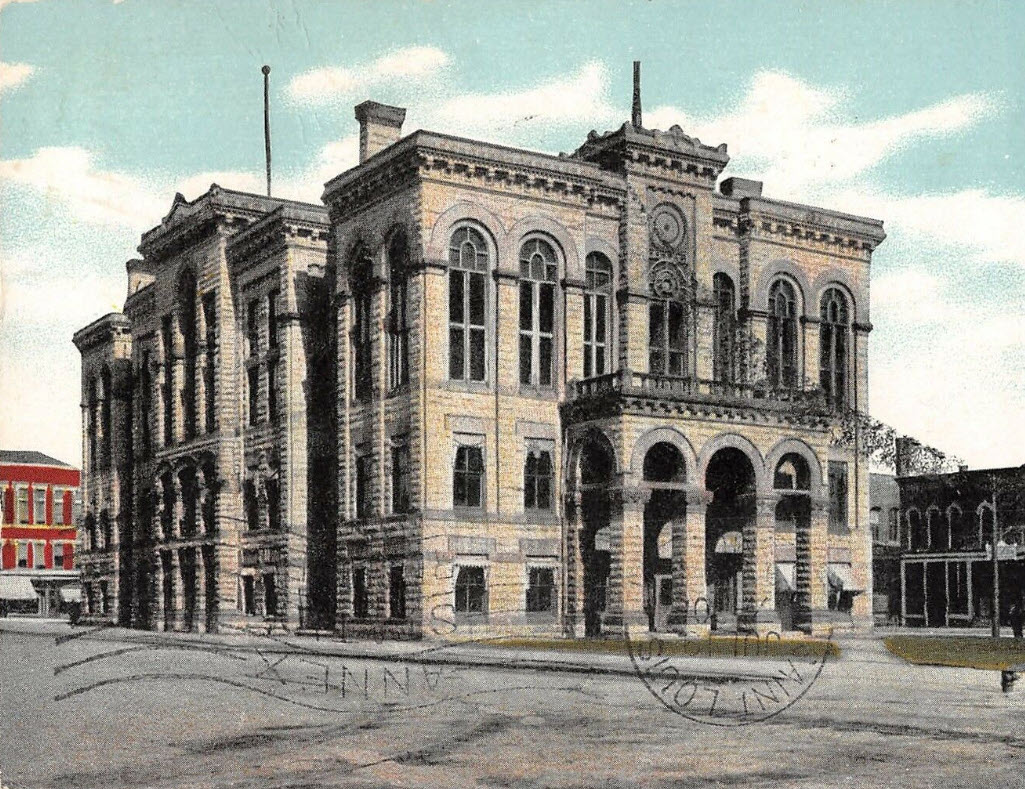
Ottawa Courthouse

Ottawa Courthouse

The following column is reprinted from volume 3 of the 1953-54 publication, The Dayton News Reel, produced by the students of the Dayton School.

The seventh and eighth grades are studying county, city and state government in civics, and in connection with that visited the Court House in Ottawa on January 14.

They visited the Sheriff’s office, the office of County Recorder and there saw the photostat machine at work and the addressograph machine being worked.

We learned of the work of the County Recorder and how the records of the county real estate, deeds, mortgages, etc are kept.

We were given a photostat copy of a chattel mortgage and watched a plate made for the addressograph machine and were given a copy of the work done by this machine.

We went to the County Clerk’s Office and learned how the records of births,  marriages and deaths are kept, and were given a demonstration of how a delayed birth certificate may be secured from these records.  Connie Krug’s record was looked up and we saw the information available when needed.

We also saw the jury box and the names in it which may be drawn for jury duty as needed. The County Clerk has the only key to this box.

We saw the files where the permanent registrations are kept for voting privileges, the books which are sent to the precincts on voting days, and the files for those who have not voted for four years and where the registrations of deceased persons are kept.

We saw where the Board of County Supervisors hold their meetings, where the Board of Review meets.

We witnessed a class of twenty-seven persons from LaSalle County, Grundy County and Bureau County receive the oath of allegiance to the United States. They had fulfilled all the legal requirements for naturalization previous to this final step. Following the oath of allegiance short speeches were made by representatives of the following organizations:
The American Legion
Veterans of Foreign Wars
Daughters of the American Revolution
War Mothers
Relief Corps
La Salle County Bar Association
Dept of Naturalization and Immigration
Judge Zearing of the District Court

Following the oath of allegiance the pledge to the flag was repeated, the new citizens were given their naturalization papers, other patriotic material including flags, and were taken to the office of County Clerk where they registered as voters for their respective counties.

Dayton Post Office Will Close on April 1, 1954

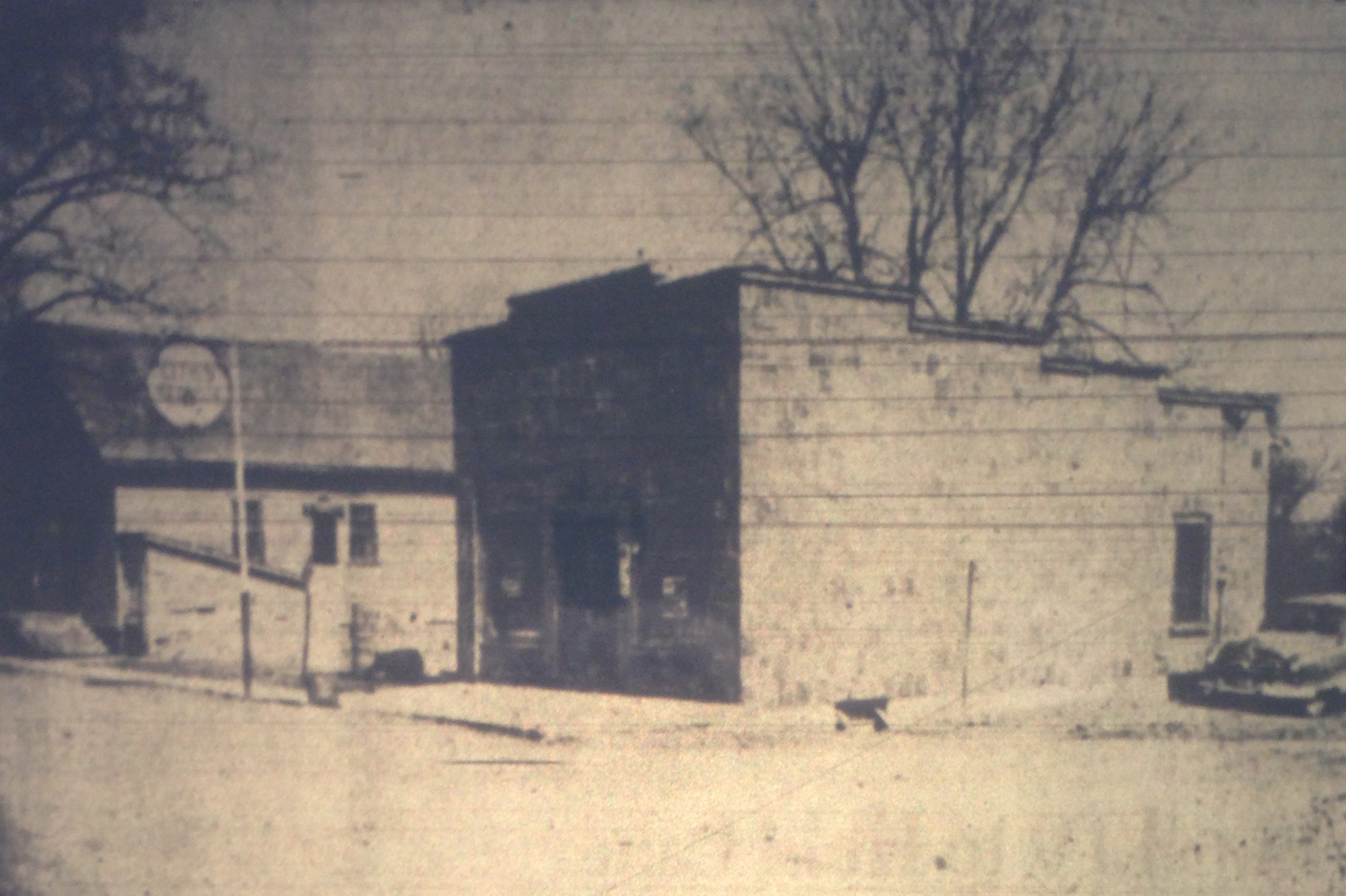
DAYTON’S Post Office, located in the grocery store, top photo, will be abandoned by the federal government April 1. The post office, serving La Salle County’s earliest settled community, is over 90 years old. Lower photo, Dominic DeBernardi, present postmaster, points to the closing notice. Note the old type boxes. (Daily Republican-Times photos.)

Old Dayton Post Office Ends Existence April 1
County’s First Settled Village Victim of U. S. Economy Drive

            As part of an economy move by the U. S. Postal Department, Dayton, oldest settled village in La Salle County, is about to lose its post office, which was set up at least 90 years ago.

            The office is located in a grocery store now run by Dominic DeBernardi who also is postmaster.

            The office will be closed April 1 and its 69 patrons will be served from the Ottawa Post Office by rural free delivery. Victor Boissenin of Ottawa will be carrier.

            The new patrons will add 1.9 miles to his daily route, according to the Ottawa Post Office. Boissenen, however, will be paid for only one extra mile in accordance with the complex figuring under postal rules and regulations.

            The Dayton Post Office patrons are all village residents. They now will have to install rural mail boxes near their homes to receive mail.

By April 15

            Postmaster Frank J. Mulholland of Ottawa said Dayton People will have until April 15 to erect such boxes, which must be of a certain height from the ground and maintained by the patron in accordance with postal regulations.

            Mulholland also said Dayton people will have to register their address at the Ottawa Post Office by April 1. The names of residents, names of their children and others who receive mail at the residence must be on the registration list.

            The Ottawa postmaster Tuesday met with about 30 Dayton residents to explain the new mail system for the village located four miles northwest [sic] of Ottawa.

            The carrier, Boissenin, will enter the village from the east via State Highway 71 and the Dayton rural road, circle the town, and leave on the road west of the village leading to Ottawa.

            The post office at Dayton has a fourth-class rating and pays between $1,200 to $1,500 per year to the federal government.

Four Deliveries

            There was a time when the Dayton Post Office received mail four times a day via the Burlington Railroad. The service was cut to two deliveries per day several years ago and on Feb. 2, 1952, the last passenger train with mail aboard passed north through the town.

            Since then mail has come into and gone out of the village twice a day via truck serving the Aurora and Streator area. The truck service will be discontinued when the rural free delivery service goes into effect.

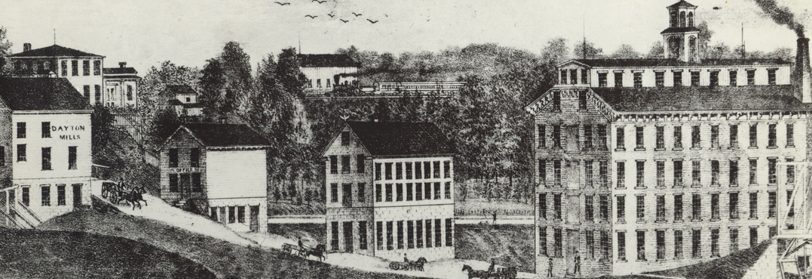
            Dayton was settled in 1829 by a party of Ohio immigrants who saw riches in the water power of the Fox River. Mills were established to grind corn and wheat.

Water Power

            Later, water power ran other mills in the hamlet, making it a prosperous place before and after the Civil War. The postmaster was an important figure then but his political head was sheared off with a change of national administration.

            The postmaster in Civil War days was an Englishman, G. W. Makinson, born in England, July 15, 1826, and who came to La Salle County in 1844. An old county history says of him, “He is an Independent (voter), Universalist; own house and two lots in Dayton, valued at $1,500; wife was Charlotte Evans, born Feb. 28, 1828; were married in Ottawa Sept. 22, 1847; have seven children, Anna, Josephine, Jesse, Lewis, Edgar and Lottie; he was appointed postmaster during the administration of James Buchanan; after two years he resigned; was reappointed and has held the office ever since.”

            Makinson must have been the exception to the rule that village postmasters were subject to dismissal when political administrations shifted at Washington. Buchanan was a Democrat, but the history was published in 1877 and the Republicans had held sway for 16 years.

from The (Ottawa, Illinois) Daily Republican-Times, March 19, 1954, p. 1, cols. 2-4

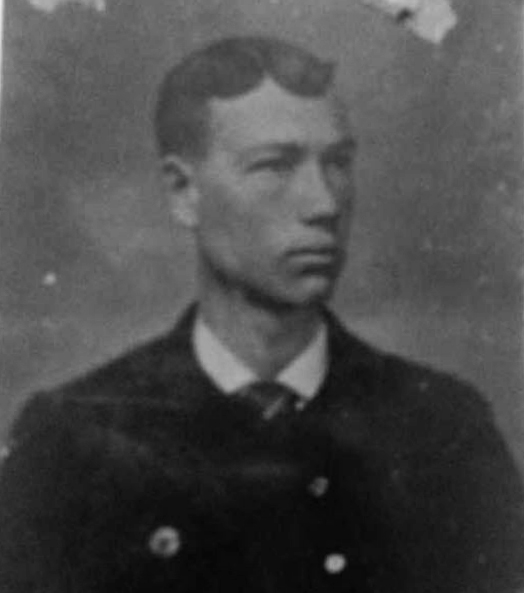
Joseph E. Skinner

Joseph Ellsworth Skinner

In the 1840 census, Dayton is not identified by name, but is not hard to locate. At the bottom of the last page of the La Salle County section, John Green’s name appears third from the end. The names surrounding his are mostly familiar names that appear frequently in the village’s history. But the name immediately above John Green’s is Joseph E. Skinner, who does not appear in the later history of the village. A newspaper search found this:

The [Streator, Illinois] Times, 19 Jan 1894, p2

This explains why he appears next to John Green in the 1840 census, but where did he go later? Upon investigation, it appears he spent only that one year of 1840 working in Greens Mill.

Here is another case of someone with a Dayton connection who went on to greater things in the larger world. The short notice above hinted at later adventures which were written up in one of the county histories. That information has been added to the biography page, which you can read here.

Churns

This scrap of paper, with its drawings of early family churns, was found among the papers of Maud Green. She pictured the churn that was used by her grandmother (Barbara Grove Green) on the left. In the center she drew a Blanchard churn (see below) with the story of 5 year old Ralph pulling out the plug. The barrel churn on the right was another means used to convert cream to butter.

Here’s a bit more information on the various types of churn.

Plunge or dasher churn (left, above)

The plunge churn is a container, usually made out of wood, where the butter-making action is created by moving in a vertical motion a staff that is inserted into the top. This type of churn is also known as an ‘up and down’ churn.  The staff used in the churn is known as the dash, dasher-staff, churn dash, or plunger.

The staff might be perforated, or it could have a wooden circle, or crossed boards attached, but even with those to help beat the cream, this method took a long time. The chant “come butter come, come butter come” was thought of as a charm to turn the cream to butter. It was sometimes made into a song that went with the rhythm of the work.

Many cultures had their own churning songs. Some had other charms and superstitions too. Both in Europe and North America metal objects – like needles, knives or horseshoes – were used to drive away evil influences which might prevent cream from turning to butter.

paddle churn

Paddle churn

Paddle churn

Another prominent type of churn was the paddle churn, which was a container that contained a paddle, which was operated by a handle. The paddle churned the butter inside the container when the handle was turned. A wooden box, earthenware crock, or glass jar had a paddle inside attached to a rod, which was turned by a handle on the top or side. These were widely sold as small, convenient household churns in 19th century America.

Barrel shaped oak container

Barrel churn

Barrel churn (right, at top)

The barrel churn was also used extensively. This type of churn was a barrel turned onto its side with a crank attached. The handle would operate a crank turning paddles inside the barrel, as in the paddle churn, or the whole barrel might be turned by the handle, either horizontally or vertically, depending on its construction. 

In the early days of the 20th century, the barrel churn was recognized as the most convenient and efficient kind of churn in use.

The Blanchard Churn (center, at top)

A variant of the barrel churn is the box churn, of which the Blanchard Churn is an example. The handle operated a crank turning paddles inside the box. One of the earliest U.S. manufacturers was the Blanchard Churn Company based in Nashua, New Hampshire. The company name on their product was so well known that Maud had no problem reproducing it in her sketch.

I can still remember one additional way I watched my great-aunt Maud churn. She would put the cream in a large glass jar with a lid and sit sloshing it back and forth between her hands until the butter formed. It was a slow process and made a small amount of butter, but she did it to amuse us, I suppose, not because she needed to.

A Card and Dancing Party at the Dayton Club House

Dayton
by Mrs. Grace MacGrogan

DAYTON WOMAN’S CLUB HOSTESS AT PUBLIC PARTY

Members of the Dayton Woman’s club were hostesses Friday evening at a card and dancing party in the Dayton club house. The early part of the evening was spent playing games of bridge, five hundred, and euchre. Favors were awarded, Mrs. Earl Gardner and John Jackson in bridge; to Mrs. Ada Hallowell and Sam Buckingham in five hundred, and to Gladys Lattimore and Glen Nelson in euchre. A four piece orchestra furnished music for dancing at the conclusion of the card games. The committee in charge of the arrangements was comprised of Mrs. Earl Gardner, Mrs. Harold Schilling, and Mrs. Benson Chamberlain.1

Dayton store

On the left, behind the store, is the Dayton clubhouse


  1. Ottawa Republican-Times, March 16, 1934, p. 2, col. 4

March 8, 1884 – News From Dayton

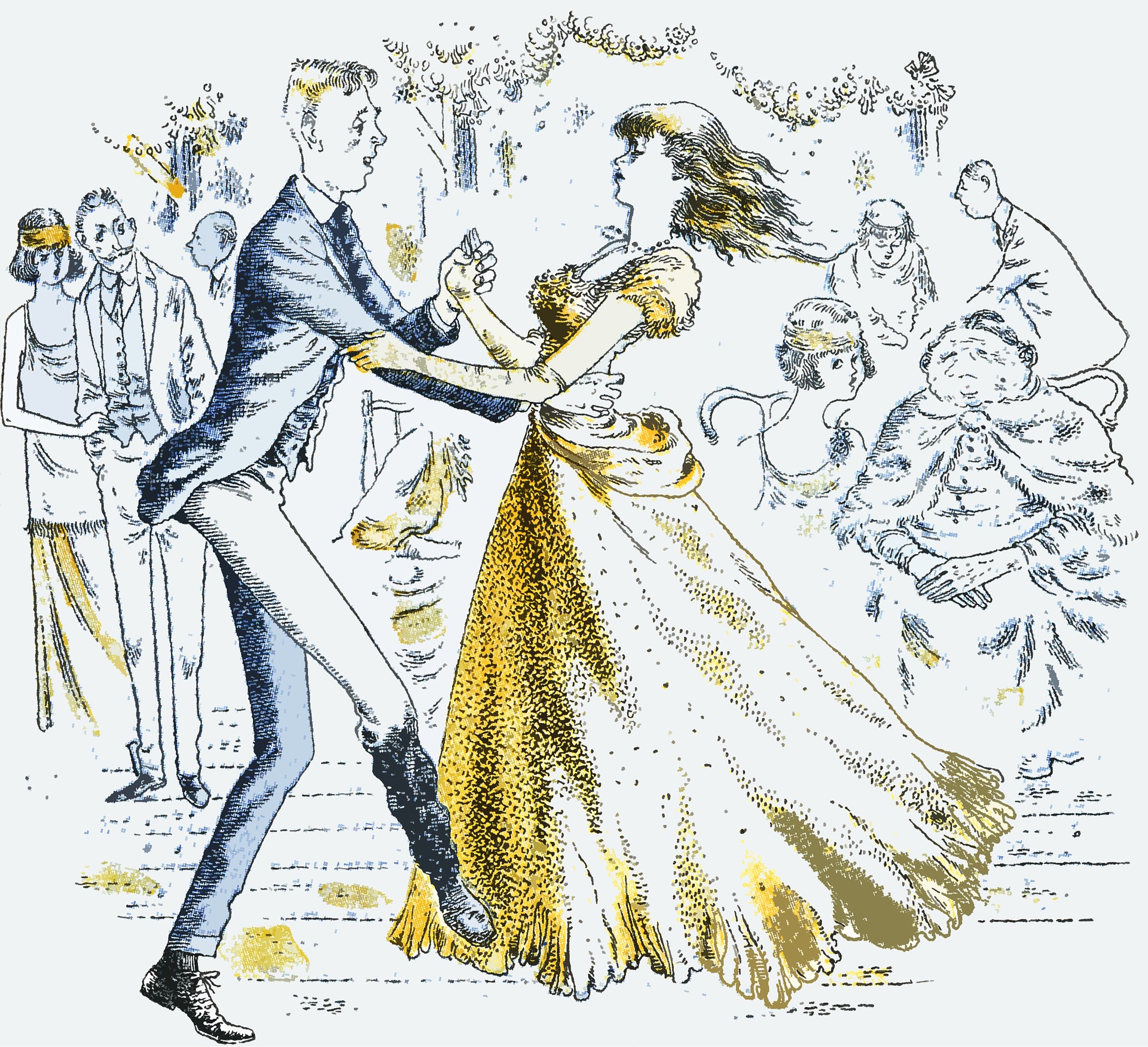
dance party

From Dayton

Dayton, March 4, ’84. – The young folks sent out about twenty-five invitations last week for a social party at the residence of H. B. Williams, Esq., in East Ottawa of Friday evening, Feb. 29. Messrs. John Hall, Chas. Green and Wm. Dunavan were the invitation committee, and Messrs. C. B. Hess and S. W. Dunavan were floor managers. About twenty couples were present and all had a very enjoyable time. Two large parlors had been prepared for dancing, the floors nicely waxed, and everything was in good trim. The music by Prof. Cliff G. Sweet and wife of Aurora, consisting of violin and harp, was excellent and was greatly enjoyed by all present. For good first class music, new changes and delicious waltzes, they cannot be excelled and we can heartily recommend them to parties desiring such music. At a late hour the guests retired thanking Mr. and Mrs. W. for their kind hospitality and for the pleasant time they had had. The following guests were present: Prof. and Mrs. C. W. Tufts; Mr. and Mrs. T. E. MacKinlay; Mr. and Mrs. C. B. Hess; Misses Stout, Misses Angevine, Misses Dunavan, Misses Watts, Craig, Barnes, Marriner, Misses Childs, Misses Loy and others. Messrs. Angevine, Trumbo, Hall, Mitchell, Butters, Dunaway, Flick, Clauson, Messrs. Green, Messrs. Dunavan and others.

            The paper mill after being shut down for three months, will start up this week.

            The tile works have opened a coal mine across the feeder from their works and will mine their own coal this season. The coal and fire clay will be run across and delivered at the works in cars.

            Two pet bears passed through town last Saturday and greatly amused the boys with their tricks.1


  1. The (Ottawa, Illinois) Free Trader, March 8, 1884, p. 8, col. 1

My Dayton Childhood

My great-aunt Maud was a large part of my childhood. She lived nearby and I spent a lot of my early years following her around.

One Sunday afternoon in July 1947 she thought of several ways to amuse an eight-year old. As she wrote down for me later:

Today Candace and I measured the old elm tree in the back yard planted by my father in 1853. It was thirty feet around at the base. Then we counted my cousins on both Green & Trumbo sides. There were 62 Greens and 31 Trumbos (first cousins) and they had 198 children who would be second cousins to Candace’s mother.

As you can see, she was interested in family connections and I can remember drawing family trees on the back of old rolls of wallpaper at her direction.

She knew how to fold paper into miraculous shapes and forms. We made cornstalks out of newspaper and boats out of typing paper. There was one paper folded boat that went through many forms along the way – a pocket book, a picture frame, a double boat and finally a motorboat. We made nose pinchers, cornucopias for May Day, and lots of other things.

She showed us how to make hollyhock weddings, with a white flower turned upside down, with a bud as a head, for the bride and colorful bridesmaids to accompany her. See an example here.

Sunday dinner began with my father killing a chicken and delivering it to aunt Maud. She would pluck it and clean it, carefully pointing out the gallbladder attached to the liver and warning that breaking it would release bile which would ruin the meal. After the feet were cut off, we had the fun of pulling the tendons to make the toes flex.

She was the unofficial historian of Dayton and knew all the families for miles around. And of course (see above) she was related to almost all of them. I was fortunate to inherit all her family information and her photographs of early Dayton, most of which appear around this web site. I owe a great deal of thanks to this much-loved aunt.

Charles Hayward – Dayton Landowner

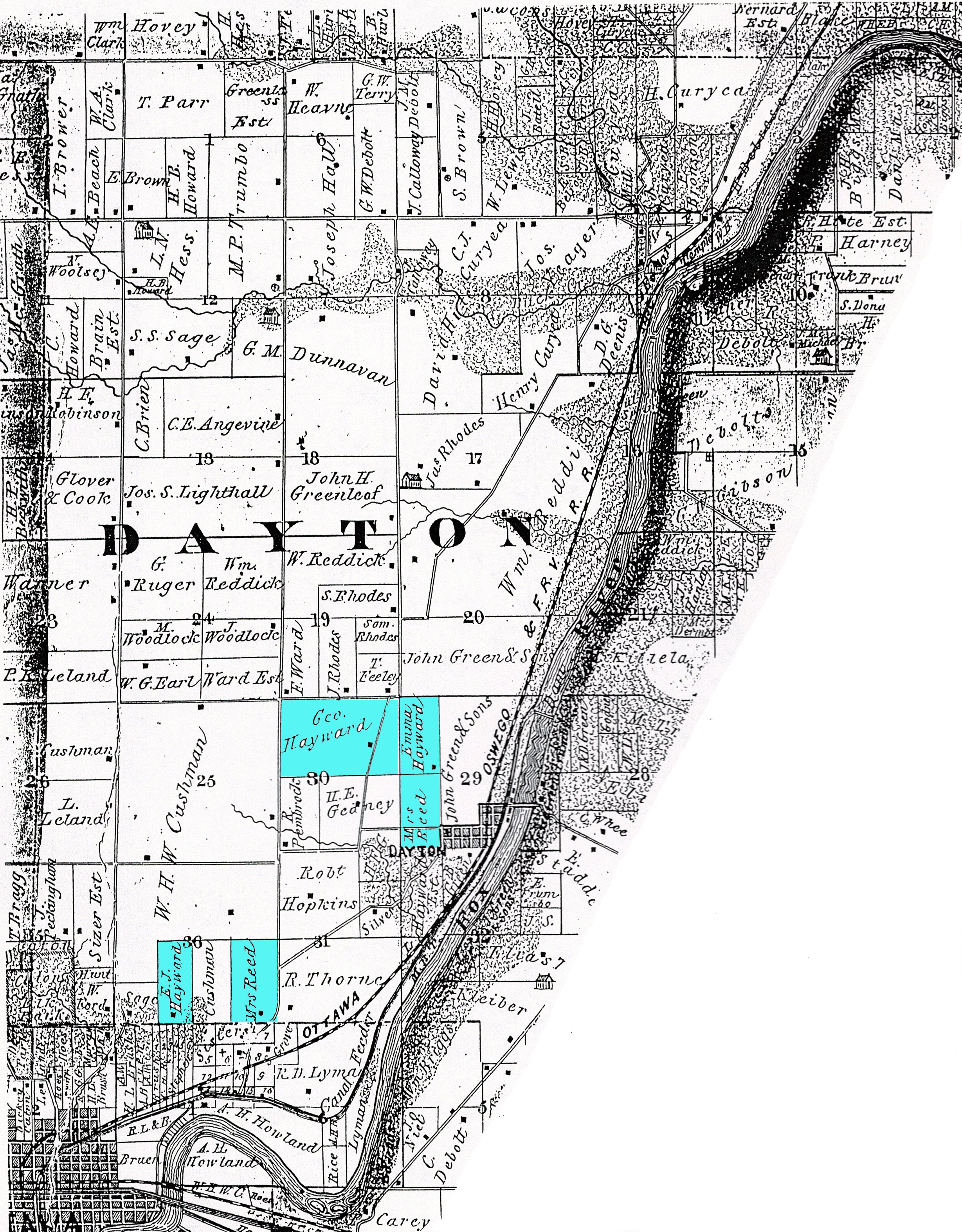
Charles Hayward was born April 8, 1808 and grew up in Lebanon, Connecticut. He moved to Cleveland, Ohio, in 1818, and in 1835 or 36 he moved to La Salle County, one of its oldest settlers. He bought farmland, some of which was in Dayton township (highlighted above). In addition to farmland he also owned lots in Ottawa, Peru, Marseilles, and La Salle.

He served as School Commissioner of the county. He also built the Fox River House in Ottawa, which he kept for a few years being also interested in merchandising. His business affairs met with well deserved success. In 1847, Charles sold his business interests in Ottawa and moved to the Dayton farm. He had carried on farming the whole time they lived in Ottawa. By the time of his death, July 20, 1849, he was a wealthy landowner, his land being valued at more than $17,000.

His wife was Miss Julia Ann Mason, who was born in Cortland County, New York, on July 22, 1819, the daughter of Oliver and Sarah (Thayer) Mason. Charles and Julia were married in Ottawa on October 8, 1838. They had three children:

Estelle J, born December 11, 1839 on the farm in Dayton township, died October 1,1918 in Ottawa. She never married. When she died her estate was valued at $113,000, with $94,000 in real estate.

George, born April 18, 1843, died March 1, 1906 in Ottawa. He married Nettie Strickland on June 17, 1875. They had 3 children: Edith, married George Gleim; Mabel; De Alton

Emma/Emily Julia, born Nov. 5, 1846, died August 4,1920, married David Lafayette Grove [d 1897] on October 21, 1880. They had two children: Louise; Chester

After Charles’ death, Julia married Henry J. Reed on December 18, 1851. They had one son, Charles.

The interesting thing about all this for me is that some of Charles Hayward’s land, the land later owned by Emma Grove, is right next to our family farm, the original John Green property, which my sister and I still own. Also, David Grove is my 1st cousin 3 times removed.

Which just goes to prove my contention that everyone connected with early Dayton is related to everyone else.

Sorghum Making in Dayton

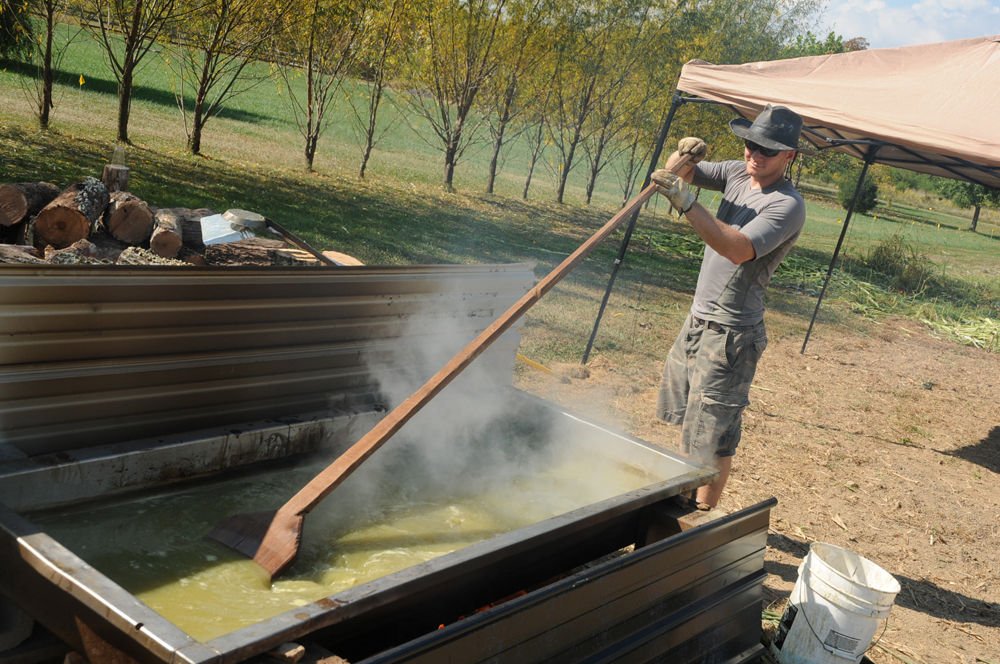
sorghum making

REVIVE MAKING OF SORGHUM IN LA SALLE CO.

Back in the days when pa and ma were young and grandpa and grandma ran the farm, making sorghum was an annual fall task, and nearly everybody who lived on the farm had sorghum for their winter pancakes.

George Gleim, Ottawa attorney, was one of those who came to manhood in the days when sorghum making was a regular part of farm work.

A few years ago Gleim made a trip to southern Illinois, commonly known as Egypt. There he found that sorghum making was not a lost art, as it had nearly become in this part of Illinois.

That gave him the idea that sorghum making might be revived in La Salle county. Last spring, Gleim induced seven farmers, in Dayton township to plant an acre of cane on their farms. Some of them were from southern Illinois and they readily agreed to raise the cane.

Last week these seven men cut their cane, preparatory to the making of sorghum. Then Gleim produced an old fashioned sorghum mill, operated by a tread mill, with a horse as motive power. He also brought a big pan, fifteen feet long and four feet wide, which he had obtained in “Egypt.”

Four men from the same district who knew how to cook sorghum were also imported into the county. A shed was erected in a woodlot on the farm of Mrs. George Gleim, in Dayton township.

After experimenting with their outfit and getting it in working order, the production of sorghum, at the rate of 70 gallons a day was started last week.

The mill will be in operation for the next ten days, keeping a crew of men busy from early morning till late at night.

William Rexroat is chief cooker. Two men skim off the scum which forms on the top of the sorghum as it is cooked in the huge vat, after being crushed in the old fashioned mill.

James Dixon, Vincent Smith, Arthur Crosiar are among the men who raised the cane, and they are helping to crush and cook it.

The sorghum is being sold at the mill, either in containers on hand there, or in containers which the buyers bring with them.1


  1. The Times (Streator, Illinois), 16 Sep 1931, p. 6

A 1917 Valentine’s Party

DAYTON CLUB AT SCHMIDT HOME

Valentine Party Held at Residence of Prominent Couple – Many Novel Features Introduced.

            Mr. and Mrs. Henry Schmidt gave a valentine party Wednesday evening to the Dayton Homemakers’ Circle and their families, numbering about sixty. Their home was like a fairy bower, each room being most artistically festooned in green and white, with red hearts hanging daintily about. Each guest was presented with a festal cap, the gentlemen wearing the high-pointed tasseled ones, and the ladies turbans of many hues. They were very picturesque and added great merriment to the entire evening. All these decorations were the work of the skillful hands of Mrs. Schmidt.

            Miss Marie Schmidt played a very pretty piano solo, after which the time was devoted to merry making.

            All were requested to write a sentence, each word beginning with the successive letters in the word heart. The ladies prize was won by Miss Lillian Arentsen and the gentleman’s by Mr. Louis Belrose. Broken hearts which were mended, formed the words of some familiar songs and the holders of the fragments were required to sing the songs together. This brought to notice many voices that had never been before the footlights, conspicuously among them the rich tenor of Frank Beach as it rose and fell with feeling in “The Old Camp Ground.”

            The men’s contest in heart dice was won by Paul Schmidt, who made the entire word with one toss. His unusual skill is attributed to the military training of the Ottawa high school.

            The grab-bag created a search for the bleeding heart, which was found by Miss Olmstead, and her reward was a box of candy.

            To test the memory of the married man, the left hand of his one-time bride was held beneath a white curtain, where he might recognize the wedding ring. Only one man was equal to the task and he was quite newly wed.

            In the dining room hung the great cushioned heart covered with valentine hearts and each lady was taken before this blindfolded and given an arrow with which to pierce a heart. This bore the name of a man who came bravely forward, read the beautiful sentiment inscribed therein and claimed the lady for his Valentine, to share with him the feast which followed. Here nothing was omitted, from chicken salad to ice cream hearts. And amidst it all one heard the voice of Henry Schnidt as he softly whispered the motto on his candy heart.

            The cheer of the occasion made the old grow young, and even Charles Olmstead was heard to express the pleasure he had received from the companionship of youth.

            The Dayton Homemakers thank Mr. and Mrs. Schmidt for the royal manner in which they were entertained and the evening of February 14, 1917, will be one of the memories which never fade.

An Effective Toothache Cure

Zada Dunavan Lyons was the granddaughter of Joseph Albert and Nancy (Green) Dunavan. In 1931 her cousin David Dunavan called on her and took notes on their conversation. He sent his handwritten notes to Mabel Greene Myers, who was collecting Green family information. When I inherited Mabel’s files from her daughter, Helen, I found the notes, which included the following story –

While grandfather J. A. D. was gone to Calif. in the gold rush the folks at home did not hear from [him] and thought he had been killed. They had heard his party had started home through Mexico and that they had been killed there.

The night he got home grandma (Nancy) had a headache as a result of a toothache cure she had applied. She had run a hot darning or knitting needle into the cavity of her tooth to stop the pain. When he got home she entirely forgot the tooth and headache and they sat up about all night talking and visiting.


Early Adventurers

historical marker

John Green was following in his father’s footsteps when he brought a group of 24 settlers from Licking County, Ohio to be the first residents of Dayton and Rutland townships. John’s father, Benjamin, and his family were the first settlers in Licking County. Benjamin and his wife, Catharine, are both buried in the Beard-Green Cemetery in the Dawes Arboretum at Newark, Ohio, along with many other family members. Benjamin Green is one of the six Revolutionary War veterans mentioned on the marker.

tombstone of Benjamin Green

tombstone of Benjamin Green

tombstone of Catharine Green

The Little Red Hen

In June 1957 the graduation ceremonies at the Dayton school included a number of songs and plays.
Grades 6, 7, and 8 presented the operetta “All About Spring”.
The 5th grade girls gave a reading, “O Wide Wide World”.
Grade 3 sang the English hiking song, “Heave Ho”.
Grades 1 and 2 sang “The Robin in My Cherry Tree”.
The boys of grades 3, 4, and 5 sang “Take Me Out to the Ball Game”.

But surely the highlight of the festivities must have been grades 1 and 2’s presentation of “The Little Red Hen”. Here’s the cast:

Narrators: Danny Kossow and Susan Krug
The Little Red Hen: Nancy Sensiba
The Miller: Stephen Robertson
The Cat: Georgia Clark
The Pig: Robert Wilson
The Frog: Tim Gage
and last, but not least, the Little Chickens: Gerald Abell, Patsy Arwood, Shirley Arwood, Darlene Clark, Ronald Grieves, David Harmon, Janel Hiland, Judith Mathews, Susan Mathews, and Pamela Spence.

If only cell phone cameras had existed then!!

Dayton School Has Reunion at Community House

picture of school

Opened in 1891, this school replaced the one which burned in 1890

From the Ottawa Republican-Times, June 14, 1937, p6

Graduates of the Dayton school from towns and cities in various parts of Illinois gathered Saturday night in the Dayton Community House for a reunion, planned by the Dayton School Alumni association.

There was a banquet and dancing. Mrs. George Pool, who later was elected president of the association, presided as toastmistress.

Mrs. Fred Sapp of Ottawa told of the coronation in England, which she viewed.

Short talks were given by Ralph Green, who offered a toast to members of the 1937 graduating class of the school; Miss Blanche Reynolds and Miss Emma Fraine. Miss Maud Green told of the history of the Dayton school and how it was established over 100 years ago.

Miss Beulah Canfield, who arranged this year’s reunion, presided at a business session at which Mr. Pool was elected president; Rush Green, vice president; Miss Loretta Gleason, secretary and Herbert Mac Grogan, treasurer. Retiring officers are Miss Canfield, president; Ralph Green, vice president; Miss Helen Hallowell, secretary and Herbert Mac Grogan, treasurer. A social time and dancing followed.

Blush pink and gold were used in the appointments of the banquet. There were yellow tapers and pink peonies and roses in crystal services on the tables. At the place of each guest were miniature girl graduates in pink and tiny tulip nut cups.

The basement of the house, where there was dancing, was decorated with honeysuckle.

Miss Canfield was in general change of the reunion. Mrs. Gilbert Masters and Miss Hallowell arranged the program and Miss Jennie Fraine had charge of the table decorations.

Agreement to Adventure

In February of 1849, the Greens had decided to go to the California gold fields. Young Torkel Erickson was drawn by the idea of adventure and wanted to join the westward rush. The problem  was how to afford the trip and how to travel with others for protection.

This was solved when the Greens offered to include him in their party, providing he would work his way. The result was an agreement signed by both parties wherein the Greens agreed to furnish provisions and ammunition to get to the Sacramento valley of California, furnish provision, tools, and ammunition for one year after commencing work at gathering gold, and pay all necessary expenses on the trip.

In return Torkel Erickson, in the document above, agrees to assist in driving the teams going to California, and to give the Greens one half of the proceeds of his earnings or labor for one year after they commence work, at gathering gold or any other business in California.

He additionally agrees to compensate the Greens if he is unable to work for any considerable length of time due to sickness or any other cause; the compensation to be based on the price for labor in the immediate area. The agreement was written up and signed in the presence of two witnesses.

The Greens proceeded with their arrangements for the trip and were ready to set out for California leaving Ottawa on April 2 on the Timoleon which they chartered to take them through to St. Joseph, on the Missouri river. No other men had yet offered to work for their passage, but three men must have decided at the last minute to go along. The agreements with Jackson Beem, Erick Erickson, and Alanson Pope were written and signed on April 3, presumably on the boat.

Don’t Believe Everything You Read in the Journal

man reading newspaper

From Dayton1
     December 28, 1893

            We do not take the Ottawa Journal, but a friend seeing an account of our Christmas entertainment and knowing it to be untrue, sent us the paper, and, being an eye witness, we will take the trouble to give a true account, as there is great injustice done in naming those that were no more to blame than other boys that began the disturbance by throwing paper wads at Shauner, who was under the influence of liquor but probably would have made no disturbance, as he was sitting quietly, instead of calling names, as the Journal says. The whole commotion lasted but a few minutes and, aside from a rush to rid the house before there was danger of anything insulting or disgraceful, the exercises were not delayed at all and nothing further was heard in the house.

We were very sorry to have had anything unpleasant occur, but as every one leaving and the entertainment broken up is a falsehood, fabricated by some malicious person or want of a sensational article for a paper like the Journal.

Our school is taught by W. S. Moore, principal, and Miss Carrie Barnes, assistant, with an attendance of over eighty.

Our principal was called home today to attend the funeral of a cousin in Troy Grove.

Mr. B. Green is getting ready for spring work by putting in a new Brewer tile machine which will increase his capacity for manufacturing one half.

Mr. Hoxie, from Nebraska, carried off one of our young ladies, Miss Nora Breese, on Xmas day. She will be missed by all and all wish them happiness.

No sickness in our town.

OCCASIONAL


  1. The Free Trader, December 30, 1893, p. 4, col. 5

Christmas Programs in Dayton – 1931 and 1955

School Christmas program

I have no pictures of the 1931 celebration described below, but here is a picture from the 1955 school pageant. It, too, was held in the Dayton clubhouse.

Program Given at Community Party at Dayton1

Decorated Christmas trees and red and green streamers formed an attractive setting in the Dayton Community hall, Saturday evening for the annual Christmas party sponsored by the Dayton Woman’s club.

One hundred and seventy-five guests were served cafeteria style at the community supper at 7:30 o’clock.

An interesting program of vocal, piano and dance numbers was presented by a group from the vicinity of Dayton. The program consisted of the following numbers: piano solo, Dorothy Mitchell; song, Mrs. T. J. Cruise, Miss Anna Cruise and Will Breese; solo, Will Breese; duet, Mrs. T. J. Cruise and Miss Cruise; reading, Zelda Garrow; solo, Billy Gardner; solo dance, Dorothy Mitchell; acrobatic dance, Della Tohella; Christmas song, Mrs. Benson Chamberlin; cornet solo, Walter Anderson; solo, Alden Garrow; solo, Earl Gardner; solo, Nicholas Parr.

An orchestra furnished tunes for old time and modern dances at the conclusion of the program.

The committee in charge was comprised of Mrs. Arthur Retz, Mrs. Thomas Waldron, Mrs. Alvin Hepner and Miss Emma Fraine.


  1. Ottawa Republican-Rimes, December 28, 1931

News From February 1888


sleigh

THE COUNTY
Dayton Dottings

Dayton, Ill., Feb. 7 – Another fine snow storm has commenced this morning which will make the sleighing still better. It has been excellent this winter, and during the past few weeks the weather has been warm enough to make sleighing thoroughly enjoyable. We have a very fine drive from here to Ottawa on the feeder, and as the ice is about 18 inches thick it is perfectly safe. The young people have been improving the times with sleighing parties in the surrounding neighborhood. They had a very enjoyable party a week or two ago at the large and commodious residence of Lew Robinson, Esq., in Rutland township, and last week they were entertained by Mr. and Mrs. H. B. Williams, of Ottawa.

A. W. Ladd is operator now for the “Q.”

The paper mill expects to get started this week or next. The state’s men have been busy during the past two weeks stopping a leak in the bank near the flume.

The tile works are having a good many tile hauled out of their yard this winter, and their stock is beginning to get low. They are getting ready to do a good business the coming season.

Recent letters from Dayton boys in Kansas say that they are having warm weather at Kinsley, and at Fort Scott the frost is out and farmers are getting ready for spring work. Kansas winters, it seems, are quite severe, but not so long as those of Illinois.

We recently learned of the good fortune of Mr. Woolsey, formerly an old resident of the northwest portion of our township, but making his home during the past four years near San Diego, Cal. He bought about 20 acres of land at $70 per acre, and commenced putting it in fruit trees. Within a short time he got discouraged and wrote to his friend, Irenus Brower, Esq., (everybody knows that whole souled man) offering to sell out to him for cost. Mr. Brower let the opportunity pass by, and now he is ready to kick himself all over the county, for Mr. Woolsey was offered $1,000 per acre for that identical land this winter.

The roller mill is doing a booming business this winter grinding for farmers. They ground over two thousand bushels of custom work last month.

Geo. M. Dunavan, Esq., and family, old residents of this township, are now living near Wellington, Kas. His sons are scattered. Ed. is at home, Frank is in the Indian Territory, Charlie is in Central City, Col., and Silas is in South America. Belle and Cora are at home. We hope they will get together some time and revisit their old friends and acquaintances in Dayton.

Mrs. M. D. Skinner and Miss Della, and Mr. Chas. Snydam, of north of Somonauk, were visiting at Mr. Chas. Green’s last week.

Mrs. Stowell, of Bloomington, is visiting her sister, Mrs. John F. Wright.

Mrs. and Miss Davis, of Maine, mother and sister of Ira W. Davis, Esq., are keeping house for him since the death of his wife.

Mrs. Jennie Martell, of Chicago, is visiting her parents and friends in Dayton. We understand her and her husband will soon make their future home in Saratoga, N. Y.

Mr. J. A. Dunavan, of Rutland township, will hold a public sale on Thursday of this week, and about March 1st he and his family will remove to Colorado, near Sterling, where they will make their future home.

Our schools are prospering under the instruction of Mr. A. E. Butters and Miss Etta M. Barnes.

Occasional1


  1. The (Ottawa, IL) Free Trader, February 11, 1888, p. 2, col. 4

The Last Will and Testament of Mary Daniels


In the name of God, Amen,
I Mary Daniels of Rutland in the County of La Salle & State of Illinois, being of sound mind & mindful of my mortality, do, on this nineteenth day of September in the year of our Lord one thousand eight hundred & fifty three, hereby make & declare this my last will & testament in manner & form, to wit:

First –
It is my desire that my funeral expenses & just debts, be fully paid.

Second –
After the payment of such funeral expenses & debts, I give & devise & bequeath unto my son, Aaron Daniels, all the live stock, horses, cattle, sheep, hogs, &c, by me now owned, & also, all the household furniture & other articles of personal property not herein disposed of or enumerated in this will to have and to hold, by him, the said Aaron Daniels, his heirs & assigns forever, —, I also give & bequeath to the said Aaron Daniels his heirs & assigns, all money or monies now in my possession, or now due & owing to me, by any & all persons, And also, all my share in the crops now growed, or such as shall hereafter grow, upon the land, now occupied by me, the said Mary Daniels.

Third –
I give & bequeath to my nephew Elmer E. Daniels, all the packing casks & barrels by me now owned. Als, one bedstead. & also bed & beding necessarily belonging therto & als one Clock.

Fourth –
I give & bequeath to my daughter Juda Stadden, one comforter, two table cloths, & one sheet.

Fifth –
I give & bequeath to my daughter Elizabeth Kleiber, one comforter, two table cloths, & one sheet.

And, lastly,
I hereby constitute & appoint Aaron Daniels Executor of this my last will & testament, & hereby declaring, ratifying & confirming this & no other to be my last will & testament.

In witness whereof I the said Mary Daniels have hereunto set my hand & seal, the day & year first above mentioned.

Signed, sealed, published, & declared by the said Mary Daniels, as for her last will & testament, in presence of us, who in her presence, & in the presence of each other & at her request, have subscribed our names, thereto.

Washington Bushnell
E. S. Hallowell


Last will and testament image by Nick Youngson CC BY-SA 3.0 Pix4free

An Unexplained Explosion

SHACK NEAR DAYTON IS DESTROYED
Charge of Dynamite Resulted in Injury to Two

Two men were injured, and the lives of two others endangered when the three room shack of William Hibbard located along the banks of the old feeder and just outside of Dayton, was dynamited by an unknown assailant early Tuesday morning. The injured, William Hibbard and Albert Charlery are now confined to the Hibbard home and are being attended by an Ottawa physician. Neither of the other two men, Frank Davis and Arthur Gosney, were badly injured and they did not need medical attention.

The matter has not been reported to the authorities, but it was learned that Hibbard and his three friends who are employed at the James Funk coal beds near Dayton had entered the house, a little three room shack, located on the trestle road from Dayton and the north bank of the feeder late in the evening. According to their own story, it is said they became engaged in a card game and did not hear or see anyone about the place.

Shortly after midnight there came a deafening crash that could be heard for some distance from the house. Every one of the quartet was knocked from his chair and onto the floor, Hibbard being rendered unconscious while his three companions were dazed.

So great was the force of the explosion that every bit of glass in the house was shattered. The stove was blown clear across the room, pictures were knocked from the wall and all of the furniture damaged as well as the exterior of the house.

The alleged charge of dynamite from all appearances was dropped along the side of the house where Albert Charlery was sitting. When the explosion came he was hurled clear across the room.

While the explosion occurred between midnight Sunday and 1 o’clock Monday authorities have not received any notification of the mysterious occurrence. Residents of Dayton are unable to throw any light on the affair and all they can tell is of the mute evidence of the happenings of the night and the roar of the explosion.

The Hibbard shack was built by Hibbard after his other house had been destroyed by fire and was used as a kind of hang-out by men working in the coal beds and clay pits near Dayton. Why anyone would attempt to blow up the house and murder or injure the occupants is a question that the residents of Dayton are asking one another.

from the Streator Times, 22 November 1923

[It’s frustrating that there is never a follow-up to stories like these. Who blew up William Hibbard’s shack? and why?]