Another Dayton Wedding


Society’s Doings

Miss May Trumbo, daughter of Mr. and Mrs. M. P. Trumbo, of Dayton, and Mr. Edgar B. Bradford, second son of Mr. and Mrs. Wm. Bradford, of Ottawa, were married at the elegant home of the bride’s parents in the town of Dayton, at eight o’clock on Wednesday evening, Rev. Gilbert Frederick officiating.

The spacious parlors were tastefully and handsomely decorated with cut flowers, festoons and banks of flowers. At eight o’clock the guests ceased conversation, and the bridal party proceeded down the staircase and assumed positions facing the doors. Mr. Chas, E. Hook acted as best man and Miss Susie Rhoades as bridesmaid. The bride wore white faille silk, demi-train, with drapings of Duchess lace, and pearl ornaments, and Miss Rhoades wore cream surah silk and diamonds. The ushers were Messrs. W. J. Graham, Geo. M. Trimble, A. S. Hook, and Dr. Butterfield.

When the ceremony was concluded, congratulations were followed by an elegant wedding supper, followed by music and more congratulations, Mr. and Mrs. Bradford leaving on the three o’clock train for Chicago.

Among those present were Wm. Bradford and wife, F. Trumbo and wife, Chas. Angevine and wife, W. C. Riale and wife, C. K. Smith and wife (N. Y.), D. M. Hall and wife, A. E. Beach and wife, J. R. Shaver and wife, Charles Cracraft and wife, Judge and Mrs. Blanchard, Charles Neubert and wife (Kansas City), W. W. Nash and wife, L. M. Hess and wife, James Milligan, jr., and wife, C. B. Hess and wife, L. E. Porter and wife, T. E. Mackinlay and wife, I. N. Beem and wife, Gibson Strawn and wife, George W. Yentzer and wife, Capt. and Mrs. Blanchard, L. Leland and wife, George Debolt and wife and W. Van Etten and wife; Mesdames Hook, Fuller (Chicago), and Davidson (Connelsville, Penn.), and Mitchell; Misses Mayo, Finley, Brady (Chicago), Mitchell, Blanchard, Clara and Bertha Angevine, Griffith, Trimble, Rhoades, Porter, Nellie and Kate Bradford, and Kagy (Chicago); and Messrs. Hook, Hamilton, Trimble, Hess, Cary, hall (Chicago), Angevine and Sam, Tom and C. B. Bradford.1


  1. The Ottawa [Ill] Free Trader, September 21, 1889, p. 4, col. 5

Oliver H. and Martha Ellen (Hite) Thompson

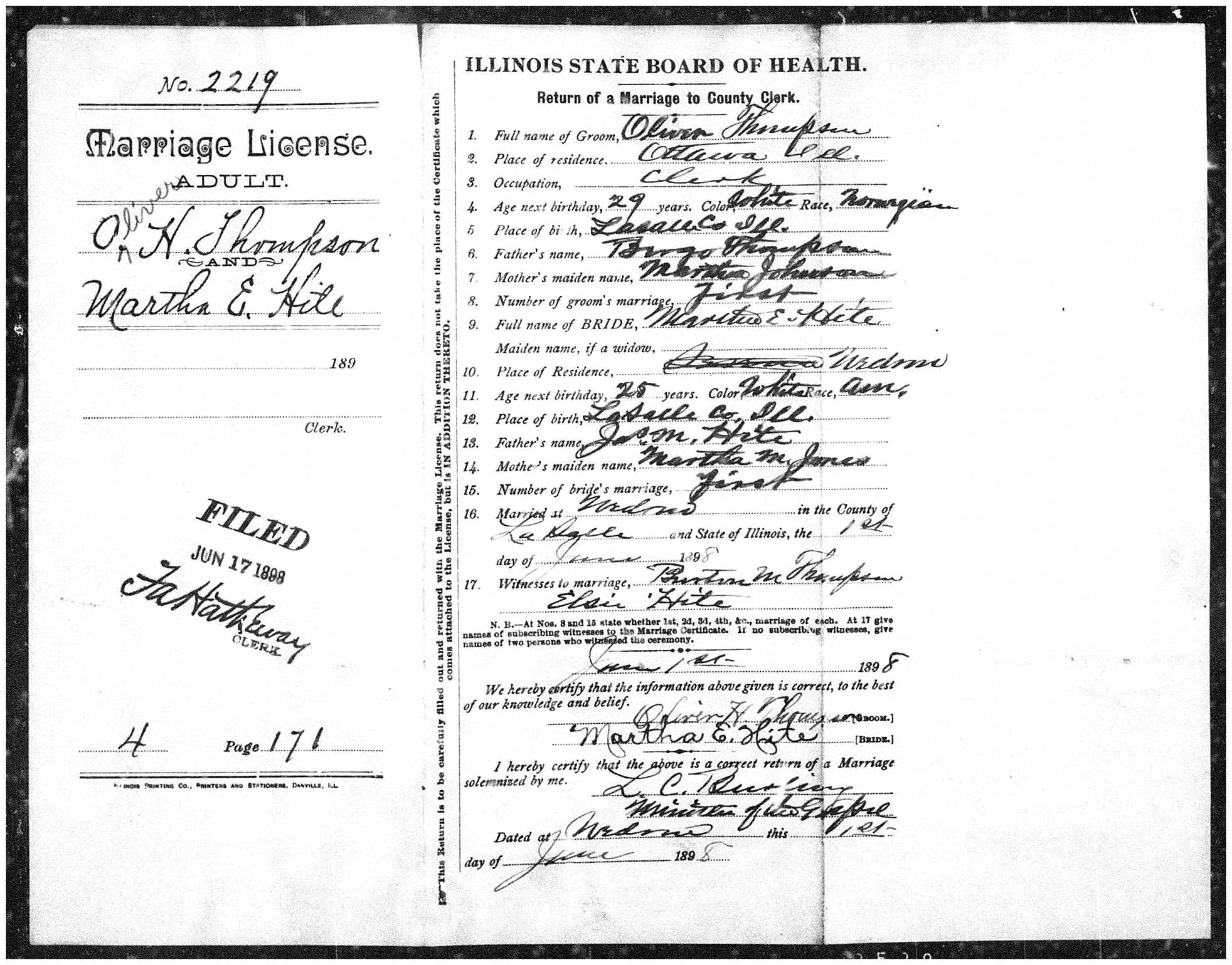
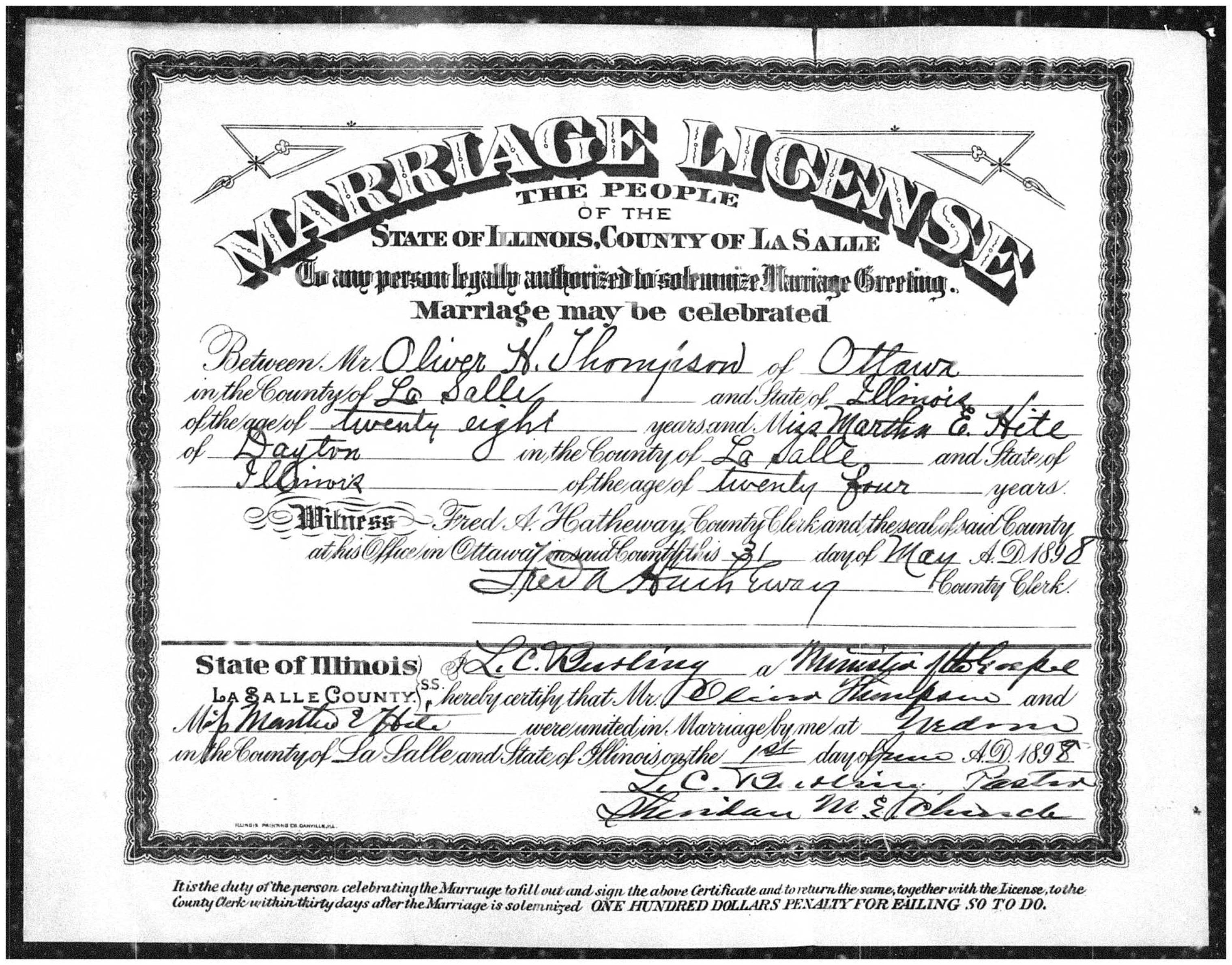
On the 31st of May, 1898, Oliver Thompson and Martha Hite appeared at the La Salle County Clerk’s office in Ottawa to apply for a marriage license. Oliver signed an affidavit that both of them were of legal age to marry.

Oliver was twenty-eight and Martha twenty-four. They then completed the application for a marriage license.

Oliver H. Thompson was a clerk, residing in Ottawa. He was Norwegian, born in La Salle County, the son of Bergo and Martha (Johnson) Thompson. It was his first marriage.

Martha E. Hite was the daughter of James M. Hite and his wife, Martha M. Jones. She also was born in La Salle County. It was her first marriage.

The following day, June 1, 1898, they were married in Wedron.

The witnesses were Burton M. Thompson, Oliver’s brother, and Elsie Hite, Martha’s sister. The ceremony was performed by L. C. Burling, pastor of the Sheridan Methodist Episcopal Church.

And here is a picture of the happy couple!

Oliver and Martha Ellen Thompson

There Seems to be Some Disagreement Here

Not the 1887 event, but the river was never tame in the winter.

The Ottawa [Illinois] Free Trader, February 12, 1887, p. 4, col. 6
From Dayton
Dayton, Ill., Feb. 11th, 1887. – The little Fox became the raging Ohio during the flood of last Tuesday. Never since 1857 have we had such a heavy run of water and ice. The ice commenced running Tuesday morning, and run two hours; just before noon it run two hours, and in the evening it run five hours, making nine hours, run. And contrary to the usual manner, the last ice running, instead of being the lightest, was the heaviest, some of it being two feet thick. The fish chute was carried out, but no damage was done to the dam. One of the gates at the locks was broken, and the feeder bank was washed nearly through for quite a distance. The water was so high it ran over the locks and the surrounding embankment. The trestle work of the second span of the new bridge was carried away Monday night, and during the heavy run of ice Tuesday evening, the stone were all knocked out of the noses of the piers, leaving them in a very battered condition. The water alongside of the piers was nearly twenty feet deep. The paper mill lost six hundred dollars worth of straw, which is quite a loss to them, as it is difficult to replace it at this time of year, on account of the bad roads.

The Ottawa [Illinois] Free Trader, February 19, 1887, p. 1, col. 4
Please Rise and Explain
The managers of canal affairs in this city have provoked the ire of divers and sundry of our manufacturers here, by either gross inattention to their duties or a want of due knowledge thereof, as follows:

On Sunday last an ice gorge occurred in the river and feeder of the canal at Dayton, and soon the waters there were on a level – formed a “pool,” and threatened to do considerable damage. On Sunday evening the ice broke away and the waters subsided. Then the waters in the canal were let out, why, no one knows, as all danger was then over. The canal remained dry four days, during which every manufactory in Ottawa whose power is supplied by water was idle. The canal and feeder banks were all sound and no repairs were needed, and none have been made. This withdrawing of the water and stopping the factories, as figured by the proprietors of the different establishments, resulted in damage as follows:
Victor and City Mills, per day, $70; H. C. Strawn, $10; Tile Works, $250; Weis & Wolf, $10; King, $10; Koeppler, $15; Colwell and Rugg, and the Electric Light Co., not reported. Result, a loss of $865 a day, or $1,460, to the factories that have been heard from.

The State of Illinois or its servants ought to make good this loss, in the absence of a satisfactory explanation.

The Ottawa [Illinois] Free Trader, February 26, 1887, p. 8, cols. 2-3
From Dayton
Dayton, Feb. 24. – The slush ice is slowly cutting away out of the river, but large banks of it twelve feet thick remain upon the shores. The mills all got started up again this week.

Your valuable paper last week, in an article under the heading of “Please Rise and Explain,” publishes some things in regard to the shutting out of water from the feeder and canal, which your reporter obtained from a very unreliable source, for there is hardly a word of truth in the whole article. Our manufacturers and citizens who witnessed the flood of the 18th all agree in saying that the canal authorities acted wisely in closing down the gates and thus preventing much greater damage than was actually done; and it is but just to those in authority to state the true facts. Your article stated that “on Sunday evening the ice broke away and the waters subsided.” Now, this is not true, for although the waters subsided a few feet, yet the ice did not break away, but, on the contrary, the ice remained in the same dangerous condition as it was on Sunday, and a fall of temperature, bringing down more slush ice on Monday, would have made the situation more dangerous than on Sunday. Your article further states, “Then the waters in the canal were let out, why, no one knows, as all danger was then over.” As a matter of fact, the water in the feeder and canal was let out about nine o’clock Sunday morning, and a messenger on horseback was dispatched to the canal authorities warning them of the danger to the banks. A gang of the state’s men watched the feeder banks all night Sunday ready to cut it and let the water back into the river again should the danger increase. Again we quote “The canal remained dry four days, during which every manufactory in Ottawa whose power is supplied by water was idle.” Sunday, when the current of the river was forced by the slush ice into the feeder, an ice jam was formed which completely shut off all the water and forced it over the banks into the river again. Tuesday morning, when it was thought the danger was over for the present, the lock gates were raised, and as much water was let in as could be forced through the ice jam. It required two or three days to cut out the ice, and the feeder and canal were being filled as rapidly as possible. If the gates had been left up during the flood there is no question but that a large amount of the bank would have been washed out, which would have taken at least two weeks to repair. Then, let us figure what the damage would have been to the Ottawa manufacturers had the canal authorities not taken the precautions they did: Victor and City Mills, $70 per day, 12 days, $840; H. C. Strawn, $10 per day, for two weeks, $120; Tile Works, $250 per day, for two weeks, $3,000; Weiss & Wolf, $10 per day, for two weeks, $120; King, $10 per day, for 12 days, $120; Koeppler, $15 per day, for 12 days, $180. Result, an actual loss of $1,460 – a probable loss of $4,380, leaving to the credit of the canal authorities $2,920 by reason of their taking such precautions as they did.
Occasional

The Ottawa [Illinois] Free Trader, March 5, 1887, p. 4, cols. 5-6
The Freshet and the Canal
Ottawa, Ill., March 3, 1887
Messrs. Editors: – As “Occasional” has charged in your issue of Feb 26th that the statements made in your issue of Feb. 19th were nearly every word false; and as those statements were obtained from me, in an interview with your reporter, I feel that I ought to reply briefly to the wholesale charge of falsehood.

I visited Dayton Tuesday, Wednesday and Thursday following the overflow of the canal bank at Dayton, on Sunday, the 13th of February last. I examined and inspected the canal banks, lock and floodgates each day; and I hereby declare and affirm that not a cent’s worth of damage was done to the canal banks or canal property at Dayton at that overflow, either Sunday, Monday, Tuesday, Wednesday, or Thursday, the day they finally let in the water. Nor was there one cent’s worth of work done nor material furnished or used for any repairs to the canal during that time at that place for any damage done the canal by the overflow of the Fox river into the canal.
The canal authorities declared to me Tuesday morning, standing on the bridge at Dayton, that there was no damage done to the canal.
Now, will Mr. “Occasional” inform me, or the public, why the water could not have been let into the canal as soon, at least, as its authorities were informed that no damage was done, and that no repairs were needed.

“Occasional” says that some water was let in on Tuesday. That may be true; but I measured the water in the lock at the head of the feeder every day, – Tuesday, Wednesday and Thursday, – and the water was twenty inches lower Thursday morning than Wednesday morning; so that if the gates were opened Tuesday, they must have been closed again.

“Occasional” says that the State men watched the banks all night Sunday night, and at the same time admits that the ice gorge broke below the dam, in the river, Sunday night and that the water went down. But he neglects to inform us that on Monday (notwithstanding, as he says, the danger was over) they did cut the feeder bank more than one mile below where the overflow was and when there was no water in the canal and no prospect of any. And this large hole was cut in the narrowest part of the bank and where, if a washout could have been furnished to the invitation thus made and kept open three full days (for it was not refilled until Thursday, I think it would have been later than the next planting time before the bank would have been rebuilt. “occasional,” especially in the Ottawa Republican, is very full in his charge of falsehood, but still follows each charge with an admission of facts stated in the Free Trader of the 19th of February. He says, if the weather should change, &c., &c.; as well he might say, if we should have a June freshet, or if some other awful thing should happen, it was safe to wait and see.
The canal authority that would shut the water out of the canal and keep it out for four days and cut a large hole in the canal bank and keep it open three days as a precaution against what may happen in the future, is no doubt a very prudent authority.

And now, if “Occasional” will point out, over his own signature, where one cent’s worth of damage was done to the canal on account of the overflow, or where, during the time between Sunday and Thursday, one cent’s worth of repairs was made by the canal authorities on account of the damage done by the overflow, that shall be the truth, then I will confess that I am wrong. Until that is done, no matter how many times you charge me with falsehood, the facts as stated must stand for the truth.

No, Mr. “Occasional,” the conduct up there at that time is consistent with the conduct here daily. There is hardly a day but the water in the main canal is anywhere from ten to twenty inches below navigation stage. That, Mr. Authority knows full well, taken from a six-foot head, well nigh destroys the power on that head. And all, as Mr. Authority says, because he will take no chances.
Once more, if, as “Occasional” says, it was true that an ice bar was formed across the feeder below the gates so that no water could pass if the gates were open, then, in the name of common sense, why were the State men set at work Monday cutting the canal bank one mile down the feeder, where there was no water and none could be got if his statement was true? There is an adage, that “of all men, liars ought to have good memories,” – or ought to have reason enough to see where their statements convict themselves.
Respectfully, Wm. Thomas

The Ottawa [Illinois] Free Trader, March 12 [printed; actually 19], 1887, p. 2, col. 5
The Dayton Flood Again
Dayton, March 3, 1887 – On your last issue Mr. William Thomas, an old citizen of Ottawa, came out in a lengthy article admitting that he is the author of the unjust criticisms on the action of the canal authorities, and charging your correspondent with telling falsehoods. Our citizens and manufacturers feel that Mr. Thomas has very much misrepresented the facts in this matter and desire that we should answer his article and place the facts again correctly before the public.
Why should we write anything but the truth when we are a user of the water at this place and a loser by the shutting out of the water? We are also your reporter for this vicinity and always try to give your paper nothing but the facts, and we know that we are supported by the citizens here who were eye-witnesses of the overflow, in saying that we have given the facts correctly in the matter.

In Mr. Thomas’ whole article he does not (and cannot) deny the points we made, viz.: of the danger during Sunday and Monday, Feb. 13th and 14th of a wholesale destruction of the banks, and of the fact that the canal was filled as rapidly as the water could force its way through the ice jam. There can be no denial of these facts.

Mr. Thomas charges that we admitted that the ice gorge broke below the dam Sunday night. Why does he say this, when in our last correspondence dated Feb. 24th, this was one of the points which we most emphatically denied. We claimed that the ice remained in the same dangerous condition on Monday as on Sunday.

Mr. Thomas claims that on Tuesday morning the canal authorities declared to him, standing on the bridge at Dayton, that no damage was done to the canal. We were present during that conversation, as were also three or four more responsible witnesses who testify to the same thing, and heard the canal supt. say that he did not know what damage was done to the banks. How could he tell when the ice was piled up all over the banks? Mr. Thomas acknowledged during the conversation on the bridge, that he had been up trying to examine the banks but as he had no shovel to clear away the ice, he could not tell the condition of the banks.

In regard to the big hole in the bank, he states was cut on Monday. These are the facts: the canal authorities thought the danger so great that they employed the bridgemen who were idle that day to cut the frost out of the bank below the paper mill, so that in case the river raised again and overflowed the banks, the bank could be quickly and easily cut and the water turned into the river again, and the canal would not be given more water than it could dispose of. It was not safe to cut the bank any nearer the locks as the river was too high.

We have never said or claimed that any damage was done to the banks at this time, but these are the facts: during the heavy run of ice of Feb. 8th the banks near the dam were cut about one-half through for a distance of nearly 100 feet, and the states’ men were two or three days repairing them, but the banks were still weak, however, when the flood of the 13th came on and it was only by a narrow escape that they were preserved. Instead of finding fault, Mr. Thomas should feel thankful that his electric light was not dimmed for three months instead of three days.

In regard to the measurements which he states he made at the lock, we have responsible witnesses who testify that at no time was the water more than fourteen inches low at the locks and that more water was being let in every day than could force its way through the ice jam.
We have interviewed a few of our prominent citizens and give you their opinions: A. F. Dunavan, Esq., of the Horse Collar Works, says he feels confident that the authorities did the proper thing in shutting out the water on that Sunday, and that there was great danger to the banks by the overflow. His factory was laid idle for a few days, but he feels confident that his loss would have been much greater had not the canal authorities shut out the water. J. W. Channel, of the Tile Works, says he is positive the authorities did perfectly right in shutting out the water, and that any one who would have seen the condition of the river at the dam at that time could not have a different opinion. He was an eye witness of the overflow. He had lived in Dayton a good many years, and never saw the water in as dangerous a condition to the banks as on that Sunday and Monday.
O. W. Trumbo who has lived here 30 years says he never saw the water so high. Mr. D. Moore of the paper mill thinks the authorities did the proper thing, as do Mr. Davis and Green Bros.
Occasional

————————————- AND THAT’S THAT, SO THERE!!
Charlotte Lyman Rogers

Charlotte Rodgers’ [sic: Rogers] entry in 1860 mortality census for Dayton

Charlotte (Lyman) Rogers was born about 1836 in Ohio. She was the daughter of John West Lyman from Charlotte, Vermont, and an unknown first wife,  John came to La Salle county, in 1838, and bought the NW quarter of section 24 in Freedom township. He married his second wife, Jerusha Newcomb, March 18, 1840, in La Salle county.

In the 1850 census, Charlotte Lyman, 14,  is found in the household of John W. Lyman, Freedom township. Also in the 1850 census, Thomas Rogers, 11, appears in the household of Jeremy W. Rogers, farmer in Dayton township.

On February 3, 1857, Charlotte Lyman and Thomas Rogers applied for a marriage license. Charlotte was over 18 and therefore of legal age to marry, but Thomas was only 19 and had to file an affidavit that his parents knew about the engagement and gave their permission for the marriage. They were married two days later, on February 5th. The marriage was performed by John Read, J. P., in La Salle county, Illinois.

Thomas Rogers swears that his parents know of his engagement and consent to his marriage.

Charlotte and Thomas had two children:
• A daughter Charlotte, called Lottie, born November 15, 1857.
• A son, Charles E. born August 14, 1859.
Charlotte died of typhoid fever in March 1860, when Charles was still an infant.

Lottie Rogers married Abner White February 28, 1875 in Kankakee, Illinois.
She died December 24, 1910 in Ames, Story Co, Iowa.

Charles Rogers died 10 July 1935 in San Gabriel, Los Angeles, California.

Rebecca Emma (Headley) (Morrison?) (Wight) McBrearty

Rebecca Emma Headley was born June 15, 1849, in Bureau county, Illinois, the daughter of John and Anna (Johnson) Headley. John died about 1854. In 1860 Rebecca is living with her mother in Ohio township, Bureau county, where they are also found in 1865.

Rebecca was married at age 21, to Francis Marion Wight, on the 18th of April 1870, in Red Oak, Montgomery County, Iowa. She was listed on the marriage documents as Rebecca Morrison, implying that she was married previously. Also, in the 1870 census of Francis and Rebecca’s household, there is a baby girl named Minnie Morrison, born Feb 1870. No evidence has been found of a marriage to Morrison, nor any trace of Minnie after 1870.

Rebecca and Francis had a daughter, Mary, born in October 1875, and a son, Roy, born about 1881. She was divorced from Wight March 12, 1885 in Lee County, Illinois.

Rebecca was married to James McBrearty, 11 July 1885 in Dixon, Lee County, Illinois. James worked for the C. B. & Q. railroad. His job took them to La Grange and Western Springs before moving to Dayton in May 1899.

Note that her name, “Wight”, is mistakenly written as White.

Mary was 10 and Roy 4 when their mother married James. Both children then used their stepfather’s surname.

In the 1900 census, Rebecca and James are living with her daughter Mary, now Mrs. Edward Emmons, in Dayton. In 1910 she and James are in their own household. Grandson Edward Emmmons lives with them.

Rebecca died January 18, 1917 in Joliet and was buried January 21 in the Dayton cemetery.

Her obituary may be seen here.

A Flying Visit – Dayton, Ohio to Dayton, Illinois

AIRPLANE IS USED TO PAY VISIT TO DAYTON

Richard Whitehouse, a former Dayton resident, and Russell A. Moore, owner of Moore’s Flying Service of Dayton, Ohio, visited friends in the village of Dayton for an hour this morning. They flew here in one of Moore’s planes, landing at 8 o’clock near the Lyle Green residence, and then took off an hour later, expecting to be home by noon.
Whitehouse was formerly herdsman of Green’s Jersey herd, and is now a student flyer with 25 hours of solo flying to his credit.


The clipping above comes from the family scrapbook kept by Maud Green, Dayton historian. The item appeared on June 27, 1933, most likely in the Ottawa newspaper. She noted how it compared with the 35 day trip the Green party made from Ohio in 1829. 


Richard Francis Whitehouse was born March 31, 1895 in Auburn, Maine. In 1917 he was living in the Dayton, Ohio, area, working for the Foreman Dairy Farm. He was employed at various places in the dairy business and it may be around this time that he worked for Lyle Green.  On June 24, 1919, he married Nellie (Skinner) Hurless in Van Wert County, Ohio. By 1930 he was manager of a dairy farm and in 1942, when he registered for the draft, he was a manager at the Borden Finch Jersey Farms in Dayton, Ohio. He died August 25, 1957, in Athens, Texas.

The Valuable Water Power at Dayton

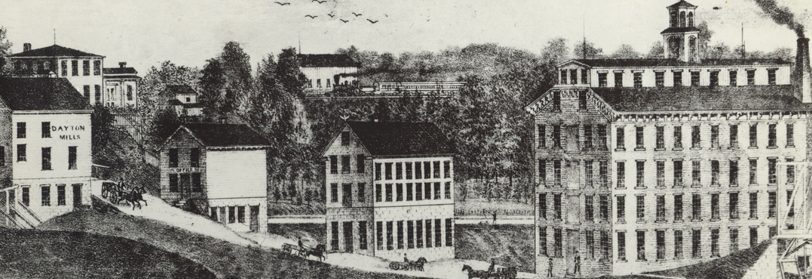
A view of the west bank of the river in the area occupied by businesses that were powered by the water from the feeder.

The Ottawa [Illinois] Free Trader, February 14, 1852, p. 4, col. 4

Water Power to Lease

The undersigned offer great inducements to capitalists and manufacturers, as they have decidedly the best water power in the state, having over 25 feet head and fall, and situated in Dayton, 4 miles above Ottawa, and drawn from the Fox river Feeder, which is kept in repair by the state, without any cost to the undersigned. They have water to lease for a term of years sufficient to drive 20 run of 4 ½ feet burrs, and will lease on very liberal terms to any good responsible company.

This is a rare chance for men of capital who may wish to go into the manufacturing business. The location is very healthy and admirably situated, as it is on a navigable feeder, within 4 miles of the contemplated Rock Island rail road, and the head of steamboat navigation. For further information, address John Green & Sons.

Dayton, may 31.

July 4th, 1849 – News from Dayton

In July 1849, Eliza Green Dunavan and Nancy Green Dunavan took the opportunity to add to a letter David Green was writing to his father and brothers. Eliza’s husband, William, and Nancy’s husband, Albert, were with the Greens in the gold fields of California and were surely glad to get news of home.

Dear Husband haveing an opportunity of writing a few lines in Davids letter i embrace it we are spending the 4th with our friends in Dayton we are all well and have been ever since you left my health is better than it has been for two years we are getting along better than i expected we could alone[.] our crops look promising thus far I can not say enough in praise of our boys they work like men and get a long with out any trouble i send Emma Elizabeth and James to school and keep Rachel for company i must close and give room for others i will write when you get settled and give you the particulars      Eliza your affectionate wife

         Dear Husband I embrace this opportunity of writing you a few lines. David was writing and left room for us to say a few words we have all enjoyed very good health since you left and do much better than I thought we possibly could although we are very lonely. I have received four letters from you since you left and am very happy to hear that you are getting along well I hope you will continue to write whenever you have an opportunity. I am sending our four oldest children to school and the crops look well       from your affectionate wife Nancy Dunnavan                               

Invented in Dayton

To all whom it may concern:
Be it known that I, Isom L. Thompson, a citizen of the United States, residing at Dayton, in the county of LaSalle and State of Illinois, have invented certain new and useful Improvements in Wagon-Jacks; and I do hereby declare the following to be a full, clear, and exact description of the invention, such as will enable others skilled in the art to which it appertains to make and use the same.

This is how Isom Thompson began his application for a patent on his invention, an improved wagon-jack. His application was witnessed by his brother, Foster V. Thompson and by Freeman Wheeler. The improvement came from his experience with farming, but Isom had not always been a farmer.

He was born in November, 1840, in Adams, Jefferson County, New York, one of five children of Isom Thompson and Elzina Foster. He left the farm sometime between 1875 and 1880, and took up the trade of carriage maker.

About 1894 his older brother, Foster, decided to move his family to Illinois. Isom made the journey with them and settled on a farm in Rutland township. After Foster died in 1897, Isom, who never married, continued to make his home with his sister-in-law and her 2 sons, his nephews, Oscar and Lamotte Thompson. Isom died there on Saturday, December 2, 1905, of apoplexy. 

Opal is a Standout

Jersey cows

Not, unfortunately, a picture of Opal, but a close lookalike.

DAYTON, ILL., COW COMPLETES TEST

Dayton, Ill., July 16. — Opal of Greenacres, 569949, a pure bred Jersey cow in the herd of L. A. Green, at Dayton, Ill., has completed an official production test. Opal was started on this test at the age of 4 years and 11 months and in the following 365 days she yielded 549.86 lbs. of butterfat and 8,109 lbs. of milk. Her milk averaged 6.78 per cent butterfat for the year and for two successive months of this test her production of butterfat was above 63 lbs. per month. With the above record, made on two milkings a day, Opal of Greenacres qualified for the Register of Merit of the American Jersey Cattle Club. Her sire is Master of the Sea 183761, and her dam is Mayfield’s Spotted Maid 351671.1


  1. The [Streator, Illinois] Times, July 16, 1928, p. 2.

84 Years Ago Today in Dayton

Dayton store

On the left, behind the store, is the Dayton clubhouse

Dayton Woman’s Club Observes Anniversary of Its Founding1

The Dayton Woman’s club today had started the 26th year of its organization, with memories of the fitting observance yesterday of the silver anniversary of its founding.

The present members of the club, who include many of the 13 charter members, received 100 friends from 3 to 5 p. m. yesterday in the Dayton clubhouse, to mark the anniversary.

Silver and white appointments were used on the tea table from which the guests were served. Daises, calla lilies and white delphinium formed a centerpiece. Mesdames Ralph Green and Gilbert Masters poured.

Baskets of flowers were used about the room to create a background for the lovely event.

Piano solos were played by Miss Betty Rensch, a piano duet was played by Mary Louise Varland and Betty Follett, a vocal solo, “June Morning,” was sung by Miss Ida Chamberlain and a violin solo was played by Marjorie Williamson, accompanied by her mother, Mrs. Ernest Williamson.

Painting Given

A painting of Wallace Nutting’s was presented to the club by Mrs. Bert Tuttle in memory of Mrs. Fannie Osbourne. A tribute was given Mrs. Osbourne by Mrs. E. C. Cleary. The presentation was made to Mrs. Arthur Retz, president of the club.

Of interest to the guests was a picture on exhibit of the home of Mrs. Rush Green, now destroyed by fire, in which the club was organized 25 years ago.

Honored yesterday were the following past presidents of the club: Mesdames Gilbert Masters, Dan Hallowell, Ben Chamberlain, Will Fleming and Miss Maud Green. They were given special badges and also were in the receiving line, as was Miss Jennie Fraine.

Charter Members

Among the 13 charter members of the club present were: Mesdames Masters, Hallowell and Misses Jennie and Emma Fraine.

The guests included Mrs. B. O. Benson of Tampa, Fla., a guest of Mrs. John Smith of Wedron; Mrs. Annie Barnes of Boston, a guest of Miss Jennie Barnes and Mrs. Carrie Green; Mrs. Barbara Masters of Chicago, a guest of Miss Maud Green; Mrs. Emily Brown and daughter Ethel of Oak Park; and others from Ottawa, Grand Ridge, Harding, Wedron and Marseilles.

The celebration was in general charge of Mesdames Charles Clifford, Arthur Retz, Ralph Green, Will Ryan and Misses Jennie and Emma Fraine and Maud Green.

The first meeting of the group in its 26th year will take place Wednesday, June 29, in the club house, which the organization constructed in 1923 and 1924.

The club was founded June 13, 1913, to promote sociability, discuss subjects relating to a betterment of the community and provide amusement and recreation.


  1. Ottawa Republican-Times, June 15, 1938, p6

Early June in Dayton

Rural Happenings

Dayton, June 5. – The late rains have raised the river somewhat. Fishing is some better than it was before the rain. Lots of people come to enjoy piscatorial sports. A few bring tents and camp out for a few days, but as soon as a tent is pitched, we notice the mercury in the thermometer begins to move toward zero, so camping out has been so far a wretched cold business.

Query: “If Park Reed still continues to seine, what has become of the Ottawa Fish Protective Association?”

Mr. Harry Green departed last Tuesday on a wool-buying trip near Mendota.

J. Green’s horse which was supposed to have been stolen from the stable last Saturday night, was taken up as an estray by Mr. Jos. Hall, four miles north-west of town, and returned to Mr. Green last Wednesday. The horse had broken his halter and walked off.

Mr. W. B. Roberts, with A. Reed & Sons, Chicago, was in town Wednesday.

Mr. Wm. George, Miss Ida George, and Miss Helen Tarket, all of Leland, were visiting at D. Green’s a few days last week.

Miss Carrie Stowell of Bloomington, is visiting her sister Mrs. J. Wright.

Mr. Jos. Green returned last Saturday from a wool buying excursion near Washburne. Mr. Burtie Stadden, formerly of this place but now of Wenona, accompanied him for a few days visit with his little Dayton friends.

The musical Union at their meeting last week chose the following officers for the ensuing term: president, Chas. K. Howard; secretary and treasurer, Miss Reed; Leader, Chas. Green; organist, Jennie Dunavan.

Universalist services next Sunday evening by Rev. Mrs. Gibb.

Rev. G. B. Barnes, of Ottawa, preaches at the school house this evening. Mr. B. delivered an excellent sermon at his last appointment, being a forcible argument in favor of Christianity.1


  1. The Ottawa Free Trader, June 7, 1879, p. 8, col. 1

Another Dayton Business

PLOUGH FACTORY

Jacobs & Co. would inform the Farming Public that they are manufacturing at Dayton several kinds of Ploughs, which have been heretofore approved, to which they invite the attention of those wishing to buy. These ploughshare – made of the best material, and warranted to be perfect in every respect – They are also manufacturing the improved revolving Colter, which is acknowledged to be far superior to the common straight ones. Call and examine for yourselves.

Old ploughs will be repaired to order on reasonable terms.1

The revolving colter was an improvement on the previous form, which was a vertical knife edge to cut through roots and vines. A fixed knife collects roots and vines and tends to plug up. The rolling blade greatly reduces the friction through the ground and does not gather rubbish on its edge. 

Another Dayton company in the forefront of technological advancement!


The Ottawa Republican, April 29, 1854, p4, c4

Sibling Dispute Leads to Fratricide

The 1860 mortality schedule for Dayton

I was looking at the 1860 list of deaths in Dayton in the preceding year and was struck by the entry for James Mahar. MURDERED? A little research in the local newspaper produced this story:

FRATRICIDE – On Saturday last, two brothers, named James and Daniel Maher, living in the town of Dayton in this County, came to Ottawa to do some trading, and as is too frequently the case with a certain class of countrymen, drank a great deal too much whiskey before they went home. They got home however, about 8 or 9 o’clock in the evening and both took supper at James’ house. After supper James got to quarreling with his boys, when Daniel interfered and took the boys’ part.

Thereupon the brothers quarreled, and agreed to fight it out, but conceded that both were too drunk then, fixed upon the next morning for the fight, shaking hands upon the agreement. Daniel then started for home, and in passing through the bars, picked up a large club, and dared James to meet him. James picked up a mop or fork handle, and followed Daniel beyond the bars, where the fight commenced.

James struck the first blow which was warded by Daniel so that the mop handle broke in two. Daniel then struck James on the head, felling him instantly, and then passed on. James not rising again, his boys went to him and found him insensible. On closer examination, it was found that his skull was fractured, and that his injury was mortal. He lay insensible until next morning, when he died.

The Coroner was sent for, and an inquest being held, brought to light the above facts. Daniel made an attempt to escape but Deputy Sheriff having gone after him with a competent force arrested him on the prairie in the neighborhood, and brought him back to jail, where he now awaits his trial.1


  1. The Ottawa Free Trader, June 18, 1859, p. 3, col. 2

A Shower for a New Bride

MRS. HERBERT M’GROGAN HONORED PARTY GUEST

Misses Emma C. Fraine, Jennie L. Fraine and Addie Thompson were hostesses at a miscellaneous shower given Saturday afternoon in the Dayton Community house in honor of Mrs. Herbert McGrogan, a recent bride, who was formerly Miss Ceal Pillion.

The program consisted of a heart relay contest, participated in by all the guests. Mrs. Hans Vogel accompanied by her daughter, Miss Virginia, gave three vocal solos, “To You,” by Speaks, “A Brown Bird Singing,” by Barrie, and “Smilin’ Through,” by Penn. Miss Zelda Garrow interpreted two readings entitled “Like Calls to Like,” by Edgar A. Guest and “Before and After.” Miss Ida Chamberlain, accompanied by Mrs. Arnold Wilson, rendered two vocal solos, “And [sic] Old Fashioned Town,” by Squires, “Try Smilin’” by Penn. Nicholas Parr, accompanied at the piano by Miss Katherine Pitts, favored the guests with two vocal solos addressed especially to the bride, “I Love You Truly,” by Carrie Jacobs Bond and “Just A-Wearyin’ For You,” by the same composer.

After the program the honored guest, seated at a table over which was suspended a parasol of pink petals under a white bell, received the many beautiful and varied gifts presented to her by the other guests.

The guests were then seated at a long table arranged in the form of a large T. The color plan was pink and white with yellow chrysanthemums in many crystal bud bases [sic] and in a large crystal vase and also, tall pink and white tapers were used. The three main center pieces consisted of a bride and groom in a Cinderella coach drawn by a large white swan. The individual favors were “Ships of Love on a Sea of Matrimony,” and the place cards were cupids bearing two hearts united as one. Various baskets of flowers and large white bells were arranged throughout the room. Dainty refreshments in pink and white were served.

Among the 60 guests present were people from Ottawa, Marseilles, Wedron, Wallace, Waltham, Rutland, Dayton and vicinity.1


  1. Ottawa Republican-Times, October 23, 1933, p. 2, col. 1

Drama in Dayton

An evening of entertainment at the Dayton school house

A large audience assembled at the school house last Saturday evening to witness the presentation of the drama, “The Lost Children,” by the Musical Union, assisted by others of the home talent. Considerable pains had been taken to make this closing entertainment a complete success and the members of the company exerted themselves to their utmost to secure that end and acquit themselves creditably. The words of the play were all well memorized and the parts were finely sustained.

The characters of Jamie and Lily, “the lost children,” were performed in an excellent manner by little Eddie Hess and Gertie Howard, who entered into the spirit of the play and were highly encored by their appreciative listeners.

The prologue and epilogue by Eddie and the tableaux in which Gertie figured beautifully as the Goddess of Liberty, capped the climax of their success.

William Dunavan as Mr. Manly, Cora Green as Mrs. Manly, and Dessie Root as Bridget sustained their parts admirably. The other characters of the play, Jennie Dunavan as Miss Fitzallen, William Davis as Mr. Bonville, James Green as Town Crier, Chas. Green as Watchman, and William Holton as Dick, played their parts well.

The squad of soldiers under the command of Thomas Howard was a novel feature in our home theatricals, and the drill and the military tableaux were considered very fine.

The minstrels deserve a word of praise for their funny efforts.

The singing between the scenes by the chorus of young girls was quite good and their selections appropriate.

All in all the drama was quite a success and is highly satisfactory to the management. The members of the Union desire to return thanks to Capt. S. R. Blanchard, of Ottawa, for his kindness in fitting out the military scene, which made the drama quite effective, to Mr. Thos. Howard and others for their kind assistance in presenting the drama, and to Wright’s orchestra for their excellent music.1

For those of us unlucky enough to have missed this outstanding production, this newspaper description of another presentation of the play gives an idea of the action:

The opening scene takes place in the parlor of Manly Hall. Mrs. Manly tells Bridget (who has an endless story about “my father”) to dress the children and let them out to play. The children dressed, the lady with matronly solicitude tells them above all things not to run after the soldiers.

The next scene opens with a most imposing array of soldiers, neatly dressed in dark blue cloth with white facings. The men were put through the manual exercise and company drill and then marched and counter-marched followed alas! by Lillie and Jamie, now as the reader will see, two lost children. Fortunately a sailor boy on his way to his vessel stumbles across the lost ones in the street and finding that they only know that their names were Lillie and Jamie, and that “pa’s name is pa”, and “ma’s name is ma”, he takes them to his home and leaves them with his mother.

Meanwhile the frantic father has enlisted a watchman and the town crier into his service but no signs of the children can be found. A report however comes that a sailor was seen carrying two children off to sea. The upshot is that the sailor is found, brought before Mr, Manly who seizes him by the throat. Fortunately the sailor’s mother enters with the two children and all is explained. The sailor refuses to take any reward; Bridget tries to tell a wonderful tale about “my father’’ and all ends well.2


  1. Ottawa Free Trader, May 7, 1881, p. 8, col. 1
  2. Passaic (New Jersey) Daily Times, December 20, 1884. p. 2, col. 2

Definition of an Old Settler

early settler

There were many Old Settlers Reunions in La Salle County in the 1870s and 1880s and many arguments as to what constituted an old settler, but there was little argument as to the three major events one had to have experienced to be a true Old Settler. Those were the deep snow of 1830-31, the cholera epidemic of 1832-1834, and the sudden freeze of 1836.

Jesse Green wrote about these in his memoir, although he was a year off in his recollection of the sudden freeze. But he wrote his memoir in 1895, at the age of 78, so he was close enough. None of the Green family died from cholera in the 1832 epidemic and consequently it does not play a large role in Jesse’s memoir.

The second and third winters we were here we had about two feet of snow, which lay on the ground most of the winter, and drifted badly and crusted over so that we could ride over fences without difficulty, and prairie chickens were so plentiful and tame that on a frosty morning, they would sit on trees so near our cabin that Father stood in the door and shot them, until some of the men said he must stop before he shot away all of our ammunition, and leave none to shoot deer and turkeys. 

I will give an account of the most sudden, and greatest change in temperature, in my recollection, which occurred in the early winter of 1837 & ’38.  I left home about noon when it was drizzling rain sufficient to wet my clothing, and when I reached a point a little below Starved Rock, it commenced turning cold so fast that I ran my horse as fast as he could go to Utica, and by the time I reached the hospitable home of Simon Crasiar, it had frozen the ground hard enough to bear up my horse, and my clothing as stiff as it would freeze from being wet.  I had to be helped from my horse, and saddle and all together my clothing being frozen to the saddle, and I do not think I could have gone a quarter of a mile farther. The next day returning home it was a terrible cold day, my left side against the wind was nearly frozen by the time I reached Ottawa, where I went into a store to warm myself, and all I could do to prevent it, fell asleep in a short time, I heard a number say that during that blizzard, they saw chickens frozen in their tracks.

For more information, illinoishistory.com has this page devoted to the stories of the Winter of the Deep Snow. And see here for information on the Sudden Freeze of 1836, and here for more on the cholera epidemic.

Croquet Games and More – A View of Dayton Social Life

croquet player

Dayton, May 8, 1879. – The weather during the past week has been quite cool. Small fruit is doubt injured somewhat, but it is to be hoped no great damage will be done. The frost’s come like the Dutch girl’s beau, “efery evening, mine sweet sourcrout.”

J. Green & Sons have the Woolen Mills refitted, and are now ready for custom work, manufacturing goods on shares, &c. They will also pay the market price in cash for a limited amount of wool.

Messrs. Zearing & Row, and Basil Green will finish at the culvert this week or next. Two large coal beds have been opened on Mr. Green’s land, enough coal to supply the town for some time.

Mr. Martin Wilkie has commenced the erection of a dwelling house on his property south of his present residence.

The tile machine with brick attachment arrived this week, and D. Green & Son say they will be making first class brick in about a week. It is generally conceded that the clay around Dayton is of an excellent quality and will make good substantial brick and tile.

Mr. W. R. Roberts with A. Reed & Sons, Reed’s Temple of Music, Chicago, was in town last Saturday.

Prof. Newberry has two schools at Hinckley, Ill. He sends his best regards to the Union, and wishes it success.

D. L. Grove is laid up with a severe attack of erysipelas.

Miss Clara Grove of Rutland is spending a few days in town.

Quite a number of our young folks gathered at the pleasant and commodious residence of O. W. Trumbo, Esq., last Wednesday, to celebrate the birthday of Miss Josie Green. Croquet and other games were engaged in on the pleasant lawn adjoining the residence, but as overcoats and mittens were needed and the party did not come prepared with those convenient articles, the games were adjourned and all gathered around a good, comfortable fire. After an excellent repast, prepared in honor of the occasion by Mrs. Trumbo, the party scattered; some to tune their voices for the meeting of the Union, others ascended to the balcony and enjoyed the beautiful prospect. May Miss Josie have many happy returns of the day, was the wish of her many friends.

Occasional1


  1. Ottawa Free Trader, May 10, 1879, p. 8, col. 1

History of the Fox River at Dayton

The power house at Dayton – 1925

In 1915, the State of Illinois conducted a survey of the Fox River and proposed improvements. The report traced a history of the state of the Fox River from the 1830s to the present day (1915). Much information was presented on flooding and how it affected the many structures along the length of the river. The following excerpts from the report give a look at the river at Dayton and the place’s suitability for a hydro-electric plant. Following this report, the state built a dam and power house at Dayton in 1925. 

State of Illinois Rivers and Lakes Commission
Report of Survey and Proposed Improvement of the Fox River

p. 48: Although the records are not complete it seems to be pretty well established that there have been great floods on the Fox River in 1849, 1857, 1872, 1882 and 1902.

p. 48-9: Of all the floods, however, the one of 1857 seems to have been the most pronounced. . . . Heavy rain on February 6, 1857, melted the accumulated snow and broke up the ice. All the bridges from Batavia to Ottawa were washed out and several dams upstream gave way.

p. 50: There seems to have been many more floods in the days of the early settlement of the Fox River valley than in later years, although there were plenty of forested areas then while now there is practically no timber. In the early records frequent mention is found to washing out of dams and bridges year after year. The explanation for this is very likely due to the fact that originally the bridges were low wooden structures and the dams were crude affairs whose main reliance for stability consisted of logs across the channel. These were insecure affairs and high water floated them away. Most of the early bridges were built by private subscription and at great sacrifice of time and money to the pioneer settlers. Often they were no sooner erected than a freshet would wash them away.

p. 57: The Fox River valley was settled by the white race from 1839 to 1850. Pioneers looking for homesteads were impressed by the beauties of the valley, the abundance of clear water supplied by the river and the opportunities for securing water power from this stream. One of the first thoughts of the early settler was to start a saw or grist mill, the former to cut timber for buildings for family and cattle, and the latter in order to feed both himself and his stock. Otherwise, long journeys over trackless forest and prairie were required before the early family could have flour or meal. The history of the early settlements in the Fox River valley shows that practically the first thing done in every case, after building a house, was to build a dam and put up a water-wheel-driven mill. These dams were very crude timber structures, built of logs and slabs, and generally washed out or were seriously damaged by high water.

p. 62: Of the abandoned water-power sites, that at Dayton would naturally have a greater interest than the ordinary on account of its use in diverting the water from the river to the feeder of the Illinois and Michigan canal, which connected the canal proper at Ottawa. The head of the feeder was located about half a mile north of Dayton, where the State constructed the dam. Edward B. Talcott, resident engineer, in his report of December 10, 1840, referring to the Fox River dam, lock and section of the feeder, says this work was finished in September, 1839. This improvement was maintained until 1902 when the dam was washed out, since which time the feeder has been abandoned, as well as other interests dependent on this water power. In addition to its use as a feeder for the Illinois and Michigan Canal, a reservation was made between the Canal Commissioners and the owners of the mill property at Dayton that the latter were to have the use of one-fourth the supply created by the improvement, “the same shall be drawn out of said feeder within seven-eighths of a mile from the head of the guard lock” under direction of the Canal Commissioners. This gave the required power for manufacturing interests, but with the passing of the dam and power all else was abandoned, as shown by the large four-story building stripped of all machinery.

The first dam at Dayton was built in 1830 by John Green and was erected to furnish power for a grist-mill. It is claimed that this mill was the first one in the State to be operated by water power.
The second dam built by the State in 1839 was about fourteen feet high and was constructed of stone with a wooden crest. It developed about 2,000 horse-power, part of which was distributed —
120 horse-power to paper mills
40 horse-power to tannery
34 horse power to tile factory
120 horse-power to grist mill
40 horse-power to collar factory
120 horse-power to brick factory
—-
474 horse-power

One-fourth of the power was to be used on the east bank of the river and one-half the total developed power was to be used in Ottawa. The present stone mill building was built in 1864 by Jesse Green, at a cost of $65,000, and was operated as a woolen mill until 1882, when it was sold to a pressed brick company, who operated it until 1901, when financial reverses caused the owners to close the mill.

p. 66: Mr. R. S. Feurtado, of Chicago, made a report in 1910 on the proposed hydro-electric development of the Fox River near Dayton and Wedron. This report is in considerable detail and has gone into the question of power development at these two locations thoroughly. The minimum flow of the river is taken at 620 second-feet, but by building dams across Indian and Somonauk Creeks and holding the flood waters in the reservoirs thus created and discharging same into the Fox, a minimum flow of 933 second feet is obtained. On this basis the river alone at Dayton, with a 31-foot head, would furnish 1,740 horse-power constantly. With the two reservoirs proposed and the mill pond at Wedron to add additional water during the periods of low water, Mr. Feurtado estimated the total installation at the Dayton power house would be 6,220 horse-power.

p. 67: In this proposed development it was intended to build a 19-foot dam near Dayton that would create a pond of 209½ acres and have a capacity of 80,864,000cubic feet. The Wedron mill pond would have an area of 950 acres, that at Indian Creek would have 680 acres, and that at Somonauk Creek would have 550 acres area. This would make a total reservoir of 2,370 acres.
By reference to the profile of the Fox River it will be seen that there is a sharp drop in the river bed just above Dayton, giving a large head for a dam located at the foot of this slope. Near Wedron the river bed flattens out, giving a better storage location. This, combined with the fact that Indian Creek and Somonauk Creek valleys form natural reservoir basins, tends to make this an exceptional location for power development. Owing to these natural advantages and also that there is a good district surrounding Dayton for marketing electrical power, all contribute to make this one of the best locations for the development of a hydro-electric plant in this part of the State.