A View of Our Sidewalks

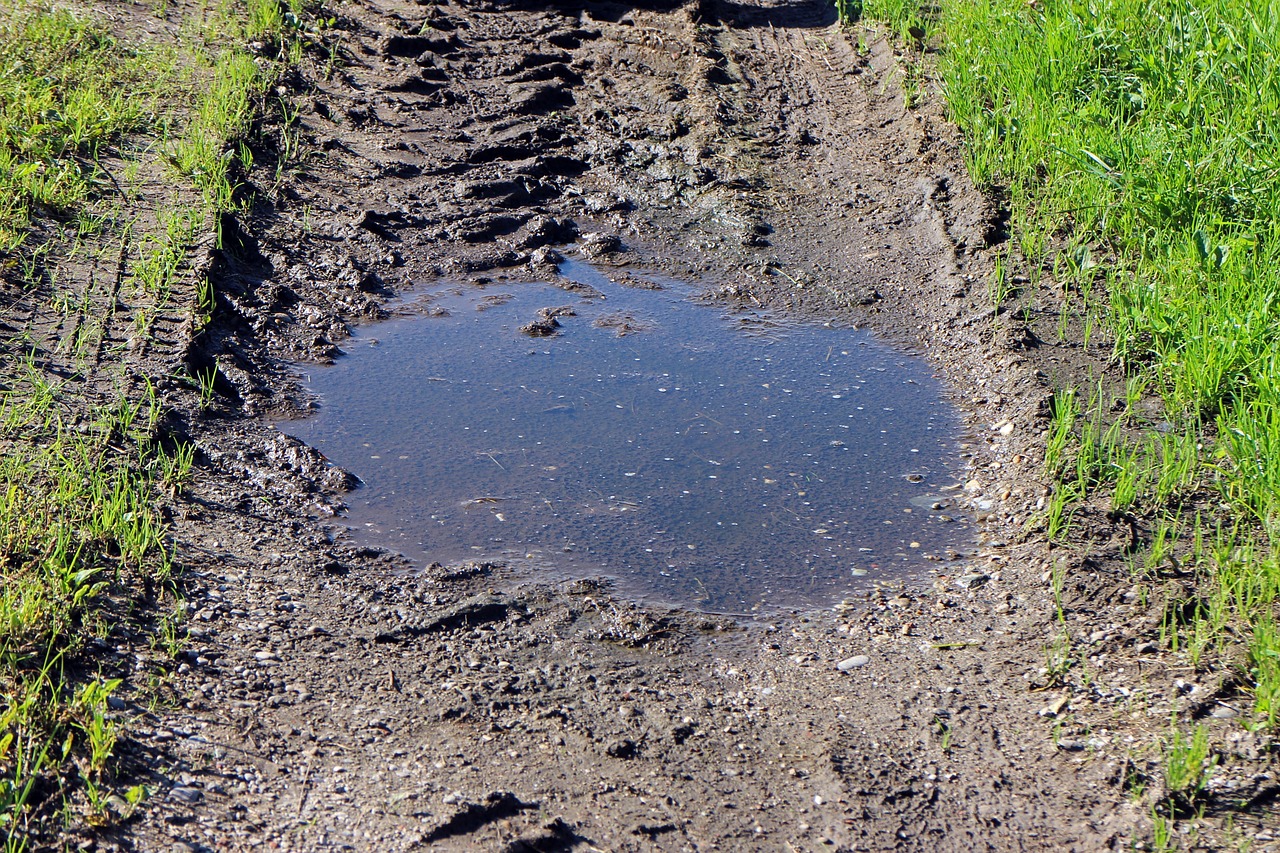
Not specifically Dayton, but you wouldn’t walk down the middle of this, either.

DAYTON

Dr. Bascom left the first treasure of the season at the home of Wm. Ryan. A fine baby girl.

Sleet, rain, snow, mud and sunshine inside of twenty-four hours. Verily, variety is the spice of life.

Mrs. Wright, of Ottawa, formerly a resident of Dayton, is spending a few days with friends in town.

We have no saloon, yet enough strong drink reached town to cause a drunken brawl last Sunday.

Mr. Brown is moving to town. Now the large, long vacant house will be brightened with the light of life and home.

The school entertainment Thursday evening should be patronized by all interested in the education of the boys and girls. Admission, 10c.

Last Saturday we were reminded of what we have read about women turning out and sweeping the streets in cities when we saw an energetic little girl wheeling ashes on a street crossing to make it passable. Our sidewalks are truly side walks, as a person must get to one side to be able to walk. Ottawa should be happy at the prospect of permanent pavements.

FISHER1

Image by Manfred Antranias Zimmer from Pixabay


  1. Ottawa Republican Times, 10 Mar 1892, p4.

Social Activities of the Dayton Women’s Club

The Dayton Woman’s Club, with motto “Community Betterment and Improved Sociability,” was organized on June 13, 1913. It was founded by a group of women who wanted to socialize, but also to contribute to the community. The constitution of the club declared that the Woman’s Club is undenominational and nonpartisan, and is organized first for the good of all; second, for the betterment of conditions around us; and third, to promote sociability in our community.

Meetings were held at the homes of members until more space was needed, at which time a hall was rented from local farmer, Rush Green, for $5 a month. Club meetings were held monthly, with a luncheon in the club house. In 1917 they decided to invite the public to an ice cream social on Thursday evening, June 20. The  money raised was donated to the Chicago Tribune’s Red Cross Christmas Fund for kits for our soldiers in France.

The success of this enterprise led to a variety of public events; strawberry and ice cream socials in the summer and chicken suppers and bazaars in the winter. The annual bazaar sold many hand-made items, made by club members. In the fall, Halloween parties and masquerade balls were popular, and card parties could be held in any season. The proceeds from these supported many charitable causes.

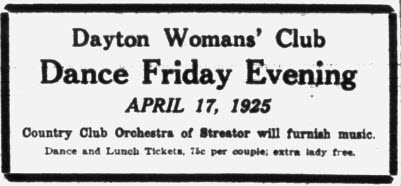
By 1922, the members had been considering having a club house of their own. A lot  was donated to the group in 1923. Plans were drawn up by Lyle Green for a two-story building. Members of the Dayton Farmers association did the excavating for the basement and all members of the club and the community worked to complete the building.  A community dance, Feb, 1, 1924, opened the club house and Feb. 5, 1924 the first club meeting was held. The hall soon became the social hub of the community.

Events at the Dayton club house were popular and well attended, as shown by this newspaper item:

250 Gather for Annual Dayton Halloween Party

Two hundred and fifty gathered at the Dayton clubhouse Saturday night for the annual Halloween costume party of the Dayton Woman’s club.

Pumpkins, corn stalks and Halloween symbols formed decorations. Cards furnished the diversion during the early part of the evening and later the guests danced. A supper was served.

Mrs. Leroy Brown and Oran Mathias won pinochle prizes and Mrs. Frances Leibold and Arthur Retz received the “500” awards.

Judges in the Halloween masquerade costume contest were Charles Shields. James Trent and Harriet Moss. Mr. and Mrs. Ralph Ashley won the prize for the best dressed couple; Wesley Quinn for the “most comical lady”; Catherine Brown for the best dressed lady; Donald Ashley for the “most comical man” and Vincent Aubry for the best dressed man.1

A corner of the club house during a community event

Dayton Woman’s Club Makes Plans for Lawn Social

The meeting of the Dayton Woman’s club opened yesterday with musical numbers and a salute to the flag. The meeting was held in the Dayton club house and Mrs. Nettie Masters, newly elected president, was in charge of the business session.

During the meeting plans were made for an ice cream social Aug. 8. Mrs. Raymond McCormick was named general chairman in charge.

Refreshments were served to the 34 people attending. Guests were seated at a long table arranged with bouquets of summer flowers. Mrs. Ada Thompson and Misses Jennie and Emma Fraine were hostesses.

In games of “500” prizes went to Mrs. Masters, Mrs. Elizabeth Waldron and Mrs. William Calhoun. Prize winners in other games were Mrs. Hans Johnson and Mrs. Frances McCormick.

Aug. 10 the club will meet again. Mrs. George Thomas and Mrs. Nicholas Parr will be hostesses.2

A Maypole at graduation

Dayton School Graduation – 1955

Graduation ceremonies were held in the club house, as well as Christmas pageants and parties, spring teas, harvest dinners and other seasonal festivities. The club house was in use into the 1990s although it has since been sold and a house erected on the lot.


  1. Ottawa Daily Republican Times, November 1, 1943, p. 6, col. 3.
  2. Ottawa Daily Republican Times, July 28, 1949, p. 16, col. 1.

A Very Fishy View of Dayton and its Industries in 1880

Dayton Items.

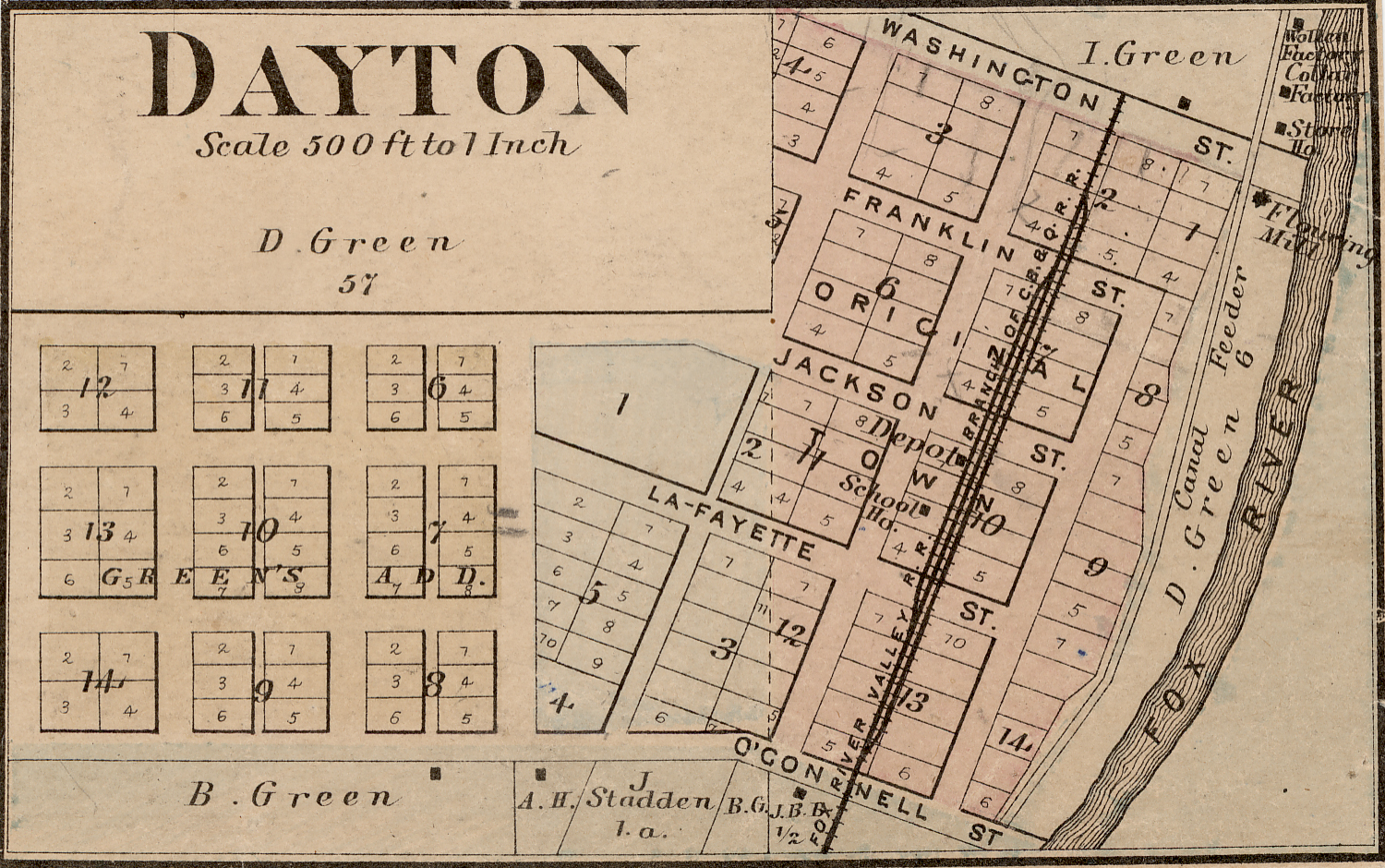
Dayton, as a point where the finny tribe and fishermen do most congregate, has long been celebrated in this section of the country. People armed with hooks, and lines, buckets of bait and togged in old clothes, come daily and nightly from far and near. They arrive on foot, in buggies, in lumber wagons, and dumped off the cars, and are landed in every shape all bent on the same purpose, i. e., that of catching fish, not by the dozens, or in fifties, but by bushels, bagsfull, wagon-loads, and in other prodigious quantities.

They arrive in lofty spirits, braced up by lofty expectations of astonishing the natives. They usually depart wet, hungry, tired, disgusted and without any fish worth speaking of. To a man whose constitution requires a vast deal of rest — long continued and complete relaxation of every muscle and nerve — fishing is just the thing. Fish, as food, may be brain food, but catching them is certainly a brain softener. It does not require a very high order of intellect in a man to fish, that is, a man of very moderate brain power ought to know enough to out-wit a fish, which stands rather low in brain development. In short, fishing, to an outsider, is a very languid, sleepy sort of work. There never has been any employment so well adapted to the wants of a lazy man as that of fishing as they do it at Dayton. To see the anglers as they line the banks and cover the rocks like so many mud turtles [illegible] is a sight fit to make a person yawn.

To the man to whom any kind of exercise is a bore fishing is just about exercise enough. The fellow lands upon some sequestered spot, sits down to rest and meditate awhile, then baits his hook, summons up all his energies like a man trying to ward off sleep, gets the line in the water, and then the thing fishes itself. When a man gets too lazy to fish they accuse him of having a softening of the brain and soon after he becomes too tired to draw his breath and this ends him.

Some of the fellows we saw fishing on Friday last were half a mile from the water, under a shade tree, three of ‘em asleep and the fourth studying the sun’s altitude and position of its spots through a “pocket” telescope. Though we were ln sight of a score or more of fishers for an hour, we did not see a fish hauled out, nor even hear of one being captured, though a shoal of three or four minnows were reported to have swam up among the fishers early in the morning.

Dayton, however, has another point of view of far more importance to the business man and to the farmer. We refer to her woolen mills — as good as any in the state built some years ago at great expense, and stocked with as excellent machinery as the Union anywhere could boast. Though under a cloud for a time, but now started anew by its original owners, the Greens, it will soon be working upon a large scale, and is daily turning out great quantities of yarn of various grades, also superior cloth.

Another enterprise is the collar factory, under the management of Mr. Dunavan. It employs a large force of hands, turns out the premium horse collars of the United States and also a fine article of leather fly nets, the latter being its chief production during the summer months. The goods from this establishment find a ready market all over the country.

Another business, as yet young, but extensive and rapidly increasing in importance, is the Dayton tile works. When the factory was started it was not supposed that it would, in five years, reach the dimensions it has attained in a few months. The tile they manufacture is as good as any made in the west.

The large paper mill here next claimed our attention. This institution has long since become fixed and firmly established upon a substantial business basis. It runs exclusively on straw and manilla paper and consumes vast quantities of material. It has on hand an enormous stock of as good paper as is made anywhere. The recently senseless boom in prices of material used is happily subsiding, and the rather sluggish demand in this county for paper, has been rather unsatisfactory, but it runs ahead, looking for a fairer margin between its expenses for stock and the price of manufactured goods than has generally prevailed.

Besides, a good flouring mill and a local store and a “tavern” and good prices for farm products in general, all contribute to make Dayton a live business village.

Since the tile works were started in full operation a new industry has been developed, being coal mining operations, managed by Simpson & Wilke, a couple of hard-working miners, who obtain a good quality of coal which lies on the level with the banks of the feeder, and is drifted and removed on hand cars on a tramway and dumped below the woolen mills into wagon, or on the public roads as may be required.1


  1. Ottawa Republican, 27 May 1880, p2, col 3

Garden Club Picnic

Green home in Dayton

Annual Picnic Of Garden Club At Green Home

Because of the rainy weather yesterday afternoon, the 35 members of the Ottawa Garden club who gathered at the home of Mrs. Ralph Green at Dayton for their annual picnic, were compelled to turn the event into an indoor fete.

The luncheon tables at which the sumptuous repast prepared by the members of the club was served were prettily decorated in garden flowers.

Following the luncheon, at a club business meeting presided over by Mrs. Fred Claus, chairman, arrangements were made for co-operating with the city in the beautification of the grounds around the stand pipe on State street. Members of the club are to donate plants and shrubbery for this work.

Reports of the district and state Federation of Woman’s clubs conventions were made. Mrs. Ralph Green made a report of the district federation meeting, and Mrs. John Johnson and Mrs. Clarence Wilson gave reports of the state convention that took place in Chicago.

Plans for the coming year’s program were also discussed.


  1. Ottawa Republican-Times, June 18, 1935, p. 2, col. 3.

Dayton Honors Teacher for 50 Years Service

Miss Fraine

Miss Fraine

The entire community of Dayton turned out yesterday to pay honors to Miss Emma C. Fraine of Dayton, a teacher for 50 continuous years in the rural schools of La Salle County. Miss Fraine received 600 residents of the community and former students in a reception held from 2 to 5 in the Dayton clubhouse

She will terminate her teaching career at the end of the current school year At present she is a teacher in the Dayton school The club was decorated with numerous bouquets of gold colored flowers in low bowls The refreshment table was covered with a gold and white cloth and arranged with a huge tiered wedding cake. Gold and white tapers completed the arrangement.

The chief entertainment of the afternoon for the one-time pupils of the Dayton School was trying to identify themselves in scores of pictures which Miss Fraine has taken through the years and which were on display The school house was opened for inspection and numerous ex-students of Miss Fraine showed their children or grandchildren where they were taught to read and learned the golden rule.

Miss Fraine is well known throughout Dayton and the surrounding community. She was born in the house in which she is residing. Her parents were early settlers, coming here from the village of Alsace, France, about the year 1875. Miss Fraine attended the elementary schools and the high school which was then taught in Dayton.

In 1902. Miss Fraine embarked on her teaching career which carried her over a span of a half century and through many changes in the educational field. She first taught in a rural school north of Earlville, later going to the Waltham Township School to teach. She then taught in the Kleiber School north of Ottawa and in Grand Ridge During this time she furthered her own education by taking summer courses at DeKalb.

It was in 1907 that she was assigned to teach the primary grades in the two-room Dayton School and has continued in that capacity ever since — a total of 45 years.

Mrs. R. P. Schmidt assisted as general chairman of yesterday’s affair and Mrs. Donald Ainsley and Mrs. E. H. Charlier the decorating committee. Others assisting included Mesdames Art Thorson, H. M. McGrogan, Stanley Thorson, Robert Ohme, Nicholas Parr, W. O. Calhoun, Charles Poole, Bernard Hackler, Mildred Summins, Charles Clifford, Clara Matthews, Sylvia Murphy, Glen Morris and Dominic DeBernardi.

Those who assisted In the receiving line were Mrs. Schmidt, Mrs. James Trent, a teacher at the school, Mrs. Oakley Esmond, Mrs. Barney Nogay, Mrs. Clarence Duffy and Mrs. Donald Ainsley. Girls assisting included Sharon Newton, Dorothy Ohme, Shirley Walleck, Mary Gantz, Nancy Ohme and Candace Clifford.

Those presiding at the silver tea and coffee services were Mrs. Edward Beard, Mrs. Trent, Mrs. Ruth Green, Mrs. George Poole, Mrs. Sara Green, Mrs. Vincent McGrath, Miss Ida Chamberlin, Mrs. Irma Fraine and Mrs. Mildred Summins.

A program was presented by Miss Ida Chamberlin’s students. They were Monica Fosse, Beverly Lowery, Evelyn Meyers, Barbara Edgcomb, Charlotte Treat, Howard Hampton, Donald Meyers.1


  1. The (Ottawa) Daily Republican Times, 19 May 1952, p. 10, cols. 4-6.

News From Dayton – Fall 1900

DAYTON

The coal industry is still thriving in our burg.
G. G. Galloway, our enterprising manager of the electric plant, has just placed a telephone in his residence.
It was expected that the shutting down of the brick mill so early in the season would cause a number of men and boys to lay idle until spring, but such is not the case. Our men, as weil as boys, are all hustlers, and scarcely an idle man can be found on our streets.
Mrs. E. McClary, who has had the measles for the past week, is now much better and able to be about again.
A special school election has been called for Dec. 15th to elect a director to fill the place made vacant by J. W Channel, now deceased.

Mr. and Mrs. Henry Clodt have had troubles enough of their own for the past two weeks. Their oldest son, Henry, has been sick with scarlet fever for the past two weeks, and the four youngest are laid up with the measles. The house still under quarantine.
Mr. and Mrs. E. Hill and Miss Bartlett, of Rutland, attended the dance at Woodman ball on Thanksgiving night.
A large gathering attended the dance at Woodman ball on Thanksgiving night, and everybody seemed to have enjoyed themselves.
The crown in one of the kilns at the tile mill fell in one day last week, but fortunately no one was injured. The kiln was full of tile partly burned, and will necessitate the emptylng of the kill and burning the tile over again. It will be repaired at once
The river is at a height to harvest a good crop of ice should it freeze up in the near future.

The old paper mill, at one time one of the greatest industries that Dayton ever had, is a thing of the past and a sight to behold. Hardly anything is left that could be carried away but the foundation, and the trust will be at no expense in clearing away the ruins.
Joseph Barends has lost his valuable shepherd dog.
E. Trumbo, of Rutland, is shipping cord wood from Dayton on the cars for the C, B. & Q R. R.
Mr. and Mrs. George A. Mills, of South Ottawa, spent Sunday with Mr. and Mrs. G. G. Galloway.
Mr. and Mrs. Ed Emmons, of Marseilles, have been visiting Mr. and Mrs. McBraerty the past few days.

A number of rabbits have been killed here the past week.
Wm. Hanna and family have removed to Morris and will make that city their future home. Mr. Hanna is employed in the tannery
Emery Waller is still on the sick list, but was out for a while this morning.
Mrs. Susan Ellis, of Chicago, an aunt of Mr. Galloway died on Monday. Mr. Galloway left this morning to attend the funeral.
Mrs. Grace McGrogan, who has been sick for some time past has recovered.
The tile mill is still busy shipping fire clay.

A Thanksgiving dinner given by Mr. and Mrs. O. W. Trumbo was largely attended: Among those present were Mr. and Mrs. W. Van Etten and three children, Batavia, Mr. Eugene Appleton. Miss Ella Green, Aurora, Wm. Miller, wife and three children, Rutland, Mr. and Mrs. Isaac Green, Miss Carrie Green and Lyle A Green, Dayton.
Gilbert Masters, with the P. R. R.at Chicago, returned home on Sunday, after spending a couple of days among his friends here.
Mrs. Emma Boyd, of Seneca, is visiting Mrs. John Channel for a few days.

QUINN1


  1. The Ottawa [Illinois] Republican-Times, 6 Dec 1900, p. 4, col. 4.

Frankie Trumbo

Dayton Items

We are pained to announce the sad news of the death of Frankie, the youngest daughter of Mr. and Mrs. O. W. Trumbo. Frankie was about seven years of age, very bright and quick of intelligence, with many winning ways and greatly beloved by her parents, sister, relatives and friends, to whom her death is a sad blow and the untimely ending of a beautiful life full of hope and promise.

She had been ill for some time past, and, altho’ hopes have been established of her recovery, and the parents were thinking of taking her to a milder climate, yet she slowly and steadily failed, and last Saturday morning, about eight o’clock, she breathed her last in the presence of the bereaved family and friends.

The funeral services, which were quite largely attended, took place in the residence at two o’clock P. M. Sunday. Rev. J. Straub, of Marseilles, conducted the services and made a few appropriate and touching remarks. The choir – Mrs. H. B. Williams, Mrs. C. B Hess, Wm. S. Davis, and Chas. Green – sang “Waiting and Watching,” and “Safe in the Arms of Jesus,” two beautiful and appropriate songs.

The pall-bearers were A. W. Ladd, Jesse Makinson, Henry Geduldig, and Wm. Dunnavan. As the earth closed over the last sad remains of little Frankie many tears were shed, but all found consolation in the thought that she was not gone from us forever, but only “gone before.” “Only a few more trials, only a few more tears,” and then we shall join her in that happy land above.1


  1. The Ottawa Republican, Friday, March 14, 1884, p. 8, col. 6.

July News From Dayton

From Dayton

Dayton, Ill., July 7, 1886. – Our village with the rest of this section of county, we suppose, is sweltering at present in the heat of the nineties, and our people are vainly sighing for a cool Manitoba wave. A fine breeze however is blowing today and we hope the “hot” spell is over for the present.

Most of our citizens spent the glorious Fourth (or 5th) in Ottawa and “took in” all the sports and fireworks.

There is a slight difference of opinion as to the success of the celebration, but nearly every one thinks it might be improved upon in a great many particulars.

Messrs. Burt W. Stadden, P. W. Lilly, and William Pettis, of Chicago, came down Sunday evening and spent Sunday among friends and acquaintances in Dayton, and “took in” the celebration at Ottawa on Monday.

Misses Cora and Winnie Childs of Morris, spent last Sunday in Dayton.

Mr. Charles Park of Shabbona, Ill., is visiting at Mr. Charles Green’s.

Mrs. Wm. McMullen of Clinton, Iowa, is spending the summer at her mother’s Mrs. David Green.

Mr. Jessie Makinson celebrated with his best girl in Indiana, on the 4th and 5th.

Mr. James Ryan ate his Fourth of July spring chicken in Chicago.

A few of our citizens held a pleasant picnic near Barnes’ fish pond last Sunday.

Our public schools closed last Friday, and the teachers, Messrs. [sic] Crane and Miller, are spending their vacations at their homes in Ottawa.

Miss Jennie Dunavan left town on the 7:40 train Friday morning for a brief visit among relations in Michigan. During her absence, her position as organist in the S. S. will be taken by Miss Cora Moore.

The Brick Co. are loading a boat with brick for King & Hamilton of Ottawa; we understand they have bought 150,000 brick. The Brick Co. has just put in a Penfield Brick and Tile machine, and will make fire brick, sidewalk brick, &c.

The Paper Co. are turning out about six tons of straw wrapping paper per 24 hours.

Prof. Jenkins of Mendota tried his luck at fishing here, a few days last week.

There are few camping and fishing parties along the river here at present.

H. B. Williams, Esq. has been painting and repairing his tenant houses in Dayton this spring, and greatly improved their appearances. The paper mill also received a coat of paint which makes it look quite respectable.

Mr. Henry Hewit who was called to his home in Wisconsin by telegraph, a short time ago stating that his mother was quite ill, has not returned yet.

Occasional1


  1. The Ottawa Free Trader, July 10, 1886, p. 8, col. 4


Charles G. Miller

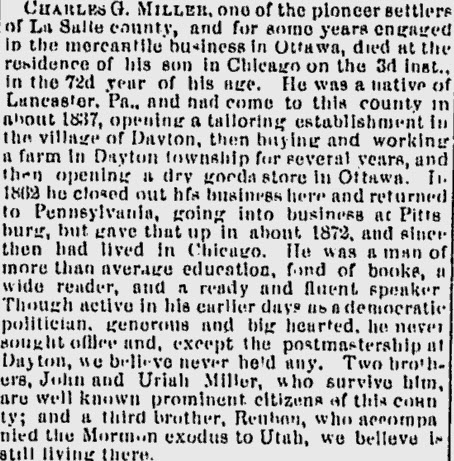
Charles G. Miller, one of the pioneer settlers of La Salle county, and for some years engaged in the mercantile business in Ottawa, died at the residence of his son in Chicago on the 3rd inst., in the 72nd year of his age. He was a native of Lancaster, Pa., and had come to this county in about 1837, opening a tailoring establishment in the village of Dayton, then buying and working a farm in Dayton township for several years, and then opening a dry goods store in Ottawa. In 1862 he closed out his business here and returned to Pennsylvania, going into business at Pittsburg, but gave that up in about 1872, and since then had lived in Chicago. He was a man of more than average education, fond of books, a wide reader, and a ready and fluent speaker. Though active in his earlier days as a democratic politician, generous and big hearted, he never sought office and, except the postmastership at Dayton, we believe never held any. Two brothers, John and Uriah Miller, who survive him, are well known prominent citizens of this county; and a third brother, Reuben, who accompanied the Mormon exodus to Utah, we believe is still living there.1

Charles was the son of Isaac and Esther (Gleim) Miller. He was born in 1809 in Lancaster, Pennsylvania. He and his wife, Eliza Smith, had four sons and a daughter: Mary, born abt 1834; William born about 1839; Milton B, born October 25, 1841 in Dayton; Edgar S born abt 1844; and Edward, born abt 1845. Charles was a justice of the peace in addition to serving as Dayton’s postmaster from1839 to 1845.

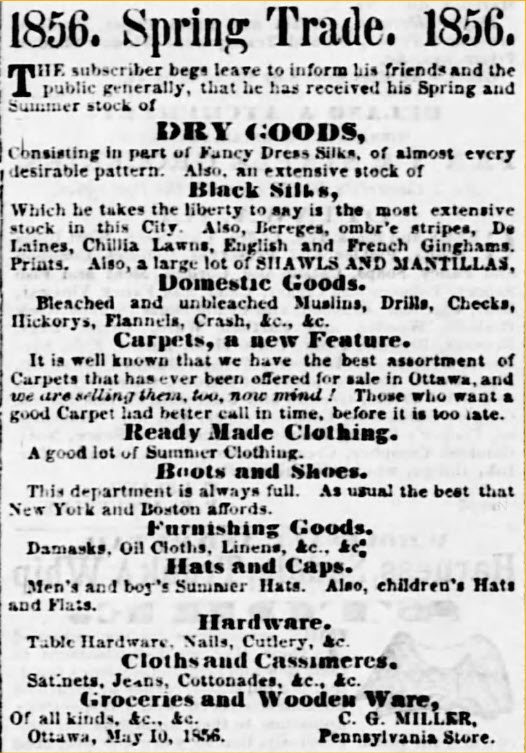
This is an ad for Charles’ dry goods store in Ottawa, showing the variety of items he offered. Note that the name of the store is the Pennsylvania Store, in honor of Charles’ home state. In 1857 ads appeared in the Ottawa Free Trader where Charles was selling his business in Ottawa and his farm prior to his move back to Pennsylvania. Charles never lived in La Salle county again, though he may well have visited his brothers after he (Charles) returned to live in Chicago.


  1. The Ottawa Free Trader, September 17, 1881, p. 1, col. 2.

The Marriage of Cora Green and Hosea B. Williams

Cora Green

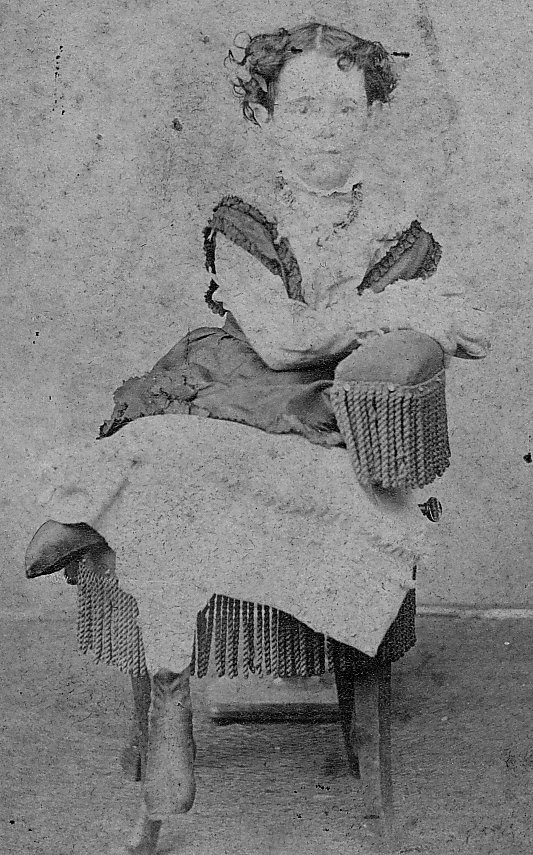
Cora was the oldest daughter of Jesse and Hannah (Rhoads) Green, born September 21, 1862, in Dayton.

From Dayton
Matrimonial

Cards have been out during the past week for a grand matrimonial event, in which all of our citizens and socially interested, for the wedding on the 22d inst. deprives us of two of our best members of the social circle, whose place it will be difficult to fill, and whose absence will be deeply regretted. The spacious parlors of the bride’s parents’ were elegantly decorated and festooned with evergreens and roses, and a fine floral arch and horseshoe were tastefully arranged over the entrance. At one o’clock, about sixty guests having assembled, the bridal party entered the parlors and in the presence of the friends and relatives, Miss Cora Green was united in wedlock to Hosea B. Williams, both of this city. The ceremony was beautifully and impressively performed by the Rev. E. C. Arnold, of Ottawa. The bride and groom received the congratulations of the whole company who with your reporter wishes them a long and prosperous voyage through life. After partaking of an elegant repast, the bridal party departed in the midst of a floral shower on the 4:10 train for Niagara Falls and the East. They will be gone about three weeks, and on their return will reside in Mr. Williams’ fine new residence in East Ottawa.

The bride was elegantly attired in a plain blue and brocaded silk, Spanish lace, natural orange blossoms, white kids, &c. The presents were many and elegant, evincing in a slight degree the high respect and love in which the bride and groom are held by their numerous friends.

Bride’s father and mother, two pairs of woolen blankets; groom, gold watch and chain; groom’s father and mother, elegant ice pitcher and goblets; Mr. and Mrs. S. W Williams of Streator, silver and decorated berry dish; Harry Green, silver card receiver; James Green, set of solid silver teaspoons; Joseph Green, set of silver nut picks and crackers; Mr. and Mrs. C. B. Hess of Ottawa, silver ice pitcher; Mrs. G. W. Gibson and Mrs. Isaac Green, elegant silver castor; Mrs. O. W. Trumbo, antique lace sofa lambrequin; John and Ella Green, double silver and cut glass pickle castor; Mr. and Mrs. G. W. Green, silver and cut glass celery holder; Mrs. Wm. Reddick of Ottawa, silver gold lined cake basket; Frank Dunnavan, elegant globe butter dish; Silas Dunnavan, celuloid toilet case; Cora, Chas and Belle Dunnavan, plush and satin glove box. Hattie Edwards of Mendota, elegant large-sized portrait; Mattie Brown of Newark, oil painting; Mr. and Mrs. Milton Peddicord of Rutland, silver and gold lined goblet; Estelle and Mira Bagley, pair of ornamental deer heads; Zetta and Nellie Strawn, pearl card case; Katie Rhodes, pair of vases; Eddie Hess, statuary; Dessie Root, silver pickle castor.

Occasional1


  1. The Ottawa Free Trader, June 24, 1882, p. 8, col. 1.

In Memory of John W. Rhoads

In Memory of John W. Rhoads

Died – At the homestead, in the town of Dayton, June 19th, 1891, John W. Rhoads, aged 69 years.

Born in Brownsville, Pa., came to Ottawa with his widowed mother and settled in Dayton township. Shortly afterwards he left his home for St. Louis, to work at his trade of a carpenter; the mother remaining with her small children founded the old homestead from which all the family have gone out one by one. In 1846 he enlisted for the Mexican war, in the Company of Captain Hudson, attached to the famous regiment of Col. Doniphan, sharing all its trying marches and participating in the battle of Sacramento, where 1500 fell on the Mexican side and less than a dozen on the American.

After this war he was at home for a short time and then went with the early gold seekers to California. Three times he crossed the plains, returning home once the same way and twice by water. Later on he went to Montana, stopping at Helena City. Here again he was successful as a miner, and was sent twice to the territorial legislature. Then he came home and a year afterwards went to the Black Hills, and remaining there but a short time, finished up his wanderings.

At the old home his life flowed along quietly, amid friends. He was intelligent and of a pleasant, social, turn. Had a wide knowledge of people and places and knew the world, its fluctuating scenes and cares, and was content. He came to the old home after the death of his dearly beloved mother in 1874, and in quiet gathered strength for the world to come, his life flowing on in the peaceful intercourse with friends, a well woven chain from manhood to middle life and then to old age, with silver locks – a crown of glory – the river of life flowing at his feet. A friend to the unfortunate, a brother in adversity, faithful and kind to all – his works do follow him and it is well.

Over the river a boatman pale
Dips his hand in the silvery stream.
Deeper and deeper than earth his voice:
“Come rest thee and bathe thee, O tempest tossed.”1


John W. Rhoads was born November 13, 1821 in Brownsville, Pennsylvania, the son of Thomas R. and Sarah (Collins) Rhoads. His father died in Pennsylvania, and Sarah afterward brought the family to La Salle county, securing a farm near Dayton. There were six children in the family – John, the eldest; Elizabeth, who married Robert Strawn; Samuel; Hannah, who was Jesse Green’s second wife; Mary Jane; and Thomas.

John never married. At his death in 1891 the inventory of his estate listed the assets as 120 acres of real estate, 105 lambs, 138 sheep, 43 swarms of bees, farm implements, growing crops, notes, credits, accounts, cash on hand, etc., of the value of about $4100. He may have led an adventurous early life, but he ended his days as a prosperous Illinois farmer.


  1. Ottawa Free Trader, September 19, 1891, p. 8, col. 3.

Dayton Teenagers Who Registered in the Civil War Draft

Unidentified young drummer boy in Union uniform

About Civil War Draft Registrations Records

There were four drafts between 1863 and 1865, which produced 3.175 million records. The Enrollment Act of 1863 required the enrollment of every male citizen between 20 and 45 years of age, unless exempted by the Act. These records are basically lists of individuals who registered for the draft.

This list of the young men from Dayton who registered for the draft must be from 1864, when men as young as 17  were drafted for the first time. Appearance on this list does not prove they actually served, only that they were registered.


Enrollment Record of Names Between the Ages of 17 and 20 Years
in the 6th Congressional Dist., State of Illinois.
Sub Dist #19
Residence: Dayton

Name                                    Age        Occupation         Birth date                            Birth place

Ames, James                      18           Farmer                  3 May 1846                        N. Y.
Buckaleb, John S.              17           Farmer                  4 Feb 1847                          Penn
Bidgood, Chas W.             18           Farmer                  30 Aug 1848                       Ohio
Brown, Perry                      18           Farmer                  28 Oct 1848                        N. Y.
Conley, William                  18           Farmer                  15 Aug 1846                       N. Y.
Carlon, James M.              17           Farmer                  24 Jun 1847                        Ireland
Carton, John Thomas      19           Farmer                  24 Dec 1845                       Ireland
Calloway, Alonzo              19           Farmer                  29 Apr 1845                       Illinois
Collins, DeKalb                   17           Farmer                  10 Jun 1847                        Ilinois
Curtis, Wm H.                     19           Farmer                  6 Mar 1845                         Illinois
Clark, George L.                 18           Farmer                  25 Oct 1845                        Ohio
Deweese, John                  19           Farmer                  29 Dec 1945                       Penn.
Donlevy, Francis                 18           Student                19 July 1846                       Mass
Donahue, Walthen           17           Farmer                  10 May 1847                      Ireland
Feely, James                       17           Farmer                  Oct 1846                              Ills.
Grove, David                      18           Farmer                  14 Apr 1846                       Ohio
Greenless, Wm A.             17           Farmer                  16 Nov 1846                       N. Y.
Hinkey, John                       18           Farmer                  1 Oct 1846                          Germany
Hays, Jesse                          18           Farmer                  Nov 1845                             Ills
Kain, Simeon C.                 17           Farmer                  8 Jun 1847                          Penn.
Marvin, George                 19           Farmer                  16 Aug 1845                       Penn
Nelson, Lewis                     18           Farmer                  Dec 1846                             Norway
Parr Francis M.                  19           Farmer                  10 Jun 1845                        Ills
Ruhl, Peter                          18           Farmer                  1 May 1846                        Penn
Smith, George                    18           Farmer                  30 Aug 1845                       Ills
White, Walthen                 17           Laborer                 4 Mar 1847                         Ireland
Yeager, Francis                   17           Farmer                  10 June 1847                     Ills
Miller, Gottzeni                 17           Farmer                  18 Apr 1847                       France

A Bicentennial and Homecoming in 1932

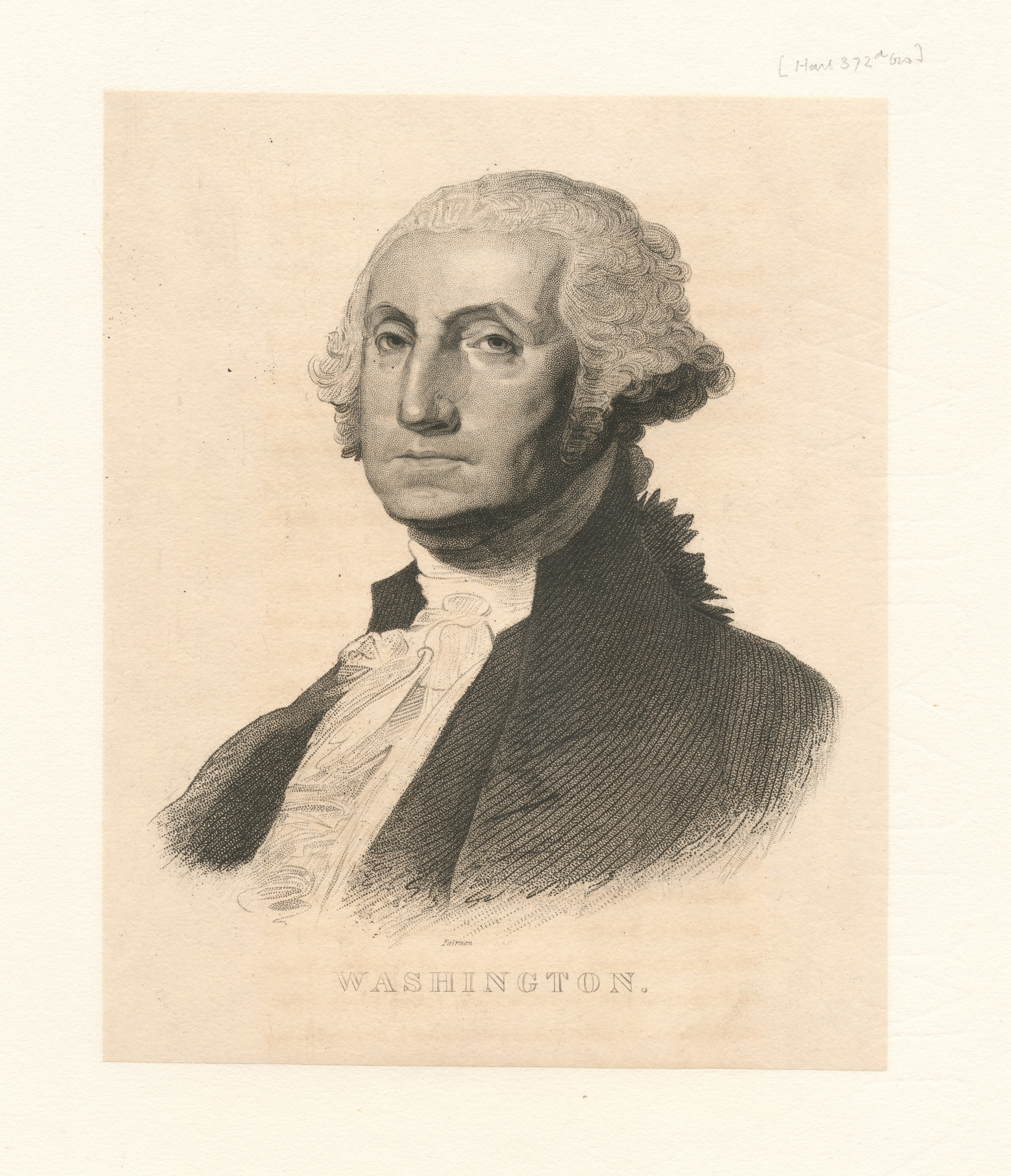
Dayton celebrates the 200th anniversary of his birth.

500 GATHER AT DAYTON FOR HOME COMING

Five hundred persons from various parts of the state gathered at Dayton yesterday for the Dayton home coming and George Washington bicentennial celebration.

The dedication of two trees, an address by W. R. Foster, county superintendent of schools, a musical program and a dance featured the activities of the day.

The morning program was opened with community singing under the direction of L. H. Chally. The invocation was given by Dr. J. J. Dunlop. Theodore Nelson dedicated the trees, one to the memory of George Washington and the second to the Dayton World war veterans. A parchment with the names of the veterans was also dedicated and will hang in the Dayton Community house. The morning program closed with a vocal solo by Marie Schmidt and a prayer by Dr. Dunlop.

Over half of the visitors were served a dinner in the club house at noon by members of the community.

Florence Louise Grove opened the afternoon program with a reading; Katherine Fleming gave a solo dance; Edwin O’Leary a vocal solo; Mrs. Albert Breuer a reading; Marie Schmidt a vocal solo; W. R. Foster, superintendent of schools, gave the main address of the day. The afternoon events closed with community singing.

Motion pictures and a dance formed the evening activities. The dance started with a grand march, led by Miss Helen Hallowell, dressed as Miss Liberty, and Mr. and Mrs. Arthur Retz as Martha and George Washington.1


  1. The Ottawa Republican-Times, September 6, 1932, p7.

Death of Mrs. Sarah Lewis

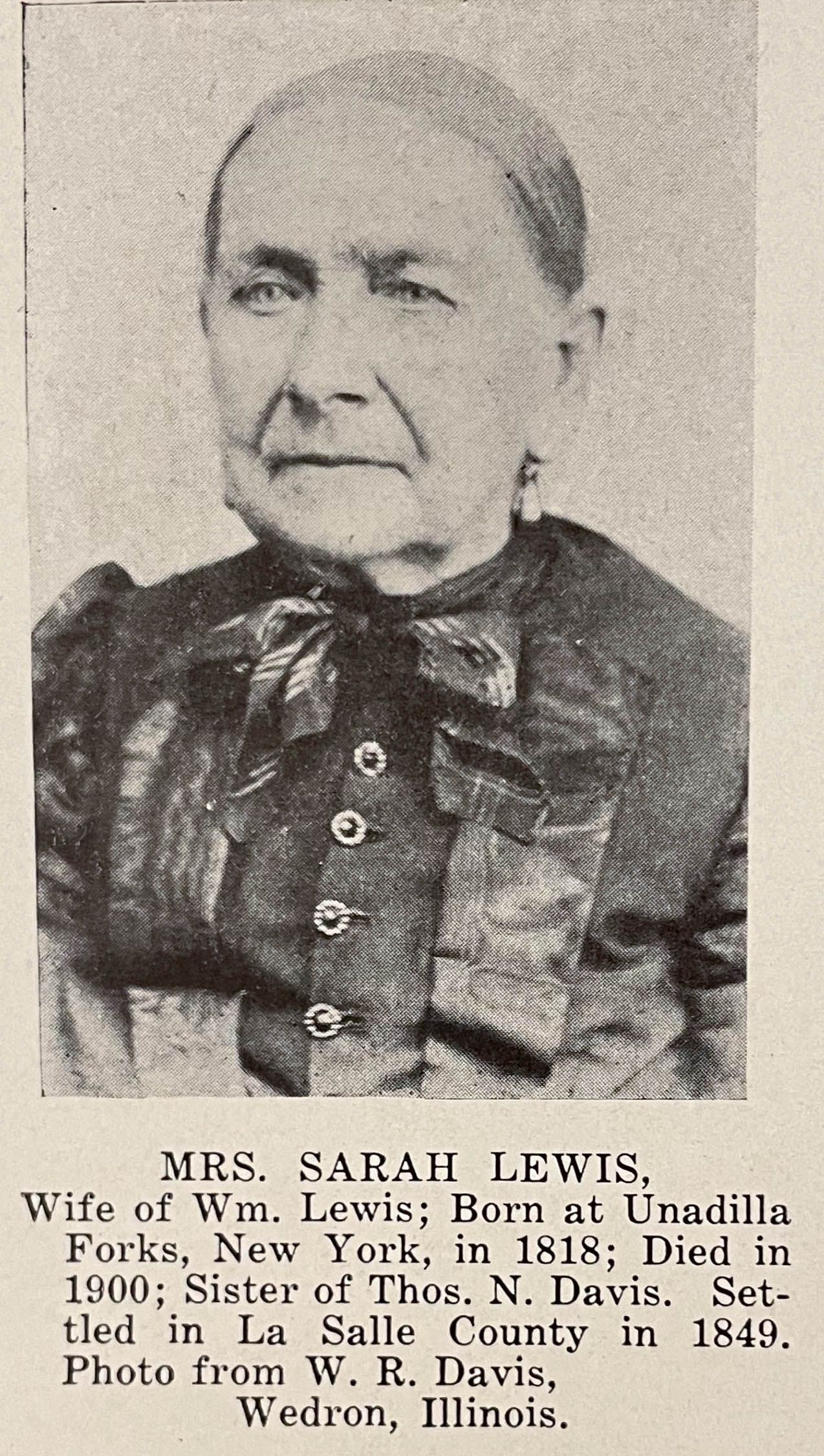
photo from FindAGrave

Wedron

Passed to spirit life, March 19th, Mrs. Sarah Lewis, aged 81 years, at the home of her son, Park Cole. Deceased was an old settler and resident of the town of Dayton. She had been sick for about a year and her demise was not unexpected. Five sons survive her. The funeral occurred from the school-house on Wednesday, at 11 a. m., Rev. Baird, of Ottawa, officiating. As we write a large concourse of friends are gathering to pay last respects to the memory of one who was loved and esteemed while living and mourned in death.1

The above obituary gives little information about Sarah Lewis’s life, so this is an attempt to expand on the few facts in the obituary.

Sarah Davis Cole Lewis was born abt 1818/19 in New York. She married William Cole on February 4th, 1838, in Plainfield, Otsego County, New York. They had 6 children: Lyman, Leroy, Jay, Marian, Parke, and Burt. The family moved to La Salle county about 1849 and settled in Serena township, north of Dayton. By 1860 they had moved to Marseilles, Illinois.  On November 18, 1861, William Cole enlisted in the 53rd regiment, Illinois Infantry at Ottawa, Illinois. Unfortunately, his part in the war was of short duration. He died at Pittsburg Landing, Tennessee, on April 6th, 1862. As reported by the Regiment Major:

He was breaking teams consisting of six mules, was thrown from the one he was riding on, was run over by the wagon and his back broken and otherwise injured.

William is buried in the West Serena Cemetery. Sarah applied for a widow’s pension and there were two young children who were also entitled to support. She was appointed guardian for her two young sons, Parke and Burt. She got a pension of $8/month from William’s service.

In June 1865 Sarah Cole and William Lewis, of Dayton, were planning to marry. Because her widow’s pension would end at her remarriage, she wanted some assurance that she would be provided for should her husband predecease her.  On June 13, the two of them signed an agreement in which Sarah says that without such a contract she would not have married Lewis. The provisions for her children are that Lewis will support, clothe and educate her two sons until the age of twenty and when they reach twenty-one he will give each a horse, saddle, bridle and suit of clothes. Should Lewis die before Sarah, she will have all his real and personal property and, in addition to maintaining herself and her sons, she will provide for the younger Lewis children until they reach the age of twenty.

With the contract signed and registered with the county court, the marriage took place the next day, June 14th, 1865. The two Cole boys worked alongside the Lewis men on the farm and Sarah kept house for the blended family.

William Lewis died October 9th, 1874 and was buried in the Dayton Cemetery next to his first wife, Eliza Ann Holman. Sarah lived on the dower tract of her husband’s farm until her death on March 19th, 1900. She was buried in the West Serena Cemetery, next to her first husband, William Cole.


  1. Ottawa Republican-Times, March 22, 1900, p. 5, col. 2


The Dayton Cemetery Association – a retrospective

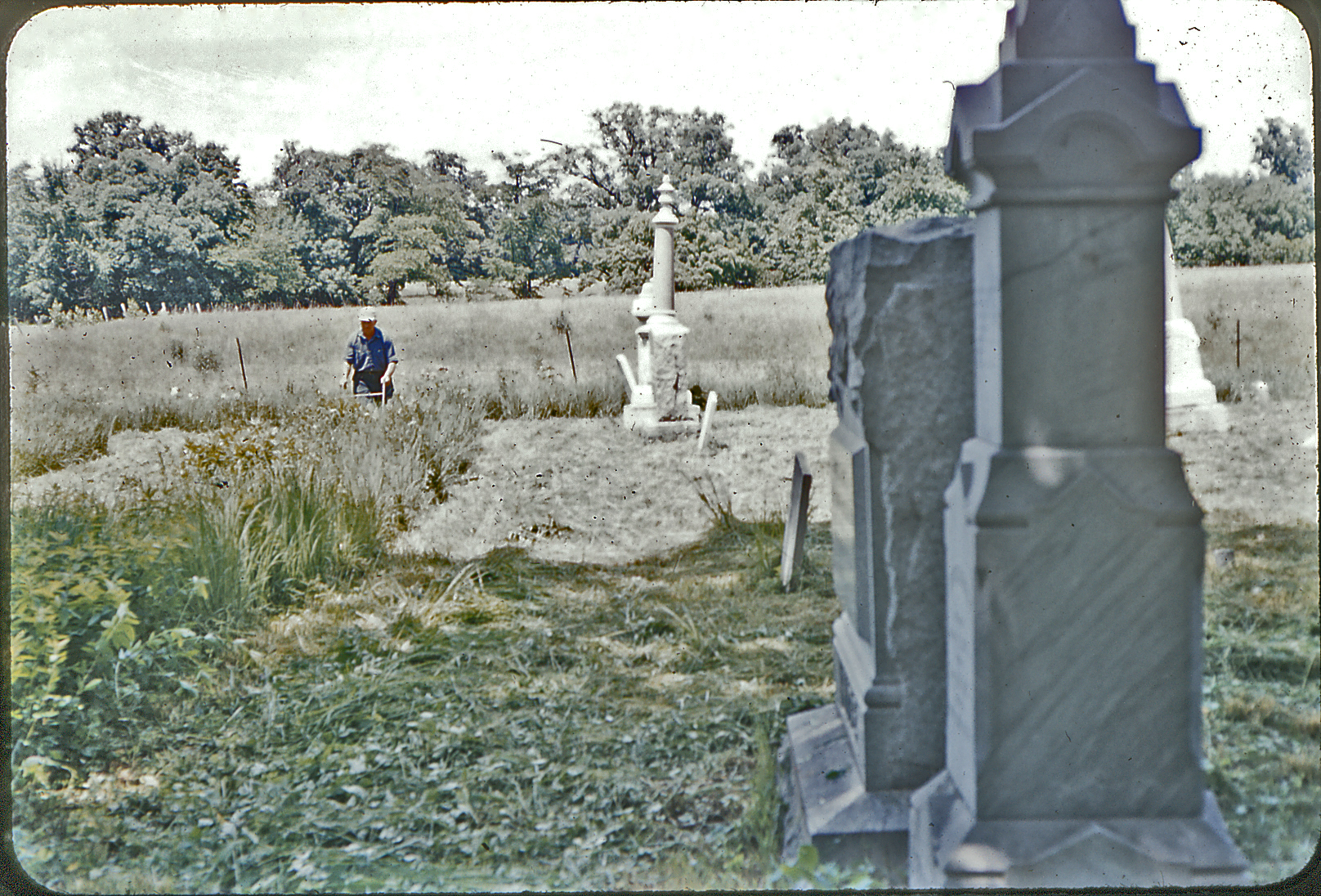
There have been several different Dayton Cemetery Associations over the years since the first burial in 1835, The current group was organized in 1956, with the object of cleaning up the cemetery, which had been allowed to go wild, and building a fund for providing on-going maintenance and support.

The first job was to mow the tall weeds.

Cleaned around the stones and trimmed branches

The annual meeting of the Association is held on the Sunday of Memorial Day weekend, and for many years met at the home of Grace and Charles Clifford, in Dayton.

Mabel Myers, Sandra Dunavan, and the 10th anniversary cake – 1966

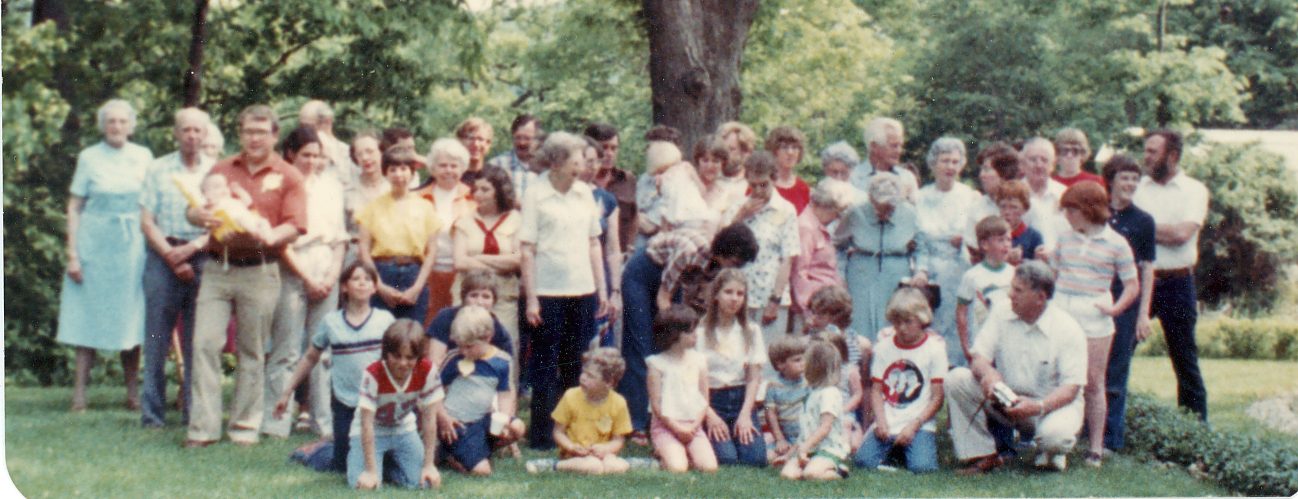
As the years went by, the group grew larger.

1980 – taken on the Clifford lawn

In 1996 Secretary Carrie Ann Green searched through the minutes and created a timeline of the organization up to that point. The timeline and the program Carrie gave in 1996, can be seen here.

Every year the meeting concluded with a historical program, frequently a story of families buried in the cemetery. More of the old programs will be added to this site as I get around to it.

In 2000, after the Cliffords moved from Dayton to Ottawa, the annual meetings were held at Skydive Chicago.  The traditional potluck meal and the historical program following the business meeting carried on the traditions, regardless of location.

2007 – We had to draft someone from the skydivers to take our picture.

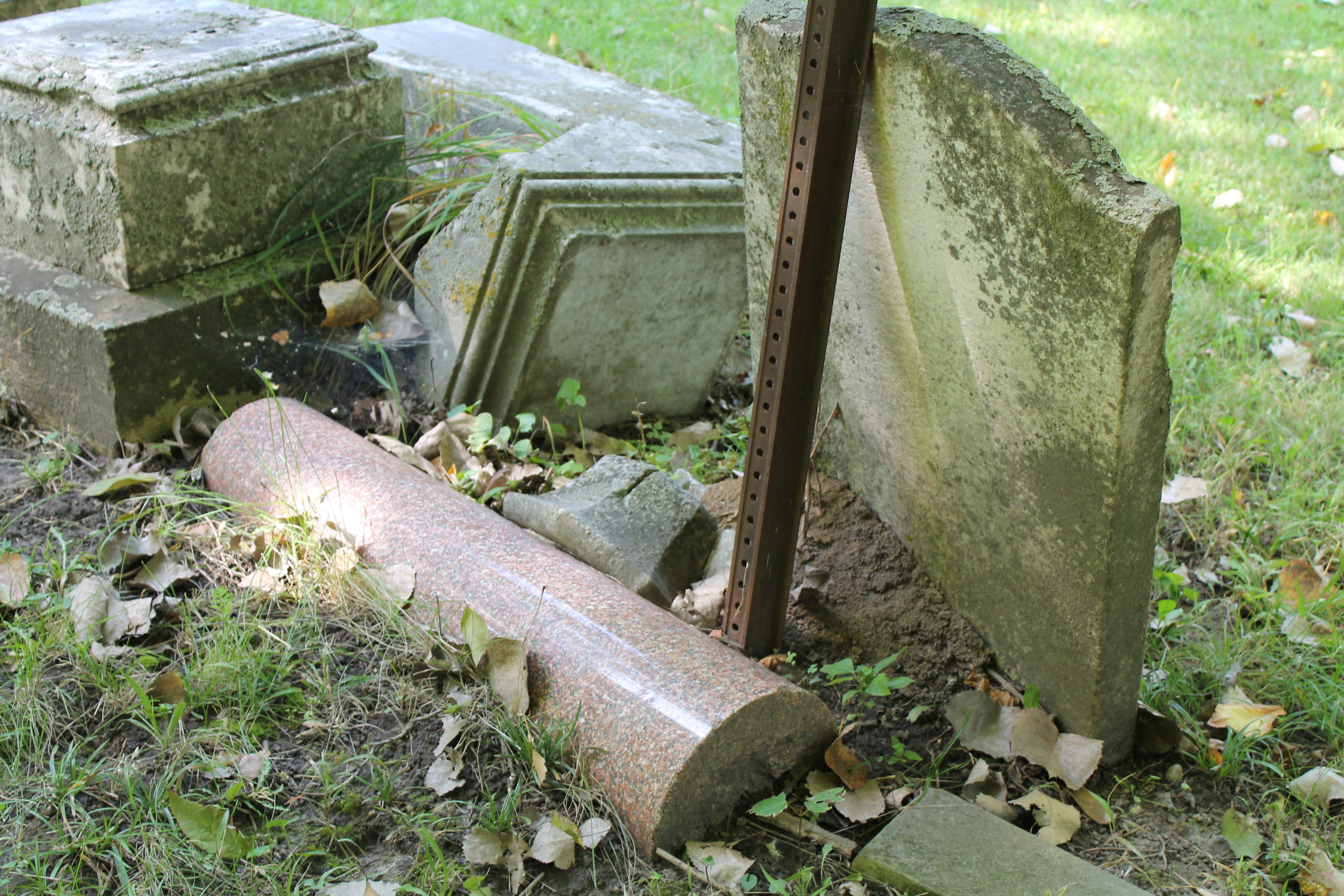
In 2014 we worked with John Heider, a professional cemetery restoration expert. That year we restored 20 stones and the following year he came back and we did another 30 or so.


In 2020 Covid changed everything and we went to Zoom for meetings (though not for the pot-luck meals). In 2024 we are returning to Skydive Chicago and a more normal existence.

A view to the west

Rural Happenings

Rural Happenings
Dayton

Dayton, June 2d, 1881
The river is falling slowly, and is now being crossed at both fords. Fishermen and sportsmen are here in great numbers. The Earlville people seem to have struck a “boom” and are turning out en masse for a good time fishing and camping out.

The bridge across the Fox river at Dayton went out in the flood of 1875 and was not replaced until 1887.  People got very tired of having to ford the river.

Peter Coleman, an old resident of this place, was taken suddenly ill last Tuesday morning while at work in his garden, and for a time was unconscious, but soon recovered possession of his faculties and is recovering.

Miss Carrie Stowell, of Bloomington, Ill., has been visiting her sister, Mrs. Wright, and returns home today.

A meeting is to be held next Saturday evening at the school house for the purpose of obtaining an expression of the views of the people in regard to building a new school house.

They got their new school house the next year. It was in use until it burned down in 1890.

A lawn festival was held at Mr. O. W. Trumbo’s last Wednesday evening, for the benefit of Prof. H. L. Boltwood, of Ottawa. There was a fair attendance and all seemed to have a pleasant time. Next to the pretty girls, strawberries and ice cream were the principal attractions. The evening’s receipts were satisfactory to the managers.

Henry L. Boltwood was the first principal of the Ottawa Township High School.

A few of our young folks have organized an Archery Club for amusement and recreation. They expect to become expert marksmen, perhaps.

The tile works have just finished burning another of their excellent kilns of tile. They make the best hard tile in the county, for smoothness, hardness and durability.

Misses Myrtle Stadden, Judith Dent and Bertie Stadden, of Wenona, have been visiting in Dayton during the past week. They returned home Thursday.

Miss Clara Gibson, of Rutland, came over to attend the lawn festival and visit relatives.

Occasional1


The Ottawa Free Trader, June 4, 1881, p. 8, col. 2

An Amateur Mesmerist

Forty-five years after the incidents related here, Jesse Green wrote this article about his experience with hypnotism:

“An Amateur Mesmerist”
“How I became interested in the investigation of Mesmerisn”

In the fall of 1848 one Doctor Underhill visited Dayton where I then resided, with a Mesmeric subject and claimed that through him he could among other things find lost property.  He undertook to find a pair of buggy wheels lost in fording the River during a high stage of water a short time previous.  The buggy wheels were lost by Dr. Ward of Marseilles.

He started in at the ford, and when in the River opposite my house, the subject said “he saw no buggy wheels, but there lay an old saddle under a ledge of rocks in deep water”.  There had not been a word said about a saddle being lost.

But I had lost my saddle during the same rise in the River, and he described it as well as if lying before him, which was an easy matter as I had started hastily to cross the River, and found one of my stirrups gone, and took an odd one in its place.  We then went under his directions, in a boat with a lantern, and persons on the bluff overlooking the River, and in communication with the subject (Jockey Smith) who directed us to the spot.  We did not find the saddle but found the ledge of rocks in about ten feet of water.

This so impressed me that I together with a number of others got the Doctor to deliver us a course of lectures on Mesmerism, and the night of the third lecture he had us all take a subject and see what success we might have.  I selected my sister and succeeded in getting her Mesmerised, before the Doctor got his, and gave her up to him, not yet knowing how to proceed farther, but soon became familiar with all the Doctor knew on the subject.  During that winter I Mesmerised eight or ten different persons.  My first experience worthy of note was with my first subject.  Father requested me to send her to Newark, Ohio, and from there up the Ohio Canal, and see if she could name the Towns she would pass through (he being familiar with the whole length of the canal, having built fifteen miles of it).  She would name places in their regular order (apparently by reading some sign giving the name) and when she reached Cleveland she exclaimed “Oh! what a great body of water”.  Father was fully satisfied that she either read the signs correctly or read his mind.  This much I know they can do.  My best subject being the best clairvoyant I had outstripped this all hollow.  He would personate anyone, in speech, actions, and in every way.  I had him sing by exciting the organ of tune, and have thrown it off, at the highest pitch in the tune, with the word half uttered, and in a half minute or so would excite the organ again when he would start in again where he left off with the same pitch of tune, and the other half of the word as perfect as if there had been no intermission.

During one evening some one suggested that I “have him look ten years into the future and see what he would say about Dayton”.  Of course I had no faith that he could tell anything reliable, but did so.  He looked around a little and said it had not improved much “but they have a new mill down there and Uncle Johnny is up in the third story”.  Uncle Johnny was my Father and lived a number of years after that mill was built, and I believe that this clairvoyant saw it seven years previous to its being built.  It may be said that he guessed it.

I will relate another experience that will show too much complication to admit of guess work.  This all occurred during the winter of 1848 and ’49, and we were calculating to go to California in the Spring (and in the clairvoyant state) I sent him there to see what he would say about it.  We did not get much information only that there seemed to be a great rush to that country, and they were getting plenty of gold”.  It seemed to him in returning that he met our train going in the spring and his first exclamation on meeting it was “See that wagon, how they have fixed it up”.  I inquired about the wagon and he said it was “George Dunavans wagon and that they had broken the coupling pole, and had it wound with ropes and chains, and Uncle Johnny is behind carrying some birds”.  When he told this Father had no idea of going to California with us.  The Company employed him to go to Missouri and buy oxen for the outfit and return home, but there being so much cholera on the River he preferred crossing the Plains, rather than risk getting the cholera on his return.  Our company consisting of forty nine men with twenty wagons, left Ottawa April 2, 1849.  Myself being elected captain of the Company, one day on the route a short distance East of Fort Kearney, my clairvoyant (Daniel Stadden) borrowed a horse from one of the company and rode ahead with me, when we were a mile ahead of the train we saw that they had stopped, and by the time we rode back to see what was the matter, here was George Dunavans wagon reach broken and wound with both ropes and chains and Father was behind carrying a sage hen he had shot.  Stadden said to me “that is just how I saw it when I was mesmerised”.

Had it been any other wagon we probably should not have thought anything further about his prophecy, but every circumstance connected with it, being literally fulfilled brought it vividly to the minds of both of us.

I have often regretted that on my return home I had not further investigated it, I did very little in California but on our return home via Mexico one of our Company had a horse stolen and having faith in Mesmerism he wanted me to Mesmerize Mr. A.B.Goodrich (one of my former subjects) and one of our Company to see if he could find his horse.  I was a little afraid to do so there knowing the superstition of that people, but we had an interpretor who went and saw the Alcalde of the place and found that he had seen it before, and was anxious that I should Mesmerize Goodrich, he being present with our interpretor.  He soon described the thief and pointed out the direction he had taken, describing minutely every crook and turn in the road, and where the thief had stopped for the night.  The Alcalde had such confidence in everything that he said he would send next morning to recover the horse and thief if possible.  We were driving five hundred horses, and did not wait to see the result.

I think the possibilities of Mesmerism are very imperfectly understood even at the present time.  I have frequently seen accounts published of what seemed a little strange, but nothing equal to my experience with it.

I should have taken up the further investigation of it, but my second wife thought she could see the cloven foot of his Satanic Majesty in it, and on her account I gave it up, but my experience was entirely the reverse, and with evil intentions I was taught and believed it would prove a deserved failure.

It may be asked by some, why did you not have your clairvoyant find gold for you in California.  I do not pretend to say whether he could have done so or not.  The poor fellow died of scurvy soon after reaching California.

Should this seem a little too fishy, I would say that there are still living witnesses to corroborate the facts stated.

Ottawa
October 17th 1894,
Jesse Green.
A May Dayton Marriage

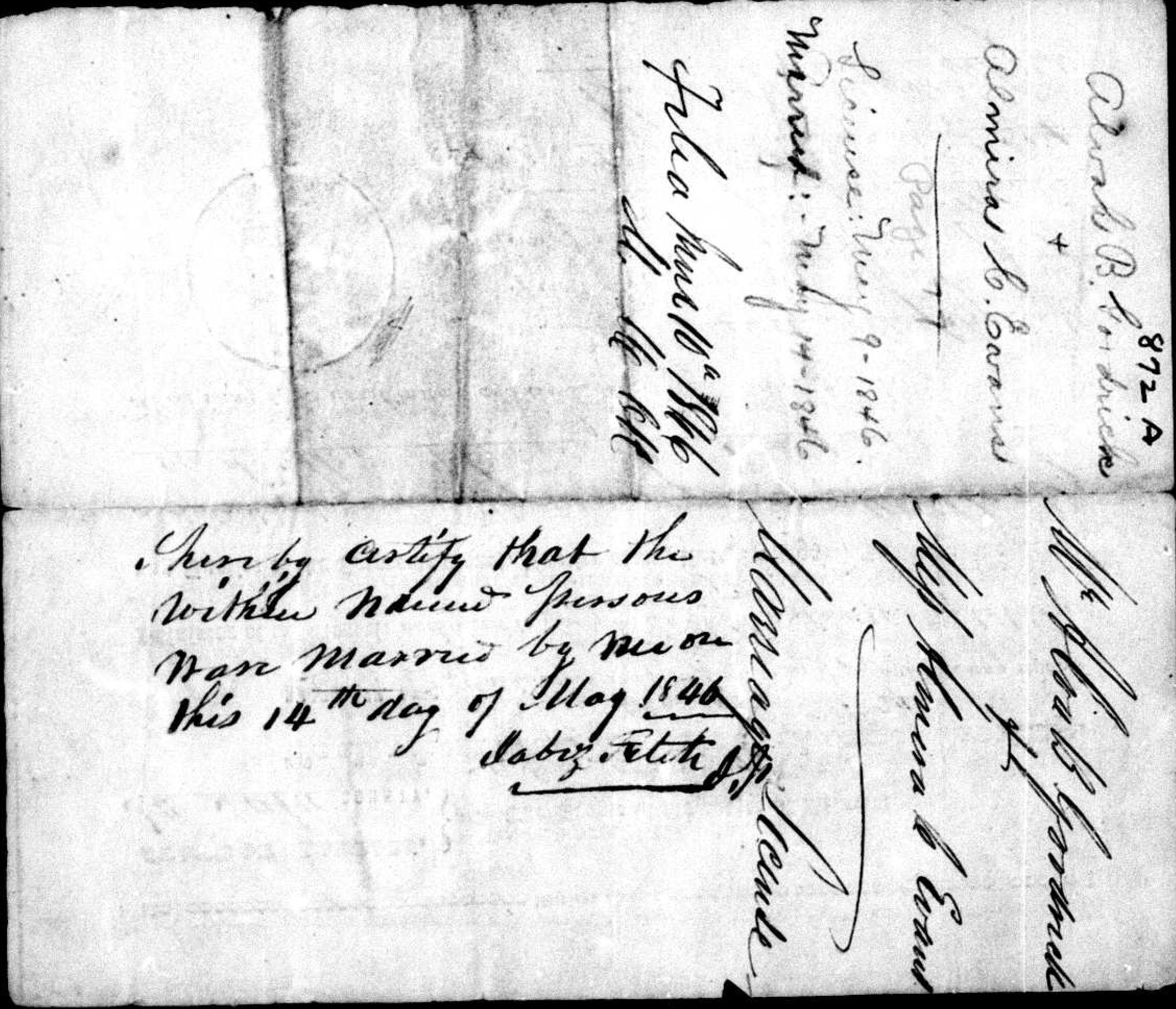
On the 9th of May, 1846, Alva B. Goodrich and Almira C. Evans applied for a marriage license in Ottawa.

Five days later they made good use of it, as reported in the Ottawa newspaper:

MARRIED – At this place, on the 14th inst, by J. Fitch, Esq., Mr. A. B. Goodrich to Miss Almira C. Evans, all of Dayton.1

Alvah Goodrich came to La Salle county in 1844. He worked in the Greens’ woolen mill in Dayton, having learned the trade in the woolen mills of his hometown. In 1849 he went with the Green party to California and spent two years working in the mines. He returned to Dayton and spent an additional year working in the woolen mill. He then bought 88 acres and turned to farming. After he retired, he lived in Miller township, where he died on February 3, 1893

Obituary

DIED. – At his home in Miller township, Friday morning, the 3d inst., Alvah B. Goodrich, at the advanced age of nearly 76 years. Mr. Goodrich was born in Clinton county, New York, February 14, 1817, and passed his boyhood days in his native state, emigrating to Illinois nearly fifty years ago and settling in Dayton township, where he married Miss Almira Evans in May, 1846. Of this union two children were born, Emma L. and Willis J., who both survive, the daughter living on the old homestead and the son in Macon county, Missouri. During the gold excitement in 1849 Mr. Goodrich accompanied the Green expedition to California in search of gold and after nearly two years’ absence returned to his wife and little daughter and settled on a farm near where the village of Wedron now stands.

Here he resided for five years, removing to his late home in Miller township in 1857, where he spent the remainder of his days, honored and respected by all. Ten years ago last September the wife of his youth was laid to rest in the “churchyard on the hill,” leaving her companion and family nearly brokenhearted. Now they sleep side by side awaiting the last call. So one by one the “old settlers” are passing to the great beyond.2


  1. The Ottawa Free Trader, Friday, May 15, 1846, p. 3, col. 1.
  2. ibid, 18 Feb 1893, p5, col 2

Spring in Dayton

Judy Gallagher, CC BY 2.0 <https://creativecommons.org/licenses/by/2.0&gt;, via Wikimedia Commons


from The Ottawa Free Trader, March 30, 1907

Dayton

Mrs. Ostrander spent Tuesday with Mrs. Thompson.

Mr. Basil Green and granddaughter, Gladys, were Ottawa visitors Saturday.

Mrs. McCleary, Mrs. Dallam, Mr. and Mrs. Ostrander and Mrs. Pyatt shopped in Ottawa Saturday.

Mr. F. M. Ostrander did a small job of carpenter work for Oscar Thompson Tuesday and Wednesday.

Mrs. Libbie Hayes went to Marseilles Wednesday to visit her parents, returning Thursday evening.

A new little daughter, weight 9 lbs., has come to the home of Mr. and Mrs. James O’Meara. Born Tuesday, March 19th.

Mr. Tom Maher and Mr. Fullerton are putting in tile on Dr. Smurr’s farm and expect to go next to the Trumbo farm.

Mr. Rush Green, who has been doing jury duty in Chicago, came down on Thursday evening. Mr. O’Meara came Wednesday.

Mr. Ostrander did carpenter work for Mr. Sam Hippard Thursday, then started Monday morning for Mr. Chas. Knoll’s to do about two hours’ work.

Spring seems here to stay. Folks are making garden and the hustlers also have “spring frys” on the way. Mrs. Tanner leads off with thirty-five new chicks.


Spring in Dayton always meant bluebells and violets to me. We put them in May baskets to hang on door knobs the evening of April 30.

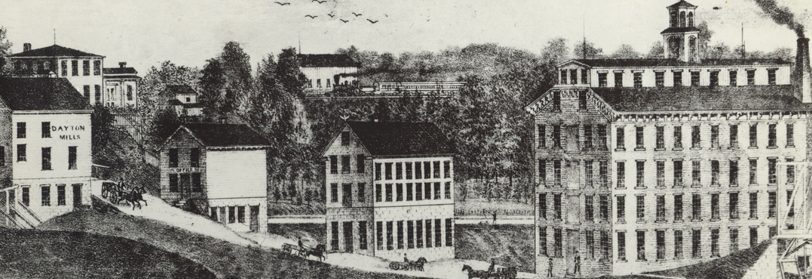
Status Report on the Dayton Industries


The following is from The Ottawa Free Trader, June 2, 1888, p. 8, cols. 2-3

Dayton

Times are a little livelier now in this vicinity than they have been for some time past.

The paper mill has started up again, and is getting a number of car loads of baled straw.

The tile works are running right along and are shipping a considerable quantity of drain tile of the very best quality. They are also shipping a lot of fire clay, having received an order for one hundred tons to be shipped immediately to Chicago. Users of clay are beginning to learn that we have the very best quality of fire clay in the county, and no doubt in the near future Dayton will contain a number of good substantial fire clay manufactories.

The roller mills are running on custom and merchant work as usual, and are manufacturing a first class article of straight grade roller flour. Try a sack and be convinced.

The horse collar works have cut down on their working force, as this is their usual dull season, and are manufacturing fly nets. With good crops this season, this firm anticipate a good trade during the fall and winter.

The old woolen mill property which has been run as a pressed brick factory by the Chicago and Dayton Brick Co., has been sold to an eastern firm who are putting it in shape for manufacturing purposes. We have not learned yet the intentions of the new company, but hope they have sufficient capital to do an extensive business.

The town is full of fishermen at present, and Landlord Timmons, of the Dayton Hotel, says he has had a good run of custom during the past two or three weeks.

Harding turned out a good sized fishing party last Saturday.

Mr. and Mrs. T. H. Green, and Miss Winnie Childs, of Morris were in Dayton over Sunday.

Mr. Bert W. Stadden and Miss Taylor, of Chicago, were in Dayton a few hours Sunday afternoon.

The river is a little higher on account of the late heavy rains.

Mr. William Hewitt is greatly improving the appearance of his piece of property by a coat of paint.

We find there is considerable interest taken in our extracts from California letters among various readers of your valuable paper in the county, as this information is reliable and not highly colored like the usual real estate men’s information. We wrote Mr. Butler of Puryn, Place Co., California, in regard to the fruit business being overdone in that State, and will give you his reply and other information: [content of letter not transcribed]

Occasional