Charles Green

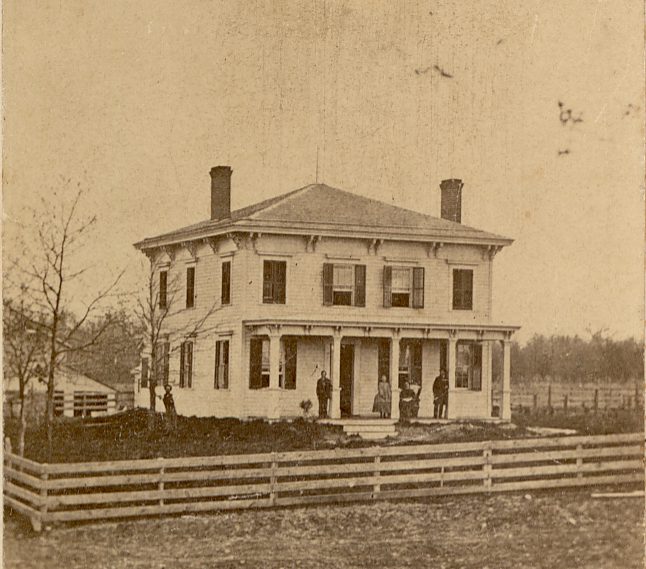
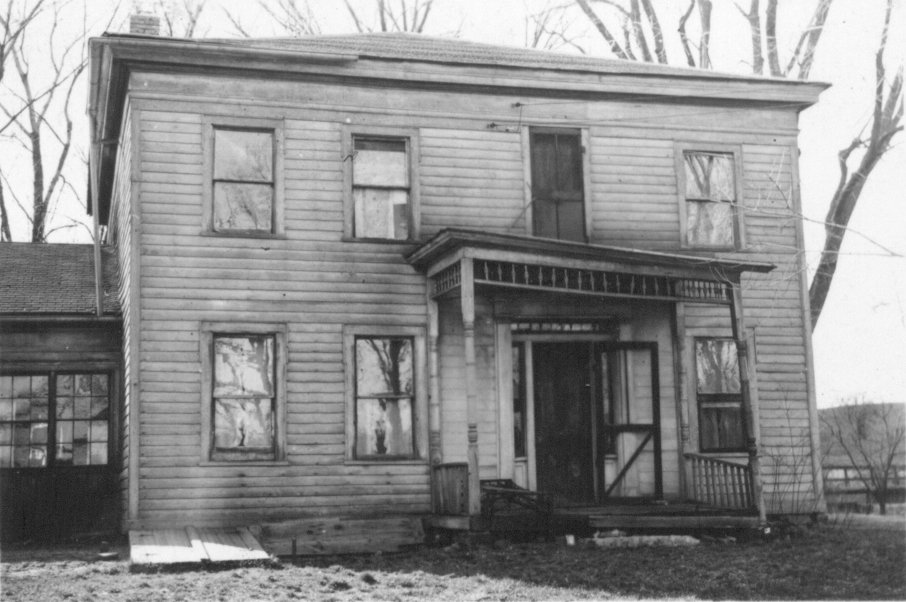
The house where Charles Green was born. His room was the top window on the right.1

Charles Green was born August 4th, 1858, in Dayton, the sixth child and fourth son of David and Mary (Stadden) Green. He may have been injured in his youth, as the 1880 census lists him as crippled.

As a young man he produced a semi-monthly newspaper called the Dayton Enterprise, He had a small printing press and he was editor, reporter, printer, and publisher. Unfortunately, only one copy survives, but it is issue #4, so the paper ran for at least 2 months. It advertised that he would print cards, bill heads, letterhead, envelopes, tickets, and the like, with reduced rates for quantity.

In April 1879 Professor Newbury, a music teacher from Hinkley, Illinois, held a week long music class in Dayton, ending with a concert. The class was then organized into a Musical Union, with Charles Green as the leader. Charles later also organized and led a Glee Club, in addition to giving private lessons. His efforts were appreciated by all of Dayton:

DAYTON, Dec. 24, 1879 – Dayton, unlike many western towns, is blest with a number of good things, and one of the good things is the Musical Union, which was organized last spring by Prof. Newbury, and has since been conducted by our esteemed fellow citizen, Mr. Chas. Green. We also have a Glee Club in Dayton. And all feeling a high appreciation of Mr. Green, determined to make that feeling manifest by giving him a benefit. Hence a concert was agreed upon and given last Friday evening, which was well attended, not only by the village people, but by many from the country. All were well pleased with the entertainment and expressed a desire to come again. We certainly have good reason for anticipating a bright future for Charlie in his wisely chosen field of labor, knowing as most of us do that he is in a very large degree self-made in his profession. May success crown your every noble effort, friend Charles.2

In addition to leading the choral groups, he taught both vocal and instrumental classes, for children as well as adults. Charles was also active in the Literary  Society, appearing in the plays they put on and willing to take a side in one of their debates. He supported the Library Association, serving as its secretary.

In 1882 he was elected town clerk of Dayton. He also went into business with his brother John, purchasing an interest in the Dayton Tile Works. A few years later they rented the old flour mill and fitted it up with new machinery,

He married Etta M. Skinner in DeKalb county, Illinois, on November 25, 1885. She was born February 14, 1865 in Leland, the daughter of Charles and Matilda Skinner. They had three children:

Guy, born October 25 1886 in Dayton, died April 22 1912, in Napa, California
Caroline, born February 25, 1891 in Benicia, California; died August 31, 1955 in San Rafael, California
Wilbur, born June 18, 1896 in Vallejo, California; died January 22, 1976 in Sonoma, California

Mary Stadden Green and children

Guy and Carrie with Charles’ mother, Mary Stadden Green


In 1889 the family moved to California, settling in Vallejo where Charles continued his musical profession. He taught music in the public schools, led the choir in the Baptist church, as well as continuing to give private lessons. He also had a sideline in tuning pianos. As his family grew, his income from music may have needed augmenting. He got a civil service job as a clerk in the Office of the General Storekeeper at the Mare Island Navy Yard in Vallejo. However, this did not put an end to his musical activities, as he continued leading the Baptist choir and offering private lessons.

The children married and moved away to other parts of California, but Charles and Etta remained in Vallejo, where she died in January 1936 and Charles in July of that same year.

Jan 1936 GREEN–In Vallejo, Solano County, January 19, 1936, Etta Skinner Green, wife of Charles Green, mother of Wilbur Allen Green of San Francisco and Caroline Green of Vallejo, grandmother of Cheryl Green Kennedy and Helen Marie Green of San Francisco, great-grandmother of Robert Emmett Kennedy of Vallejo, and sister of Mrs. Sadie Dickens of Wyanett, Ill., and Mrs. Mary Keyes of Manchester, Iowa; a native of Leland, Ill., aged 70 years. Funeral services were held in the Vallejo Episcopal Church to-day, with interment in the Masonic and Odd Fellows Cemetery.3

GREEN—In Vallejo, California, July 24, 1936, Charles Green, dearly beloved husband of the late Etta Skinner Green; devoted father of Wilbur Allen Green of San Francisco, Caroline M. Green of Vallejo, and the late Guy Green; loving grandfather of Cheryl Green Kennedy of Vallejo, and Helen Marie Green of San Francisco; devoted great grandfather of Emmett Kennedy of Vallejo, and beloved brother of William S. Green of San Francisco and Ella Riley, Leland, Illinois. A native of Dayton, Illinois, age 77 years. Funeral services to which friends and acquaintances are invited, will be conducted at the Ascension Episcopal Church on Monday, July 27, 1936, at 11 o’clock A. M. Interment in Masonic and Odd Fellows’ Cemetery. Friends may call at the Funeral Home.4


  1. You may wonder how I know which room belonged to Charles. My great-aunt Maud, who was eight years younger than Charles and knew him well, told me about his printing the newspaper in what was, at the time she told me, my sister’s bedroom.
  2. Ottawa Free Trader, December 27, 1879, p. 8, c. 2.
  3. Vallejo [California} Evening News, January 20, 1836, p. 8, c. 8.
  4. Vallejo Evening News, July 24, 1936, p. 3, c. 1.

Illness, Visits, and a Telephone

Mr. and Mrs. David Sisk, of Ottawa, spent Sunday with Mr. and Mrs. Jas. O’Meara.

Mr. and Mrs. G. G. Galloway Sundayed in South Ottawa.

Quite a number of relatives and friends viewed the remains of the two youngest sons, Leroy and Sidney, children of Mr. and Mrs. G. L. Makinson, who died last Friday within ten hours of each other. Both were taken sick with the measles on Sunday, and on Thursday pneumonia set in and in a few hours both were dead. The funeral would have undoubtedly been a large one, but it was the earnest wish of the parents that it should be private. Both were buried at 11 o’clock on Saturday morning in the same grave at the Dayton cemetery.

Ottawa seems to be a ready market for our Dayton coal, and most of it is a superior quality. The people of our sister city know a good thing when they use it.

There seems to be no let up in the shipping of fire clay. The tile mill is kept busy every day shipping it to the cars.

Ice is forming on the Fox river here, much to the satisfaction of the small boy who owns a pair of skates.

J. McBrearty, agent of the C. B. & Q., is again troubled with the rheumatism.

Newton Connors is down with the measles.

Mrs. B. Jackson, of Millington, has been spending a few days with Mr. and Mrs. O. W. Trumbo.

Chas. Seward, becoming tired of our quiet little winter resort has moved his family to Ottawa, in which city he will make his future home.

Martin Wilkie had a narrow escape while mining coal on Monday. The bank caved in and he was warned by a passer by just in time to make his escape.

O. W. Trumbo is contemplating placing a private telephone at his residence.

The C. B. & Q. bridge over Nigger creek, just south of Dayton, is being repaired.

Miss Jennie Barends, who has been on the sick list for the past ten days, and has been taking baths at the mineral spring at Ottawa, is now much better.

Thos. Nagle, foreman of the Q. section, has laid off two of his men, as is customary in the winter.

AN election of the M.  W. A., Fox River Camp, No. 6117, was held at their hall on Tuesday night.

QUINN1


  1. The Ottawa [Illinois] Republican Times, 13 Dec 1900, p4.

Grand Wolf Hunt

It is proposed to have a general turn-out of all in the towns of Rutland and Dayton (the cooperation of the towns of Mission and Serena respectfully invited) who are desirous of ridding themselves of these pests — the wolves —  which are becoming so numerous that they have been seen in droves of three and as high as five, to the great annoyance of sheep men, and others.

The plan of operations will  be for Rutland and Dayton — with the request that Serena and Mission join them — to elect one marshal in each town, who shall have entire control, first and second lieutenants for every twenty men, who shall be subordinate to the marshals, the people of those towns to drive to Fox river, where the meeting shall be simultaneous, with a view of capturing every wolf, which is considered better than to meet on the prairie, as is usually the custom in such hunts.

Friday, the 27th day of February, is the time appointed for this grand turn out — for this grand raid on the wolves — for the organization and success of which the following meetings are hereby called: One at the Grove school  house, Rutland; one at the Dunavan school-house, on Buck creek; and one at the schoolhouse in the village of Dayton, on Saturday evening, February 21st. The meeting at the Dunavan school-house to have the privilege of electing the marshal for the town of Dayton.1

Hunts typically involved hundreds of men walking in a line with guns. In 1875, Illinois had a bounty for wolf scalps. Settlers could receive $20 for each wolf scalp they provided. There was also a smaller bounty of $3 for wolf pups.

Although the submitter of this report promised to provide a report on the success of the event, a search of the next few issues of the newspapers was unsuccessful. Maybe there wasn’t much to brag about?


  1. The Ottawa Republican, February 19, 1874, p5.

Of Schools and Concerts and Burning Tile

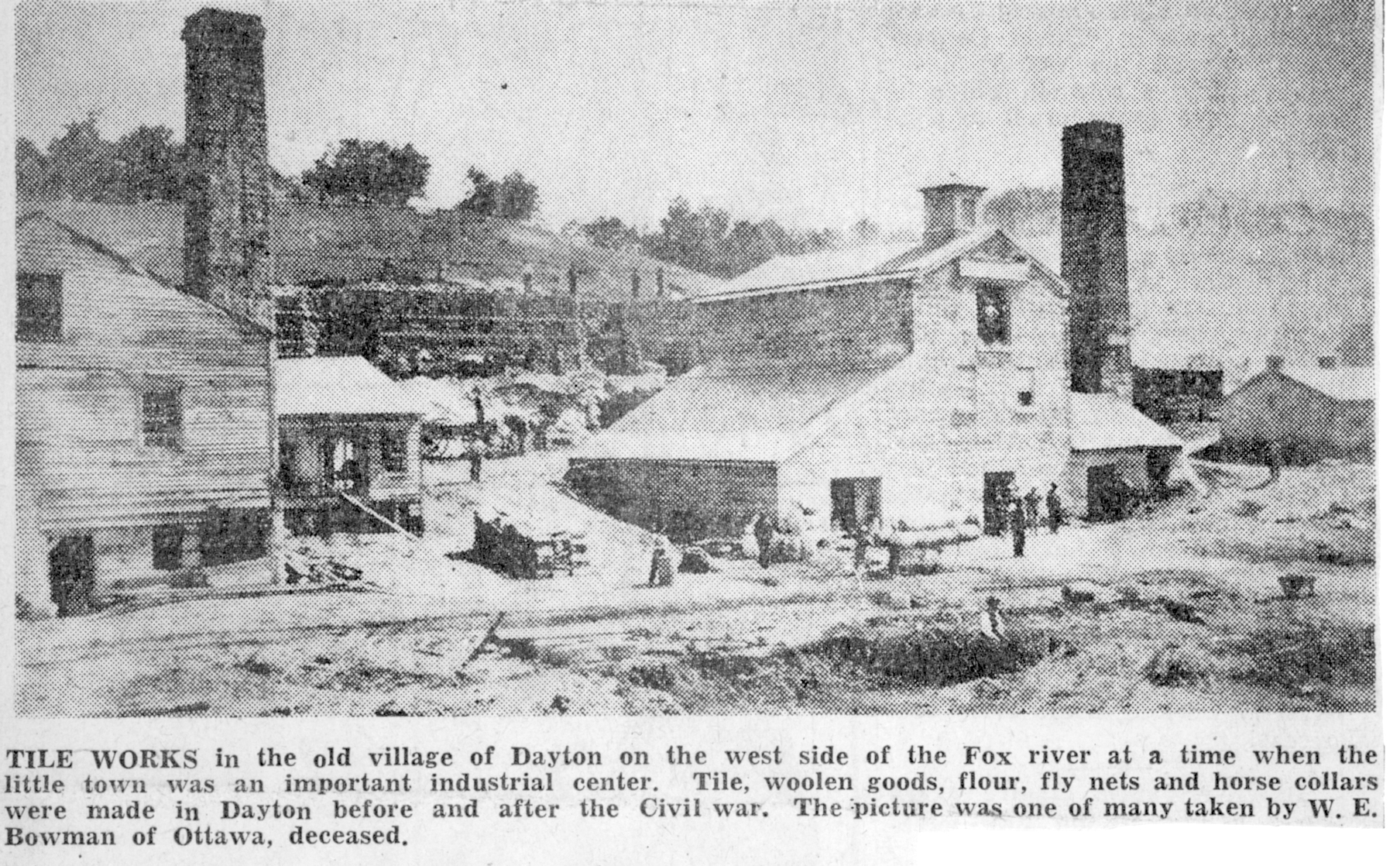
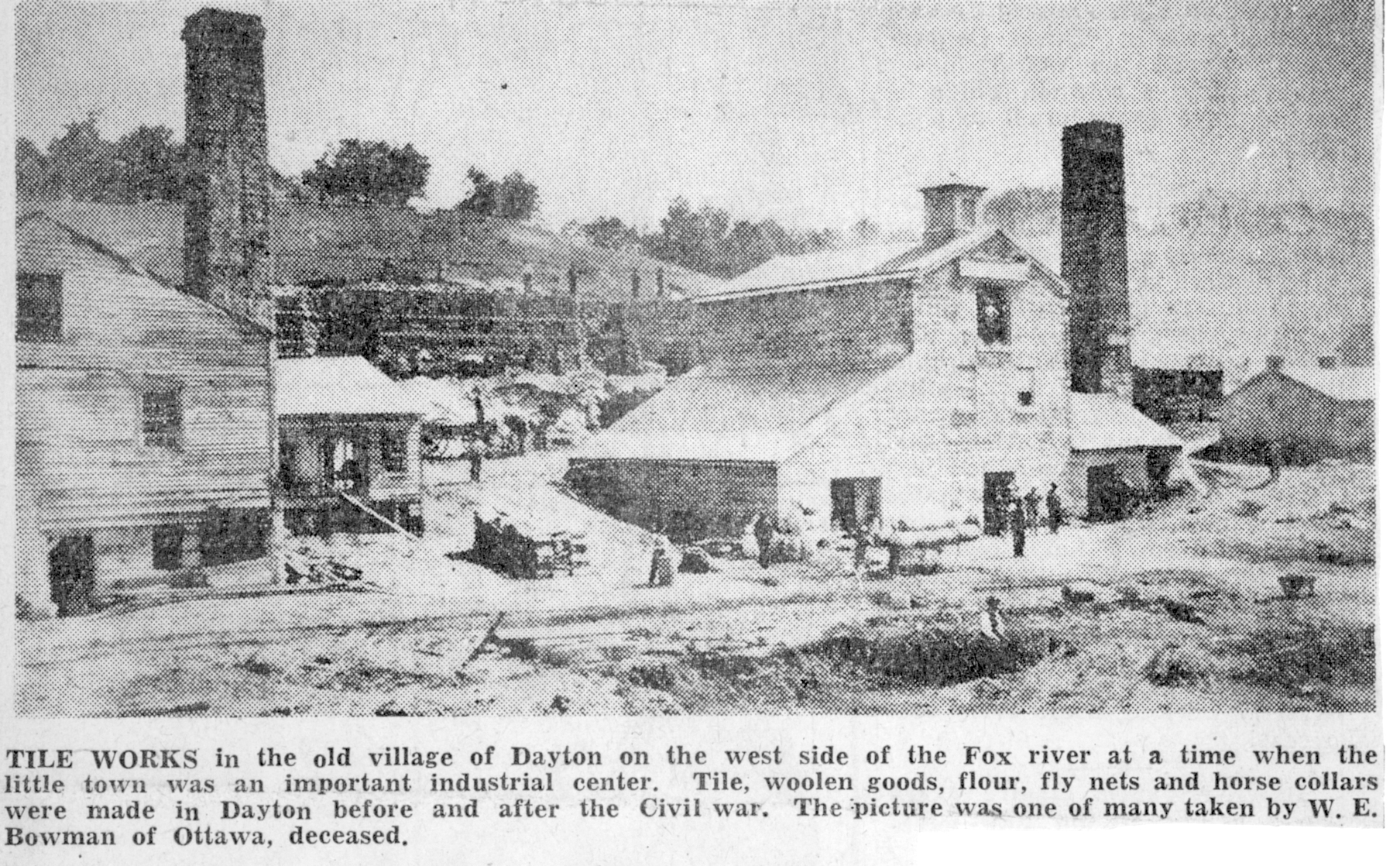
Tile factory in the background

Dayton, Sept. 11, 1879. – After a brief silence, again we are at our post ready to abuse and be abused. Not that we would willfully abuse any one, but some persons are so sensitive, you know, that even complimentary remarks are by them turned into abuse, and then they are “mad” at the writer.

Never – what, never? – yes, never, has the river been as low here as it is at present. But the mills are all running yet, thanks to our first right to the water.

Our public school has been reorganized and divided into two branches. One is under the supervision of Mr. Chas. Howard, the other being taught by Miss Ada Green. The attendance is quite large, and the board was wise in dividing the school.

Mrs. R. C. Stadden and family, of Wenona, are in town visiting relatives and friends.

Miss Kate D. Jordan, of Morris, who has been spending the past two weeks in Dayton, bade good bye to her many friends and returned home last Saturday.

A number of our young folks “took in” the theatre at Ottawa last week, and came home with sore sides. The Troubadours, they say, were immensely funny.

Mr. Wm. Dunavan is attending the Ottawa high school this year.

The concert given at the close of the musical convention last Friday evening was quite well attended, and was, without doubt, a success both musically and financially. Miss Jordan’s solos were very fine, and were greatly enjoyed by our people, by whom she was frequently encored. The class, under Miss J’s excellent leadership, rendered the choruses in a very pleasing and acceptable manner.

Green Bros. have just finished burning their third kiln of tile, and are now ready to furnish customers with a good quality of tile at the lowest market price. Great care has been taken in the burning, and the tile taken from the kilns are found to be of the same degree of hardness none too soft, but all alike. Some parties have been misrepresenting the tile by saying they are too soft, but to those who would know the truth, we must say, “visit the kilns and see.” Tile will be drawn to the top of the hill by the proprietors for those who will notify them of their desire. In fact, the firm will do everything to please customers, not only in market prices but in a good quality of tile.

We chronicle the following deaths in town since our last article: Miss Bula Timmons, died Aug. 3; Mr. Ransler Timmons, died Aug. 22; Mr. Hathaway’s child, Aug. 8.1


  1. The Ottawa Free Trader, September 13, 1879, p.8, cols. 1-2

Finding Birth Dates in a Probate File

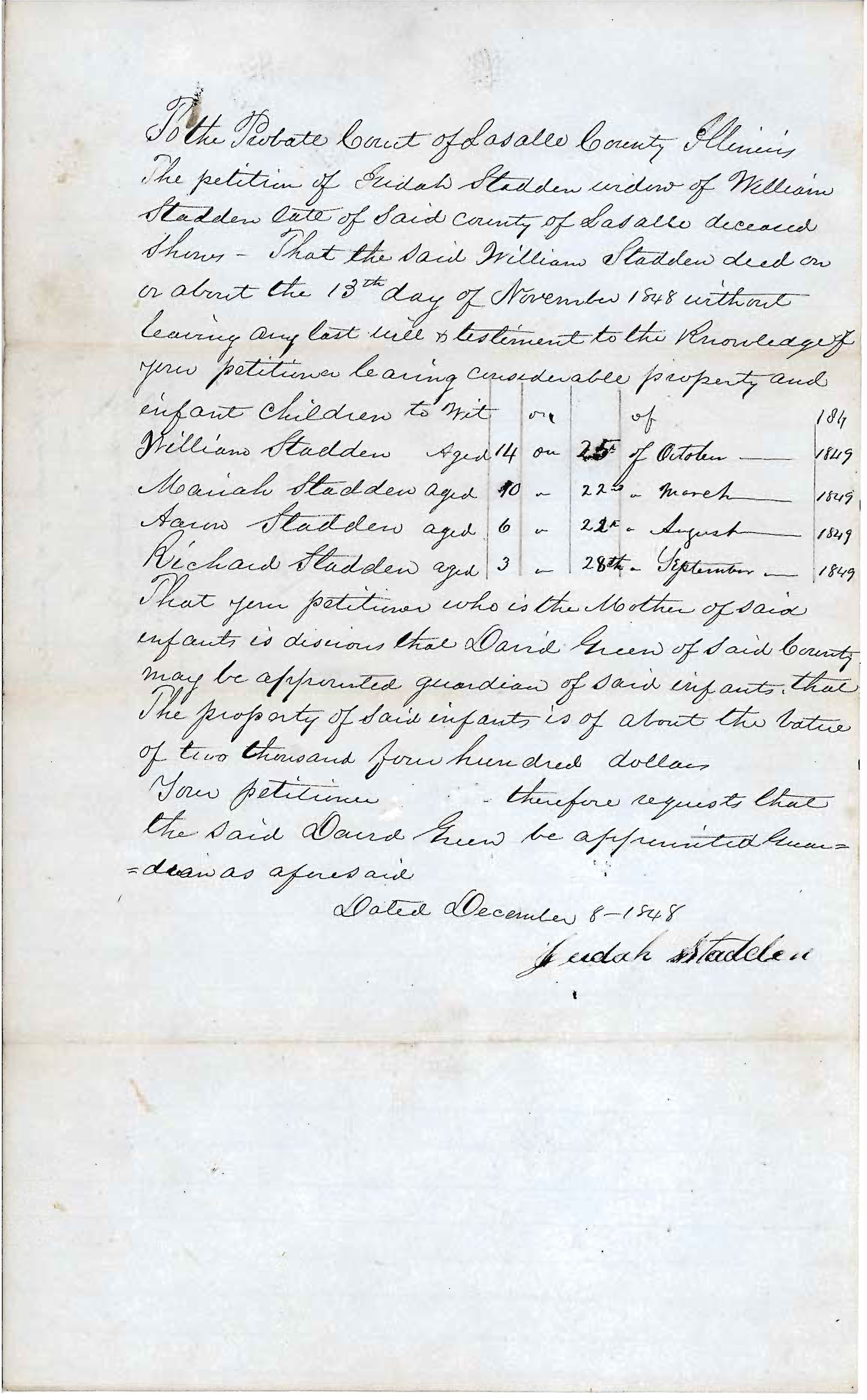
When William Stadden died in Dayton in 1848, he left 6 minor children. Because they had inherited from their father’s estate they needed a guardian to take charge of said estate. The mother of the four youngest children requested that David Green, the husband of her oldest daughter, be named guardian. In her petition she gave the birthdays of the children

William Stadden aged 14 on 25th of October 1849
Mariah Stadden aged 10 on 22d of March 1849
Aaron Stadden aged 6 on 22d of August 1849
Richard Stadden aged 3 on 28th of September 1849

The guardianship petition was filed January 22, 1849, so the birthdays listed for the children had not yet occurred. In fact, Aaron’s never did. He died of scarlet fever on February 28th, at the age of five.

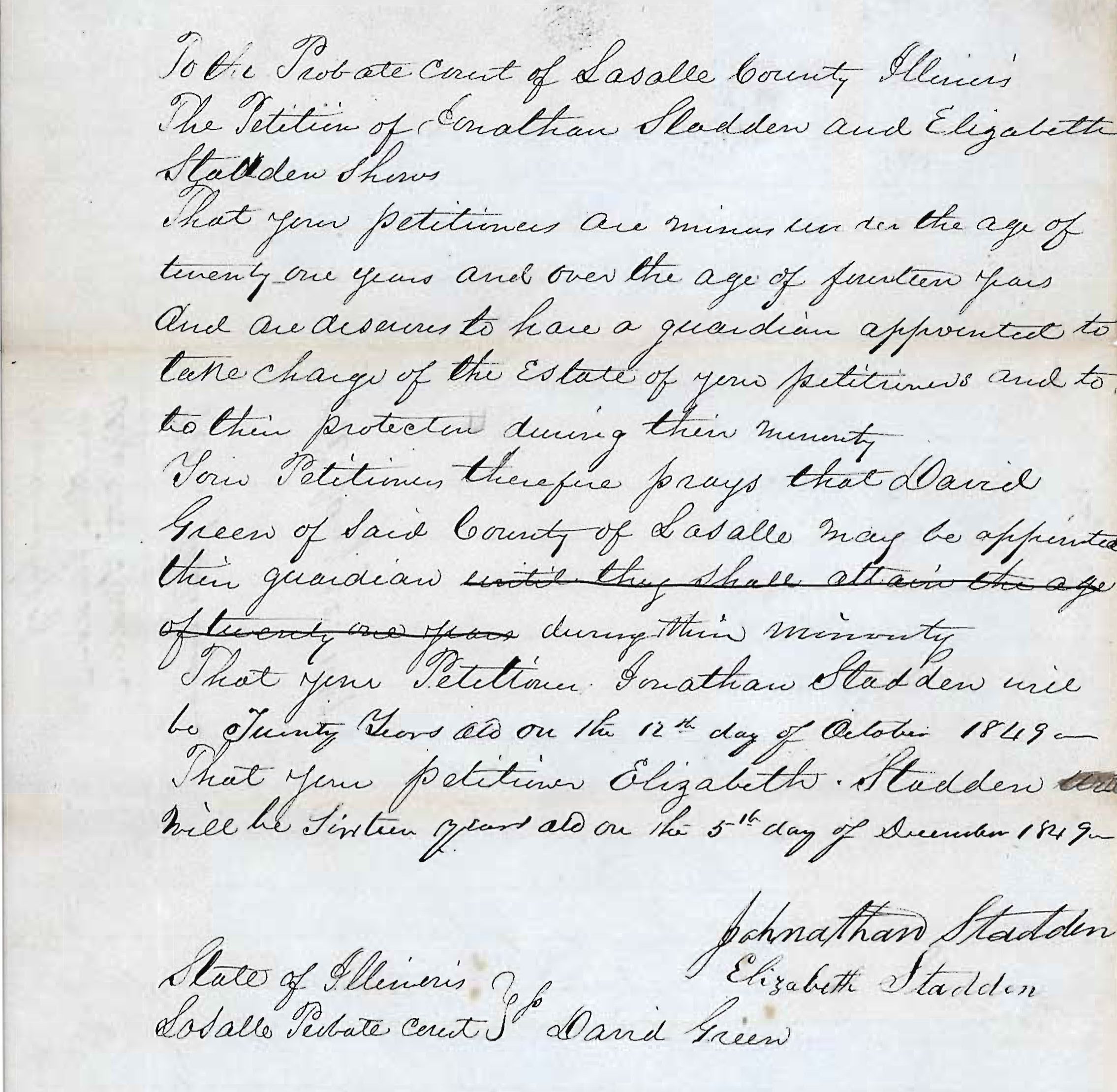
The two oldest, Jonathan and Elizabeth, were over 14 and were thus legally able to select their own guardian. Unsurprisingly, they also chose David Green, their sister’s husband. In their petition, their birthdays were given:

That your Petitioner Jonathan Stadden will be Twenty Years old on the 12th day of October 1849 —
That your petitioner Elizabeth Stadden will be Sixteen years old on the 5th day of December 1849


Authentic Signatures

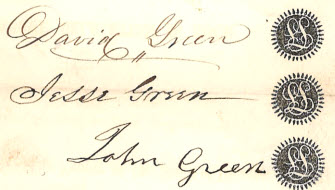
When William Stadden died in Dayton on November 13, 1848, his widow, Judah Stadden, renounced her right to administer his estate and requested that David Green, her son-in-law be appointed administrator.

Stadden’s estate was large enough that David needed to file a bond for fifteen thousand dollars. In order to do this, his father, John, and brother, Jesse, joined in the bond.

It’s not always easy to find authentic signatures, which makes finding a father and sons combination even more delightful. It’s interesting to note the generational difference in the handwriting styles: the capital J and capital G in John’s signature show an older style of penmanship.


News of the Day – 1892

Scarlet rash or scarlet fever, which is it? was the question of the day. Now there are new cases, and some of the recently afflicted are seen on the streets, and the excitement is dying away. The carelessness of some of our people in dealing with contagion deserves severe criticism.

Pliny Masters is down with some grippe complication.

Wm. Flemming made a flying trip to Iowa. Just returned.

Last week Ellis Breese left for Lincoln, Nebraska, where he will visit for some time.

What has become of the Sunday-school? we have not heard the bell for several Sabbaths.

Miss Carrie Barnes is on the sick list. Her sister Emma is filling her place as teacher in the primary department of our school.

The winter term of school will close March 10th. Arrangements are being made for an entertainment in the evening.

Our factories and fisheries will soon furnish employment for all weary of resting.

The morning sun strikes Dayton squarely in the face and makes her smile again.

The interest in the World’s Fair is growing. This is right. We should be pleased to see vigorous steps made towards a good representation of the American Indians at the Columbian Exposition. A large encampment of Indians, with all their rude equipments on the grounds, would make a grand contrast between then and now.

FISHER1


  1. Ottawa Republican-Times, 3 Mar 1892, p4.

Obituary of Charles H. Hoag


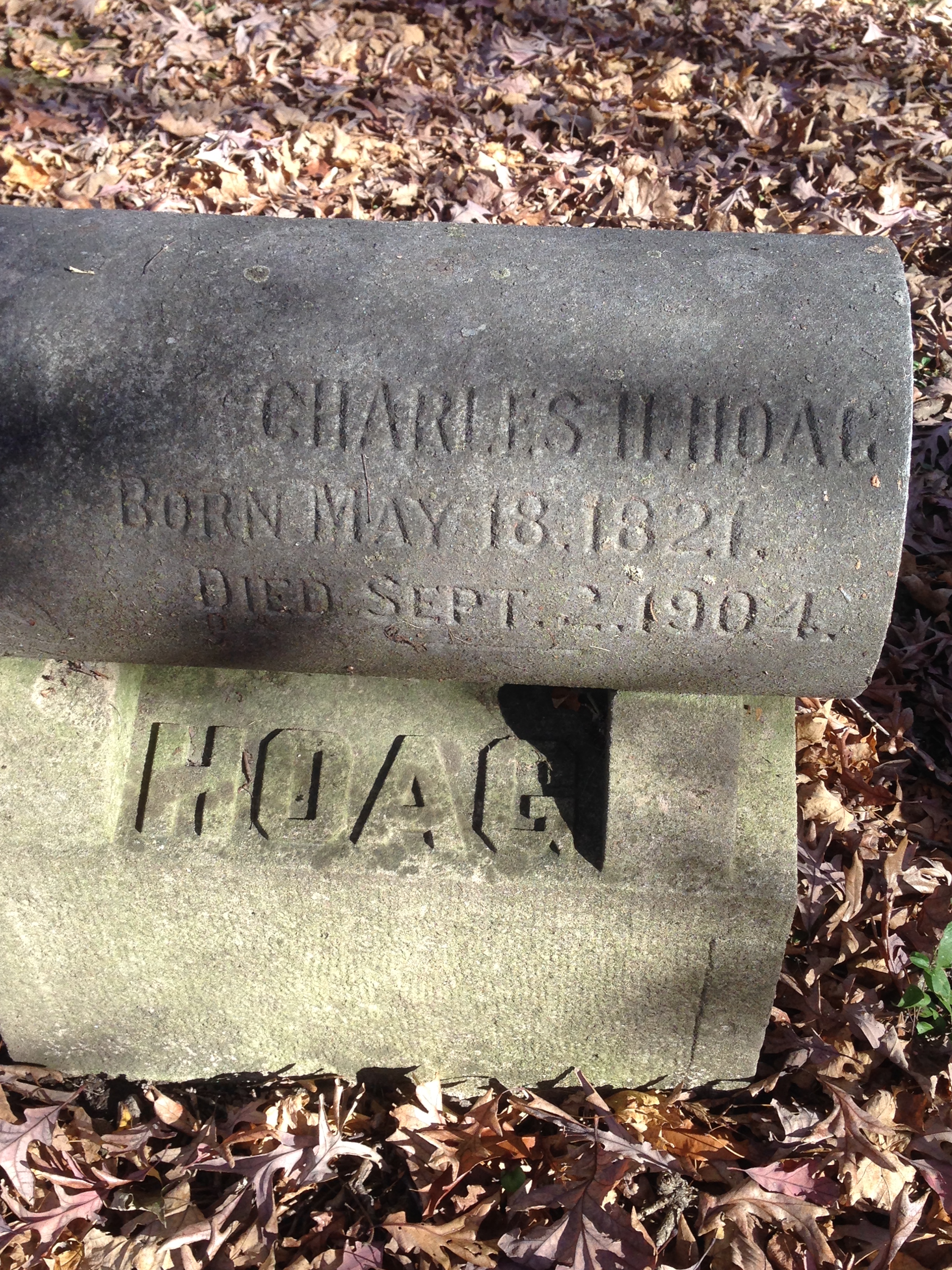
Charles H Hoag, tombstone

Our old friend and neighbor, Chas. H. Hoag, passed away peacefully at his home in Serena last Friday Morning, Sept. 2d. All his children were present except one daughter, Mrs. Clara Fread. Mr. Hoag was born in Delaware county, N. Y., May 18, 1821. He obtained his education in his native state and at the age of 21 came to Illinois. Before permanently locating he spent four years in Michigan, going to that state in 1845, and stopping in St. Joseph county, where he was married in 1847 to Miss Helen Robinson. They came to La Salle county two years later, by wagon, and settled on a rented farm in Dayton township. In 1853 he purchased his present home, and three years later his wife died. Of this union three children were born — Mary, wife of Leonidas Fread, and William, both deceased, and Mrs. Clara Fread, now living in California. Mr. Hoag’s second wife was Miss Mary Wells, who died in 1891. Their children were Lincoln, of Chicago, George, who died in Texas, Lillie, the wife of Walter Carted, now living in Yorkville, Cyrus, who died in Kansas in 1889, Franklin, Alvin, Adams, who married Josephine Beckwith, and Maude, The wife of C. B. Stockham. He leaves also eight grandchildren and six great-grandchildren. Mr. Hoag retained his faculties to the last, and it was a pleasure to hear him recount incidents relating to his long life. His death breaks the link connecting us with the sturdy pioneer past, which has made our country what it is. Last Sunday we laid him to rest in the Dayton Cemetery among the departed loved ones.1


  1. Ottawa Republican Times, 8 Sep 1904, p7.

A View of Our Sidewalks

Not specifically Dayton, but you wouldn’t walk down the middle of this, either.

DAYTON

Dr. Bascom left the first treasure of the season at the home of Wm. Ryan. A fine baby girl.

Sleet, rain, snow, mud and sunshine inside of twenty-four hours. Verily, variety is the spice of life.

Mrs. Wright, of Ottawa, formerly a resident of Dayton, is spending a few days with friends in town.

We have no saloon, yet enough strong drink reached town to cause a drunken brawl last Sunday.

Mr. Brown is moving to town. Now the large, long vacant house will be brightened with the light of life and home.

The school entertainment Thursday evening should be patronized by all interested in the education of the boys and girls. Admission, 10c.

Last Saturday we were reminded of what we have read about women turning out and sweeping the streets in cities when we saw an energetic little girl wheeling ashes on a street crossing to make it passable. Our sidewalks are truly side walks, as a person must get to one side to be able to walk. Ottawa should be happy at the prospect of permanent pavements.

FISHER1

Image by Manfred Antranias Zimmer from Pixabay


  1. Ottawa Republican Times, 10 Mar 1892, p4.

Social Activities of the Dayton Women’s Club

The Dayton Woman’s Club, with motto “Community Betterment and Improved Sociability,” was organized on June 13, 1913. It was founded by a group of women who wanted to socialize, but also to contribute to the community. The constitution of the club declared that the Woman’s Club is undenominational and nonpartisan, and is organized first for the good of all; second, for the betterment of conditions around us; and third, to promote sociability in our community.

Meetings were held at the homes of members until more space was needed, at which time a hall was rented from local farmer, Rush Green, for $5 a month. Club meetings were held monthly, with a luncheon in the club house. In 1917 they decided to invite the public to an ice cream social on Thursday evening, June 20. The  money raised was donated to the Chicago Tribune’s Red Cross Christmas Fund for kits for our soldiers in France.

The success of this enterprise led to a variety of public events; strawberry and ice cream socials in the summer and chicken suppers and bazaars in the winter. The annual bazaar sold many hand-made items, made by club members. In the fall, Halloween parties and masquerade balls were popular, and card parties could be held in any season. The proceeds from these supported many charitable causes.

By 1922, the members had been considering having a club house of their own. A lot  was donated to the group in 1923. Plans were drawn up by Lyle Green for a two-story building. Members of the Dayton Farmers association did the excavating for the basement and all members of the club and the community worked to complete the building.  A community dance, Feb, 1, 1924, opened the club house and Feb. 5, 1924 the first club meeting was held. The hall soon became the social hub of the community.

Events at the Dayton club house were popular and well attended, as shown by this newspaper item:

250 Gather for Annual Dayton Halloween Party

Two hundred and fifty gathered at the Dayton clubhouse Saturday night for the annual Halloween costume party of the Dayton Woman’s club.

Pumpkins, corn stalks and Halloween symbols formed decorations. Cards furnished the diversion during the early part of the evening and later the guests danced. A supper was served.

Mrs. Leroy Brown and Oran Mathias won pinochle prizes and Mrs. Frances Leibold and Arthur Retz received the “500” awards.

Judges in the Halloween masquerade costume contest were Charles Shields. James Trent and Harriet Moss. Mr. and Mrs. Ralph Ashley won the prize for the best dressed couple; Wesley Quinn for the “most comical lady”; Catherine Brown for the best dressed lady; Donald Ashley for the “most comical man” and Vincent Aubry for the best dressed man.1

A corner of the club house during a community event

Dayton Woman’s Club Makes Plans for Lawn Social

The meeting of the Dayton Woman’s club opened yesterday with musical numbers and a salute to the flag. The meeting was held in the Dayton club house and Mrs. Nettie Masters, newly elected president, was in charge of the business session.

During the meeting plans were made for an ice cream social Aug. 8. Mrs. Raymond McCormick was named general chairman in charge.

Refreshments were served to the 34 people attending. Guests were seated at a long table arranged with bouquets of summer flowers. Mrs. Ada Thompson and Misses Jennie and Emma Fraine were hostesses.

In games of “500” prizes went to Mrs. Masters, Mrs. Elizabeth Waldron and Mrs. William Calhoun. Prize winners in other games were Mrs. Hans Johnson and Mrs. Frances McCormick.

Aug. 10 the club will meet again. Mrs. George Thomas and Mrs. Nicholas Parr will be hostesses.2

A Maypole at graduation

Dayton School Graduation – 1955

Graduation ceremonies were held in the club house, as well as Christmas pageants and parties, spring teas, harvest dinners and other seasonal festivities. The club house was in use into the 1990s although it has since been sold and a house erected on the lot.


  1. Ottawa Daily Republican Times, November 1, 1943, p. 6, col. 3.
  2. Ottawa Daily Republican Times, July 28, 1949, p. 16, col. 1.

A Very Fishy View of Dayton and its Industries in 1880

Dayton Items.

Dayton, as a point where the finny tribe and fishermen do most congregate, has long been celebrated in this section of the country. People armed with hooks, and lines, buckets of bait and togged in old clothes, come daily and nightly from far and near. They arrive on foot, in buggies, in lumber wagons, and dumped off the cars, and are landed in every shape all bent on the same purpose, i. e., that of catching fish, not by the dozens, or in fifties, but by bushels, bagsfull, wagon-loads, and in other prodigious quantities.

They arrive in lofty spirits, braced up by lofty expectations of astonishing the natives. They usually depart wet, hungry, tired, disgusted and without any fish worth speaking of. To a man whose constitution requires a vast deal of rest — long continued and complete relaxation of every muscle and nerve — fishing is just the thing. Fish, as food, may be brain food, but catching them is certainly a brain softener. It does not require a very high order of intellect in a man to fish, that is, a man of very moderate brain power ought to know enough to out-wit a fish, which stands rather low in brain development. In short, fishing, to an outsider, is a very languid, sleepy sort of work. There never has been any employment so well adapted to the wants of a lazy man as that of fishing as they do it at Dayton. To see the anglers as they line the banks and cover the rocks like so many mud turtles [illegible] is a sight fit to make a person yawn.

To the man to whom any kind of exercise is a bore fishing is just about exercise enough. The fellow lands upon some sequestered spot, sits down to rest and meditate awhile, then baits his hook, summons up all his energies like a man trying to ward off sleep, gets the line in the water, and then the thing fishes itself. When a man gets too lazy to fish they accuse him of having a softening of the brain and soon after he becomes too tired to draw his breath and this ends him.

Some of the fellows we saw fishing on Friday last were half a mile from the water, under a shade tree, three of ‘em asleep and the fourth studying the sun’s altitude and position of its spots through a “pocket” telescope. Though we were ln sight of a score or more of fishers for an hour, we did not see a fish hauled out, nor even hear of one being captured, though a shoal of three or four minnows were reported to have swam up among the fishers early in the morning.

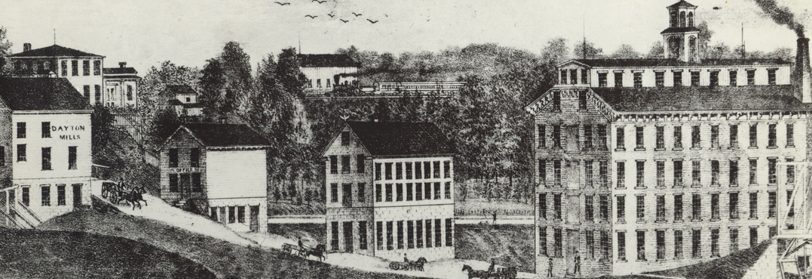
Dayton, however, has another point of view of far more importance to the business man and to the farmer. We refer to her woolen mills — as good as any in the state built some years ago at great expense, and stocked with as excellent machinery as the Union anywhere could boast. Though under a cloud for a time, but now started anew by its original owners, the Greens, it will soon be working upon a large scale, and is daily turning out great quantities of yarn of various grades, also superior cloth.

Another enterprise is the collar factory, under the management of Mr. Dunavan. It employs a large force of hands, turns out the premium horse collars of the United States and also a fine article of leather fly nets, the latter being its chief production during the summer months. The goods from this establishment find a ready market all over the country.

Another business, as yet young, but extensive and rapidly increasing in importance, is the Dayton tile works. When the factory was started it was not supposed that it would, in five years, reach the dimensions it has attained in a few months. The tile they manufacture is as good as any made in the west.

The large paper mill here next claimed our attention. This institution has long since become fixed and firmly established upon a substantial business basis. It runs exclusively on straw and manilla paper and consumes vast quantities of material. It has on hand an enormous stock of as good paper as is made anywhere. The recently senseless boom in prices of material used is happily subsiding, and the rather sluggish demand in this county for paper, has been rather unsatisfactory, but it runs ahead, looking for a fairer margin between its expenses for stock and the price of manufactured goods than has generally prevailed.

Besides, a good flouring mill and a local store and a “tavern” and good prices for farm products in general, all contribute to make Dayton a live business village.

Since the tile works were started in full operation a new industry has been developed, being coal mining operations, managed by Simpson & Wilke, a couple of hard-working miners, who obtain a good quality of coal which lies on the level with the banks of the feeder, and is drifted and removed on hand cars on a tramway and dumped below the woolen mills into wagon, or on the public roads as may be required.1


  1. Ottawa Republican, 27 May 1880, p2, col 3

Garden Club Picnic

Green home in Dayton

Annual Picnic Of Garden Club At Green Home

Because of the rainy weather yesterday afternoon, the 35 members of the Ottawa Garden club who gathered at the home of Mrs. Ralph Green at Dayton for their annual picnic, were compelled to turn the event into an indoor fete.

The luncheon tables at which the sumptuous repast prepared by the members of the club was served were prettily decorated in garden flowers.

Following the luncheon, at a club business meeting presided over by Mrs. Fred Claus, chairman, arrangements were made for co-operating with the city in the beautification of the grounds around the stand pipe on State street. Members of the club are to donate plants and shrubbery for this work.

Reports of the district and state Federation of Woman’s clubs conventions were made. Mrs. Ralph Green made a report of the district federation meeting, and Mrs. John Johnson and Mrs. Clarence Wilson gave reports of the state convention that took place in Chicago.

Plans for the coming year’s program were also discussed.


  1. Ottawa Republican-Times, June 18, 1935, p. 2, col. 3.

Dayton Honors Teacher for 50 Years Service

Miss Fraine

Miss Fraine

The entire community of Dayton turned out yesterday to pay honors to Miss Emma C. Fraine of Dayton, a teacher for 50 continuous years in the rural schools of La Salle County. Miss Fraine received 600 residents of the community and former students in a reception held from 2 to 5 in the Dayton clubhouse

She will terminate her teaching career at the end of the current school year At present she is a teacher in the Dayton school The club was decorated with numerous bouquets of gold colored flowers in low bowls The refreshment table was covered with a gold and white cloth and arranged with a huge tiered wedding cake. Gold and white tapers completed the arrangement.

The chief entertainment of the afternoon for the one-time pupils of the Dayton School was trying to identify themselves in scores of pictures which Miss Fraine has taken through the years and which were on display The school house was opened for inspection and numerous ex-students of Miss Fraine showed their children or grandchildren where they were taught to read and learned the golden rule.

Miss Fraine is well known throughout Dayton and the surrounding community. She was born in the house in which she is residing. Her parents were early settlers, coming here from the village of Alsace, France, about the year 1875. Miss Fraine attended the elementary schools and the high school which was then taught in Dayton.

In 1902. Miss Fraine embarked on her teaching career which carried her over a span of a half century and through many changes in the educational field. She first taught in a rural school north of Earlville, later going to the Waltham Township School to teach. She then taught in the Kleiber School north of Ottawa and in Grand Ridge During this time she furthered her own education by taking summer courses at DeKalb.

It was in 1907 that she was assigned to teach the primary grades in the two-room Dayton School and has continued in that capacity ever since — a total of 45 years.

Mrs. R. P. Schmidt assisted as general chairman of yesterday’s affair and Mrs. Donald Ainsley and Mrs. E. H. Charlier the decorating committee. Others assisting included Mesdames Art Thorson, H. M. McGrogan, Stanley Thorson, Robert Ohme, Nicholas Parr, W. O. Calhoun, Charles Poole, Bernard Hackler, Mildred Summins, Charles Clifford, Clara Matthews, Sylvia Murphy, Glen Morris and Dominic DeBernardi.

Those who assisted In the receiving line were Mrs. Schmidt, Mrs. James Trent, a teacher at the school, Mrs. Oakley Esmond, Mrs. Barney Nogay, Mrs. Clarence Duffy and Mrs. Donald Ainsley. Girls assisting included Sharon Newton, Dorothy Ohme, Shirley Walleck, Mary Gantz, Nancy Ohme and Candace Clifford.

Those presiding at the silver tea and coffee services were Mrs. Edward Beard, Mrs. Trent, Mrs. Ruth Green, Mrs. George Poole, Mrs. Sara Green, Mrs. Vincent McGrath, Miss Ida Chamberlin, Mrs. Irma Fraine and Mrs. Mildred Summins.

A program was presented by Miss Ida Chamberlin’s students. They were Monica Fosse, Beverly Lowery, Evelyn Meyers, Barbara Edgcomb, Charlotte Treat, Howard Hampton, Donald Meyers.1


  1. The (Ottawa) Daily Republican Times, 19 May 1952, p. 10, cols. 4-6.

News From Dayton – Fall 1900

DAYTON

The coal industry is still thriving in our burg.
G. G. Galloway, our enterprising manager of the electric plant, has just placed a telephone in his residence.
It was expected that the shutting down of the brick mill so early in the season would cause a number of men and boys to lay idle until spring, but such is not the case. Our men, as weil as boys, are all hustlers, and scarcely an idle man can be found on our streets.
Mrs. E. McClary, who has had the measles for the past week, is now much better and able to be about again.
A special school election has been called for Dec. 15th to elect a director to fill the place made vacant by J. W Channel, now deceased.

Mr. and Mrs. Henry Clodt have had troubles enough of their own for the past two weeks. Their oldest son, Henry, has been sick with scarlet fever for the past two weeks, and the four youngest are laid up with the measles. The house still under quarantine.
Mr. and Mrs. E. Hill and Miss Bartlett, of Rutland, attended the dance at Woodman ball on Thanksgiving night.
A large gathering attended the dance at Woodman ball on Thanksgiving night, and everybody seemed to have enjoyed themselves.
The crown in one of the kilns at the tile mill fell in one day last week, but fortunately no one was injured. The kiln was full of tile partly burned, and will necessitate the emptylng of the kill and burning the tile over again. It will be repaired at once
The river is at a height to harvest a good crop of ice should it freeze up in the near future.

The old paper mill, at one time one of the greatest industries that Dayton ever had, is a thing of the past and a sight to behold. Hardly anything is left that could be carried away but the foundation, and the trust will be at no expense in clearing away the ruins.
Joseph Barends has lost his valuable shepherd dog.
E. Trumbo, of Rutland, is shipping cord wood from Dayton on the cars for the C, B. & Q R. R.
Mr. and Mrs. George A. Mills, of South Ottawa, spent Sunday with Mr. and Mrs. G. G. Galloway.
Mr. and Mrs. Ed Emmons, of Marseilles, have been visiting Mr. and Mrs. McBraerty the past few days.

A number of rabbits have been killed here the past week.
Wm. Hanna and family have removed to Morris and will make that city their future home. Mr. Hanna is employed in the tannery
Emery Waller is still on the sick list, but was out for a while this morning.
Mrs. Susan Ellis, of Chicago, an aunt of Mr. Galloway died on Monday. Mr. Galloway left this morning to attend the funeral.
Mrs. Grace McGrogan, who has been sick for some time past has recovered.
The tile mill is still busy shipping fire clay.

A Thanksgiving dinner given by Mr. and Mrs. O. W. Trumbo was largely attended: Among those present were Mr. and Mrs. W. Van Etten and three children, Batavia, Mr. Eugene Appleton. Miss Ella Green, Aurora, Wm. Miller, wife and three children, Rutland, Mr. and Mrs. Isaac Green, Miss Carrie Green and Lyle A Green, Dayton.
Gilbert Masters, with the P. R. R.at Chicago, returned home on Sunday, after spending a couple of days among his friends here.
Mrs. Emma Boyd, of Seneca, is visiting Mrs. John Channel for a few days.

QUINN1


  1. The Ottawa [Illinois] Republican-Times, 6 Dec 1900, p. 4, col. 4.

Frankie Trumbo

Dayton Items

We are pained to announce the sad news of the death of Frankie, the youngest daughter of Mr. and Mrs. O. W. Trumbo. Frankie was about seven years of age, very bright and quick of intelligence, with many winning ways and greatly beloved by her parents, sister, relatives and friends, to whom her death is a sad blow and the untimely ending of a beautiful life full of hope and promise.

She had been ill for some time past, and, altho’ hopes have been established of her recovery, and the parents were thinking of taking her to a milder climate, yet she slowly and steadily failed, and last Saturday morning, about eight o’clock, she breathed her last in the presence of the bereaved family and friends.

The funeral services, which were quite largely attended, took place in the residence at two o’clock P. M. Sunday. Rev. J. Straub, of Marseilles, conducted the services and made a few appropriate and touching remarks. The choir – Mrs. H. B. Williams, Mrs. C. B Hess, Wm. S. Davis, and Chas. Green – sang “Waiting and Watching,” and “Safe in the Arms of Jesus,” two beautiful and appropriate songs.

The pall-bearers were A. W. Ladd, Jesse Makinson, Henry Geduldig, and Wm. Dunnavan. As the earth closed over the last sad remains of little Frankie many tears were shed, but all found consolation in the thought that she was not gone from us forever, but only “gone before.” “Only a few more trials, only a few more tears,” and then we shall join her in that happy land above.1


  1. The Ottawa Republican, Friday, March 14, 1884, p. 8, col. 6.

July News From Dayton

From Dayton

Dayton, Ill., July 7, 1886. – Our village with the rest of this section of county, we suppose, is sweltering at present in the heat of the nineties, and our people are vainly sighing for a cool Manitoba wave. A fine breeze however is blowing today and we hope the “hot” spell is over for the present.

Most of our citizens spent the glorious Fourth (or 5th) in Ottawa and “took in” all the sports and fireworks.

There is a slight difference of opinion as to the success of the celebration, but nearly every one thinks it might be improved upon in a great many particulars.

Messrs. Burt W. Stadden, P. W. Lilly, and William Pettis, of Chicago, came down Sunday evening and spent Sunday among friends and acquaintances in Dayton, and “took in” the celebration at Ottawa on Monday.

Misses Cora and Winnie Childs of Morris, spent last Sunday in Dayton.

Mr. Charles Park of Shabbona, Ill., is visiting at Mr. Charles Green’s.

Mrs. Wm. McMullen of Clinton, Iowa, is spending the summer at her mother’s Mrs. David Green.

Mr. Jessie Makinson celebrated with his best girl in Indiana, on the 4th and 5th.

Mr. James Ryan ate his Fourth of July spring chicken in Chicago.

A few of our citizens held a pleasant picnic near Barnes’ fish pond last Sunday.

Our public schools closed last Friday, and the teachers, Messrs. [sic] Crane and Miller, are spending their vacations at their homes in Ottawa.

Miss Jennie Dunavan left town on the 7:40 train Friday morning for a brief visit among relations in Michigan. During her absence, her position as organist in the S. S. will be taken by Miss Cora Moore.

The Brick Co. are loading a boat with brick for King & Hamilton of Ottawa; we understand they have bought 150,000 brick. The Brick Co. has just put in a Penfield Brick and Tile machine, and will make fire brick, sidewalk brick, &c.

The Paper Co. are turning out about six tons of straw wrapping paper per 24 hours.

Prof. Jenkins of Mendota tried his luck at fishing here, a few days last week.

There are few camping and fishing parties along the river here at present.

H. B. Williams, Esq. has been painting and repairing his tenant houses in Dayton this spring, and greatly improved their appearances. The paper mill also received a coat of paint which makes it look quite respectable.

Mr. Henry Hewit who was called to his home in Wisconsin by telegraph, a short time ago stating that his mother was quite ill, has not returned yet.

Occasional1


  1. The Ottawa Free Trader, July 10, 1886, p. 8, col. 4


Charles G. Miller

Charles G. Miller, one of the pioneer settlers of La Salle county, and for some years engaged in the mercantile business in Ottawa, died at the residence of his son in Chicago on the 3rd inst., in the 72nd year of his age. He was a native of Lancaster, Pa., and had come to this county in about 1837, opening a tailoring establishment in the village of Dayton, then buying and working a farm in Dayton township for several years, and then opening a dry goods store in Ottawa. In 1862 he closed out his business here and returned to Pennsylvania, going into business at Pittsburg, but gave that up in about 1872, and since then had lived in Chicago. He was a man of more than average education, fond of books, a wide reader, and a ready and fluent speaker. Though active in his earlier days as a democratic politician, generous and big hearted, he never sought office and, except the postmastership at Dayton, we believe never held any. Two brothers, John and Uriah Miller, who survive him, are well known prominent citizens of this county; and a third brother, Reuben, who accompanied the Mormon exodus to Utah, we believe is still living there.1

Charles was the son of Isaac and Esther (Gleim) Miller. He was born in 1809 in Lancaster, Pennsylvania. He and his wife, Eliza Smith, had four sons and a daughter: Mary, born abt 1834; William born about 1839; Milton B, born October 25, 1841 in Dayton; Edgar S born abt 1844; and Edward, born abt 1845. Charles was a justice of the peace in addition to serving as Dayton’s postmaster from1839 to 1845.

This is an ad for Charles’ dry goods store in Ottawa, showing the variety of items he offered. Note that the name of the store is the Pennsylvania Store, in honor of Charles’ home state. In 1857 ads appeared in the Ottawa Free Trader where Charles was selling his business in Ottawa and his farm prior to his move back to Pennsylvania. Charles never lived in La Salle county again, though he may well have visited his brothers after he (Charles) returned to live in Chicago.


  1. The Ottawa Free Trader, September 17, 1881, p. 1, col. 2.

The Marriage of Cora Green and Hosea B. Williams

Cora Green

Cora was the oldest daughter of Jesse and Hannah (Rhoads) Green, born September 21, 1862, in Dayton.

From Dayton
Matrimonial

Cards have been out during the past week for a grand matrimonial event, in which all of our citizens and socially interested, for the wedding on the 22d inst. deprives us of two of our best members of the social circle, whose place it will be difficult to fill, and whose absence will be deeply regretted. The spacious parlors of the bride’s parents’ were elegantly decorated and festooned with evergreens and roses, and a fine floral arch and horseshoe were tastefully arranged over the entrance. At one o’clock, about sixty guests having assembled, the bridal party entered the parlors and in the presence of the friends and relatives, Miss Cora Green was united in wedlock to Hosea B. Williams, both of this city. The ceremony was beautifully and impressively performed by the Rev. E. C. Arnold, of Ottawa. The bride and groom received the congratulations of the whole company who with your reporter wishes them a long and prosperous voyage through life. After partaking of an elegant repast, the bridal party departed in the midst of a floral shower on the 4:10 train for Niagara Falls and the East. They will be gone about three weeks, and on their return will reside in Mr. Williams’ fine new residence in East Ottawa.

The bride was elegantly attired in a plain blue and brocaded silk, Spanish lace, natural orange blossoms, white kids, &c. The presents were many and elegant, evincing in a slight degree the high respect and love in which the bride and groom are held by their numerous friends.

Bride’s father and mother, two pairs of woolen blankets; groom, gold watch and chain; groom’s father and mother, elegant ice pitcher and goblets; Mr. and Mrs. S. W Williams of Streator, silver and decorated berry dish; Harry Green, silver card receiver; James Green, set of solid silver teaspoons; Joseph Green, set of silver nut picks and crackers; Mr. and Mrs. C. B. Hess of Ottawa, silver ice pitcher; Mrs. G. W. Gibson and Mrs. Isaac Green, elegant silver castor; Mrs. O. W. Trumbo, antique lace sofa lambrequin; John and Ella Green, double silver and cut glass pickle castor; Mr. and Mrs. G. W. Green, silver and cut glass celery holder; Mrs. Wm. Reddick of Ottawa, silver gold lined cake basket; Frank Dunnavan, elegant globe butter dish; Silas Dunnavan, celuloid toilet case; Cora, Chas and Belle Dunnavan, plush and satin glove box. Hattie Edwards of Mendota, elegant large-sized portrait; Mattie Brown of Newark, oil painting; Mr. and Mrs. Milton Peddicord of Rutland, silver and gold lined goblet; Estelle and Mira Bagley, pair of ornamental deer heads; Zetta and Nellie Strawn, pearl card case; Katie Rhodes, pair of vases; Eddie Hess, statuary; Dessie Root, silver pickle castor.

Occasional1


  1. The Ottawa Free Trader, June 24, 1882, p. 8, col. 1.

In Memory of John W. Rhoads

In Memory of John W. Rhoads

Died – At the homestead, in the town of Dayton, June 19th, 1891, John W. Rhoads, aged 69 years.

Born in Brownsville, Pa., came to Ottawa with his widowed mother and settled in Dayton township. Shortly afterwards he left his home for St. Louis, to work at his trade of a carpenter; the mother remaining with her small children founded the old homestead from which all the family have gone out one by one. In 1846 he enlisted for the Mexican war, in the Company of Captain Hudson, attached to the famous regiment of Col. Doniphan, sharing all its trying marches and participating in the battle of Sacramento, where 1500 fell on the Mexican side and less than a dozen on the American.

After this war he was at home for a short time and then went with the early gold seekers to California. Three times he crossed the plains, returning home once the same way and twice by water. Later on he went to Montana, stopping at Helena City. Here again he was successful as a miner, and was sent twice to the territorial legislature. Then he came home and a year afterwards went to the Black Hills, and remaining there but a short time, finished up his wanderings.

At the old home his life flowed along quietly, amid friends. He was intelligent and of a pleasant, social, turn. Had a wide knowledge of people and places and knew the world, its fluctuating scenes and cares, and was content. He came to the old home after the death of his dearly beloved mother in 1874, and in quiet gathered strength for the world to come, his life flowing on in the peaceful intercourse with friends, a well woven chain from manhood to middle life and then to old age, with silver locks – a crown of glory – the river of life flowing at his feet. A friend to the unfortunate, a brother in adversity, faithful and kind to all – his works do follow him and it is well.

Over the river a boatman pale
Dips his hand in the silvery stream.
Deeper and deeper than earth his voice:
“Come rest thee and bathe thee, O tempest tossed.”1


John W. Rhoads was born November 13, 1821 in Brownsville, Pennsylvania, the son of Thomas R. and Sarah (Collins) Rhoads. His father died in Pennsylvania, and Sarah afterward brought the family to La Salle county, securing a farm near Dayton. There were six children in the family – John, the eldest; Elizabeth, who married Robert Strawn; Samuel; Hannah, who was Jesse Green’s second wife; Mary Jane; and Thomas.

John never married. At his death in 1891 the inventory of his estate listed the assets as 120 acres of real estate, 105 lambs, 138 sheep, 43 swarms of bees, farm implements, growing crops, notes, credits, accounts, cash on hand, etc., of the value of about $4100. He may have led an adventurous early life, but he ended his days as a prosperous Illinois farmer.


  1. Ottawa Free Trader, September 19, 1891, p. 8, col. 3.

Dayton Teenagers Who Registered in the Civil War Draft

Unidentified young drummer boy in Union uniform

About Civil War Draft Registrations Records

There were four drafts between 1863 and 1865, which produced 3.175 million records. The Enrollment Act of 1863 required the enrollment of every male citizen between 20 and 45 years of age, unless exempted by the Act. These records are basically lists of individuals who registered for the draft.

This list of the young men from Dayton who registered for the draft must be from 1864, when men as young as 17  were drafted for the first time. Appearance on this list does not prove they actually served, only that they were registered.


Enrollment Record of Names Between the Ages of 17 and 20 Years
in the 6th Congressional Dist., State of Illinois.
Sub Dist #19
Residence: Dayton

Name                                    Age        Occupation         Birth date                            Birth place

Ames, James                      18           Farmer                  3 May 1846                        N. Y.
Buckaleb, John S.              17           Farmer                  4 Feb 1847                          Penn
Bidgood, Chas W.             18           Farmer                  30 Aug 1848                       Ohio
Brown, Perry                      18           Farmer                  28 Oct 1848                        N. Y.
Conley, William                  18           Farmer                  15 Aug 1846                       N. Y.
Carlon, James M.              17           Farmer                  24 Jun 1847                        Ireland
Carton, John Thomas      19           Farmer                  24 Dec 1845                       Ireland
Calloway, Alonzo              19           Farmer                  29 Apr 1845                       Illinois
Collins, DeKalb                   17           Farmer                  10 Jun 1847                        Ilinois
Curtis, Wm H.                     19           Farmer                  6 Mar 1845                         Illinois
Clark, George L.                 18           Farmer                  25 Oct 1845                        Ohio
Deweese, John                  19           Farmer                  29 Dec 1945                       Penn.
Donlevy, Francis                 18           Student                19 July 1846                       Mass
Donahue, Walthen           17           Farmer                  10 May 1847                      Ireland
Feely, James                       17           Farmer                  Oct 1846                              Ills.
Grove, David                      18           Farmer                  14 Apr 1846                       Ohio
Greenless, Wm A.             17           Farmer                  16 Nov 1846                       N. Y.
Hinkey, John                       18           Farmer                  1 Oct 1846                          Germany
Hays, Jesse                          18           Farmer                  Nov 1845                             Ills
Kain, Simeon C.                 17           Farmer                  8 Jun 1847                          Penn.
Marvin, George                 19           Farmer                  16 Aug 1845                       Penn
Nelson, Lewis                     18           Farmer                  Dec 1846                             Norway
Parr Francis M.                  19           Farmer                  10 Jun 1845                        Ills
Ruhl, Peter                          18           Farmer                  1 May 1846                        Penn
Smith, George                    18           Farmer                  30 Aug 1845                       Ills
White, Walthen                 17           Laborer                 4 Mar 1847                         Ireland
Yeager, Francis                   17           Farmer                  10 June 1847                     Ills
Miller, Gottzeni                 17           Farmer                  18 Apr 1847                       France