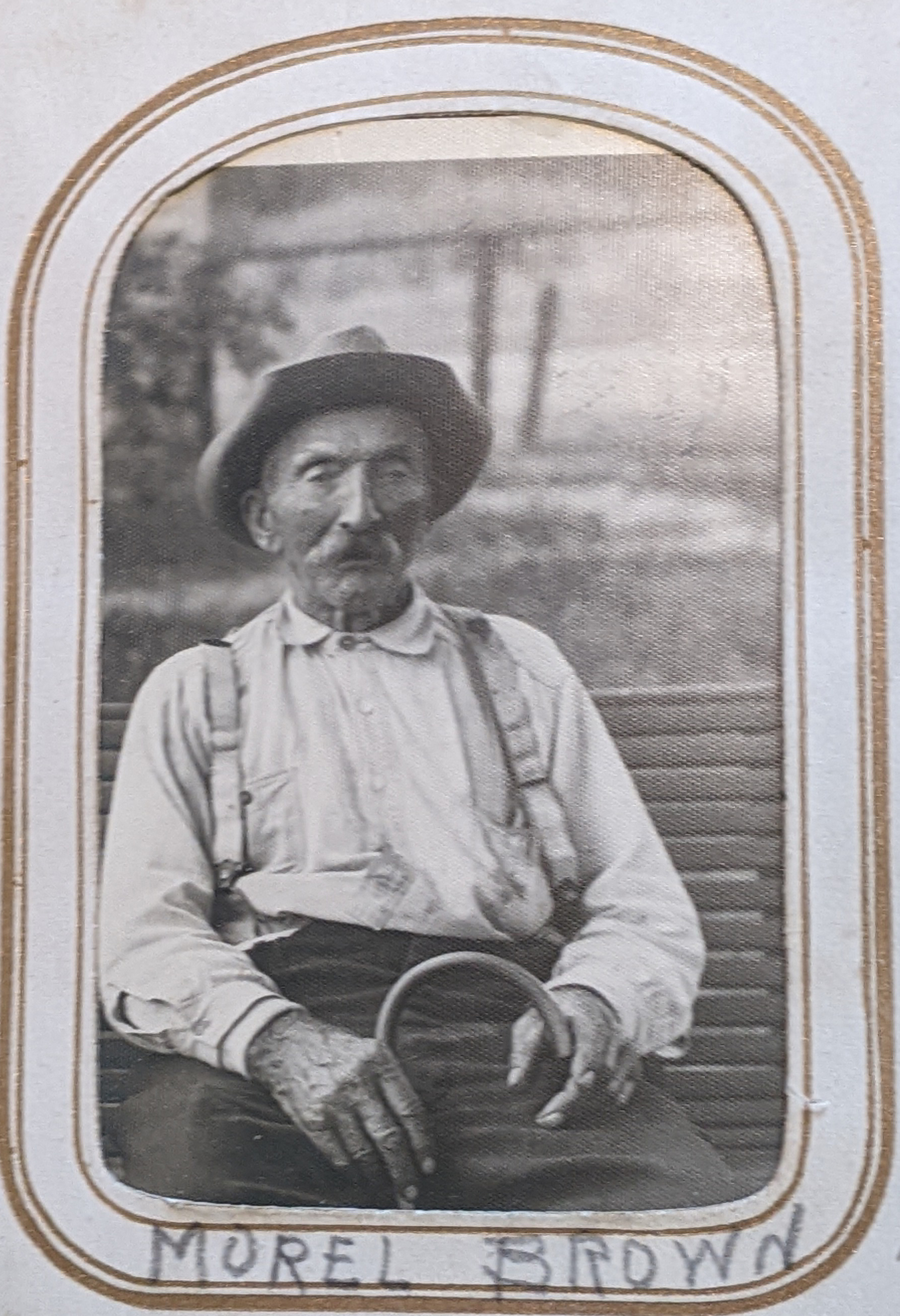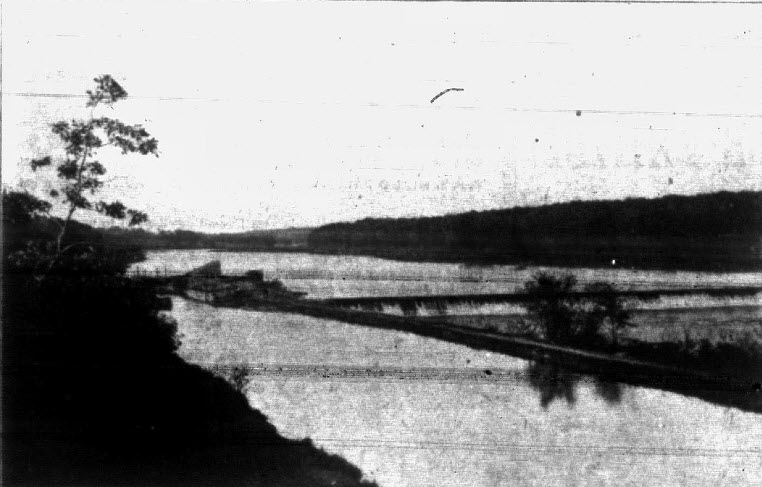
Dayton in 1858-59

In 1858 the Chicago publisher, John C. W. Bailey, decided to publish a directory of La Salle County. In his introduction to the work, he explains that he had no material from any previous publication to aid him and that, therefore, it took a long time to collect the information. He states that in the farming districts he relied on the postmaster for a list of the persons in their district. Because of this the lists are sometimes incomplete and at other times duplicate other lists. For instance, the townships of Dayton and Rutland are closely connected, both by residence and relationships. In many cases names appear on both lists, so caution is needed. Also, the lists are certainly incomplete, so lack of a name does not imply lack of residence.

Here are the pages that refer to Dayton township.

DAYTON
TOWN 34, range 3
The Post Office Dayton. O. W. Trumbo, Post Master

The village of Dayton, in the township of the same name, is situated on the west bank of the Fox River, four miles above Ottawa, and is destined to be one of the greatest manufacturing places in the west. The water is drawn from the Fox River Feeder, under a twenty foot head; there is sufficient water unoccupied to drive fifty run of burrs. It contains two large flouring mills, one woolen factory, one wool carding establishment, one machine shop, one cloth store, one saw mill and one tavern, all owned by John Green, who located here in 1829 as an extensive farmer and stock grower. He possesses some of the best blood stock, both Durham and Spanish.

Two school houses and churches are within 1 1/2 miles of this place, also two miles distant on the east bank of the river, is the largest white sulphur spring in the State, and is a great place of public resort; the water contains great medical qualities, and probably will become the principal watering place in the west. It is also owned by John Green, of this place.

Col. Wells Wait, school commissioner for La Salle county; resides at Dayton.
Office, in the Sheriff’s room, Ottawa city.

John Green, principal landed proprietor.      Andrew Thompson, blacksmith.

FARMERS

Albert, Thomas B, S W qr. Sec. 1.

Bagley John
Bennett Enoch
Black Samuel
Bly Frederick A.
Breese David K.
Breese Silas
Brisco, Patrick, S W qr. Sec. 35
Brown Enos, N W qr. Sec. 2.
Brown Silvester, S W qr. Sec. 3.
Brownfield K., S W qr. Sec. 3.
Burke Daniel, N E qr. Sec. 9

Carton Thomas, N E qr. Sec. 18.
Carpenter George W.
Chapman Samuel, S E qr. Sec. 4.
Clark W. O., N E qr. Sec. 2.
Connelly John G.
Conway Michael, S E qr. Sec. 9.
Cowper Mary, S W qr. Sec. 20.
Curyea Cincinatti
Curyea Henry
Curyea John H.

Daniels Aaron
Delevan E. C., N E qr. Sec. 21.
Dixon James, N W qr. Sec. 15.
Dobbins John, N W qr. Sec. 3.
Dunovan J. A.
Dunovan George M.
Dunovan W. L.

Erwin Wm., N E qr. Sec. 34.

Fisher Charles A., N W qr. Sec. 24.
Fielding John, S E qr. Sec. 33.

Gedney H. E., S E qr. Sec. 30.
Groove Davis
Groove Joseph

Hall Joseph
Harrington Robert
Hess Henry H.
Hess, Levi, N W qr. Sec. 12.
Hite David
Howard Humphrey, S E qr. Sec. 2.
Howland Ezekial, S E qr. Sec. 6.

Jacobs Peter

Kenny Christopher, N W qr. Sec. 18.
Kennedy Francis, S E qr. Sec. 33.
Kleiber Joseph

Lamb John F.
Laning Jacob, S E qr. Sec. 21.
Larkin Martin
Lawrence Daniel G.
Leland Lorenzo, S E qr. Sec. 21.
Lowell Calvin
Lyghthall Joseph

McCarthy Timothy, N E qr. Sec. 5.
McNeal William
Miller Edmund, N W qr. Sec. 13.
Miller John
Morgan Rees
Montgomery John H., S E qr. Sec. 2.
Monroe James, S W qr. Sec. 9.

O’Donnell Edward, S W qr. Sec. 4.
O’Donnell John, S E qr. Sec. 3

Pakenham Joseph, N E qr. Sec. 35.
Parr Thomas, N W qr. Sec. 1.
Pembroke Richard
Pennell Dwight
Pickings James, S E qr. Sec. 19.
Platt Joseph, N E qr. Sec. 5.

Reddick Hon. William
Reed Henry J.
Reigart Wm. H.
Rhodes Samuel
Robson Thomas, N E qr. Sec. 14.
Rowen James
Rumery William
Russell John

Sage Seth S., S W qr. Sec. 12.
Scovill Palmer F.
Sizer Randolph, N E qr. Sec. 35.
Stodden Jonathan

Thompson G. L., S W qr. Sec. 13.
Thorne Isaac
Thorne Richard, S W qr. Sec. 31.
Trumbo Elias
Trumbo Mathias
Trumbo Moab P.
Turner Benjamin

Wait Wells
Webb B. E., N E qr. Sec. 8.
White James
Wightman James D.
Wright Samuel
Wolsey Nathan. N E qr. Sec. 10
Woodlock Patrick, S W qr. Sec. 24.

What’s Going on in Dayton?

Dayton Items

Our public schools are again in session, with Miss Cora Childs still in charge as principal and Miss Jennie Crane, of Ottawa, as assistant.

Misses Maud Green, Jessie Trumbo and Carrie Barnes are attending the Ottawa high school. Apparently they did not attend the full four years, as none of them appear in the lists of graduates in 1884-1888.

Mr. Joseph Green is kept busy at his sugar camp across the river. His maple syrup is excellent and in great demand.

H. B. Williams, Esq., and wife, of Ottawa, were in town last Sabbath.

Mr. Isaac Green has had a force of men clearing off the woods, brush, etc., across the river. It will make a fine sheep pasture.

Mr. Geo. W. Makinson came near having his house burned down last week from a defective flue. He talks now of having it insured with Mr. John Green, who is agent for the Phoenix and Aetna at this place.

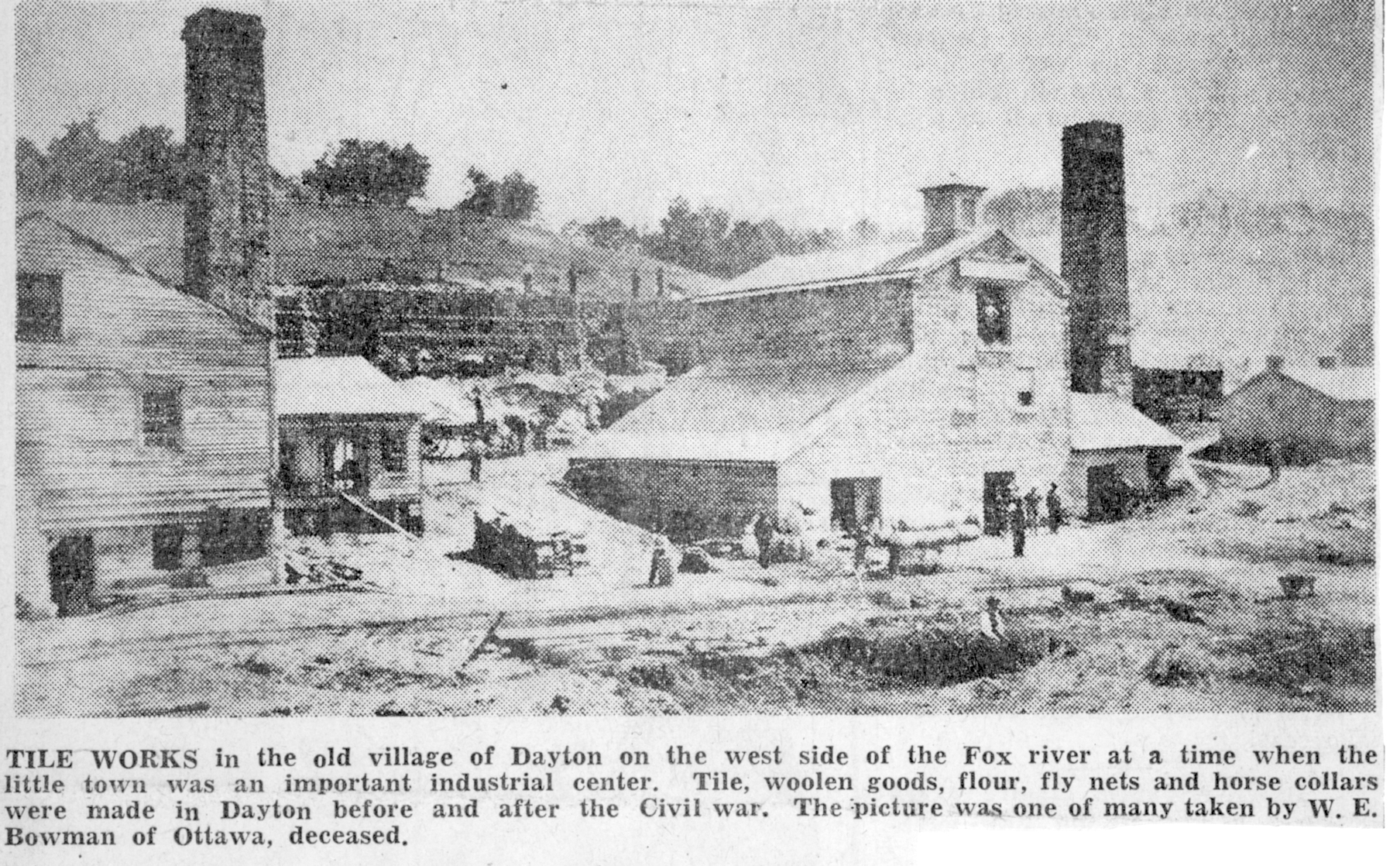
The tile works got their first kiln of the season ready to burn last week, but were obliged to wait for coal. They are turning out a fine quality of tile, which is meeting with a ready demand.

The fact that caused the election of Mr. Beach as supervisor over Mr. Roades, we understand, was the removal from the town of a number of the latter’s supporters. The contest was close.

And now why can’t we build a thing that is greatly needed in our village, as well as the whole neighborhood, viz: a bridge across the river here. Nearly five thousand dollars have been spent for bridges, etc., in the north part of town during the past year or two, and wouldn’t it be the fair thing for about half the above amount to be invested in a bridge here. Eleven or twelve thousand dollars ought to put up a good, substantial iron bridge, and from twenty-five hundred to three thousand dollars from each town with one-half from the county will make up the above amount. A bridge here would greatly increase the value of property in the village and in consequence raise the assessment. This, of course, would materially lighten the taxes in the other part of the township. In fact, a bridge would be a great advantage in more ways than one, and we think has become a public necessity and should be built at once. The railroad bond case has been settled and most of the money raised to pay the lawyers, and now what sort of an excuse can we find to vote against investing a few hundred dollars in a much-needed bridge?

Occasional1


  1. Ottawa Republican, April 11, 1884, p. 5

Elvira G, wife of C. F. Ford

photo of Ford, Elvira G - tombstone

Elvira Ford is another example of an isolated burial in the cemetery. There are no other Fords and no indication that she is related to any of the others. She arrived in Dayton with her husband by June of 1850 and appeared in the census in Dayton with her husband and daughter, but died shortly thereafter.

Elvira was born about 1826 in New Hampshire, the daughter of Solomon and Jane (Willoughby) Hall. On April 13, 1846 she married Calvin F. Ford in Lowell, Massachusetts. He was born September 25, 1820, in Maine, the son of Isaac and Charlotte (Heselton) Ford. Elvira and Calvin had one child, Mary Jane, born June 30, 1847, in Maine.

They came to Dayton by 1850, where Calvin was working as a miller, At that time he owned no land.  Apparently Calvin wrote home to tell of opportunities in the west. William Crompton, who was married to Calvin’s sister, moved to Freedom township, La Salle county, with his wife and family.

Elvira died January 9, 1852, in Dayton and was buried in the Dayton cemetery.

On November 11, 1852, Calvin married Martha Crompton, the sister of William Crompton. Martha was born December 7, 1805, in Industry, Maine, the daughter of Samuel and Martha Crompton. Martha was unmarried and had been living with her sister’s family in New Sharon, Maine in 1850. When her brother William moved to Illinois, Martha came with him.

In the early 1850s Calvin, Martha, and Mary Jane moved to Union township, Black Hawk county, Iowa. By 1860 he owned land worth $5000.

Martha died on June 29, 1863 and on May 12, 1864, Calvin married Lois Maria Gilkey.

By 1870 Calvin, Lois, and Mary Jane had moved into Cedar Rapids, where Calvin was selling agricultural implements. His real estate was valued at $2500. In 1880 the family was back in Union township, where Calvin died on October 23. He was buried in the neighboring Gerholdt Cemetery.

In 1882, at age 35, Mary Jane Ford married Frank A. Butler. They had one child, Fred, born in 1884. Mary Jane (Jennie) died August 15, 1925, and is also buried in the Gerholdt Cemetery.

Elizabeth Trumbo’s furniture

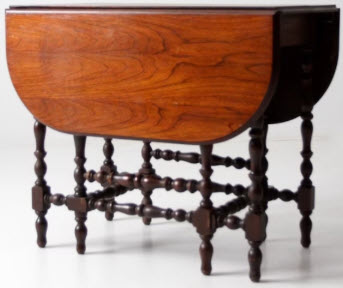
Continuing our description of Elizabeth Trumbo’s household goods, we’ve already looked at her stable and her kitchen. We turn now to the inventory of her furniture from her probate file. Unfortunately, there are no pictures of her actual furniture, so I have attempted to find examples that convey the idea, if not the actual item.

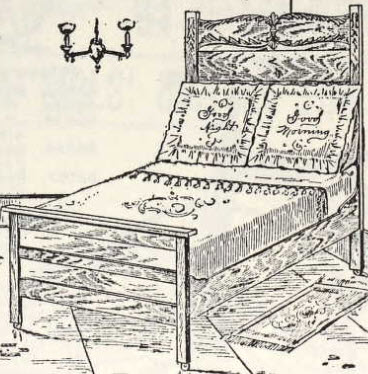
cottage bedstead

4 cottage bedsteads – A cottage bedstead was a wooden frame that supported a mattress and bedding.  The bedstead was often decorated with floral designs, curves, and scrolls. 

common bedstead

1 common bedstead – often made from iron or brass. Considered healthier as there were no crevices to hide dust, dirt, or bedbugs.

bureau / dresser

2 small bureaus
1 large bureau

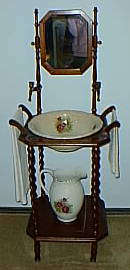
washstand

1 washstand – a piece of furniture to hold a wash basin and pitcher, used before the advent of modern plumbing

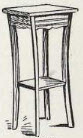
1 stand – small table, possibly for holding a plant

cane seated rocking chair

1 set cane seated chairs
2 cane seated chairs
2 cane seated rocking chairs

flag seat chair

1 set flag bottomed chairs
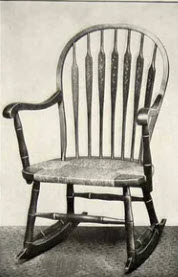
1 common rocking chair – wooden


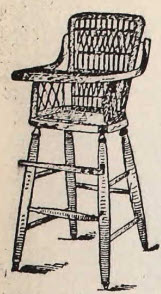
1 high-chair


1 extension table – with extra leaves to make it longer

drop-leaf table

2 fall-leaf tables

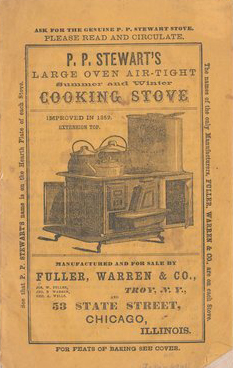
P. P. Stewart’s Large Oven Air-Tight Summer and Winter Cooking Stove

1 Stewart Cooking Stove and fixtures

available from the Sears catalog


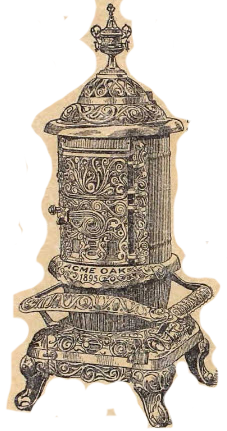
1 Parlor stove  – burned wood or coal. The parlor would be the only room in the house other than the kitchen that was heated.

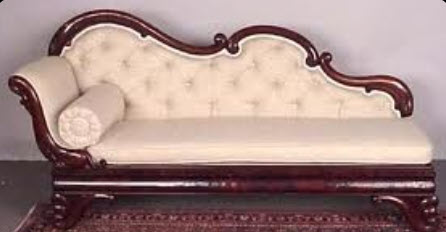
More elegant, but of the right type

1 lounge and mattress

We’re nearly done with Elizabeth’s household inventory. All that remains is the contents of her linen closet. Watch this space.

An Evening with Longfellow


Rural Happenings
[Mislaid last week]

Dayton, Feb. 2. – Mr. James Dunavan, of Livingston county, was visiting among relatives and friends in Dayton last week.

S. W. Williams, Esq, of Ottawa, was in town last Monday. According to report he will soon commence building a paper mill in Streator.

Mr. George W. Green and family have been suffering from diphtheria, but have now completely recovered.

Rev. A. H. Laing, of Joliet, preached to a fair congregation last Saturday evening. On account of the cold weather and bad roads services were not held at Wedron on Sunday morning.

The Historical club met at the residence of A. F. Dunavan, Esq, on Friday evening. The study of Egypt was continued.

Our public schools are progressing finely under the instruction of Mr. N. Clawson, principal; and Miss Dessie Root, assistant.

The Musical Union are preparing a series of three entertainments, to be entitled “Evenings with the Poets.” The first of these, “An Evening with Longfellow,” will take place at the school house Saturday evening, Feb. 11th, and will consist of selections from the poet, comic dialogue, music, etc., the whole forming a very pleasant evening’s entertainment. The remaining entertainments in the course will follow about two weeks apart, and the committee who have charge of them desire to state to the public that they are endeavoring to give good satisfaction, and hope they will receive the generous patronage of the public. The admission has been placed at the low sum of 10 cents, or 25 cents for the course of three. Proceeds for the benefit of the Musical Union.

Occasional1


  1. The Ottawa Free Trader, February 11, 1882, p. 8, col. 2.

Death Parts, Then Reunites, Dayton Couple


MRS. BROWN, 91, DAYTON RESIDENT PASSES AWAY

As the larger part of the world celebrated the advent of a new year at 1 o’clock yesterday morning death ended the career of Mrs. Katherine Hess Brown, aged 91, wife of William Morrell Brown and a well known Dayton resident. A fall four years ago greatly impaired Mrs. Brown’s health and had since made is necessary for her to go about in a wheel chair but her final illness dates to a cold she contracted the day after Christmas.

Funeral services are to be held tomorrow afternoon at 2 o’clock from the family home in Dayton and burial will be made in the Ottawa Avenue cemetery.

Mrs. Brown was one of the oldest residents in this part of the country and was greatly beloved by all who knew her. She was born July 1, 1837 in Rockingham county, Virginia but came to La Salle county with her parents in 1850. Her girlhood was spent on the farm north of Ottawa which is commonly known as the “Ells farm”.

Her marriage to William M. Brown took place on May 10, 1871. The family resided for many years on a farm near Dayton township after which they moved into Ottawa and resided here for two years. Twenty years ago they moved to Dayton where they have since resided.

Mrs. Brown is survived by her husband and two sons, Wells Brown of Ottawa and Frank A. Brown of Dayton.1

DEATH PARTS, THEN REUNITES DAYTON COUPLE

Death, which separated Mr. and Mrs. William Morrell Brown on New Year’s, when Mrs. Brown died at her home in Dayton, joined the couple this morning, when Mr. Brown, aged 91, died after an illness of a few days duration.

Mr. and Mrs. Brown had been married fifty-eight years, and both were 91 years of age at their deaths.

Funeral services will be held at 2 o’clock tomorrow afternoon at Gladfelter’s chapel. Ottawa Commandery of the Masons will be in charge. Rev. George C. Fetter, pastor of First Baptist church, will preach the sermon. Interment will be in Ottawa Avenue cemetery.

Mr. Brown was born May 22, 1837, in the east, and came to Dayton when a young man. He was united in marriage with Miss Katherine Hess May 10, 1871. Following their marriage, they made their home on a farm near Dayton for a quarter of a century, when they retired from farming life and moved to Ottawa. For five years they resided there and then moved to Dayton, where they made their home.

Mrs. Brown died at 1 o’clock New Year’s morning and the next day Mr. Brown became unconscious and died without regaining consciousness. He had not been ill, but it is thought that the shock of his wife’s death was too great for him.

He is survived by two sons, Wells Brown of Ottawa and Frank Brown of Dayton. A third son, Lester, died 25 years ago. Two grandchildren, Everett and Stanley Brown and two great-grandchildren, Edward and Mary Katherine Brown and two sisters, survive.2

Although both obituaries list their marriage date as 1871, they were actually married in Livingston county, Illinois on May 10, 1870.


  1. Ottawa Daily Republican Times,  January 2, 1929, p. 2.
  2. ibid, January 14, 1929, p. 7.

Photos courtesy of Rand James.

Drain Tile and Brick Works and Circus, Oh My!

Dayton Items

There is no particular excitement over anything in our little town at present, except over Lehmann’s circus, which is billed for here tomorrow. Of course every one will attend and drop their quarter to assist the showmen in paying their expenses.

I was not able find any information on Lehmann’s circus, not even an ad in The Free Trader. A Google search turned up nothing. Mr. Lehmann’s circus must have been a very small one, which of course it would have been if it came to Dayton.

Mr. Chas. Burch, the superintendent of the Paper Mill, and Miss Carrie Larson, of Rutland, were married at Ottawa last week.

Mrs. Jesse Green returned from a five or six weeks visit at New Orleans and vicinity.

The tile works are having a very heavy trade this fall. They are manufacturing the best tile in the market and the famers in this vicinity say they have tried all other kinds, but like the Dayton tile best. Four carloads were ordered Monday and one more today.

Mr. Joseph Green is fixing up a piece of land across the river where he is raising small fruit and “garden truck.”

The brick works have turned out a few good brick, but are not in good running order yet.

“Harry” Green is agent for A. J. Van Liew’s Nursery of New York. He is canvassing throughout the county.

Our schools are running successfully under the instruction of Misses Crane and Miller, of Ottawa.

Farmers about here report a good corn crop, tiled lands especially giving a heavy yield. One or two farmers who tiled quite extensively last year say they will more than pay for them on the increased yield of this season.

OCCASIONAL1


  1. The Ottawa Republican, October 2, 1885, p. 5.

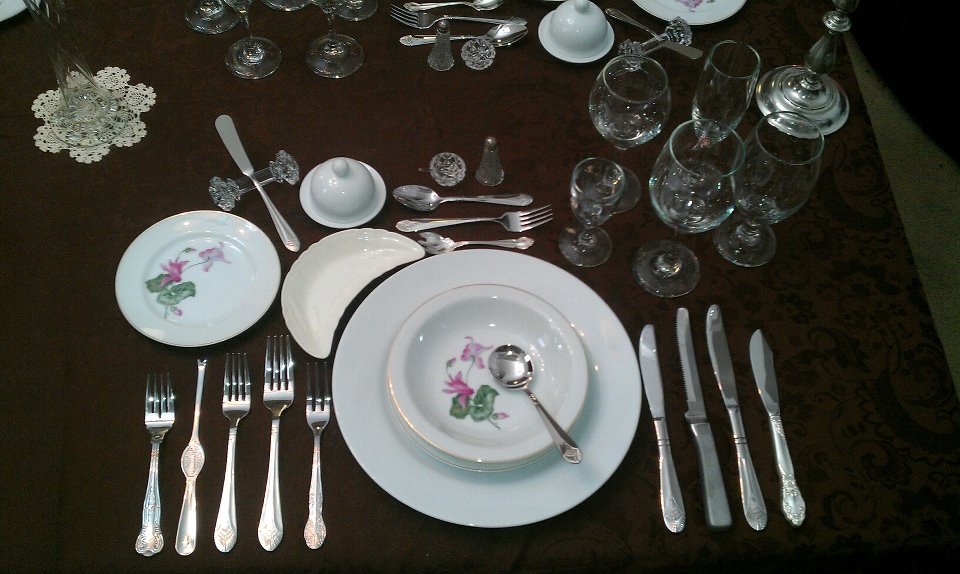
A well-equipped kitchen

Having inspected the contents of Elizabeth Trumbo’s stable here, we move to the kitchen, again as itemized in her probate file.


Although the contents of her kitchen were probably not as elegant as that pictured above, she was well supplied with these necessary items:

15 tea plates
6   butter plates
12 dinner plates
2   large platters
1   potato dish
6   table spoons
15 tea spoons
1   butter knife
6   knives and forks
1   carving knife
1   teapot
1   cream jug
1   water pitcher
6   cups and saucers
1   lot glass ware

in addition, the larder contained

20 glass fruit jars
7   earthen jars
14 jars of fruit (glass)
1   2 gal jar of sugar (earthen)
1   2 gal jar of apple butter

The 14 jars of fruit would clearly be augmented by filling the 20 empty jars as the season progressed. The seven empty earthen jars could have held pickles, salted or smoked meat, jams and jellies, or sauces or soups. The jars kept the food cool and could be sealed with wax or cloth.


image, CC BY-SA 3.0, via Wikimedia Commons

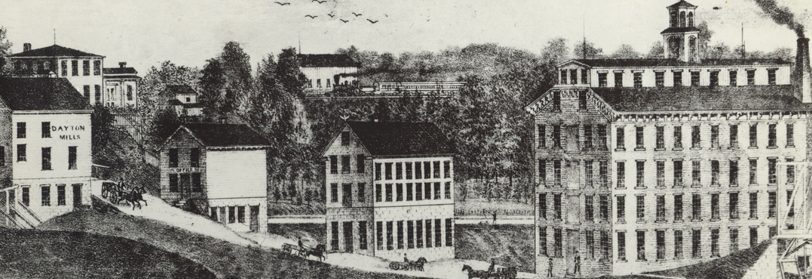
The Woolen Mill in 1870

Large stone building

The Dayton Woolen Mills

La Salle County, and Dayton especially may refer with just pride to the factory of J. Green & Co., as turning out a quality of woolen goods, cassimeres, doeskins, flannels, etc., that is not excelled anywhere in the west. Although this firm has made no attempt to push the goods upon the market by puffing in the newspapers, depending entirely on the quality of the articles to effect sales, yet the Dayton goods are widely known, and the dry goods merchant need only, as many of them do, offer the article with the single remark, “Dayton goods,” to call the attention of the purchaser to the beautiful texture and finish of the cloths manufactured in this establishment.

The rapid strides made in the west, within the past ten years, is producing a superior article of woolen goods, is admitted even by the older establishments of the East, and no man, at this day, need look for any finer article than is made at home, as he surely cannot find a better. To show the public appreciation of the Dayton goods, it need only be dais that the agent of the firm recently took orders in the city of Davenport, in one day, for goods to the amount of $1500, and the sale is all the more important when it is considered that that city has mills of its own.

The present factory building is of stone, built in the most substantial manner, situated on the right bank of the Fox river just above the bridge. Its dimensions are 50 by 100 feet in the clear, and four stories high, besides the attic. It was built in 1864, when the old mill was found to be too small for the increase of the business. Entering on the lower floor, the wool is seen on the left hand, the dressing machines on the right, and the fulling and carding apparatus at the opposite end, while an addition beyond contains the steam works used in heating the building and furnishing the necessary hot water used in the various processes of manufacture.

The machinery is driven by a turbine wheel placed under this floor, and propelled by the water from the feeder that flows past the mill/ The floors above are used for carding, weaving and spinning, there being two sets of carding machines of three in each set, making nine in all, besides a machine that turns out the rolls that feed the housewife’s spinning wheel. The third floor contains fourteen looms in all, eleven of them for double fold, and three making cloth of treble width; these wide machines being a great saving over the loom making cloth, but one yard wide, since both require the same attendance. These looms, when in full blast, make a music peculiarly their own, the nail machine being the only contrivance that beats it in racket.

Of spinning machines there are six, four of them having 2540, and two running 216, spindles each, making an aggregate of 1,392 spindles, tended by six men. Just think how many women it would take with the old family concern to twist all this yarn, that is done so easily by these six men. And these machines can be set so as to make yarn coarse or fine, nor can they fail in spinning it absolutely even throughout. About fifty hands are employed, a dozen of them being females, the rest men and boys.

The factory will consume this year about 120,000 lbs of wool. The carding machine is supplied with teasels, imported from the State of New York, which seems to be unnecessary, as they might be produced here, and the transportation saved to the company or put into the pockets of our farmers. Why has this not been done?

The sales of the firm show that manufacturing efforts in the West are appreciated. Still the mill is not run up to its full capacity.1


  1. Ottawa Republican, Thursday, August 18, 1870, p. 2.

More Christmas Festivities

Thanksgiving dinner

Dayton

Miss Theresa Fullerton is staying at Mrs. Thomas Meagher’s.

Mr. Vet Canfield unloaded a new buggy at the Dayton depot this week.

Miss Anna Fleming is home for a short vacation. She spent Christmas at Kankakee.

Mrs. Edward McCleary has a beautiful new piano, the Christmas gift of Mr. McCleary

Mr. John Pyatt, who was home with his family Christmas week, returned to his work in Chicago Sunday.

Mrs. Edward McCleary gave a family dinner in honor of her sister, Mr. and Mrs. Winn Green, of Joliet.

Mr. and Mrs. Winn Green and little daughter, of Joliet, are visiting Mrs. Green’s parents, Mr. and Mrs. Joseph Barnes.

Mr. Clarence Doran, who has sold his farm to Mrs. Gray, of Ottawa, and who vacates soon, held a sale Monday, December 30th.

Mr. Lyle Green had the shredding machine at work at his place several days last week. The machine goes to Rush Green’s next.

Mrs. John Pyatt entertained at dinner Sunday. Her guests were Mr. and Mrs. John Breese and Mr. and Mrs. Hoxie and son Charles.

Mr. and Mrs. Edward McCleary were entertained by Mrs. McCleary’s parents, Mr. and Mrs. J. Barnes, Christmas day at the family reunion.

Mr. and Mrs. J. McBrearty entertained their daughter and husband, Mr. and Mrs. Ed Emmons, and daughter Margaret, of Marseilles, at Christmas dinner.

There were nearly 24 hours of heavy rain Sunday and Monday. Roads are in a fearful condition, putting the coal diggers and haulers out of commission for the present.

Mr. and Mrs. Will Breese, of Aurora, and little daughter Marian took dinner Christmas day with Mrs. B’s parents, Mr. and Mrs. John Breese. They only stayed between trains.

Mrs. Lowell Hoxie and son Charles came up Saturday evening to visit her parents, Mr. and Mrs. Breese. They stayed until the noon train. Mr. Hoxie drove up for a few hours Sunday.

The Dayton school gave a delightful entertainment Christmas eve. A fine program by the pupils and a fine Christmas tree was presented. School closed for the remainder of the week, reopening on Monday.1


  1. Ottawa Daily Republican Times, 3 Jan 1908, p4

Happy New Year’s at Dayton


The Green Family and Connections Hold a Reunion at Jesse Green’s Residence

The reunion of the Green family and connections at the residence of Mr. and Mrs. Jesse Green, Dayton, on New Year’s was a much larger affair than was expected by Mr. Green. The occasion was the 73rd anniversary of his birth. It was not until the guests had begun to arrive that an inkling of what was intended entered his mind. His amiable better half understood more fully than he did what was to be, and made her preparations accordingly. She had eatables cooked in large quantities and great variety, and, when the hunger of all had been appeased, it was found that fully seventy-five persons — men, women and children — had sat at the table. A conspicuous object on the table was a large frosted cake, with the date of Mr. Green’s birth in raised letters and figures.

After dinner Mr. Thos. W. MacKinlay, on behalf of the relatives, presented Mr. Green an easy chair and Mrs. Green a table as tokens of their affection and esteem.

The following gentlemen were present with their wives: Ex-Attorney-General McCartney, now of Hutchinson, Kansas; L. C. Robinson, Rutland; Jos. Jackson, Millington; Frank Allen, Galesburg; Harry Green, T. E. MacKinlay, C. B. Hess, H. B. Williams, Wm. Bagly, Ottawa; O. W. Trumbo, Isaac Green, Dayton; also Mesdames J. Harris, J. Crum, Lavina Matlock, Yorkville, Craig, Jacksonville, and Bagley, Ottawa, Ray Harris and Myrtie Crum, Yorkville, Ella, Maud and Barbara Green, Dayton; and Messrs Ed. Jackson, Cincinnati, Kent Green, Chicgo, E. J. Hess, Harry Robinson, Theodore Strawn, W. E. and Don MacKinlay, Ottawa, and Basil and James Green, Dayton. The children numbered about fifteen.

The reunion will not be forgotten soon by any one of the fortunate guests of Mr. and Mrs. Green. May they continue to enjoy the evening of their lives and live to celebrate the 80th anniversary on a scale equally large and enjoyable.1


  1. The Ottawa [Illinois] Republican Times, January 8, 1891, p. 3.

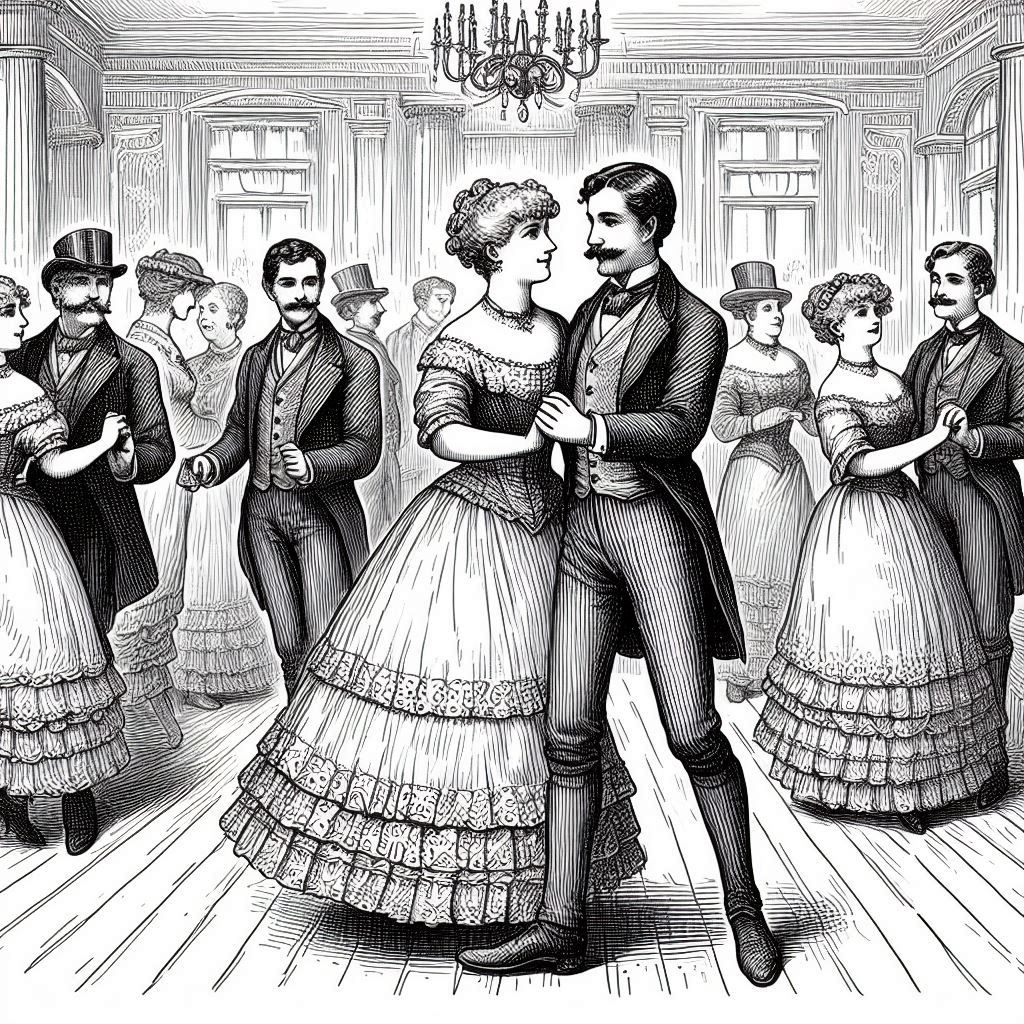
A Christmas Night Dance

Christmas greetings

Dayton

Fred Green left this morning for San Francisco, and will be absent about two weeks.

Miss Jennie Barends has entirely recovered from her recent illness.

Wm. Fleming left on Monday morning for De Kalb, where he will stay for a few days.

Mrs. Jas. H. Timmons furnished the supper for the patrons of the Christmas dance held at Woodman hall.

E. McClary and wife dined on Christmas day with Mr. and Mrs. Jos. Barends.

Christmas passed off quietly in our little burg.

Leroy McBraerty, operator at Ladd, spent Christmas with his parents.

The dance given by the Dayton orchestra on Christmas night was well attended, about 100 persons being present. Messrs. Breese, Hoxie, Warner, Breese and McGrogan furnished some very good music, and every one had a royal good time. Supper was served by Mrs. Jas. H. Timmons.

Winn Green and wife, of Joliet, spent Christmas at the home of Mr. and Mrs. Joseph Barends.

Miss Nellie McGrogan and Leroy Luce were married last week Wednesday at Ottawa by Squire Larkin. May you both live long and prosper.

Ellis Breese has just purchased a number of fine sheep from Jay Shaver, and expects to engage in sheep raising on a large scale, having fenced in 22 acres of fine grazing land on the river bottom.

George Wolf and wife entertained a number of friends at dinner on Christmas day.

George Galloway and wife were visiting in Ottawa on Tuesday.

John Rhoades and family were visitors at Mr. and Mrs. John Benoits.

Miss Drennan is visiting friends in Chicago for a few days.1


  1. The Ottawa Republican-Times, January 3, 1901, p. 6, col. 4

January 1891 -The State of the Village


A RESURRECTION
At Dayton! — A General Revival of Business in Our Northern Suburb
C. B. Hess Practices What he Preaches — The Dayton Tile Factory Will Resume Operations Next Week

The little town of Dayton has again struck its gait. The grist mill is running at full blast, the collar factory has its hands full, the paper mills are behind in orders, and now comes C. B. Hess, one of Ottawa’s most enterprising citizens and to-day leases the brick and tile works for a year commencing Feb. 1st, with an option for further time and will open up on Monday next full blast with forty hands, the works to run night and day. The firm name will be Hess, Williams & Hess, and Ed. J. Hess, junior partner, will have full charge.

These works will put out paving brick, fire brick and drain tile, and will be run in a measure in connection with the Ottawa factory. The capacity will be 50,000 brick, or 10 car loads, and 200 tons of clay will be used every day. The works have six kilns, with every facility for increasing the capacity if found practicable. The water power used is of 200 hundred [sic] horse power. The firm will build a tramway across Fox river to its beds of fire clay, which are 7 foot veins, while the common clay will be taken from a 30 foot bank just across the feeder from the works. Probably an inclined railway will be put in from the works to the “Q.” tracks to increase the shipping facilities.

Hitherto the difficulty at these works has been in getting the clay properly united, but Mr. Hess has been experimenting with it for the past six weeks and is satisfied that he has at last found the right thing.

These works will make their drain tile for the local trade, but the paving tile and fire brick will, most of it, find its was to Chicago and Peoria.

Mr. Hess says he intends to make the a “go,” and we have no doubt but he will.1

C. B. Hess was a member of the large Green clan. He was married to Clara “Callie” Green, the daughter of Jesse Green and Isabella Trumbo.


  1. Ottawa Republican Times, January 29, 1891, p. 8.
The Old Plank Road Needs to be Upgraded

An example of a plank road

The old plank road, which ran north out of Ottawa, was built in 1847; a direct line from Earlville to Ottawa, by way of Harding. It was in such poor shape by the 1890s that farmers in the north of the county were doing their trading in Earlville rather than in Ottawa. It was clear that something needed to be done. By 1895 the road from Earlville to Harding had been improved and Freedom township had graveled the road to the Dayton township line but the six miles through Dayton remained unimproved.

Ottawa Republican Times, 26 Sep 1895, p2

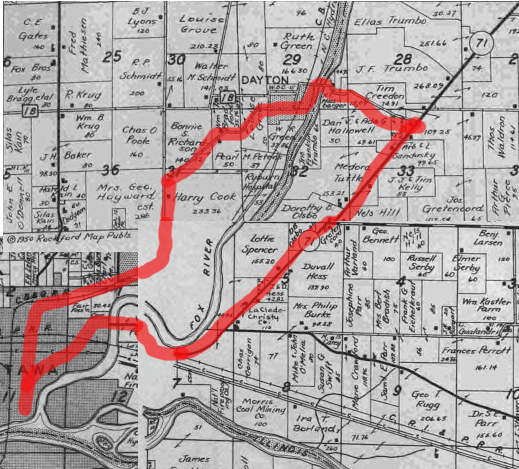
It was to the advantage of Ottawa to get this portion of the road completed and plans were made to share the work. The portion of the road to be graveled is shown below.

Residents of Dayton, Ottawa, Troy Grove and Wallace were asked to contribute money or labor to finish the final six miles of the road. The merchants of Ottawa contributed significantly in view of the increased trade they would see.

Ottawa Republican Times, 26 Sep 1895, p1

The joint effort appears to have succeeded. There is no further mention of the state of the road north out of Ottawa in the newspapers. It is hoped that the Ottawa merchants saw the increased trade they expected.

Sickness, Sunday School, and the World’s Columbian Exposition

DAYTON

Scarlet rash or scarlet fever: which was it? was the question of the day. Now there are new cases, and some of the recently afflicted are seen on the streets, and the excitement is dying away. The carelessness of some of our people in dealing with contagion deserves severe criticism.

Pliny Masters is down with some grippe complications.

Wm. Fleming made a flying visit to Iowa. Just returned.

Last week Ellis Breese left for Lincoln, Nebraska, where he will visit for some time.

What has become of the Sunday-school? We have not heard the bell for several Sabbaths.

Miss Carrie Barnes is on the sick list. Her sister Emma is filling her place as teacher in the primary department of our school.

The winter term of school will close March 10th. Arrangements are being made for an entertainment in the evening.

Our factories and fisheries will soon furnish employment for all weary of resting.

The morning sun strikes Dayton squarely in the face and makes her smile again.

The interest in the World’s Fair is growing. This is right. We should be pleased to see vigorous steps made towards a good representation of the American Indians at the Columbian Exposition. A large encampment of Indians, with all their rude equipments on the grounds, would make a grand contrast between then and now.1


  1. [Ottawa] Republican Times, March 3, 1892, p4.

Of Industry – and Lack Thereof


Fox river with dam in background

Dayton Items

Dayton, as a  point where the finny tribe and fishermen do most congregate has long been celebrated in this section of the country. People armed with hooks and lines, buckets of bait and togged in old clothes, come daily and nightly from far and near. They arrive on foot, in buggies, in lumber wagons, and dumped off the cars, and are landed in every shape, all bent on the same purpose, i. e., that of catching fish, not by the dozens, or in fifties, but by bushels, bagsfull, wagon loads, and in other prodigious quantities. They arrive in lofty spirits, braced up by lofty expectations of astonishing the natives. They usually depart wet, hungry, tired, disgusted, and without any fish worth speaking of. To a man whose constitution requires a vast deal of resr – long continued and complete relaxation of every muscle and nerve – fishing is just the thing. Fish, as food, may be brain food, but catching them is certainly a brain softener. It does not require a very high order of intellect in a man to fish, that is, a man of very moderate brain power ought to know enough to outwit a fish, which stands rather low in brain development. In short, fishing, to an outsider, is a very languid, sleepy sort of work.

There never has been any employment so well adapted to the wants of a lazy man as that of fishing as they do it at Dayton. To see the anglers as they line the banks and cover the rocks like so many mud turtles is a sight fit to make a person yawn. To the man to whom any kind of exercise is a bore fishing is just about exercise enough. The fellow lands upon some sequestered spot, sits down to rest and meditate awhile, then baits his hook, summons up all his energies like a man trying to ward off sleep, gets the line in the water, and then the things fishes itself! When a man gets too lazy to fish they accuse him of having a softening of the brain, and soon after he becomes too tired to draw his breath, and this ends him!

Some of the fellows we saw fishing on Friday last were half a mile from the water, under a shade tree, three of ‘em asleep and the fourth studying the sun’s altitude and position of its spots through a “pocket” telescope! Though we were in sight of a score or more of fishers for an hour, we did not see a fish hauled out, nor even hear of one being captured, though a shoal of three or four minnows were reported to have swam up among the fishers early in the morning.

Large stone buildingDayton, however, has another point of view of far more importance to the business man and to the farmer. We refer to her woolen mills – as good as any in the state – built some years ago at great expense, and stocked with as excellent machinery as the Union anywhere could boast. Though under a cloud for a time, but now started anew by its original owners, the Greens, it will soon be working upon a large scale, and is daily turning out great quantities of yearn of various grades, also superior cloth.

Another enterprise is the collar factory, under the management of Mr. Dunavan. It employs a large force of hands, turns out the premium horse collars of the United States, and also a fine article of leather fly nets, the latter being its chief production during the summer months. The goods from this establishment find a ready market all over the country.

Another business, as yet young, but extensive and rapidly increasing in importance, is the Dayton tile works. When the factory was started it was not supposed that it would, in five years, reach the dimensions it has attained in a few months. The tile they manufacture is as good as any made in the west.

The large paper mill here next claimed our attention. This institution has long since become fixed and firmly established upon a substantial business basis. It runs exclusively on straw and manilla paper and consumes vast quantities of material. It has on hand an enormous stock of as good paper as is made anywhere. The recently senseless boom in prices of material used is happily subsiding, and the rather sluggish demand in this county for paper, has been rather unsatisfactory, but it runs ahead, looking for a fairer margin between its expenses for sock and the price of manufactured goods than has generally prevailed.

Besides, a good flouring mill and a local store and a “tavern” and good prices for farm products in general, all contribute to make Dayton a live business village.

Since the tile works were started in full operation a new industry has been developed, being coal mining operations, managed by Simpson & Welke, a couple of hard-working miners, who obtain a good quality of coal which lies on the level with the banks of the feeder, and is drifted and removed on hand card on a tramway and dumped below the woolen mills into wagons, or on the public roads as may be required.[1]


[1] Ottawa Republican, May 27, 1880, p2.

Fact or Fiction? History or Poetry?

POETRY VERSUS FACT
FICTION AND HISTORY

The following letter was written by David Green in reference to the wide-spread article about his brother Joseph, which was covered here previously in “He Wasn’t the One”. Apparently a collection of poems by a Nebraska poet, which referenced this event, provoked an article in The Platte Journal attempting to correct the story. Here is David Green’s response to the inquiry, as printed in the paper.

Dayton, Ill., March 31st, 1871
J. G. Higgins, Esq., Columbus, Neb –

Dear Sir: — Yours of the 7th inst. asking for information was duly received, in which you give some extracts from a poem written by the Rev. Orsamus C. Dake, entitled the “Raw Hide,” which is found in a recent publication entitled “Nebraska Legends,” with the following preface:

“A certain man, of a small company moving up the great plain of the Platte, in a spirit of bravado, said he would shoot the first Indian he met; which he did, having shortly afterward found a Pawnee woman a little separated from her tribe. But a band of warriors, pursuing, demanded from his companions the surrender of that man, which being refused, the Pawnees made ready to slay the whole company of whites, whereupon the offender being given into their hands, they flayed him alive. From this circumstance the little stream, on whose banks it occurred takes the name of the ‘Raw Hide.’”

The Rev. Mr. Drake has given in the above, the substance of a report which in 1849 found its way into nearly every newspaper in the United States, and no doubt but he together with many others, in good faith and very innocently believes that such a tragedy did really take place as stated, but the whole story is a base and unmitigated falsehood from beginning to end, as there never was the least foundation for said report. The hoax was gotten up in Magnolia, Putnam county, Illinois, in a bar-room to gull a gaping crowd, without any thought of its going any further, but someone present took it to be true and communicated it to the editor of a paper published in Lacon, Marshall county, Illinois, from which it was, as stated, very extensively copied.

On receipt of yours I wrote to Hon. Wm. E. Parret now of Winona, Illinois, but at the time the hoax was gotten up he resided in Magnolia, Illinois, and in reply he says, “That two men by the name of D. P. Fyffe and David Law, of Magnolia, got up the hoax out of whole cloth. The said Mr. Fyffe of Magnolia, over his signature of the 27th inst, says “It (referring to said hoax) originated here and was known to be a hoax.” I merely give you the above that you may know where said report originated.

My Father, two Brothers and some twenty or thirty others from this county were the company referred to, and my brother Joseph Green was the reported victim, who would have been the last man in the world to make any such threat, or be guilty of any such rash act.

The said company went out to California in the spring of 1839 – he Joseph Green returned in 1851 – went out to California again in 1852, returned in 1853, and died in this place in 1855, with the consumption. A more noble, kind-hearted and generous man never lived, and I hope you will use your best efforts to correct this infamous slander upon his fair name.

I am, very respectfully,
D. Green1


  1. The Platte [Nebraska] Journal, April 12, 1871, p2, col2.

Dayton Cemetery Association Celebrates 10th Anniversary

DINNER HELD AT CLIFFORD’S

The Dayton Cemetery Assn. held its annual meeting Sunday, with Mr. and Mrs. Charles Clifford of Dayton. After the morning work party had completed their task of mowing the grass, trimming trees and decorating the graves all met at the Clifford home for a picnic dinner and historical program. A display of family heirlooms was in charge of Mrs. Clifford, historian.

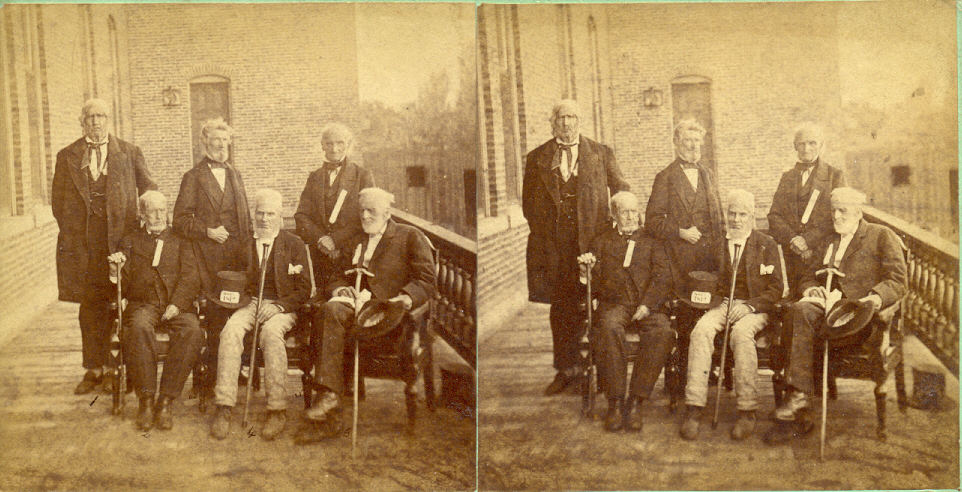
Mrs. Lewis E. Myers of Chicago was presented with a cake and ten lighted candles to mark the anniversary of the Association; for it was her idea that sparked the restoration of this beautiful old pioneer burial ground, which was started by John Green, who in 1829 led a party of settlers from Licking County Ohio to settle the community of Dayton.

At the business meeting Mrs. Mildred Summins of Ottawa was elected president. Other officers to serve with her for the coming year are Miss Dorothy Masters of Evanston, secretary; David Holmes of Oak Park, treasurer and Mrs. Myers, Care Fund Officer.

The following committees were named by the president.
Grounds: Charles Clifford of Dayton, Howard Baker of Leland, David Holmes of Oak Park.
By-laws: Mabel Greene Myers and Dorothy Masters.
Membership and Funds: Helen MacLoraine of Wilmette, La Vonne Gillman of Ottawa, and Eugene Pottinger of DeKalb.
Research: Candace Clifford Wilmot of Champaign, Mrs. William Temple of Serena and Mrs. Oakley W. Esmond of Ottawa.

Members and friends of the Association are from all parts of the United States. Those coming from the greatest distance at this meeting were Mr. and Mrs. Kenneth L. Green Jr. of Corbin, Ky.1


  1. The (Ottawa, IL) Daily Republican Times, May 31st, 1966, p. 11, col. 3.

The Contents of a Lady’s Stable

The Elizabeth Trumbo house

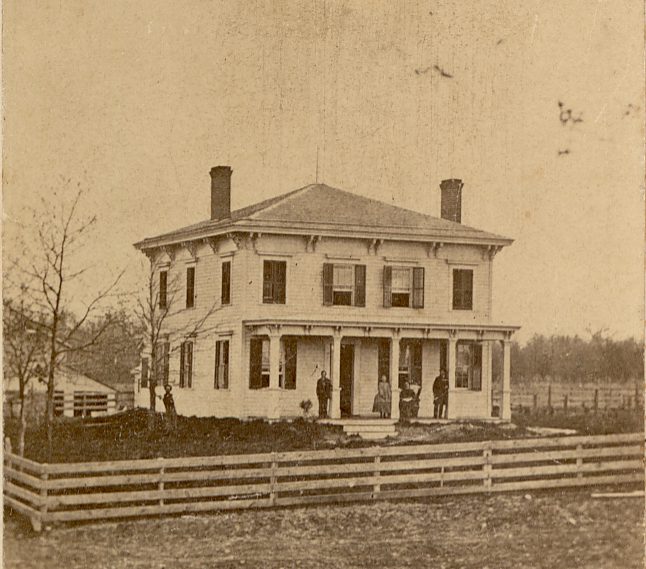
Elizabeth Trumbo house

When Elizabeth Snyder Trumbo died in 1873, she was a well-to-do widow living in Dayton, near a number of her children. At her death her estate was inventoried and the list gives a good idea of her life style. Included in the list is the contents of her stable:
1 top buggy (single)
1 spring wagon
1 double wagon
1 pair bobs
1 single cutter
1 buffalo robe
2 horses, one brown, one sorrel
1 double harness
1 single harness

Here’s what they would have looked like.

a top buggy

A top buggy was a type of horse-drawn carriage with a folding top, also known as a “Jenny Lind”. It was a lightweight, four-wheeled vehicle designed for two passengers and was often pulled by a single horse. The top could be raised or lowered to provide protection from the weather, making it a versatile option for rain or sunshine.

spring wagon

A spring wagon was a four-wheeled vehicle drawn by draft animals, usually horses. It had a square box for carrying goods or passengers and was equipped with platform springs to provide a smoother ride. A single seat for two people was mounted in the middle of the box leaving room behind the seat for cargo.  It was a versatile and popular choice for farmers and general transportation needs, much like a pickup truck or delivery van.

double wagon

A double wagon was a type of freight wagon designed to carry heavier loads than a single wagon. It typically had a sturdy, wooden frame with a large flat wooden bed mounted on four wheels, with high sideboards to keep the load secure. The wagon was drawn by a team of two or more horses and was equipped with springs to provide a smoother ride over rough terrain. The wheels were typically made of wood with iron rims. The front and rear axles were connected by a central beam, allowing for a bit of flexibility over rough terrain. It was often drawn by a team of two or more horses, with a driver’s seat at the front for steering and controlling the team.

bobsled

Bobsleds were used for transportation in the snow and for recreational activities. A snowfall and a hill could prove irresistible to children and even, sometimes, to their elders. Bobsledding eventually evolved into the Olympic sport known today.

single cutter

A cutter is a type of light, one-horse sled with a single seat. it is smaller than a sleigh, more streamlined, usually for one or two passengers, and has a more open design.

buffalo lap robe

If you had a cutter, then you had to have a buffalo robe. A buffalo robe is a cured buffalo hide, with the hair left on. They were made into lap robes and used as blankets and padding in carriages and sleighs  Only hides taken in winter between November and March when the furs are in their prime were suitable for buffalo robes.

two horses, one sorrel, one brown

The standard harness of America

This illustrates many styles of harness, both single and double.

I like to picture Elizabeth and her daughter Mary Jane, my great-grandmother, going out on a chilly day in the top buggy, with a buffalo robe tucked around them.

The Better Farming Association – Dayton Branch

DAYTON FARMERS MEET
ORGANIZE BRANCH OF BETTER FARMING ASSOCIATION
C., B. & Q. Agricultural Expert Delivers Talk—Other Fine Talks Heard

Thursday evening fifty representative farmers of Dayton township assembled at the Beach school house in that township for the purpose of organizing a branch of the Better Farming association. Great interest was taken in the proceedings and it proved to be a very enthusiastic meeting.

Mr. Sampson, agriculturalist for the C., B. & Q. Ry. company, which he represented at the meeting, spoke on ‘Why the Burlington Railway is interested in this work.’ The Burlington is the largest financial contributor in this work and the speaker gave his audience a very interesting talk as to the success of the new movement.

J. S. Brook, the La Salle County Farm Advisor, gave a good talk on “Soils and Their Treatment.” He showed how farmers could benefit themselves largely by using better methods and more scientific ideas in their farming. T. W. Esmond, president of the association, talked along the same lines. Both taking up the matter in detail and how much might be gained by using better farming methods. Mr. Esmond also told of the organization and what they hoped to make out of it.

J. F. Farrell, who was present, also made a few remarks.

After the discussions were completed the local organization elected officers with the following result:
President—Frank Beach
Vice President—Lewis Belrose
Secretary—Chas. Retz
Treasurer—Lyle Green1

The Better Farming Association had a three fold purpose: to improve its members, making each a better and more satisfied citizen; to improve their farms, by making them more efficient and therefore more productive; and to improve the community, by better schools, markets, roads and whatever will make the community a better place in which to live.


  1. Ottawa Free Trader, October 30. 1914, p. 5, col. 2.