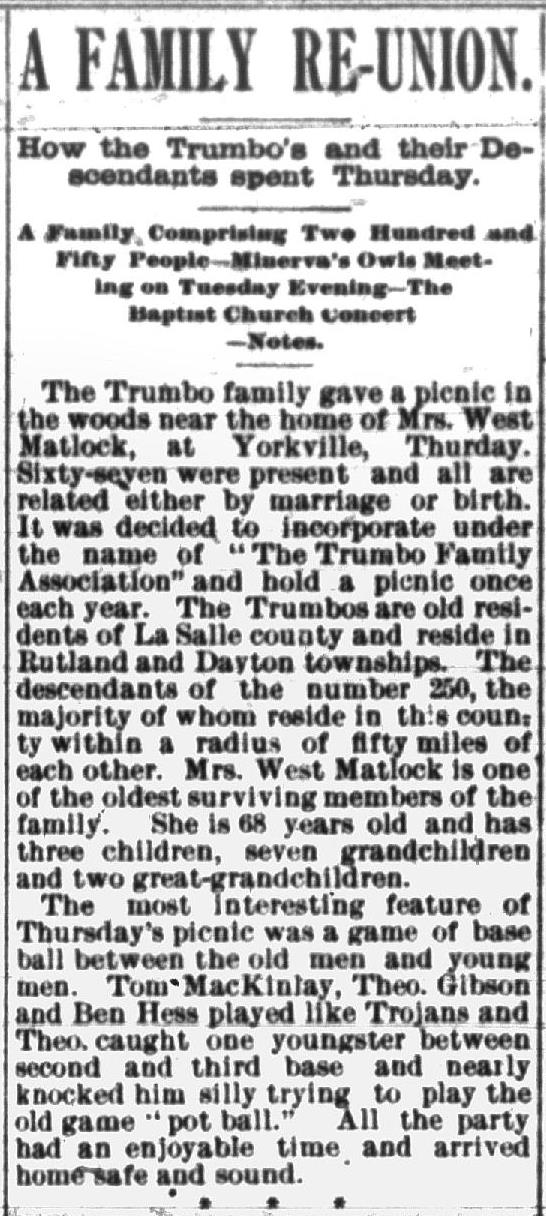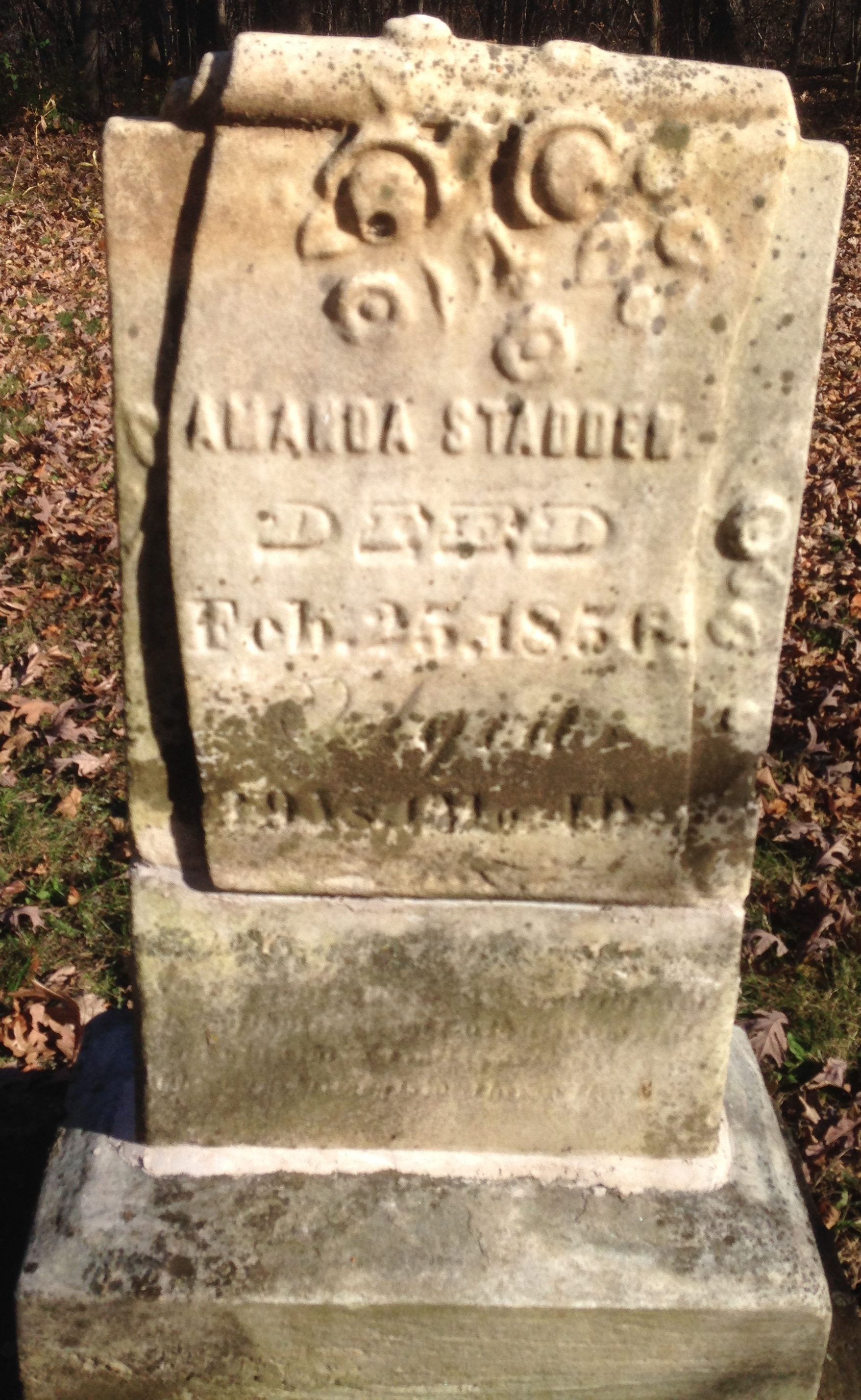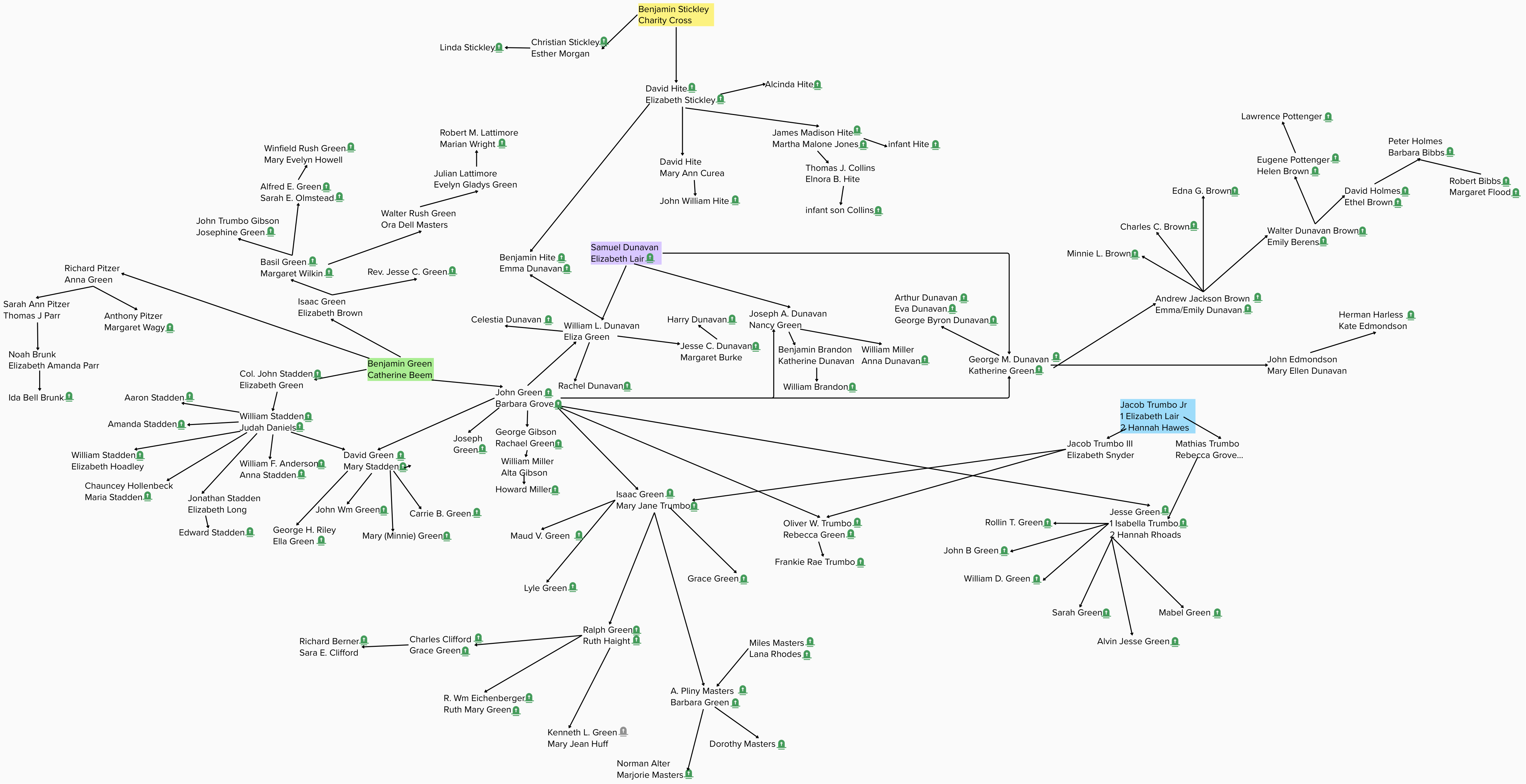
Three Dayton Groups Join for Red Cross Work

Women of Dayton and vicinity met in Dayton clubhouse yesterday and formed a unit to work for the Red Cross under auspices of Dayton Woman’s club.

Mesdames Guy Kerr, E. O. Schneider, G. W. Kirby and J. J. Digman, who are in charge of Red Cross work for the Ottawa area, attended the organization meeting.

Mrs. Ralph Green was appointed general chairman of the new unit. Mrs. William Luce and Mrs. Harvey Wohlfert were placed in charge of sewing, and Miss Maud Green of knitting.

Mrs. Gilbert Masters, president of the Dayton Woman’s club, was assisted in calling yesterday’s meeting by Mrs. Homer Mathews, president of Dayton Parent-Teacher association, and Mrs. Wohlfert, president of the Dayton Homemakers club.

Mrs. Green and Miss Green served refreshments at a table covered with nasturtiums. Mrs. Masters and Mrs. Wohlfert poured.

The newly organized unit is to meet again in two weeks for actual work.1


  1. Ottawa Daily Republican-Times, October 3, 1940, p. 12, col. 8.

A New Watchman for the Feeder

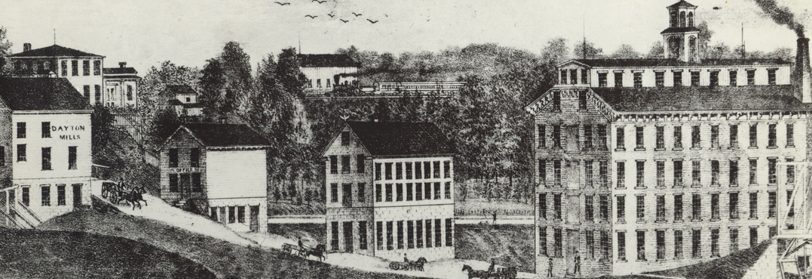
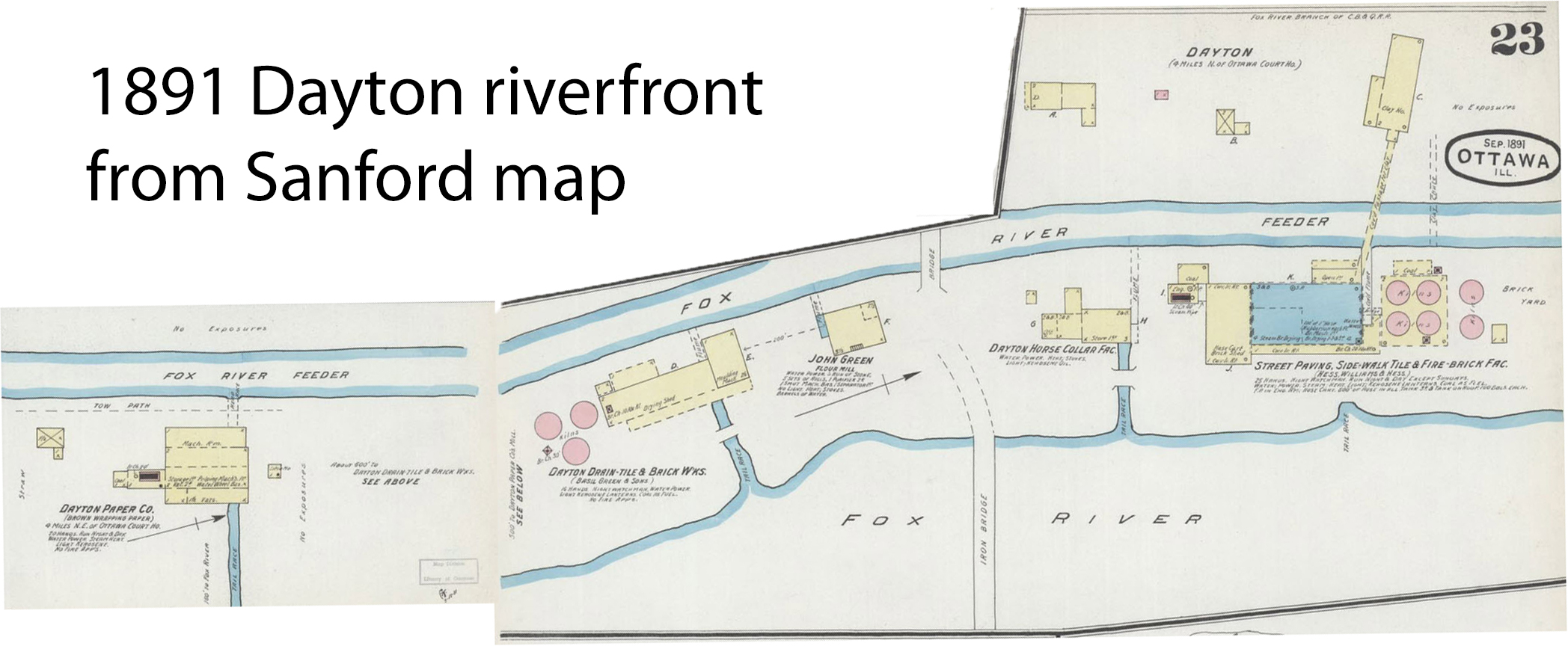
Left center: Feeder watchman’s house. Old dam in the background.

CORRESPONDENCE
DAYTON

The Rox [sic] river at this point is frozen over.

Len Hubbell is spending this week in Chicago.

A. W. Ladd made a business trip to Aurora last week.

Charles Sheppler has been laid up for a few days with a lame back.

John Marshall of Serena made a business call here on Saturday.

George Galloway enjoyed his duck at his own fireside on Thanksgiving day.

Mr. and Mrs. Moore spent a couple of days last week with friends at Earlville.

The Mutual Protective League meets on Wednesday night at Woodman hall.

Miss Mary Coleman and Miss Mary Cloat spent Wednesday and Thursday at Streator.

John Hippard has joined the T., P., & C. W. brigade and is now one of their teamsters.

Miss Mary Dunn of Ottawa spent Sunday with the Misses Mary and Maggie Coleman.

Mrs. Edwards and daughter, Mamie, of Ottawa spent Monday at Mr. and Mrs. James Timmons.

Mr. Isaac Green and family were guests of Mr. and Mrs. O. W. Trumbo on Thanksgiving day.

Mrs. John Lannel [Channel] and A. W. Ladd were visiting Mr. and Mrs. Beik’s at Ottawa on the 28th.

Corn husking is nearly over in the corn fields, but has just commenced at the fireside in the store.

Miss Jennie Barnes starts for Joliet in a few days to spend the winter with her sister, Mrs. Winn Green.

Mrs. Marguerite Mills and Mrs. Brown of South Ottawa spent Friday with Mrs. George Galloway.

One hundred and fifty bushels of corn were sold here on Monday for sixty cents per bushel, cash.

John Green and son, Percival, former residents here for many years, spent Sunday with friends here.

Mrs. John Gibson and son, Fred, left for Chicago on Tuesday, where they will make their home for the present.

Roy McBrearty, operator for the Q. at Denrock, spent Thanksgiving with his parents, Mr. and Mrs. J. McBrearty.

Mr. and Mrs. George La Pere dined with Mrs. La Pere’s parents, Mr. and Mrs. William Lohr, on Thanksgiving day.

Mr. and Mrs. Ed McClary spent Thanksgiving with Mr. E. H. Pederson and wife, deputy U. S. marshal at Yorkville.

Miss Blanche McGrath and Miss Kate Hogan of Streator were guests of the Misses Colman on Thanksgiving day.

The ticket winning the watch at the raffle on Saturday night was No. 31, and was held by Joseph Futterer of Ottawa.

William and Walter Breese and Lowell Hoxie and wife of Aurora spent Thanksgiving with Mr. and Mrs. John Breese.

John Campbell, feeder watchman at Dayton, has tendered his resignation, the same going into effect December 1st, 1901.

The Woodman Lodge will elect their officers on Tuesday night, December 10th, at 7:30, at their hall. A large attendance is expected.

On account of the scarcity of water in the feeder the electric plant was compelled to shut down on several occasions the last few days.

Bert Edwards, who has been employed as teamster for George Green, has gone to Streator, which city he expects to make his future home.

William Collamore, Jr., of Ottawa and Miss Olson of near Morris, gave Thanksgiving at the home of William Collamore, Sr., and wife, on the 28th.

Mrs. Ed Vernon and two children left for Somonauk on Saturday morning, where she will be the guest of Mr. and Mrs. Joseph Colb for a few days.

John Cisco of Ottawa is now acting as feeder watchman until the successor of John Campbell, resigned, is appointed.

W.  Wheeler and R. Doran left here for Chicago on Wednesday morning where they will visit the fat stock show and will remain until Saturday.

Wilmot Van Etten, agent for the Q. at Batavia, with his wife and three sons, Clare, Walcott and Frank, dined with Mr. and Mrs. O. W. Trumbo on Thanksgiving day, returning on the afternoon train for Batavia.

The commissioners of the Illinois and Michigan canal met at Lockport on Tuesday to appoint a feeder watchman to take the place of John Campbell, resigned. Mr. George Galloway of our little burg was also present in the interest of one of our citizens, who has resided in our midst for the past nine years. Mr. G. with his credentials made an interesting effort in behalf of Mr. William Collamore and returned home on Tuesday night with the pleasing news that Mr. Collamore had been appointed. Mr. Collamore, the new appointee, is well deserving the place he is about to fill. He has always been a staunch Republican, served three and one-half years in the war of the rebellion in the Fifty-eighth regiment, Company G., Illinois Volunteers. Mr. Collamore and his family will shortly move into his new quarters on the banks of the feeder. Well, William, that your journey along the tow path, from Dayton to Ottawa, for the next four years may be one of pleasure and no thorns to mar your path is the wish of your many friends of Dayton.1


  1. The Ottawa Free Trader, December 6, 1901, p. 12, cols. 1-2

Death of Eliza Green Dunavan

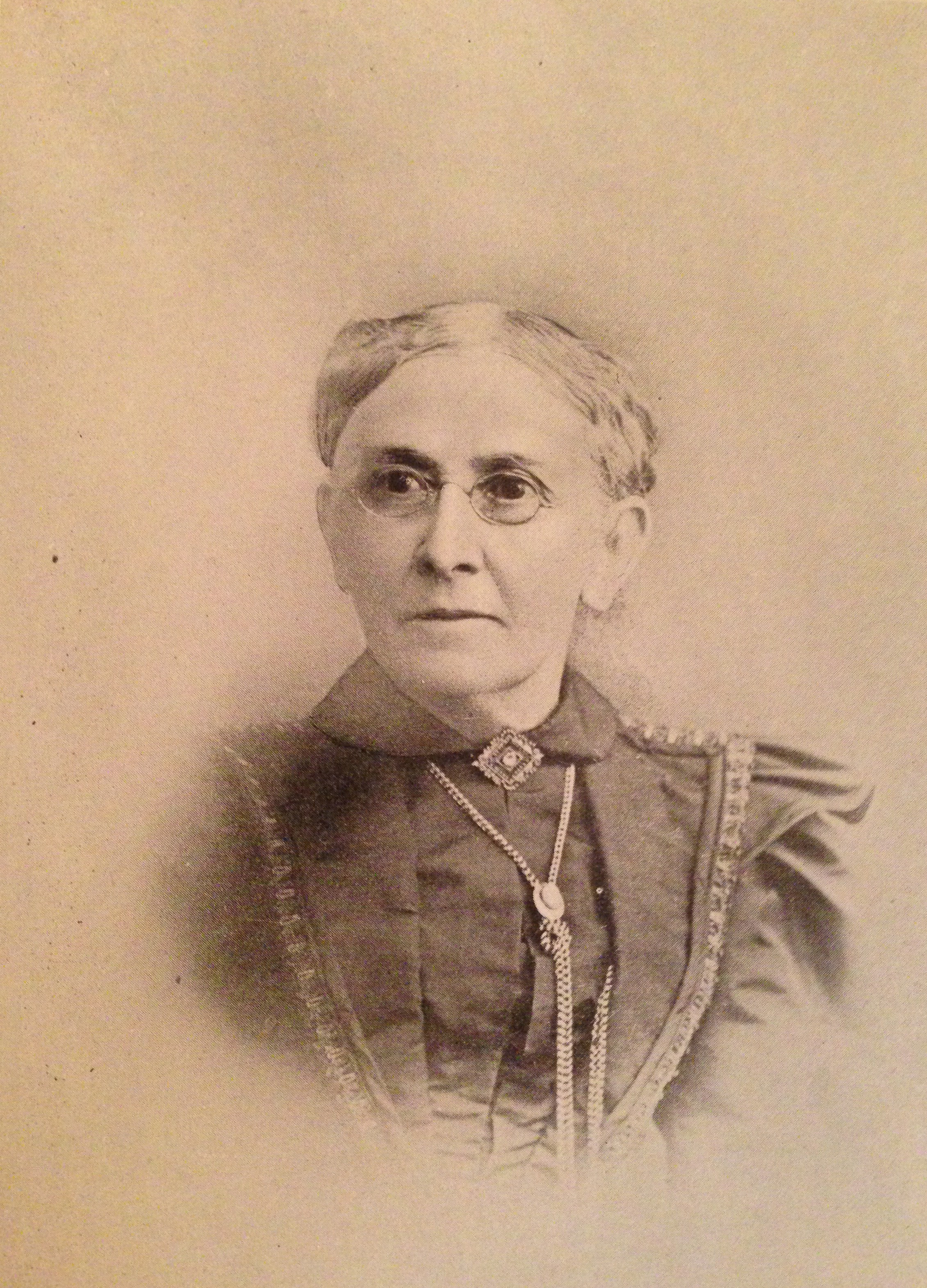
Eliza Green Dunavan

GRANDMA DUNAVAN’S DEATH
She Had Resided at Denton, Texas, for Sixteen Years

Mrs. Eliza G. Dunavan died last Wednesday night at the residence of her son, N. H. Dunavan, on West Oak street. Funeral services were held at the family residence yesterday afternoon at 3 o’clock. The interment was at the Odd Fellows cemetery. Mrs. Dunavan was eighty-two years of age.

“Grandma Dunavan had lived here sixteen years and was well known and universally loved.

“You could not say too much of her sweet disposition and kindly nature,” said a friend to us, “She was one of the sunshiniest and most lovable of women I ever knew.” Elder J. B. Cole conducted the funeral services.1

Eliza Green Dunavan was born in Licking county, Ohio, September 26, 1814, the oldest child of John and Barbara (Grove) Green. She married William Lair Dunavan November 6, 1831, in Rutland township, La Salle county. He was born November 9, 1808, in Licking county. They farmed in Rutland for many years, but in 1880 they moved to Denton, Texas, where William died May 3, 1889. Eliza died October 28, 1896.

They had nine children:
Albert F. (1832-1913
Emma L. (1834-1905) married Benjamin Hite
John (1836-    )
Elizabeth (1838-1916) married Cyrus Debolt
James William (1840-1906)
Rachel (1845-1856)
Celestia (1847-1847)
Jesse C. (1854-1880)
Noah H. (1856-1922)


  1. Denton (Tex.) Chronicle, November 6, 1896, p. 2, col. 6

Contents of a Bride’s Dowry

Matthias Trumbo

No picture of Elma, so here is her father, Mathias Trumbo.

Since daughters typically did not receive land, at their marriage they would often receive furnishings for a home, including furniture, bedding, and even livestock. Mathias Trumbo had six daughters:
Lavina, who married West Matlock in 1840
Isabella, who married Jesse Green in 1843
Eliza, who married William Gibson in 1848
Barbara, who married Joseph Jackson in 1855
Elizabeth, who married Jacob Strawn in 1860
Elma, who married Lewis Robison in 1862

When Mathias Trumbo wrote his will in 1865, one clause applied to only one of his children:

Third, To my daughter Elma Anna Robison I give and bequeath the usual outfit given to my other daughters when married viz: One (1) good horse, Two (2) cows, two (2) good beds and bedding, One (1) bureau, one (1) set of chairs, one (1) Table and Table ware, In case any of the articles so bequeathed to her are not on hand at my decease, my executors shall purchase the required ones for her out of any money belonging to the estate,

Elma was married in 1862. Why didn’t she get her dowry then?

There was this little thing called the Civil War going on. It was no time to reduce Mathias’s ability to plant, harvest, and haul supplies when labor was scarce. By 1865 he felt able to dower his youngest daughter, though only at his death.

How Did the Dayton School Compare in 1876?

The 1859 School

The 1859 School

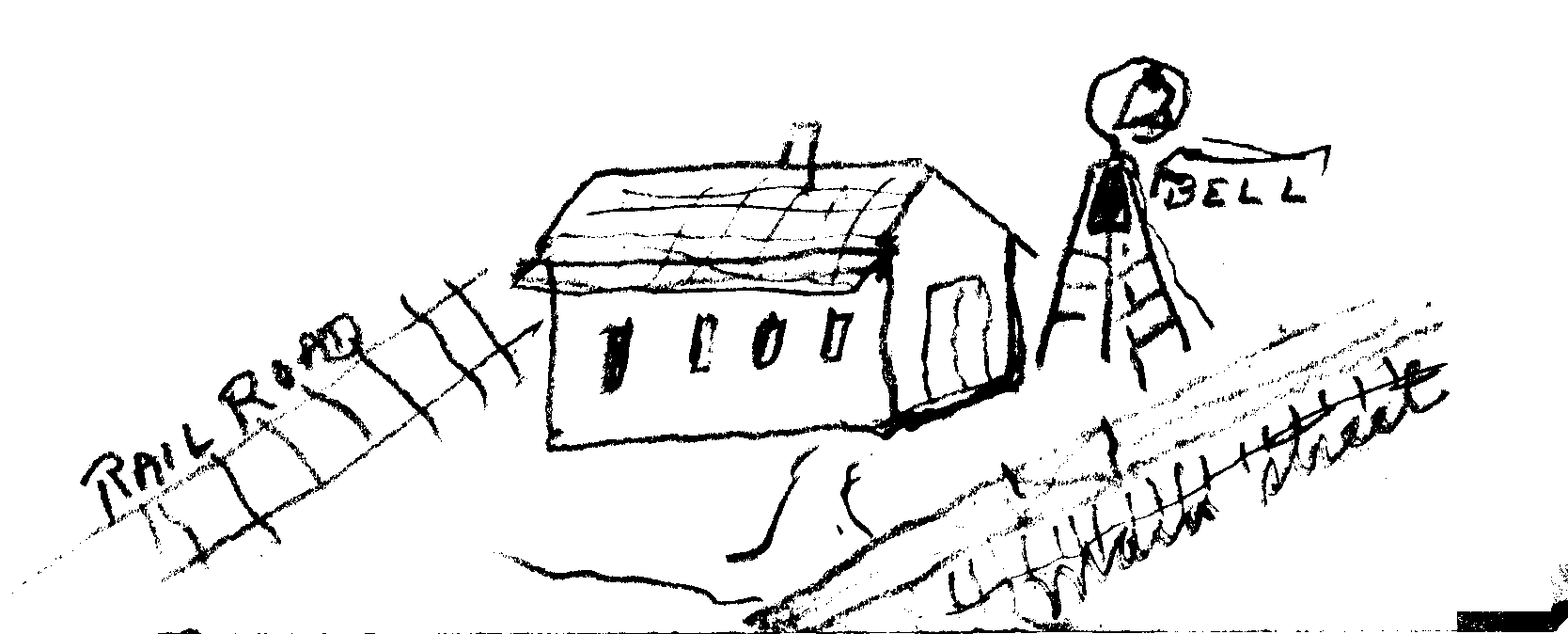
This drawing of the 1859 school was made by Ruth Green in an article on early schools. The school was by the railroad tracks, in the spot later used by the elevator.

Extracts from the Report of the County Superintendent of La Salle County Schools for the Year Ending September 18761

Number Graded Schools                                                           19
Number Ungraded Schools                                                     282

Number Male Teachers                                                           216
Number Female Teachers                                                       394

Highest monthly salary paid to any Male Teacher              $200
Highest monthly salary paid to any Female Teacher               70

Lowest monthly salary paid to any Male Teacher                     20
Lowest monthly salary paid to any Female Teacher                 15

Number Stone School Houses                                                       1
Number Brick School Houses                                                      21
Number Frame School Houses                                                 280

In 1876 Dayton was one of the 280 frame schools and was still an ungraded school, with a single teacher responsible for all classes. In 1879 the school was reorganized and divided into two branches, taught by Charles Howard and  Ada Green. By 1880 there were definite grades and subjects, though apparently NOT algebra. Female teachers were in the majority, but definitely underpaid compared to their male counterparts.

As this report shows, ungraded schools were the norm in La Salle County
     One-room schoolhouses: A single teacher taught all subjects to students of widely varying ages and abilities.
     Mixed-age instruction: Students were grouped not by age or grade, but by their level of mastery. Younger children sat in front learning the alphabet, while older students worked on more advanced subjects like arithmetic or geography.
     Flexible structure: Lessons were often individualized or taught in small groups. There was no formal progression from one grade to the next.

Graded Schools began to emerge in towns and cities as education reform gained momentum:
     Multiple classrooms: Students were divided by age or academic level into separate grades, each with its own teacher.
     Standardized curriculum: Each grade had a defined set of subjects and expectations. This made it easier to track progress and prepare students for higher education or vocational paths.
     Efficiency and order: Graded schools were seen as more modern and effective, especially in growing urban areas like Alton or Chicago, where population density allowed for more specialized instruction.

The shift from ungraded to graded schools reflected broader changes in public education—especially after Illinois passed its Free School Law in 1855, which expanded access and encouraged more uniform schooling across the state.


  1. Past and Present of La Salle County, pp. 273-4.

November Activities in Dayton

CORRESPONDENCE
DAYTON

The 14th was pay day on the Q.
Mrs. Martha Bagley is having one of her houses reshingled.
Farmers are paying three cents per bushel and board for husking.
There is hardly enough water in the river to make a good sized creek.
The crowns on the kilns at the brick mill have been given a coat of paint.

Mr. and Mrs. Moore spent Saturday and Sunday with friends in Earlville.
Miss Susie Galloway of Utica spent Saturday with Mrs. Geo. G. Galloway.
The entertainment at Woodmen hall last Friday evening was very poorly attended.
Props and cordwood are being loaded on the cars here, for different points on the Q.
Ralph Green attended the banquet of Occidental Lodge, A. F. & A. M. Monday night.

Miss Jennie Barnes spent a few days last week with her sister, Mrs. Winn Green, of Joliet.
Geo. G. Galloway has had the phone at his residence connected with the Central at Ottawa.
A number of our wells here are dry, and water has to be carried quite a distance for household use.

Mrs. Wm. Lohr presented her daughter Anna with a beautiful bible, it being a birthday present.

Lyle Green received by express on Tuesday night, from Buffalo, a fine young bull, valued at $250.

Mrs. Edw. McClary, who has been visiting friends at Joliet and Chicago, returned home on Friday night.

James Timmons has his “goo goo” eyes on the boys just at present. He is about to raffle off a silver watch valued at $20.

G. H. Green, of Seneca, contractor for the props and cord wood now being shipped from here, made a business call here Monday.

With the beautiful weather of the past two weeks, corn picking goes merrily on, and most of the boys will finish up this week.

Second bets have been made here among the sporting fraternity on the Jeffries-Rhulin fight, to take place on Friday night.

Stephen Koenig, who has been sick with malaria and typhoid fever for the past two weeks, is rapidly gaining and expects to be out in a few days.

George Timmons, a former resident of this village, and now operator for the C. B. & Q. at Maywood, is now laid up with the rheumatism at the home of his parents in Marseilles.

Some of the old plank on the Feeder bridge have been taken up and replaced with new ones. The bridge should all be newly planked, as it is in very poor condition at present.

Mrs. Emma O’Neill and three children, who have been visiting Mr. and Mrs. James Timmons, started for San Francisco, Cal., on Thursday, which place they will make their future home.

G. G. Galloway, foreman of the Northern Illinois Telephone Co., now operating at La Salle, spent Sunday at home, and returned to La Salle on Sunday night. The line is practically finished from Ottawa to La Salle.

Ed. McClary, our genial store keeper, is doing a nice business. He has his store stocked, equal to that of towns twice this size. Ed is a hustler, and that’s what counts in the grocery business.

Several saloon keepers of Ottawa have visited here to secure turtles for their five cent lunch counters. Alas, the poor turtle has gone down deep in the mud, and pulled the mud in after him, and will not be seen until the robins nest again.

The young Indians were out in full force of Sunday morning, the event being the moving of the boiler from the old paper mill to the saw mill, at the organ and piano factory at Ottawa. It proved to be quite a task, but Bert Holmes and his little Eugene proved equal to the emergency. Mr. Lou Merrifield was in charge.

A party of about a dozen men will hunt the ‘coon to a finish. The time of starting is not made public at this writing. The start will be made from the Fox river bridge north. Any person or persons wishing some of the aforesaid “‘coon meat” will kindly leave their order at the store.1


  1. The Ottawa Free Trader, November 15, 1901, p. 12, col. 1

Volunteer War Work in Dayton

Women of Dayton and vicinity met in Dayton clubhouse yesterday and formed a unit to work for the Red Cross under auspices of Dayton Woman’s club.

Mesdames Guy Karr, E. G. Schneider, G. W. Kirby and J. J. Dignan, who are in charge of Red Cross work for the Ottawa area, attended the organization meeting.

Mrs. Ralph Green was appointed general chairman of the new unit. Mrs. William Luce and Mrs. Harvey Wohlfert were placed in charge of sewing, and Miss Maud Green of knitting.

Mrs. Gilbert Masters, president of the Dayton Woman’s club, was assisted in calling yesterday’s meeting by Mrs. Homer Mathews, president of Dayton Parent-Teacher association, and Mrs. Wohlfert, president of the Dayton Homemakers club.

Mrs. Green and Miss Green served refreshments at a table centered with nasturtiums. Mrs. Masters and Mrs. Wohlfert poured.

The newly organized unit is to meet again in two weeks for actual work.1


  1. Ottawa Daily Republican Times, October 3, 1940, p. 12

Report Card Time

Report of Dayton School

The following are the average standings in the examination of the pupils in the higher departments of the Dayton school for the term ending Dec. 22, 1881:

Maud Green, 98; Frank Green, 70; Etta Barnes, 95; Louisa Benoit, 70; Lyle Green, 87; Will Barnes, 70; James Ryan, 87; Winnie Green, 70; Carrie Barnes, 85; Claud Rost, 65; Ralph Green, 80; Ellis Breese, 63; Herbert Dunavan, 76; Luther Fuer, 47; Hugh Metcalf, 74; Charlie Fuer, 40; Lizzie Bogerd, 71; Jennie Bogerd, 67.

There will be a change of teachers in this department next term. C. H. McGrew having been recently elected county superintendent of Keokuk co., Iowa, his native place, has resigned, and Mr. Clauson succeeds him as principal.

Very respectfully,
C. H. McGrew1

I was very pleased to see that my Great-aunt Maud had the highest marks.


  1. The Ottawa Republican, Thursday, 29 Dec 1881, p. 2.

The 75 Club

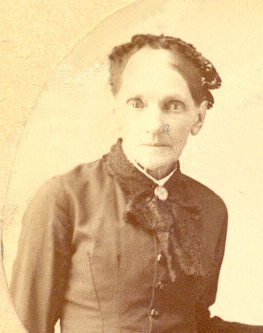
Barbara (Trumbo) Jackson

Mrs. Barbara Jackson, 97 Years Old, is Elected Head of 75 Club

Mrs. Barbara Jackson, 97 years old, of Dayton, today was elected temporary president of the Republican-Times “75 club,” an organization composed of residents of La Salle county who are upwards of 75 years of age.

Under the rules previously announced, the oldest member of the club is declared head of the organization, so Mrs. Jackson will have that honor until someone older than 97 is reported.

Mrs. Jackson was born September 19, 1829, in Licking county, Ohio, but came to La Salle county at the age of one year, and has lived here ever since. Her only living descendant is one child.

Others received into the “75 club” today are:

Mrs. Annie Hayer, 75 years old, R. 60, Seneca, who was born September 26, 1851, in Miller township, and who during her entire lifetime has been a resident of La Salle county. She has 16 living descendants, six children and ten grandchildren.

Mrs. Katherine Hess Brown of Dayton, 89 years old, born July 1, 1837, in Brock’s Gap, Virginia. She has been a resident of La Salle county for 75 years. Her living descendants are five in number, two of them being children, two grandchildren and one great grandchild.

Mrs. Belinda Jones, 86 years old, of Millington, claims La Salle county for 75 years. Her living descendants are five in number, two of inside the county line, although part of her yard is in Kendall county. She was born January 1, 1841, in Norway, Europe, and has lived in La Salle county 80 years. She has three children.

Everett Angell, 78 years old, 707 First avenue, Ottawa. He was born January 28, 1848 in Vermillionville, and has been a life-long resident of this county.

A. C. Baldwin of Deer Park township, 78 years  old. Mr. Baldwin was born in that township, and has always resided there. He has five children and 18 grandchildren.

Mrs. Anna J. Flanagan, 76 years old, who resides at 439 Fourth avenue, was born in South Ottawa, April 1, 1850, and this city has always been her home. She has four children, two grandchildren, and two great grandchildren.

For the convenience of other 75ers who have not as yet sent in their names, the membership application blank is herewith republished. Clip it out and mail it to “75 club,” in care of the Republican-Times. Membership is free to all who are eligible.1


  1. The Ottawa Daily Republican Times, October 4, 1926, p. 2.

Just Another Day in a Small Illinois Town

From Dayton

Dayton, Ill, Aug. 26, 1883. – Corn is looking well in this vicinity and will probably yield at least two-thirds of a crop. Small grain has done well, and hay turned out a good crop.

The tile works shipped out six carloads of tile last week, and are having a good home trade.

The paper company are putting in a new pulp engine and a new bleach tub.

Miss Jennie Dunavan has returned from her visit among relatives in Michigan.

Mr. Burt W. Stadden, of Chicago, a reporter of the Wholesalers’ Agency and Exchange, No. 175 Dearborn street, is spending his vacation among relatives and friends in Dayton.

Mr. Isaac Green and Mr. O. W. Trumbo have greatly improved their residences with fresh coats of paint. The school house has also received a painting.

The young folks will hold a picnic at Deer Park and Starved Rock next Saturday.

The State has been widening and strengthening the feeder bank, and is now engaged in repairing the dam.

Mr. William Dunavan started out this week on a business trip for his firm.

Miss Eva Channel has been visiting over the river all week.

The flour mill is doing some good work now on custom grinding, and considerable new wheat is now coming in. Farmers will do well to patronize this mill, where they can get a good yield of first class flour.

Rev. J. Straub, of Marseilles, preached two very excellent sermons at the school house last Sabbath morning and evening.

The news of the result of the anarchist trial in Chicago was received with great satisfaction.

The brick works are hauling large quantities of brick to Ottawa.

Our station agent, T. S. Bunn, we understand, is to go to Sheridan.

Mr. Mark Brown, formerly agent at this place, is at Ottawa for a few weeks during the vacation of the Ottawa agent, Mr. Ros.

The miller, Mr. Chas. Newman, of Montgomery, tells of a sad case of poisoning which occurred in his town last week. A lady had spread arsenic on a cookie and took it down cellar to poison the rats. She ran upstairs for something, and while gone her little child took the cookie and ate it, and died in two hours.

Occasional1


  1. Ottawa Free Trader, August 28, 1886, p. 8, col. 1

The Funeral of Cyrus Hoag

The funeral services of Cyrus Hoag, which were conducted by Henry Parr, were held at the home of his parents in Serena, at 10 A. M., Thursday, Oct. 17. The sermon being preached by Rev. Hilster, of Sheridan.

Only a few months ago one could have seen a bright young man, just in the bloom of youth, bidding the last farewell to parents, to brothers and sisters, and as he boards the train, he casts one lingering look upon the faces of his friends and companions from whom he is carried far away to try the stern realities of western life. If the veil of futurity could have been lifted, and one could have read the pages of a few coming months, we would have hardly believed that one so vigorous in health, in so short a time, with scarcely a moment’s warning, would be brought back cold in death.

Although the family had been informed of his illness, no serious thoughts were entertained until Monday morning, when a telegram was received, informing them that he was rapidly growing worse. Mrs. Hoag commenced making preparations at once, intending to take the first train. But ere it arrived the second message was received saying that Cyrus was beyond all earthly help.

He had crossed the dark river of death and entered, we trust, the bright haven of rest, where there is one bright summer always and storms do never come. One, and the most consoling thought, is that he was known as one whose character was beyond reproach, and was respected by all who knew him. Our eulogy is too feeble to give due honor to his memory, but those who knew him well say they never knew him to do a wrong act. Notwithstanding the short notice there was a long procession which followed the remains to its last resting place in Dayton cemetery.

Were we to offer an epitaph we might write —-
“Breath soft ye winds, ye waters gently flow,
Shield them ye trees, sweet flowers round them grow;
Ye sons of men in silence pass them by,
For ‘neath this sod our loved asleep doth lie.”

At the time of his death he was 22 years, 6 months and 6 days old.1

Cyrus Hoag was the son of Charles H. and Mary (Wells) Hoag who married November 5, 1857, in La Salle County. They are also buried in the Dayton Cemetery.


  1. Ottawa Republican, 25 Oct 1889, p. 4.

The Civil War Pension File for James Timmons

his signatures from 1898, 1904, and 1907 show his advancing age

To receive benefits under the Pension Act of June 27, 1890, the veteran must have served at least 90 days in the Union military during the Civil War and have received an honorable discharge. He must also be physically disabled and unable to work. The disability did not need to be service-related.

James Timmons, of Dayton, applied for a pension July 24, 1890. His name appears in the records as both Timons and Timmons. He appears to have preferred Timons. He submitted that he was unable to earn his support because of the loss of his right arm and rheumatism. His right arm was amputated about 4 inches from shoulder as a result of a railway accident.

He provided the following information to the pension office:
He enlisted February 21, 1865 in Company C, 53rd Regiment, Illinois Infantry, and was discharged July 22, 1865 in Louisville, KY.
He was married to Zilpha Welton, in Jefferson, New York, December 25, 1852
He has a son, James Henry Timons, born March 21, 1857.

Based on this, he got a pension of $12 per month.


The Pension Act of February 6, 1907, again required 90 days service and an honorable discharge, but there was no disability requirement. Instead the pension was based on age: 62–69: $12 per month; 70–74: $15 per month; 75 and older: $20 per month. Many men who had received pensions under the 1890 Act reapplied in 1907 if they qualified for the larger amount.

From James’s application we learn that he was a stone mason, born in County Armagh, Ireland, on April 9th, 1832. His claim to be at least 70 years old was accepted, but the claim to be over 75 was not accepted, so he was awarded a pension of $15 per month.

To support the over 75 years old claim, he says that his sister, Mary McCune, fifty years ago gave him a Bible that contains the record of his birth, the only record he knows of. He brought this record to the local JP who wrote, testifying to its authenticity. The pension office then said, that’s nice, but send us the Bible. He replied that he couldn’t as he had sent the Bible to Ireland to find more information on his birth. His pension stayed at $15/month.

He was removed from the pension rolls when he died, April 15, 1911.

Elaborate Society Wedding

JACOBS-BEACH
Elaborate Society Wedding Yesterday Noon in Serena Township

Miss Nellie Jacobs, daughter of Mr. and Mrs. Peter W. Jacobs, of Serena township, and Mr. Frank L. Beach, son of Mr. and Mrs. A. E. Beach, of Dayton township, and a member of the class of ’86 of the Ottawa High School, were married at the home of the bride’s parents in Serena at noon yesterday, Rev. P. D. Perkins, of Harding, officiating. The bride wore a handsome gray traveling dress. After the ceremony a bounteous wedding dinner was spread in the dining room, and at four o’clock the bride and groom left for Chicago and the north on their wedding tour. They will reside on the Beach homestead in Dayton.

The entire lower floor of the house was beautifully decorated with golden rod, and a great floral bell, made of golden rod, with a clapper of roses, was suspended over the central dining room table. Tony Simon officiated at the piano. Those present from Ottawa were Geo. Grove and wife, Misses Shaver, Sanders, Conard, and Fox; and Messrs. L. W. Brewer, Grant Conard, Chas. Wilcox, Leo Stockley and John O’Kane.1


  1. Ottawa Free Trader, September 24, 1892, p. 1, col. 4

Railroad Accident Near Dayton

The Dayton depot

BURLINGTON KILLS MAN NEAR DAYTON
Dead Man is Believed to be Oscar Classon of Danway
Mutilated Body is Found on Tracks
Parts of Body Strewn Along the Tracks for Almost a Mile–Identification is Next to Impossible — Body was Brought to Ottawa Saturday

The mutilated body of a man, supposed to be Oscar Classon, aged 47 years, married, of Danway, was found on the Burlington track shortly after 5:30 a. m. Saturday by Robert Burch, a resident of Dayton. The body was found one mile north of the Dayton depot and was horribly mangled. The Kellman Undertaking Co., of this city, was called and took charge of the body and removed it to this city.

The identification of the body is almost impossible, but circumstances surrounding the case lead the residents of Dayton to believe it to be the body of Oscar Classon. The indications are that he was struck by the south bound freight train, due in this city at 2:30 o’clock that morning.

Mr. Classon was in this city Friday and was seen by a number of people. He purchased a ticket at the local station for Millington and departed on the north bound passenger train, leaving this city at 3:05 p. m. It is reported that Mr. Classon had been drinking and that he was put off the train at Dayton at 3:15 o’clock. He was seen on several occasions late Friday afternoon by residents of Dayton wandering about the village. Classon, it is reported, made several attempts to walk the tracks and between 6 and 7 o’clock was found lying in the middle of the tracks by a man walking to the village. He was aroused and led off the tracks just previous to the passing of the passenger at 7:05 o’clock Friday evening.

It is presumed that Classon wandered back onto the tracks after the 8:30 o’clock north bound freight passed by and that he was struck by the south bound freight shortly after midnight.

Robert Burch, a resident of Dayton, while walking north on the tracks this morning, found a portion of the body a short distance from the depot. The remainder of the body was found one mile north of the depot.

The identification of the body is almost impossible. An Ingersoll watch and a ticket, bearing the date of April 8th, for Millington, were found in the pocket of the deceased.

He is reported to have been a married man and worked on a farm near Danway. He has one brother, T. B. Classon, residing east of Wedron, who has been notified to identify the body, if possible.1


  1. Ottawa Republican Times, April 14,1910, p. 7.

The Bovine Aristocracy

Isaac Green’s handsome Durham bull ‘Clifton’ would have looked a lot like this.

BLOODED CATTLE

La Salle county may well be proud of her splendid stock of cattle. Her enterprising and wealthy farmers have spent thousands and thousands of dollars in improving the breed of stock of all kinds and especially short-horned Durhams.

Desirous of doing equal and exact justice to all we began at the north end of the cattle stalls, after looking at some fine lots of cattle exhibited by Isaiah Strawn. We found, first: Mr. Isaac Green’s blooded stock. First, his handsome Durham bull “Clifton,” 3 year old, weight 5,000 lbs; is brown and white spotted; :Jenny June,” six months old, weight 500; both having a No. 1 record in the herd books.1


  1. Ottawa Free Trader, September 10, 1870, p. 4, col. 3.

September News

Dayton

Martin Wilkie has picked his grapes and expects to make about forty gallons of wine.

Mrs. Chas. Frein, while attending the funeral of Mrs. Coleman on Saturday last, met with a painful, but not serious, accident. When near the cemetery the horse, which her son was driving, became frightened at some brush which was being burnt, and she suddenly grabbed one of the lines and turned the horse so short that the occupants were thrown to the ground. Mrs. Frein’s face was cut near the temple, and she was taken at once to Ottawa, where Dr. Roberts sewed up the wound.

Henry Glodt, employed on the Q. section here, has been on the sick list the past few days.

August Kruger, wife and son, of Serena, spent Sunday with Mr. and Mrs. Charles Glodt.

Miles Masters is still very weak, but is able to leave the house.

Cider pressing goes merrily on, much to the delight of our school boys.

Mrs. Peter Coleman, 89 years of age, and a resident here since 1872, died at her home on Thursday last after an illness of fifteen months. Three daughters, Misses Mary and Meggie and Mrs. Nellie McGraw, of Streator, and one son, Richard, survive her. The interment took place at St. Columbo cemetery.

Miss Josie Shields has returned, and is now visiting Mr. and Mrs. James Timmons.

The river is still high and the feeder furnishes plenty of water to run the mills.

A. W. S.1


  1. Ottawa Republican Times, September 13, 1900, p. 9.

Let’s Include the Gentlemen

Society Notes

Last fall the ladies of Dayton township organized a little club and christened it “Dayton Home Makers’ Circle.” Since that time they have held monthly meetings at the various homes of the members and have been perfecting themselves in all the arts known to the latter day home makers. The husband did not accompany his wife, but when she was gone he washed the dinner dishes, took care of the children and had supper ready upon her return.  Although, at times, it seemed almost more than he could accomplish, he worked faithfully and has now come to his reward. Last Thursday evening the gentlemen were invited to come with the ladies to the beautiful home of Mr. and Mrs. Louis Chally, where they were most royally entertained. To Henry Smith fell the honor of opening the evening’s entertainment by bringing to view a beautiful sofa pillow which had been created in some mysterious way and become the property of Miss Dwyer’s school in District No. 198. He commented upon it in a very creditable manner, and, after assuring all the money would be well taken care of by the directors, the pillow was “raffled off,” bringing to the school treasury thirteen dollars. Mrs. Ed. McCleary held the lucky number.

The following program was then given:
Piano solo – Miss Dwyer
Vocal solo – Mrs. Frank Beach
Recitation – Mrs. Frank Funk
Piano solo – Miss Barrett
Vocal solo – Mr. Chally

After this came a luncheon, such as is known only to the ladies of Dayton township which included ice cream made from pure Jersey cream. After this brief glimpse of the wonderful, the beautiful and the eatable, the husbands felt encouraged to remain faithfully at their posts of duty. Even though disappointments may sometimes arise at noon tide and a feeling of loneliness creep o’er them in the gathering twilight hour, they realized as never before that the “Dayton Home Maker’s Circle” is still in its infancy and time alone can reveal the things that are to be. As the guests bade Mr. and Mrs. Chally goodnight they assured them heartily that the evening had been most enjoyable. Those present were Messrs and Mesdames: Donavan, La Salle; W. J. Butler, Ottawa; Wm. O’Donnell, Wallace; Silas Kain, Edward Barrett, John McCormick, Charles Eels, Frank Beach, Willis Clark, Frank Trumbo, Richard Schmidt, Masters Frank Funk, E. C. McCleary, Mesdames Olmstead, Ward, Trucker, Krug and McGrath, Misses Dwyer, Woodlock, Krug, Barnes, Baker and Barrett, Messrs. Toombs, Furr, Krug, Schmidt and Lucas, Dayton.1


  1. Ottawa Free Trader, 24 Mar 1911, p8, cols 1-2

A Correction

The errors which are corrected below are highlighted in the biographical sketch, which may be seen here.

Editors Free Trader:–In your issue of the 5th of February, Under the title of “Biographical Sketches,” you—or the types—have made three small errors which I have been requested, by a relative of the persons named, to ask you to correct. The first and second occur in the nineteenth and twentieth lines from your quotation from history of La Salle county, and should read, Mathias Trumbo and Rebecca (Grove) Trumbo, David Shaver and Nancy (Grove) Shaver. The third occurs in the thirteenth line from the closing sentence, and should read, Isabel (Parr) Potts, &c.

Mary (Parr) Grove is still living near Utica, with her husband, Ex Supervisor Samuel Grove. The daughter Isabel was the literary one of the family, and in her girlhood days contributed an occasional poem to the Free Trader. She was an estimable young lady—“fair as a lilly,” modest and retiring in her manner, yet intelligent and charming in her conversation. I have never had the pleasure of perusing any of her poems, as I was not then a subscriber to the Free Trader, but I have often thought I would be most happy could I gaze upon an emanation from her youthful pen.

A lady friend of deceased tells me that her last published literary effort was a poem written upon the death of her father, Wm. Parr, and was very pathetic and exhibited a fair degree of poetic talent. If you have the time, and it would not be asking too much, I would suggest that you look among the files of your paper for January and February, 1858, and if you can find it, to republish it. I am sorry to say I cannot give you the title, nor the “nom de plume” subscribed to her poem.1

As this reader suggested, I looked among the January-February 1858 issues (available at Chronicling America) and did indeed find the poem.

DIED–At his residence, in Rutland, Jan. 11, William Parr, aged 50 years, 1 month, 16 days.

Farewell! dear father, thou art gone,
Thy loss we feel most deep,
But though ’tis thy eternal gain,
We can but grieve and weep.

Farewell! within this world of care,
Thy form we’ll see no more,
But trust in Heaven thy spirit rests
With loved ones gone before.

Farewell! ’tis Jesus called thee home,
And we must be resigned;
But, oh! we miss thy words of love,
For thou wast ever kind.

Farewell! we dare not wish thee back,
Thy troubles now are o’er;
Sickness and sorrow, pain and death
Will ne’er disturb thee more.

Farewell! and may we not forget
Thy dying, last request,
To be prepared when death shall come
And meet thy spirit, blest.              I. D. P.2


  1. Ottawa Free Trader, February 12, 1887, p. 8, col. 2.
  2. Ottawa Free Trader, January 16, 1858, p. 3, col. 3.


There Should be a Bridge at Dayton

There have been many bridges at Dayton over the years, as they were continually washed out by  ice and rain. They were usually replaced promptly, but at least once there was a gap of ten years with no bridge. There were several failed attempts to rebuild until this one was (eventually) successful.

Editors, REPUBLICAN:: Ten years ago the bridge across the Fox river at Dayton was carried off by high water. It had been very useful as a crossing for the public in general, and especially for farmers living in the north end of the township of Rutland, and many from the townships of Miller, Manlius and Mission on their way to and from Ottawa. Of course it was very important to the township of Dayton, and especially to the residents of the village of Dayton and vicinity. The bridge has not et been replaced. At the annual town meeting last April the voters of Dayton township authorized the commissioners of highways to borrow money to aid in building a bridge. The river is the line between Dayton and Rutland townships. Certain citizens of the village of Dayton were so desirous to have a bridge that they subscribed individually and guaranteed to the commissioners of Rutland $1,000 as an inducement to the voters of Rutland township to authorize their commissioners, at a special election, to borrow not to exceed $1500 to aid in the building of a bridge. An election was held yesterday in the township of Rutland. In the 2nd precinct, where the voters were more interested than in the 1st, the proposition was carried by a fair majority. But in the 1st precinct, which includes the village of Marseilles, it was lost by a majority sufficient to defeat the enterprise. We don’t want the public to think that we lay all the blame of our defeat at the door of Marseilles. We think the greater part attaches to certain farmers living in the eastern and southern parts of the township, who were frightened at a small increase of tax.

Let us look at the tax question for a moment. The assessor told me that the valuation of the township for the year 1884 was about $562,000. The average laboring man, so often referred to yesterday, is not assessed at to exceed $100. His share of the tax would not exceed 100-562000 of the $1500 asked for, or not more than 20 cents — about two hours work for a common laborer. The well-to-do farmer and manufacturer and capitalist would pay in the same proportion. We are unwilling to believe that the men who opposed us at the election in Marseilles yesterday would repeat it, after knowing the true situation, for such a paltry increase to their tax. We are grateful to the gentlemen who gave us their votes, and especially to those who gave us active influence. We thank those who opposed us for courtesy extended. The friction of life wakes life interesting. But unnecessary friction is expensive.
Basil Green.
Second Precinct, June 2, 18851

Dayton, Sept. Sept. 16. – At last it is settled that we are to have the bridge! The Board of Supervisors yesterday by a vote of twenty-seven to nine granted county aid to the amount of $5,000, and appointed Supervisors Anderson and Bubeck to look after the county’s interest. The bids will be opened next Monday and the contract let so that work may commence at once. The citizens are greatly rejoiced at the result and hope nothing serious may interfere with the completion of the work.
Our worthy supervisor, Mr. Basil Green, has been attending the meeting of the board at Ottawa, this week, and looking after the interests of our bridge.2

iron bridge at Dayton 1886
Dayton, Ill, April 1st, 1887. – Our bridge is finished at last and open for public travel. It is a very fine three span iron bridge, the neatest one on the river, and is a fine addition to our village. Of course every one will use it now that it is constructed, and it was noticed that about one of the first to use it was one who had fought the hardest.3


  1. Ottawa Republican, June 5, 1885, p. 8.
  2. Ottawa Free Trader, September 18, 1886, p. 5, col. 3
  3. Ottawa Free Trader, April 2, 1887, p. 4, col. 6

Support of a Family Burying Ground

The red circle indicates the location of the Trumbo burying ground

When Mathias Trumbo wrote his will in 1865 he had thought carefully of how his estate was to be divided and had left explicit instructions. However, in 1874, just a year before his death, he realized that there was something else he wanted done at his death. In order to accomplish this, he created a codicil to his will stipulating that out of the proceeds of his estate, one hundred dollars should be invested for ornamenting and keeping in good order the grave yard located in Section Twenty Seven, Township Thirty four North in Range Four East in the Town of Rutland LaSalle County, Illinois.

An overhead view of the burying ground in 2025.

It appears that when Mathias wrote this codicil no trustees for the grave yard had yet been appointed. He directed that at his demise, if no trustees had yet been appointed, his executors should invest the one hundred dollars and hold it in trust until trustees were appointed, at which time the money would be paid to them. He further stipulated that the trustees were to spend only the interest on the investment and that the said principal of one hundred dollars was to be held by the said trustees and their succession forever.1

Mathias’s care for the burying ground did not end there. When he conveyed the land around it to his daughter in 1870 in return for her care of him for his lifetime, he stipulated that she must grant a right of way 2 rods wide from the Chicago road to the burying ground.

In 1988 when my father took me to see this tiny cemetery, we had to walk through a field to reach it (so much for the 2 rods right-of-way). It was totally overgrown and it was difficult to see the stones, although I was able to photograph the one I had come to see.  Unfortunately, I did not know of Mathias Trumbo at that time, so I missed seeing his stone. Now the cemetery is being cared for, as you can see in the photograph above. I don’t have any information though as to whether the interest on that hundred dollars is still accumulating somewhere.

Thanks to the folks at the La Salle County Genealogy Guild (lscgg.org) for this picture of Mathias Trumbo’s tombstone. They have a wealth of information on La Salle County families and are wonderful at sharing it.


  1. You can see the complete text of Mathias’s will and codicil here.