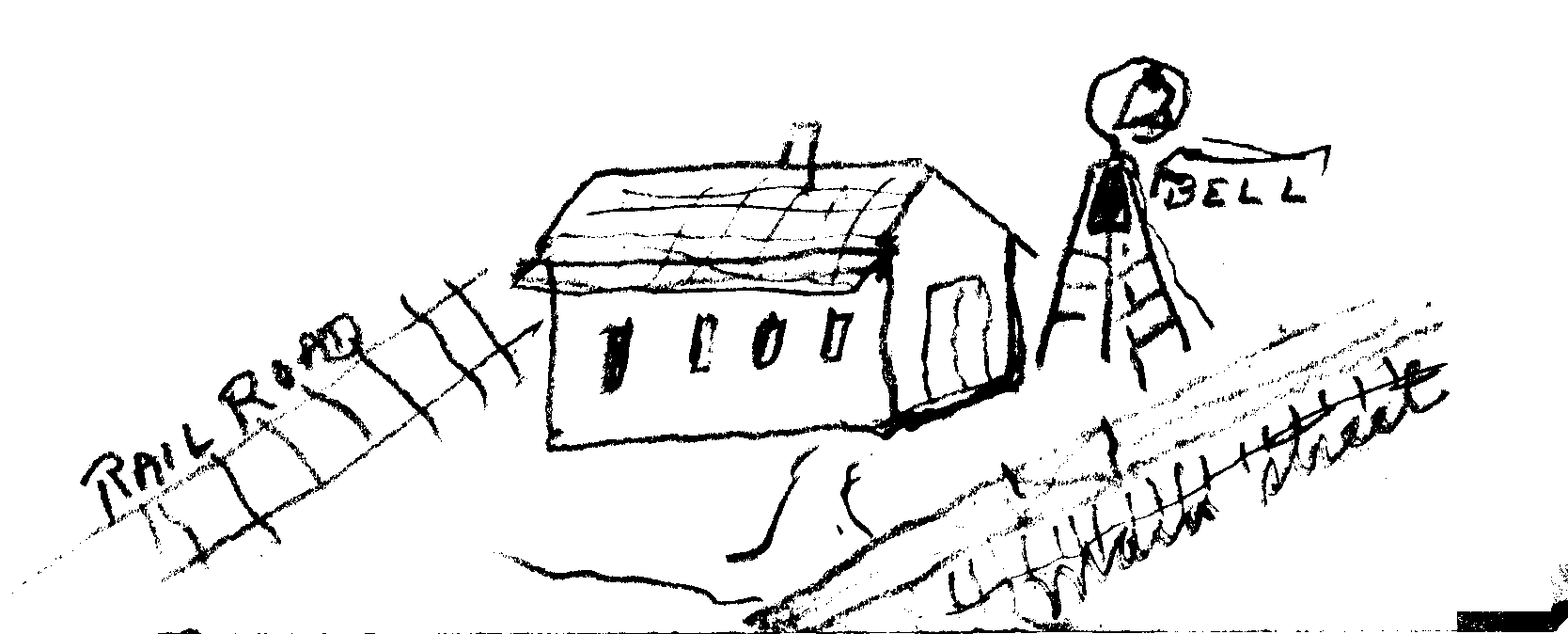
The 1859 School
This drawing of the 1859 school was made by Ruth Green in an article on early schools. The school was by the railroad tracks, in the spot later used by the elevator.
Extracts from the Report of the County Superintendent of La Salle County Schools for the Year Ending September 18761
Number Graded Schools 19
Number Ungraded Schools 282
Number Male Teachers 216
Number Female Teachers 394
Highest monthly salary paid to any Male Teacher $200
Highest monthly salary paid to any Female Teacher 70
Lowest monthly salary paid to any Male Teacher 20
Lowest monthly salary paid to any Female Teacher 15
Number Stone School Houses 1
Number Brick School Houses 21
Number Frame School Houses 280
In 1876 Dayton was one of the 280 frame schools and was still an ungraded school, with a single teacher responsible for all classes. In 1879 the school was reorganized and divided into two branches, taught by Charles Howard and Ada Green. By 1880 there were definite grades and subjects, though apparently NOT algebra. Female teachers were in the majority, but definitely underpaid compared to their male counterparts.

As this report shows, ungraded schools were the norm in La Salle County
One-room schoolhouses: A single teacher taught all subjects to students of widely varying ages and abilities.
Mixed-age instruction: Students were grouped not by age or grade, but by their level of mastery. Younger children sat in front learning the alphabet, while older students worked on more advanced subjects like arithmetic or geography.
Flexible structure: Lessons were often individualized or taught in small groups. There was no formal progression from one grade to the next.
Graded Schools began to emerge in towns and cities as education reform gained momentum:
Multiple classrooms: Students were divided by age or academic level into separate grades, each with its own teacher.
Standardized curriculum: Each grade had a defined set of subjects and expectations. This made it easier to track progress and prepare students for higher education or vocational paths.
Efficiency and order: Graded schools were seen as more modern and effective, especially in growing urban areas like Alton or Chicago, where population density allowed for more specialized instruction.
The shift from ungraded to graded schools reflected broader changes in public education—especially after Illinois passed its Free School Law in 1855, which expanded access and encouraged more uniform schooling across the state.
- Past and Present of La Salle County, pp. 273-4.
 Dayton and the Greens