Contents of a Bride’s Dowry

Matthias Trumbo

No picture of Elma, so here is her father, Mathias Trumbo.

Since daughters typically did not receive land, at their marriage they would often receive furnishings for a home, including furniture, bedding, and even livestock. Mathias Trumbo had six daughters:
Lavina, who married West Matlock in 1840
Isabella, who married Jesse Green in 1843
Eliza, who married William Gibson in 1848
Barbara, who married Joseph Jackson in 1855
Elizabeth, who married Jacob Strawn in 1860
Elma, who married Lewis Robison in 1862

When Mathias Trumbo wrote his will in 1865, one clause applied to only one of his children:

Third, To my daughter Elma Anna Robison I give and bequeath the usual outfit given to my other daughters when married viz: One (1) good horse, Two (2) cows, two (2) good beds and bedding, One (1) bureau, one (1) set of chairs, one (1) Table and Table ware, In case any of the articles so bequeathed to her are not on hand at my decease, my executors shall purchase the required ones for her out of any money belonging to the estate,

Elma was married in 1862. Why didn’t she get her dowry then?

There was this little thing called the Civil War going on. It was no time to reduce Mathias’s ability to plant, harvest, and haul supplies when labor was scarce. By 1865 he felt able to dower his youngest daughter, though only at his death.

How Did the Dayton School Compare in 1876?

The 1859 School

The 1859 School

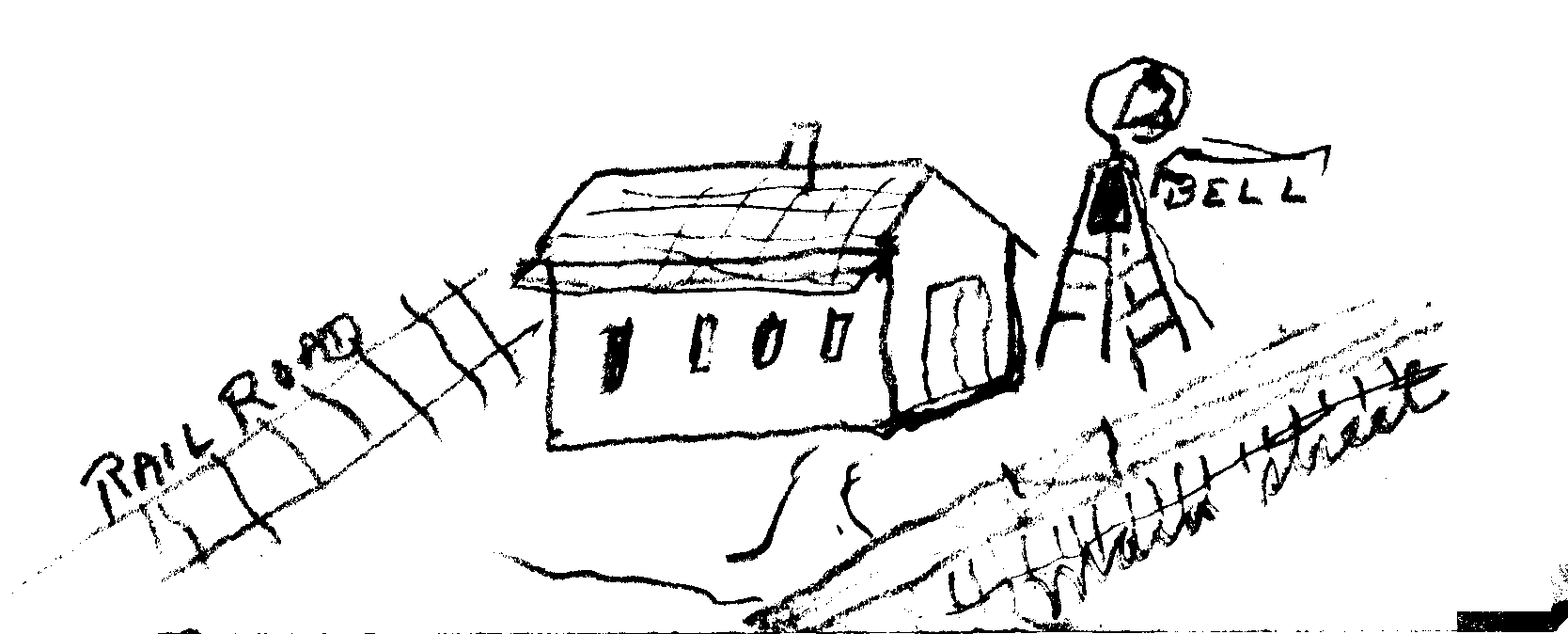
This drawing of the 1859 school was made by Ruth Green in an article on early schools. The school was by the railroad tracks, in the spot later used by the elevator.

Extracts from the Report of the County Superintendent of La Salle County Schools for the Year Ending September 18761

Number Graded Schools                                                           19
Number Ungraded Schools                                                     282

Number Male Teachers                                                           216
Number Female Teachers                                                       394

Highest monthly salary paid to any Male Teacher              $200
Highest monthly salary paid to any Female Teacher               70

Lowest monthly salary paid to any Male Teacher                     20
Lowest monthly salary paid to any Female Teacher                 15

Number Stone School Houses                                                       1
Number Brick School Houses                                                      21
Number Frame School Houses                                                 280

In 1876 Dayton was one of the 280 frame schools and was still an ungraded school, with a single teacher responsible for all classes. In 1879 the school was reorganized and divided into two branches, taught by Charles Howard and  Ada Green. By 1880 there were definite grades and subjects, though apparently NOT algebra. Female teachers were in the majority, but definitely underpaid compared to their male counterparts.

As this report shows, ungraded schools were the norm in La Salle County
     One-room schoolhouses: A single teacher taught all subjects to students of widely varying ages and abilities.
     Mixed-age instruction: Students were grouped not by age or grade, but by their level of mastery. Younger children sat in front learning the alphabet, while older students worked on more advanced subjects like arithmetic or geography.
     Flexible structure: Lessons were often individualized or taught in small groups. There was no formal progression from one grade to the next.

Graded Schools began to emerge in towns and cities as education reform gained momentum:
     Multiple classrooms: Students were divided by age or academic level into separate grades, each with its own teacher.
     Standardized curriculum: Each grade had a defined set of subjects and expectations. This made it easier to track progress and prepare students for higher education or vocational paths.
     Efficiency and order: Graded schools were seen as more modern and effective, especially in growing urban areas like Alton or Chicago, where population density allowed for more specialized instruction.

The shift from ungraded to graded schools reflected broader changes in public education—especially after Illinois passed its Free School Law in 1855, which expanded access and encouraged more uniform schooling across the state.


  1. Past and Present of La Salle County, pp. 273-4.

November Activities in Dayton

CORRESPONDENCE
DAYTON

The 14th was pay day on the Q.
Mrs. Martha Bagley is having one of her houses reshingled.
Farmers are paying three cents per bushel and board for husking.
There is hardly enough water in the river to make a good sized creek.
The crowns on the kilns at the brick mill have been given a coat of paint.

Mr. and Mrs. Moore spent Saturday and Sunday with friends in Earlville.
Miss Susie Galloway of Utica spent Saturday with Mrs. Geo. G. Galloway.
The entertainment at Woodmen hall last Friday evening was very poorly attended.
Props and cordwood are being loaded on the cars here, for different points on the Q.
Ralph Green attended the banquet of Occidental Lodge, A. F. & A. M. Monday night.

Miss Jennie Barnes spent a few days last week with her sister, Mrs. Winn Green, of Joliet.
Geo. G. Galloway has had the phone at his residence connected with the Central at Ottawa.
A number of our wells here are dry, and water has to be carried quite a distance for household use.

Mrs. Wm. Lohr presented her daughter Anna with a beautiful bible, it being a birthday present.

Lyle Green received by express on Tuesday night, from Buffalo, a fine young bull, valued at $250.

Mrs. Edw. McClary, who has been visiting friends at Joliet and Chicago, returned home on Friday night.

James Timmons has his “goo goo” eyes on the boys just at present. He is about to raffle off a silver watch valued at $20.

G. H. Green, of Seneca, contractor for the props and cord wood now being shipped from here, made a business call here Monday.

With the beautiful weather of the past two weeks, corn picking goes merrily on, and most of the boys will finish up this week.

Second bets have been made here among the sporting fraternity on the Jeffries-Rhulin fight, to take place on Friday night.

Stephen Koenig, who has been sick with malaria and typhoid fever for the past two weeks, is rapidly gaining and expects to be out in a few days.

George Timmons, a former resident of this village, and now operator for the C. B. & Q. at Maywood, is now laid up with the rheumatism at the home of his parents in Marseilles.

Some of the old plank on the Feeder bridge have been taken up and replaced with new ones. The bridge should all be newly planked, as it is in very poor condition at present.

Mrs. Emma O’Neill and three children, who have been visiting Mr. and Mrs. James Timmons, started for San Francisco, Cal., on Thursday, which place they will make their future home.

G. G. Galloway, foreman of the Northern Illinois Telephone Co., now operating at La Salle, spent Sunday at home, and returned to La Salle on Sunday night. The line is practically finished from Ottawa to La Salle.

Ed. McClary, our genial store keeper, is doing a nice business. He has his store stocked, equal to that of towns twice this size. Ed is a hustler, and that’s what counts in the grocery business.

Several saloon keepers of Ottawa have visited here to secure turtles for their five cent lunch counters. Alas, the poor turtle has gone down deep in the mud, and pulled the mud in after him, and will not be seen until the robins nest again.

The young Indians were out in full force of Sunday morning, the event being the moving of the boiler from the old paper mill to the saw mill, at the organ and piano factory at Ottawa. It proved to be quite a task, but Bert Holmes and his little Eugene proved equal to the emergency. Mr. Lou Merrifield was in charge.

A party of about a dozen men will hunt the ‘coon to a finish. The time of starting is not made public at this writing. The start will be made from the Fox river bridge north. Any person or persons wishing some of the aforesaid “‘coon meat” will kindly leave their order at the store.1


  1. The Ottawa Free Trader, November 15, 1901, p. 12, col. 1
Volunteer War Work in Dayton

Women of Dayton and vicinity met in Dayton clubhouse yesterday and formed a unit to work for the Red Cross under auspices of Dayton Woman’s club.

Mesdames Guy Karr, E. G. Schneider, G. W. Kirby and J. J. Dignan, who are in charge of Red Cross work for the Ottawa area, attended the organization meeting.

Mrs. Ralph Green was appointed general chairman of the new unit. Mrs. William Luce and Mrs. Harvey Wohlfert were placed in charge of sewing, and Miss Maud Green of knitting.

Mrs. Gilbert Masters, president of the Dayton Woman’s club, was assisted in calling yesterday’s meeting by Mrs. Homer Mathews, president of Dayton Parent-Teacher association, and Mrs. Wohlfert, president of the Dayton Homemakers club.

Mrs. Green and Miss Green served refreshments at a table centered with nasturtiums. Mrs. Masters and Mrs. Wohlfert poured.

The newly organized unit is to meet again in two weeks for actual work.1


  1. Ottawa Daily Republican Times, October 3, 1940, p. 12