Let’s Include the Gentlemen

Society Notes

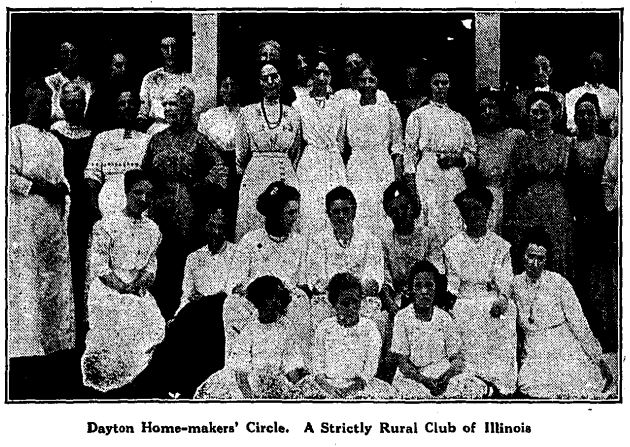
Last fall the ladies of Dayton township organized a little club and christened it “Dayton Home Makers’ Circle.” Since that time they have held monthly meetings at the various homes of the members and have been perfecting themselves in all the arts known to the latter day home makers. The husband did not accompany his wife, but when she was gone he washed the dinner dishes, took care of the children and had supper ready upon her return.  Although, at times, it seemed almost more than he could accomplish, he worked faithfully and has now come to his reward. Last Thursday evening the gentlemen were invited to come with the ladies to the beautiful home of Mr. and Mrs. Louis Chally, where they were most royally entertained. To Henry Smith fell the honor of opening the evening’s entertainment by bringing to view a beautiful sofa pillow which had been created in some mysterious way and become the property of Miss Dwyer’s school in District No. 198. He commented upon it in a very creditable manner, and, after assuring all the money would be well taken care of by the directors, the pillow was “raffled off,” bringing to the school treasury thirteen dollars. Mrs. Ed. McCleary held the lucky number.

The following program was then given:
Piano solo – Miss Dwyer
Vocal solo – Mrs. Frank Beach
Recitation – Mrs. Frank Funk
Piano solo – Miss Barrett
Vocal solo – Mr. Chally

After this came a luncheon, such as is known only to the ladies of Dayton township which included ice cream made from pure Jersey cream. After this brief glimpse of the wonderful, the beautiful and the eatable, the husbands felt encouraged to remain faithfully at their posts of duty. Even though disappointments may sometimes arise at noon tide and a feeling of loneliness creep o’er them in the gathering twilight hour, they realized as never before that the “Dayton Home Maker’s Circle” is still in its infancy and time alone can reveal the things that are to be. As the guests bade Mr. and Mrs. Chally goodnight they assured them heartily that the evening had been most enjoyable. Those present were Messrs and Mesdames: Donavan, La Salle; W. J. Butler, Ottawa; Wm. O’Donnell, Wallace; Silas Kain, Edward Barrett, John McCormick, Charles Eels, Frank Beach, Willis Clark, Frank Trumbo, Richard Schmidt, Masters Frank Funk, E. C. McCleary, Mesdames Olmstead, Ward, Trucker, Krug and McGrath, Misses Dwyer, Woodlock, Krug, Barnes, Baker and Barrett, Messrs. Toombs, Furr, Krug, Schmidt and Lucas, Dayton.1


  1. Ottawa Free Trader, 24 Mar 1911, p8, cols 1-2

A Correction

The errors which are corrected below are highlighted in the biographical sketch, which may be seen here.

Editors Free Trader:–In your issue of the 5th of February, Under the title of “Biographical Sketches,” you—or the types—have made three small errors which I have been requested, by a relative of the persons named, to ask you to correct. The first and second occur in the nineteenth and twentieth lines from your quotation from history of La Salle county, and should read, Mathias Trumbo and Rebecca (Grove) Trumbo, David Shaver and Nancy (Grove) Shaver. The third occurs in the thirteenth line from the closing sentence, and should read, Isabel (Parr) Potts, &c.

Mary (Parr) Grove is still living near Utica, with her husband, Ex Supervisor Samuel Grove. The daughter Isabel was the literary one of the family, and in her girlhood days contributed an occasional poem to the Free Trader. She was an estimable young lady—“fair as a lilly,” modest and retiring in her manner, yet intelligent and charming in her conversation. I have never had the pleasure of perusing any of her poems, as I was not then a subscriber to the Free Trader, but I have often thought I would be most happy could I gaze upon an emanation from her youthful pen.

A lady friend of deceased tells me that her last published literary effort was a poem written upon the death of her father, Wm. Parr, and was very pathetic and exhibited a fair degree of poetic talent. If you have the time, and it would not be asking too much, I would suggest that you look among the files of your paper for January and February, 1858, and if you can find it, to republish it. I am sorry to say I cannot give you the title, nor the “nom de plume” subscribed to her poem.1

As this reader suggested, I looked among the January-February 1858 issues (available at Chronicling America) and did indeed find the poem.

DIED–At his residence, in Rutland, Jan. 11, William Parr, aged 50 years, 1 month, 16 days.

Farewell! dear father, thou art gone,
Thy loss we feel most deep,
But though ’tis thy eternal gain,
We can but grieve and weep.

Farewell! within this world of care,
Thy form we’ll see no more,
But trust in Heaven thy spirit rests
With loved ones gone before.

Farewell! ’tis Jesus called thee home,
And we must be resigned;
But, oh! we miss thy words of love,
For thou wast ever kind.

Farewell! we dare not wish thee back,
Thy troubles now are o’er;
Sickness and sorrow, pain and death
Will ne’er disturb thee more.

Farewell! and may we not forget
Thy dying, last request,
To be prepared when death shall come
And meet thy spirit, blest.              I. D. P.2


  1. Ottawa Free Trader, February 12, 1887, p. 8, col. 2.
  2. Ottawa Free Trader, January 16, 1858, p. 3, col. 3.


There Should be a Bridge at Dayton

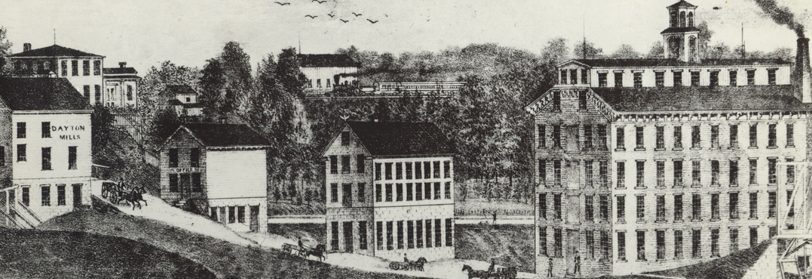
There have been many bridges at Dayton over the years, as they were continually washed out by  ice and rain. They were usually replaced promptly, but at least once there was a gap of ten years with no bridge. There were several failed attempts to rebuild until this one was (eventually) successful.

Editors, REPUBLICAN:: Ten years ago the bridge across the Fox river at Dayton was carried off by high water. It had been very useful as a crossing for the public in general, and especially for farmers living in the north end of the township of Rutland, and many from the townships of Miller, Manlius and Mission on their way to and from Ottawa. Of course it was very important to the township of Dayton, and especially to the residents of the village of Dayton and vicinity. The bridge has not et been replaced. At the annual town meeting last April the voters of Dayton township authorized the commissioners of highways to borrow money to aid in building a bridge. The river is the line between Dayton and Rutland townships. Certain citizens of the village of Dayton were so desirous to have a bridge that they subscribed individually and guaranteed to the commissioners of Rutland $1,000 as an inducement to the voters of Rutland township to authorize their commissioners, at a special election, to borrow not to exceed $1500 to aid in the building of a bridge. An election was held yesterday in the township of Rutland. In the 2nd precinct, where the voters were more interested than in the 1st, the proposition was carried by a fair majority. But in the 1st precinct, which includes the village of Marseilles, it was lost by a majority sufficient to defeat the enterprise. We don’t want the public to think that we lay all the blame of our defeat at the door of Marseilles. We think the greater part attaches to certain farmers living in the eastern and southern parts of the township, who were frightened at a small increase of tax.

Let us look at the tax question for a moment. The assessor told me that the valuation of the township for the year 1884 was about $562,000. The average laboring man, so often referred to yesterday, is not assessed at to exceed $100. His share of the tax would not exceed 100-562000 of the $1500 asked for, or not more than 20 cents — about two hours work for a common laborer. The well-to-do farmer and manufacturer and capitalist would pay in the same proportion. We are unwilling to believe that the men who opposed us at the election in Marseilles yesterday would repeat it, after knowing the true situation, for such a paltry increase to their tax. We are grateful to the gentlemen who gave us their votes, and especially to those who gave us active influence. We thank those who opposed us for courtesy extended. The friction of life wakes life interesting. But unnecessary friction is expensive.
Basil Green.
Second Precinct, June 2, 18851

Dayton, Sept. Sept. 16. – At last it is settled that we are to have the bridge! The Board of Supervisors yesterday by a vote of twenty-seven to nine granted county aid to the amount of $5,000, and appointed Supervisors Anderson and Bubeck to look after the county’s interest. The bids will be opened next Monday and the contract let so that work may commence at once. The citizens are greatly rejoiced at the result and hope nothing serious may interfere with the completion of the work.
Our worthy supervisor, Mr. Basil Green, has been attending the meeting of the board at Ottawa, this week, and looking after the interests of our bridge.2

iron bridge at Dayton 1886
Dayton, Ill, April 1st, 1887. – Our bridge is finished at last and open for public travel. It is a very fine three span iron bridge, the neatest one on the river, and is a fine addition to our village. Of course every one will use it now that it is constructed, and it was noticed that about one of the first to use it was one who had fought the hardest.3


  1. Ottawa Republican, June 5, 1885, p. 8.
  2. Ottawa Free Trader, September 18, 1886, p. 5, col. 3
  3. Ottawa Free Trader, April 2, 1887, p. 4, col. 6

Support of a Family Burying Ground

The red circle indicates the location of the Trumbo burying ground

When Mathias Trumbo wrote his will in 1865 he had thought carefully of how his estate was to be divided and had left explicit instructions. However, in 1874, just a year before his death, he realized that there was something else he wanted done at his death. In order to accomplish this, he created a codicil to his will stipulating that out of the proceeds of his estate, one hundred dollars should be invested for ornamenting and keeping in good order the grave yard located in Section Twenty Seven, Township Thirty four North in Range Four East in the Town of Rutland LaSalle County, Illinois.

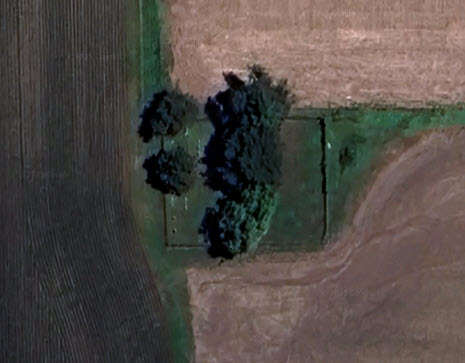
An overhead view of the burying ground in 2025.

It appears that when Mathias wrote this codicil no trustees for the grave yard had yet been appointed. He directed that at his demise, if no trustees had yet been appointed, his executors should invest the one hundred dollars and hold it in trust until trustees were appointed, at which time the money would be paid to them. He further stipulated that the trustees were to spend only the interest on the investment and that the said principal of one hundred dollars was to be held by the said trustees and their succession forever.1

Mathias’s care for the burying ground did not end there. When he conveyed the land around it to his daughter in 1870 in return for her care of him for his lifetime, he stipulated that she must grant a right of way 2 rods wide from the Chicago road to the burying ground.

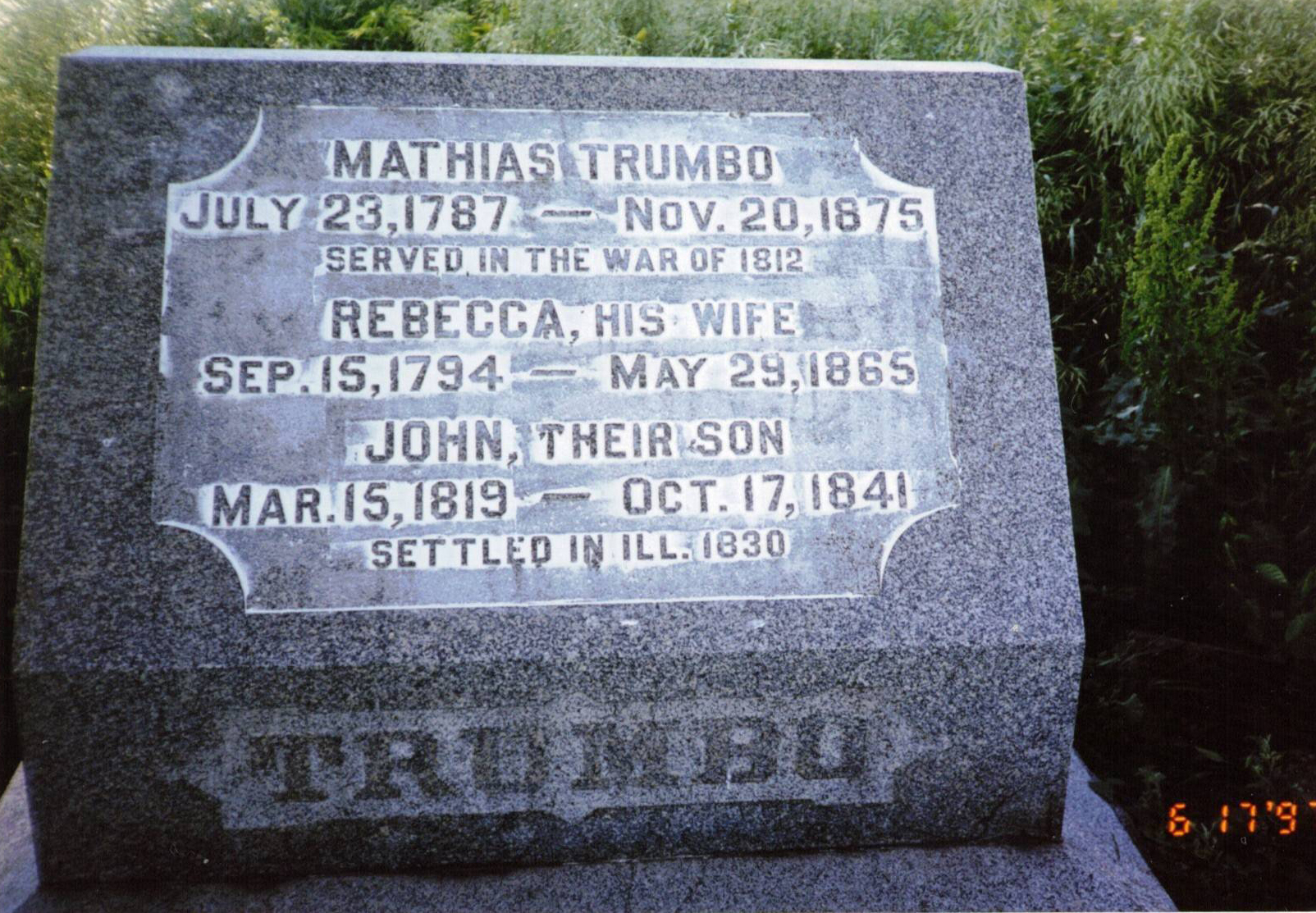
In 1988 when my father took me to see this tiny cemetery, we had to walk through a field to reach it (so much for the 2 rods right-of-way). It was totally overgrown and it was difficult to see the stones, although I was able to photograph the one I had come to see.  Unfortunately, I did not know of Mathias Trumbo at that time, so I missed seeing his stone. Now the cemetery is being cared for, as you can see in the photograph above. I don’t have any information though as to whether the interest on that hundred dollars is still accumulating somewhere.

Thanks to the folks at the La Salle County Genealogy Guild (lscgg.org) for this picture of Mathias Trumbo’s tombstone. They have a wealth of information on La Salle County families and are wonderful at sharing it.


  1. You can see the complete text of Mathias’s will and codicil here.