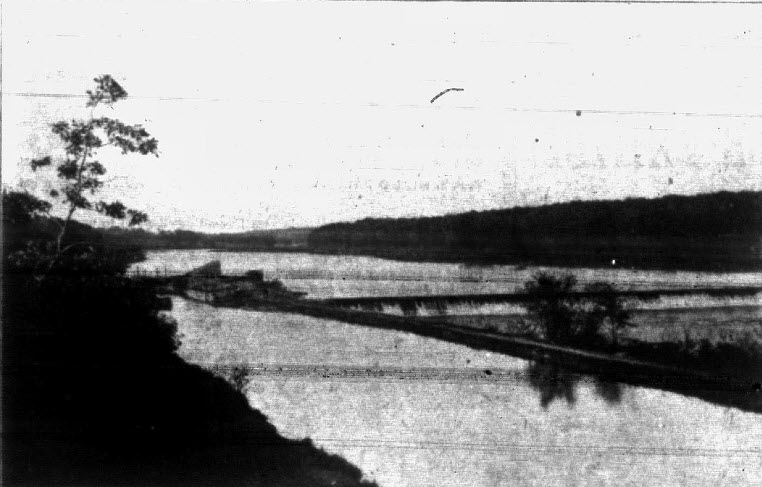
Dayton dam with feeder in the foreground
In 1899, the Merrifield Electric Light company made a proposal to the Ottawa city council to grant them a franchise to supply electric light to Ottawa, with the power to be supplied from Dayton, on wires running down the feeder bank. The source of the power would be the mill property situated on the feeder in Dayton which Louis W. Merrifield purchased from Miles Masters in 1897. One Ottawa newspaper, The Republican Times, urged caution in accepting the proposal:
Some of our city contemporaries have come out for and against the proposed granting of an electric light franchise to Mr. L. B. Merrifield, of the Organ Company. If the city council is asked for such a franchise the aldermen should take whatever time is needed to examine into the probable results of such an enterprise, not only in the matter of lights, but in its effect upon the industries using the water power furnished by the Hydraulic Company. The Republican-Times holds that a careful and impartial investigation should precede action on any application for special privileges.1
The paper then provided some historical information on the Hydraulic Basin:
Although an old institution, the people of Ottawa have very little real knowledge of the Ottawa Hydraulic Company and of the advantages in an industrial way that it has been to this city. The canal from Dayton, called the Feeder, was constructed by the state to feed the Illinois-Michigan canal. The side-cut and the oblong basin it empties into, called the hydraulic basin, were constructed by the state for commercial purposes and to regulate the level of the main canal. At one time on the banks of these artificial bodies of water were located six or eight great elevators, with a capacity of 25,000 or 30,000 bushels of grain per day. Then Ottawa was the greatest grain market in the world where the grain was handled direct from the wagon.
A number of citizens of Ottawa in the year 1852 leased of the state of Illinois the surplus water of the hydraulic basin, side-cut and canal. Heretofore that water had run to waste in a race to the Illinois river at La Salle street. The company organized was called the Ottawa Hydraulic Company.
At present the following industries are operating on leases from the Ottawa Hydraulic Company:
The Pioneer Fire-Proof Construction Company
The Illinois Valley Milling and Shipping Company
The Ottawa Electric Light Company
The Ottawa City Electric Light Company
The T. J. Nortney Manufacturing Company
The H. C. King Box Factory
The Sanderson Refrigerator Factory
The Ottawa Harness Company
The McCully and Flick Mold Factory
The Yockey Carpet Renovating Factory2
The concern voiced by the paper was that in order to supply the electricity for the proposed lighting the Merrifields would use more than their share of the Dayton water power to generate electricity, thus depriving the industries in the hydraulic basin of the water they needed. Another article laid out the history of the Dayton water power.
DAYTON WATER POWER
The Facts and Figures About the Leases of Power, the Parties and Amounts
THE MERRIFIELD CONTRACT
Ottawa Factories Would Suffer Material Damage From Lack of Water
The publication in the Republican Times of the description of the hydraulic basin and its dependent manufacturing institutions and the danger threatening them through a drawing off of the water at Dayton has created much interest among our citizens. Many inquiries have been made as to the real relations of the parties at Dayton and their rights there.
Dayton, by the terms of contract between the Illinois & Michigan Canal and Green & Stadden, is entitled to ONE FOURTH OF THE SURPLUS WATER that comes into the feeder, after the canal is provided for. From several measurements made one-fourth of the surplus water amounts to from 125 to 250 horse power, according to the stage of water. Most of the year the total surplus water power that could be legally used at Dayton is 150 to 200 horse power.
The Merrifields bought out Masters, who owned three thirty-seconds of the power, less 34 horse power, which had been sold to Basil Green. This gives the Merrifields the right to use, at the highest stage, a run of 64 horse power; at a medium stage 32 horse power, and at a minimum stage the limited amount of only 13 horse power. The Merrifields, on taking possession, took out the Masters’ wheel of about 90 horse power and put in two wheels which will produce 218 horse power.
The past season has been a very wet one, but, notwithstanding this, a considerable more than the one-fourth they are entitled to has been drawn out at Dayton, and had the Pioneer Construction Company been running in September and October they would have suffered material damage from lack of water. Now that the Pioneer Company has built their modern factory they are prepared to and expect to run all the time, and will suffer great loss if forced to shut down. The Merrifields, it is claimed by Ottawa parties, have wheels that will use not only the power they are entitled to, but more water than all Dayton is entitled to for over six months in the year. Notwithstanding the consequent and evident injury to all Ottawa’s industries that use water power, they are asking for a franchise to use all their power.3
The Merrifields responded by denying that they had ever taken more than their share of the water. They claimed that they had made improvements which generated more power from the same amount of water.
The Ottawa Hydraulic Company sued the Merrifields for damages. Meanwhile, the city council could not vote on the question of the Merrifield franchise because the original ordinance had been lost and Merrifield had failed to make a copy, so the vote was postponed to the next meeting of the council.
There is likely to be a lively scrap between Lew Merrifield on one side, the Canal Commissioners, Ottawa Hydraulic Water Power Company and other owners of the water power at Dayton on the other. Under a decision of the court that Merrifield was using more than he was entitled to, the Commissioners constructed a flume leading to the Merrifield electric plant which would give him no more water than he was entitled to. Yesterday morning Mr. Merrifield tore the flume out, claiming it prevented him from getting as much water as he was entitled to. Today a gang of canal workmen went up to rebuild the flume and it is likely that an injunction will issue to prevent a repetition of the tearing out of the flume.4
The trouble between the Illinois and Michigan Canal Commissioners and the Ottawa Hydraulic Company on one side and L. W. Merrifield on the other, in which the Commissioners and Hydraulic Company claim that Merrifield uses more than his share of the water at Dayton, will most likely be settled by a bill for injunction filed in the Circuit Court this afternoon by Brewer & Strawn for the Commissioners and Hydraulic Company. It will be remembered that about two weeks ago Merrifield tore out a water gauge which had been placed in his flume by the Canal Commissioners to prevent him using more than his share of the water. The Canal Commissioners replaced the gauge and a few days ago Merrifield tore it out for the second time.5
The canal commissioners, on behalf of their patrons, the Ottawa Hydraulic Company, caused their engineer to construct a weir at Dayton which limited the quantity of water to each owner down to the amount they were entitled to. Mr. Merrifield tore this out. The canal authorities replaced it and Mr. Merrifield again removed it. The third time the weir or flume was rebuilt the court was appealed to and granted an injunction which prevented Mr. Merrifield from interfering with it. After the court enjoined him, a motion was made to have the injunction dissolved, and that matter is now being heard. There are quite a number of affidavits from engineers on the quantity of the flow and amount each is entitled to and, that used by Mr. Merrifield, and the court will undoubtedly take the matter under advisement.6
In June 1901, the court refused to dissolve the injunction. In May 1902, the matter was still in the courts. Then in March,1904, the dam at Dayton was swept away in an ice jam. In spite of this, it took another seven months to close the books on the Great Dayton Water Power Fight.
The Canal Commissioners’ Case
Another of the cases decided was the suit brought by the Canal Commissioners and the Ottawa Hydraulic Company to restrain L. W. Merrifield from diverting more than a certain amount of water of Fox river from the feeder at Dayton to his factory at that place. It is needless to say that the proceedings were commenced before the dam at Dayton was wrecked by ice and floods. The contention on behalf of Mr. Merrifield was that he was entitled to use two sixteenths of the water of the river while the Commissioners contended that he was entitled to only one sixteenth. Some controversy also arose as to the weir put in by the Commissioners. The Supreme Court seems to have decided that Merrifield has a right to but one sixteenth of the water but the weir interfered with his rightful use of that. Hence the cause was reversed and remanded to the Circuit Court for a new trial.7
Since the dam had been torn out , the court case died a natural death a few weeks later.
Rehearings were also denied in the case of the Canal Commissioners vs. L. W. Merrifield, which had been reversed and remanded to the trial court. The question involved related to the amount of water which Merrifield was entitled to use from the Fox river at Dayton. Since the commencement of the suit, however, a permanent injunction has been placed on any water being diverted from the natural course of the stream, the dam having been carried away by floods and ice.8
- Republican Times, November 24, 1898, p. 4.
- Ibid, January 12, 1899, p. 1.
- Ibid, January 19, 1899, p. 2.
- Free Trader, March 8, 1901, p. 7.
- Republican Times, March 21, 1901, p. 4.
- Free Trader, May 24, 1901, p. 7.
- Republican Times, October 29, 1904,
- Daily Republican Times, December 10, 1904, p. 8.
 Dayton and the Greens