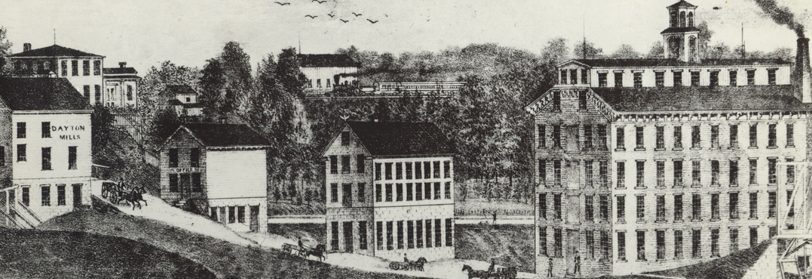
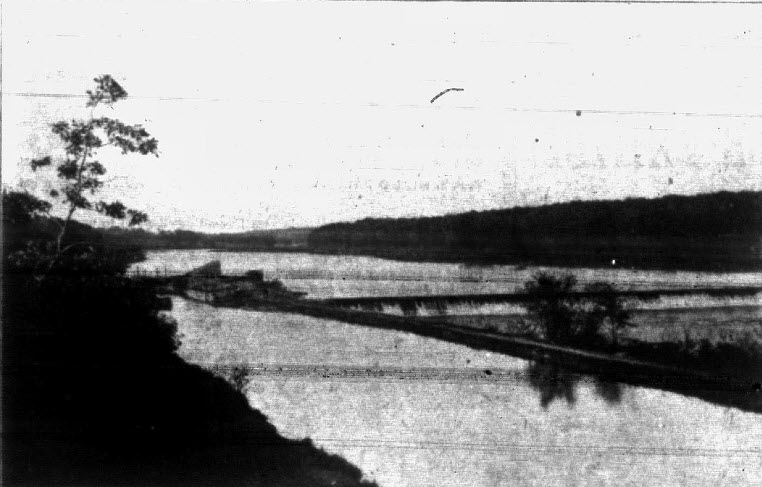
Looking up the river toward the dam, with the feeder in the foreground
from the Ottawa Daily Republican Times, April 9, 1904:
The recent floods have overthrown the work of years, wrought destruction to property which, in all probability will never be replaced. This is undoubtedly the fate of the Fox river feeder of the Illinois and Michigan canal and the dam across the Fox river at Dayton. The recent decision of the Supreme Court seems to emphasize the fact that the usefulness of the canal is well nigh spent. The scant water which has flowed through the feeder during the summer months of each year for several years past has been the means of calling attention to the diminishing value of the Fox river as a source of water power for both Dayton and Ottawa.
With the destruction of the dam there arises thoughts of the days which have long since gone. But few now live who can remember the building of the canal feeder and the Dayton dam. Many interesting facts center around those events and a few reminiscences may be interesting, if not instructive.
Going back to the first settlement of the county it is found that one of the pioneers was John Green, father of Jesse Green, now of Ottawa, who first came in September, 1829, and finally located where Dayton now stands in December of that same year. He owned over a thousand acres of land on the west bank of Fox river, extending up and down the stream for over a mile and a half. Before the state dam was built (which was commenced in 1837) a dam was built a part of the way across the Fox river at a point about a quarter of a mile below the state dam by Mr. Green. It extended from the west bank of the Fox to an island which has long since disappeared under the influence of the floods and ice. This first dam was constructed soon after Mr. Green took up his residence at that place about 1830 or 1831. First one mill, then a second and third were built by the Greens, the last one furnishing power for six runs of burrs, or seventy-two horsepower. This first dam was used until the state dam was completed in 1838.
In those days, according to the testimony of Jesse Green given in a recent law suit, the Fox river had about three times as much water as it has had in later years. When the state took up the question of building a feeder for the canal and a dam across the river at Dayton, Mr. Green entered into an agreement whereby he was to receive power to operate his mills from the state.
It may be a matter of surprise to know that for some time after the completion of the feeder, canal boats, on several occasions, went up to Dayton, taking cargoes of grain from that point to St. Louis. This boating did not last many years, as by 1864 the feeder had only about three feet of water.
The survey of the feeder was made by William Jerome, civil engineer in charge of the western division of the canal, in 1837, and the work of construction was commenced in December of the same year. Its length is about four and a half miles. The channel was four feet deep and sixty feet wide for 1,200 feet north of the main canal, and from that point to the Dayton dam it was forty feet wide. At the time of the construction of the feeder and the hydraulic basin at Ottawa it was estimated that the water power which would be created would be sufficient to drive at least “40 pairs of millstones of four and a half feet in diameter.” It was thought that a connection might be made with the Illinois river at this point by means of a short canal and a system of lockage.
The following table was given as an estimate of the cost of the feeder and dam, when construction was about to be commenced:
218,992 yards of earth excavation ………………..$50,340.32
23,000 yards of rock excavation …………………….17,250.00
131,215 yards of embankment ………………………26,253.00
1,470 slope wall ……………………………………………..2,205.00
Dam across Fox …………………………………………….14,000.00
Guard lock …………………………………………………….12,000.00
Road bridge …………………………………………………….2,800.00
Two culverts ……………………………………………………4,300.00
Contingencies, etc. ………………………………………….6,457.41
Total ………………………………………………………..$135,605.73
In the annual report of W. F. Thornton and Jacob Fry, Canal Commissioners, to Hon. Thomas Carlin, Governor of Illinois, in December 1838 the following language was used in regard to the construction of the feeder. “The judicious improvements, ordered at the last session of the Legislature cannot fail to advance the prosperity of Ottawa to a high degree. Strengthened and cultivated as her natural advantages now are, it is admitted by all intelligent observers that she must soon become an important manufacturing city, creating a vast amount of business for the canal, diffusing incalculable benefits through an extensive scope of country, and remunerating the state, by increased value of property. more than three-fold the amount of the additional expenditures.” The expectations of these men were realized only in part. And now, after all the advantages which the state derived from an increase in values to its then marketable lands, the economists of the state have killed the fowl which laid the golden egg.
In another report, made in 1830, when the building of the canal was first considered, the Commissioners said, in speaking of the proposed survey for a canal: “The town of Ottawa, at the mouth of Fox river of the Illinois, is advantageously situated in the heart of the most beautiful, fertile and healthy region of the country, and, as connected with the canal, deserves the legislative care of the state.”
But all these things have gone. Neglected by the state the dam became weakened and gave way before the crush of ice. Sand was washed into the entrance of the guard lock of the feeder and effectually choked that source of water to the canal and hydraulic basin.
The history of the efforts made by the canal authorities to obtain the appropriation voted by the Legislature at its last session, the injunction suit instituted at the instance of Chicago parties, the decision of the Supreme Court making perpetual that injunction and the very late order denying the prayer of the Canal Commissioners for a rehearing, all are recent events. They are disheartening facts and may be taken as an indication that the dam and its feeder for the canal will never again be used for valuable commercial purposes. They will soon become only a memory, then a few lines or a page in history, and will then be forgotten. It is, in truth, to be thus?
 Dayton and the Greens