Bread and Strawberries – and FISH!

From Dayton

Dayton Ill., April 28, 1887. – The commissioners of Rutland are busy at work on the hill leading to the bridge, and will put the road in first class order.

Mr. T. H. Green is graveling the approach on the west end of the new bridge.

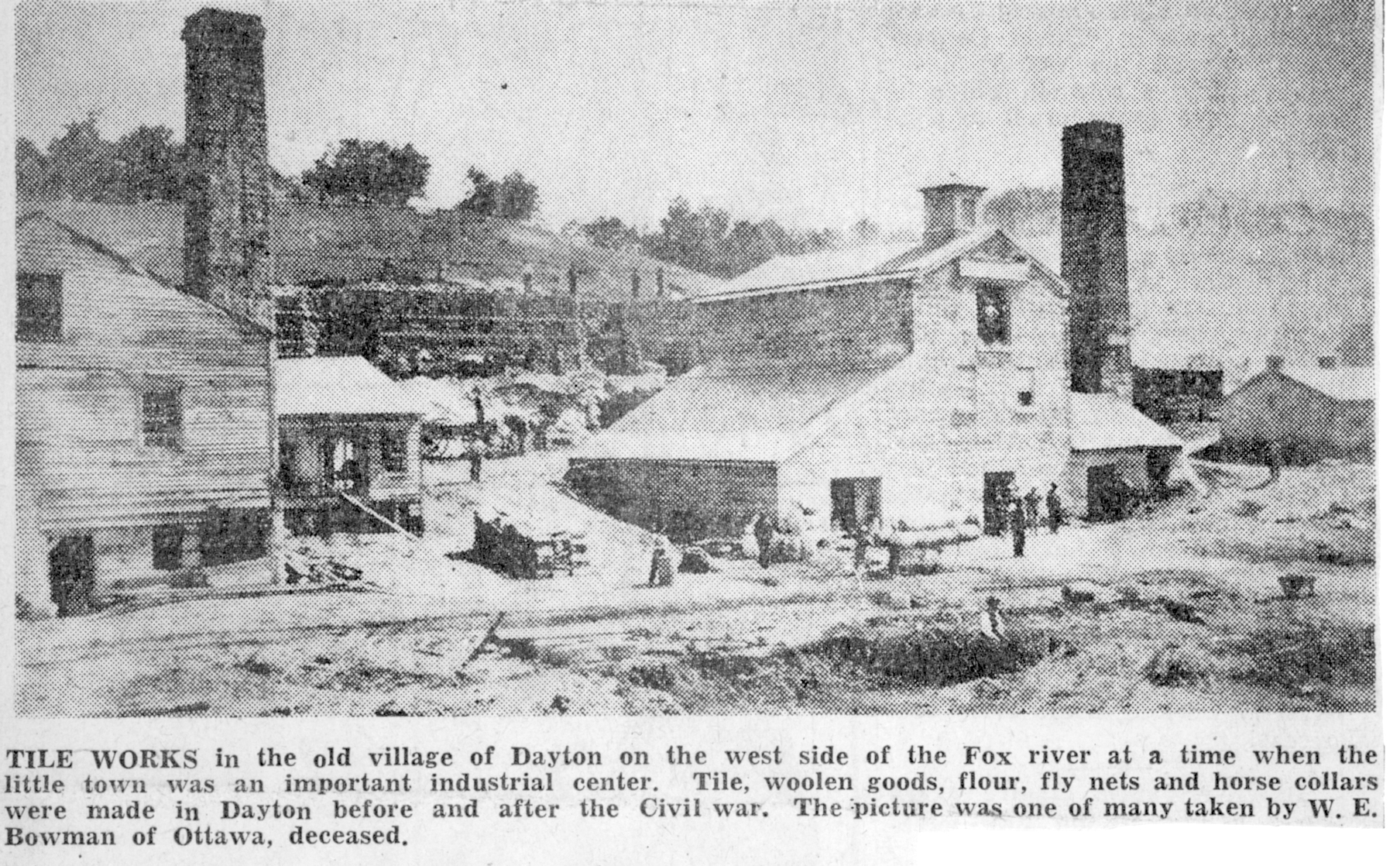
The tile works are having a good trade, and are shipping lots of tile.

A large number of game fish have been caught this week. A good rain to raise the river and start the fish northwest, would greatly improve the sport.

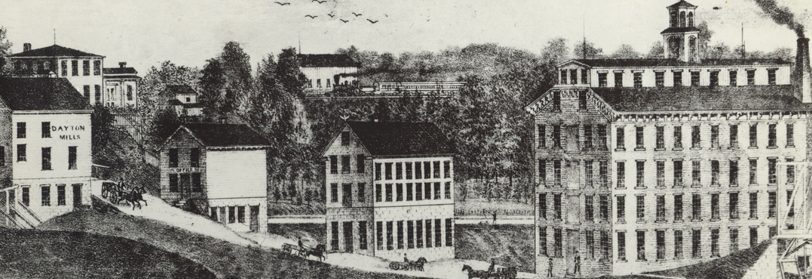
One of the proprietors of the “Short System” Roller Mills took samples of their flour to your city one day this week, and showed it alongside of all the long system mills flour in the marker, and the short system flour stood at the head of the list for whiteness. The landlady of the Dayton Hotel baked some of the short system patent flour last week, and says she never had a flour in the house that baked as light and white. Tally two for the short system!

Mr. Joseph Green now has an acre and a quarter of strawberry plants in his garden across the river.

The old woolen factory property is lying idle this spring. It is to be hoped that something may be done with it before long.

Mr. Wm. Rhodes who was so unfortunate as to lose a limb while working on a railroad out west, has returned home, and will study telegraphing with Mr. Ballard [?] at Ottawa.

Our town is receiving considerable benefit from the new bridge in the way of trade.

There is a good opening here now for a good blacksmith.

Occasional1


  1. The Ottawa Free Trader, April 30, 1887, p. 8, col. 3.

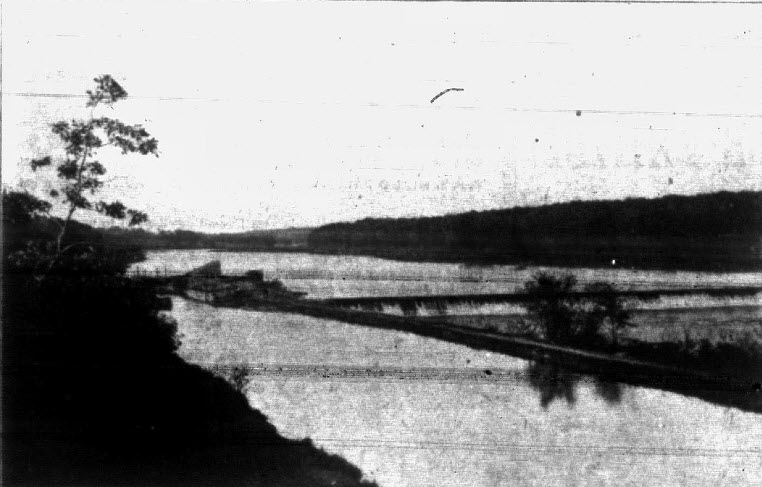
Dayton Dam and Fox River Feeder

Looking up the river toward the dam, with the feeder in the foreground

from the Ottawa Daily Republican Times, April 9, 1904:

The recent floods have overthrown the work of years, wrought destruction to property which, in all probability will never be replaced. This is undoubtedly the fate of the Fox river feeder of the Illinois and Michigan canal and the dam across the Fox river at Dayton. The recent decision of the Supreme Court seems to emphasize the fact that the usefulness of the canal is well nigh spent. The scant water which has flowed through the feeder during the summer months of each year for several years past has been the means of calling attention to the diminishing value of the Fox river as a source of water power for both Dayton and Ottawa.

With the destruction of the dam there arises thoughts of the days which have long since gone. But few now live who can remember the building of the canal feeder and the Dayton dam. Many interesting facts center around those events and a few reminiscences may be interesting, if not instructive.

Going back to the first settlement of the county it is found that one of the pioneers was John Green, father of Jesse Green, now of Ottawa, who first came in September, 1829, and finally located where Dayton now stands in December of that same year. He owned over a thousand acres of land on the west bank of Fox river, extending up and down the stream for over a mile and a half. Before the state dam was built (which was commenced in 1837) a dam was built a part of the way across the Fox river at a point about a quarter of a mile below the state dam by Mr. Green. It extended from the west bank of the Fox to an island which has long since disappeared under the influence of the floods and ice. This first dam was constructed soon after Mr. Green took up his residence at that place about 1830 or 1831. First one mill, then a second and third were built by the Greens, the last one furnishing power for six runs of burrs, or seventy-two horsepower. This first dam was used until the state dam was completed in 1838.

In those days, according to the testimony of Jesse Green given in a recent law suit, the Fox river had about three times as much water as it has had in later years. When the state took up the question of building a feeder for the canal and a dam across the river at Dayton, Mr. Green entered into an agreement whereby he was to receive power to operate his mills from the state.

It may be a matter of surprise to know that for some time after the completion of the feeder, canal boats, on several occasions, went up to Dayton, taking cargoes of grain from that point to St. Louis. This boating did not last many years, as by 1864 the feeder had only about three feet of water.

The survey of the feeder was made by William Jerome, civil engineer in charge of the western division of the canal, in 1837, and the work of construction was commenced in December of the same year. Its length is about four and a half miles. The channel was four feet deep and sixty feet wide for 1,200 feet north of the main canal, and from that point to the Dayton dam it was forty feet wide. At the time of the construction of the feeder and the hydraulic basin at Ottawa it was estimated that the water power which would be created would be sufficient to drive at least “40 pairs of millstones of four and a half feet in diameter.” It was thought that a connection might be made with the Illinois river at this point by means of a short canal and a system of lockage.

The following table was given as an estimate of the cost of the feeder and dam, when construction was about to be commenced:
218,992 yards of earth excavation ………………..$50,340.32
23,000 yards of rock excavation …………………….17,250.00
131,215 yards of embankment ………………………26,253.00
1,470 slope wall ……………………………………………..2,205.00
Dam across Fox …………………………………………….14,000.00
Guard lock …………………………………………………….12,000.00
Road bridge …………………………………………………….2,800.00
Two culverts ……………………………………………………4,300.00
Contingencies, etc. ………………………………………….6,457.41
Total ………………………………………………………..$135,605.73

In the annual report of  W. F. Thornton and Jacob Fry, Canal Commissioners, to Hon. Thomas Carlin, Governor of Illinois, in December 1838 the following language was used in regard to the construction of the feeder. “The judicious improvements, ordered at the last session of the Legislature cannot fail to advance the prosperity of Ottawa to a high degree. Strengthened and cultivated as her natural advantages now are, it is admitted by all intelligent observers that she must soon become an important manufacturing city, creating a vast amount of business for the canal, diffusing incalculable benefits through an extensive scope of country, and remunerating the state, by increased value of property. more than three-fold the amount of the additional expenditures.” The expectations of these men were realized only in part. And now, after all the advantages which the state derived from an increase in values to its then marketable lands, the economists of the state have killed the fowl which laid the golden egg.

In another report, made in 1830, when the building of the canal was first considered, the Commissioners said, in speaking of the proposed survey for a canal: “The town of Ottawa, at the mouth of Fox river of the Illinois, is advantageously situated in the heart of the most beautiful, fertile and healthy region of the country, and, as connected with the canal, deserves the legislative care of the state.”

But all these things have gone. Neglected by the state the dam became weakened and gave way before the crush of ice. Sand was washed into the entrance of the guard lock of the feeder and effectually choked that source of water to the canal and hydraulic basin.

The history of the efforts made by the canal authorities to obtain the appropriation voted by the Legislature at its last session, the injunction suit instituted at the instance of Chicago parties, the decision of the Supreme Court making perpetual that injunction and the very late order denying the prayer of the Canal Commissioners for a rehearing, all are recent events. They are disheartening facts and may be taken as an indication that the dam and its feeder for the canal will never again be used for valuable commercial purposes. They will soon become only a memory, then a few lines or a page in history, and will then be forgotten. It is, in truth, to be thus?
A Well-Stocked Linen Closet – 1873 Style

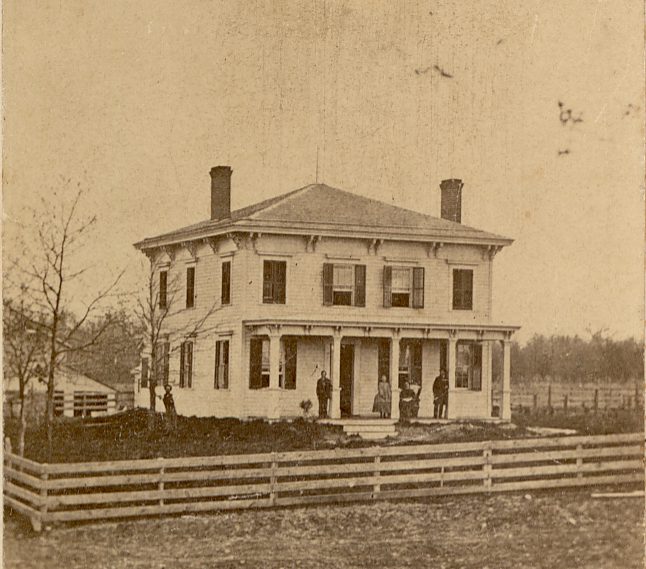
The Elizabeth Trumbo house

Elizabeth Trumbo house

When Elizabeth Trumbo died in 1873 she had an extensive collection of household textiles, suggesting a well-furnished home with an emphasis on comfort and hospitality. The variety of bedding—feather beds, wool and corn husk mattresses, and multiple quilts and coverlids—indicates a concern for warmth and comfort, reflecting the seasonal needs of the time.

Bedding Items

4 Feather Beds – Large sacks filled with feathers, used as mattresses or mattress toppers. These were considered a luxury and provided warmth and softness.

1 Spring Mattress – A more modern mattress for the time, likely featuring a metal spring frame for added support.

1 Woolen Mattress – A mattress stuffed with wool, offering warmth and softness but firmer than a feather bed.

3 Corn Husk Mattresses – Mattresses filled with dried corn husks, which were inexpensive but not as comfortable as feather or woolen options. These were often used by servants or in guest quarters.

12 Small Pillows – Smaller pillows, possibly decorative or used for neck support.

6 Pairs of Woolen Sheets – Woolen sheets provided warmth in colder months, an alternative to cotton or linen.

18 Cotton Sheets – Lighter, breathable sheets for summer months, likely made of muslin or homespun fabric.

29 Pillow Slips – Pillowcases to cover and protect pillows from dirt and oils.

Bed Coverings

5 Coverlids – Woven or quilted bed coverings, often decorative and used as a top layer on a bed.

5 Comforters – Thick, stuffed blankets used for warmth, usually filled with wool or cotton batting.

3 Quilts – Layered bed coverings stitched together, providing warmth and decoration. Quilts often had intricate patterns and could be handmade.

2 Counterpanes – A decorative bedspread, usually lighter than a quilt, used for covering the bed during the daytime.

Household Linens

6 Table Spreads – Decorative cloths used to cover tables, protecting them from spills and adding an ornamental touch.

15 Towels – Likely made of linen or cotton, used for drying hands and face, as well as general household cleaning.

1 Chair Tidy – A small decorative cloth placed over the back or arms of a chair to protect it from hair oils and dirt.

This concludes our look at Elizabeth Trumbo’s home at her death. We have previously considered her stable, kitchen, and furniture, finishing here with her linen closet. It was a comfortable family home and probably held many family gatherings of relatives and neighbors.

A Resurrection at Dayton

A General Revival of Business in Our Northern Suburb
C. B. Hess Practices What He Preaches
The Dayton Tile Factory Will Resume Operations Next Week

The little town of Dayton has again struck its gait. The grist mill is running at full blast, the collar factory has its hands full, the paper mills are behind in orders, and now comes C. B. Hess, one of Ottawa’s most enterprising citizens and to-day leases the brick and tile works for a year commencing Feb. 1st, with an option for further time and will open up on Monday next full blast with forty hands, the works to run night and day. The firm name will be Hess, Williams & Hess, and Ed J. Hess, junior partner, will have full charge.

These works will put out paving brick, fire brick and drain tile, and will be run in a measure in connection with the Ottawa factory. The capacity will be 50,000 brick or 10 car loads, and 200 tons of clay will be used every day. The works have six kilns, with every facility for increasing the capacity if found practicable. The water-power used is of 200 hundred [sic] horse power. The firm will build a tramway across Fox river to its beds of fire clay, which are 7 foot veins, while the common clay will be taken from a 30 foot band just across the feeder from the works. Probably an inclined railway will be put in from the works to the “Q.” tracks to increase the shipping facilities.

Hitherto the difficulty at these works has been in getting the clay properly united, but Mr. Hess has been experimenting with it for the past six weeks and is satisfied that he has at last found the right thing.

These works will make their drain tile for the local trade, but the paving tile and fire brick will, most of it, find its way to Chicago and Peoria.

Mr. Hess says he intends to make this a “go,” and we have no doubt but he will.1


  1. The Ottawa Republican Times, January 29, 1891, p. 8.

On This Day in 1887


iron bridge at Dayton 1886

From Dayton

Dayton, Ill, April 1st, 1887. – Our bridge is finished at last and open for public travel. It is a very fine three span iron bridge, the neatest one on the river, and is a fine addition to our village. Of course every one will use it now that it is constructed, and it was noticed that about one of the first to use it was one who had fought the hardest.

Our schools opened again Monday after a week’s vacation, with the same teacher at the helm.

The tile works are doing a rushing business, having shipped five car loads last week.

The Horse Collar works are also doing a fine business, shipping lots of collars every day. They are working day and night, and are about seventy dozen behind orders.

Mr. James Timmons, our genial landlord, is putting in a fine new maple floor in his office, also a new floor in the kitchen.

Our Sugar camp under the management of Misses Joseph and Win Green, has been turning out a lot of excellent maple syrup.

Mr. Basil Green, our worthy supervisor, has announced himself as a candidate for re-election.

The Roller Mill is about fitted up and will be running next week. It has the latest improved machinery for running on the short system and the product will no doubt be as fine as any on the market.

Farmers should take their wheat where they can get it ground into the very best flour and receive a large yield.

The Sunday school will hold an Easter Concert on Sunday evening, April 10th. A fine programme is being arranged and everyone should attend.

Occasional1


  1. The [Ottawa, IL] Free Trader, April 2, 1887, p. 4, col. 6