
A Christmas Night Dance

Christmas greetings

Dayton

Fred Green left this morning for San Francisco, and will be absent about two weeks.

Miss Jennie Barends has entirely recovered from her recent illness.

Wm. Fleming left on Monday morning for De Kalb, where he will stay for a few days.

Mrs. Jas. H. Timmons furnished the supper for the patrons of the Christmas dance held at Woodman hall.

E. McClary and wife dined on Christmas day with Mr. and Mrs. Jos. Barends.

Christmas passed off quietly in our little burg.

Leroy McBraerty, operator at Ladd, spent Christmas with his parents.

The dance given by the Dayton orchestra on Christmas night was well attended, about 100 persons being present. Messrs. Breese, Hoxie, Warner, Breese and McGrogan furnished some very good music, and every one had a royal good time. Supper was served by Mrs. Jas. H. Timmons.

Winn Green and wife, of Joliet, spent Christmas at the home of Mr. and Mrs. Joseph Barends.

Miss Nellie McGrogan and Leroy Luce were married last week Wednesday at Ottawa by Squire Larkin. May you both live long and prosper.

Ellis Breese has just purchased a number of fine sheep from Jay Shaver, and expects to engage in sheep raising on a large scale, having fenced in 22 acres of fine grazing land on the river bottom.

George Wolf and wife entertained a number of friends at dinner on Christmas day.

George Galloway and wife were visiting in Ottawa on Tuesday.

John Rhoades and family were visitors at Mr. and Mrs. John Benoits.

Miss Drennan is visiting friends in Chicago for a few days.1


  1. The Ottawa Republican-Times, January 3, 1901, p. 6, col. 4
January 1891 -The State of the Village


A RESURRECTION
At Dayton! — A General Revival of Business in Our Northern Suburb
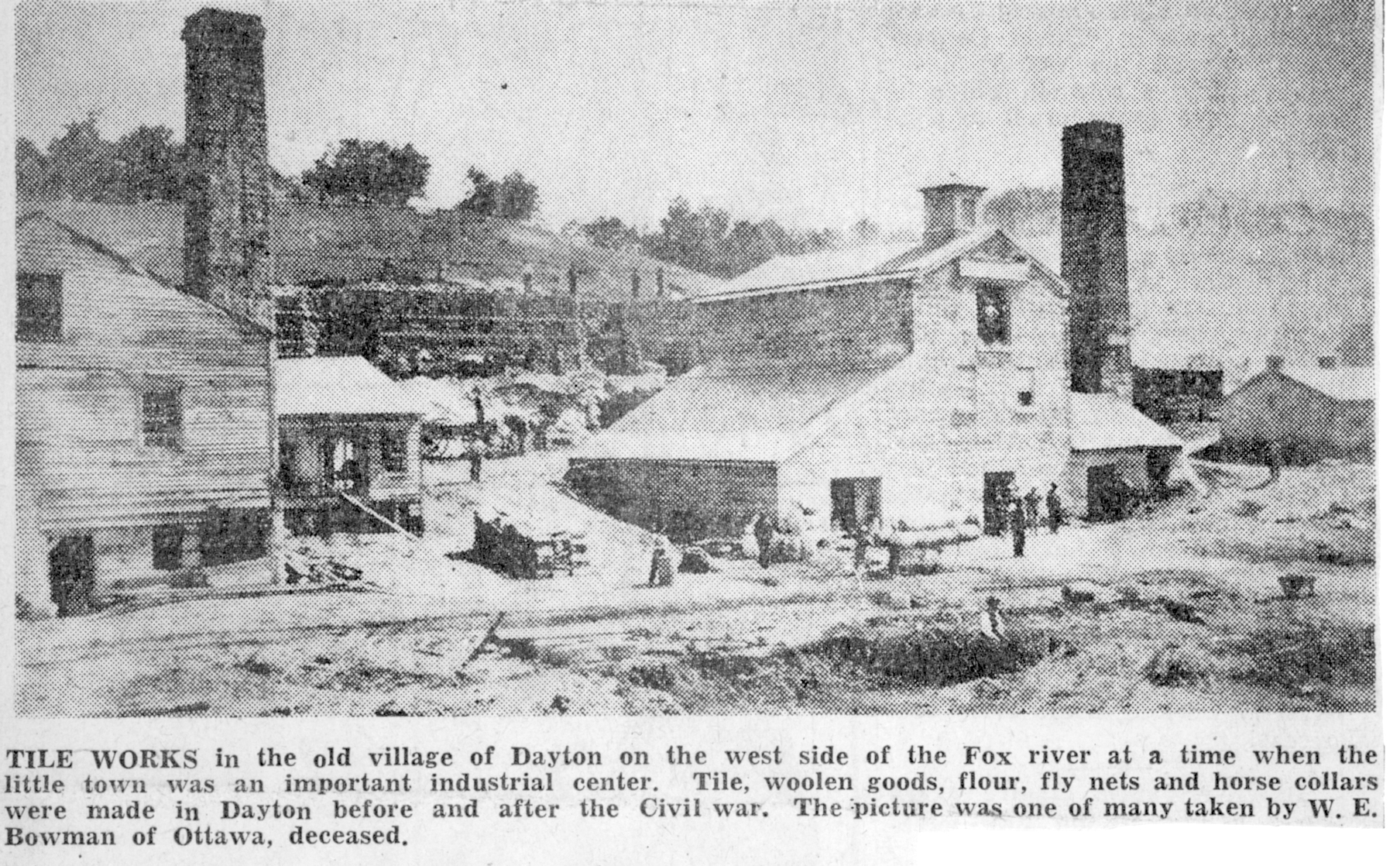
C. B. Hess Practices What he Preaches — The Dayton Tile Factory Will Resume Operations Next Week

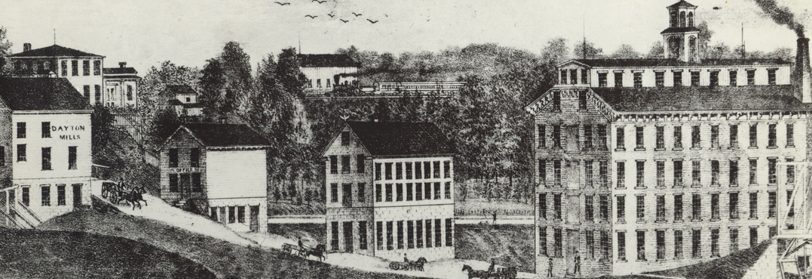
The little town of Dayton has again struck its gait. The grist mill is running at full blast, the collar factory has its hands full, the paper mills are behind in orders, and now comes C. B. Hess, one of Ottawa’s most enterprising citizens and to-day leases the brick and tile works for a year commencing Feb. 1st, with an option for further time and will open up on Monday next full blast with forty hands, the works to run night and day. The firm name will be Hess, Williams & Hess, and Ed. J. Hess, junior partner, will have full charge.

These works will put out paving brick, fire brick and drain tile, and will be run in a measure in connection with the Ottawa factory. The capacity will be 50,000 brick, or 10 car loads, and 200 tons of clay will be used every day. The works have six kilns, with every facility for increasing the capacity if found practicable. The water power used is of 200 hundred [sic] horse power. The firm will build a tramway across Fox river to its beds of fire clay, which are 7 foot veins, while the common clay will be taken from a 30 foot bank just across the feeder from the works. Probably an inclined railway will be put in from the works to the “Q.” tracks to increase the shipping facilities.

Hitherto the difficulty at these works has been in getting the clay properly united, but Mr. Hess has been experimenting with it for the past six weeks and is satisfied that he has at last found the right thing.

These works will make their drain tile for the local trade, but the paving tile and fire brick will, most of it, find its was to Chicago and Peoria.

Mr. Hess says he intends to make the a “go,” and we have no doubt but he will.1

C. B. Hess was a member of the large Green clan. He was married to Clara “Callie” Green, the daughter of Jesse Green and Isabella Trumbo.


  1. Ottawa Republican Times, January 29, 1891, p. 8.

The Old Plank Road Needs to be Upgraded

An example of a plank road

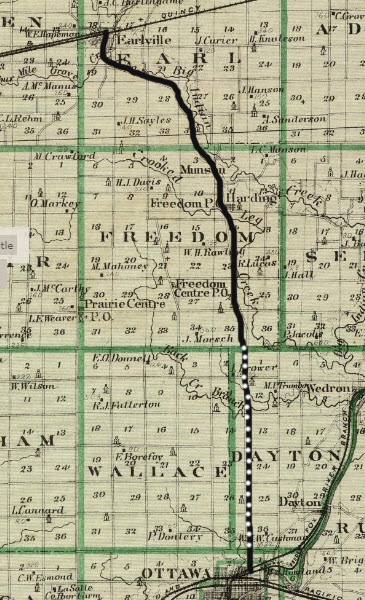
The old plank road, which ran north out of Ottawa, was built in 1847; a direct line from Earlville to Ottawa, by way of Harding. It was in such poor shape by the 1890s that farmers in the north of the county were doing their trading in Earlville rather than in Ottawa. It was clear that something needed to be done. By 1895 the road from Earlville to Harding had been improved and Freedom township had graveled the road to the Dayton township line but the six miles through Dayton remained unimproved.

Ottawa Republican Times, 26 Sep 1895, p2

It was to the advantage of Ottawa to get this portion of the road completed and plans were made to share the work. The portion of the road to be graveled is shown below.

Residents of Dayton, Ottawa, Troy Grove and Wallace were asked to contribute money or labor to finish the final six miles of the road. The merchants of Ottawa contributed significantly in view of the increased trade they would see.

Ottawa Republican Times, 26 Sep 1895, p1

The joint effort appears to have succeeded. There is no further mention of the state of the road north out of Ottawa in the newspapers. It is hoped that the Ottawa merchants saw the increased trade they expected.

Sickness, Sunday School, and the World’s Columbian Exposition

DAYTON

Scarlet rash or scarlet fever: which was it? was the question of the day. Now there are new cases, and some of the recently afflicted are seen on the streets, and the excitement is dying away. The carelessness of some of our people in dealing with contagion deserves severe criticism.

Pliny Masters is down with some grippe complications.

Wm. Fleming made a flying visit to Iowa. Just returned.

Last week Ellis Breese left for Lincoln, Nebraska, where he will visit for some time.

What has become of the Sunday-school? We have not heard the bell for several Sabbaths.

Miss Carrie Barnes is on the sick list. Her sister Emma is filling her place as teacher in the primary department of our school.

The winter term of school will close March 10th. Arrangements are being made for an entertainment in the evening.

Our factories and fisheries will soon furnish employment for all weary of resting.

The morning sun strikes Dayton squarely in the face and makes her smile again.

The interest in the World’s Fair is growing. This is right. We should be pleased to see vigorous steps made towards a good representation of the American Indians at the Columbian Exposition. A large encampment of Indians, with all their rude equipments on the grounds, would make a grand contrast between then and now.1


  1. [Ottawa] Republican Times, March 3, 1892, p4.