Of Industry – and Lack Thereof


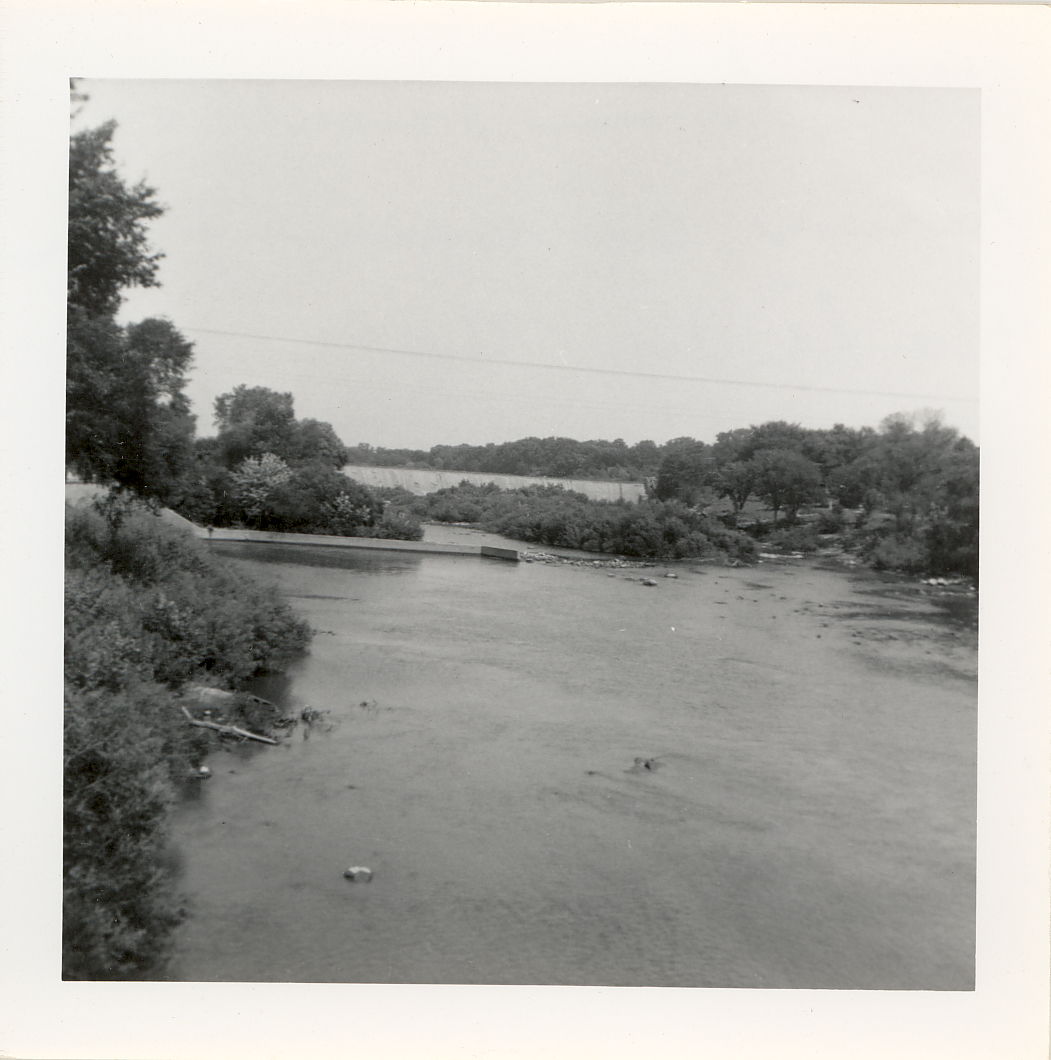
Fox river with dam in background

Dayton Items

Dayton, as a  point where the finny tribe and fishermen do most congregate has long been celebrated in this section of the country. People armed with hooks and lines, buckets of bait and togged in old clothes, come daily and nightly from far and near. They arrive on foot, in buggies, in lumber wagons, and dumped off the cars, and are landed in every shape, all bent on the same purpose, i. e., that of catching fish, not by the dozens, or in fifties, but by bushels, bagsfull, wagon loads, and in other prodigious quantities. They arrive in lofty spirits, braced up by lofty expectations of astonishing the natives. They usually depart wet, hungry, tired, disgusted, and without any fish worth speaking of. To a man whose constitution requires a vast deal of resr – long continued and complete relaxation of every muscle and nerve – fishing is just the thing. Fish, as food, may be brain food, but catching them is certainly a brain softener. It does not require a very high order of intellect in a man to fish, that is, a man of very moderate brain power ought to know enough to outwit a fish, which stands rather low in brain development. In short, fishing, to an outsider, is a very languid, sleepy sort of work.

There never has been any employment so well adapted to the wants of a lazy man as that of fishing as they do it at Dayton. To see the anglers as they line the banks and cover the rocks like so many mud turtles is a sight fit to make a person yawn. To the man to whom any kind of exercise is a bore fishing is just about exercise enough. The fellow lands upon some sequestered spot, sits down to rest and meditate awhile, then baits his hook, summons up all his energies like a man trying to ward off sleep, gets the line in the water, and then the things fishes itself! When a man gets too lazy to fish they accuse him of having a softening of the brain, and soon after he becomes too tired to draw his breath, and this ends him!

Some of the fellows we saw fishing on Friday last were half a mile from the water, under a shade tree, three of ‘em asleep and the fourth studying the sun’s altitude and position of its spots through a “pocket” telescope! Though we were in sight of a score or more of fishers for an hour, we did not see a fish hauled out, nor even hear of one being captured, though a shoal of three or four minnows were reported to have swam up among the fishers early in the morning.

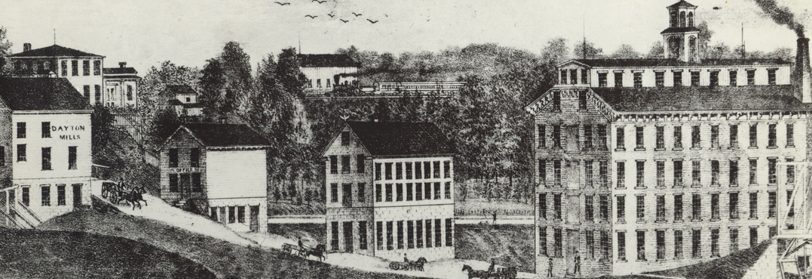
Large stone buildingDayton, however, has another point of view of far more importance to the business man and to the farmer. We refer to her woolen mills – as good as any in the state – built some years ago at great expense, and stocked with as excellent machinery as the Union anywhere could boast. Though under a cloud for a time, but now started anew by its original owners, the Greens, it will soon be working upon a large scale, and is daily turning out great quantities of yearn of various grades, also superior cloth.

Another enterprise is the collar factory, under the management of Mr. Dunavan. It employs a large force of hands, turns out the premium horse collars of the United States, and also a fine article of leather fly nets, the latter being its chief production during the summer months. The goods from this establishment find a ready market all over the country.
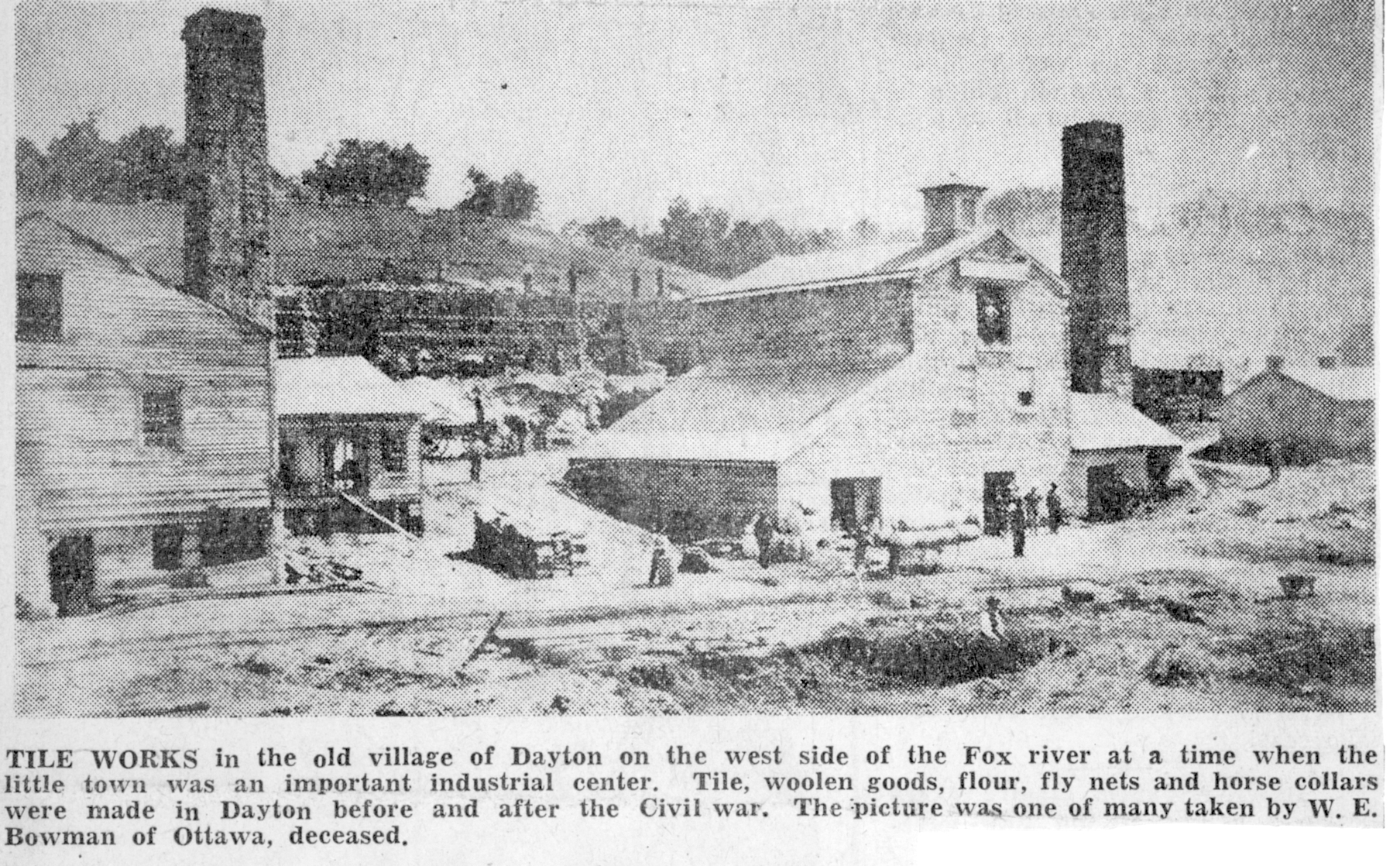
Another business, as yet young, but extensive and rapidly increasing in importance, is the Dayton tile works. When the factory was started it was not supposed that it would, in five years, reach the dimensions it has attained in a few months. The tile they manufacture is as good as any made in the west.

The large paper mill here next claimed our attention. This institution has long since become fixed and firmly established upon a substantial business basis. It runs exclusively on straw and manilla paper and consumes vast quantities of material. It has on hand an enormous stock of as good paper as is made anywhere. The recently senseless boom in prices of material used is happily subsiding, and the rather sluggish demand in this county for paper, has been rather unsatisfactory, but it runs ahead, looking for a fairer margin between its expenses for sock and the price of manufactured goods than has generally prevailed.

Besides, a good flouring mill and a local store and a “tavern” and good prices for farm products in general, all contribute to make Dayton a live business village.

Since the tile works were started in full operation a new industry has been developed, being coal mining operations, managed by Simpson & Welke, a couple of hard-working miners, who obtain a good quality of coal which lies on the level with the banks of the feeder, and is drifted and removed on hand card on a tramway and dumped below the woolen mills into wagons, or on the public roads as may be required.[1]


[1] Ottawa Republican, May 27, 1880, p2.
Fact or Fiction? History or Poetry?

POETRY VERSUS FACT
FICTION AND HISTORY

The following letter was written by David Green in reference to the wide-spread article about his brother Joseph, which was covered here previously in “He Wasn’t the One”. Apparently a collection of poems by a Nebraska poet, which referenced this event, provoked an article in The Platte Journal attempting to correct the story. Here is David Green’s response to the inquiry, as printed in the paper.

Dayton, Ill., March 31st, 1871
J. G. Higgins, Esq., Columbus, Neb –

Dear Sir: — Yours of the 7th inst. asking for information was duly received, in which you give some extracts from a poem written by the Rev. Orsamus C. Dake, entitled the “Raw Hide,” which is found in a recent publication entitled “Nebraska Legends,” with the following preface:

“A certain man, of a small company moving up the great plain of the Platte, in a spirit of bravado, said he would shoot the first Indian he met; which he did, having shortly afterward found a Pawnee woman a little separated from her tribe. But a band of warriors, pursuing, demanded from his companions the surrender of that man, which being refused, the Pawnees made ready to slay the whole company of whites, whereupon the offender being given into their hands, they flayed him alive. From this circumstance the little stream, on whose banks it occurred takes the name of the ‘Raw Hide.’”

The Rev. Mr. Drake has given in the above, the substance of a report which in 1849 found its way into nearly every newspaper in the United States, and no doubt but he together with many others, in good faith and very innocently believes that such a tragedy did really take place as stated, but the whole story is a base and unmitigated falsehood from beginning to end, as there never was the least foundation for said report. The hoax was gotten up in Magnolia, Putnam county, Illinois, in a bar-room to gull a gaping crowd, without any thought of its going any further, but someone present took it to be true and communicated it to the editor of a paper published in Lacon, Marshall county, Illinois, from which it was, as stated, very extensively copied.

On receipt of yours I wrote to Hon. Wm. E. Parret now of Winona, Illinois, but at the time the hoax was gotten up he resided in Magnolia, Illinois, and in reply he says, “That two men by the name of D. P. Fyffe and David Law, of Magnolia, got up the hoax out of whole cloth. The said Mr. Fyffe of Magnolia, over his signature of the 27th inst, says “It (referring to said hoax) originated here and was known to be a hoax.” I merely give you the above that you may know where said report originated.

My Father, two Brothers and some twenty or thirty others from this county were the company referred to, and my brother Joseph Green was the reported victim, who would have been the last man in the world to make any such threat, or be guilty of any such rash act.

The said company went out to California in the spring of 1839 – he Joseph Green returned in 1851 – went out to California again in 1852, returned in 1853, and died in this place in 1855, with the consumption. A more noble, kind-hearted and generous man never lived, and I hope you will use your best efforts to correct this infamous slander upon his fair name.

I am, very respectfully,
D. Green1


  1. The Platte [Nebraska] Journal, April 12, 1871, p2, col2.

Dayton Cemetery Association Celebrates 10th Anniversary

DINNER HELD AT CLIFFORD’S

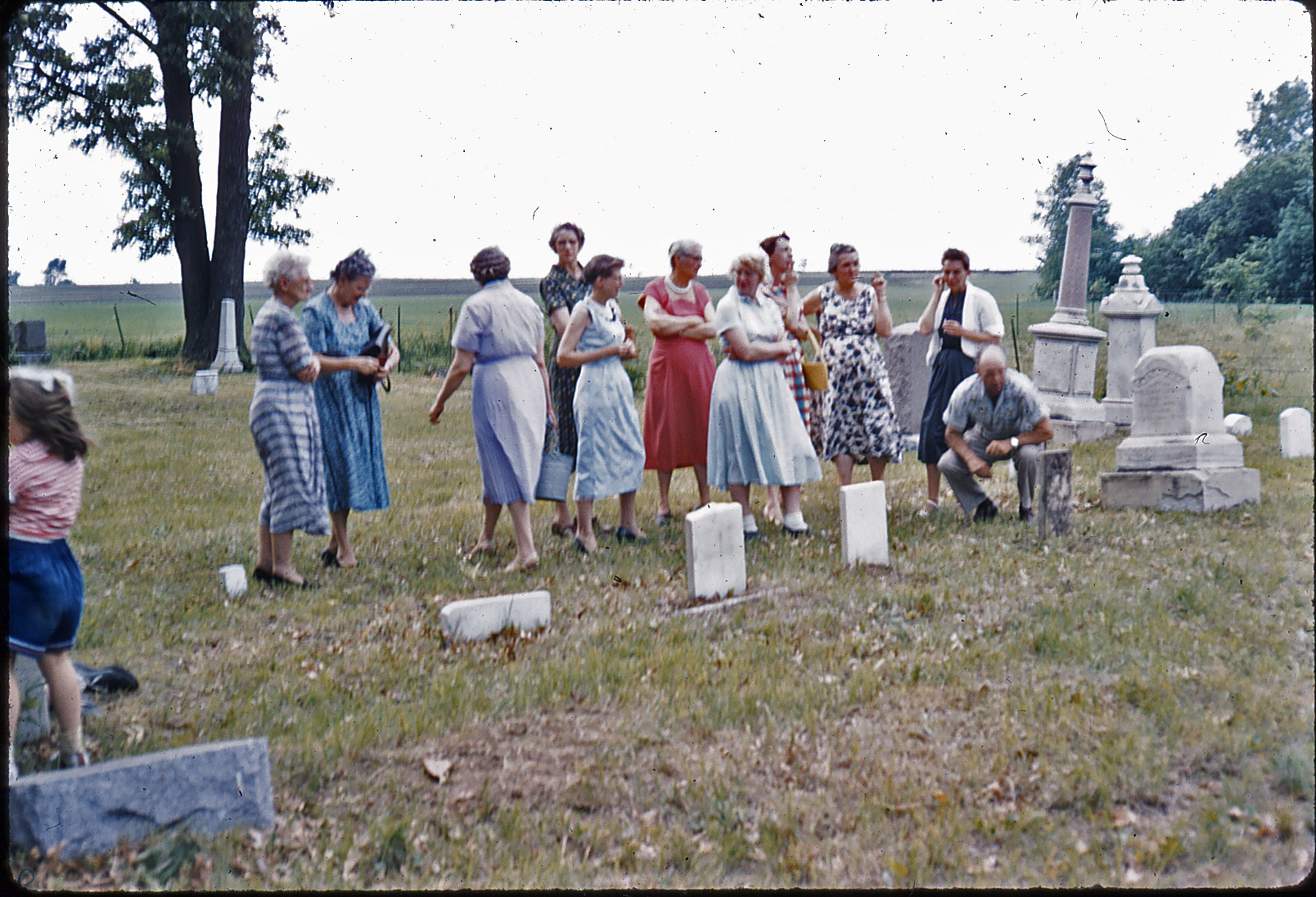
The Dayton Cemetery Assn. held its annual meeting Sunday, with Mr. and Mrs. Charles Clifford of Dayton. After the morning work party had completed their task of mowing the grass, trimming trees and decorating the graves all met at the Clifford home for a picnic dinner and historical program. A display of family heirlooms was in charge of Mrs. Clifford, historian.

Mrs. Lewis E. Myers of Chicago was presented with a cake and ten lighted candles to mark the anniversary of the Association; for it was her idea that sparked the restoration of this beautiful old pioneer burial ground, which was started by John Green, who in 1829 led a party of settlers from Licking County Ohio to settle the community of Dayton.

At the business meeting Mrs. Mildred Summins of Ottawa was elected president. Other officers to serve with her for the coming year are Miss Dorothy Masters of Evanston, secretary; David Holmes of Oak Park, treasurer and Mrs. Myers, Care Fund Officer.

The following committees were named by the president.
Grounds: Charles Clifford of Dayton, Howard Baker of Leland, David Holmes of Oak Park.
By-laws: Mabel Greene Myers and Dorothy Masters.
Membership and Funds: Helen MacLoraine of Wilmette, La Vonne Gillman of Ottawa, and Eugene Pottinger of DeKalb.
Research: Candace Clifford Wilmot of Champaign, Mrs. William Temple of Serena and Mrs. Oakley W. Esmond of Ottawa.

Members and friends of the Association are from all parts of the United States. Those coming from the greatest distance at this meeting were Mr. and Mrs. Kenneth L. Green Jr. of Corbin, Ky.1


  1. The (Ottawa, IL) Daily Republican Times, May 31st, 1966, p. 11, col. 3.

The Contents of a Lady’s Stable

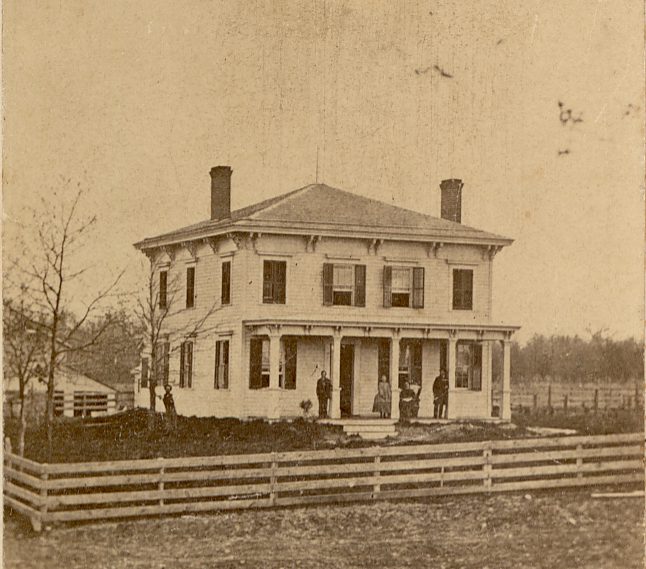
The Elizabeth Trumbo house

Elizabeth Trumbo house

When Elizabeth Snyder Trumbo died in 1873, she was a well-to-do widow living in Dayton, near a number of her children. At her death her estate was inventoried and the list gives a good idea of her life style. Included in the list is the contents of her stable:
1 top buggy (single)
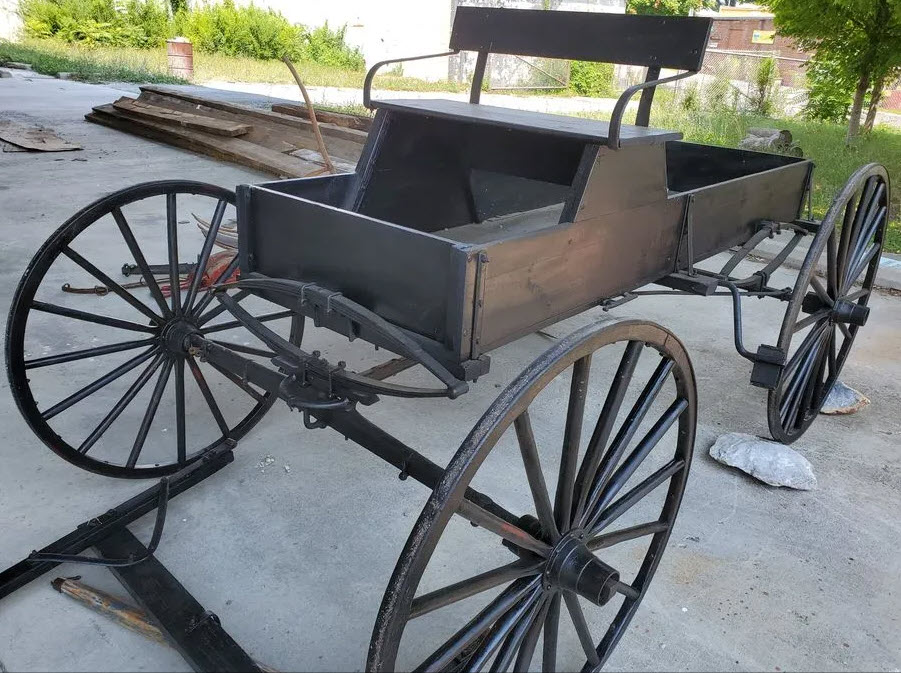
1 spring wagon
1 double wagon
1 pair bobs
1 single cutter
1 buffalo robe
2 horses, one brown, one sorrel
1 double harness
1 single harness

Here’s what they would have looked like.

a top buggy

A top buggy was a type of horse-drawn carriage with a folding top, also known as a “Jenny Lind”. It was a lightweight, four-wheeled vehicle designed for two passengers and was often pulled by a single horse. The top could be raised or lowered to provide protection from the weather, making it a versatile option for rain or sunshine.

spring wagon

A spring wagon was a four-wheeled vehicle drawn by draft animals, usually horses. It had a square box for carrying goods or passengers and was equipped with platform springs to provide a smoother ride. A single seat for two people was mounted in the middle of the box leaving room behind the seat for cargo.  It was a versatile and popular choice for farmers and general transportation needs, much like a pickup truck or delivery van.

double wagon

A double wagon was a type of freight wagon designed to carry heavier loads than a single wagon. It typically had a sturdy, wooden frame with a large flat wooden bed mounted on four wheels, with high sideboards to keep the load secure. The wagon was drawn by a team of two or more horses and was equipped with springs to provide a smoother ride over rough terrain. The wheels were typically made of wood with iron rims. The front and rear axles were connected by a central beam, allowing for a bit of flexibility over rough terrain. It was often drawn by a team of two or more horses, with a driver’s seat at the front for steering and controlling the team.

bobsled

Bobsleds were used for transportation in the snow and for recreational activities. A snowfall and a hill could prove irresistible to children and even, sometimes, to their elders. Bobsledding eventually evolved into the Olympic sport known today.

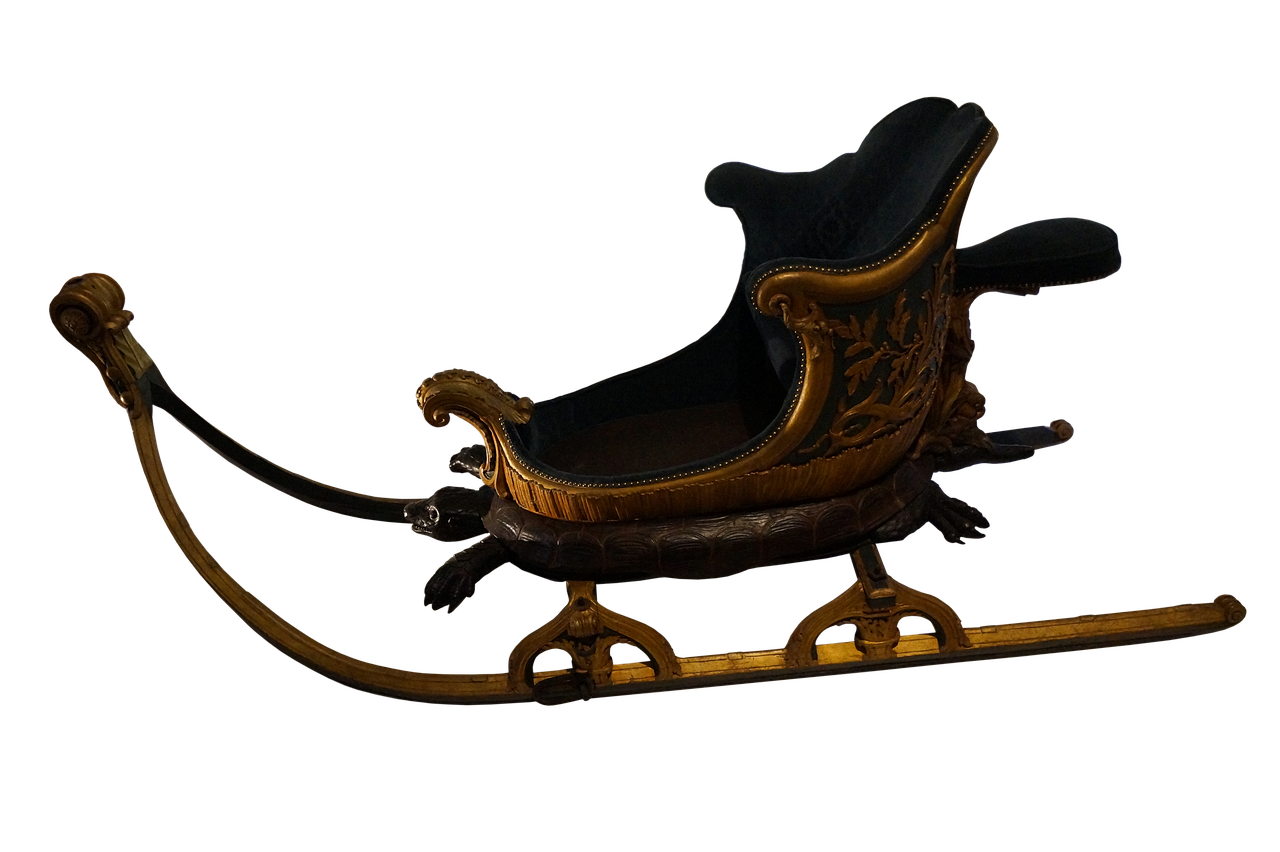
single cutter

A cutter is a type of light, one-horse sled with a single seat. it is smaller than a sleigh, more streamlined, usually for one or two passengers, and has a more open design.

buffalo lap robe

If you had a cutter, then you had to have a buffalo robe. A buffalo robe is a cured buffalo hide, with the hair left on. They were made into lap robes and used as blankets and padding in carriages and sleighs  Only hides taken in winter between November and March when the furs are in their prime were suitable for buffalo robes.

two horses, one sorrel, one brown

The standard harness of America

This illustrates many styles of harness, both single and double.

I like to picture Elizabeth and her daughter Mary Jane, my great-grandmother, going out on a chilly day in the top buggy, with a buffalo robe tucked around them.