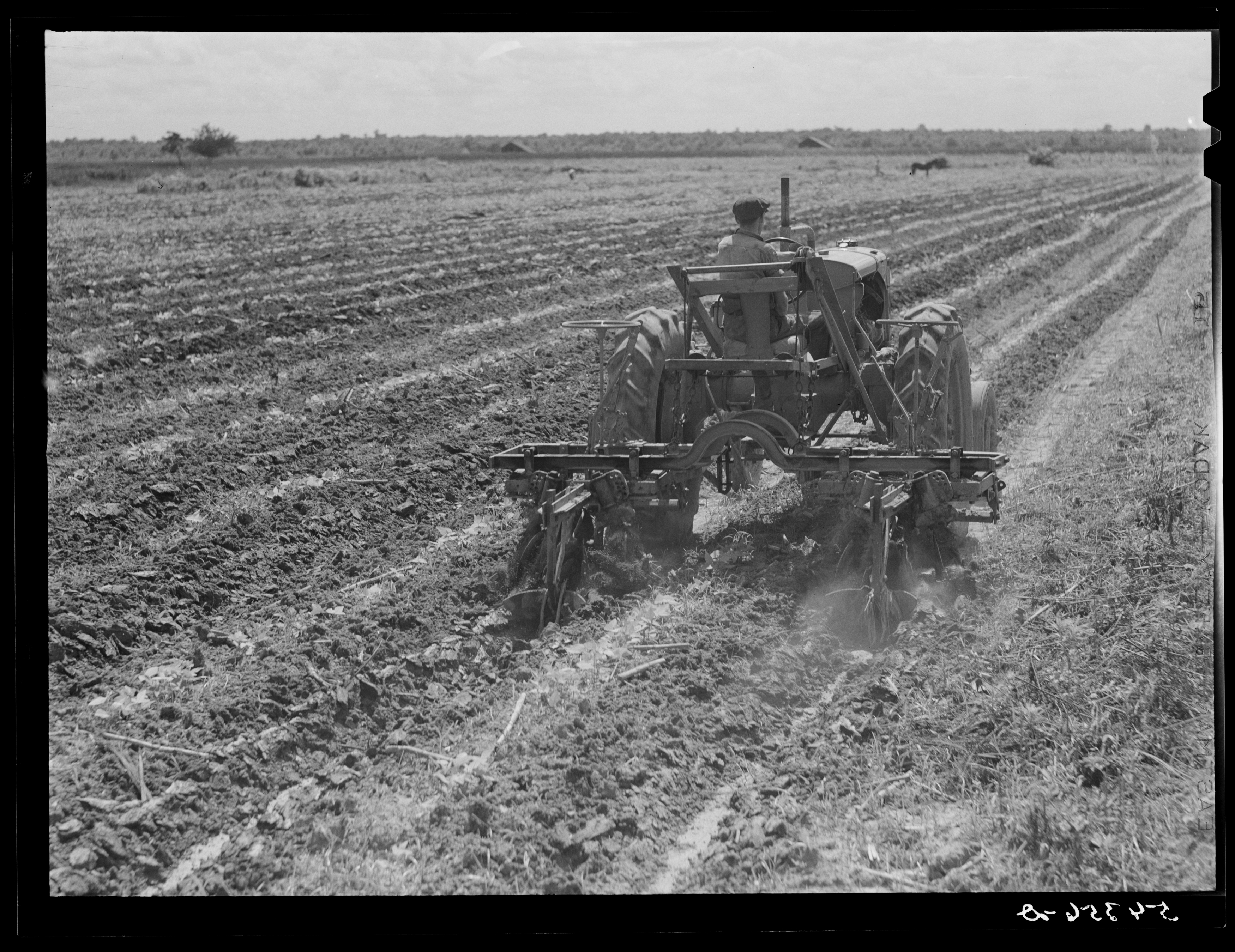
The Better Farming Association – Dayton Branch

DAYTON FARMERS MEET
ORGANIZE BRANCH OF BETTER FARMING ASSOCIATION
C., B. & Q. Agricultural Expert Delivers Talk—Other Fine Talks Heard

Thursday evening fifty representative farmers of Dayton township assembled at the Beach school house in that township for the purpose of organizing a branch of the Better Farming association. Great interest was taken in the proceedings and it proved to be a very enthusiastic meeting.

Mr. Sampson, agriculturalist for the C., B. & Q. Ry. company, which he represented at the meeting, spoke on ‘Why the Burlington Railway is interested in this work.’ The Burlington is the largest financial contributor in this work and the speaker gave his audience a very interesting talk as to the success of the new movement.

J. S. Brook, the La Salle County Farm Advisor, gave a good talk on “Soils and Their Treatment.” He showed how farmers could benefit themselves largely by using better methods and more scientific ideas in their farming. T. W. Esmond, president of the association, talked along the same lines. Both taking up the matter in detail and how much might be gained by using better farming methods. Mr. Esmond also told of the organization and what they hoped to make out of it.

J. F. Farrell, who was present, also made a few remarks.

After the discussions were completed the local organization elected officers with the following result:
President—Frank Beach
Vice President—Lewis Belrose
Secretary—Chas. Retz
Treasurer—Lyle Green1

The Better Farming Association had a three fold purpose: to improve its members, making each a better and more satisfied citizen; to improve their farms, by making them more efficient and therefore more productive; and to improve the community, by better schools, markets, roads and whatever will make the community a better place in which to live.


  1. Ottawa Free Trader, October 30. 1914, p. 5, col. 2.

Charles Green

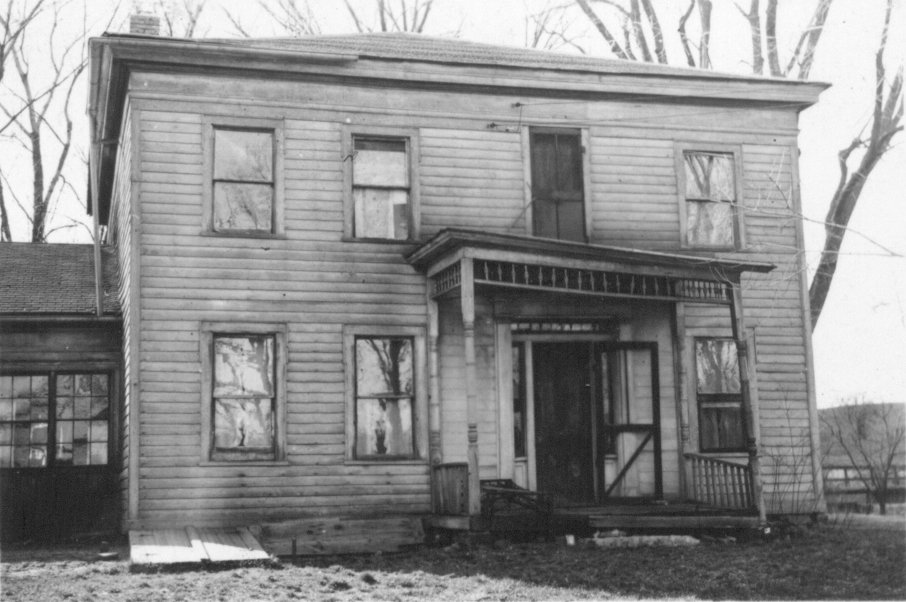
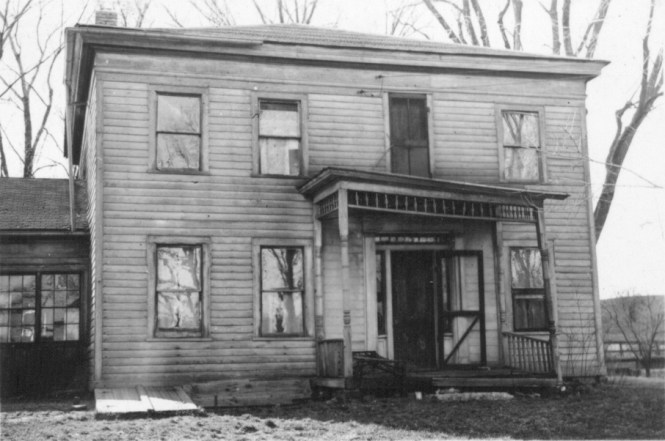
The house where Charles Green was born. His room was the top window on the right.1

Charles Green was born August 4th, 1858, in Dayton, the sixth child and fourth son of David and Mary (Stadden) Green. He may have been injured in his youth, as the 1880 census lists him as crippled.

As a young man he produced a semi-monthly newspaper called the Dayton Enterprise, He had a small printing press and he was editor, reporter, printer, and publisher. Unfortunately, only one copy survives, but it is issue #4, so the paper ran for at least 2 months. It advertised that he would print cards, bill heads, letterhead, envelopes, tickets, and the like, with reduced rates for quantity.

In April 1879 Professor Newbury, a music teacher from Hinkley, Illinois, held a week long music class in Dayton, ending with a concert. The class was then organized into a Musical Union, with Charles Green as the leader. Charles later also organized and led a Glee Club, in addition to giving private lessons. His efforts were appreciated by all of Dayton:

DAYTON, Dec. 24, 1879 – Dayton, unlike many western towns, is blest with a number of good things, and one of the good things is the Musical Union, which was organized last spring by Prof. Newbury, and has since been conducted by our esteemed fellow citizen, Mr. Chas. Green. We also have a Glee Club in Dayton. And all feeling a high appreciation of Mr. Green, determined to make that feeling manifest by giving him a benefit. Hence a concert was agreed upon and given last Friday evening, which was well attended, not only by the village people, but by many from the country. All were well pleased with the entertainment and expressed a desire to come again. We certainly have good reason for anticipating a bright future for Charlie in his wisely chosen field of labor, knowing as most of us do that he is in a very large degree self-made in his profession. May success crown your every noble effort, friend Charles.2

In addition to leading the choral groups, he taught both vocal and instrumental classes, for children as well as adults. Charles was also active in the Literary  Society, appearing in the plays they put on and willing to take a side in one of their debates. He supported the Library Association, serving as its secretary.

In 1882 he was elected town clerk of Dayton. He also went into business with his brother John, purchasing an interest in the Dayton Tile Works. A few years later they rented the old flour mill and fitted it up with new machinery,

He married Etta M. Skinner in DeKalb county, Illinois, on November 25, 1885. She was born February 14, 1865 in Leland, the daughter of Charles and Matilda Skinner. They had three children:

Guy, born October 25 1886 in Dayton, died April 22 1912, in Napa, California
Caroline, born February 25, 1891 in Benicia, California; died August 31, 1955 in San Rafael, California
Wilbur, born June 18, 1896 in Vallejo, California; died January 22, 1976 in Sonoma, California

Mary Stadden Green and children

Guy and Carrie with Charles’ mother, Mary Stadden Green


In 1889 the family moved to California, settling in Vallejo where Charles continued his musical profession. He taught music in the public schools, led the choir in the Baptist church, as well as continuing to give private lessons. He also had a sideline in tuning pianos. As his family grew, his income from music may have needed augmenting. He got a civil service job as a clerk in the Office of the General Storekeeper at the Mare Island Navy Yard in Vallejo. However, this did not put an end to his musical activities, as he continued leading the Baptist choir and offering private lessons.

The children married and moved away to other parts of California, but Charles and Etta remained in Vallejo, where she died in January 1936 and Charles in July of that same year.

Jan 1936 GREEN–In Vallejo, Solano County, January 19, 1936, Etta Skinner Green, wife of Charles Green, mother of Wilbur Allen Green of San Francisco and Caroline Green of Vallejo, grandmother of Cheryl Green Kennedy and Helen Marie Green of San Francisco, great-grandmother of Robert Emmett Kennedy of Vallejo, and sister of Mrs. Sadie Dickens of Wyanett, Ill., and Mrs. Mary Keyes of Manchester, Iowa; a native of Leland, Ill., aged 70 years. Funeral services were held in the Vallejo Episcopal Church to-day, with interment in the Masonic and Odd Fellows Cemetery.3

GREEN—In Vallejo, California, July 24, 1936, Charles Green, dearly beloved husband of the late Etta Skinner Green; devoted father of Wilbur Allen Green of San Francisco, Caroline M. Green of Vallejo, and the late Guy Green; loving grandfather of Cheryl Green Kennedy of Vallejo, and Helen Marie Green of San Francisco; devoted great grandfather of Emmett Kennedy of Vallejo, and beloved brother of William S. Green of San Francisco and Ella Riley, Leland, Illinois. A native of Dayton, Illinois, age 77 years. Funeral services to which friends and acquaintances are invited, will be conducted at the Ascension Episcopal Church on Monday, July 27, 1936, at 11 o’clock A. M. Interment in Masonic and Odd Fellows’ Cemetery. Friends may call at the Funeral Home.4


  1. You may wonder how I know which room belonged to Charles. My great-aunt Maud, who was eight years younger than Charles and knew him well, told me about his printing the newspaper in what was, at the time she told me, my sister’s bedroom.
  2. Ottawa Free Trader, December 27, 1879, p. 8, c. 2.
  3. Vallejo [California} Evening News, January 20, 1836, p. 8, c. 8.
  4. Vallejo Evening News, July 24, 1936, p. 3, c. 1.
Illness, Visits, and a Telephone

Mr. and Mrs. David Sisk, of Ottawa, spent Sunday with Mr. and Mrs. Jas. O’Meara.

Mr. and Mrs. G. G. Galloway Sundayed in South Ottawa.

Quite a number of relatives and friends viewed the remains of the two youngest sons, Leroy and Sidney, children of Mr. and Mrs. G. L. Makinson, who died last Friday within ten hours of each other. Both were taken sick with the measles on Sunday, and on Thursday pneumonia set in and in a few hours both were dead. The funeral would have undoubtedly been a large one, but it was the earnest wish of the parents that it should be private. Both were buried at 11 o’clock on Saturday morning in the same grave at the Dayton cemetery.

Ottawa seems to be a ready market for our Dayton coal, and most of it is a superior quality. The people of our sister city know a good thing when they use it.

There seems to be no let up in the shipping of fire clay. The tile mill is kept busy every day shipping it to the cars.

Ice is forming on the Fox river here, much to the satisfaction of the small boy who owns a pair of skates.

J. McBrearty, agent of the C. B. & Q., is again troubled with the rheumatism.

Newton Connors is down with the measles.

Mrs. B. Jackson, of Millington, has been spending a few days with Mr. and Mrs. O. W. Trumbo.

Chas. Seward, becoming tired of our quiet little winter resort has moved his family to Ottawa, in which city he will make his future home.

Martin Wilkie had a narrow escape while mining coal on Monday. The bank caved in and he was warned by a passer by just in time to make his escape.

O. W. Trumbo is contemplating placing a private telephone at his residence.

The C. B. & Q. bridge over Nigger creek, just south of Dayton, is being repaired.

Miss Jennie Barends, who has been on the sick list for the past ten days, and has been taking baths at the mineral spring at Ottawa, is now much better.

Thos. Nagle, foreman of the Q. section, has laid off two of his men, as is customary in the winter.

AN election of the M.  W. A., Fox River Camp, No. 6117, was held at their hall on Tuesday night.

QUINN1


  1. The Ottawa [Illinois] Republican Times, 13 Dec 1900, p4.

Grand Wolf Hunt

It is proposed to have a general turn-out of all in the towns of Rutland and Dayton (the cooperation of the towns of Mission and Serena respectfully invited) who are desirous of ridding themselves of these pests — the wolves —  which are becoming so numerous that they have been seen in droves of three and as high as five, to the great annoyance of sheep men, and others.

The plan of operations will  be for Rutland and Dayton — with the request that Serena and Mission join them — to elect one marshal in each town, who shall have entire control, first and second lieutenants for every twenty men, who shall be subordinate to the marshals, the people of those towns to drive to Fox river, where the meeting shall be simultaneous, with a view of capturing every wolf, which is considered better than to meet on the prairie, as is usually the custom in such hunts.

Friday, the 27th day of February, is the time appointed for this grand turn out — for this grand raid on the wolves — for the organization and success of which the following meetings are hereby called: One at the Grove school  house, Rutland; one at the Dunavan school-house, on Buck creek; and one at the schoolhouse in the village of Dayton, on Saturday evening, February 21st. The meeting at the Dunavan school-house to have the privilege of electing the marshal for the town of Dayton.1

Hunts typically involved hundreds of men walking in a line with guns. In 1875, Illinois had a bounty for wolf scalps. Settlers could receive $20 for each wolf scalp they provided. There was also a smaller bounty of $3 for wolf pups.

Although the submitter of this report promised to provide a report on the success of the event, a search of the next few issues of the newspapers was unsuccessful. Maybe there wasn’t much to brag about?


  1. The Ottawa Republican, February 19, 1874, p5.

Of Schools and Concerts and Burning Tile

Tile factory in the background

Dayton, Sept. 11, 1879. – After a brief silence, again we are at our post ready to abuse and be abused. Not that we would willfully abuse any one, but some persons are so sensitive, you know, that even complimentary remarks are by them turned into abuse, and then they are “mad” at the writer.

Never – what, never? – yes, never, has the river been as low here as it is at present. But the mills are all running yet, thanks to our first right to the water.

Our public school has been reorganized and divided into two branches. One is under the supervision of Mr. Chas. Howard, the other being taught by Miss Ada Green. The attendance is quite large, and the board was wise in dividing the school.

Mrs. R. C. Stadden and family, of Wenona, are in town visiting relatives and friends.

Miss Kate D. Jordan, of Morris, who has been spending the past two weeks in Dayton, bade good bye to her many friends and returned home last Saturday.

A number of our young folks “took in” the theatre at Ottawa last week, and came home with sore sides. The Troubadours, they say, were immensely funny.

Mr. Wm. Dunavan is attending the Ottawa high school this year.

The concert given at the close of the musical convention last Friday evening was quite well attended, and was, without doubt, a success both musically and financially. Miss Jordan’s solos were very fine, and were greatly enjoyed by our people, by whom she was frequently encored. The class, under Miss J’s excellent leadership, rendered the choruses in a very pleasing and acceptable manner.

Green Bros. have just finished burning their third kiln of tile, and are now ready to furnish customers with a good quality of tile at the lowest market price. Great care has been taken in the burning, and the tile taken from the kilns are found to be of the same degree of hardness none too soft, but all alike. Some parties have been misrepresenting the tile by saying they are too soft, but to those who would know the truth, we must say, “visit the kilns and see.” Tile will be drawn to the top of the hill by the proprietors for those who will notify them of their desire. In fact, the firm will do everything to please customers, not only in market prices but in a good quality of tile.

We chronicle the following deaths in town since our last article: Miss Bula Timmons, died Aug. 3; Mr. Ransler Timmons, died Aug. 22; Mr. Hathaway’s child, Aug. 8.1


  1. The Ottawa Free Trader, September 13, 1879, p.8, cols. 1-2