A View of Our Sidewalks

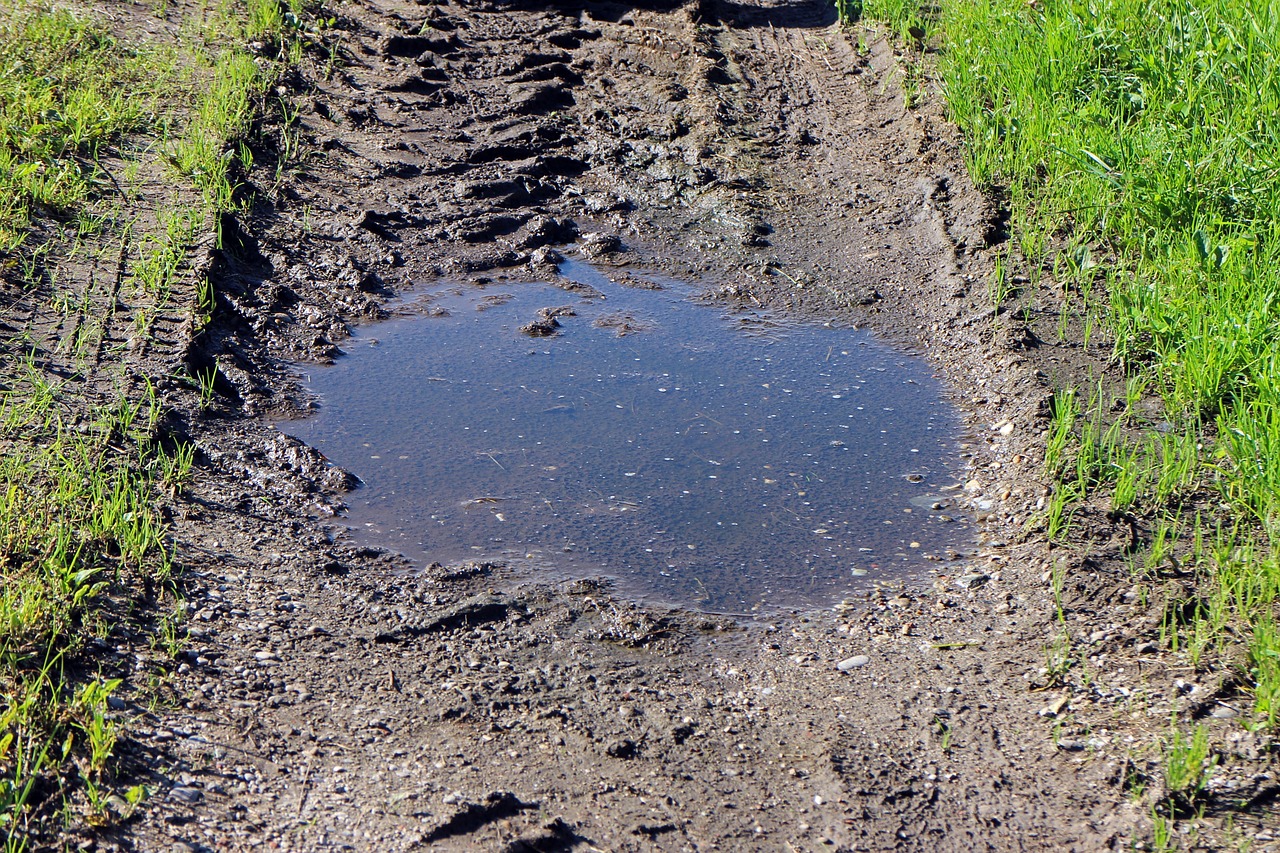
Not specifically Dayton, but you wouldn’t walk down the middle of this, either.

DAYTON

Dr. Bascom left the first treasure of the season at the home of Wm. Ryan. A fine baby girl.

Sleet, rain, snow, mud and sunshine inside of twenty-four hours. Verily, variety is the spice of life.

Mrs. Wright, of Ottawa, formerly a resident of Dayton, is spending a few days with friends in town.

We have no saloon, yet enough strong drink reached town to cause a drunken brawl last Sunday.

Mr. Brown is moving to town. Now the large, long vacant house will be brightened with the light of life and home.

The school entertainment Thursday evening should be patronized by all interested in the education of the boys and girls. Admission, 10c.

Last Saturday we were reminded of what we have read about women turning out and sweeping the streets in cities when we saw an energetic little girl wheeling ashes on a street crossing to make it passable. Our sidewalks are truly side walks, as a person must get to one side to be able to walk. Ottawa should be happy at the prospect of permanent pavements.

FISHER1

Image by Manfred Antranias Zimmer from Pixabay


  1. Ottawa Republican Times, 10 Mar 1892, p4.

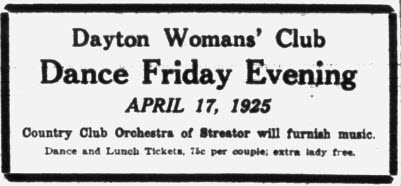
Social Activities of the Dayton Women’s Club

The Dayton Woman’s Club, with motto “Community Betterment and Improved Sociability,” was organized on June 13, 1913. It was founded by a group of women who wanted to socialize, but also to contribute to the community. The constitution of the club declared that the Woman’s Club is undenominational and nonpartisan, and is organized first for the good of all; second, for the betterment of conditions around us; and third, to promote sociability in our community.

Meetings were held at the homes of members until more space was needed, at which time a hall was rented from local farmer, Rush Green, for $5 a month. Club meetings were held monthly, with a luncheon in the club house. In 1917 they decided to invite the public to an ice cream social on Thursday evening, June 20. The  money raised was donated to the Chicago Tribune’s Red Cross Christmas Fund for kits for our soldiers in France.

The success of this enterprise led to a variety of public events; strawberry and ice cream socials in the summer and chicken suppers and bazaars in the winter. The annual bazaar sold many hand-made items, made by club members. In the fall, Halloween parties and masquerade balls were popular, and card parties could be held in any season. The proceeds from these supported many charitable causes.

By 1922, the members had been considering having a club house of their own. A lot  was donated to the group in 1923. Plans were drawn up by Lyle Green for a two-story building. Members of the Dayton Farmers association did the excavating for the basement and all members of the club and the community worked to complete the building.  A community dance, Feb, 1, 1924, opened the club house and Feb. 5, 1924 the first club meeting was held. The hall soon became the social hub of the community.

Events at the Dayton club house were popular and well attended, as shown by this newspaper item:

250 Gather for Annual Dayton Halloween Party

Two hundred and fifty gathered at the Dayton clubhouse Saturday night for the annual Halloween costume party of the Dayton Woman’s club.

Pumpkins, corn stalks and Halloween symbols formed decorations. Cards furnished the diversion during the early part of the evening and later the guests danced. A supper was served.

Mrs. Leroy Brown and Oran Mathias won pinochle prizes and Mrs. Frances Leibold and Arthur Retz received the “500” awards.

Judges in the Halloween masquerade costume contest were Charles Shields. James Trent and Harriet Moss. Mr. and Mrs. Ralph Ashley won the prize for the best dressed couple; Wesley Quinn for the “most comical lady”; Catherine Brown for the best dressed lady; Donald Ashley for the “most comical man” and Vincent Aubry for the best dressed man.1

A corner of the club house during a community event

Dayton Woman’s Club Makes Plans for Lawn Social

The meeting of the Dayton Woman’s club opened yesterday with musical numbers and a salute to the flag. The meeting was held in the Dayton club house and Mrs. Nettie Masters, newly elected president, was in charge of the business session.

During the meeting plans were made for an ice cream social Aug. 8. Mrs. Raymond McCormick was named general chairman in charge.

Refreshments were served to the 34 people attending. Guests were seated at a long table arranged with bouquets of summer flowers. Mrs. Ada Thompson and Misses Jennie and Emma Fraine were hostesses.

In games of “500” prizes went to Mrs. Masters, Mrs. Elizabeth Waldron and Mrs. William Calhoun. Prize winners in other games were Mrs. Hans Johnson and Mrs. Frances McCormick.

Aug. 10 the club will meet again. Mrs. George Thomas and Mrs. Nicholas Parr will be hostesses.2

A Maypole at graduation

Dayton School Graduation – 1955

Graduation ceremonies were held in the club house, as well as Christmas pageants and parties, spring teas, harvest dinners and other seasonal festivities. The club house was in use into the 1990s although it has since been sold and a house erected on the lot.


  1. Ottawa Daily Republican Times, November 1, 1943, p. 6, col. 3.
  2. Ottawa Daily Republican Times, July 28, 1949, p. 16, col. 1.

A Very Fishy View of Dayton and its Industries in 1880

Dayton Items.

Dayton, as a point where the finny tribe and fishermen do most congregate, has long been celebrated in this section of the country. People armed with hooks, and lines, buckets of bait and togged in old clothes, come daily and nightly from far and near. They arrive on foot, in buggies, in lumber wagons, and dumped off the cars, and are landed in every shape all bent on the same purpose, i. e., that of catching fish, not by the dozens, or in fifties, but by bushels, bagsfull, wagon-loads, and in other prodigious quantities.

They arrive in lofty spirits, braced up by lofty expectations of astonishing the natives. They usually depart wet, hungry, tired, disgusted and without any fish worth speaking of. To a man whose constitution requires a vast deal of rest — long continued and complete relaxation of every muscle and nerve — fishing is just the thing. Fish, as food, may be brain food, but catching them is certainly a brain softener. It does not require a very high order of intellect in a man to fish, that is, a man of very moderate brain power ought to know enough to out-wit a fish, which stands rather low in brain development. In short, fishing, to an outsider, is a very languid, sleepy sort of work. There never has been any employment so well adapted to the wants of a lazy man as that of fishing as they do it at Dayton. To see the anglers as they line the banks and cover the rocks like so many mud turtles [illegible] is a sight fit to make a person yawn.

To the man to whom any kind of exercise is a bore fishing is just about exercise enough. The fellow lands upon some sequestered spot, sits down to rest and meditate awhile, then baits his hook, summons up all his energies like a man trying to ward off sleep, gets the line in the water, and then the thing fishes itself. When a man gets too lazy to fish they accuse him of having a softening of the brain and soon after he becomes too tired to draw his breath and this ends him.

Some of the fellows we saw fishing on Friday last were half a mile from the water, under a shade tree, three of ‘em asleep and the fourth studying the sun’s altitude and position of its spots through a “pocket” telescope. Though we were ln sight of a score or more of fishers for an hour, we did not see a fish hauled out, nor even hear of one being captured, though a shoal of three or four minnows were reported to have swam up among the fishers early in the morning.

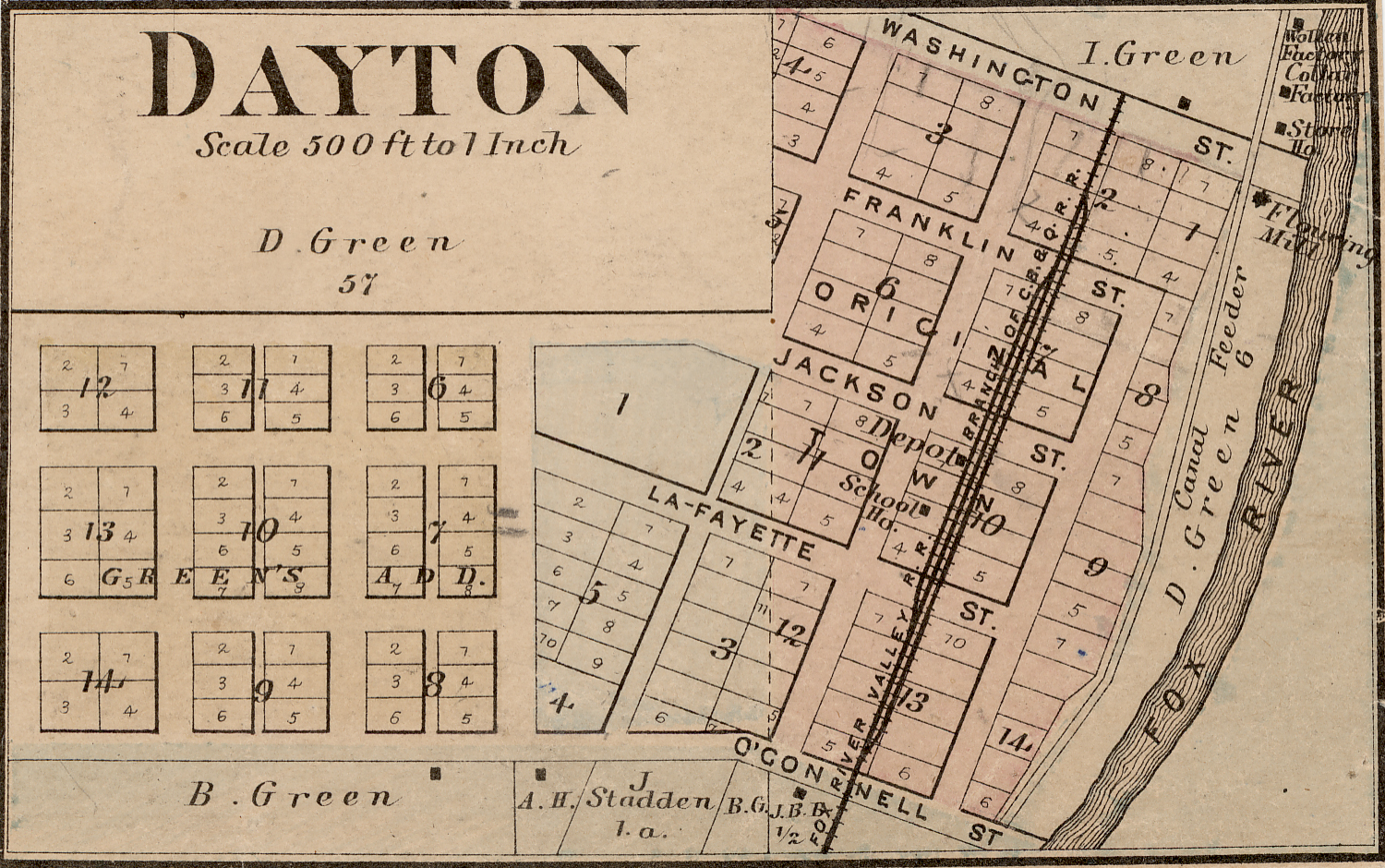
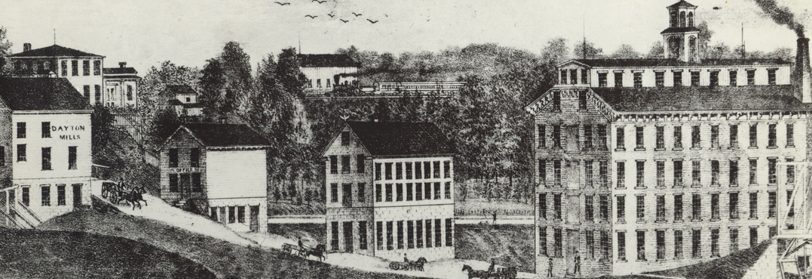
Dayton, however, has another point of view of far more importance to the business man and to the farmer. We refer to her woolen mills — as good as any in the state built some years ago at great expense, and stocked with as excellent machinery as the Union anywhere could boast. Though under a cloud for a time, but now started anew by its original owners, the Greens, it will soon be working upon a large scale, and is daily turning out great quantities of yarn of various grades, also superior cloth.

Another enterprise is the collar factory, under the management of Mr. Dunavan. It employs a large force of hands, turns out the premium horse collars of the United States and also a fine article of leather fly nets, the latter being its chief production during the summer months. The goods from this establishment find a ready market all over the country.

Another business, as yet young, but extensive and rapidly increasing in importance, is the Dayton tile works. When the factory was started it was not supposed that it would, in five years, reach the dimensions it has attained in a few months. The tile they manufacture is as good as any made in the west.

The large paper mill here next claimed our attention. This institution has long since become fixed and firmly established upon a substantial business basis. It runs exclusively on straw and manilla paper and consumes vast quantities of material. It has on hand an enormous stock of as good paper as is made anywhere. The recently senseless boom in prices of material used is happily subsiding, and the rather sluggish demand in this county for paper, has been rather unsatisfactory, but it runs ahead, looking for a fairer margin between its expenses for stock and the price of manufactured goods than has generally prevailed.

Besides, a good flouring mill and a local store and a “tavern” and good prices for farm products in general, all contribute to make Dayton a live business village.

Since the tile works were started in full operation a new industry has been developed, being coal mining operations, managed by Simpson & Wilke, a couple of hard-working miners, who obtain a good quality of coal which lies on the level with the banks of the feeder, and is drifted and removed on hand cars on a tramway and dumped below the woolen mills into wagon, or on the public roads as may be required.1


  1. Ottawa Republican, 27 May 1880, p2, col 3
Garden Club Picnic

Green home in Dayton

Annual Picnic Of Garden Club At Green Home

Because of the rainy weather yesterday afternoon, the 35 members of the Ottawa Garden club who gathered at the home of Mrs. Ralph Green at Dayton for their annual picnic, were compelled to turn the event into an indoor fete.

The luncheon tables at which the sumptuous repast prepared by the members of the club was served were prettily decorated in garden flowers.

Following the luncheon, at a club business meeting presided over by Mrs. Fred Claus, chairman, arrangements were made for co-operating with the city in the beautification of the grounds around the stand pipe on State street. Members of the club are to donate plants and shrubbery for this work.

Reports of the district and state Federation of Woman’s clubs conventions were made. Mrs. Ralph Green made a report of the district federation meeting, and Mrs. John Johnson and Mrs. Clarence Wilson gave reports of the state convention that took place in Chicago.

Plans for the coming year’s program were also discussed.


  1. Ottawa Republican-Times, June 18, 1935, p. 2, col. 3.