Death of Mrs. Sarah Lewis

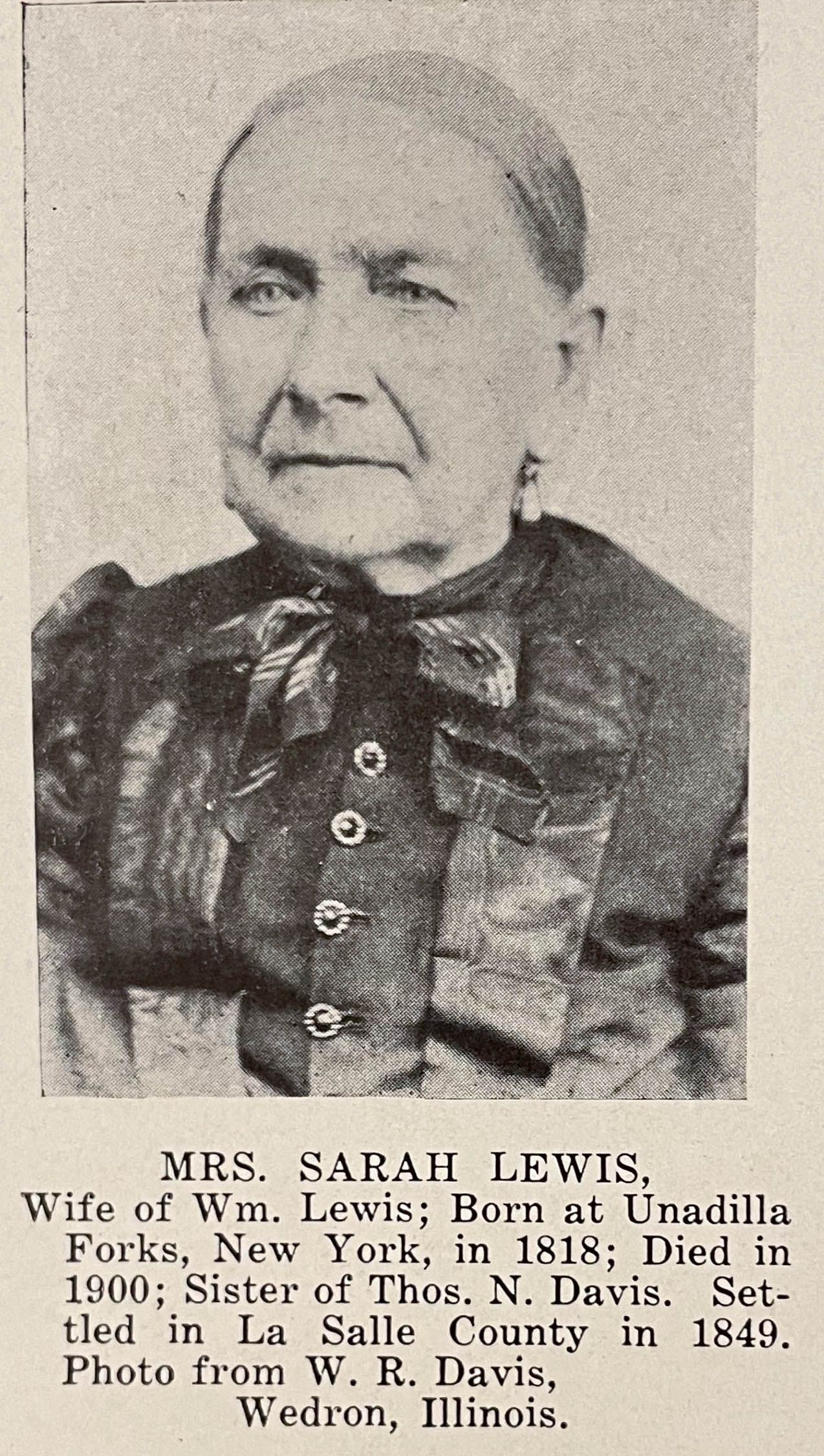
photo from FindAGrave

Wedron

Passed to spirit life, March 19th, Mrs. Sarah Lewis, aged 81 years, at the home of her son, Park Cole. Deceased was an old settler and resident of the town of Dayton. She had been sick for about a year and her demise was not unexpected. Five sons survive her. The funeral occurred from the school-house on Wednesday, at 11 a. m., Rev. Baird, of Ottawa, officiating. As we write a large concourse of friends are gathering to pay last respects to the memory of one who was loved and esteemed while living and mourned in death.1

The above obituary gives little information about Sarah Lewis’s life, so this is an attempt to expand on the few facts in the obituary.

Sarah Davis Cole Lewis was born abt 1818/19 in New York. She married William Cole on February 4th, 1838, in Plainfield, Otsego County, New York. They had 6 children: Lyman, Leroy, Jay, Marian, Parke, and Burt. The family moved to La Salle county about 1849 and settled in Serena township, north of Dayton. By 1860 they had moved to Marseilles, Illinois.  On November 18, 1861, William Cole enlisted in the 53rd regiment, Illinois Infantry at Ottawa, Illinois. Unfortunately, his part in the war was of short duration. He died at Pittsburg Landing, Tennessee, on April 6th, 1862. As reported by the Regiment Major:

He was breaking teams consisting of six mules, was thrown from the one he was riding on, was run over by the wagon and his back broken and otherwise injured.

William is buried in the West Serena Cemetery. Sarah applied for a widow’s pension and there were two young children who were also entitled to support. She was appointed guardian for her two young sons, Parke and Burt. She got a pension of $8/month from William’s service.

In June 1865 Sarah Cole and William Lewis, of Dayton, were planning to marry. Because her widow’s pension would end at her remarriage, she wanted some assurance that she would be provided for should her husband predecease her.  On June 13, the two of them signed an agreement in which Sarah says that without such a contract she would not have married Lewis. The provisions for her children are that Lewis will support, clothe and educate her two sons until the age of twenty and when they reach twenty-one he will give each a horse, saddle, bridle and suit of clothes. Should Lewis die before Sarah, she will have all his real and personal property and, in addition to maintaining herself and her sons, she will provide for the younger Lewis children until they reach the age of twenty.

With the contract signed and registered with the county court, the marriage took place the next day, June 14th, 1865. The two Cole boys worked alongside the Lewis men on the farm and Sarah kept house for the blended family.

William Lewis died October 9th, 1874 and was buried in the Dayton Cemetery next to his first wife, Eliza Ann Holman. Sarah lived on the dower tract of her husband’s farm until her death on March 19th, 1900. She was buried in the West Serena Cemetery, next to her first husband, William Cole.


  1. Ottawa Republican-Times, March 22, 1900, p. 5, col. 2


The Dayton Cemetery Association – a retrospective

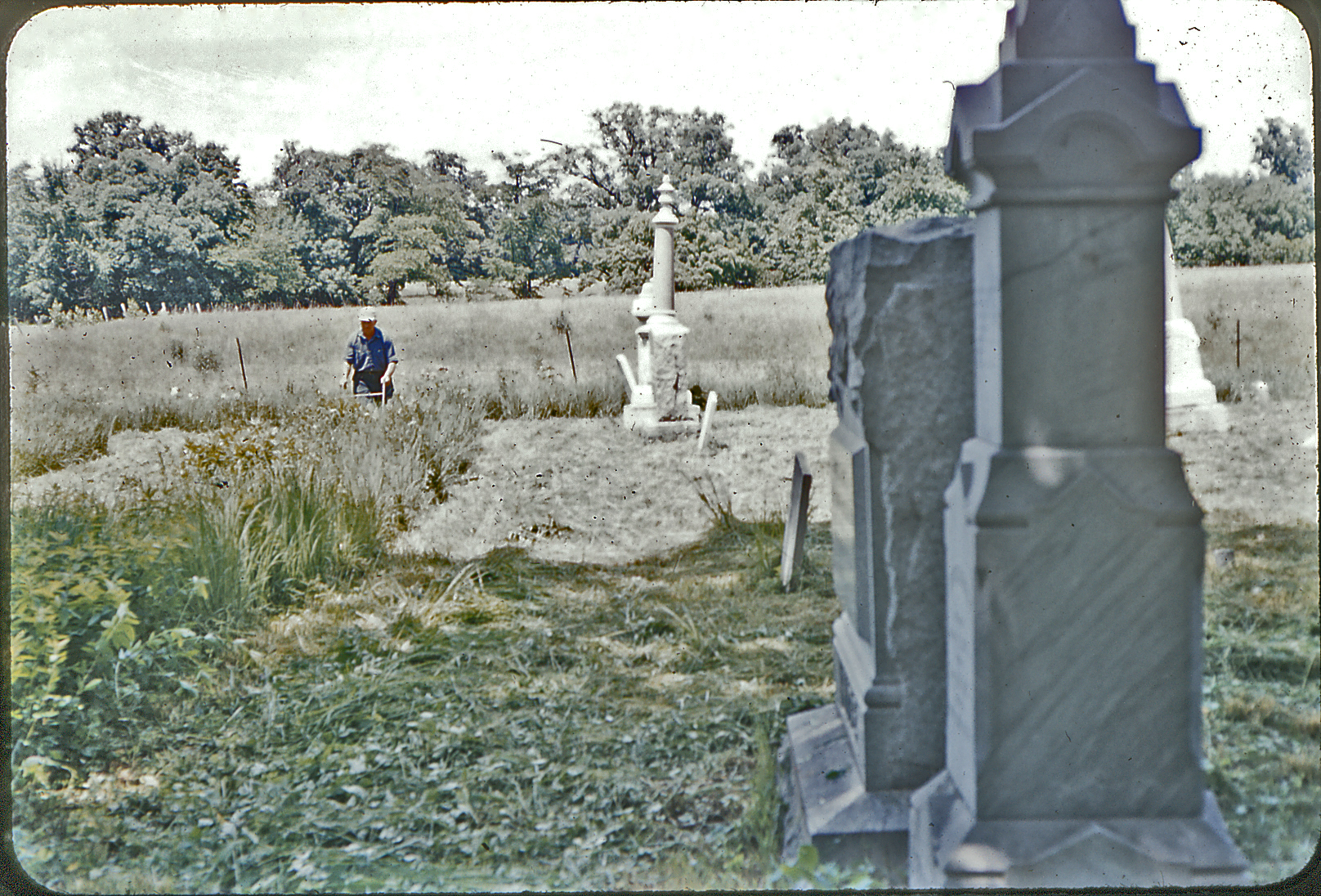
There have been several different Dayton Cemetery Associations over the years since the first burial in 1835, The current group was organized in 1956, with the object of cleaning up the cemetery, which had been allowed to go wild, and building a fund for providing on-going maintenance and support.

The first job was to mow the tall weeds.

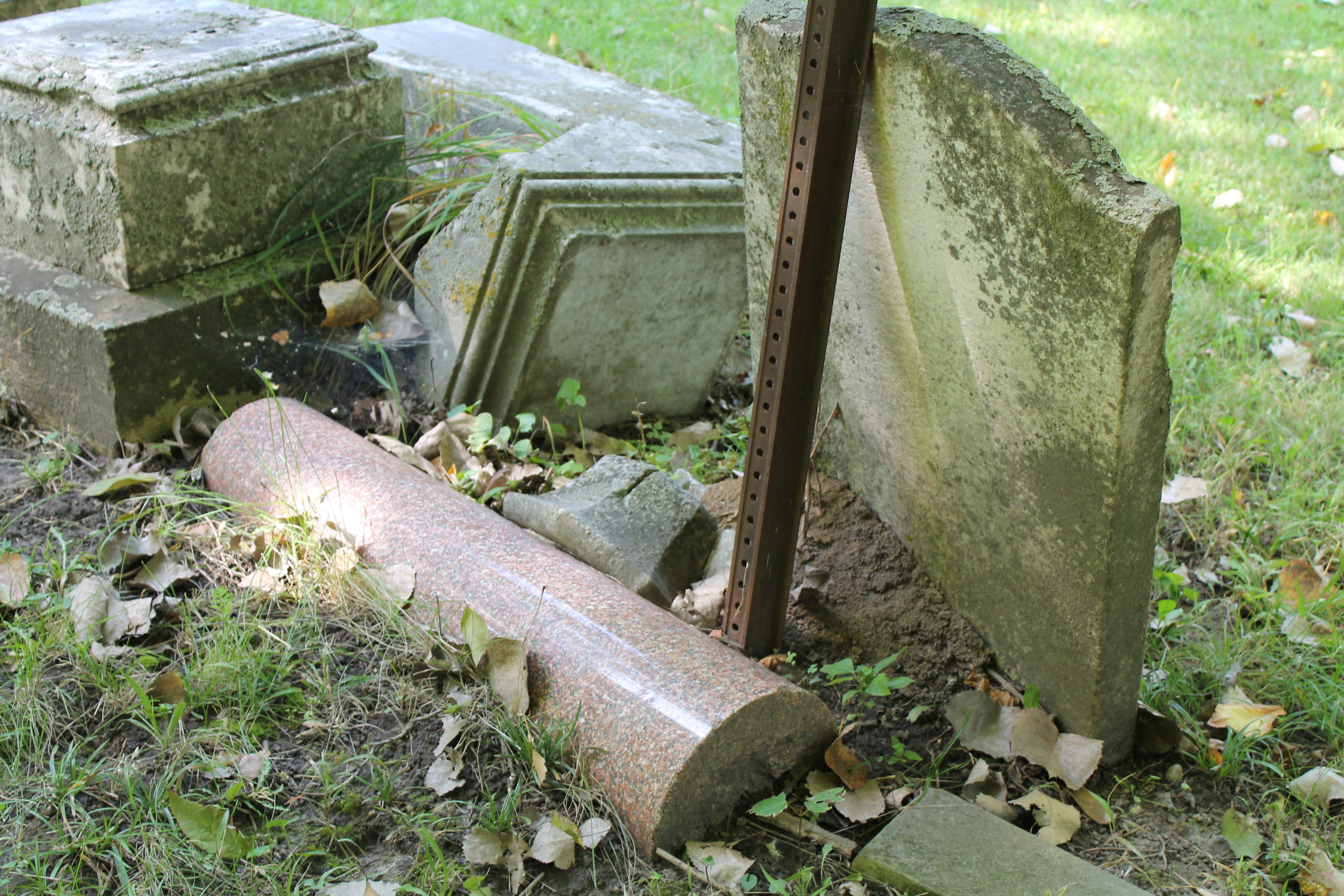
Cleaned around the stones and trimmed branches

The annual meeting of the Association is held on the Sunday of Memorial Day weekend, and for many years met at the home of Grace and Charles Clifford, in Dayton.

Mabel Myers, Sandra Dunavan, and the 10th anniversary cake – 1966

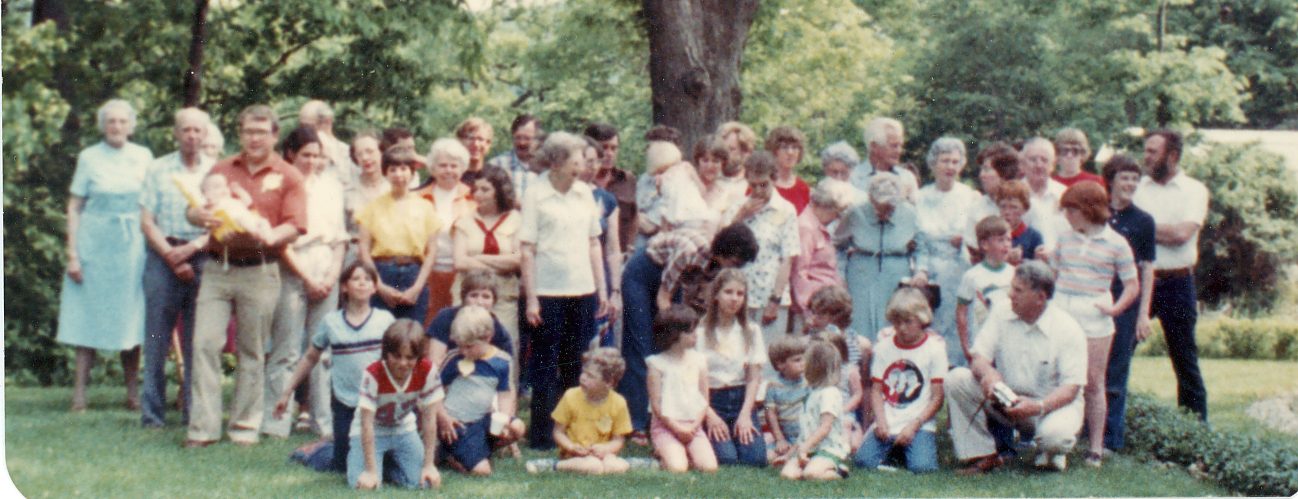
As the years went by, the group grew larger.

1980 – taken on the Clifford lawn

In 1996 Secretary Carrie Ann Green searched through the minutes and created a timeline of the organization up to that point. The timeline and the program Carrie gave in 1996, can be seen here.

Every year the meeting concluded with a historical program, frequently a story of families buried in the cemetery. More of the old programs will be added to this site as I get around to it.

In 2000, after the Cliffords moved from Dayton to Ottawa, the annual meetings were held at Skydive Chicago.  The traditional potluck meal and the historical program following the business meeting carried on the traditions, regardless of location.

2007 – We had to draft someone from the skydivers to take our picture.

In 2014 we worked with John Heider, a professional cemetery restoration expert. That year we restored 20 stones and the following year he came back and we did another 30 or so.


In 2020 Covid changed everything and we went to Zoom for meetings (though not for the pot-luck meals). In 2024 we are returning to Skydive Chicago and a more normal existence.

A view to the west

Rural Happenings

Rural Happenings
Dayton

Dayton, June 2d, 1881
The river is falling slowly, and is now being crossed at both fords. Fishermen and sportsmen are here in great numbers. The Earlville people seem to have struck a “boom” and are turning out en masse for a good time fishing and camping out.

The bridge across the Fox river at Dayton went out in the flood of 1875 and was not replaced until 1887.  People got very tired of having to ford the river.

Peter Coleman, an old resident of this place, was taken suddenly ill last Tuesday morning while at work in his garden, and for a time was unconscious, but soon recovered possession of his faculties and is recovering.

Miss Carrie Stowell, of Bloomington, Ill., has been visiting her sister, Mrs. Wright, and returns home today.

A meeting is to be held next Saturday evening at the school house for the purpose of obtaining an expression of the views of the people in regard to building a new school house.

They got their new school house the next year. It was in use until it burned down in 1890.

A lawn festival was held at Mr. O. W. Trumbo’s last Wednesday evening, for the benefit of Prof. H. L. Boltwood, of Ottawa. There was a fair attendance and all seemed to have a pleasant time. Next to the pretty girls, strawberries and ice cream were the principal attractions. The evening’s receipts were satisfactory to the managers.

Henry L. Boltwood was the first principal of the Ottawa Township High School.

A few of our young folks have organized an Archery Club for amusement and recreation. They expect to become expert marksmen, perhaps.

The tile works have just finished burning another of their excellent kilns of tile. They make the best hard tile in the county, for smoothness, hardness and durability.

Misses Myrtle Stadden, Judith Dent and Bertie Stadden, of Wenona, have been visiting in Dayton during the past week. They returned home Thursday.

Miss Clara Gibson, of Rutland, came over to attend the lawn festival and visit relatives.

Occasional1


The Ottawa Free Trader, June 4, 1881, p. 8, col. 2

An Amateur Mesmerist

Forty-five years after the incidents related here, Jesse Green wrote this article about his experience with hypnotism:

“An Amateur Mesmerist”
“How I became interested in the investigation of Mesmerisn”

In the fall of 1848 one Doctor Underhill visited Dayton where I then resided, with a Mesmeric subject and claimed that through him he could among other things find lost property.  He undertook to find a pair of buggy wheels lost in fording the River during a high stage of water a short time previous.  The buggy wheels were lost by Dr. Ward of Marseilles.

He started in at the ford, and when in the River opposite my house, the subject said “he saw no buggy wheels, but there lay an old saddle under a ledge of rocks in deep water”.  There had not been a word said about a saddle being lost.

But I had lost my saddle during the same rise in the River, and he described it as well as if lying before him, which was an easy matter as I had started hastily to cross the River, and found one of my stirrups gone, and took an odd one in its place.  We then went under his directions, in a boat with a lantern, and persons on the bluff overlooking the River, and in communication with the subject (Jockey Smith) who directed us to the spot.  We did not find the saddle but found the ledge of rocks in about ten feet of water.

This so impressed me that I together with a number of others got the Doctor to deliver us a course of lectures on Mesmerism, and the night of the third lecture he had us all take a subject and see what success we might have.  I selected my sister and succeeded in getting her Mesmerised, before the Doctor got his, and gave her up to him, not yet knowing how to proceed farther, but soon became familiar with all the Doctor knew on the subject.  During that winter I Mesmerised eight or ten different persons.  My first experience worthy of note was with my first subject.  Father requested me to send her to Newark, Ohio, and from there up the Ohio Canal, and see if she could name the Towns she would pass through (he being familiar with the whole length of the canal, having built fifteen miles of it).  She would name places in their regular order (apparently by reading some sign giving the name) and when she reached Cleveland she exclaimed “Oh! what a great body of water”.  Father was fully satisfied that she either read the signs correctly or read his mind.  This much I know they can do.  My best subject being the best clairvoyant I had outstripped this all hollow.  He would personate anyone, in speech, actions, and in every way.  I had him sing by exciting the organ of tune, and have thrown it off, at the highest pitch in the tune, with the word half uttered, and in a half minute or so would excite the organ again when he would start in again where he left off with the same pitch of tune, and the other half of the word as perfect as if there had been no intermission.

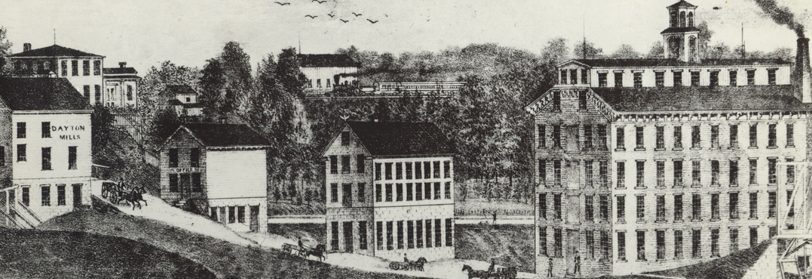
During one evening some one suggested that I “have him look ten years into the future and see what he would say about Dayton”.  Of course I had no faith that he could tell anything reliable, but did so.  He looked around a little and said it had not improved much “but they have a new mill down there and Uncle Johnny is up in the third story”.  Uncle Johnny was my Father and lived a number of years after that mill was built, and I believe that this clairvoyant saw it seven years previous to its being built.  It may be said that he guessed it.

I will relate another experience that will show too much complication to admit of guess work.  This all occurred during the winter of 1848 and ’49, and we were calculating to go to California in the Spring (and in the clairvoyant state) I sent him there to see what he would say about it.  We did not get much information only that there seemed to be a great rush to that country, and they were getting plenty of gold”.  It seemed to him in returning that he met our train going in the spring and his first exclamation on meeting it was “See that wagon, how they have fixed it up”.  I inquired about the wagon and he said it was “George Dunavans wagon and that they had broken the coupling pole, and had it wound with ropes and chains, and Uncle Johnny is behind carrying some birds”.  When he told this Father had no idea of going to California with us.  The Company employed him to go to Missouri and buy oxen for the outfit and return home, but there being so much cholera on the River he preferred crossing the Plains, rather than risk getting the cholera on his return.  Our company consisting of forty nine men with twenty wagons, left Ottawa April 2, 1849.  Myself being elected captain of the Company, one day on the route a short distance East of Fort Kearney, my clairvoyant (Daniel Stadden) borrowed a horse from one of the company and rode ahead with me, when we were a mile ahead of the train we saw that they had stopped, and by the time we rode back to see what was the matter, here was George Dunavans wagon reach broken and wound with both ropes and chains and Father was behind carrying a sage hen he had shot.  Stadden said to me “that is just how I saw it when I was mesmerised”.

Had it been any other wagon we probably should not have thought anything further about his prophecy, but every circumstance connected with it, being literally fulfilled brought it vividly to the minds of both of us.

I have often regretted that on my return home I had not further investigated it, I did very little in California but on our return home via Mexico one of our Company had a horse stolen and having faith in Mesmerism he wanted me to Mesmerize Mr. A.B.Goodrich (one of my former subjects) and one of our Company to see if he could find his horse.  I was a little afraid to do so there knowing the superstition of that people, but we had an interpretor who went and saw the Alcalde of the place and found that he had seen it before, and was anxious that I should Mesmerize Goodrich, he being present with our interpretor.  He soon described the thief and pointed out the direction he had taken, describing minutely every crook and turn in the road, and where the thief had stopped for the night.  The Alcalde had such confidence in everything that he said he would send next morning to recover the horse and thief if possible.  We were driving five hundred horses, and did not wait to see the result.

I think the possibilities of Mesmerism are very imperfectly understood even at the present time.  I have frequently seen accounts published of what seemed a little strange, but nothing equal to my experience with it.

I should have taken up the further investigation of it, but my second wife thought she could see the cloven foot of his Satanic Majesty in it, and on her account I gave it up, but my experience was entirely the reverse, and with evil intentions I was taught and believed it would prove a deserved failure.

It may be asked by some, why did you not have your clairvoyant find gold for you in California.  I do not pretend to say whether he could have done so or not.  The poor fellow died of scurvy soon after reaching California.

Should this seem a little too fishy, I would say that there are still living witnesses to corroborate the facts stated.

Ottawa
October 17th 1894,
Jesse Green.
A May Dayton Marriage

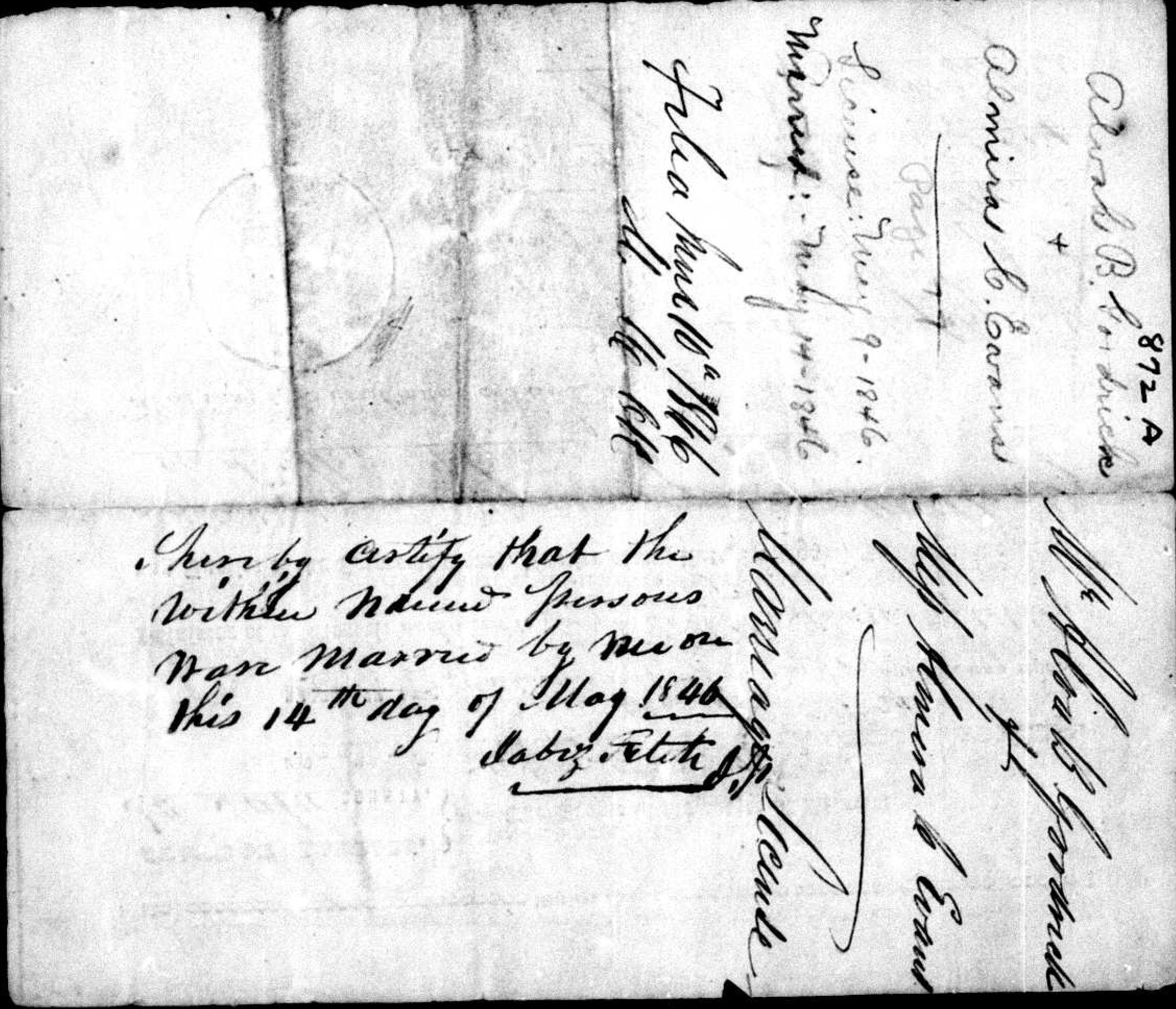
On the 9th of May, 1846, Alva B. Goodrich and Almira C. Evans applied for a marriage license in Ottawa.

Five days later they made good use of it, as reported in the Ottawa newspaper:

MARRIED – At this place, on the 14th inst, by J. Fitch, Esq., Mr. A. B. Goodrich to Miss Almira C. Evans, all of Dayton.1

Alvah Goodrich came to La Salle county in 1844. He worked in the Greens’ woolen mill in Dayton, having learned the trade in the woolen mills of his hometown. In 1849 he went with the Green party to California and spent two years working in the mines. He returned to Dayton and spent an additional year working in the woolen mill. He then bought 88 acres and turned to farming. After he retired, he lived in Miller township, where he died on February 3, 1893

Obituary

DIED. – At his home in Miller township, Friday morning, the 3d inst., Alvah B. Goodrich, at the advanced age of nearly 76 years. Mr. Goodrich was born in Clinton county, New York, February 14, 1817, and passed his boyhood days in his native state, emigrating to Illinois nearly fifty years ago and settling in Dayton township, where he married Miss Almira Evans in May, 1846. Of this union two children were born, Emma L. and Willis J., who both survive, the daughter living on the old homestead and the son in Macon county, Missouri. During the gold excitement in 1849 Mr. Goodrich accompanied the Green expedition to California in search of gold and after nearly two years’ absence returned to his wife and little daughter and settled on a farm near where the village of Wedron now stands.

Here he resided for five years, removing to his late home in Miller township in 1857, where he spent the remainder of his days, honored and respected by all. Ten years ago last September the wife of his youth was laid to rest in the “churchyard on the hill,” leaving her companion and family nearly brokenhearted. Now they sleep side by side awaiting the last call. So one by one the “old settlers” are passing to the great beyond.2


  1. The Ottawa Free Trader, Friday, May 15, 1846, p. 3, col. 1.
  2. ibid, 18 Feb 1893, p5, col 2

Spring in Dayton

Judy Gallagher, CC BY 2.0 <https://creativecommons.org/licenses/by/2.0&gt;, via Wikimedia Commons


from The Ottawa Free Trader, March 30, 1907

Dayton

Mrs. Ostrander spent Tuesday with Mrs. Thompson.

Mr. Basil Green and granddaughter, Gladys, were Ottawa visitors Saturday.

Mrs. McCleary, Mrs. Dallam, Mr. and Mrs. Ostrander and Mrs. Pyatt shopped in Ottawa Saturday.

Mr. F. M. Ostrander did a small job of carpenter work for Oscar Thompson Tuesday and Wednesday.

Mrs. Libbie Hayes went to Marseilles Wednesday to visit her parents, returning Thursday evening.

A new little daughter, weight 9 lbs., has come to the home of Mr. and Mrs. James O’Meara. Born Tuesday, March 19th.

Mr. Tom Maher and Mr. Fullerton are putting in tile on Dr. Smurr’s farm and expect to go next to the Trumbo farm.

Mr. Rush Green, who has been doing jury duty in Chicago, came down on Thursday evening. Mr. O’Meara came Wednesday.

Mr. Ostrander did carpenter work for Mr. Sam Hippard Thursday, then started Monday morning for Mr. Chas. Knoll’s to do about two hours’ work.

Spring seems here to stay. Folks are making garden and the hustlers also have “spring frys” on the way. Mrs. Tanner leads off with thirty-five new chicks.


Spring in Dayton always meant bluebells and violets to me. We put them in May baskets to hang on door knobs the evening of April 30.