David Hite, Jr.

To continue the enumeration of David Hite’s children, his second son, David, Jr., was born in July 1831 in Licking County, Ohio, and came with his father’s family to Dayton in 1848. On December 23, 1851, he married Mary Ann Curyea, the daughter of John and Lydia (Sager) Curyea, whose family had come to Dayton in 1843. The license clearly states that David is not yet 21 and that his father has given consent, as can be seen below.

David and Mary Ann lived in Dayton for thirty-five years and raised their family of 3 boys and 5 girls. One other son, John William, died at the age of three. In 1881 the family moved to Nebraska, where David died in 1928. His obituary  appeared in The Frontier, the O’Neill Nebraska newspaper on April 5, 1928. Barring the errors in his birth information, it gives a good idea of his life in Nebraska.


DAVID HITE
Holt County’s Oldest Citizen Passed Away Monday

David Hite was born July 15, 1830, in Lincoln County, Ohio, and died at the home of his daughter, Mrs. Flora B. Lewis, April 23, 1928, at O’Neill, Nebraska, aged 97 years, 9 month and 8 days.

He was united in marriage to Mary A. Coryea, December 23, 1851. To this union were born nine children, three of which are living.

When sixteen years of age he moved from Ohio to Illinois, and in 1881 with his family to Cass County, Nebraska; in 1912 he moved to Holt county and made his residence in O’Neill. By occupation he was a farmer and gardner. He loved the soil and was a sincere lover of nature.

Mr. Hite was Holt county’s oldest citizen and took keen delight in political conditions. He was an ardent “Dry” and his two aims seemed to be to live to be 100 years old and to vote as often as given an opportunity to make America dry.

His beloved wife passed away February 22, 1905. “Grandpa Hite was the last of seven children in his family to pass away. He leaves to mourn his going one son and two daughters, T. J. Hite, of Ottawa, Illinois; Mrs. Flora B. Lewis, of O’Neill, Nebraska, and Mrs. Nellie B. Ryan, of Denver, Colorado. Twenty-two grandchildren, twenty-seven great grandchildren, and one great, great grandchild (Donna Rae Cooper, of Lincoln, Nebraska, age seven years) are mourning his going. He will be laid to rest beside his beloved wife in the cemetery near Elmwood, Nebraska. His funeral was held Wednesday, April 25th, in the Methodist Episcopal church at Elwood.

So has fallen one of our best known men. He was in good health until October 16, 1927, and since that time has steadily grown weaker. He was confined to his bed for the last few weeks where his daughter and granddaughter gave him the most loving care. The community extends their heartfelt sympathy to these bereaved ones.1


  1. The Frontier, O’Neill, Nebraska, April 25, 1928, p. 7, col 6.

The Almost Inevitable Spring Flood – 1857

The Flood

The great storm and flood last week, of which we had but the beginning as our paper went to press on Friday night, appears to have been general throughout the country, and our exchanges from all quarters comes filled with accounts of disasters and hair-breadth escapes. From New York and New England, from Virginia and Maryland, Pennsylvania, Ohio, Indiana, Michigan, &c., the burden of the papers and telegraph dispatches is the same. To give anything like a full account from all directions would occupy more space than we can command, so that we shall attempt little more than a resume of disasters at and near home.

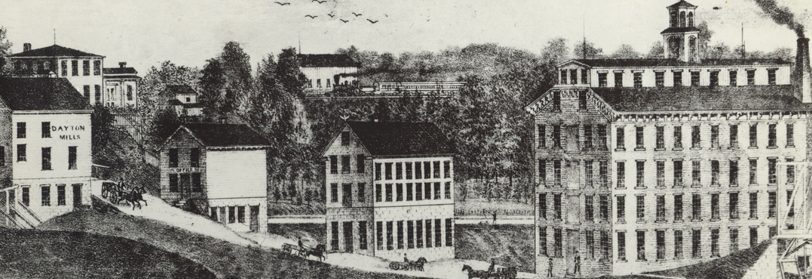
AT DAYTON. – The chief disaster at Dayton was the destruction of the fine bridge, erected by the people four or five years ago, at an expense of some $1000. It was taken off bodily, leaving nothing but the naked abutment. The dam was not seriously injured. A break in the feeder will probably stop the mills from running a month or more. Of individuals, the Messrs. Green are the only serious sufferers. Their dye house, a new building erected north of the woolen factory, has been so badly damaged as to require re-building, and the kilns, hearths, kettles, &c., in it are mostly ruined. The lower floor of the factory was also six or seven feet under water, and suffered considerable damage.

FOX RIVER FEEDER. – The Fox River feeder, leading from Dayton to Ottawa, has again, as usual, suffered serious damage. Some sixty or seventy rods of the bank at Dayton has been swept away, the lower gates and wing of the guard lock have gone out and the lock otherwise much damaged. There are also several smaller breaks in the feeder lower down, and a good deal of dirt has been washed into it. It will take a month at least to repair it.1


  1. The Ottawa Free Trader, February 14, 1857, p. 2, col. 1

David Hite and Son Benjamin

The tallest monument in the Dayton Cemetery is that of David Hite, but for many years the top part was lying in a heap next to the base. In 2014 a restoration effort restored a number of monuments in the cemetery and David’s was one of the stars of the project.

David Hite was born in Strasburg, Virginia, on July 30, 1798. as calculated from his age at death. He was apprenticed to the blacksmith trade and at the age of 21 was given $15.00 and a suit of clothes for his work. He decided to go to Newark, Ohio, arriving there late in 1819. There he met Elizabeth Stickley, whose family was also from Virginia. Elizabeth was born April 5, 1798, in Cedar Creek, Virginia. She and David were married August 28, 1820, in Licking County, Ohio.

A number of their friends and neighbors moved to the Dayton-Rutland area in La Salle County, Illinois, and in 1848 David and Elizabeth joined the migration. In 1850 David bought 160 acres of land on Buck Creek in Dayton township, where he moved with his family.  David and Elizabeth lived here until their deaths, he dying April 22, 1881, and she, January 4, 1890.

David and Elizabeth had nine children. Three, Alexander, Isaac, and Catherine “Kittie” Ann all died young. This site seems a good place to write about each of the six who lived to adulthood, so I will begin with Benjamin, as he has a special connection to the Greens.

The usual beginning to an account of someone is to start with their birth date, if known. The source that has been used for his birth date is that calculated from the death date on the tombstone and the age at death.

Benjamin Hite, tombstone

The death date is May 26, 1863 and his age was 38 years, 3 months, and 26 days, for a calculated birth date of January 30, 1825.  However, Benjamin’s probate file at the La Salle County Genealogy Guild in Ottawa clearly states that Benjamin died 26 May 1865, and his death notice was published in The Free Trader on June 10, 1865. The upshot is that he was probably born sometime around the end of January 1827.

Benjamin was 22 in 1849, when John and Jesse Green were leaving for the gold fields of California. They needed to make provision for the farm while they were away and Benjamin rented it from them. My aunt Maud always said that was the only time someone other than the Greens lived there. This stayed true up until the time my grandmother, Ruth Haight Green, sold or rented the house in the 1950s.

On February 22, 1853, Benjamin married Emma L. Dunavan, the daughter of William Lair Dunavan and Eliza Green. They had two children, Willard and Dora.

Emma Dunavan Hite went to live with a daughter in Cedar Rapids, Iowa, where she died on November 19, 1905. She, too, is buried in the Dayton cemetery.

D. Green and Sons – Grist Mill Statistics

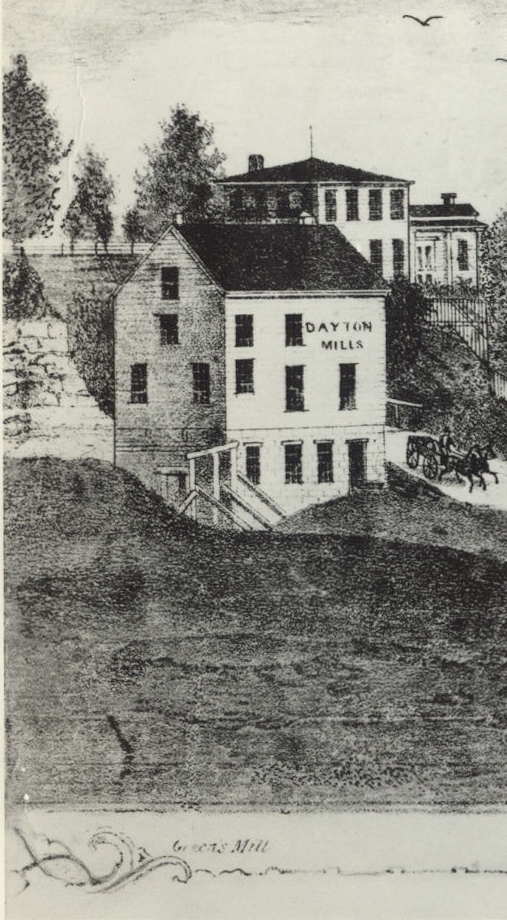
Green's Mill with house behind

In addition to the population census, in 1880 the census also collected information on grist mills, on Special Schedule of Manufactures #7, which included only mills producing more than $500 in goods. The mill in Dayton was operated by David Green’s sons. It was the only grist mill of that size in Dayton Township. From the enumeration we learn the following:

The mill was operated by D. Green and Sons, who had invested $10,000 in the business. The greatest number of hands employed at any one time was two. The average number was also two, described as 2 males over 16. These would be David’s sons.

The ordinary working day was 10 hours long, year round. The average day’s wages for skilled workers was $2.50, for unskilled, $1.00. The total amount paid in wages for the year was $110. The mill was in operation on half time for 6 months and idle for 6 months.

They had four runs of stone, which could produce a maximum of 550 bushels per day. Eighty percent of their business was grinding for customers who brought their grain to the mill. The miller retained a portion of the output as a toll for his work. For the other 20 percent the Greens purchased grain and sold the resulting products in their store.

The mill was located on the Fox river, which flows into the Illinois river. The height of the fall of water was 18 feet. They had five wheels producing 120 horsepower.

Products for the year: 80 barrels of wheat flour; no rye flour; 500 pounds of buckwheat flour; no barley meal; 6000 pounds of feed; no hominy; total value of all products, $1500.

from November 22, 1884 edition