The Time of the Big Snow

snowdrifts

Since there are no pictures of the 1830 deep snow, here is a newer one.

THE “TIME OF THE BIG SNOW”

Sixty five Years Ago Great Suffering Was Caused by the “Beautiful”

Old settlers who were little boys and girls in the winter of 1830-’31 tell of the “big snow” with as great emphasis as does the old time Irishman of the “big wind” that is popularly, though erroneously, supposed to have assisted St. Patrick to “shoo” the snakes and frogs off Irish soil. An old settler says of the “time of the big snow:’

“About Christmas time, 1830, and continuing at short intervals from that date until late in January following, a snow storm raged in Central and Northern Illinois which the settlers called the “Deep Snow.” No such snow had fallen before that time within the memory of the white settlers and no such snow has fallen since. It formed an epoch in the history of Illinois, and men were accustomed to refer to it as fixing the time for occurrences which took place long afterward. Old settlers even now occasionally refer to it. The snow began falling after noon on the day before Christmas. Prior to that time it had rained for a considerable time, and the ground was saturated with moisture. The corn had little of it been gathered; the cattle and hogs had until that time managed to get most of their feed in the woods. The corn meal, then the chief food of the settlers, was getting low, but not low enough to cause any particular uneasiness. Fuel was plenty in the woods but little was at the houses. The settlers, accustomed to the open winters of preceding years, saw nothing to cause alarm, either in their exposed condition, or in the lack of fuel and provisions.

“The storm continued with slight intermission until it was, on a level, about three feet deep all through this part of the country.

“After a few days of snow, the rain fell enough to wet the top of the snow, which then froze, forming a crust which was strong enough to bear up a wolf or a dog, but was not strong enough to bear up a horse, and in places was not strong enough to bear up a man. The deer were unable to run on the snow, as their sharp hoofs would cut through and the animal would then be wallowing helplessly in three feet of snow, unable to get out. The consequence was the wolves destroyed multitudes of them. The deer were almost all of them exterminated in that way. Perhaps the worst consequences were felt by the early settlers. Their corn was not much of it harvested, and it was impossible to harvest it then, or at least, not enough could be harvested to feed cattle or hogs.

“A man could by hard work gather enough to feed himself and family, but the question of supplying any fire wood, to cook or keep warm, became serious.”1


  1. The Ottawa Free Trader, December 27, 1895, p. 3, col. 3

One Hundred and One Years Ago Today in Dayton

Green-Lattimore

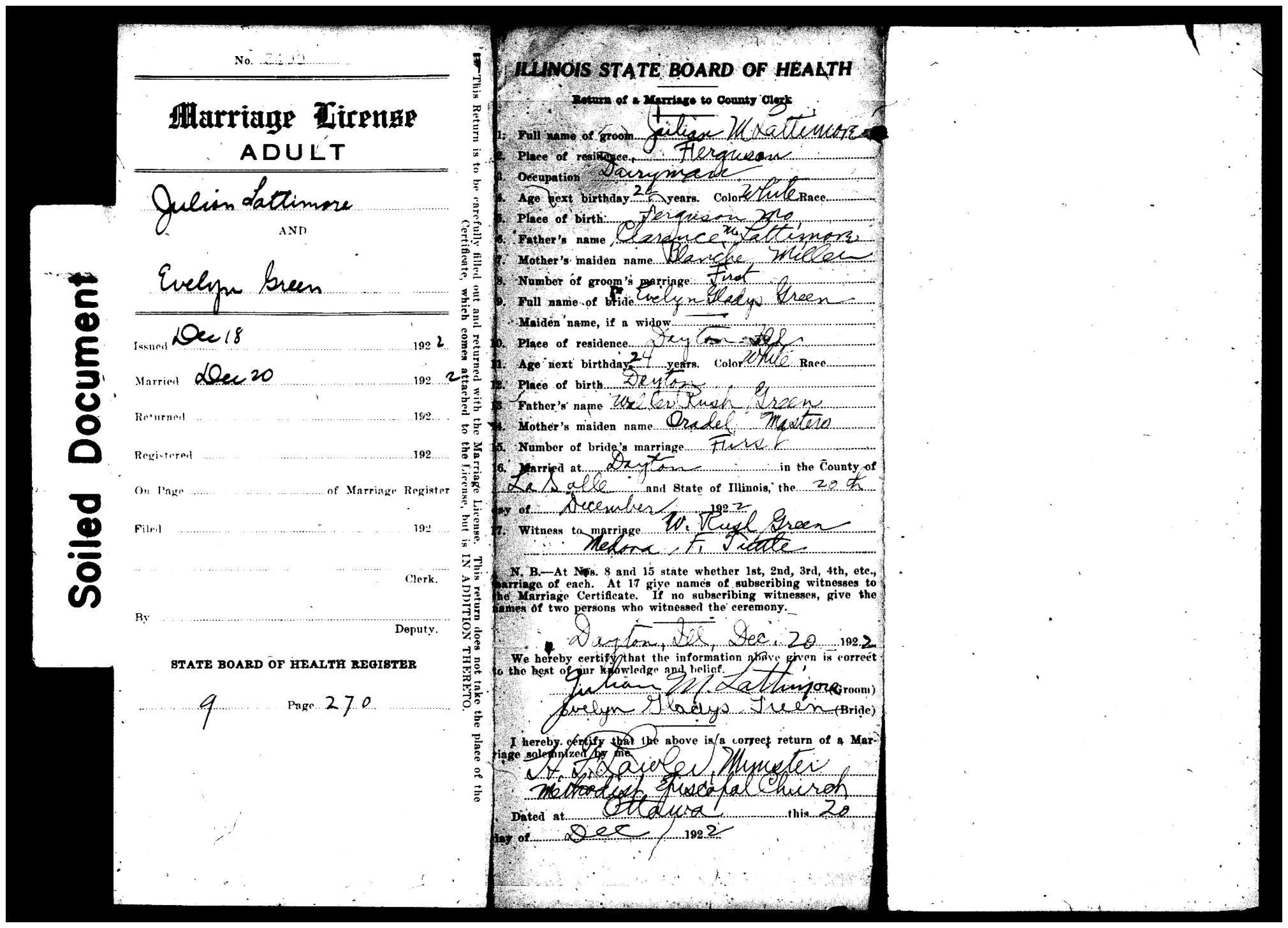
            A large number of Ottawans went to Dayton today to attend the wedding of Miss Evelyn Gladys Green, only daughter of Mr. and Mrs. Rush Green, and Julian M. Lattimore of Ferguson, Mo., which occurred at 1:30 o’clock this afternoon at the Green residence near Dayton. Eighty guests were in attendance. The Christmas idea was carried out in the decorations, Christmas greens and red being used in very effective manner.

The wedding service was read in the living room by Rev. H. P. Lawler, pastor of the First Methodist church.

Miss Mildred Masters of Dayton acted as the maid of honor, and W. R. Cornell of Cottonplant, Miss., served as Mr. Lattimore’s best man.

The bride wore a gown of white crepe de chine, made over white satin and a long tulle veil, which was held in place with orange blossoms. She carried a formal bridal bouquet of white sweet peas.

Miss Masters also wore a frock of white crepe de chine and carried white sweet peas.

At the close of the wedding service a two-course wedding dinner was served in the dining room. In keeping with the Christmas season, red and green decorations were used on the tables.

Mr. Lattimore and his bride left this afternoon for a honeymoon trip, the destination of which they are keeping a secret from their friends.

They will make their future home in Jackson, Miss.

The bride has a large circle of friends both here and in Dayton. She attended the Ottawa High school and was graduated from there in the class of 1919.

The groom is the son of Mr. and Mrs. C. M. Lattimore of Ferguson, Mo. He was raised in that city and is a graduate of the University of Missouri. Since finishing school he has been making his home in Jackson, Miss., where he is engaged as a dairy herdsman.

Among the guests from a distance also attending the wedding were Mr. and Mrs. A. E. Green of Peoria and Mr. and Mrs. W. A. Holmes of Chicago.1


  1. The Ottawa Free Trader, December 20, 1922, p. 4, col. 1

A Family Reunion at Christmas

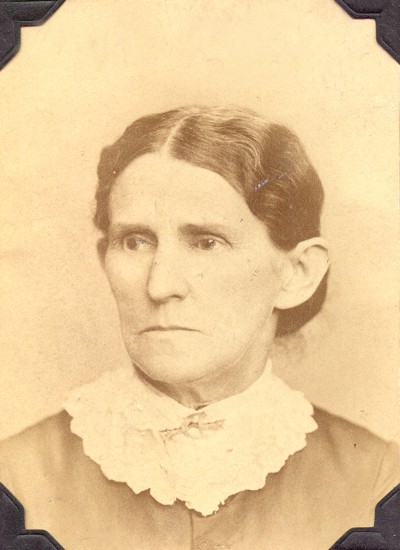
Mr. and Mrs. Green came to Dayton from Licking county, Ohio, in 1829. Mrs. Green died in 1886 at the advanced age of 93 years, having been preceed[ed] by her husband some six years. Up to the last Grandma Green could delight the young members of her family with her accounts of the Black Hawk war and many thrilling incidents and personal experiences in her life as an early settler.

Yearly family reunions have been the custom for some time and have been continue[d] since the death of the old people. Many of their descendants have scattered, but Christmas cheer and the good things of the earth are bountifully dispensed at these family reunions. Those present at the reunion on Wednesday were Mrs. O. W. Trumbo and daughter and Messrs. Jesse and Isaac Green, sons of the deceased, with their children, grandchildren and a few other relatives, exceeding fifty in number. Three other daughters – Mrs. Albert Dunavan, Mrs. Wm. Dunavan, and Mrs. Geo. Dunavan – are living in the far West.

from The Ottawa Free Trader, January 3, 1891, p. 3, col. 4.