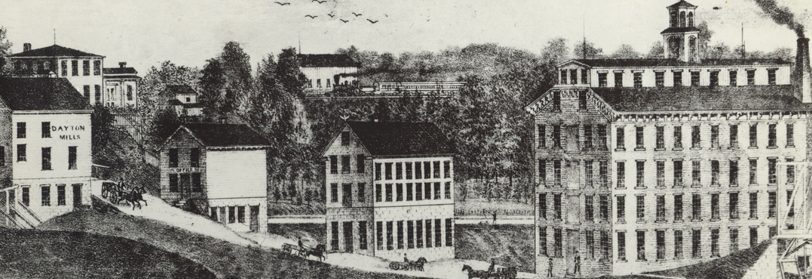
I started with the idea of providing some biographical information on two of the people buried in the Dayton Cemetery, Laura Davis and her infant son Ray. This required looking into her husband, Ira W. Davis, and exploring his life led to more than I anticipated, including unexpected links to the development of businesses in Dayton, so Ira became the focus of my story.
Ira W. Davis was born in Oldtown, Maine on November 4, 1835, the son of John Taber Davis and Harriet Jane Moore. He appears, unmarried, in his father’s household in 1850, 1860 and 1870. He is never shown as owning land, but in 1870 he has personal property of $6,000. Shortly after 1870, he and Charles Noyes, another Old Town resident decided to move west. They settled in Menasha, Wisconsin, where between them, they built a large factory to produce excelsior. In 1875 they added a new branch to the factory for making clothespins.

excelsior
In Menasha, Ira met Laura Barlow Shepard, daughter of Lysander C. Shepard and Ethelinda Ann Chapman, They married in 1877 and the following year, their first daughter, Nellie, was born.
In 1878, Ira in company with a younger man, Duncan MacKinnon, formed the firm of Davis & MacKinnon, which became a successful producer of excelsior. Ira became a very prominent business man in Menasha and was elected alderman from his ward.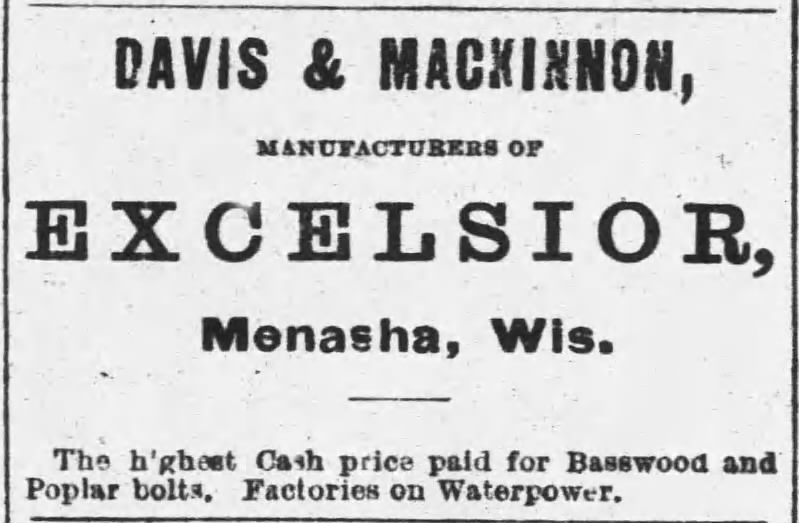
In 1881, Davis and MacKinnon sold a water power site to Henry Hewitt, Jr. a wealthy fellow Menasha businessman. Hewitt had invested in several businesses in Menasha and elsewhere in the Wisconsin area. In 1884 Hewitt and Ira invested in The Chicago and Dayton Brick Company, located in Dayton, Illinois, and it is through this connection that Ira took up the position of superintendent of the brick works being established in Dayton.
On November 22, 1884, the Dayton correspondent to the Free Trader reported that
“Mr. Ira Davis, the superintendent of the new brick works, has brought his family from Wisconsin and moved into G. W. Gibson’s residence, on the hill.”
His family at that time consisted of wife Laura, daughters Nellie, 6, and Harriet, 3, and son Taber, 1. In April of 1885 his son Ray was born, but he died three months later and was buried in the Dayton Cemetery.
Despite his position with the Chicago and Dayton Brick Company, his principal interest appeared still to be with paper making. In 1886 he sold out his interest in the brick works and in that year Ira and 2 others (Moore & Hewitt) rented the paper mill from H. B. Williams. Ira kept in touch with the business atmosphere in Wisconsin, however, making several trips back to the Menasha area. In 1887 his brother-in-law, E. E. Bolles, was preparing to erect a $50,000 paper mill in De Pere, Wisconsin, and Ira planned to move back and join him.
In December 1887, his wife, Laura, died, leaving three small children. She, too, is buried in the Dayton Cemetery, as shown on her death certificate. If there ever was a stone marking her grave, it has since disappeared.
Ira’s widowed mother, Harriet, and his unmarried sister, Emily, came from Maine to keep house for Ira’s family, arriving in Dayton in February, 1888. They left Dayton for Menasha, Wisconsin fairly soon, and lived there until Ira moved to Wausau in 1893. It may be about this time that the two girls, Nellie and Harriet, went to live with their mother’s sister Alice, the wife of E. E. Bolles, in De Pere, Wisconsin. Tabor continued to live with his father, grandmother and aunt in Wausau.
Ira engaged in business with a Milwaukee firm and, with W. W. Abbott, established an Excelsior Manufactury in Wausau. He is last seen in Wausau in 1895. When and why he went to California is not clear, but in the 1900 census, he appears in Scott Valley, Siskiyou County, California. He died August 15, 1902. His death was reported back in Bangor, Maine, more than 30 years after he left for “The West”.
News has been received here of the death at Orlans, Cal., on Aug. 15, of Ira W. Davis, formerly a well-known Oldtown lumberman. He was the son of John T. Davis of Oldtown and was a brother-in-law of Judge Charles A. Bailey of this city. He went west many years ago, and had been engaged in the manufacture of excelsior in California.
from The Bangor (Maine) Daily News, September 1, 1902, p. 3, col. 2.
 Dayton and the Greens