141 Years Ago Today the School I Attended Was Nearing Completion

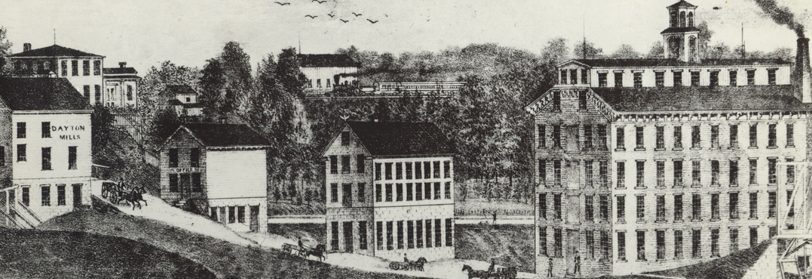
picture of school

Opened in 1891, this school replaced the one which burned in 1890

From Dayton

            Dayton, Ill., Aug. 29. – Mr. John Channel, who went West to southeastern Kansas and Missouri a short time ago on a land-buying excursion, brings back unfavorable reports of that section of the country for farming purposes, but gives it as his opinion that the manufacturing of lime might be engaged in profitably.

Mrs. George W. Green, who has been visiting relatives and friends at Braidwood during the past week, returned home last Saturday.

Mr. George W. Gibson and Miss Alta start this week for Nebraska on a short visit.

Miss Jessie Trumbo returned last week from a week’s visit among relatives in Chicago.

Grandma Green, who is 90 years old, shook hands with her old friends at the Old Settlers’ picnic last week. Her health is quite good, and we hope she may have many pleasant returns of the day.

The new school building is rapidly nearing completion and will be one of the prettiest buildings in the country. It is a two-story frame structure, 36 feet square, and a belfry.

There has been a vacancy in our board of directors ever since last spring, and notwithstanding the fact that the law says it must be filled without delay, no election had been called until the people took the matter into their own hands as provided by law and petitioned the township treasurer to call such election. The two directors, however, learned of the petition, and after studying their law books concluded to call an election before they were brought to their senses by the township treasurer. The election took place at the school house last Saturday afternoon and resulted in a complete victory for the taxpayers and destruction to the one-man power. The vote stood 26 for Isaac Green and 18 for J. Wright. A petition was also extensively signed, authorizing the sale of the old school building.

Mr. James Timmons, proprietor of the Dayton Hotel, has repainted and refurnished it and put it in good shape for the convenience and accommodation of the traveling public, fishing parties, &c.1


  1. The Ottawa Free Trader, August 30, 1882, p. 4, col. 3

A Stroke of Lightning

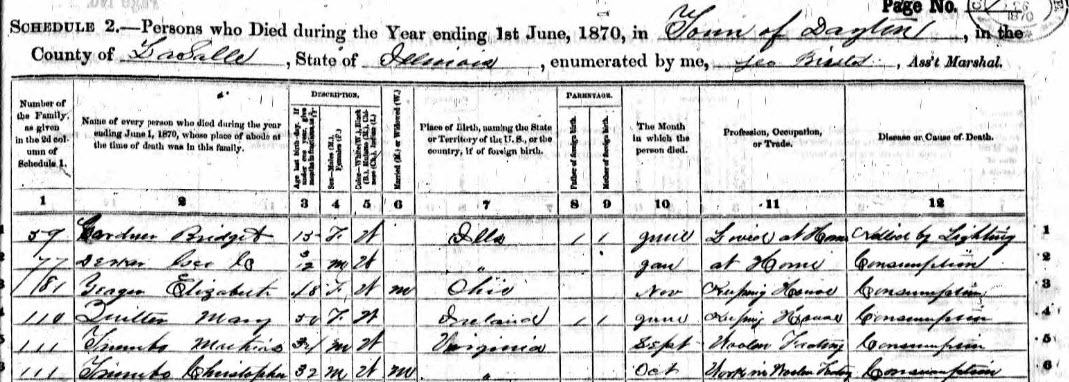
In 1870, in addition to the US population census, there is also a mortality census, which lists everyone who died in the 12 months prior to the census. The official census day for 1870 was June 1 and therefore any deaths that occurred between June 1, 1869, and May 31, 1870 should be included. The first line of this list of Dayton residents includes Bridget Gardner, age 15, who died in June, killed by lightning. This implies  a death date of June 1869.


A death by lightning was unusual enough to warrant a mention in the newspaper, and the Ottawa Free Trader printed the following notice on the front page. Clearly this refers to the same young girl listed in the mortality census, whose father was farming some of Mr. Reddick’s land,


HOWEVER, this notice appeared in the Ottawa Free Trader on Saturday, July 2, not in 1869, but in 1870.

It seems most unlikely that the newspaper would save such a notice for a year before publishing it. It is much more likely that Bridget actually died on June 30, 1870. Why, then, does she appear in the mortality census?

When the census taker arrived at the Gardner household on July 21, 1870 and asked his questions, the answers were supposed to be true as of June 1, the official census date. It is very easy, though, to imagine the following interchange:
“Has anyone in your family died in the past year?”
“Yes, my daughter Bridget”
“How old was she and how did she die?
“She was 15 and was struck by lightning.”
“What month did she die in?”
“June”

Actually, Bridget, alive on June 1, should have been listed as a 15-year-old daughter in the family census entry, but adherence to the official census day for information was often overlooked.


Willie Kibler

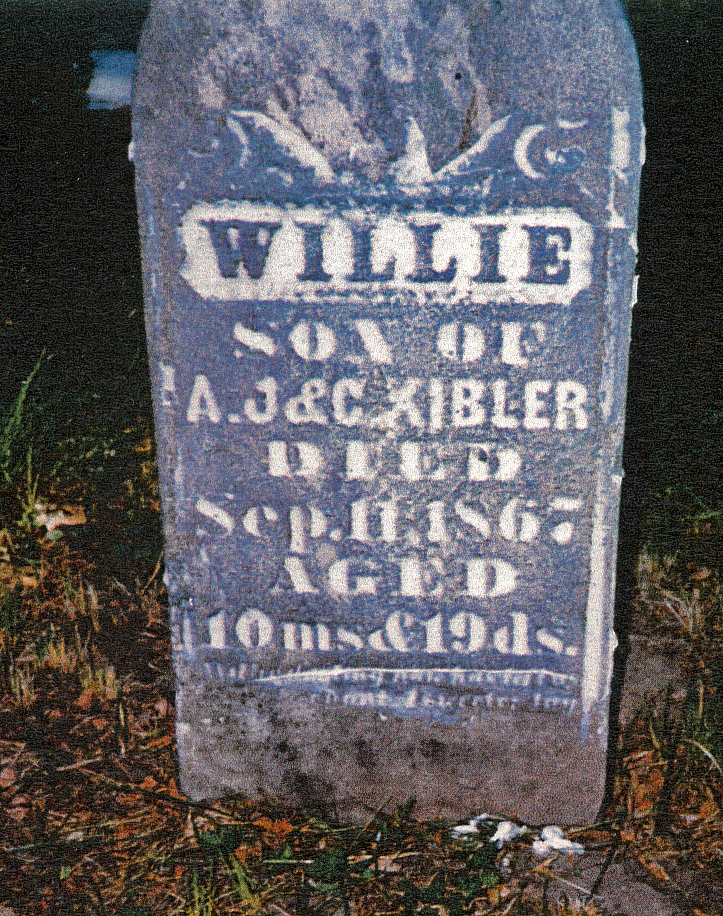
Among all the people buried in the Dayton cemetery there are 22 who appear to have no other family members buried there. One such is Willie Kibler, a baby who died before his first birthday.

The A. J. and C. Kibler listed on little Willie’s gravestone in the Dayton cemetery were Andrew Jackson and Caroline Kibler, residents of Rutland township when Willie died, on Sept 11, 1867. They lived in the Dayton area for only a short while. A, J, grew up in Virginia and married Caroline there in 1865. They must have left for Illinois very soon thereafter, as they were on a farm in Rutland when Willie died.  Andrew, a farmer, was listed as head of household in 1870, although he owned no land. However, George W. Lamb, listed as a boarder in the household, was a 20-year old who had inherited a large farm from his father. It is likely that Andrew Kibler was farming George’s land.

When Andrew died his obituary (included below) appeared in the Wellsville, Kansas, Globe on December 12,1913.

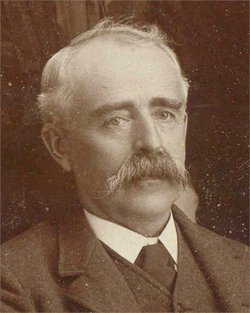
Andrew Jackson Kibler

Andrew Jackson Kibler, son of Philip and Margaret Kibler, was born August 11, 1840, in Shenandoah county, Virginia; died at Wellsville, Kans., Decenber 2, 1913, aged 73 years, 3 months and 20 days.

During the Civil War he served with the Thirty-third Virginia Infantry, in the Southern army. He was in the battle of Gettysburg, and saw many of his comrades and neighbors wounded and killed. A fragment of a flying shell struck him in the head during that battle and he was compelled to go to the hospital.

December 21, 1865, after the close of the war, he was married to Caroline Burner. To this union there were nine children, two dying in infancy.

The family moved from Virginia to Illinois, and later to Kirksville, Mo. In 1887 they came to Wellsville where they have made their home since. Mr. Kibler was engaged in the watch repairing and jewelry business until recently, when his health gave way.

His health and strength gave way gradually, and his death occurred Tuesday morning, December 2d, at 5:55. The funeral services were held at the Methodist church Friday afternoon, at two o’clock, and were conducted by the Rev. J. C. Wilson. Members of Lookout Post G. A. R. gathered at the home and acted as escort to the body, and accompanied it to the church.

Interment was in the Wellsville cemetery. The weather was inclement, and many who had expected to attend the funeral services at the church and at the grave were kept at home on account of of the rain.

The deceased is survived by the widow and seven children: Mrs. E. E. Appleton, of Louisvile, Ky.; Miss Mattie Kibler, Wellsville, Kans.; Dr. J. B. Kibler, Kansas City, Mo.; Dr. H. B. Kibler, Frankfort, Kans.; Miss Georgia Kibler, Ottawa, Kans.; Mrs. C. C. Fields, Winnipeg, Canada; Mrs. Eugene Bice, Omaha, Nebr. Besides there are seven granchildren; two sisters, Mrs. Mary E. Brunk, of Breckenridge, Mo., and Mrs. J. B. Clem, Lantz Mills, Va. and one brother, J. C. Kibler, Woodstocj, Va.

Everyday Life in Dayton at the End of August

From the Ottawa Republican-Times, August 30, 1900, p. 4, col. 5

Dayton

The pile driver of the C., B. & Q. R. R. has been busy the past few days repairing the Q bridge here.

The water in the feeder is now in a condition to furnish all the power necessary.

James O’Meara has some of the finest potatoes in this section. Jim is a hustler, and knows a good thing when he sees it.

The rain has ruined the oats in many places in this vicinity, and farmers are out of pocket.

E. McClary, our genial store-keeper, is improving his lawn by laying a new tile sidewalk around his house.

Walter Breese and George Timmons leave on Monday morning for Chicago. If they are successful in their new undertaking they will make Chicago their future home.

The river on Monday was the highest this season.

Thomas Nagle has purchased from Mrs. Martha Bagley the house adjoining his own lot, and will move it and convert it to a barn for his own use.

Mrs. Hudson and son, who have been visiting Mr. and Mrs. John Channel, returned to Chicago on Monday

H. C. Tueley has gone to Indianapolis to spend a few days.

E. Emmons and family intend moving, and will make Marseilles their future home.

It was proven on Saturday last that the hydraulic cider press here can turn out 2,000 gallons per day.

About forty persons from here attended the old settler’s picnic and Pawnee Bill’s aggregation.

Munroe Durkee, of Wedron, was a caller here this week.

The Dayton Republican Club expect a good turn-out at their meeting on Tuesday evening next.

Emory Waller has been on the sick list for the past week/

The war whoop of the juvenile Indians will soon cease to be heard on our streets, as next week school commences and they will then speak their little piece to their new teacher.

Etta Barnes visited Mr. and Mrs. E. McClary on Tuesday.

Commissioner Jas. H. Timmons is having the hill graveled just west of the feeder bridge. That’s right, Jim, keep on with your good work, and may your shadow never grow less.

Only one lone fisherman could be seen along the banks of the muddy Fox the past week. What a change from a few years ago.

Threshing has been going on at a lively rate for the past two days.

One of our enterprising young men is to start a tonsorial parlor in the near future. It will fill a long felt want. We wish him success in his new undertaking.

The rain causes lots of work on the section for the men employed by the Q. road.

Miles Masters is still very sick and will be unable to leave his bed for some time

Ira W. Davis in Wisconsin and Illinois

I started with the idea of providing some biographical information on two of the people buried in the Dayton Cemetery, Laura Davis and her infant son Ray. This required looking into her husband, Ira W. Davis, and exploring his life led to more than I anticipated, including unexpected links to the development of businesses in Dayton, so Ira became the focus of my story.

Ira W. Davis was born in Oldtown, Maine on November 4, 1835, the son of John Taber Davis and Harriet Jane Moore. He appears, unmarried, in his father’s household in 1850, 1860 and 1870. He is never shown as owning land, but in 1870 he has personal property of $6,000.  Shortly after 1870, he and Charles Noyes, another Old Town resident decided to move west. They settled in Menasha, Wisconsin, where between them, they built a large factory to produce excelsior. In 1875 they added a new branch to the factory for making clothespins.

excelsior

In Menasha, Ira met Laura Barlow Shepard, daughter of Lysander C. Shepard and Ethelinda Ann Chapman, They married in 1877 and the following year, their first daughter, Nellie, was born.

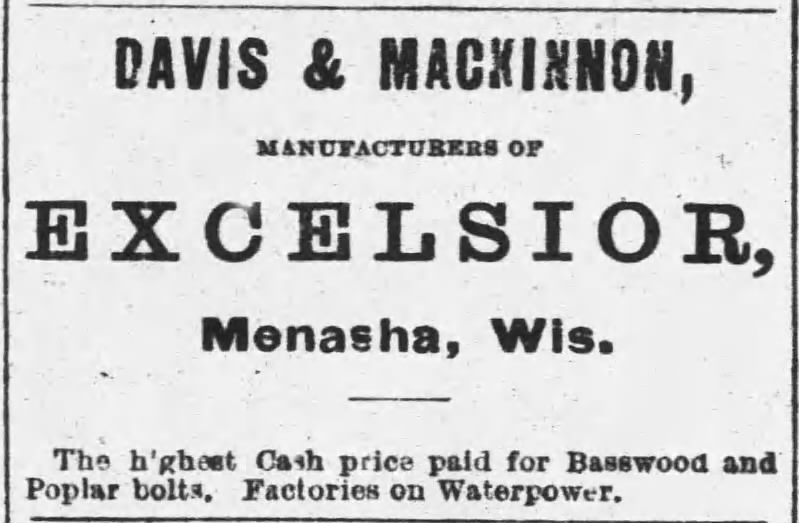
In 1878, Ira in company with a younger man, Duncan MacKinnon, formed the firm of Davis & MacKinnon, which became a successful producer of excelsior.  Ira  became a very prominent  business man in Menasha and was elected alderman from his ward.ad for Davis & MacKinnon
In 1881, Davis and MacKinnon sold a water power site to Henry Hewitt, Jr. a wealthy fellow Menasha businessman. Hewitt had invested in several businesses in Menasha and elsewhere in the Wisconsin area. In 1884 Hewitt and Ira invested in The Chicago and Dayton Brick Company, located in Dayton, Illinois, and it is through this connection that Ira took up the position of superintendent of the brick works being established in Dayton.

On November 22, 1884, the Dayton correspondent to the Free Trader reported that

“Mr. Ira Davis, the superintendent of the new brick works, has brought his family from Wisconsin and moved into G. W. Gibson’s residence, on the hill.”

His family at that time consisted of wife Laura, daughters Nellie, 6, and Harriet, 3, and son Taber, 1. In April of 1885 his son Ray was born, but he died three months later and was buried in the Dayton Cemetery.

Despite his position with the Chicago and Dayton Brick Company, his principal interest appeared still to be with paper making. In 1886 he sold out his interest in the brick works and in that year Ira and 2 others (Moore & Hewitt) rented the paper mill from H. B. Williams. Ira kept in touch with the business atmosphere in Wisconsin, however, making several trips back to the Menasha area. In 1887 his brother-in-law, E. E. Bolles, was preparing to erect a $50,000 paper mill in De Pere, Wisconsin,  and Ira planned to move back and join him.

In December 1887, his wife, Laura, died, leaving three small children. She, too, is buried in the Dayton Cemetery, as shown on her death certificate. If there ever was a stone marking her grave, it has since disappeared.

Ira’s widowed mother, Harriet, and his unmarried sister, Emily, came from Maine to keep house for Ira’s family, arriving in Dayton in February, 1888. They left Dayton for Menasha, Wisconsin fairly soon, and lived there until Ira moved to Wausau in 1893. It may be about this time that the two girls, Nellie and Harriet, went to live with their mother’s sister Alice, the wife of E. E. Bolles, in De Pere, Wisconsin. Tabor continued to live with his father, grandmother and aunt in Wausau.

Ira engaged in business with a Milwaukee firm and, with W. W. Abbott, established an Excelsior Manufactury in Wausau. He is last seen in Wausau in 1895. When and why he went to California is not clear, but in the 1900 census, he appears in Scott Valley, Siskiyou County, California. He died August 15, 1902. His death was reported back in Bangor, Maine, more than 30 years after he left for “The West”.

News has been received here of the death at Orlans, Cal., on Aug. 15, of Ira W. Davis, formerly a well-known Oldtown lumberman. He was the son of John T. Davis of Oldtown and was a brother-in-law of Judge Charles A. Bailey of this city. He went west many years ago, and had been engaged in the manufacture of excelsior in California.
from The Bangor (Maine) Daily News, September 1, 1902, p. 3, col. 2.